A property manager usually finds out about a bad door restrictor in the worst possible way. A tenant reports that the elevator doors can be pulled open when the car is not level. A service call turns into a shutdown. Or an inspector writes up a violation that suddenly moves a quiet maintenance item to the top of the budget list.
That moment matters because this is not just another door adjustment. A faulty Elevator Door Restrictor creates a direct life-safety problem, and in Michigan that also means a code and liability problem.
In older buildings, especially those running mixed equipment from different eras, restrictor issues rarely stay isolated. A worn clutch, poor vane alignment, weak door panels, bad door lock monitoring, or years of debris in the pit and on the car top can all show up together. In a busy property, that turns into tenant complaints, avoidable downtime, and a hard conversation with ownership about why the elevator keeps failing the same way.
The practical answer is not to treat the restrictor as a one-part fix. It has to be handled as part of the full door safety system, with attention to Michigan code expectations, non-proprietary modernization options, and the practical aspects of maintaining older equipment in places like Sterling Heights, Oak Park, Southfield, Detroit, Ann Arbor, and Lansing.
Elevator Safety and Service in Michigan
A common call starts with a simple complaint. Someone says the doors felt wrong. The elevator may still run, but the doors hesitate, reopen unexpectedly, or show signs that the car door can move when it should not.
For a building manager, that puts three problems on the table at once:
- Safety exposure: If a door opens outside the landing zone, the hazard is immediate.
- Inspection risk: A small mechanical fault can become a violation.
- Operational disruption: One elevator down in a medical office, apartment building, school, or industrial site changes traffic flow for everyone in the building.
Why this issue gets missed
Door restrictors are not glamorous parts. They sit in the background and do their job until they fail. Many owners know the controller, the machine, and the cab interior. Far fewer know the condition of the restrictor, the landing interface, or whether the system was adapted properly during a past repair.
That is especially true in older Michigan properties where elevators have seen multiple contractors, partial upgrades, and brand-specific workarounds over time. A restrictor may be present but poorly adjusted. It may be the wrong style for the door setup. It may also work on paper and still fail in service conditions.
A restrictor problem is rarely just a restrictor problem. The door system tells you how the elevator has been maintained.
The Michigan reality
In Southern Michigan, a practical elevator program has to account for age, weather, building traffic, and inspection pressure. Hospitals, commercial towers, schools, municipalities, and residential properties all have different usage patterns, but the same rule applies. If the door safety system is weak, the elevator becomes unreliable fast.
That is why a building manager should treat door restrictor service as part of a broader elevator partnership. The right contractor should be able to handle repair, testing, violation correction, door lock monitoring, modernization, and emergency response across all makes and models, including older non-proprietary systems and hard-to-service legacy units.
What Is an Elevator Door Restrictor
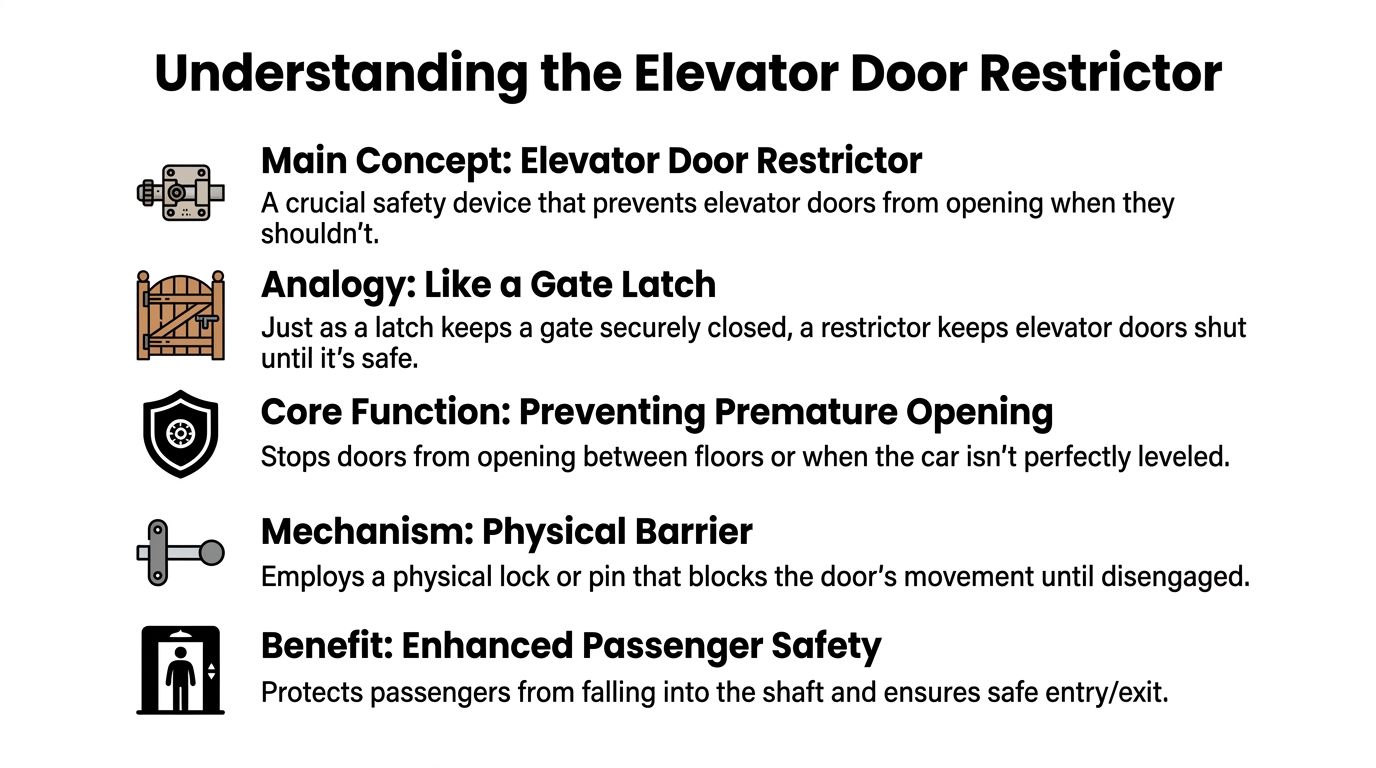
An Elevator Door Restrictor is a mechanical safety device that stops the car doors from opening when the elevator is outside the unlocking zone. Under ASME A17.1 and CSA B44, that unlocking zone is typically within 18 inches of a floor landing, and a common design uses a spring-biased locking arm that only releases when a cam on the hoistway door rotates it into the correct position, so the doors can open only when the car and landing are properly aligned, as described in the patent summary for a common door restrictor design.
Like a gate latch
The simplest way to explain it is to compare it to a gate latch. A gate opens only when the latch lines up with the catch. If the gate is out of position, the latch stays engaged and the gate stays shut.
A restrictor does the same job on an elevator. If the car is not where it belongs, the mechanism keeps the door from opening. That physical block matters because it does not rely only on software or electrical logic. It adds a mechanical layer of protection.
Other names you may hear
In the field, building staff and mechanics often use different names for the same idea. You may hear:
- Door restriction device
- Hatch Latch
- Chicago Lock
Sometimes those names refer to a specific product style or a familiar trade nickname rather than a strict technical category. The important point is the function. Whatever name is on the service ticket, the device is there to stop unintended door opening outside the landing zone.
What works and what does not
A good restrictor setup is simple, durable, and easy to inspect. In practice, the best results usually come from a properly matched mechanical device installed with correct door geometry and checked against the rest of the door system.
What does not work is assuming that an electrical interlock alone gives enough protection, or installing a restrictor during a rushed repair without checking the clutch, vane, rollers, gibs, and landing relationship. That is where nuisance calls start.
A proper door inspection should also look at the overall condition of the car door operator and landing equipment. If the door system is already showing wear, a restrictor replacement by itself may not hold its adjustment for long. This is one reason many owners start with a broader elevator door repair review instead of trying to solve the issue with one replacement part.
If a restrictor is fighting worn door hardware, the callback is usually already scheduled. The fix has to match the condition of the whole entrance system.
Part of a layered safety system
The restrictor is not a stand-alone answer. It works alongside door lock monitoring, proper landing door engagement, and the physical strength of the hoistway door panels. In a well-maintained elevator, those systems support one another.
That layered approach matters most on older equipment. Many Michigan buildings operate elevators that have been repaired across decades with mixed parts and mixed philosophies. In those jobs, a contractor has to know when to adjust, when to retrofit, and when a full non-proprietary modernization is the safer long-term move.
Michigan Code Compliance for Door Restrictors
Compliance problems usually surface during annual testing, an inspection follow-up, or after a door incident that forces someone to look more closely. In Michigan, a building owner should assume inspectors will care less about what part was ordered and more about whether the elevator is operating safely and meeting the code intent.
Why code got stricter
Door-related hazards drove these rules. Elevator door-related incidents account for over 40% of all elevator-related injuries, and in the United States elevators handle 18 billion trips annually while accidents still result in about 17,000 injuries and 30 deaths per year. In response, safety mandates required door restrictors on passenger elevators, and inspectors can issue fines up to $1,000 and cease-use orders for non-compliant restrictors, as outlined in this elevator regulation summary.
That should get any manager’s attention. Door restrictor compliance is not a paperwork item. It is a life-safety enforcement item.
What Michigan managers should expect
Michigan follows the broader ASME A17.1 framework, and in practice that means annual inspections need the restrictor to function correctly, not just exist on the car. The device has to stop unintended door opening outside the unlocking zone, and the rest of the door system has to support that function.
Inspectors and service teams commonly focus on issues like these:
| Inspection focus | What they are looking for |
|---|---|
| Restrictor function | The car door cannot be opened outside the unlocking zone |
| Door alignment | The landing and car door relationship is correct |
| Wear and damage | Bent linkage, weak springs, loose hardware, or bypassed components |
| Door lock monitoring | Safety circuits and related door protection behave properly |
| Previous repairs | No improvised fixes that defeat the code intent |
The risk of partial compliance
A building can have a restrictor installed and still be out of compliance. That happens when the mechanism is present but inoperative, poorly adjusted, defeated during another repair, or mismatched to the door equipment.
Many older systems in Detroit-area suburbs and downstate communities get into trouble. A legacy elevator may have had enough repairs over time that nobody has stepped back to verify whether the door package still functions as a coherent system. The restrictor may be one generation newer than the operator. The door panels may be tired. The landing interface may be inconsistent from floor to floor.
A code-compliant elevator does not rely on one good part. It relies on every related part doing the right job at the right time.
Practical Michigan steps
If you manage a building in Southfield, Sterling Heights, Oak Park, Ann Arbor, Lansing, or elsewhere in Lower Michigan, the practical approach is to do three things before the next inspection becomes a problem:
- Verify the restrictor type and operation. Do not assume previous work was complete.
- Check the door system as a whole. Restrictor, clutch, vane, interlocks, rollers, gibs, and door panels all matter.
- Review upcoming code deadlines and modernization needs. If an older unit is nearing a broader upgrade cycle, folding the restrictor work into that plan often avoids repeat labor.
For owners planning ahead, this Michigan elevator code deadline overview is a useful starting point for understanding the broader compliance environment.
Expert Door Restrictor Repair and Modernization
When a restrictor problem is confirmed, the next question is whether the right answer is repair, replacement, or modernization. The answer depends on the door package, the age of the elevator, and how many related problems are hiding behind the original complaint.
What a proper repair call should include
A restrictor service call should start with diagnosis, not parts swapping. The mechanic should inspect the car door, landing interface, vane engagement, linkage condition, and door operation through the travel cycle.
In practical terms, the job may involve:
- Adjustment work on linkage, clutch relationship, or vane position
- Replacement of a worn or broken restrictor assembly such as a Hatch Latch or Chicago Lock style device
- Correction of related faults that keep the restrictor from operating consistently
- Testing under normal operation so the elevator is not returned to service with a temporary fix
That matters on all equipment types, from newer passenger elevators to older freight units that still serve industrial buildings across Michigan.
Why the door system has to be evaluated together
The restrictor is one layer. The door panels and retainers are another. Since 1993, ASME A17.1 has required hoistway door panels to withstand forces up to 1,125 lbf, and modernization or repair work should verify that the door panels and restrictor function together through appropriate testing, as discussed in Elevator World’s review of hoistway door strength and restrictor system performance.
That is an important trade-off. A quick restrictor replacement may stop the immediate violation, but if the landing door system is weak, the building still owns a safety problem. Good contractors know when to tell the customer that the hardware around the restrictor is just as important as the restrictor itself.
Repair versus modernization
Not every restrictor issue needs a full modernization. If the operator, doors, and landing equipment are in decent shape, a properly selected replacement and a full adjustment can restore safe, compliant operation.
Modernization becomes the better answer when you see repeated door faults, obsolete components, poor parts availability, or earlier repairs that created a patchwork system. In those cases, non-proprietary upgrades usually give the owner the best long-term control over maintenance options and parts sourcing.
A useful rule of thumb for building managers is this short comparison:
| Condition in the field | Better path |
|---|---|
| Isolated restrictor wear, stable door operation | Repair or direct replacement |
| Multiple recurring door faults | Broader door system repair |
| Obsolete equipment and recurring callbacks | Non-proprietary modernization |
| Building facing wider code work | Fold restrictor work into modernization scope |
That is especially relevant in communities such as Sterling Heights Michigan, Oak Park Michigan, and Southfield Michigan, where many properties run a mix of older commercial equipment and upgraded tenant spaces. The elevator may need to serve a modern building use while still relying on legacy door hardware.
For owners evaluating a broader upgrade, this elevator modernization overview helps frame what should be included beyond the visible cab finishes.
A Proactive Partnership for Total Elevator Health
The biggest mistake owners make with door restrictors is treating them as isolated failures. In the field, repeat door trouble usually comes from maintenance habits, not bad luck.

Aging equipment needs cleaner, tighter maintenance
Older elevators collect small problems until one safety device starts showing the strain. A two-speed door can develop vane alignment issues. A pit full of debris affects reliable travel. A dirty car top hides wear that should have been corrected months earlier.
That is not theory. In aging elevator infrastructure, vane misalignment in two-speed doors can cause 10-15% of false locks, and proactive maintenance programs that include pit and car-top clean-downs can prevent up to 80% of restrictor-related failures while cutting lifetime costs by an estimated 25%, according to the door restrictor assembly guidance referenced here.
The practical lesson is simple. Restrictor reliability depends on housekeeping and inspection discipline as much as hardware choice.
What a proactive program should include
A good maintenance partnership does more than answer breakdown calls. It should build repeatable practices into the service routine.
Look for a program that includes work such as:
- Machine room, pit, and car-top clean-downs: Dirt, oil, and debris hide wear and interfere with moving parts.
- Routine door observation: A mechanic should watch the full opening and closing cycle, not just reset faults.
- Minor recurring items handled during service: Burned-out COP and PI bulbs, loose hardware, and obvious wear should not become separate emergency calls.
- Door lock and restrictor checks: These should be part of regular maintenance, not only annual testing.
- Clear callback accountability: If the same door problem keeps returning, the root cause has not been solved.
The difference between reactive and proactive service
Reactive service says the elevator is running again. Proactive service asks why it failed and what will fail next if nobody addresses it.
That distinction matters most in buildings with heavy use, such as healthcare, municipal, education, and industrial properties. In those settings, one nuisance door problem can create passenger delays, access complaints, and extra wear on the remaining units.
Here is the practical difference:
| Service style | Typical result |
|---|---|
| Breakdown-only | Short-term restoration, repeat callbacks likely |
| Basic preventive maintenance | Better consistency, but hidden system issues may linger |
| Thorough proactive maintenance | Fewer repeat door failures, better inspection readiness, more predictable ownership costs |
The best elevator maintenance lowers the number of surprises. It should not wait for an inspector or a trapped passenger to identify the weak point.
Why non-proprietary systems matter in long-term care
A proactive partnership also means keeping your options open. If the restrictor, operator, and related door components are tied to a proprietary setup that only one provider wants to touch, every future repair becomes harder to price and schedule.
Non-proprietary modernization avoids that trap. It also makes practical sense for Michigan owners managing mixed portfolios, where one contractor may need to support a freight elevator in an industrial building, a passenger unit in an office property, a wheelchair lift in a public building, and a residential elevator in a multifamily setting.
A complete elevator partner should be able to move across all of those conditions without forcing the owner into a closed system. That gives the building manager more control over service continuity, budgeting, and long-term asset value.
How to Choose Your Michigan Elevator Partner
Many contractors can replace a part. Fewer can explain whether that part will solve the problem six months from now. That is the standard building managers should use when selecting an elevator company.
Ask about non-proprietary work first
This question saves a lot of frustration later. If a contractor recommends a restrictor replacement or a broader modernization, ask whether the resulting system will remain serviceable by qualified providers outside one brand channel.
That issue matters because a key gap in the market is guidance on non-proprietary modernizations in states like Michigan. Source material on restrictor integration notes that choosing a contractor who understands local code nuances and non-proprietary solutions can reduce integration costs, which range from $500-$1500 per unit, while lowering liability through full compliance, as noted in this discussion of mechanical elevator door restrictors.
Compare contractors on real operating questions
A building manager should not evaluate elevator vendors on brochures. Compare them on field behavior.
Use questions like these:
- Do they service all makes and models? That matters if your portfolio includes mixed equipment.
- Can they support repairs, inspections, testing, and modernization? Fragmented service creates gaps.
- Do they operate 24/7/365? Door failures do not wait for office hours.
- Will they give a second opinion? That shows confidence in diagnosis.
- Do they offer financing for larger work? A code-driven modernization often lands before the budget was ready.
What separates a strong partner from a parts vendor
A parts vendor sells hardware. A strong elevator partner manages risk.
That means the company should be able to do the following well:
| What to evaluate | Why it matters |
|---|---|
| Local Michigan experience | They know regional inspection expectations and building types |
| Non-proprietary philosophy | You avoid vendor lock-in |
| Repair depth | They can correct root causes, not just symptoms |
| Modernization capability | Older systems need a path forward |
| Emergency response | Downtime affects tenants, staff, and liability |
Local coverage matters
A provider serving Lower Michigan should be comfortable working across urban and suburban properties, from Detroit and Ann Arbor to Lansing, Flint, Kalamazoo, Sterling Heights, Oak Park, and Southfield. The issue is not just geography. It is whether the company has enough field depth to respond consistently and enough technical breadth to support older and newer equipment alike.
Ask who will work on your elevator after the proposal is signed. The answer tells you more than the proposal itself.
A final practical point: choose a contractor that communicates plainly. If they cannot explain why a Hatch Latch, Chicago Lock, or other door restrictor setup is right for your elevator, they probably do not understand the door system well enough to own the result.
Ensure Your Elevator is Safe Compliant and Reliable
An Elevator Door Restrictor is not optional hardware. It is a life-safety device that helps stop one of the most serious door-related hazards an elevator can present. In Michigan, that also makes it a compliance issue that deserves regular attention, especially on older equipment and mixed-use properties.
For building managers, the practical path is clear.
Start with these steps
- Have the door system evaluated as a system. Do not limit the review to the restrictor alone.
- Correct known faults before inspection pressure forces the issue. Emergency compliance work is rarely the most efficient work.
- Use maintenance to prevent repeat failures. Clean-downs, inspections, and door observations matter.
- Consider non-proprietary modernization when repeated repairs stop making sense. This protects future service options.
- Choose a Michigan elevator partner that can support the full lifecycle of the equipment. Repairs, testing, modernization, and emergency response should work together.
What building owners gain
When the restrictor and the rest of the door safety system are handled correctly, the benefits are practical. Safer operation. Better inspection readiness. Fewer recurring door callbacks. More predictable budgeting. Less disruption for tenants, staff, patients, residents, and visitors.
That is the standard to hold your elevator program to, whether you manage one residential lift or a portfolio of commercial and industrial properties across Southern Michigan.
If your elevator has a known door issue, an old code violation, recurring nuisance calls, or equipment that has been patched together over time, now is the right time to get a qualified second opinion and a clear plan for repair or modernization.
If you need help with door restrictor repair, Hatch Latch or Chicago Lock replacement, code-required inspections, preventative maintenance, non-proprietary modernization, or 24/7 emergency service anywhere in Lower Michigan, contact Crane Elevator Company for a free second opinion, a competitive quote, or a practical review of your current elevator maintenance program.