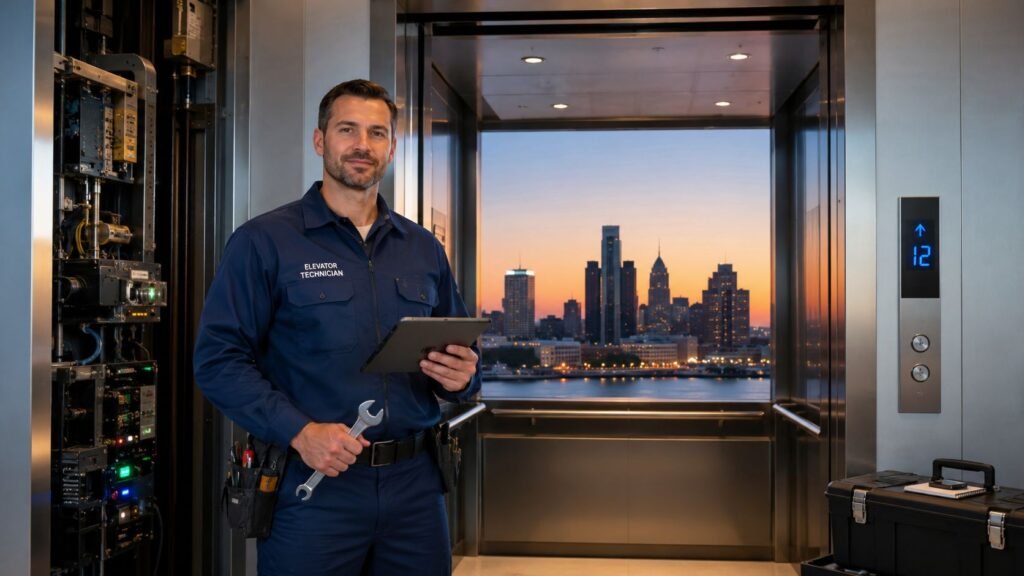
Your phone rings before 8 a.m. A tenant says the passenger car is down. The front desk wants an ETA. Ownership wants to know whether this is covered. Your maintenance company says a technician will “try to get there today.”
That's the moment a search for elevator maintenance companies near me typically begins.
The mistake is treating that search like a same-day repair problem. It's really an operating-cost problem, a safety problem, and a vendor-accountability problem. If you manage a building in Detroit, Ann Arbor, Lansing, Flint, Kalamazoo, or the surrounding Michigan towns, the company you hire will affect uptime, compliance, tenant confidence, and how much money you keep pouring into the same recurring failures.
A cheap monthly contract can get expensive fast if the provider skips real preventive work, bills for thin service visits, or locks you into proprietary parts that make future repairs harder to shop. A stronger partner does the opposite. They document work, handle code-related issues before they become surprises, and keep your options open when modernization eventually comes up.
Why Choosing Your Elevator Partner Matters
A building manager usually doesn't start with strategy. They start with a shutdown, a trapped delivery schedule, or a lobby full of frustrated people.
In practice, the problem rarely begins on the day the elevator stops. It begins weeks or months earlier, when routine work gets delayed, rushed, or handled like a paperwork exercise. That's why the maintenance company matters more than the emergency technician they dispatch.
A major reason is simple. A 2022 study by the National Institute of Building Sciences found that 78% of commercial building elevator failures are tied to inadequate or delayed preventative maintenance. The same study reported that buildings with quarterly inspections have 45% fewer emergency call-outs and can reduce total lifecycle costs by up to 30% (NIBS data referenced here).
What a bad maintenance relationship looks like
You've probably seen some version of this:
- Missed basics: The contract says maintenance is happening, but no one can clearly show what was checked.
- Repeat failures: Door issues, leveling issues, nuisance shutdowns, and callbacks keep returning.
- Reactive billing: The monthly price looks fine until overtime, emergency calls, and exclusions start stacking up.
- Weak communication: You hear more after the car goes down than you did while warning signs were building.
Practical rule: Don't judge an elevator partner by how they answer the phone on your worst day. Judge them by the work they do before that day arrives.
The business decision behind the repair call
For commercial properties, this isn't just about convenience. It's about controlling total cost of ownership. The provider you choose influences whether your building runs on planned maintenance or avoidable emergencies.
That's especially important in a trade where labor, compliance, and safety all carry real weight. According to a 2023 report summarized by McKinley Elevator's Southern California industry page, the U.S. elevator and escalator mechanic industry employed about 24,500 workers nationwide, with a median annual wage of $70,850 as of May 2022, and projected growth of 3.2% from 2022 to 2032. The same summary notes that 42% of elevator-related injuries occur during maintenance or inspection activities, which is a reminder that sloppy service work creates risk, not savings.
If you're trying to sort strong vendors from weak ones, this is a useful place to start: what reliable elevator service actually looks like.
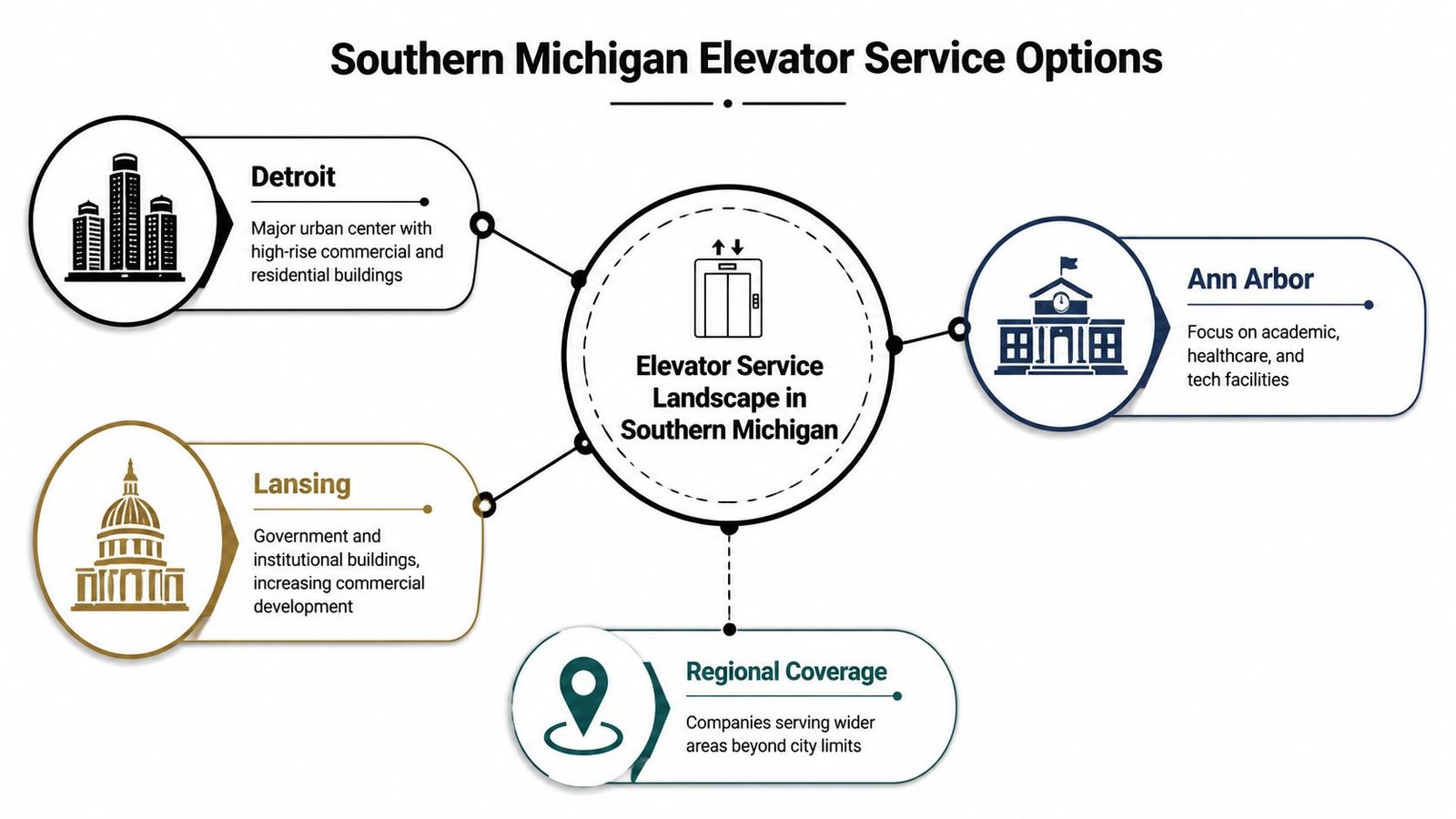
Southern Michigan Elevator Service Options
Before you compare proposals, it helps to understand what kinds of companies are serving Southern Michigan buildings in places like Detroit, Ann Arbor, Lansing, Flint, Kalamazoo, and nearby communities.
Here's the quick view.
| Provider type | Typical strengths | Common trade-off | Best fit |
|---|---|---|---|
| OEM service branch | Familiarity with its own equipment, access to brand-specific parts and software | Can steer owners toward proprietary paths and less flexibility | Buildings already heavily tied to one manufacturer |
| Independent elevator contractor | Broader make-and-model coverage, more flexibility on parts and modernization approach | Quality varies widely between firms | Owners who want options, transparency, and long-term control |
OEMs and independents don't solve the same problem
An OEM branch usually works best when a building owner wants to stay inside that manufacturer's ecosystem. That can feel simpler at first, especially if the equipment is newer and already tied to proprietary controls, tools, or parts pipelines.
An independent contractor often gives the owner more room to negotiate. That matters across Southern Michigan, where the building mix is broad. Detroit has high-rise commercial stock and older equipment. Ann Arbor has healthcare, university, and research facilities. Lansing has municipal and institutional buildings. Flint and Kalamazoo include industrial, mixed-use, medical, and education properties that often need practical service support more than a brand-driven sales pitch.
The real dividing line is flexibility
The biggest difference isn't logo recognition. It's whether the company helps you preserve choices.
If a provider pushes every service conversation toward brand dependency, future upgrades can become more restrictive. If a provider is comfortable servicing multiple makes and models, discussing open modernization paths, and explaining repair-versus-replace trade-offs clearly, you usually get a more manageable long-term relationship.
Some elevator companies sell maintenance as a monthly line item. Better companies manage the asset so the same problem doesn't keep coming back.
What Southern Michigan managers should pay attention to
When owners in Michigan search for elevator maintenance companies near them, they often compare speed first. Speed matters, but coverage footprint and service model matter too.
Look for these signs:
- Geographic reality: Can the company support Detroit, Ann Arbor, Lansing, Flint, Kalamazoo, and surrounding towns without stretching technicians too thin?
- Building-type experience: Hospitals, schools, municipalities, industrial sites, apartments, and office buildings all create different service demands.
- Repair philosophy: Do they only respond to failures, or do they actively reduce the chance of repeat shutdowns?
- Modernization mindset: Will they discuss non-proprietary options when your equipment starts aging out?
For a broader local-service perspective, this page on elevator repair companies serving nearby Michigan properties is a useful reference point.
A Closer Look at Crane Elevator Company
One Michigan contractor worth understanding in this market is Crane Elevator Company, not because every building should hire the same firm, but because it illustrates what a strong independent service model looks like in practice.
Crane Elevator Company serves the Lower Michigan region, specifically commercial property owners and managers in Southern Michigan cities including Detroit, Ann Arbor, Lansing, Flint, and Kalamazoo, with over 25 years of hands-on experience. That matters because local elevator service only works when the contractor can cover the territory and support the kinds of buildings that exist there.
What the service model includes
Crane's approach is built around proactive maintenance, code-required inspections, and repair support across all makes and models of vertical transportation. That includes passenger units, freight cars, residential elevators, wheelchair lifts, material lifts, and dumbwaiters.
That wide equipment range matters in Michigan because many properties don't run a uniform fleet. A hospital may have patient elevators, service cars, and material lifts. A school or municipal building may have older equipment with partial upgrades over time. A commercial property in Detroit or Flint may be managing legacy systems that need practical repair judgment, not a scripted answer.
The accountability piece building managers usually overlook
One of the more useful distinctions in Crane's program is its No Show, No Pay maintenance policy. That directly addresses a problem many owners worry about but don't always say out loud. They don't want to pay for visits that weren't completed or work that can't be verified.
Crane also performs full clean-downs of machine rooms, pits, and car tops, and includes COP/PI bulb replacements as part of the maintenance approach. That's a good example of what separates real preventive service from bare-minimum contract activity. Clean equipment spaces and small component upkeep won't solve every issue, but neglecting them absolutely contributes to recurring trouble.
A maintenance contract should describe what a mechanic actually does in your building, not just how often a truck is supposed to arrive.
Why non-proprietary matters
Crane also offers non-proprietary modernization financing and repair work that includes items such as door lock monitoring, hydraulic packing, motor and sheave replacements, safety tests, violation corrections, emergency phones, fire service support, and generator testing.
That matters when a building owner reaches the uncomfortable middle ground between routine maintenance and full replacement. If the only modernization path locks you into one vendor's ecosystem, future service decisions get narrower and usually more expensive. A non-proprietary path gives the owner more freedom to choose qualified support later.
Crane's field operations are also described as open 24/7/365, with free second opinions, competitive quotes, and a price-beat guarantee for Michigan property owners managing commercial elevator work and modernization planning.
If you want to review the kind of repair scope a local independent should be able to handle, this page on nearby elevator repair services in Michigan gives a practical snapshot.
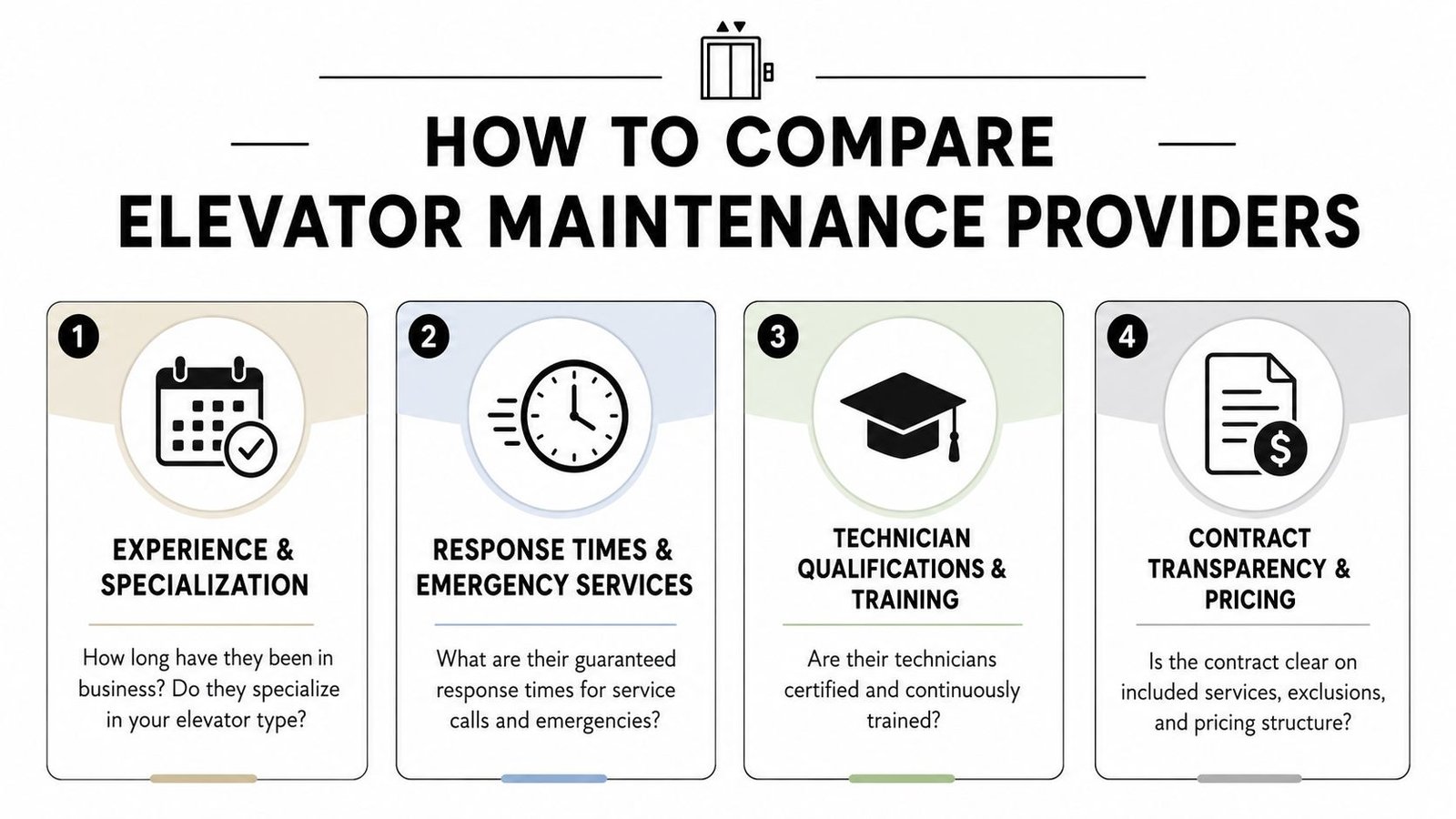
How to Compare Elevator Maintenance Providers
Most proposals look similar at first. Monthly price. Number of visits. A few exclusions. Emergency language that sounds reassuring.
That's not enough.
If you want to compare elevator maintenance companies near you properly, use four filters: service guarantees, response and availability, equipment philosophy, and maintenance scope. Those four reveal whether you're buying real asset support or just a contract that sounds good in a meeting.
Service guarantees
A guarantee tells you how much risk the company is willing to keep on its own side of the table.
The clearest example is a No Show, No Pay policy. If a contractor bills regardless of whether the visit happened or whether the work can be verified, the owner carries the accountability burden. If the contractor only bills when service is visibly delivered, the contractor shares that burden.
Owners are already paying for trust; they shouldn't also have to police whether scheduled maintenance occurred as promised.
Field advice: If a company can't explain how it verifies completed maintenance visits, treat every promise in the contract carefully.
Response and availability
Emergency support isn't just about whether a company answers the phone after hours. It's about whether field operations are set up to respond fast enough when a car is down in a busy building.
Verified benchmark data in the brief for this topic states that elite contractors use a 24/7/365 responsive field operations standard and benchmark emergency response at a 15-minute average, compared with a 45-minute industry average. The same verified data says companies that offer free second opinions and competitive quotes show a 25% higher customer retention rate. Because no supporting public source link was provided for those figures, the practical takeaway here should stay qualitative: better contractors tend to make response expectations clear, keep after-hours operations active, and remove friction when an owner wants another opinion before spending money.
In a vendor interview, don't ask only, “Do you offer emergency service?” Ask how calls are routed, who responds, and what happens if your regular route mechanic is unavailable.
Equipment philosophy
Here, long-term cost control either survives or disappears.
Some contractors are comfortable with non-proprietary repair and modernization paths. Others steer owners into systems, parts, or software arrangements that narrow future options. The danger doesn't always show up in year one. It shows up later, when replacement parts are harder to source or when changing providers becomes painful.
Verified background for this topic points to an underserved issue in the market: many elevator companies don't clearly advertise non-proprietary options or second-opinion support, even though owners often need those two things most when they're considering modernization. You don't need a sales pitch here. You need a direct answer to a direct question: will this decision make my building easier or harder to service later?
If a provider gets uncomfortable when you ask about proprietary controls, parts access, or future service freedom, keep asking.
Maintenance scope
A maintenance contract should spell out actual tasks. Not slogans. Not vague references to “full service.”
Here's a practical way to compare scope:
| Scope item | Thin contract | Strong contract |
|---|---|---|
| Equipment spaces | Little detail | Clean-downs for machine room, pit, and car top are clearly addressed |
| Small wear items | Often excluded or ignored | Routine details such as COP/PI bulb replacement are specified |
| Safety-related checks | Mentioned broadly | Door lock monitoring, safety tests, and violation-related work are defined |
| Hydraulic and mechanical upkeep | Reactive only | Items like hydraulic packing and component condition are actively reviewed |
The point isn't that every contract must read the same way. The point is that a serious provider can explain exactly what the mechanic is doing on each visit and why those tasks reduce repeat failures.
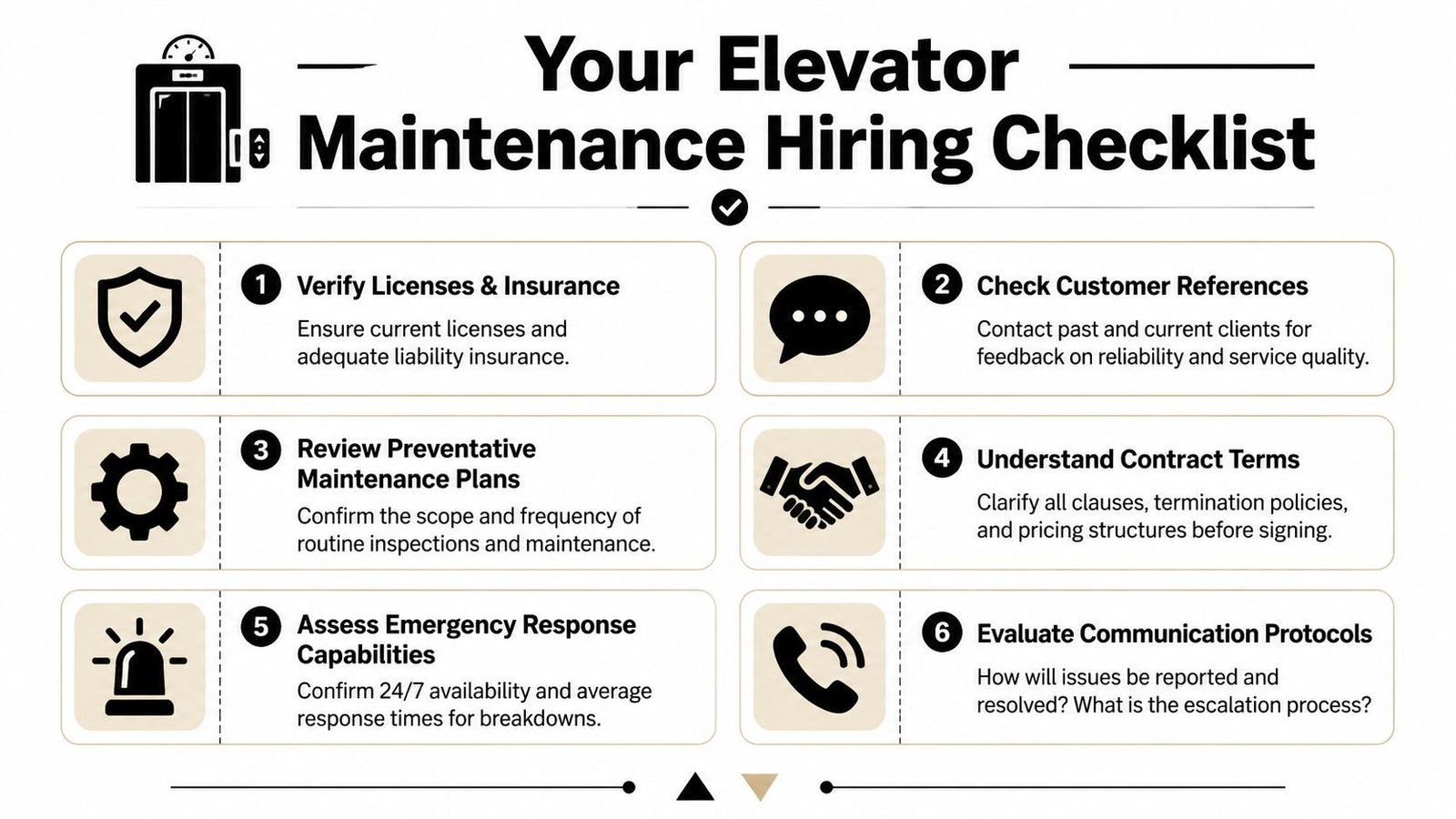
Your Elevator Maintenance Hiring Checklist
A vendor meeting goes better when you walk in with questions that force clear answers. You don't need a technical interrogation. You need enough discipline to separate polished sales language from a workable service relationship.
Questions worth asking before you sign
Bring this list into the room.
- Ask for maintenance proof: How do you document completed visits, findings, and follow-up recommendations?
- Ask about missed visits: Do you have a No Show, No Pay policy or another written accountability standard?
- Ask about emergency operations: Who takes after-hours calls, and how is emergency dispatch handled?
- Ask about equipment freedom: Are your repair and modernization solutions non-proprietary, or will this lock the building into one vendor?
- Ask about scope details: Do your visits include machine room, pit, and car-top clean-downs? Are small items like COP/PI bulbs addressed?
- Ask about code-related support: Will you handle safety tests, violation corrections, and inspection-related issues directly?
- Ask about repair judgment: When a component starts failing, how do you decide between repeated repair and replacement?
- Ask about quotes: Will you provide a free second opinion if another contractor has already proposed a major repair or modernization?
What strong answers sound like
A strong contractor answers in specifics. They explain what the mechanic checks, what's included, what's excluded, and how recommendations are documented.
A weak contractor stays general. They rely on phrases like “full service,” “extensive support,” or “we handle everything,” but get slippery when you ask what that means on a normal monthly visit.
The best operators also understand that transparency helps retention. Verified business-context guidance for this topic notes that elite contractors combine 24/7/365 responsive field operations with free second opinions and price-beat guarantees, and that this approach is associated with a 25% higher customer retention rate. Even without leaning on that number as the main point, the principle is sound: owners stay with vendors who are clear, available, and easy to evaluate.
The right maintenance company won't be annoyed by detailed questions. They'll answer them because they already run the work that way.
The final screen
Before you award a contract, compare the providers on one last point. Ask yourself which one is acting like a partner responsible for the long life of the equipment, and which one is acting like a callout vendor waiting for the next shutdown.
That difference shows up in the contract language, the service notes, the modernization philosophy, and the way they handle scrutiny.
Elevator Maintenance FAQs and Getting a Quote
What affects elevator maintenance pricing in Michigan
Price depends on the equipment type, age, condition, traffic level, building use, and how much preventive work is included. A hospital, municipal facility, apartment building, and office property won't carry the same service demands.
The important point is this: the lowest monthly number isn't always the lowest operating cost. If a cheaper contract excludes meaningful preventive work, response support, or code-related tasks, you'll feel that later through breakdowns, callbacks, and repair proposals.
What's the difference between maintenance and modernization
Maintenance keeps existing equipment operating safely and reliably. Modernization replaces aging or obsolete components when repair stops making economic sense or when serviceability becomes a problem.
A good contractor should help you see the line between the two. If they recommend modernization, ask whether the proposed path is non-proprietary and whether future service can be competitively bid.
Can I switch elevator maintenance companies
Yes, but you need to read your current contract carefully. Pay attention to renewal language, notice deadlines, exclusions, and any terms tied to proprietary equipment or software access.
Before switching, have the incoming contractor inspect the equipment and identify deferred issues, code concerns, and likely first-year repair needs. That gives you a cleaner handoff and a more honest expectation of what the new agreement should cover.
Should I get a second opinion on a big repair
Yes, especially when the repair is expensive, the diagnosis is vague, or the proposal seems to push directly toward replacement. A second opinion is useful when you need confirmation on cause, urgency, and whether there's a practical alternative.
This is one area where good contractors separate themselves quickly. If a company is confident in its recommendations, it won't act threatened by comparison.
What should I look for in a Michigan elevator partner
Look for clear maintenance scope, documented accountability, fast emergency support, code competence, and a repair philosophy that protects your future choices. If your properties are in Detroit, Ann Arbor, Lansing, Flint, Kalamazoo, or surrounding Michigan towns, local coverage matters too. A contractor can't support a region well if the field operation is spread too thin.
If you're comparing vendors in Southern Michigan and want a practical quote, a second opinion, or a clearer maintenance plan, contact Crane Elevator Company. Crane serves Detroit, Ann Arbor, Lansing, Flint, Kalamazoo, and nearby Michigan communities with preventative maintenance, repairs, code-required inspections, non-proprietary modernization options, and 24/7/365 field support. For building owners and managers who care about accountability, the company also offers free second opinions, competitive quotes, and a price-beat guarantee.