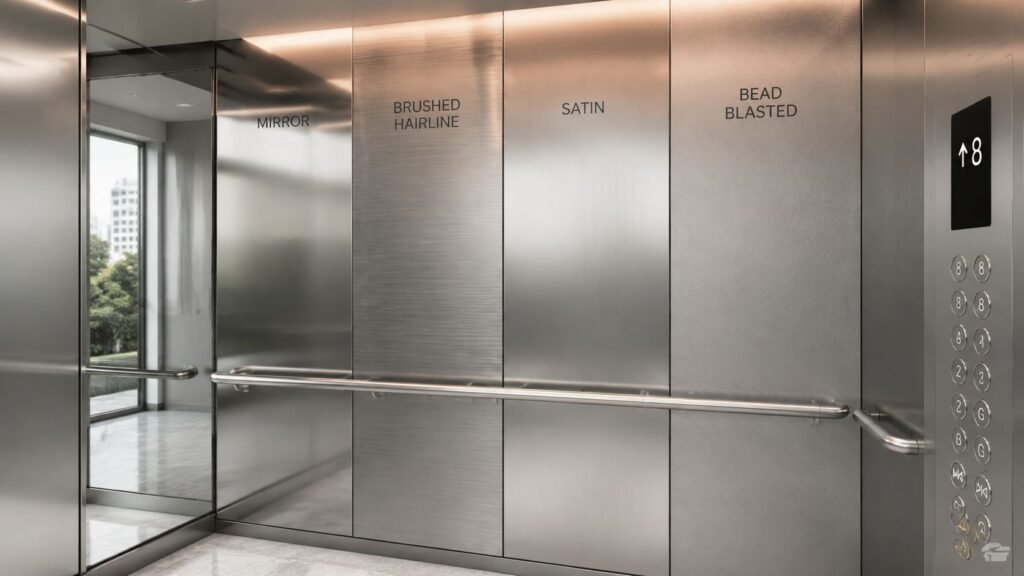
You're standing in front of an elevator cab that looked sharp on install day, and now every trip tells a different story. The mirror face shows fingerprints before the doors finish closing, the brushed panels have a few extra scuffs, and the owner wants to know whether the finish was the problem or the maintenance routine was. That's the core stainless elevator interior finish question, not what looks good on a sample board, but what still looks controlled after years of daily use.
A good cab finish does more than dress up the interior. It shapes cleaning labor, tenant perception, vandal resistance, and how often panels need attention. Stainless became common in elevator work later than one might assume, and that matters because it was chosen for the realities of crowded, high-use buildings, not for nostalgia. The finish has to work like a surface, not just like a visual.
Why the Cab Finish Matters More Than Most Owners Realize
I've seen owners approve a beautiful cab finish from a sample chip, then call back six months later because the same surface looks tired in the field. The problem usually isn't the contractor's installation, it's the mismatch between the finish and the building's traffic pattern. A cab is touched, leaned on, bumped, wiped, and cleaned every day. That makes it a working surface first and a design feature second.
Stainless fits that reality because it's non-porous, corrosion-resistant, easy to clean, and durable against physical damage, which is why it shows up so often in healthcare, transit, education, and office buildings as described in this historical overview of elevator interiors. The historical point matters, too. Stainless was developed in the first two decades of the 20th century, but it didn't become widespread in elevator applications until the early 1970s, which tells you it became popular when buildings got denser and harder on interior finishes.
That shift changed the job of the finish. Earlier decorative materials could look fine in a lower-duty setting, but modern cabs need materials that tolerate repeated cleaning and wear over decades. Owners who treat finish selection as a last-minute style choice usually end up paying for it later in touch-up labor, panel swaps, and complaints.
Practical rule: If the cab will be cleaned often or used hard, choose the finish for year five, not for the first walkthrough.
For anyone planning work around an existing cab, the interior should be discussed early, not after the structural scope is already locked. A project that includes elevator cab interior work needs the finish conversation at the front of the table because the material choice drives both appearance and maintenance.
The Four Common Stainless Finish Families
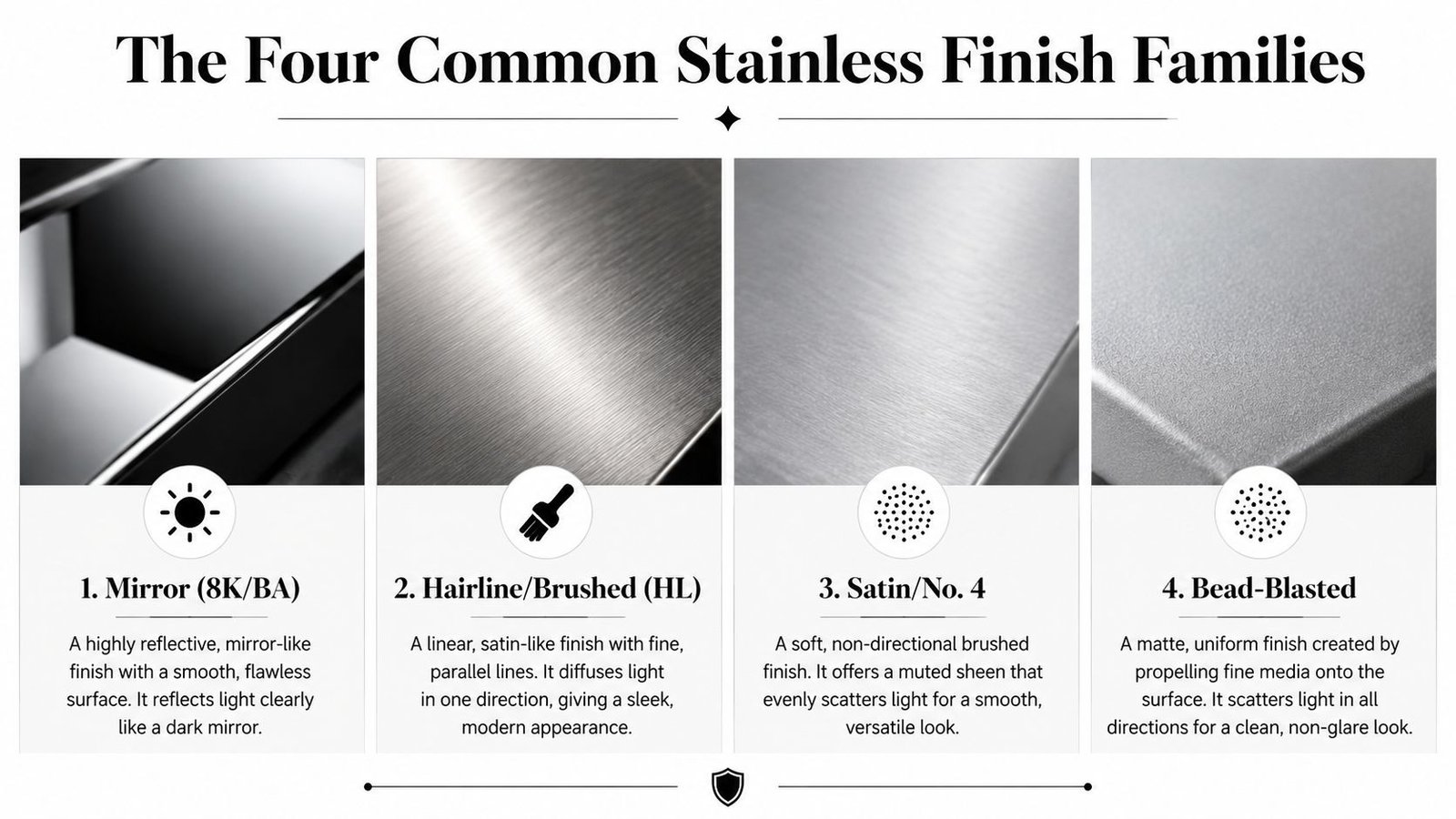
A stainless finish is not just “shiny” or “not shiny.” The surface treatment changes how the cab reflects light, hides wear, and ages under fingerprints and cleaning. The four finishes owners run into most often are mirror, hairline or brushed, satin, and bead-blasted.
Mirror and hairline finishes
Mirror, sometimes called 8K or BA, acts like a still pond. It throws light back hard, which makes a cab feel premium and bright, but it also puts every smudge in plain view. That's why it works best where the visual effect is part of the brand and the building team can keep up with spot cleaning.
Hairline or brushed finish behaves more like soft wood grain. The grain runs in one direction, and that directional texture helps soften fingerprints and minor scratches because the eye reads the pattern instead of every tiny mark. In high-traffic buildings, that's the practical advantage most owners care about.
Satin and bead-blasted finishes
Satin, often called No. 4, sits between glossy and matte. It has a muted, even look that feels calmer than mirror but still looks finished and intentional. It's a strong middle ground when a building wants stainless without the high-maintenance glare of a highly reflective surface.
Bead-blasted has a fine, matte texture, a bit like rain stippling pavement. It diffuses light well and hides some scuffing, but it can also hold grime in the texture if the cleaning routine is sloppy. That makes it a good choice only when the maintenance staff understands what the surface needs.
A contractor should be able to explain not just the look, but the behavior of each family under traffic, light, and cleaning. These finishes are not interchangeable in the field.
Mirror sells the sample. Grain sells the building.
Grades, Thickness, and the Specifications Behind a Quote
A quote for stainless elevator interior finish should never stop at “stainless panels.” Grade, thickness, and panel construction decide how the cab behaves after installation. If a bid leaves those details vague, you are not comparing the same product from one contractor to the next.
Grade choices that matter
For elevator wall panels, 304 and 316 are the common stainless grades called out in the design guidance from this elevator cladding guide. In practical terms, 304 is the standard interior choice. 316 is specified where corrosion resistance matters more, or where the building wants extra margin against tougher service conditions.
Thickness matters just as much. Typical elevator cab panels run about 0.8 mm to 1.5 mm, with flat bonded wall panels often at 0.8 mm to 1.0 mm and panels with folded return edges or added rigidity at 1.2 mm to 1.5 mm per the same guide. Ceiling panels are often kept at 0.8 mm to control weight. Those details change how the cab feels in the field, not just how it reads on a submittal sheet.
Why flatness changes the whole look
Thin stainless shows everything beneath it. That is why quality checks may target about 1 mm deviation per metre of flatness, because uneven substrates or loose tolerances show up as waviness in reflective finishes as noted in the guide. A panel can look right in the shop and still read sloppy once it is installed in the cab.
I see this most often in modernizations where the finish sample looked clean, but the backing structure was not prepared with the same care. The result is a surface that catches side light in the wrong places and makes even a good stainless finish look cheap.
The quote should make each choice visible. Grade tells you how the metal handles corrosion. Thickness tells you how it holds up structurally. Flatness tells you whether the cab will look crisp or wavy after the first year of use.
For door-adjacent details, compare the finish specification against related components like stainless steel elevator doors, because mismatched sheen or thickness can make a finished cab look pieced together.
Matching Finish to Traffic Level and Building Type
The right finish depends less on taste than on how many hands touch the cab and how much time the building team has to chase cosmetics. A mirror face in a quiet executive setting can look intentional. In a busy clinic or school, it can look like a cleaning problem by noon.
Light, medium, and heavy use
For light-traffic residential or premium low-touch spaces, mirror or a polished satin can work because the visual effect is the point and staff can keep pace with cleaning. In a quiet building, reflectivity reads as upscale rather than needy. Owners still need to accept that fingerprints will be visible, because the surface doesn't hide them.
For medium-traffic office elevators, brushed or hairline stainless usually wins. The grain gives the eye something to follow, so minor handling marks are less obvious. That translates into a cab that still looks controlled between cleanings instead of one that needs constant wiping.
For heavy-traffic healthcare, education, transit, and municipal buildings, brushed and some satin finishes are usually the workhorses. These buildings need surfaces that tolerate repeat cleaning, occasional impact, and a lot of contact without looking abused. Bead-blasted can also help hide scuffs, but only if the housekeeping team can keep dirt from settling into the texture.
| Traffic Level | Recommended Finish | Fingerprint Visibility | Scratch Behavior | Best Fit |
|---|---|---|---|---|
| Light residential | Mirror or polished satin | High on mirror, moderate on satin | Scratches show quickly on mirror | Premium low-touch cabs |
| Medium office | Hairline or brushed | Lower than mirror | Minor marks blend into the grain | Daily commuter elevators |
| Heavy healthcare, education, transit | Brushed or satin, sometimes bead-blasted | Brushed hides more than mirror | Better field durability | High-contact public cabs |
What fails in the field
Bead-blasted disappoints when the building expects a “set it and forget it” surface. Texture hides some wear, but it doesn't eliminate cleaning. Mirror also disappoints when owners want a luxury look without a luxury cleaning habit.
The finish that still looks good in five years is the one that matches how the cab is used, not how it looked under showroom lighting.
Cleaning, Sanitation, and Day-to-Day Maintenance
Stainless is popular in high-traffic buildings because it's easy to clean, durable, and non-porous, which matters wherever sanitation and maintenance efficiency are part of the operating plan. That's why you see it so often in healthcare, education, transit, and office environments. The finish choice changes the cleaning burden, though, and the wrong routine can ruin a good surface faster than normal use.
What to use and what to avoid
The basic routine is straightforward. Use a microfiber cloth and a stainless-steel cleaner, then wipe in the direction of the grain on brushed or hairline panels. That keeps cleaning marks from fighting the finish pattern. If the cab has a mirror face, plan on more frequent spot cleaning because fingerprints show immediately.
Avoid this: steel wool, bleach, and ammonia-based cleaners. They can damage the surface or make scratches look worse.
That warning matters because a lot of maintenance damage starts as an attempt to solve a small smudge with the wrong tool. A rough pad can leave a scratch pattern that looks worse than the original mark, especially on reflective panels. Once that happens, the problem turns cosmetic, not just dirty.
Match the finish to the maintenance staff
In healthcare and food-related environments, the finish has to work with cleaning protocols, not against them. Stainless helps because it can be disinfected more easily than many porous materials, but the staff still needs a safe routine. In schools and transit, the issue is vandal resistance and speed. In offices, the goal is usually the lowest labor cost in day-to-day cleaning.
A directional brushed finish is forgiving because the grain hides fingerprints and minor handling. Mirror demands more attention. Bead-blasted can look controlled, but only if grime doesn't settle into the texture. Each choice changes how often the elevator team will be called to clean, not just how the cab looks at turnover.
Cost, Specification, and the Modernization Conversation
A stainless interior gets expensive or economical based on four things, the grade, the thickness, the finish complexity, and what's behind the panel. Owners often focus on the face material alone, but the substrate and fabrication work are where a lot of the budget goes. Mirror finishes usually cost more than brushed because the polishing work is more labor-intensive.
Reading the bid without getting lost
The first question is grade. If the bid says 304, that's the standard interior callout. If it says 316, the owner should understand that the spec is pushing toward higher corrosion resistance, not just a different label. The second question is thickness, because a thinner panel and a thicker, self-supporting panel are not the same product in the field.
The substrate matters because stainless is often a finish layer, not a full wall system. If the backing is poor, the cab can still look wavy even when the metal itself is good. That's where a clean modernization package beats a patchwork approach.
For owners looking at a non-proprietary modernization, elevator cab modernization is the point where finish, controls, and wall construction should all be reviewed together. A contractor should be willing to compare options openly, not steer every building toward the same surface. Crane Elevator Company, for example, offers cab interior work as part of its modernization scope, so the finish can be discussed alongside the rest of the upgrade instead of being treated as a separate afterthought.
What affects cost most
- Material grade: 304 and 316 are not interchangeable.
- Panel thickness: thicker and more rigid panels cost more to fabricate.
- Finish complexity: mirror requires more labor than brushed.
- Substrate quality: a bad backing undermines a good face sheet.
A clean-down of the cab interior is part of preventive maintenance too, and the finish choice decides how much of that labor is cosmetic correction versus routine upkeep. That's why competitive quoting matters. Owners should ask for side-by-side options, then compare them on field behavior instead of on the prettiest sample board.
Compliance, Safety, and What to Confirm Before Signing
A stainless finish is usually compatible with common elevator interior requirements, but the owner still needs to confirm the details with the local authority having jurisdiction. Don't assume that a nice panel spec automatically clears every fire-rating or assembly question. If the finish sits inside a broader modernization, permits and inspection requirements may come with it.
What to ask before approval
First, confirm how the finish interacts with the fire-rated assembly, if the cab or surrounding structure has one. Second, check the ADA-related items that get overlooked in finish discussions, including handrail mounting, button placement, and contrast at the control panel. A highly reflective surface can create glare that makes controls harder to read, so the finish choice has a direct link to usability.
Third, ask how the upgrade will be inspected. A cab interior change is often part of a larger modernization package, which means the work isn't just cosmetic from the code office's point of view. A contractor who handles this properly will explain what needs review before materials are ordered.
Confirm the finish won't fight the code package. The safest stainless choice is the one that works with fire, accessibility, and inspection requirements, not just with the renderings.
This is also where owners should ask whether the project needs a permit trail and final sign-off tied to modernization scope. If the contractor can't answer that clearly, keep looking.
A Practical Selection Checklist and Common Questions
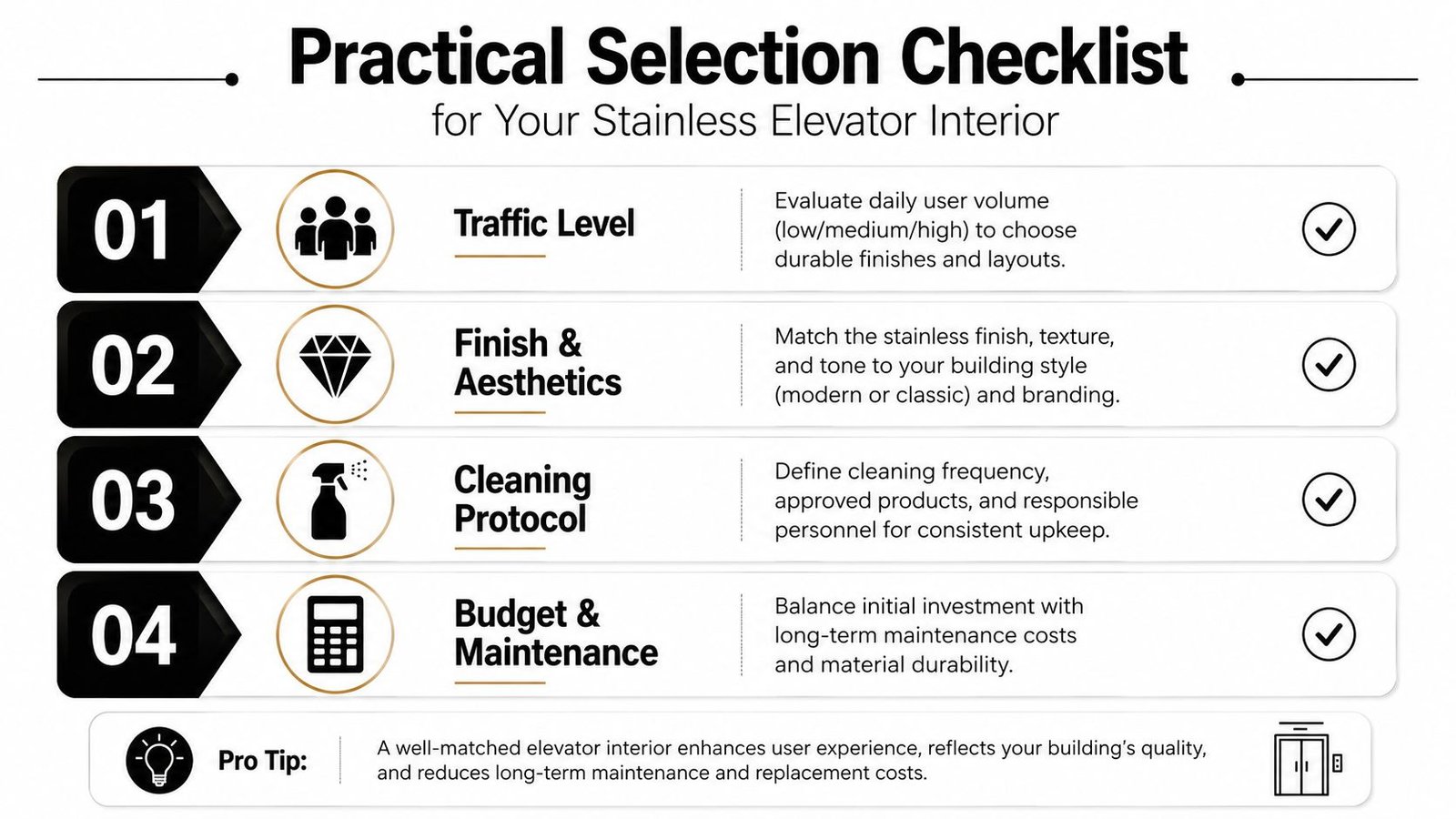
Use this short list before you sit down with a contractor.
- Traffic level: Match the finish to how often the cab is used and cleaned.
- Finish and aesthetics: Choose mirror, brushed, satin, or bead-blasted based on how much glare and fingerprint visibility you can tolerate.
- Cleaning protocol: Confirm which cleaners and cloths the building staff will use.
- Budget and maintenance: Compare initial cost against how much labor the finish will demand over time.
A few questions come up every time. Is stainless worth it over laminate? In a hard-use cab, stainless usually holds up better because the surface is more durable and easier to clean. Can you refresh an existing finish? Sometimes yes, but deep scratches and waviness usually point toward replacement rather than cosmetics. Can a finish upgrade happen without a full modernization? Often, yes, if the existing structure and code conditions allow it. What should a maintenance contract include? At minimum, clean-downs, inspection support, and a clear plan for what counts as cosmetic wear versus repair.
The right contractor will talk through those choices openly and won't push every building into the same finish package. A free second opinion is a normal part of a smart bid comparison, and it's the easiest way to keep the cab looking right in year five, not just on day one.
If you're weighing a cab finish change, a modernization, or a maintenance reset, talk with Crane Elevator Company about the options side by side. They work on non-proprietary elevators across Southern Michigan and can help you compare stainless interior choices, cleaning impact, and long-term upkeep before you sign a bid.