An elevator's risk profile is easy to underestimate until the numbers land in front of you. In the United States, elevators and escalators are linked to 31 deaths and about 17,000 serious injuries each year, and CPWR also reports 263 elevator-related deaths from 1992 to 2009, plus 89 passenger deaths among people using elevators at work during that same period, which averages to about 5 workplace passenger deaths per year (CPWR analysis of BLS and CPSC data). Those are rare events in a busy system, but they're exactly why Passenger Elevator Maintenance has to be treated as a life-safety function, not a convenience service.
That mindset changes how owners read service logs, respond to nuisance shutdowns, and budget for corrective work. The same CPWR analysis notes that the CPSC estimated only 0.015 accidents per elevator annually in the U.S. (CPWR analysis of BLS and CPSC data). Low frequency doesn't mean low importance, it means the bad outcomes cluster around the cases where maintenance, documentation, or component condition slipped.
Why Passenger Elevator Maintenance Is a Life-Safety Function
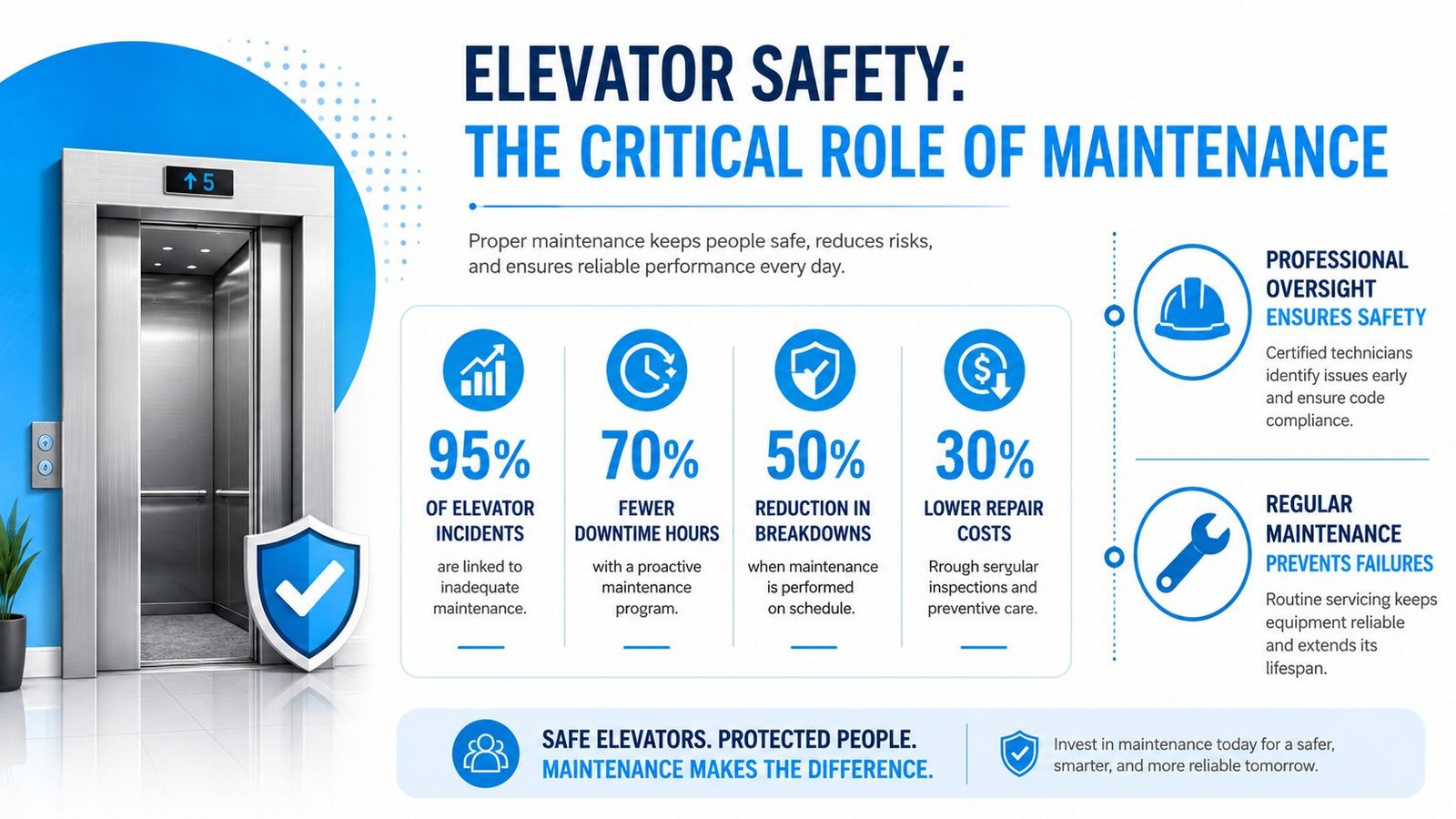
A passenger elevator can look healthy right up until one weak component puts riders at risk. A door lock that drifts out of adjustment, a brake that does not seat cleanly, or a control fault that appears only under load can turn a normal trip into a rescue call or a code violation. That is why preventive maintenance is not just upkeep, it is part of the building's life-safety program and part of the owner's compliance record.
The issue is not whether the elevator runs between service calls. The issue is whether the equipment keeps its safety margin when traffic increases, temperatures change, or wear starts to show in the door system, brake, controller, or communication device. Maintenance quality determines how much hidden deterioration gets caught before it becomes a shutdown, an entrapment, or a condition that fails inspection.
What owners and managers should take seriously
A service visit only matters when it changes the condition of the equipment. If the work does not tighten tolerances, verify operation, and document what was found, it does little to reduce risk. Owners and managers should pay close attention to the condition of the door system, the brake, the controller, the communication device, and the record that shows the equipment was checked, adjusted, and tested.
A car can still deliver an ordinary ride while carrying wear that only shows up under repeated cycling, heat, or heavier traffic. That is where maintenance quality affects downtime and compliance at the same time. The same defect that creates a nuisance shutdown can also raise the chance of entrapment or a failed test, which is why good maintenance looks for issues before passengers feel them first.
Practical rule: If a defect can strand passengers or compromise stopping performance, treat it like a life-safety issue first and a convenience issue second.
That approach keeps owners from trusting appearances. A quiet ride does not prove the brake, the door interlocks, or the control system is healthy, and a building that waits for a passenger complaint is already behind. Good maintenance reduces exposure early, keeps service logs useful, and lowers the chance that a small defect turns into avoidable downtime or a compliance problem.
Understanding Critical Elevator Safety Devices
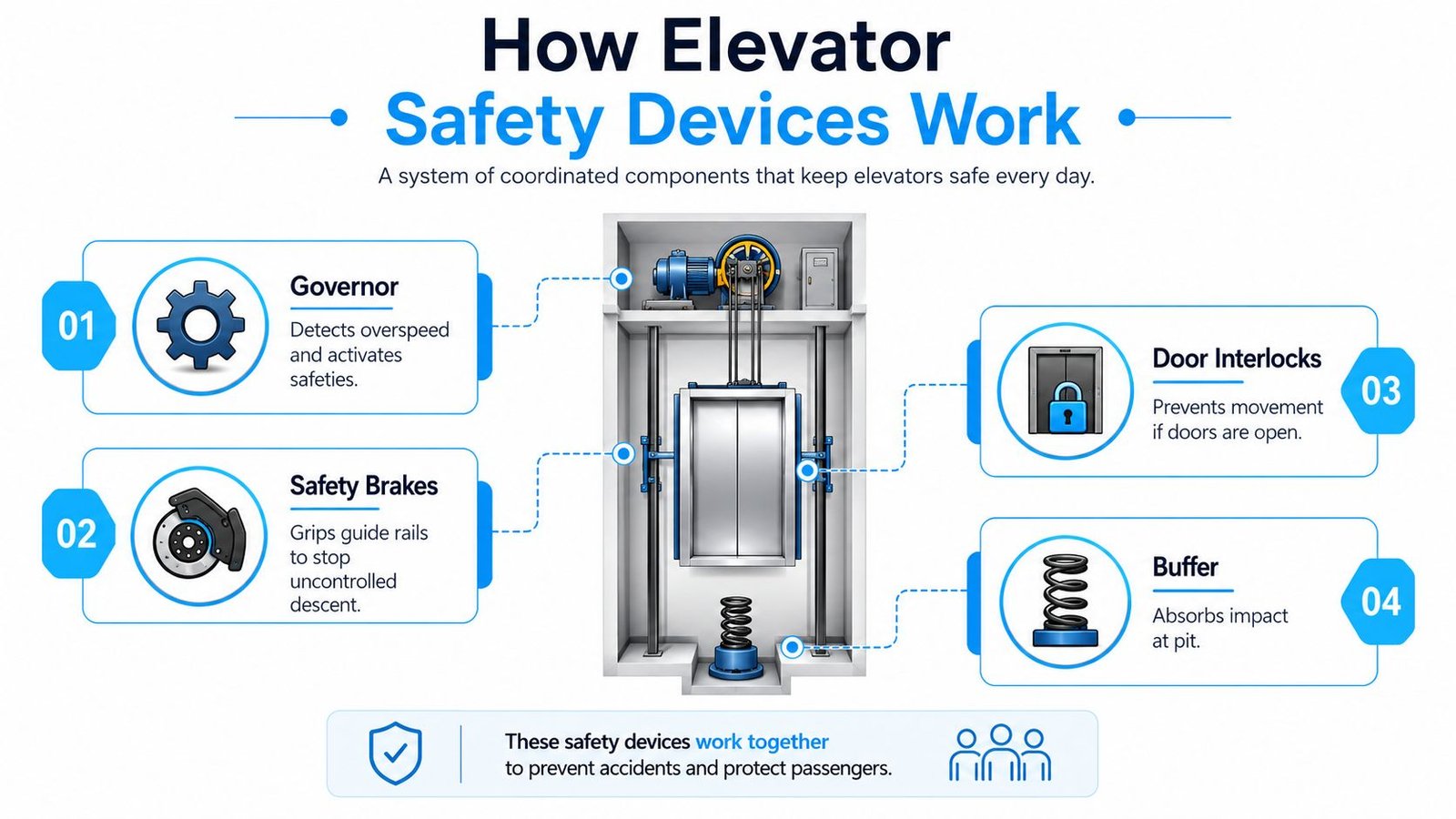
The safety devices in a passenger elevator work like a chain, not a collection of separate parts. If one link weakens, the others are forced to absorb the stress, and that's when nuisance trips become outages and outages become emergencies. Maintenance quality determines whether these devices stay ready when the car is moving, stopping, or entering a terminal landing.
Governor, safeties, and door interlocks
The governor is the device that detects overspeed. If the car starts moving faster than it should, the governor triggers the safeties so they can grip the guide rails and stop uncontrolled descent. That's the reason technicians pay close attention to adjustment, cleanliness, and wear in the system.
Door interlocks do a different job. They keep the car from moving unless the doors are properly closed and locked, which is why a bad interlock can create a serious violation even if the rest of the elevator feels normal. The simplest way to think about it is this, the car should never be allowed to “trust” an open door.
The included safety brake reference from Crane's safety-brake page is a useful reminder that the brake system is not decorative hardware, it's a control point that deserves real inspection attention: elevator safety brake details. When brakes are out of adjustment or contaminated, passengers may only notice a rough start or stop, but the risk is deeper than comfort.
Buffer and the emergency stopping path
Buffers absorb impact energy at the pit and terminal landings. They matter because no elevator should depend on human reaction alone if it overtravels or enters a fault condition. The buffer's job is to soften the end of the path when the rest of the stopping sequence has already done everything it can.
The maintenance lesson is straightforward. These devices are only as reliable as the technicians who keep them clean, adjusted, and tested. A system with a tired door lock, a weak brake, or a governor that hasn't been checked carefully is not a layered protection system, it's a building waiting on luck.
Code Requirements and Inspection Implications
Passenger elevators do not stay safe by habit or by schedule alone. They are maintained under a documented framework that ties each task to the actual condition of the equipment, and the most common code-based approach is a Maintenance Control Program (MCP). That program sets out examinations, maintenance, and tests at regular intervals, along with cleaning, lubricating, adjusting, repairing, or replacing worn components so the installation stays aligned with ASME A17.1 / CSA B44 requirements (Illinois safety code guidance). Inspectors and insurers both look for that paper trail because it shows the work was based on the machine's condition, not just a reminder on a calendar.
Code compliance also depends on the right tests being done at the right time. Passenger elevators are typically inspected annually, while the more intensive brake-and-safety or full-load safety test is required every five years under ASME A17.1 / CSA B44-based rules (inspection overview). That full-load test matters because it shows the system can still perform under actual load, not only during a light-duty check. A car that passes routine service but slips on load testing is telling you something about wear, adjustment, or hidden drift that routine observation can miss.
For owners, the hidden cost shows up in maintenance quality metrics. Missed adjustments, deferred parts replacement, and incomplete test records often show up later as repeat callbacks, failed inspections, and longer downtime. A strong maintenance program keeps those failures from stacking up, because a device that is out of tolerance may still run for a while before it creates a violation or a shutdown.
What compliance records have to prove
A clean file does more than satisfy an inspector. It has to show that the owner is running a real maintenance control program, that service intervals are being met, and that defects are being corrected instead of carried forward. If records are incomplete, the building can appear compliant on paper while the equipment is drifting away from safe operation in the field.
Missing documentation doesn't create the defect, but it does create the liability.
That matters every time a technician opens the logbook. If the elevator history cannot show what was inspected, what was adjusted, and what was replaced, the owner is left defending the system with memory instead of records. For that reason, compliance files should be treated as part of the machine, not as office paperwork, and the owner should keep the code framework close at hand through elevator code requirements.
The best internal habit is simple. Keep signed maintenance records, test results, and corrective work together so the next technician, inspector, or risk manager can see the same story the equipment is telling. When those records line up with what is happening in the field, inspections move faster, violations are easier to avoid, and downtime is easier to control.
Maintenance Best Practices and Testing Protocols
The best maintenance programs don't start with the calendar, they start with the equipment. Written procedures have to account for age, wear, usage, design quality, and environmental conditions, because a high-use passenger car in a busy building won't age like a lightly used one in a quiet property. That's why the strongest programs shift from routine checks to targeted correction the moment a component starts drifting.
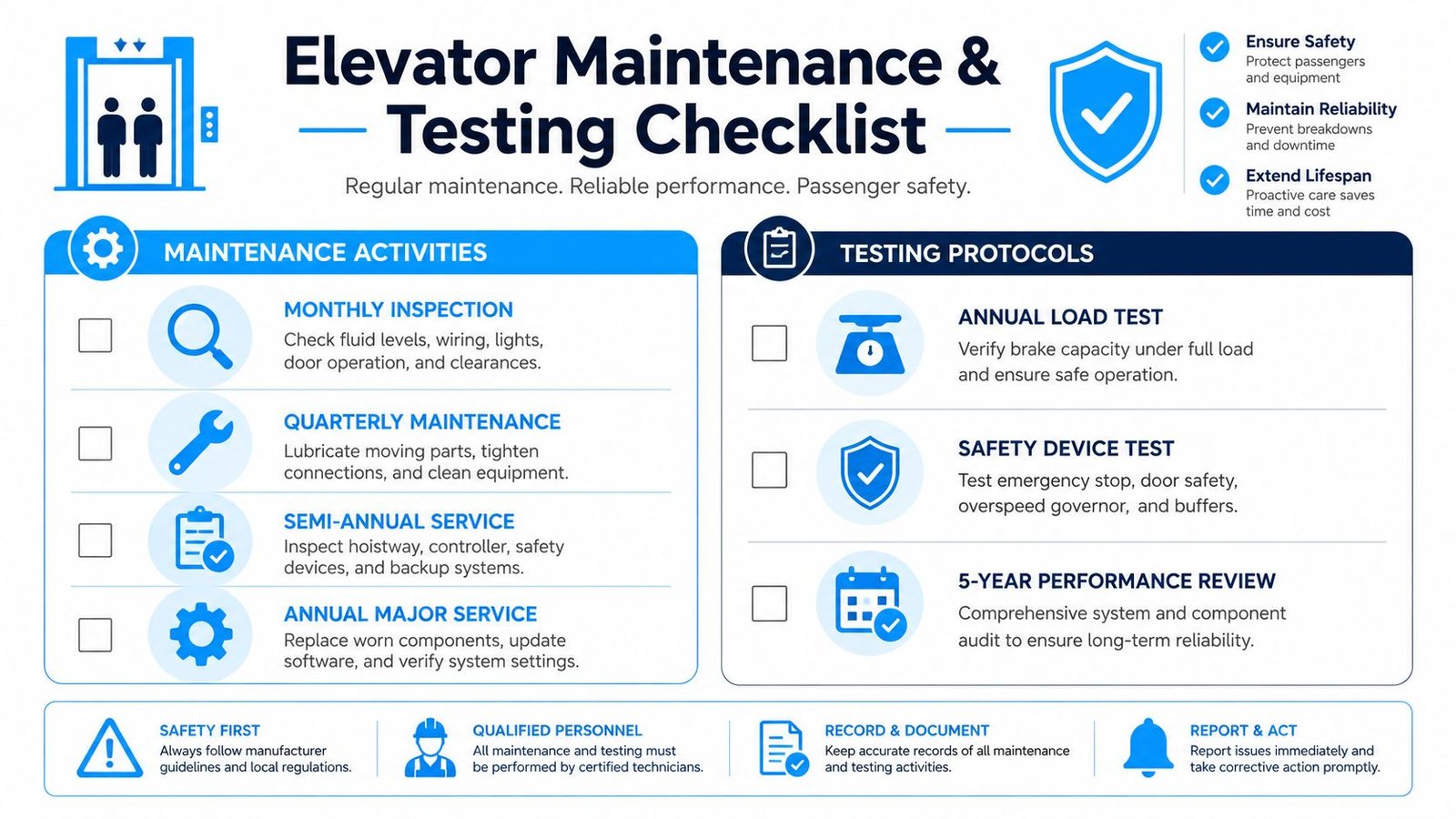
A practical monthly or quarterly log should be unit-specific and should capture what was seen in the car and hoistway, the safety devices, the machine room and controller, the drive components, and emergency communication verification (written maintenance control program guidance). The point isn't to create paperwork for its own sake. It's to turn inspection data into a trail that shows trends before they become failures.
What gets checked first
The technical order of operations usually starts with the parts that affect safe movement most directly. Door operators, landing-door locks, brakes, suspension cables, grounding, and insulation testing sit near the top because they can trigger outages or safety-device trips when they degrade. Best-practice checklists also call for cleaning and lubrication where required, plus testing of the emergency communication device.
The logic is causal. Worn rollers, weak interlocks, or degraded cabling can cause repeated reopenings, level discrepancies, nuisance outages, or controller faults. Poor grounding and insulation integrity can do the same on the electrical side, where faults are harder for a building user to diagnose and easier for a technician to miss if the logs are thin.
Warning signs that deserve immediate attention
- Abnormal sounds: Grinding, squealing, or clanking usually mean friction or alignment problems, not “normal aging.”
- Slow door cycles: Sluggish door movement often points to roller wear, track issues, or operator problems.
- Repeated reopening: If the doors keep reopening, the system is telling you the door path or interlock needs attention.
- Leveling drift: Floor-level discrepancies can signal control, brake, or drive issues and shouldn't be deferred.
- Unusual vibration or hesitation: That pattern often shows contamination or friction loss in traction equipment.
The maintenance habit that works best is simple, documented escalation. Clean and lubricate what the manual says should be serviced, test what has to function under stress, and send a technician back immediately when the car starts speaking in new noises or new behavior.
Recognizing Signs of Impending Failure
The most expensive failures rarely begin with a dramatic stop. They usually begin with a pattern, a small door issue, a recurring nuisance trip, or a ride quality change that gets brushed off because the car still moves. Building owners who learn to read those patterns tend to spend less on emergency response and more on planned correction.
Door-system degradation is the clearest warning path. Worn rollers, misaligned tracks, weak interlocks, and degraded cabling can increase door reopenings, floor-leveling errors, and nuisance outages. When the doors start acting strangely, the car is often already telling you that the system has slipped past normal wear and into a problem that needs technician review.
What separates wear from failure
Some conditions can be scheduled. Others should trigger an immediate shutdown or at least a same-day service call, especially if passengers are being trapped or the car is repeatedly going out of service. The difference comes down to whether the issue is stable and predictable, or whether it's escalating under use.
Contamination and friction losses are common in traction equipment. Dust, residue, and poor lubrication can create sounds, hesitation, or rougher operation long before a total outage appears. That's why abnormal noise should never be filed away as “just old equipment.” It's a field clue.
Poor grounding or insulation integrity is another red flag because it can lead to controller faults and electrical failures. Those problems often don't announce themselves with a clean mechanical symptom, which is why a good technician checks both the visible motion path and the electrical condition of the system.
If the elevator starts sounding different, stopping differently, or reopening doors repeatedly, treat it as an early warning, not a nuisance.
Owners and managers don't need to diagnose the exact part. They do need to know when a pattern has moved from observation to intervention. That's where fast response protects uptime and keeps a minor defect from becoming a repeated service disruption.
Measuring Maintenance Quality and Business Impact
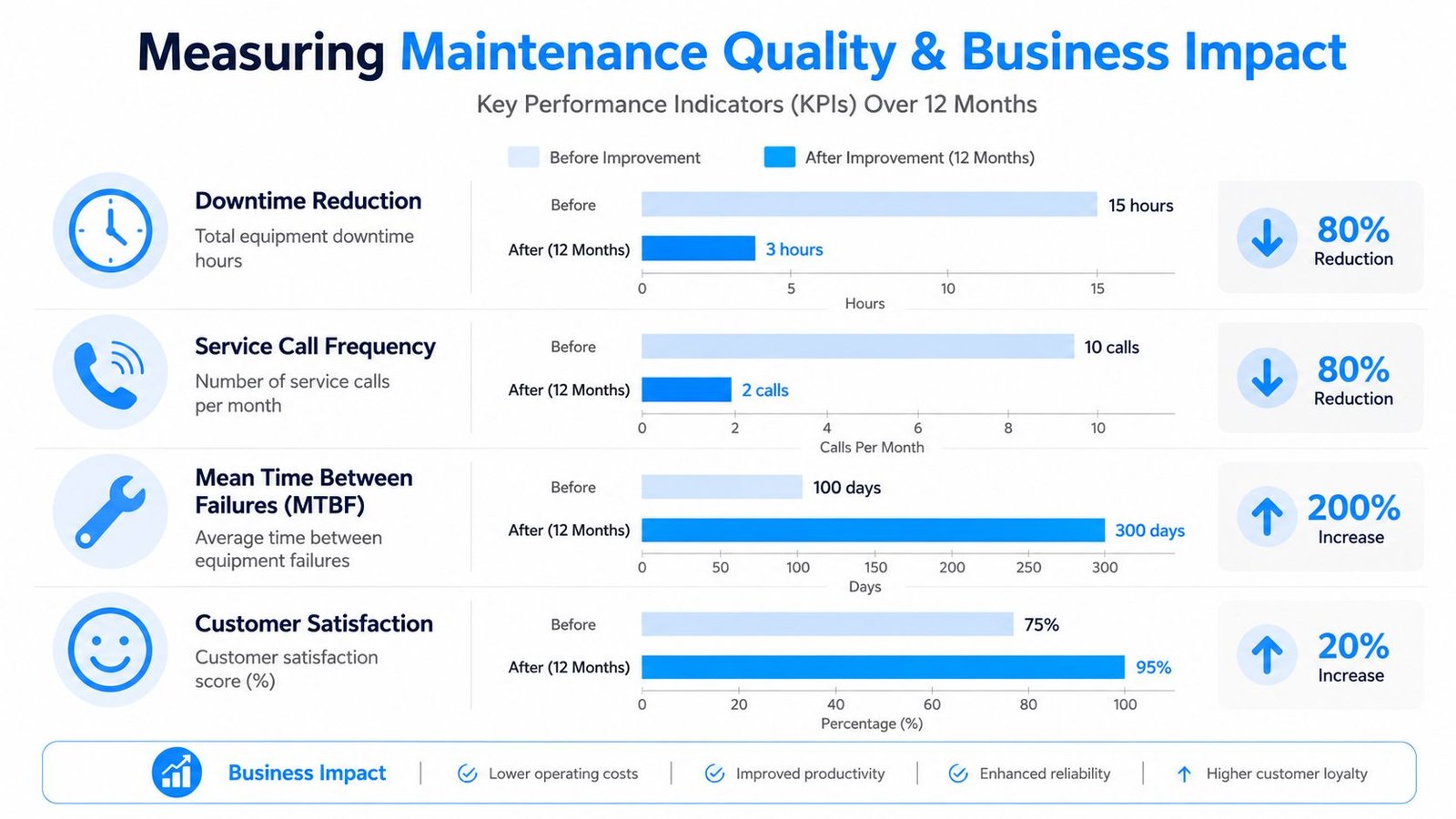
A maintenance program only deserves credit if the elevator is more available and more stable. That's why the most useful metrics aren't just “service performed,” they're downtime hours, repeat-call rates, mean time to repair, and overall elevator availability. Those numbers tell you whether the contractor is reducing disruption or just documenting visits.
Independent industry work gives a realistic benchmark. A North American availability study for Ontario found elevators in residential and institutional buildings were available 97% of the time, which the study equated to roughly 10 days out of service per year, while another estimate put availability at 99% for those same building types in 2016 (Ontario availability study). Those figures are useful because they show what good maintenance can look like when service response is prompt and the equipment is being managed properly.
What to track instead of relying on impressions
A building team should ask three questions after every service cycle. Did the car stay up? Did the same issue come back? Did the corrective work change the behavior of the elevator over time? If the answer stays vague, the program isn't being measured well enough.
- Downtime hours: Track how long the car is unavailable, not just how often someone visited.
- Repeat-call rate: Count recurring calls on the same unit or component.
- Mean time to repair: Measure how long the equipment stayed down before it was restored.
- Availability trend: Watch whether the elevator is getting more stable across months, not just days.
The business case is hidden in chronic service degradation. A compliant monthly visit can still miss the problem if it doesn't reduce repeat disruptions or improve actual availability. That's why performance data should feed repair-versus-modernization decisions instead of living in a binder.
Crane Elevator Company Maintenance Services in Michigan and Ohio
Crane Elevator Company approaches maintenance the way experienced field crews do, by focusing on the condition of the equipment, not just the date on the calendar. Their work covers Michigan and Ohio, including Toledo and surrounding cities, and their service model is built around proactive preventive maintenance, repairs, code-required inspections, and modernization for all makes and models of vertical transportation. Their non-proprietary approach matters because it keeps the equipment serviceable by qualified providers instead of locking the owner into a single path.
That practical mindset shows up in the details. Crane's maintenance program includes a No Show, No Pay policy, full clean-downs of machine rooms, pits, and car tops, and the kind of hands-on follow-through that helps catch recurring issues before they become downtime. For owners who need a service partner that understands both compliance and day-to-day reliability, that combination is useful because it matches what strong maintenance requires.
Their Ohio coverage is outlined on the company's regional service page here, Ohio elevator services, and the service scope goes well beyond routine checks. It includes door lock monitoring, hydraulic packing, safety tests, emergency phones, fire service testing, generator testing, violation corrections, and major component replacements when repair is no longer the right answer. That mix is especially important in older buildings where parts access, inconsistent equipment fleets, and legacy systems can drive downtime even when the maintenance schedule looks fine on paper.
For building owners, the bigger value is predictability. Free second opinions, competitive quotes, a price-beat guarantee, and commercial elevator financing make it easier to choose the fix that solves the problem instead of pushing it into the next outage cycle.
If your elevator is showing repeat door issues, leveling drift, or unexplained downtime, talk with Crane Elevator Company about maintenance, repair, and modernization options in Michigan and Ohio. A focused review can show whether your current program is protecting safety, compliance, and uptime the way it should. Visit Crane Elevator Company to get started.