
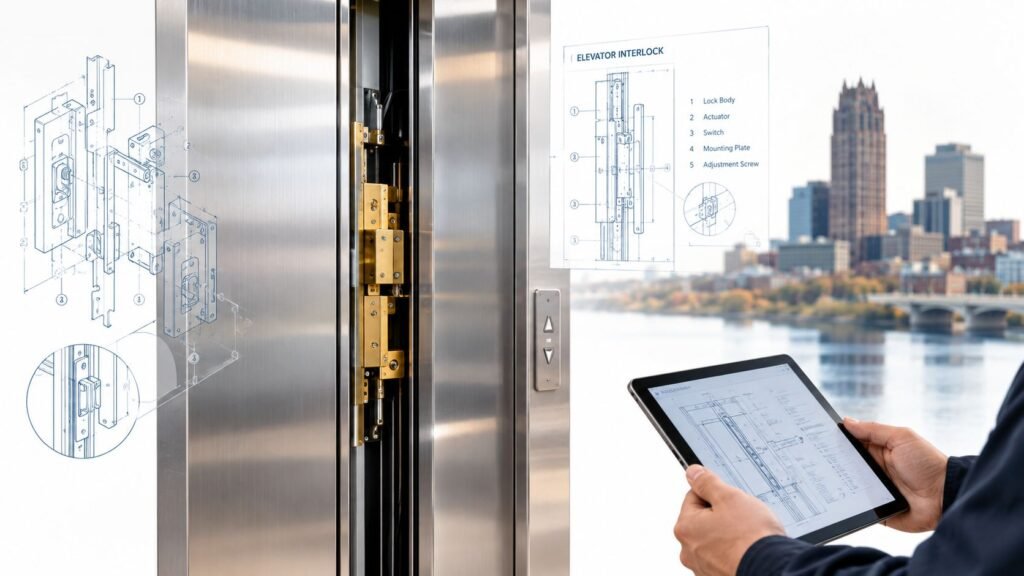
You’re usually not reading about elevator door locks on a calm day. More often, a tenant called because the car won’t run, a school custodian found an out-of-service tag, or a building manager in Flint is trying to figure out whether this is a quick adjustment or the start of a larger modernization problem. That’s why this topic matters.
For elevator companies in Flint, the smarter place to start is the lock chain on the doors. If that system isn’t right, the elevator shouldn’t move. That’s not a nuisance. That’s the machine doing its safety job.
Why Elevator Door Locks Matter More Than You Think
A stuck door always feels like a door problem. Many times it’s really a life-safety problem showing itself through the door first.
Take a common Flint scenario. An older apartment building has a hall door that needs a hard shove before it fully latches. Residents think the door is just fussy. Maintenance tapes a note near the call button and hopes the service company can get there tomorrow. Then the elevator faults out at night because the controller never gets a clean “locked” signal. Now you have stranded riders, an upset owner, and a system that did exactly what it was supposed to do. It refused to run with a doubtful door lock.
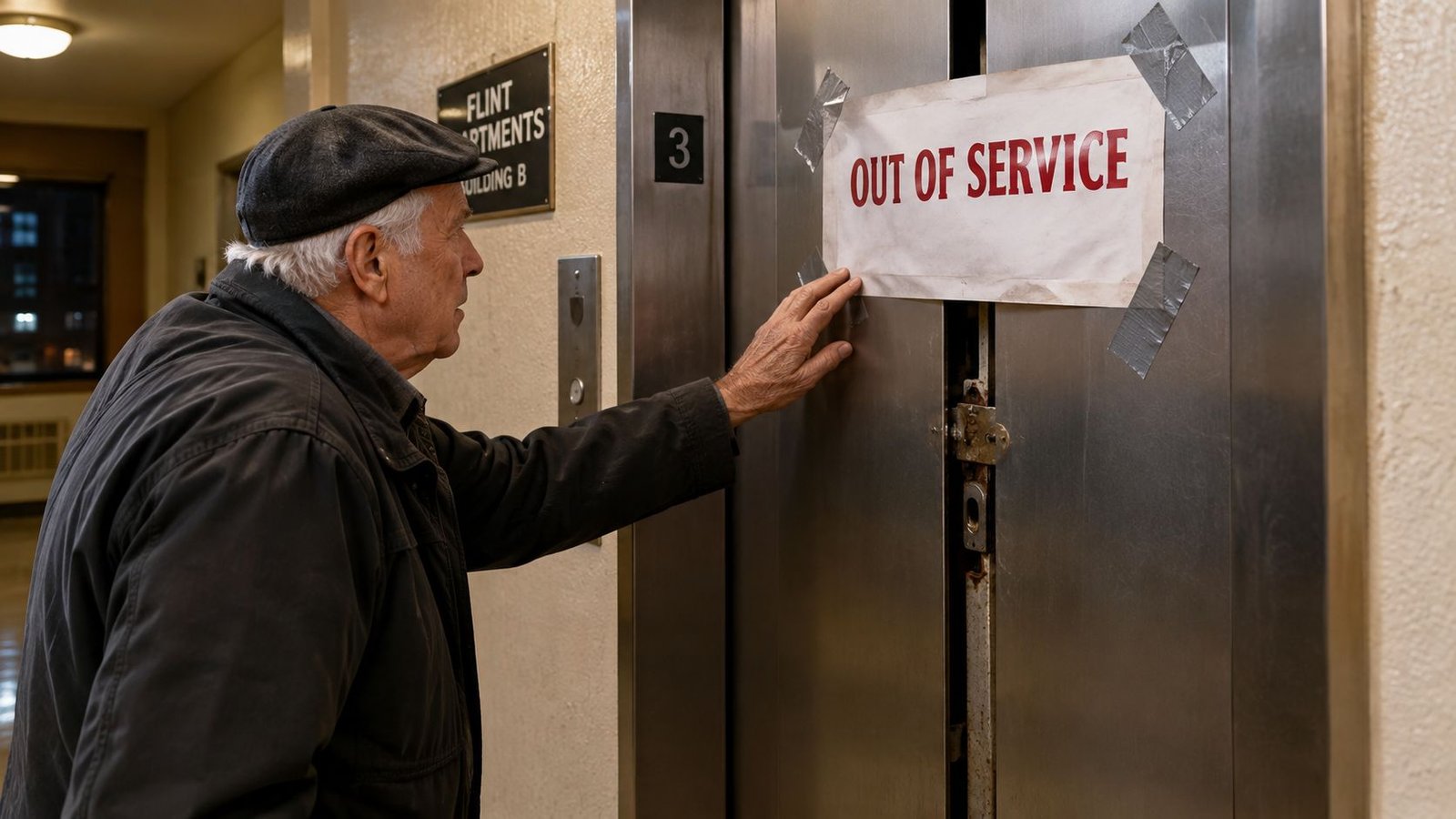
The plain-English version
Think of the door lock like a seatbelt and brake check combined. Before the elevator moves, the system has to prove the landing door is closed and locked. If it can’t prove that, motion stops.
That protects three groups at once:
- Riders: They aren’t exposed to an open hoistway or a car moving with an unsecured entrance.
- Building staff: They’re less likely to face a bad situation created by a hidden bypass or worn lock.
- Owners and managers: They avoid the kind of failure that turns into a violation, a shutdown, or a liability headache.
Why Flint owners need to take this seriously
In Flint, elevator work sits inside a formal state permit structure. Before installation or alteration of an elevating device, a licensed elevator contractor must submit a permit application, and plans and specifications must be filed in triplicate before a permit is issued. Michigan’s fee schedule also lists a $100 nonrefundable application fee for all devices and a $300 base permit fee for covered devices under the state rules in Michigan’s elevating device permit document.
That tells you something important. Elevator work isn’t treated like casual handyman repair. It’s regulated construction tied to paperwork, approvals, and inspection.
A door lock isn’t small just because it fits in your hand. In the elevator safety chain, it decides whether the entire machine is allowed to move.
Across Michigan cities such as Flint, Detroit, Lansing, Ann Arbor, Grand Rapids, Kalamazoo, Holland, Saginaw, and Traverse City, this is one of the first things experienced mechanics check when a car acts intermittent. That’s also why facility managers looking at elevator Companies in Flint should ask not just “Can you fix it?” but “How do you verify the lock chain and document the result?”
How Elevator Door Locks Work Inside the System
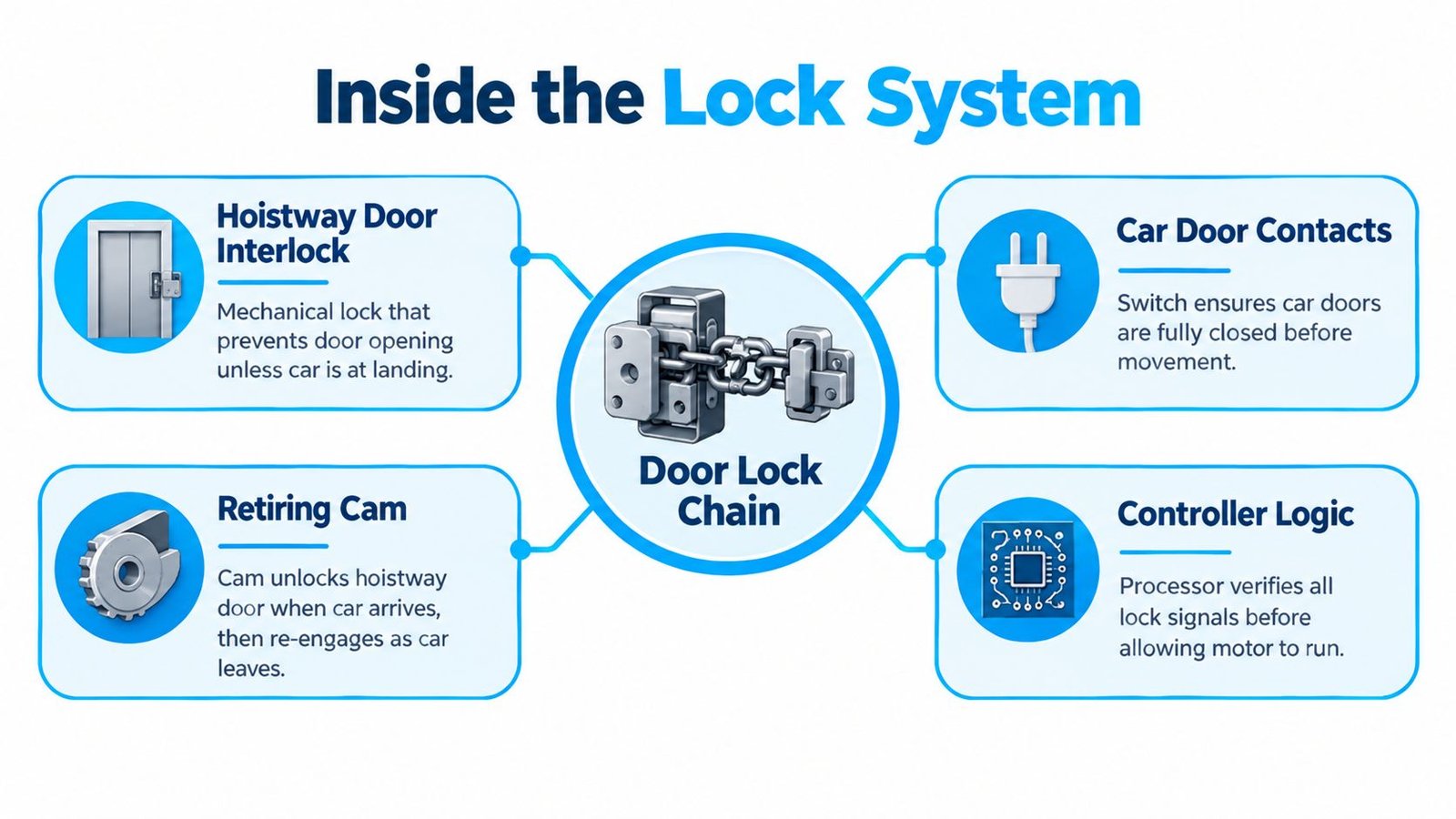
Most confusion starts because people use one word, “lock,” for several parts working together. The system is really a chain.
Start with a household analogy
A front door at home can be closed but not deadbolted. An elevator door is similar, except the machine cares about that difference every trip.
There’s the hoistway door interlock at the landing. There are car door contacts that confirm the car door is shut. On many systems, a retiring cam or pickup arrangement releases the landing door only when the car is properly at that floor. Then the controller logic reads those signals and decides whether motion is allowed.
Practical rule: Closed is not the same as locked. Elevators need proof of both.
What happens in order
Here’s the sequence in plain language:
- The car arrives at a floor and levels.
- The unlocking device lets the landing door be opened.
- Riders enter or leave.
- The doors close.
- The interlock engages and the contacts prove that engagement.
- The controller sees a complete safety chain and only then allows the motor to run.
If any link in that chain looks doubtful, the controller should hold the elevator still.
Why there are multiple checks
Older building owners sometimes ask why there are so many switches and contacts around one doorway. The answer is simple. A single moving door creates a lot of ways to fail.
A roller can wear. A door panel can sag. A pickup can bend. Contacts can get dirty or pitted. Wiring can loosen. Redundancy helps the system catch those faults before movement starts.
Where monitoring fits
Newer systems may add Door Lock Monitoring, which watches for conditions that suggest a lock isn’t behaving correctly even if the elevator might otherwise seem ready to run. That extra watchfulness is useful on aging equipment because intermittent lock problems often show up before a total shutdown.
For managers and homeowners, the mental model is this:
- Mechanical parts do the physical locking.
- Electrical contacts report whether locking happened.
- The controller decides whether the car may move.
- Monitoring adds another layer that looks for unsafe or suspicious behavior.
Once you understand that chain, service conversations make more sense. “Interlock issue,” “dirty gate switch,” “pickup adjustment,” and “DLM fault” stop sounding like random jargon and start sounding like points along the same safety path.
Types of Elevator Door Locks and Where Each Fits
Flint’s building stock is mixed. You can see older freight entrances, mid-century passenger elevators, residential lifts, and newer accessibility equipment all within the same service territory. That’s why lock hardware isn’t one-size-fits-all.
The main lock families
Some systems rely heavily on mechanical interlocks. These are common where a physical latch has to hold a landing door closed and prevent it from opening unless the car is at the landing.
Others use assemblies where electrical proving contacts play a bigger role in telling the controller the door is secure. Then there are newer or retrofitted setups with monitoring-enhanced lock assemblies, often chosen when owners want cleaner code compliance and easier diagnostics.
Elevator Door Lock Types Compared
| Lock Type | Typical Use | Key Advantage | Service Consideration |
|---|---|---|---|
| Mechanical interlock | Passenger and freight entrances with swing or sliding hoistway doors | Strong physical locking at the landing | Needs alignment, wear checks, and clean engagement surfaces |
| Electrical contact assembly | Car doors and systems where closed-and-locked status must be proved to the controller | Gives the controller a clear run/no-run signal | Sensitive to dirt, pitting, loose wiring, and intermittent faults |
| Monitoring-enabled lock assembly | Modernized passenger systems and retrofits needing stronger diagnostics | Helps identify questionable lock behavior before motion is allowed | Must match controller logic and be tested as part of the full safety chain |
| Compact lock setups for lifts and small devices | Residential elevators, wheelchair lifts, and similar specialty devices | Fits tighter spaces and simpler door arrangements | Service access can be tighter, and documentation still matters |
Matching the lock to the building
An old freight entrance in Flint or Saginaw may favor a rugged, serviceable mechanical setup because the environment is dusty, the doors are heavy, and the owner wants parts that a qualified independent contractor can maintain without proprietary traps.
A newer passenger unit in Ann Arbor or Grand Rapids may be a better fit for a modernization path that includes monitoring and updated controller logic, especially when recurring lock faults keep interrupting service.
For homeowners and property managers, the best question isn’t “What’s the fanciest lock?” It’s “What can be safely maintained, clearly documented, and sensibly repaired over the next several years?” That’s where non-proprietary thinking helps. It keeps future service options open instead of tying a building to a narrow parts path.
Code and Safety Requirements You Must Meet in Michigan
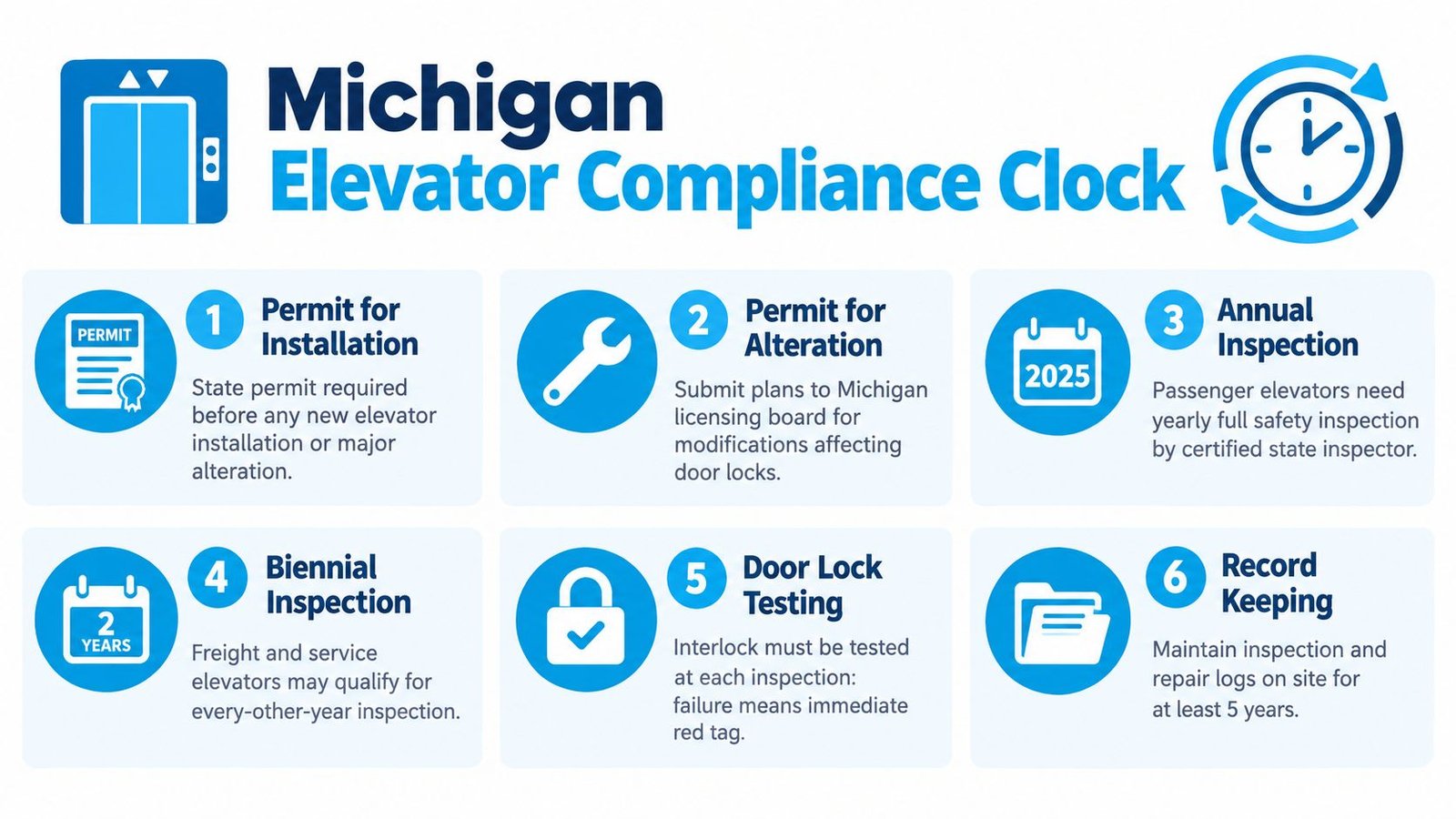
The easiest way to understand elevator code is to stop thinking of it as a book on a shelf and start thinking of it as a set of clocks. Permits have a clock. Inspections have a clock. Maintenance has a clock. Documentation has a clock too.
The permit clock
If you’re installing or altering an elevator, Michigan requires the work to move through a formal permit process. That matters in Flint because lock work can cross from maintenance into alteration depending on what’s being changed. Owners who treat major safety hardware changes like ordinary repair often get surprised when paperwork catches up with them.
The inspection clock
Michigan requires inspection intervals based on device type. Passenger and freight elevators, along with most other public-use vertical transportation devices, must be inspected at least every 12 months, while dumbwaiters, stairway chairlifts, one-person elevators, platform lifts, and power sidewalk elevators are inspected at least every 24 months under the Michigan elevator code rule set.
A related Michigan rule also supports annual inspection language across many device types, including passenger elevators, freight elevators, limited-use and limited-application devices, escalators, moving walks, belt manlifts, and special elevating devices in the Michigan inspection frequency rule.
If you manage mixed equipment at one property, you’re tracking different calendars at the same time.
The maintenance clock
Michigan also requires ongoing maintenance for power elevators at least once every 90 days, with certain devices such as dumbwaiters, one-person elevators, and some platform lifts allowed on a 180-day interval. The state also requires a written on-site record of maintenance, repairs, replacements, inspection, callbacks, and testing under Michigan maintenance rule R 408.7025.
That written log matters more than many owners realize. If an inspector asks for the record and it isn’t there, “we’ve been taking care of it” won’t carry much weight.
Detroit adds a tighter clock
Detroit buildings have another layer. Detroit code requires power elevators, escalators, and moving walks to be inspected and serviced at least every 30 days, while other covered equipment is generally serviced at least quarterly, and firefighting emergency operation must be tested every 30 days under the Detroit elevator maintenance and inspection ordinance.
That matters for owners with properties in both Flint and Detroit. One maintenance approach won’t fit both cities.
If your lock system is healthy but your records are sloppy, you still have a compliance problem.
For owners who want a plain-language look at monitoring upgrades tied to this topic, door lock monitoring details from Crane’s DLM page give a useful reference point for what these systems are intended to watch.
Common Door Lock Failure Modes and Warning Signs
Door lock problems rarely start as dramatic failures. They usually start as patterns.
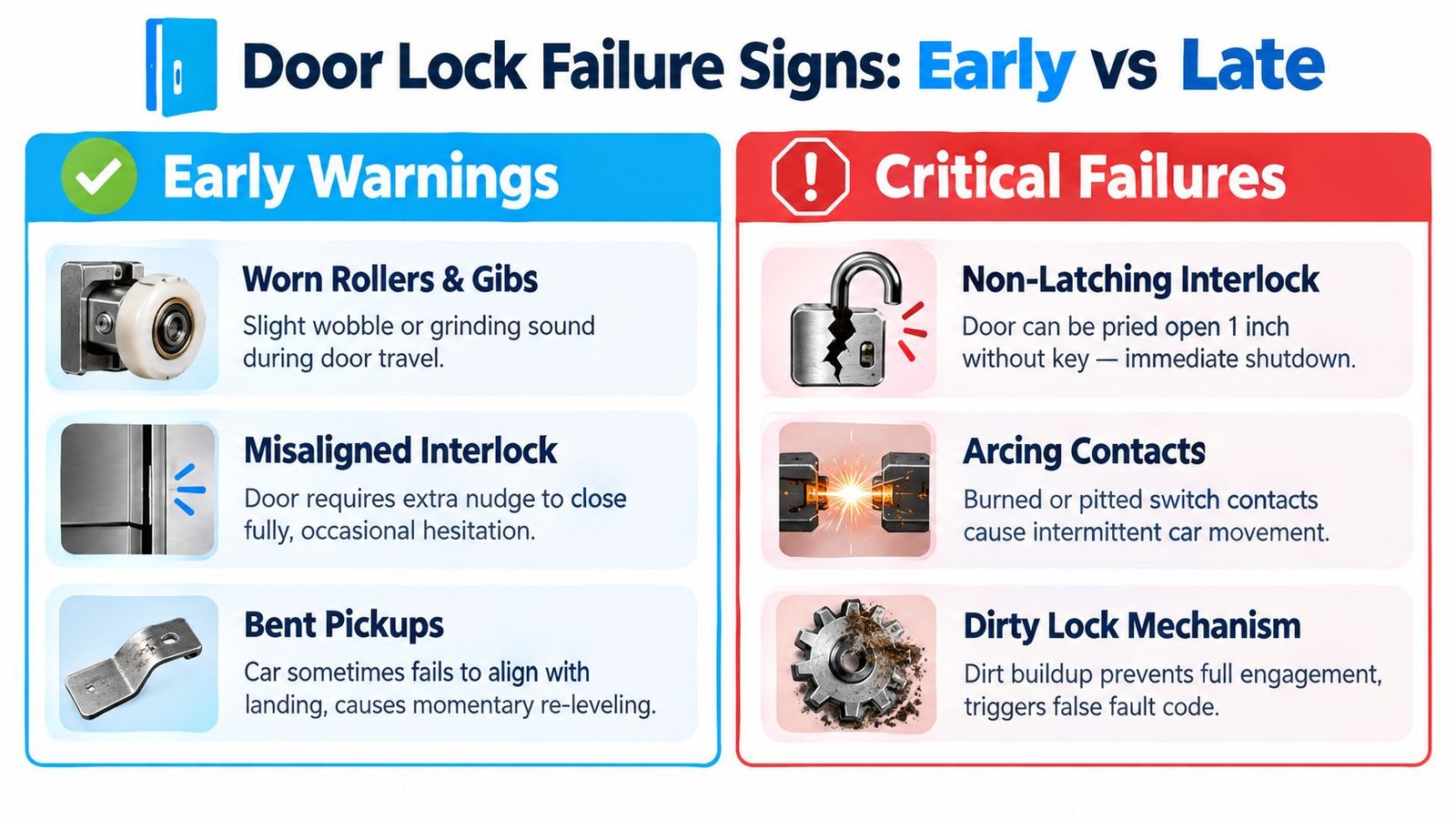
Early warnings people overlook
A hall door that bounces before it settles. A car that re-levels more than usual. A floor where riders say, “It works most of the time, just not always.” Those aren’t personality quirks. They’re clues.
Common early-stage causes include:
- Worn rollers or gibs: The door doesn’t track cleanly, so the lock and contacts don’t line up the same way every trip.
- Minor interlock misalignment: The lock wants to engage, but the hardware meets at a poor angle.
- Bent pickups or retiring cam issues: The locking and relocking sequence gets inconsistent at one or more landings.
- Dirty contacts: The lock may physically engage, but the controller gets a weak or unreliable electrical proof.
Critical signs that need immediate service
Some symptoms move out of the “watch it” category and straight into “shut it down and call.”
- Door can be moved when it shouldn’t be: If a landing door seems loose, forced, or questionable, stop guessing.
- Intermittent no-run faults after doors close: That often points to proving trouble in the lock chain.
- Visible sparking or burned contact smell: Arcing contacts can create false signals and erratic operation.
- Evidence of bypassing: Jumpered circuits and quick-fix workarounds create serious liability because they defeat the very safety chain meant to stop unsafe motion.
A lock fault that comes and goes is often more dangerous to manage than one that fails hard, because people are tempted to keep using the elevator.
What riders hear and what mechanics think
When riders say the doors “sound rough,” mechanics think about rollers, tracks, and engagement depth. When staff say the car “hesitates before leaving,” mechanics think about whether the controller is waiting for a reliable lock signal. When a homeowner says, “It only acts up on rainy days,” that can point toward contamination, swelling, or contact trouble in an entrance area.
Many searches for elevator Companies in Flint go sideways. Owners call for a repair quote on the operator, but the root problem is really in the interlock chain. Good diagnosis starts with the symptom, then follows the signal path, instead of replacing parts at random.
Inspection Maintenance and Troubleshooting That Prevents Downtime
The best lock repair is the one you never need because the wear got caught early.
What a real lock check includes
A proper maintenance visit on door equipment should do more than spray lubricant and cycle the car. It should include observation, cleaning, adjustment, and recordkeeping.
A thorough routine usually includes:
- Cleaning the mechanism: Dust, old grease, and lint change how small moving parts engage.
- Checking alignment: The lock, keeper, rollers, and door panels need to meet correctly.
- Verifying contact operation: The proving side has to make and break cleanly.
- Inspecting engagement depth: A shallow or marginal latch may work until vibration exposes the weakness.
- Testing monitoring functions where installed: Added monitoring hardware has to be checked, not assumed.
- Documenting the work: Michigan requires on-site records, so the service itself and the paper trail belong together.
What building staff can safely observe
Facility teams can help without touching safety circuits.
They can note whether a specific landing is worse than others, whether faults happen at certain times, whether doors reverse or bounce, and whether the problem appears after deliveries, weather shifts, or heavy use. They can also keep a simple written log for the service mechanic so patterns don’t get lost between callbacks.
They should not open lock covers, defeat interlocks, or try to “help” a door latch with improvised adjustments.
When it becomes contractor work
Once the problem crosses into safety-circuit adjustment, hardware replacement, or anything that may count as alteration, it belongs with a licensed elevator contractor. In Michigan, that line matters because both code compliance and permit obligations can follow the scope of the work.
For owners comparing service options, Crane Elevator’s elevator door maintenance page outlines one non-proprietary approach that includes preventive maintenance, clean-down work, and door-focused service for many equipment types. In practical terms, that kind of program is useful for buildings in Flint, Fenton, Burton, Davison, Grand Blanc, and nearby communities that need both routine care and emergency response.
Good maintenance is repetitive by design. The lock that worked last quarter still needs to prove itself this quarter.
When to Repair Replace or Modernize Your Door Lock System
This decision gets easier when you stop framing it as “old versus new” and start framing it as isolated wear versus system-level unreliability.
Repair makes sense when the fault is local
If the issue is one worn interlock, a damaged contact block, a bent pickup, or contamination at a single landing, a targeted repair is often the right move. The same goes for residential elevators and wheelchair lifts where the rest of the system is still serviceable and parts are available.
Replacement fits repeated hardware trouble
If the same entrance keeps failing, if the doors are sagging, or if multiple lock components are worn together, replacing the lock assembly or related operator hardware may save more downtime than repeated patching.
That’s especially true in older commercial buildings where every callback disrupts tenants, staff, or deliveries.
Modernization belongs in the bigger conversation
Sometimes the lock problem is the visible end of a larger control problem. Older proprietary logic, scarce parts, or recurring monitoring faults can push the decision toward modernization. Michigan’s projected 2026 rule set continues to require maintenance control programs and available on-site documentation at inspection time, which points owners toward stronger recordkeeping and more disciplined preventive maintenance under the Michigan code material discussed in this school modernization and rule-pressure summary.
That same summary also points to modernization economics. A Michigan school project was awarded at a base of $634,826 with up to $100,000 in added re-drilling options, which shows how quickly full modernization costs can rise in the real world. For many owners, that’s the reason to explore phased upgrades and component-level planning before the elevator forces a crisis decision.
If you’re weighing serviceable non-proprietary options across Flint, Detroit, Lansing, Ann Arbor, Grand Rapids, Kalamazoo, Toledo, or Perrysburg, Michigan elevator company coverage and service details provide a starting point for comparing repair, replacement, and modernization paths.
Michigan’s larger service hubs also justify regional support strategies. Detroit has about 645,705 residents, Grand Rapids about 200,117, Lansing about 114,336, and Ann Arbor about 122,925 according to Michigan city population figures. In practice, that’s why many owners need a contractor that can support multiple properties and equipment types across the state, not just one town.
If your elevator doors are bouncing, faulting, or giving inconsistent lock signals, Crane Elevator Company handles maintenance, repair, inspection support, and non-proprietary modernization for elevators, lifts, and dumbwaiters across Michigan and Ohio. If you want a second opinion on whether a lock issue needs adjustment, replacement, or a larger upgrade path, visit Crane Elevator Company.