
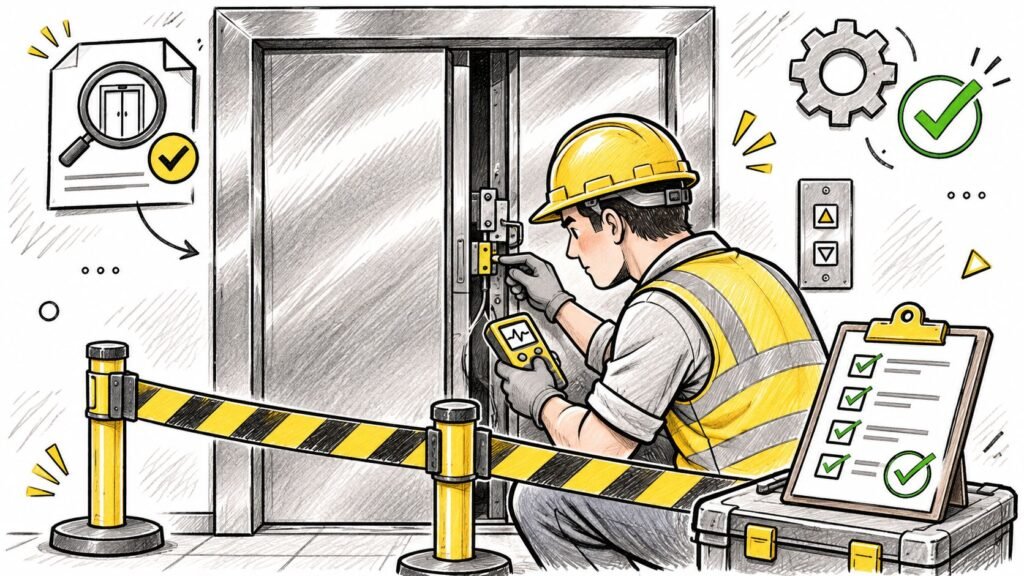
A single passenger elevator in a busy city can make hundreds of trips before lunch. The New York City Department of Buildings estimated approximately 37 million elevator trips per day citywide, about 500 daily trips per elevator. At that pace, a door that sticks, reopens for nobody, or fails to prove locked is both a safety device and a traffic device.
Facility managers often hear "door fault" and picture a worn operator. Sometimes dirty tracks and tired rollers are the whole story. Often the fault sits in an interlock, a gate contact, a detector, or a monitoring circuit the controller is right to refuse. Elevator door repair services start with that split, then follow the same fault into a Michigan code complaint and a written correction.
Door Faults That Need Repair, Not a Reset
A 1943 U.S. National Bureau of Standards circular reported that approximately 75% of elevator accidents originated at hoistway openings. Nearly everything that protects that opening runs through one device, the landing-door interlock. The first question on any door complaint is whether the opening is protected. A noisy motor is a separate, smaller problem.
On a well-run route, the contact side of the door system gets scheduled attention. A common practice is to check the position where interlock contacts engage at least once a year and inspect the contacts themselves at least twice a year. Door-closer arms get checked for excessive lost motion, and a qualified mechanic corrects what is found. Hangers and tracks get cleaned and lubricated on a regular cycle, and rollers, gibs, and sills stay on that list. None of that work replaces the lock circuit.
Triage before anyone orders parts
| Symptom | Usual cause | Do not | Next step |
|---|---|---|---|
| Slow or noisy closing | Worn rollers, dirty track, gibs, or closer-arm lost motion | Replace the operator on the first visit | Clean and inspect hangers, tracks, gibs, and closer arms |
| Door reopens with no passenger | Safety edge or detector out of adjustment | Switch the detector off to stop nuisance trips | Test reopening on both panels of center-opening doors |
| Car tries to run with a door open | Interlock, gate contact, or monitoring circuit fault | Jumper, short, or keep resetting the fault | Remove the car from service and barricade the opening |
| One landing will not lock | Misadjusted vane, worn interlock, or sill trouble | Bypass that landing's lock | Prove interlock engagement at every landing |
| Nuisance door-lock monitoring trips | Controller correctly seeing an unproven lock | Defeat or overlay-bypass the monitor | Repair the circuit and keep the fault log |
| Inspector write-up or entrapment | Violation, not only rider comfort | Wait for the next annual inspection | Start a documented correction and permit if the work is an alteration |
Read the row before you buy a door operator. Slow closing is often hangers, tracks, gibs, or lost motion in the closer arm, all mechanical wear a cleaning and adjustment can reach. A door that reopens with an empty lobby usually means a safety edge or detector out of alignment, and these elevator door sensor notes cover how those devices get knocked out of position. A car that tries to run with a door open is a safety call. It belongs on the out-of-service list, not the callback list.
What to do on site
- Take the car out of group operation and post the opening.
- Barricade the landing so nobody treats an open hoistway as a hallway.
- Don't jumper door contacts, and don't ask a vendor to "just reset it."
- Capture the fault history before anyone clears the log.
- Call a licensed contractor for interlock testing and lockout work.
OSHA documented a fatal incident in which an elevator maintenance worker disengaged an outer-door safety interlock, propped the door open, entered the pit, and was struck when the elevator activated. The controller wiring exists so the car cannot run unless both the hoistway door and the car door are properly closed. A jumper, or a fresh reset every morning, hides the exact fault that circuit was built to catch.
After the repair, the record should show closing behavior, sensor trips, clutch or vane engagement, and a run at every landing the car serves. In Michigan, that log is the paperwork a documented correction is built on, and it is what separates a fixed door from a fault that comes back on the next inspection. The cheapest part swap is the wrong buy when it masks a contact circuit.
What a Code Enforcement Complaint Actually Is
A tenant work order says the doors feel slow. A code enforcement complaint is a report to the enforcing authority that an elevator may violate the adopted code. Those are different documents, even when they describe the same car.
Michigan's Elevator Section, inside the Bureau of Construction Codes, administers and enforces the Michigan Elevator Code. Its work includes inspections of installations and alterations, annual safety inspections, accident investigations, violation investigations, and checks that required permits were issued. A complaint can come from a rider, an employee, a fire department after an entrapment, or an inspector who already wrote a correction order.
Think of it once, in building language. The complaint is the incident report. The violation is the specific failed rule. The correction is the permitted repair plus the reinspection that closes the file.
The section isn't emergency rescue, and it doesn't replace rollers or operators. Michigan's current elevator rules, effective June 27, 2023, point door operators, car-door or gate contacts, interlocks, and landing entrances at the 2016 ASME A17.1 Safety Code for Elevators and Escalators. Platform lifts and stairway chairlifts follow the 2017 ASME A18.1 standard. Those devices aren't ordinary building-door hardware.
Owners in Ann Arbor, Lansing, Kalamazoo, and Saginaw answer to the same section as owners in Detroit. The path from notice to a closed correction, and the state fees that sit beside the repair, comes next.
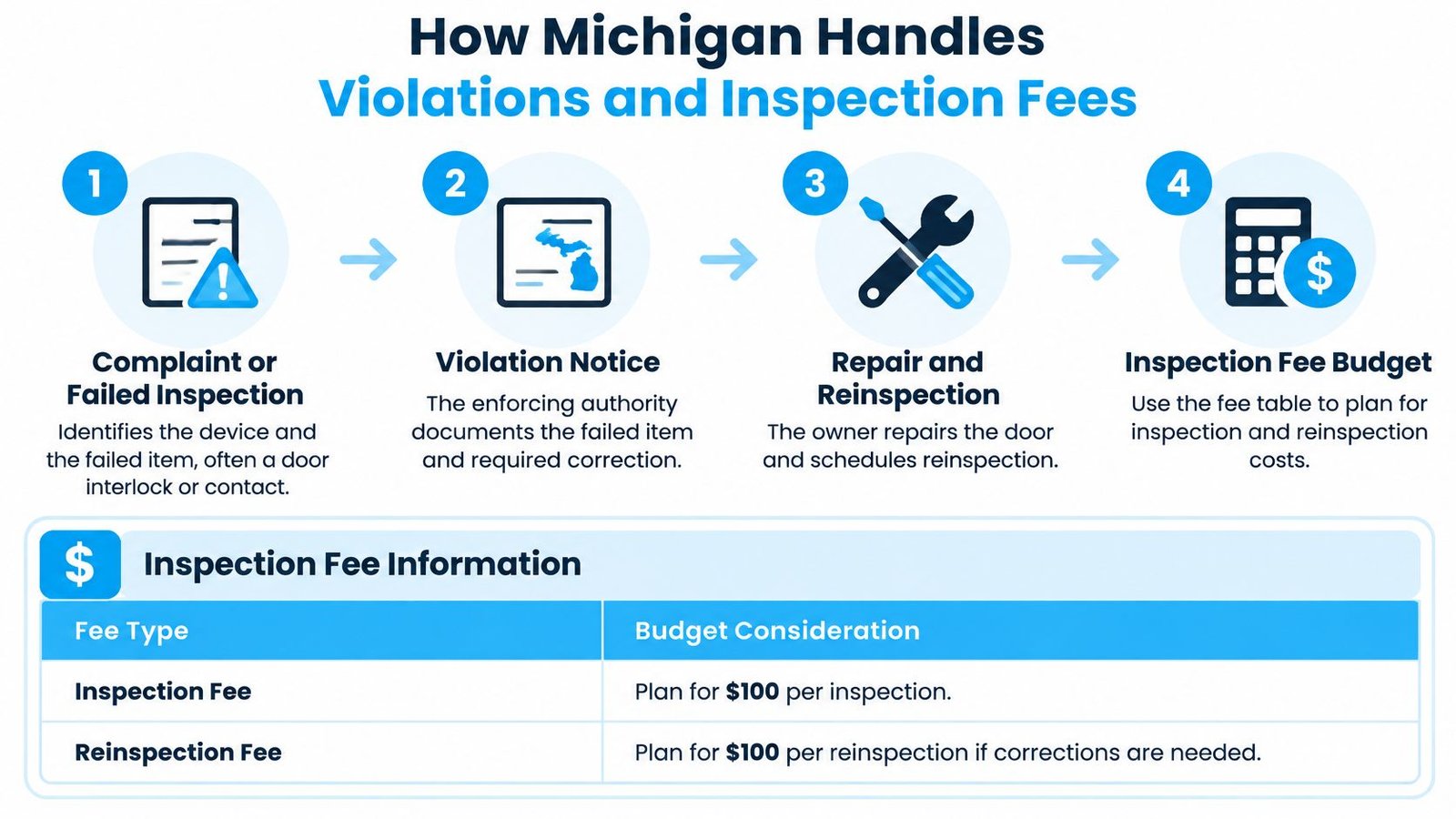
How Michigan Handles Violations and Inspection Fees
The checklist below is the work order side of a door correction. The numbered path is how the file moves.
- A complaint or a failed inspection names the device and the failed item, often a door interlock, a contact, or a missing test.
- The owner gets a correction expectation. Silence from the front desk isn't clearance.
- If the fix is an alteration, such as adding door-lock monitoring, a licensed contractor pulls a permit before the work starts. Our note on Michigan 2028 elevator compliance is the place to sort that question for an existing car.
- The repair is made and written down.
- An inspector accepts the work, and the complaint closes.
State inspection charges are a planning number, not a contractor invoice. Michigan's published elevator inspection-fee schedule lists a $125 fee for biennial inspections of devices complying with the specified rule, and a $175 fee for annual and biennial inspections of other devices. When a general inspector performs the inspection, the schedule adds $25 for each hoistway opening or each floor traveled.
Budget the state fee apart from the repair
| Inspection | Base state fee | Add-on | What changes the bill |
|---|---|---|---|
| Biennial inspection of devices complying with the specified rule | $125 | $25 per hoistway opening or floor traveled when a general inspector performs it | Device category and opening count |
| Annual or biennial inspection of other devices | $175 | $25 per hoistway opening or floor traveled when a general inspector performs it | Device category and floors traveled |
| Door-related alteration such as lock monitoring | Permit charge outside the inspection schedule | Not included in the biennial base fee | Whether the work is an alteration requiring a permit |
A six-opening car changes the state fee even when the door repair touches one landing. Those dollars sit apart from repair labor, permits, and after-hours calls. We manage violation resolutions and perform mandated CAT 1, CAT 3, and CAT 5 safety inspections, so the paperwork can ride with the door correction instead of waiting for a second mobilization.
The short video below shows why a landing door that looks closed can still be the failed item on a write-up.
Read the correction order for device type and opening count before you approve any quote. A freight car and a passenger car don't share the same base fee, and the opening count is what multiplies the add-on.
Door Repairs That Close a Real Violation
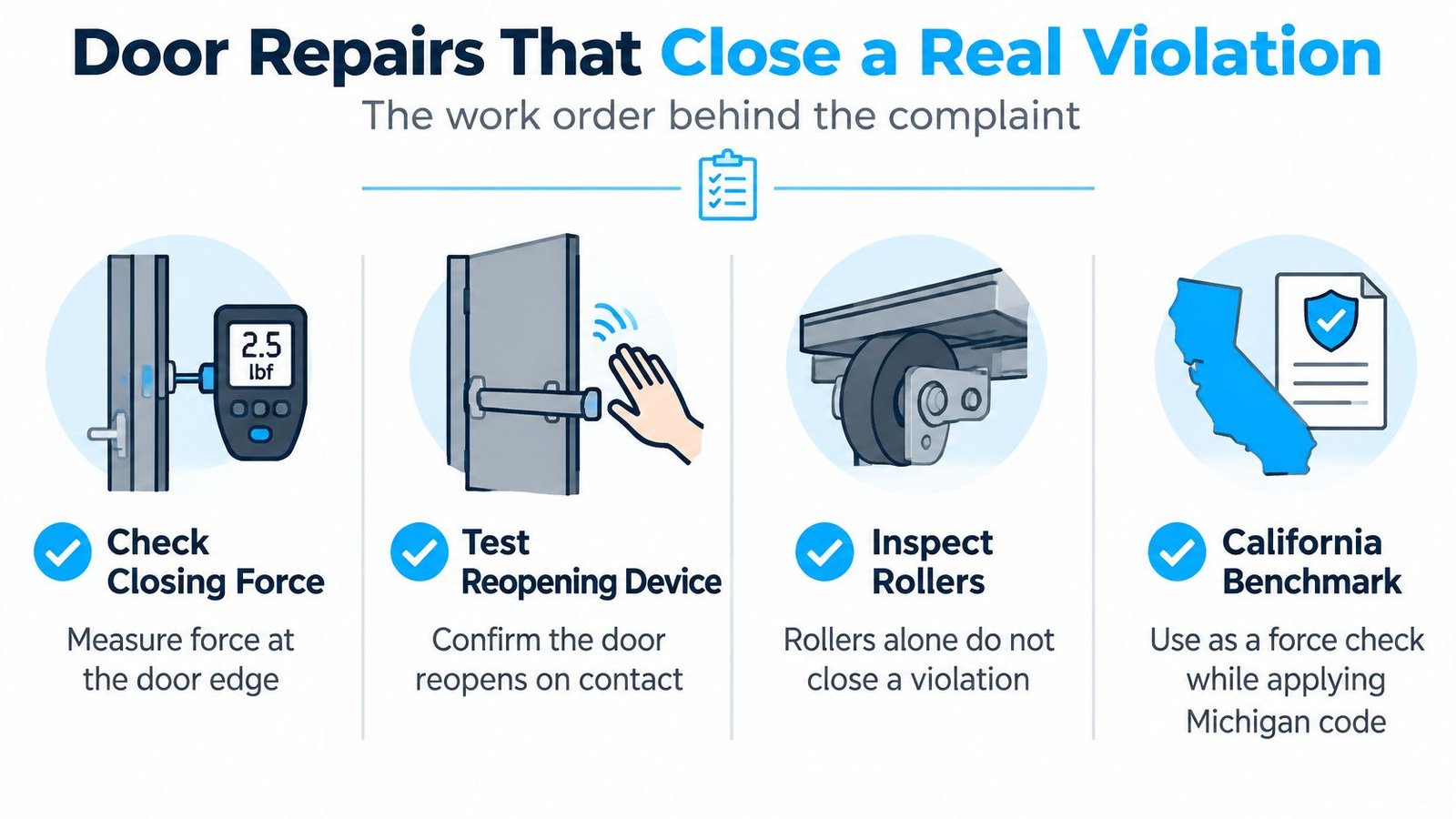
A work order that reads "replaced door operator" can still leave the violation open. A sound door repair checks closing force and the reopening device, not only the rollers. Rollers quiet a slam and still leave a pinch hazard or an unsecured landing.
California safety regulations give a useful force check while Michigan work is judged under the adopted ASME code. The force required to prevent a power-operated hoistway or car door from closing must not exceed 30 lbf (133 N), measured at the leading edge while the door is between one-third and two-thirds of its travel. An obstruction must stop and reopen the car door and the adjacent hoistway door. On center-opening doors, either panel must activate the device.
Excessive force usually traces to dirty or misaligned tracks, worn rollers, a bad operator adjustment, or a worn coupler. The operator sits last on the suspect list, not first. A triage order that saves money: clean and align the tracks, test each panel's detector edge, prove the interlocks, then condemn the operator only after the cheaper causes pass inspection.
What the inspector expects on the sheet
| Check | Benchmark | What to record |
|---|---|---|
| Closing force | 30 lbf (133 N) maximum at the leading edge between one-third and two-thirds of travel (California benchmark) | Measured force and door position |
| Reopening device | Stops and reopens car and adjacent hoistway door on obstruction; both panels on center-opening doors | Sensor activation test on each panel |
| Door-lock monitoring | Normal runs only when car and hoistway interlocks are proven locked | Lock check at every landing and the permit if monitoring was added |
Door-lock monitoring is the high-consequence item. Illinois safety-rule materials explain that ASME A17.1 door-lock monitoring is meant to stop normal operation when car and hoistway interlocks aren't proven locked. A shorted monitor, a misadjusted vane, or a cracked contact can nuisance-trip the car, and bypassing the circuit so the car "just runs" is the opposite of a correction. Our elevator door lock work treats that circuit as safety equipment, not as a nuisance relay.
Practical rule: If the controller sees an unlocked door, repair the proof. Don't teach the controller to ignore it.
We specialize in door-lock monitoring along with tank and power-unit replacement, cable work, jack replacement, hydraulic packing, and motor, sheave, and machine replacement. The same shop maintains and modernizes passenger, service, freight, and residential elevators, wheelchair lifts, material lifts, and dumbwaiters. A full non-proprietary modernization can include door equipment and fixture replacements, so a later contractor isn't locked to one brand.
Close the file with force and sensor notes, a lock check at every landing, and the permit if monitoring was added. Those records are what turn a fault on a write-up into a documented correction. Without them, the violation stays open even when the doors look smooth.
Door Timing Myths That Fail Inspections
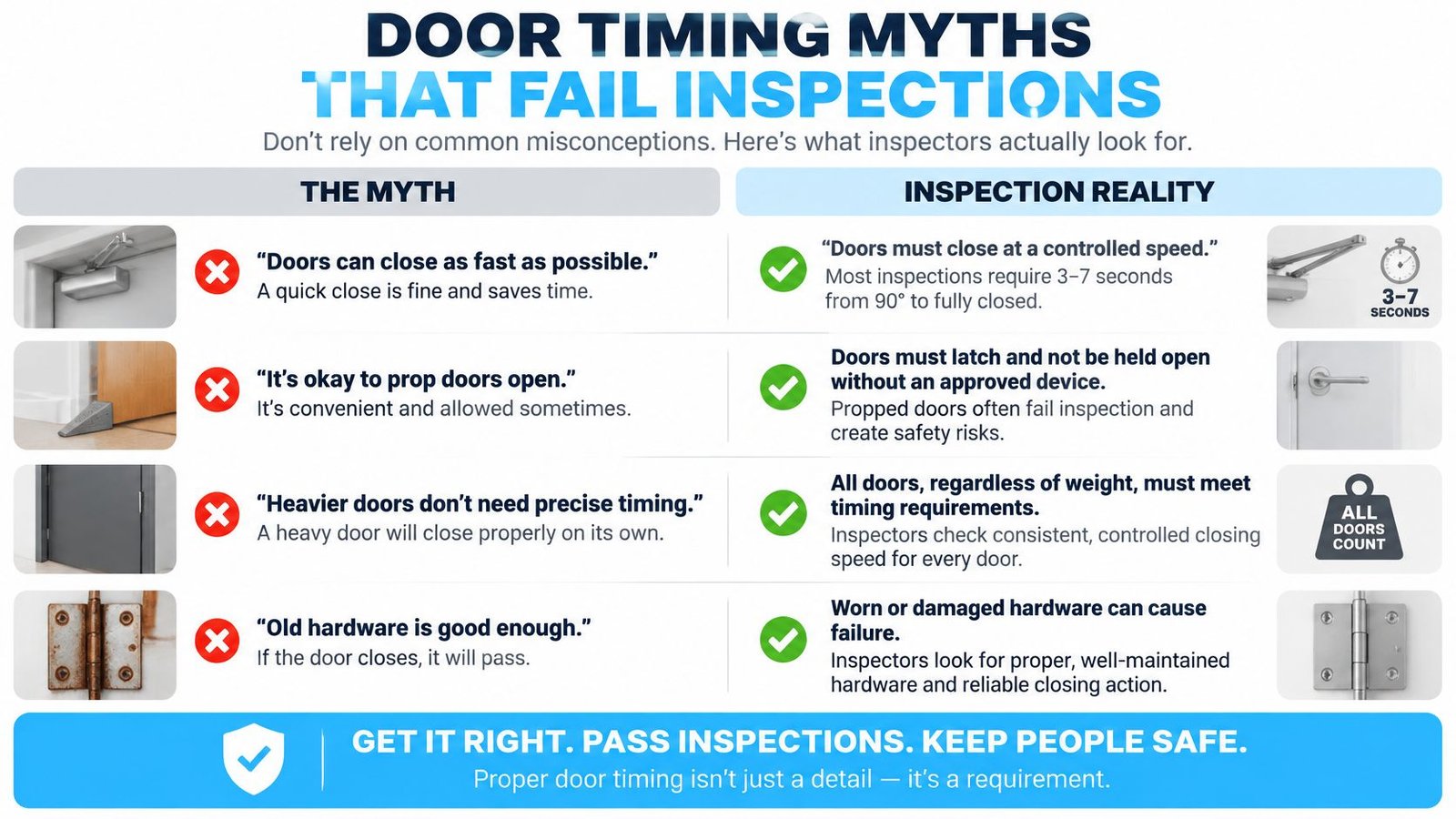
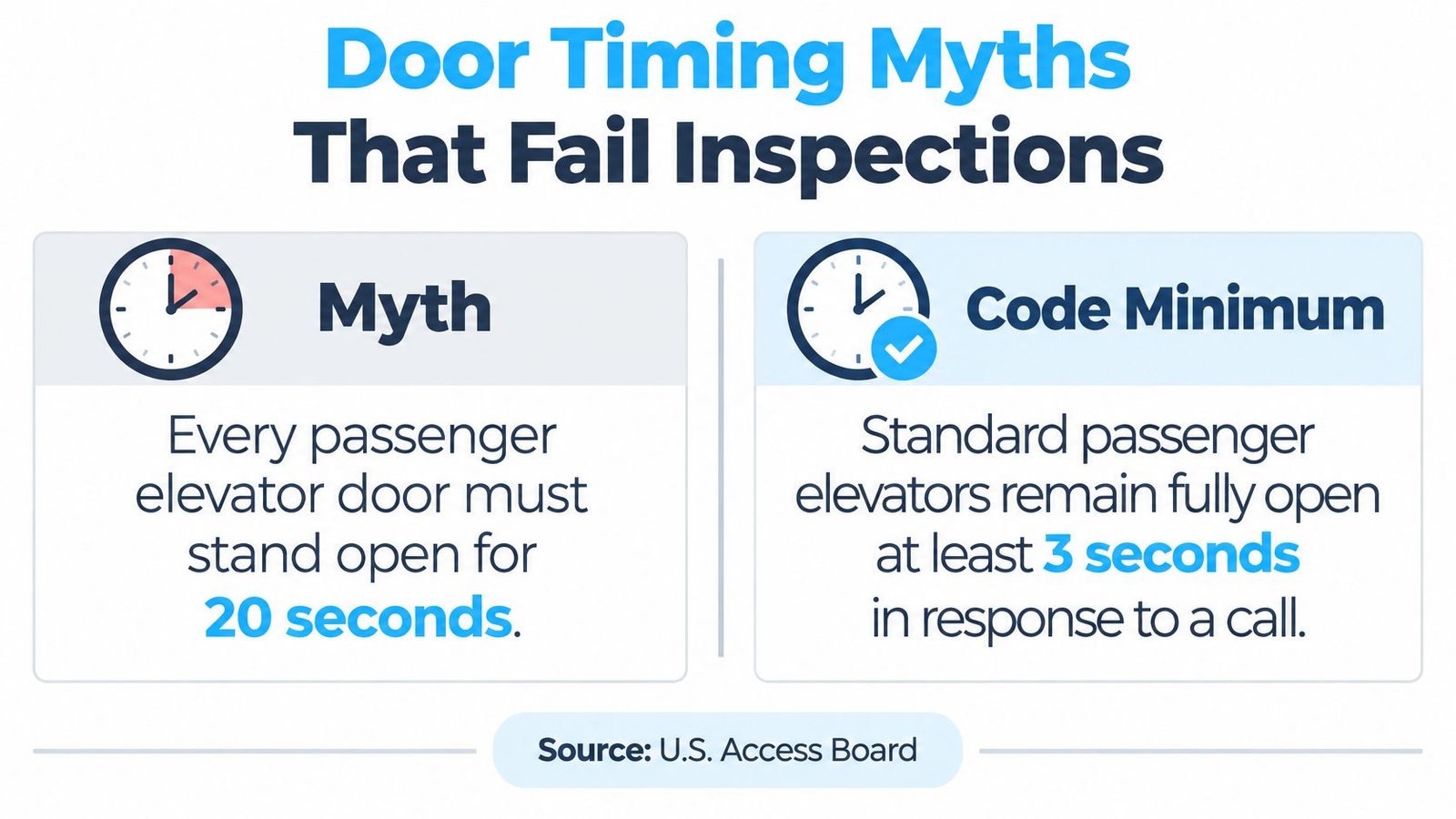
The idea that every passenger elevator door must stand open for 20 seconds is wrong, and it fails inspections in both directions. The U.S. Access Board states that standard passenger elevators must remain fully open for at least 3 seconds in response to a car call. The pre-closing interval also depends on the distance from the hall call button to the door, using a 1.5-foot-per-second calculation with a 5-second minimum.
The 20-second figure applies to certain reopening-device effectiveness requirements and to LULA, private-residence, and platform-lift doors. It isn't a universal office-tower setting. A healthcare manager or an HOA board that orders a blanket 20-second dwell slows traffic without meeting the rule that applies. A manager who cuts dwell to save energy or to hurry a security door can strand a person using a wheelchair.
Pair the stopwatch with the rest of the entrance
- Signals: Audible and visual cues have to match the dwell you just changed.
- Detector coverage: A shorter open time is useless if the reopening device misses one panel.
- Traffic: A school between classes and a clinic at shift change aren't the same lobby.
- Classification: A conventional passenger car, a LULA, and a platform lift don't share one timer.
Confirm Michigan and local requirements before anyone changes the controller. A compliant three-second minimum can still be too short for the people who use that building.
These moves make a complaint worse, not smaller.
- Defeating door-lock monitoring so the car accepts an unproven lock.
- Propping a hoistway door to "finish one more trip."
- Clearing faults with no log of what the controller saw.
- Tightening closing force until the door no longer reopens on a cart or a hand.
Observe and repair the safety circuit. Don't override it.
Ask the technician which code edition applies to that car before you accept any timing change. A stopwatch photo isn't a code citation.
Crane Elevator Door Services Across Michigan
A door fault is not automatically an operator replacement. The first pass is triage: prove the interlock, check the contacts, then test the reopening device before anyone prices a bigger swap. A worn roller can imitate a lock fault, while a defeated safety circuit can imitate a fix. Crane Elevator Company is a family-owned contractor with more than 25 years in the trade, and door problems land in the same shop as the rest of the car.
The service list that covers a door complaint includes:
- Preventive maintenance on all makes, with machine-room, pit, and car-top clean-downs, plus COP and PI bulb replacement.
- Emergency repairs when a landing is open to the hoistway or the car will move with a door unsecured.
- Safety testing, including Category 1, 3, and 5 tests, fire-service testing, emergency-phone testing, and generator testing.
- Door-lock monitoring, safety-edge and detector replacement, and the rollers, gibs, hangers, and operators those devices depend on.
- Hydraulic packing, jack, cable, tank, and power-unit work, plus motor, sheave, and machine work.
- Violation resolution and full non-proprietary modernization, including door equipment and fixtures any qualified company can later service.
The same crews work passenger, freight, service, and residential elevators, wheelchair lifts, material lifts, dumbwaiters, and home elevators. A residential division handles home elevators and wheelchair lifts when the device is not a commercial cab.
Coverage runs through Detroit, Ann Arbor, Lansing, Flint, Kalamazoo, and Birmingham and surrounding communities. A building in any Michigan town faces the same adopted code and the same correction path as a tower in Detroit. Distance changes the drive time. It does not change the interlock, the permit, or the reinspection.
Schedule the Repair Before the Correction Order
If any landing can open onto the hoistway, or the car will move with a door unsecured, take the unit out of service and call emergency field service now. Don't hold that car for a next-week slot. If the issue is noise, slow doors, or a written violation that doesn't show an open hoistway, book a diagnostic that covers interlocks, detectors, and a written correction plan.
Field operations answer 24 hours a day, 7 days a week, 365 days a year. The office is staffed 8:00 a.m. to 4:30 p.m., Monday through Friday. The service number is 1-734-726-4247. A second opinion on an existing door problem, including a visit and a solution plan, is offered at no extra charge. Compliance and violation quotes are free and without obligation.
Ask three things on that call.
- Does this device need a permit for the repair you are proposing?
- Is door-lock monitoring already required because the work is an alteration?
- What will the inspector want to see, in writing, to close the complaint?
Preventive maintenance follows once the violation is closed. It doesn't substitute for taking an unsafe door out of service tonight. A clean pit and a fresh bulb won't hold a landing door that the controller has already flagged as unsecured.
Crane Elevator Company diagnoses door operators, interlocks, detectors, and lock-monitoring faults, then documents the correction an inspector can close. If your car is nuisance-tripping, written up, or trying to run with a door unsecured, start with a no-obligation compliance quote instead of another reset. Visit Crane Elevator Company to schedule the diagnostic or the emergency call.