| Feature | What It Does | Why It’s Important (Compliance & Safety) |
|---|---|---|
| Two-Way Voice Communication | Allows a trapped passenger to speak with a 24/7 monitoring station. | The absolute foundation of compliance. It’s the primary way to confirm an entrapment, assess the situation, and reassure the passenger. |
| Battery Backup | Provides at least 4 hours of standby power and 1 hour of talk time during a power outage. | Critical for reliability. Power failures are a common cause of entrapments, so the phone must work when it’s needed most. |
| Automatic Location ID | Automatically transmits the building address and elevator car number to the operator. | Ensures responders are sent to the correct location without relying on a panicked or disoriented passenger for information. |
| Visual Call Indicators | Lights or on-screen messages confirm when a call is placed and when it has been answered. | ADA compliance essential. It provides crucial feedback for passengers who are deaf or hard of hearing. |
| On-Site Voice Message | Plays a pre-recorded message identifying the elevator’s location for authorized personnel on-site. | Helps maintenance or rescue teams quickly identify the correct elevator machine room or controller upon arrival. |
| Two-Way Texting/Video | (Advanced) Allows text or video communication between the passenger and the monitoring center. | A major step beyond basic ADA rules. It offers a richer, more effective communication method for hearing-impaired individuals. |
| Health Monitoring | (Advanced) The system automatically tests itself and reports faults to the service provider. | Proactively identifies issues like a dead battery or failed phone line before an emergency happens, preventing compliance lapses. |
While the mandatory features ensure a basic level of safety, the advanced options represent the future of elevator communication. They offer a far more robust, accessible, and proactive approach to passenger safety and property management.
Upgrading From Landlines to Modern Phone Solutions
For decades, the simple copper landline was the undisputed king of elevator emergency phones. Everyone knew it, every inspector understood it, and it just worked. That era is over. The telecom world is aggressively pulling the plug on these old POTS (Plain Old Telephone Service) lines, leaving a lot of property managers in a tough spot with compliance.
Relying on a POTS line today is like trying to navigate downtown with a folded paper map. It’s not just outdated; it’s becoming dangerously unreliable and shockingly expensive. Carriers aren’t maintaining the copper network anymore, so when a line goes down, repairs are slow—if they happen at all. This is a massive liability. A dead phone line means you’re in violation of ASME A17.1, opening the door to fines and serious legal risk.
This isn’t just some minor tech update. It’s a fundamental shift that demands a new game plan for your building’s life-safety systems.
The Problem With Sticking to Old Technology
Hanging on to a legacy copper landline for your elevator phone is no longer a safe or sustainable choice. The costs are spiraling as the infrastructure decays and the technicians who know how to fix it disappear. It’s not uncommon to see monthly bills for a single POTS line climb past $100, and that price is only going one way: up.
But the real issue isn’t the money—it’s the reliability. These old lines are failing. They’re prone to static, interference, and complete outages, especially when the weather gets rough. A call full of static that the monitoring station can’t understand is just as useless as no call at all. It simply doesn’t meet the code’s crystal-clear requirement for two-way communication.
Sticking with an obsolete POTS line is a gamble on your tenants’ safety. The question is no longer if the line will fail, but when—and whether it will happen during a critical emergency.
Exploring Modern, Compliant Alternatives
The good news is that modern tech offers far better, more reliable, and cost-effective solutions that are fully compliant with elevator code. The two best options on the table are cellular (GSM) systems and Voice over IP (VoIP) solutions. Both deliver a rock-solid connection and protect your building from the inevitable shutdown of the old copper network.
Let’s break down how these two powerful alternatives stack up.
| Technology Solution | How It Works | Key Advantages |
|---|---|---|
| Cellular (GSM) | It uses a dedicated cellular device, kind of like a built-in cell phone for your elevator, to connect to a mobile network. | Extremely reliable, especially with strong network coverage. It doesn't rely on your building's power or internet, making it perfect for outages. |
| VoIP | This solution sends the emergency call over your building's existing internet connection. | Typically the most budget-friendly option, assuming you already have a robust, reliable internet setup. It integrates easily with other building systems. |
Both of these systems are designed from the ground up to meet the mandatory four-hour battery backup requirement, so they’ll keep working even if the lights go out.
Making the Right Choice for Your Building
So, which one is right for you? The answer depends entirely on your building’s unique setup.
- Assess Your Internet Reliability: If your building has a business-grade, bulletproof internet connection that already has its own battery backup, a VoIP system can be a fantastic, cost-effective choice. But if your internet gets spotty or drops during a storm, you can’t trust it for a life-safety device.
- Check Cellular Signal Strength: Before you go with a cellular option, you must have a qualified technician test the signal strength in your elevator machine room. They need to confirm that major carriers have a strong enough signal to guarantee a clear, immediate connection every single time.
- Consider a Hybrid Approach: For the ultimate in reliability, some of the newest systems offer what’s called a “Multi-Path” or hybrid solution. They use VoIP as the main line but are smart enough to automatically switch over to a cellular network the second the internet goes down. This gives you the best of both worlds and ensures that emergency line is always, always on.
Moving on from an old landline isn’t just about ticking a compliance box. It’s a smart investment in safety, reliability, and long-term cost savings. By embracing modern solutions, you’re not just meeting today’s elevator emergency phone requirements—you’re getting your property ready for what comes next.
How to Implement Proper Testing and Record Keeping
Getting a compliant elevator phone installed is just the first step. Think of it like a fire alarm—it’s only valuable if you know for a fact it will work when you need it most. That’s where ongoing testing and meticulous records come in. They’re the only way to ensure your system stays reliable, satisfies inspectors, and, most importantly, protects your tenants.
Skipping the testing and documentation is a fast track to a compliance violation. An inspector won’t just look for a phone; they’ll ask to see your logbook to verify it’s actually being maintained. A clean, consistent log is your best defense and proof that you’re on top of your building’s life-safety equipment.
Establishing Your Testing Cadence
To stay compliant, you have to follow a consistent schedule. The ASME code spells out exactly how often to run these checks, and the whole point is to catch small problems before they become big ones. This isn’t optional—it needs to be a fixed part of your building’s maintenance plan.
Your schedule boils down to two key checks:
- Monthly Tests: These are quick functional checks. Does the phone connect? Is the audio clear?
- Annual Tests: This is a much deeper dive, including a full check of the battery backup system and all its related functions.
This regular rhythm ensures that any issue, whether it’s a dying battery or a fuzzy connection, gets caught and fixed right away.
How to Conduct and Log a Phone Test
Running the test itself is pretty simple, but you have to be thorough. While your elevator service company usually handles the more technical annual inspection, your on-site team can easily manage the monthly checks. It’s a straightforward process, but it has to be done right every single time.
Here’s a step-by-step guide for a typical monthly test:
- Notify the Monitoring Station: Before you push anything, call your 24/7 monitoring service on a separate line. Tell them you’re about to run a test on a specific elevator (e.g., “Building 1, Car 2”).
- Activate the Emergency Phone: Get in the cab and press and hold the emergency call button until the call goes through.
- Verify Two-Way Communication: Talk to the operator. Make sure you can hear them clearly and they can hear you without any static, echoes, or weird distortion.
- Confirm Location Identification: Ask the operator to read back the exact building address and elevator car number they see on their end. This is critical. It has to be 100% accurate.
- Document Everything: In your dedicated logbook, write down the date, time, elevator car number, and the name of the person who ran the test. Add a note that communication was clear and the location ID was verified.
Your logbook is your proof of due diligence. Keep it in the elevator machine room where an inspector can easily find it. Every entry should be clean, legible, and complete—it tells a story of proactive safety management.
This whole process is so important because it weeds out the noise. Industry data shows that a staggering 95% to 98% of elevator emergency phone calls are false alarms, tying up critical resources. Proactive testing ensures that when a real emergency hits, the system works flawlessly. It’s why companies like Crane always include emergency phone checks in their maintenance programs, ensuring every Detroit high-rise and Ann Arbor commercial building stays compliant. You can find more data on the hands-free emergency elevator phone market on intelmarketresearch.com.
Choosing the Right Elevator Service Partner in Michigan
Trying to decode elevator emergency phone requirements on your own is a tough job. The right service partner is way more than just a repair company—they’re a strategic asset, your guide through Michigan’s specific and often complex regulatory landscape. A real expert doesn’t just react to problems; they keep you ahead of them.
When you’re choosing this partner, look past the price tag. You need a team with a deep, practical understanding of local codes, from Detroit to Ann Arbor, and a genuine commitment to proactive solutions. Their know-how can be the one thing standing between smooth compliance and a stack of unexpected violation notices and fines from state inspectors.
The Power of Non-Proprietary Equipment
One of the biggest long-term decisions you’ll face is the choice between proprietary and non-proprietary equipment. Proprietary systems, which are common with the large original equipment manufacturers (OEMs), essentially lock you into using their service for all parts and maintenance. This is a classic vendor-lock-in scenario, and it almost always leads to inflated costs and painfully slow response times when you need help.
On the other hand, non-proprietary solutions are the open-source heroes of the elevator world. They use parts and software that are universally available, which means any qualified elevator contractor can work on them. This freedom creates healthy competition, keeps pricing fair, and gives you the flexibility to pick a partner based on great service, not because you’re stuck in a contract. Insisting on non-proprietary hardware for your emergency phone system is one of the smartest investments you can make for your property.
What to Look for in a Michigan Elevator Contractor
Finding a dependable partner in Michigan really comes down to two things: proactive service and constant availability. An elevator entrapment can happen at any hour of any day, so you need a provider who operates 24/7/365 and has a responsive field team ready to go at a moment’s notice. A great partner doesn’t just fix what’s broken—they prevent it from breaking in the first place.
Here’s a quick checklist of what a top-tier service provider should bring to the table:
- Proactive Maintenance Programs: Their plans should include regular, fully documented testing of emergency phones, batteries, and communication lines as a standard part of the service, not an add-on.
- Local Code Mastery: They must have a rock-solid, demonstrable knowledge of Michigan-specific amendments to the ASME A17.1 code. Ask them about it directly.
- Comprehensive Service: The best partner can handle it all—from routine tests and clearing violations to complete modernizations of your entire communication system.
This simple graphic breaks down the essential steps your service partner should be following during every single phone test.
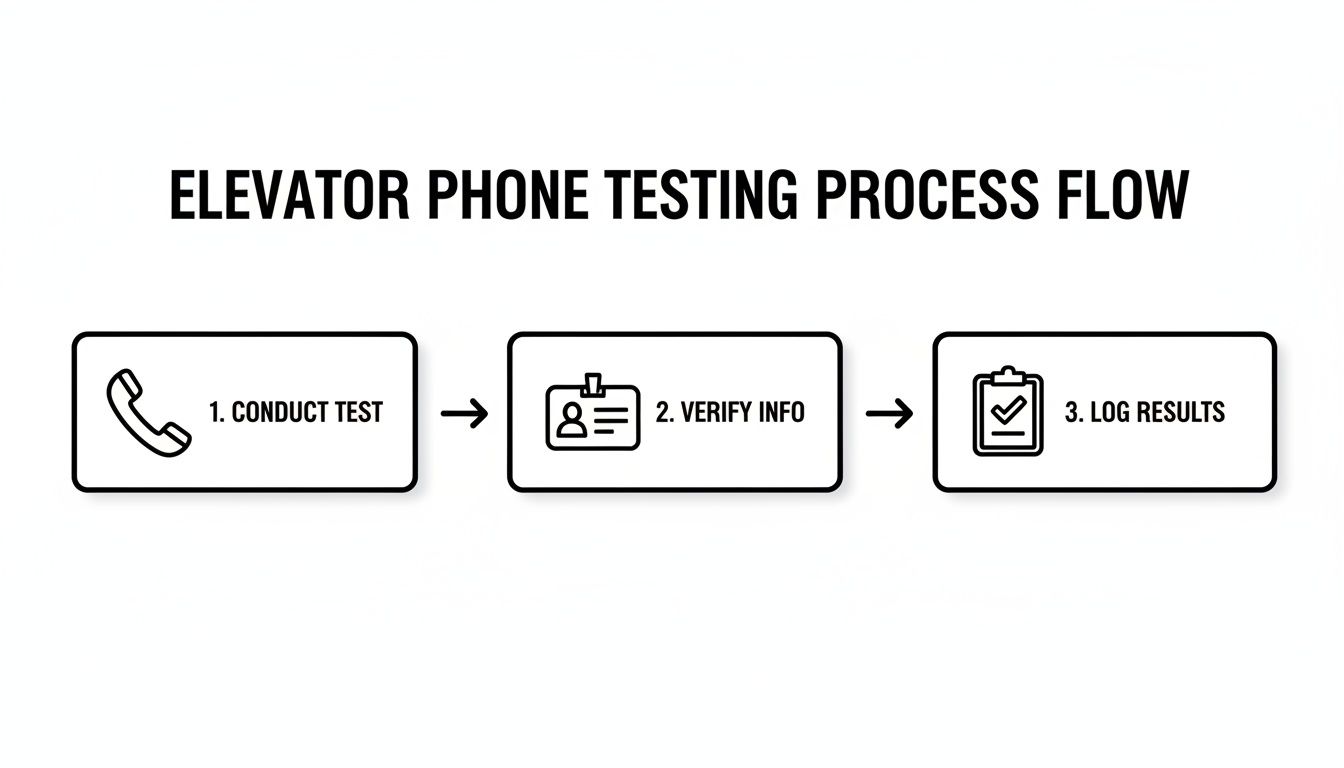
The process isn’t just about making sure the phone dials out. It’s about verifying the location data is correct and keeping meticulous records that will stand up to an inspector’s scrutiny.
If you’re managing properties in Washtenaw County, getting familiar with the available elevator services in Ypsilanti and Ann Arbor is a great first step to finding a local partner who meets these high standards. At the end of the day, the right contractor is a true partner, working with you to make sure your elevators are always safe, compliant, and reliable.
Frequently Asked Questions
Even when you think you’ve got the rules down, specific questions always seem to pop up for property managers. Let’s tackle some of the most common ones I hear about elevator emergency phones, with some quick, straightforward answers to help you stay compliant.
Can an Elevator Phone Dial 911 Directly?
Absolutely not. In fact, it’s explicitly forbidden. The ASME A17.1 code is crystal clear on this: the phone must connect to a pre-programmed, 24/7 professional monitoring service. This isn’t just red tape; it’s a critical safety requirement.
Think about it. A dedicated monitoring service has staff trained specifically for elevator entrapments. The moment a call comes in, they get automatic location data and can coordinate with your building staff and first responders far more effectively than a general 911 dispatcher ever could. It’s all about getting the right help, to the right place, as fast as possible.
Are Phones Required in Freight or Service Elevators?
Yes, almost always. If a freight elevator is part of a required accessible route between floors—meaning people use it to get from one level to another—it has to meet the same requirements as a passenger elevator. That includes a fully compliant, two-way communication system.
The logic is simple: anyone who could possibly be in that elevator, whether it’s a tenant, an employee, or a contractor, must have access to a reliable lifeline. It’s always safest to assume your service elevator needs to be compliant unless you have a specific, written exemption from your local authority.
The core principle of elevator safety codes is universal access to help. It doesn’t matter if the cab is designed for passengers or pallets; if a person can be inside, they must have a way to call for assistance.
How Long Does the Battery Backup Need to Last?
The national standard here is non-negotiable. Your elevator phone’s battery backup must be powerful enough to provide at least four hours of standby power during a complete building-wide outage.
But that’s not all. Within that four-hour window, the system also has to support a minimum of one full hour of active, two-way conversation. This ensures that even during a prolonged power failure, a trapped passenger has more than enough time to communicate with the monitoring station.
Do Older Buildings Have to Meet New Codes?
For life-safety systems? You bet they do. While some “grandfather clauses” might exist for minor structural things, equipment like elevator emergency phones is almost never exempt. When codes get updated—like the current push to phase out old copper POTS lines—buildings are typically required to upgrade to the new standard within a specific timeframe.
An inspector won’t give you a pass just because your building has been around for a while. Keeping your emergency phone system up to current code is essential for keeping your certificate of operation and, more importantly, keeping your tenants safe.
Trying to keep up with all these requirements can feel like a full-time job. An expert partner makes it easier. Crane Elevator Company specializes in making sure your elevators are safe, reliable, and fully compliant with all of Michigan’s latest codes. Whether you need to modernize an outdated phone system or just handle your routine testing and maintenance, our team is ready to help. Get a free quote and make sure your building is protected.
Pingback: A Property Owner’s Guide to Ann Arbor Elevator Maintenance - Crane Elevator Company - Detroit, Ann Arbor, Lansing, Flint