
When you're planning an accessibility upgrade, the first question is almost always about the bottom line. It's the most practical starting point for making a smart decision for your home or commercial property. The total cost to install a wheelchair lift isn't just one number—it's a mix of the equipment itself, the labor to install it, and any site-specific work needed to get it done right.
A good analogy is buying a car. The base model has one price, but adding all-wheel drive, a premium sound system, or a sunroof changes the final sticker price. In the same way, a simple outdoor porch lift has a very different cost profile than a multi-level interior lift that requires significant construction.
This guide will give you a clear, practical jumping-off point for your budget. We'll break down the numbers, explore what drives them up or down, and give you the context to feel confident when you start getting quotes.
Decoding Your Wheelchair Lift Installation Cost
So, what's the real number? The final cost depends heavily on your specific needs, but you can generally expect a residential project to fall between $15,000 and $25,000. Commercial installations almost always start higher. This price range typically covers the lift itself, professional labor, and the site modifications needed for a safe, code-compliant setup.
Estimated Wheelchair Lift Installation Cost At-a-Glance
To give you a baseline, we've put together some general industry figures. This table provides a quick summary of what you can expect for a complete, professional installation from a reputable provider like Crane Elevator Company.
| Project Type | Typical Low-End Cost | Typical High-End Cost | Average Cost (Professional Installation) |
|---|---|---|---|
| Residential Lift | $15,000 | $25,000 | $20,000 |
| Commercial Lift | $20,000 | $40,000+ | $30,000 |
These numbers account for more than just the lift; they include all the essential accessibility services needed for a system that's both safe and reliable.
Key Takeaway: Think of these figures as a starting point. Your final cost will hinge on the lift type, how high it needs to travel, your site's conditions, and local code requirements.
In the sections that follow, we'll dive deeper into exactly what drives these costs up or down.
What Drives the Cost of a Wheelchair Lift?
Ever wonder why one wheelchair lift installation seems to cost so much more than another? The final price tag isn't just one number—it's a collection of specific choices, components, and on-site requirements that shape your project.
Think of it like building a custom home versus buying a tract house. The blueprint, materials, and unique features you choose are what determine the final cost. It's the same with a wheelchair lift installation cost; every decision directly impacts the project's complexity and your total investment.
This chart gives you a quick snapshot of how costs can diverge between residential and commercial projects.
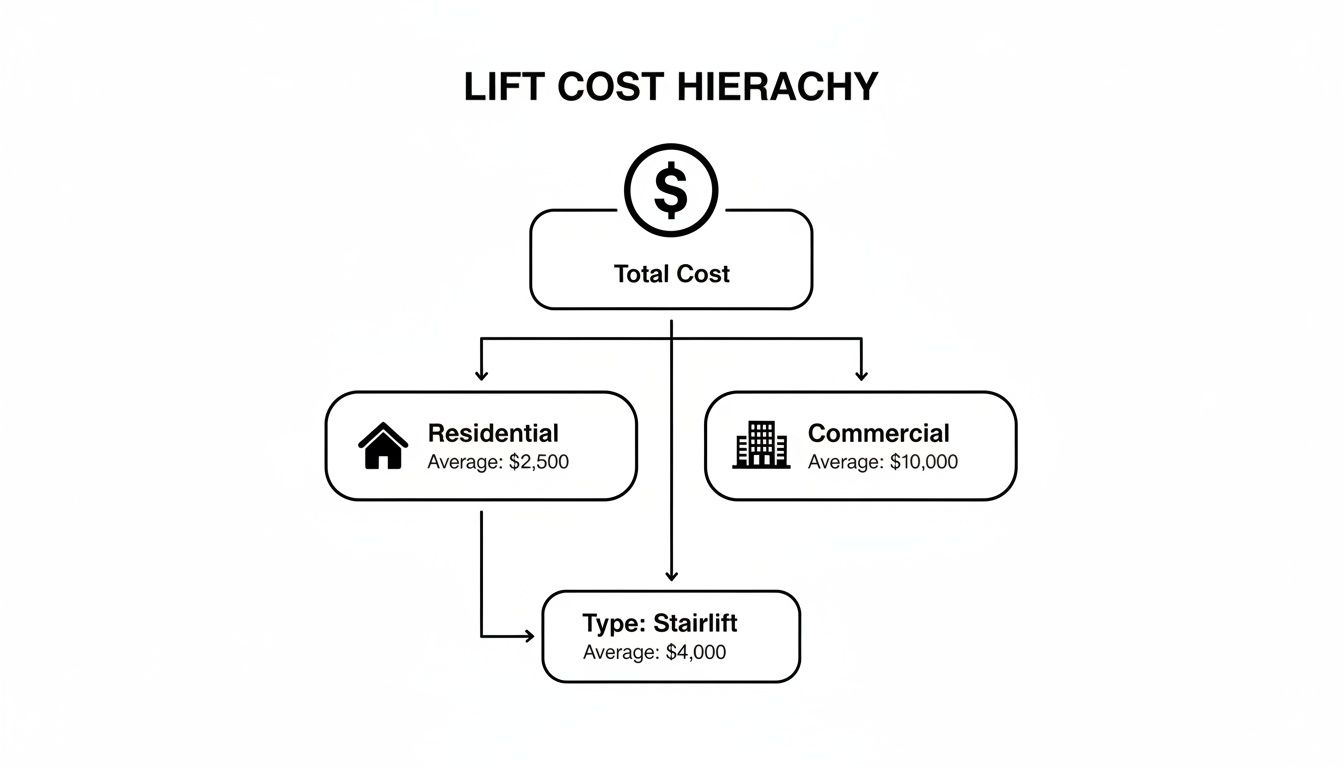
As you can see, while both paths deliver accessibility, commercial projects almost always involve stricter code requirements and higher-capacity equipment, which naturally pushes the cost up.
Your First Big Decision: Lift Type
The first, and most significant, choice you'll make is the type of lift. This decision sets the baseline for your equipment cost, and the two main options serve very different needs.
-
Vertical Platform Lifts (VPLs): You'll often hear these called "porch lifts" because they function like a mini-elevator. They're the go-to solution for getting over stairs, decks, or any change in elevation. A simple outdoor VPL covering a few feet will be on the lower end of the cost spectrum. But a multi-story indoor VPL that requires a custom-built hoistway? That's a much bigger, more expensive project.
-
Inclined Platform Lifts (IPLs): These lifts use a platform that travels along a rail system mounted next to an existing staircase. They are a fantastic solution for navigating multiple floors in a building that just doesn't have the space for a VPL or a full elevator. Just know that IPLs built for curved or multi-landing staircases have to be custom-fabricated, making them pricier than the standard straight-stair models.
Key Features That Move the Price Tag
Once you've settled on a lift type, a few other factors will fine-tune the final cost. Each of these adds function, safety, or convenience, but they also add to the bottom line.
Travel Height and Lifting Capacity
This one is pretty straightforward: the higher the lift needs to go, the more it's going to cost. A lift designed to travel 14 feet needs more materials, a stronger motor, and extra safety features compared to one that only rises four feet.
It's the same story with weight. Standard lifts typically handle a capacity around 750 pounds. If your needs require a higher capacity for heavy-duty powered wheelchairs or other equipment, you’ll need a more robust—and therefore more expensive—model.
The demand for accessibility solutions is climbing fast. The global wheelchair lift market grew from $2.21 billion in 2024 to an expected $2.43 billion in 2025. Projections show the market hitting $3.51 billion by 2029. You can dig into more market growth insights at giiresearch.com.
Customization and Finishes
A basic, no-frills lift comes with standard features that get the job done. But you can almost always choose from a menu of upgrades that will affect the price.
Common options include:
- Platform Size: You might need a larger platform to accommodate different mobility devices.
- Material and Color: Want custom colors to match your building's look? Or upgraded materials like stainless steel for extra durability? You can get them.
- Door and Gate Operators: Automated doors offer incredible independence but add mechanical complexity and cost.
- Safety Features: Think advanced sensors, emergency battery backup systems, and integrated phone lines for peace of mind.
Getting familiar with these individual cost drivers is the first step to really understanding a quote. When you know what goes into that final number, you can have a much more productive conversation with your installer and make sure you’re putting your money into the features that truly matter for your situation.
Budgeting for Site Preparation and Structural Work
The price tag on the lift itself is just one piece of the puzzle. A lot of property owners get caught off guard by the other costs needed to prepare the site for a safe, reliable, and code-compliant installation.
Think of it like getting a new furnace. You can't just drop it in the basement and plug it in. You need the right ductwork, electrical hookups, and a solid, level spot for it to sit. A wheelchair lift is the same idea, just on a much more critical scale.
Essential Structural Modifications
When you're fitting a lift into an existing building, especially an older one, some structural work is almost always part of the job. These changes make sure the building can handle the weight and forces of the lift for years to come. This is especially true for vertical platform lifts (VPLs) that travel between floors.
This work often involves a few key things:
- Reinforcing Floors: The floor has to be strong enough to hold the lift and anyone using it. Sometimes this means adding new joists or support columns underneath.
- Modifying Walls: If the lift needs to pass through a floor, you have to cut an opening. That means reframing the wall to keep everything structurally sound.
- Adding Support Beams: For heavier lifts or those covering a longer span, you might need to install new support beams in the walls or ceiling.
For many projects, these structural changes are the biggest wildcard in the budget. Research confirms that modifications are a major cost driver, especially when retrofitting older buildings that need serious work like shoring up floors or altering load-bearing walls. You can find more insights into the wheelchair lift market at techsciresearch.com to see just how common this is.
Concrete and Hoistway Construction
Beyond strengthening what's already there, you often need to build something new. What you'll need depends entirely on the lift and where it's going.
An outdoor VPL, for example, can't just be placed on the dirt. It needs a perfectly level and stable base so it doesn't shift with the weather. This almost always means pouring a dedicated concrete pad, which can run anywhere from $500 to $2,000 once you factor in excavation, materials, and labor.
If you’re installing an indoor VPL to move between stories, you’ll probably need a hoistway—the vertical shaft that encloses the lift. If the building doesn't already have one, it has to be built from scratch. It’s like building a small room from the ground up, complete with framing, drywall, and paint. Hoistway construction can easily range from $5,000 to over $20,000, based on the height and materials.
Key Takeaway: Site prep isn't an optional add-on. It’s a fundamental part of a safe, long-lasting installation. Budgeting for it upfront is the best way to avoid expensive surprises later.
Upgrading Your Electrical System
Wheelchair lifts are powerful machines. You can't just plug them into a normal wall outlet. A licensed electrician has to run a dedicated electrical circuit from your main panel straight to the lift.
This step is non-negotiable. It ensures the lift gets the consistent power it needs without overloading your building's circuits, which is a serious fire hazard.
The electrical work typically includes:
- A new circuit breaker in your main electrical panel.
- Running new wiring from the panel to the lift's location.
- Installing a disconnect switch near the lift for maintenance and safety.
Depending on how far the lift is from your panel and how tricky the wiring route is, expect this essential work to add $700 to $2,500 to your total cost. Getting this done by a pro is the only way to ensure it’s safe and up to code.
Navigating Michigan's Permit and Code Requirements
Putting in a wheelchair lift isn't just a construction project; it's a process that has to meet state and local rules. Think of it like building a deck on your house—you can't just start hammering away. You need to get the official green light to make sure everything is safe, legal, and built to last.
Ignoring this step is asking for trouble. You could be hit with hefty fines, a stop-work order, or even be told to rip out the brand-new lift you just installed. That's why getting a handle on the rules is a huge part of managing your total wheelchair lift installation cost.
Why Permits Are Non-Negotiable
A permit is basically your permission slip from the city or township. It's their way of confirming your project plans are up to snuff with all the safety and construction standards. Whether you're in Detroit, Grand Rapids, or Traverse City, the specific local requirements can change, but the need for a permit doesn't.
Key Insight: A building permit is far more than a piece of paper. It’s a critical safety net that ensures a professional inspector signs off on the work at key stages, from the electrical hookup to the structural supports.
This whole process makes sure your lift installation follows the Michigan Building Code, which lays out the bare minimum for safety across the state. A seasoned installer like Crane Elevator Company handles all of this for you. We manage everything from submitting the initial blueprints to scheduling that final inspection, which saves you from headaches and costly delays.
Understanding ADA and Commercial Compliance
For any building that’s not a private home, the rulebook gets a lot thicker. The Americans with Disabilities Act (ADA) is federal law, and it sets non-negotiable standards for accessibility. An ADA-compliant lift isn't just a nice feature; it's a legal must-have.
These federal standards get very specific about a lift’s design, including:
- Minimum Platform Size: To ensure it can fit different types of wheelchairs and scooters.
- Door and Gate Requirements: Covering details like clear width and automatic operation.
- Control Panel Accessibility: Making sure buttons are at the right height and are easy for everyone to use.
- Clearance and Maneuvering Space: So users have enough room to get on and off without a struggle.
Meeting these ADA rules often requires a more advanced lift with more features, which definitely influences the final cost. On top of that, Michigan has its own specific regulations for elevators and lifts, like the requirement for Door Lock Monitoring (DLM). You can get the full story by reading our guide on Michigan's elevator DLM requirements.
Working with a company that deeply understands how these local, state, and federal codes all fit together is the only way to guarantee a compliant installation. This expertise is what prevents expensive rework and ensures your property is truly accessible to everyone.
Exploring Real-World Installation Cost Scenarios
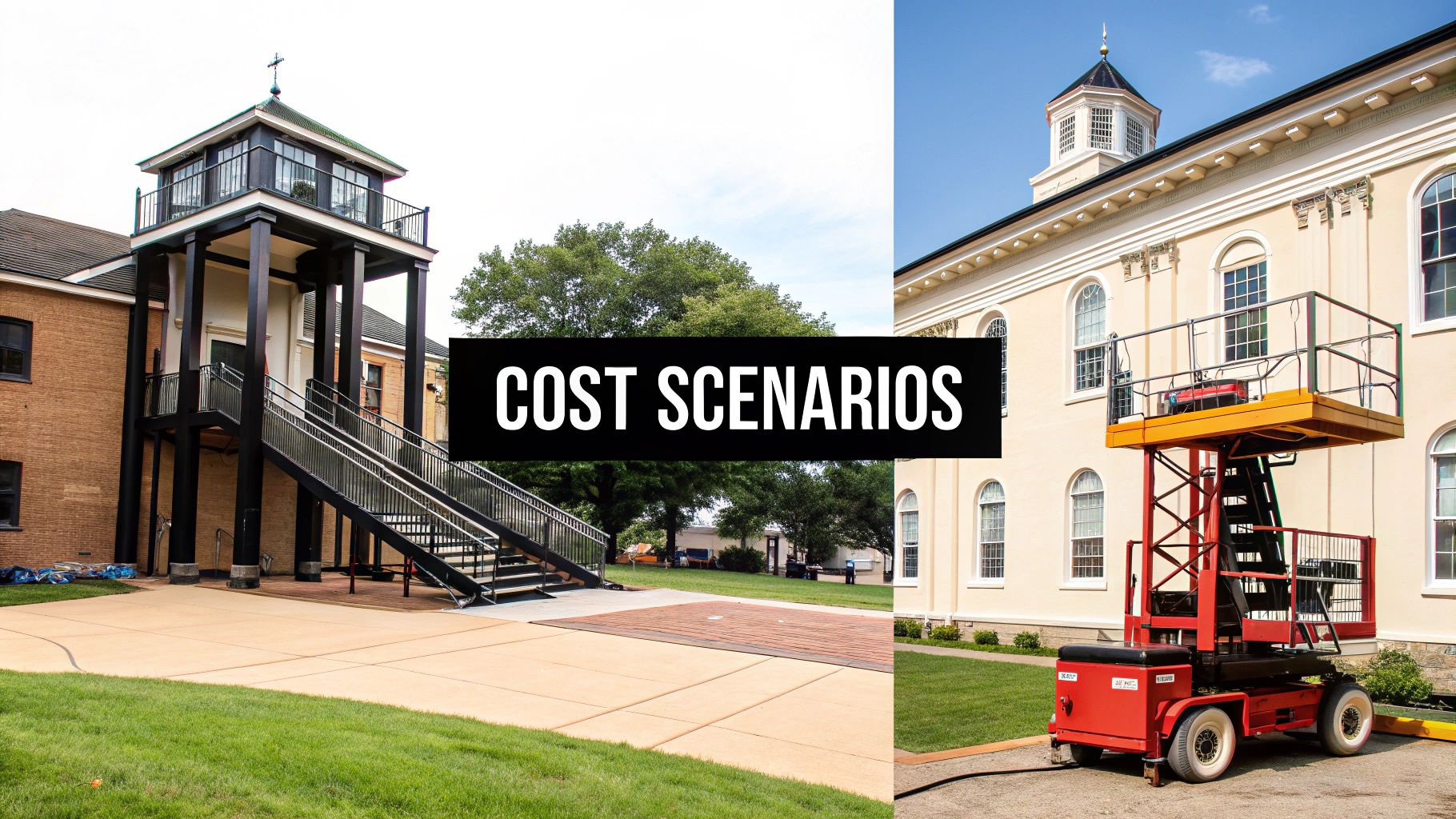
Abstract numbers are a good starting point, but let’s be honest—seeing how they play out in the real world is what really matters. To connect the dots, we'll walk through three distinct installation stories.
Each scenario shows how the lift type, site conditions, and project scope mix together to shape the final wheelchair lift installation cost. You’ll see exactly how a simple residential job differs from a complex commercial or municipal one.
Scenario 1: The Suburban Home Porch Lift
Picture a classic ranch home in a Michigan suburb. The front door sits four feet off the ground, behind a small porch with five concrete steps. The goal is straightforward: give the homeowner a safe, reliable way to get from their driveway to the front door using a power wheelchair.
A standard outdoor vertical platform lift (VPL) is the perfect fit. This project is about as simple as it gets because it doesn’t require major changes to the house itself.
Here’s a typical cost breakdown:
- VPL Equipment: A standard-duty, weather-resistant VPL built for a 48-inch rise comes in around $9,000.
- Site Preparation: We’ll need to pour a new concrete pad for the lift to sit on, which typically runs about $1,500.
- Electrical Work: A licensed electrician is needed to run a dedicated circuit out to the lift’s location. Expect this to cost around $1,200.
- Permits and Labor: The installation work itself, plus pulling local permits and arranging the final inspection, adds roughly $3,800.
All in, the homeowner is looking at a total estimated cost of $15,500 for this common residential solution.
Scenario 2: The Modern Commercial Office Building
Now, let's shift to a two-story office building in downtown Ann Arbor. They need to provide access from the lobby to a second-floor mezzanine, covering a 12-foot travel height. As a commercial space, strict ADA compliance isn't just a suggestion—it's the law.
This job calls for a much more robust VPL, and it must be enclosed in a custom-built hoistway (or shaft) to meet fire codes and match the building's professional look.
Important Insight: Commercial projects operate under a different set of rules. ADA compliance, higher weight capacities, and integration with building-wide fire safety systems make these jobs far more complex—and costly—than a simple home installation.
A detailed cost estimate would look something like this:
- Commercial VPL Equipment: A high-capacity, ADA-compliant lift with features like automatic doors will be around $18,000.
- Hoistway Construction: Building the framed and finished shaft to enclose the lift is a major line item, costing about $15,000.
- Electrical and Fire Systems: This includes the dedicated circuit plus tying the lift into the building’s fire alarm system, which adds up to approximately $4,000.
- Permits, Engineering, and Labor: The complexity here means more planning, engineering, and skilled labor, bringing this phase to around $7,000.
The total investment for this commercial project lands at an estimated $44,000.
Scenario 3: The Historic Municipal Building Staircase
Our final scenario takes us to a historic county courthouse with a grand, curved marble staircase in its entryway. A VPL would destroy the building's historic character, so that’s off the table. The challenge is to provide access up the 15-step staircase without touching the original structure.
The only real solution is a custom-fabricated inclined platform lift (IPL). The lift's rails have to be meticulously measured and built to follow the exact curve of the staircase—a truly specialized job.
- Custom IPL Equipment: The made-to-order rail and platform are highly specialized pieces of equipment. The cost reflects that, coming in at $25,000.
- Structural Mounting: We need to anchor the rail system securely to the historic staircase without causing any damage, which requires special techniques and adds $4,500.
- Electrical Work: The power supply must be routed discreetly to avoid being an eyesore, costing around $2,500.
- Permits and Specialized Labor: This isn't a job for just any crew. It demands experts in heritage installations, bringing this cost to $6,000.
This challenging historic preservation project carries a total estimated cost of $38,000.
To make these differences even clearer, here's a side-by-side comparison of the three projects. It’s a great way to see how individual cost items can vary dramatically based on the job's specific needs.
Sample Project Cost Breakdown Comparison
| Cost Item | Scenario 1: Residential Porch Lift | Scenario 2: Commercial VPL | Scenario 3: Municipal Inclined Lift |
|---|---|---|---|
| Lift Equipment | $9,000 (Standard VPL) | $18,000 (High-Capacity VPL) | $25,000 (Custom IPL) |
| Site Prep / Hoistway | $1,500 (Concrete Pad) | $15,000 (Full Hoistway) | $4,500 (Specialized Mounting) |
| Electrical / Fire Systems | $1,200 (Dedicated Circuit) | $4,000 (Circuit + Fire Integration) | $2,500 (Discreet Wiring) |
| Permits & Labor | $3,800 (Standard Install) | $7,000 (Complex Install) | $6,000 (Specialized Labor) |
| ESTIMATED TOTAL | $15,500 | $44,000 | $38,000 |
As you can see, the final price tag is a story told by many different parts. While the equipment itself is a major factor, the requirements of the site—whether it’s a simple porch or a historic landmark—drive the budget just as much.
Planning for Long-Term Ownership and Maintenance
The day your new wheelchair lift is installed isn’t the finish line for your budget. The upfront cost is a big piece of the puzzle, but smart property owners know to plan for the total cost of ownership over the lift’s entire life. Thinking ahead like this ensures your lift stays a reliable asset, not a surprise expense waiting to happen.
It’s just like owning a car. You don’t just pay for the vehicle itself; you budget for fuel, oil changes, and eventually, new tires. A wheelchair lift is a critical piece of machinery that needs the same kind of forethought to keep it running safely and smoothly for years.
The Value of Preventative Maintenance
The single best way to keep long-term costs in check is with a scheduled preventative maintenance plan. These regular service appointments are all about catching small problems—a worn cable, a weak battery—before they turn into a major, expensive breakdown that leaves someone stranded.
Key Takeaway: A proactive maintenance plan is your best defense against the high cost and major inconvenience of an emergency service call. An unexpected breakdown is always more expensive than a scheduled tune-up.
Investing in regular upkeep really pays off:
- Extended Equipment Lifespan: A well-maintained lift will last significantly longer, just like a car that gets its regular service.
- Enhanced Safety and Reliability: Routine checks make sure every safety feature is working exactly as it should.
- Compliance with Regulations: For any commercial property, keeping a maintenance log isn’t just a good idea—it’s often required by code.
You can get a better sense of how a professional service plan protects your investment by reading our guide on why elevator maintenance is crucial for performance and safety.
Factoring in Repairs and Upgrades
Even with the best care, parts don’t last forever. Over a 10 to 15-year lifespan, you should expect to handle a few repairs, like replacing a motor, upgrading a control board, or installing a new battery backup system. By setting aside a small amount each year, you can turn a potential budget-buster into a predictable expense.
Making the Upfront Cost More Manageable
While thinking long-term is key, the initial wheelchair lift installation cost can still be a big hurdle. The good news is that financing options are available to break that large investment into smaller, predictable monthly payments. This gets you the accessibility you need right now without having to drain your savings.
Here at Crane Elevator Company, we can help connect you with financing solutions that make your project happen.
Answering Your Questions About Wheelchair Lift Costs
When you’re planning a major accessibility upgrade, you’re going to have questions. It’s totally normal. Getting into the specifics of a wheelchair lift installation can feel overwhelming, so we’ve put together the most common questions we hear from property owners just like you.
Think of this as your quick-reference guide. We’ll get straight to the point on timelines, alternatives, and whether buying used is a good idea.
How Long Does a Typical Wheelchair Lift Installation Take?
The timeline really depends on the scope of the project. A simple residential porch lift, for example, can often be installed and running in just one to two days. It’s a pretty straightforward process.
On the other hand, a complex commercial vertical platform lift is a different beast. If the job involves building a new hoistway, pulling significant electrical wiring, and making structural changes, you could be looking at several weeks from start to finish. Any professional installer will give you a detailed schedule with their quote, so there are no surprises.
Are There More Affordable Alternatives to a Wheelchair Lift?
In some very specific situations, yes. A permanent or even a portable ramp can be a more budget-friendly fix for small height differences, like a couple of steps up to a porch.
But keep this in mind: for anything more than a small rise, ramps get impractical fast. ADA guidelines call for one foot of ramp for every inch of vertical rise. That means a 3-foot rise would need a 36-foot ramp—something most properties simply can’t accommodate.
For getting between floors, a wheelchair lift or a residential elevator is almost always the only safe and practical answer. An expert can take a look at your property and tell you the most cost-effective and sensible option for your specific needs.
Can I Install a Used Wheelchair Lift to Save Money?
It’s tempting to think a used lift could cut down the initial wheelchair lift installation cost, but we almost always advise against it. The risks involved usually erase any potential savings, and then some.
- Improper Fit: A used lift was designed for a different space. It almost never fits your property’s measurements perfectly, which leads to expensive, custom modifications.
- Safety Concerns: You have no idea what its maintenance history is or how much wear and tear it has. That’s a huge safety gamble.
- Compliance Issues: Buying used typically voids the manufacturer’s warranty. Even worse, it might not meet current building codes, setting you up for failed inspections and major liability risks.
Investing in a new, professionally installed lift is the only way to guarantee safety, compliance, and long-term peace of mind.
Ready to get a clear, no-surprise quote for your accessibility project? The team at Crane Elevator Company provides free estimates and a price-beat guarantee to ensure you get the best value. Start your free estimate today.