A wheelchair lift can be perfectly quiet for months, then refuse to move when someone needs it most. The platform may sit at the lower landing, the call station may light up, and the building owner may hear three different explanations: bad motor, failed control board, or worn safety device. Meanwhile, a resident, patient, student, or customer is waiting for access.
The motor deserves attention, but it shouldn't become a convenient guess. A wheelchair lift is a coordinated system of mechanical drive components, controls, brakes, barriers, interlocks, and structural supports. Understanding how those parts work together helps a facility manager decide whether a repair is straightforward, whether the equipment is being used beyond its design, and whether a replacement motor would solve the actual problem.
When the Lift Stops Moving and Nobody Knows Why
A facility manager calls on a Saturday morning after a wheelchair lift stops halfway through its routine. The platform worked the previous week. Nobody remembers an unusual noise. The first person says the motor is burned out. A second person points to the control station. Someone on the board asks whether the entire lift needs replacement.
That confusion is common because the motor is hidden inside a larger system. A failed contactor can prevent a healthy motor from starting. A worn brake can allow movement or drifting that looks like a drive failure. Water entering an outdoor enclosure can damage a controller while leaving the motor untouched. Replacing the motor before testing the complete circuit can turn a manageable repair into an expensive misdiagnosis.
Field rule: Diagnose the command, power, brake, drive, and safety circuit before ordering a motor.
The motor is still the part that does the physical work. It produces rotation, passes force through a gearbox or drive arrangement, and moves the platform along its travel path. That means motor selection affects starting current, heat, braking, ride quality, battery performance, and the service life of connected components.
A useful service conversation starts with a few plain questions:
- What changed first? A hum, hesitation, burning smell, platform drift, or complete silence can point toward different failures.
- How often does the lift run? A unit serving one home has a different duty pattern from one serving a healthcare entrance or municipal building.
- What happens during a power loss? Battery-backed equipment introduces batteries, chargers, DC controls, and additional failure points.
- Who can service the equipment? Parts availability and Michigan licensing requirements matter long after installation.
The goal isn't to make every owner a technician. It's to prevent a black-box decision. A motor-level understanding lets an owner plan maintenance, question a vague diagnosis, and choose equipment that can remain serviceable across decades of use.
What a Wheelchair Lift Is Made Of
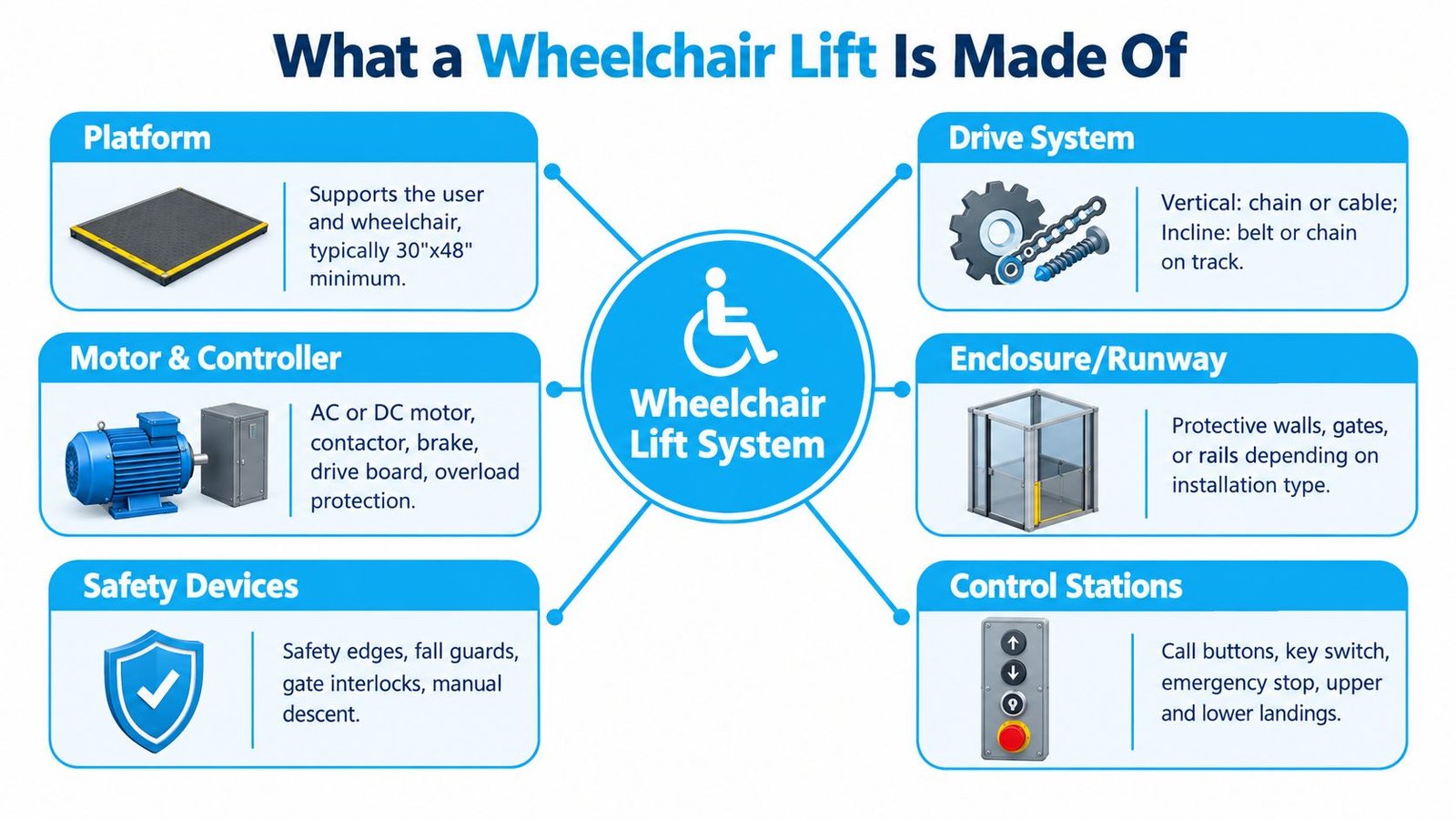
Start at the platform. It carries the wheelchair and user, but it doesn't move by itself. A mast, screw, chain, cable, or inclined track transfers force from the drive system to the platform. The enclosure or runway keeps people away from moving equipment and defines the protected travel path.
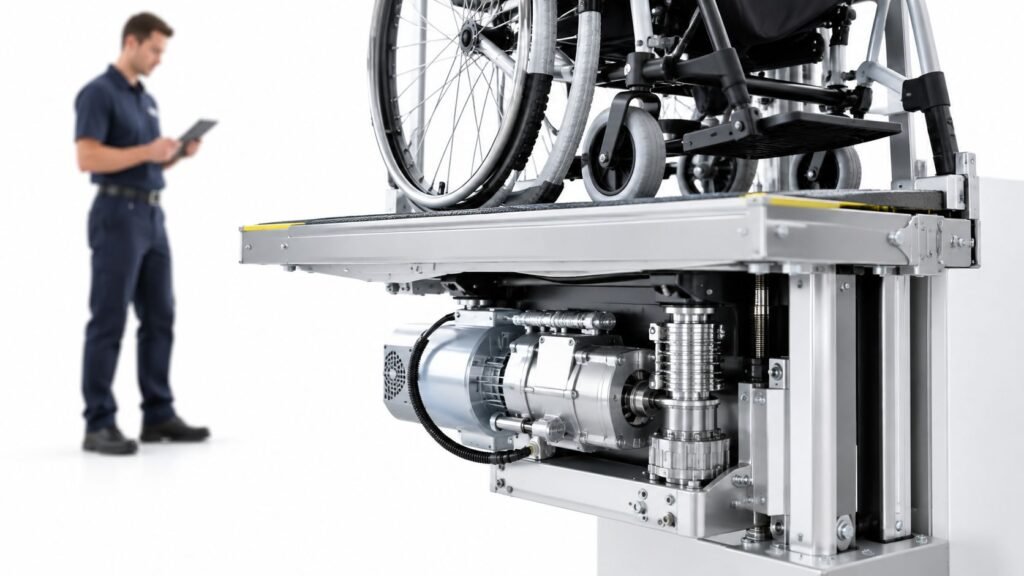
The motor and gearbox assembly supplies that force. The controller decides when the motor receives power, while contactors, relays, or electronic drives manage direction and starting. A brake holds the platform when the motor isn't turning, which is why a brake problem can look like a motor problem.
The connected parts
Call stations send an up or down command from the landings. Key switches, emergency stops, limit switches, and landing controls make sure the lift responds only under permitted conditions.
Safety devices include gates, barriers, safety edges, fall guards, obstruction sensors, and interlocks. If a gate isn't closed or an interlock doesn't prove safe, the controller should prevent motor operation.
The enclosure or runway may be a framed shaft, protective walls, rails, or an inclined track arrangement. Its construction affects clearances, weather exposure, access for service, and the way loads reach the building structure.
ASME A18.1 governs platform lifts and stairway chairlifts in the United States. The standard addresses runway enclosures, electrical wiring, structural supports, headroom, ramps, pits, and related safeguards. Under the accessibility guidance summarized by the U.S. Access Board's platform-lift requirements, vertical platform-lift platforms are limited to 18 square feet, and the guidance identifies 80 inches of minimum headroom.
Those requirements create the motor's safety envelope. The platform limits the load and usable space. The drive transfers force. The brake holds position. The controller verifies commands. Barriers and interlocks prevent a person from entering a hazardous opening while the motor runs. A wheelchair lift only works safely when all of these parts agree.
AC, DC, Gearmotor, and Brushless Options Compared
Motor architecture should follow the building's actual operating pattern, not a salesperson's favorite catalog configuration. A lightly used residential lift may value simple line power and low service complexity. A lift that must operate during an outage may need a battery-backed DC arrangement. An outdoor unit may need better protection against moisture and contamination than an indoor unit in a conditioned lobby.
AC induction motors are common on line-powered vertical units. They generally offer durable construction and straightforward service, especially where the building has a stable electrical supply. Their starting behavior, braking arrangement, and control method still need to match the lift, because a motor that runs reliably can still produce poor starts or excess heat if the controls and load don't agree.
DC motors fit systems that use batteries or need controlled acceleration. Battery-backed operation can preserve access during a power interruption, but it adds batteries, charging equipment, wiring, and battery testing to the maintenance plan. A smooth DC ride doesn't eliminate the need to verify brake holding, overload protection, and emergency lowering.
A gearmotor combines a motor with a reduction gearbox. The motor can operate at a useful speed while the gearbox converts that rotation into higher output torque at the drive. This arrangement can fit a compact installation, but gears, bearings, seals, and lubrication become part of the service picture. A noisy gearbox shouldn't be dismissed as normal until a technician checks alignment, lubrication, and wear.
Brushless designs remove brush wear from the motor itself and can reduce some routine maintenance. They often depend more heavily on electronic controls, sensors, and drive boards. That trade-off matters in an older installation where replacement electronics may be harder to identify than a conventional motor component.
| Motor Type | Best Fit | Watch Out For |
|---|---|---|
| AC induction | Line-powered lifts with predictable building power and moderate use | Starting current, heat, brake coordination, and electrical compatibility |
| DC | Battery-backed systems and applications needing controlled starts | Battery aging, charger faults, and additional DC control components |
| Gearmotor | Compact layouts requiring torque multiplication through a reduction drive | Gear wear, lubrication, seal condition, alignment, and noise |
| Brushless | Installations where reduced brush maintenance and electronic control make sense | Dependence on sensors, drive boards, and compatible replacement electronics |
Match the choice to the duty
Ask how many trips the lift makes, how long each operating cycle lasts, whether the equipment sits outdoors, and what happens when the building loses power. A motor that works well for occasional home access may overheat under repeated commercial use. Conversely, a heavily specified arrangement can add unnecessary control complexity where a simple serviceable design would be easier to maintain.
The useful question isn't “Which motor is strongest?” It's “Which motor, brake, controller, and drive arrangement can handle this duty cycle with parts and technicians available in this market?”
Sizing the Motor for Real Loads and Real Buildings
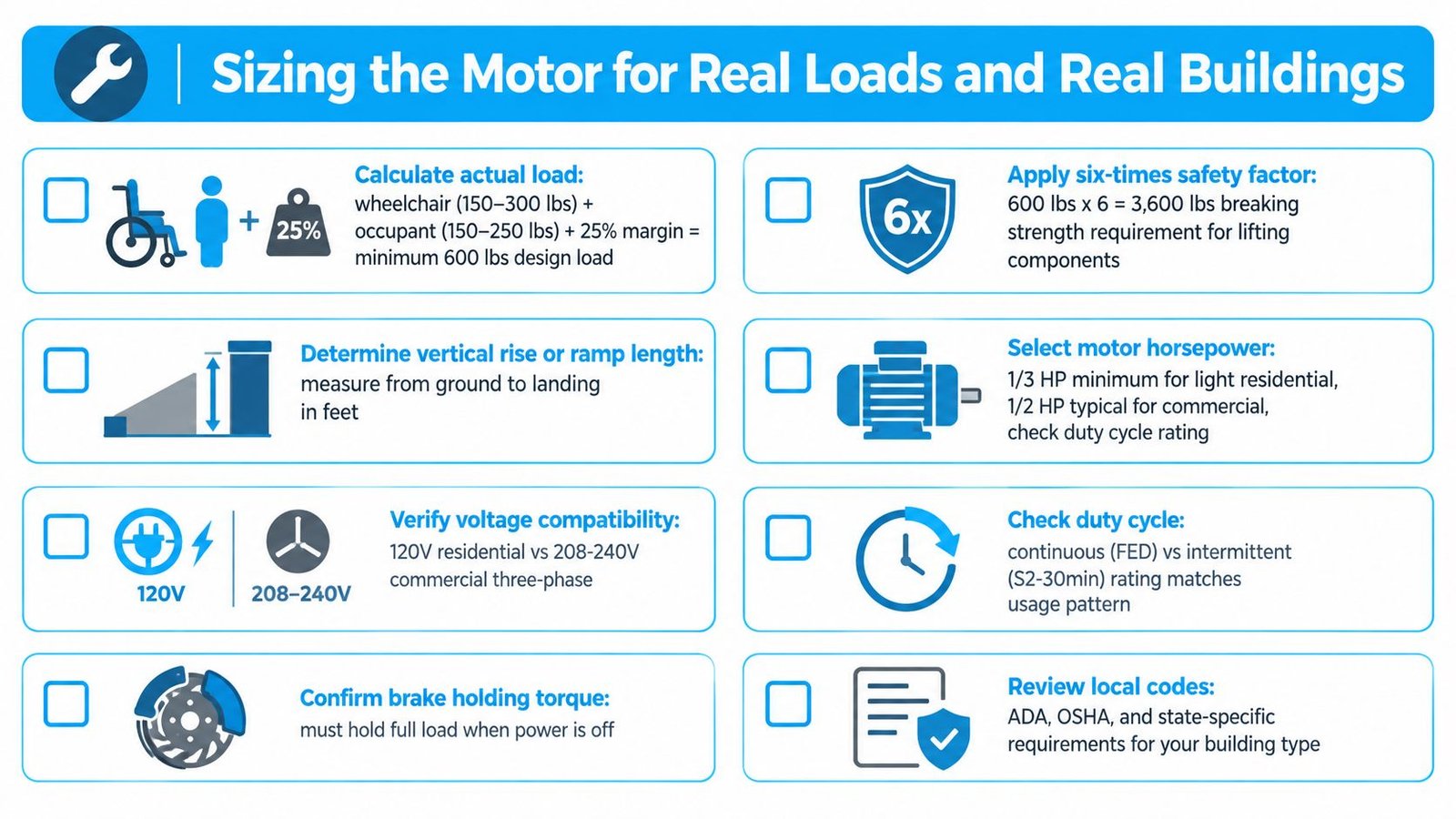
Motor sizing begins with the load, but the brochure's rated capacity isn't the whole calculation. U.S. vehicle-lift accessibility requirements specify a 600-pound minimum design load, a safety factor of at least six for wear-prone load-supporting components such as cables, pulleys, and shafts, and a safety factor of at least three for nonworking components such as platforms, frames, and attachment hardware, as detailed in the U.S. Access Board's vehicle-lift requirements.
That minimum isn't a recommendation to operate at the edge of capacity. Record the heaviest expected combined user and mobility-device load, then confirm that the platform, drive, motor, brake, structural attachments, and controls are all rated for that use. A heavier chair, power base, medical equipment, or service cart can change the operating demand even when the platform dimensions remain unchanged.
Three questions drive the selection
What is the actual load? Start with the maximum expected user and equipment combination, not an average occupant. The motor must start and stop that load without excessive current, slipping, or brake stress.
How far must it travel? Travel height affects operating time, heat, cable or chain exposure, and the required enclosure. Inclined units also need a clear track and must avoid encroaching on required egress.
How often will it run? Runtime and rest periods determine whether the motor can shed heat between trips. A borderline motor may appear healthy during a short demonstration and fail after repeated cycles at a busy entrance.
The surrounding building can defeat an otherwise suitable motor. The referenced accessibility guidance identifies 28.5 inches of minimum platform clearance, 30 inches of width above the platform, and 48 inches of length above the surface for vehicle lifts. It also identifies 80 inches of minimum headroom in platform-lift guidance. Verify landings, doors, approach space, overhead clearance, pits, ramps, and structural attachment before approving equipment.
For a small commercial accessibility project, review the requirements alongside the small commercial lift information from Crane Elevator. The right motor still won't make an undersized landing or obstructed route acceptable.
Before acceptance, document:
- Rated capacity and margin: Confirm the expected combined load and the manufacturer's rating.
- Structural attachment: Verify the mast, frame, fasteners, and supporting structure.
- Barrier interlocks: Test that open gates and failed interlocks prevent movement.
- Platform condition: Check the slip-resistant surface, edges, barriers, and clearances.
- Stopping devices: Confirm upper and lower limits, emergency stopping, and brake holding.
Common Motor Problems and What They Really Mean
A lift that hesitates at startup may have a motor problem, but contactor pitting is often the more useful place to begin. Arcing can damage the contact surfaces, creating voltage drop, intermittent starting, or a contactor that sticks. Inspect the contactor, coil, terminals, and control voltage before condemning the motor.
A platform that moves but doesn't hold position points toward the brake or the drive system. Brake wear, incorrect adjustment, contamination, or a failing release mechanism can allow drift. The technician should measure the brake gap, inspect the lining, verify the holding action, and confirm that the controller isn't releasing the brake at the wrong time.
Symptoms need targeted tests
Overheating usually demands more than a replacement motor. Check running current against the nameplate, inspect the drive for binding, review the duty cycle, and use thermography on the motor housing and connections. An undersized motor or a platform carrying more than expected can keep overheating a replacement unit.
Battery failure can strand users even when the mechanical motor is sound. A battery may show acceptable voltage without delivering usable capacity under load. Battery load testing, charger checks, terminal inspection, and review of emergency-lowering operation belong in the maintenance record.
Contamination damage is common on exposed equipment. Water, salt, dust, and condensation can damage encoders, control boards, terminals, and motor insulation. Inspect enclosure seals, drain paths, cable entries, and weather protection before installing new electronics.
The consequences of careless diagnosis are serious. A U.S. government technical survey identified 116 injured people and 11 deaths in incidents involving patient and transfer lifts from 1991 through the survey period. Those figures apply broadly to patient and transfer-lift incidents, not as a failure rate for every wheelchair lift category, but they support disciplined design, operator training, load control, inspection, and maintenance, as documented in the government technical survey on lift-related incidents.
For electrical or drive-train issues, a proper elevator motor repair evaluation should identify the failed component and the cause behind it.
Lock out power before inspection. A general handyman shouldn't open energized controls, bypass an interlock, adjust a brake, or test a lift with a user on the platform. The maintenance action should leave the equipment safer and more predictable than it was before the call.
Why Non-Proprietary Parts Change the Math
The purchase price is only one part of a wheelchair lift decision. The larger question is who can diagnose and service the equipment after the original installer has moved on, parts have changed, or the building needs a second opinion.
Proprietary equipment can tie a building to one source for controls, motors, software, documentation, and routine service. That arrangement may work while the supplier supports the product. It becomes a problem when a common component is unavailable or when an owner needs an independent assessment before approving a major repair.
A non-proprietary approach doesn't mean every part fits every lift. It means the design uses identifiable, serviceable components where possible, with documentation that lets qualified technicians understand the system. Motor nameplates, controller information, wiring diagrams, brake specifications, safety-circuit logic, and replacement-part records should remain with the building.
Michigan's elevator code requires installation, alteration, repair, maintenance, inspection, and testing work on elevating devices to be performed by a licensed elevator journeyperson. Before installation or alteration, a licensed elevator contractor must submit an application with detailed plans and specifications for approval before a permit is issued, according to the Michigan elevator permit information.
Questions to ask before purchase
- Who else can service it? Ask for the equipment category, required license, and realistic local service options.
- Are the motor and controls standard parts? Record manufacturers, model numbers, ratings, and compatible alternatives.
- Will documentation stay accessible? Require wiring diagrams, manuals, adjustment values, and maintenance records.
- Can another technician test it safely? A second opinion is valuable only if the equipment can be diagnosed without proprietary barriers.
- What happens after a control-board failure? Ask about repair, replacement, lead time, and approved substitutes.
Owners can review the practical implications of non-proprietary elevator benefits before signing a modernization or new-installation agreement. The best procurement decision is the one that preserves safe service choices throughout the equipment's useful life.
Building a Lifecycle Plan Instead of a Repair Habit
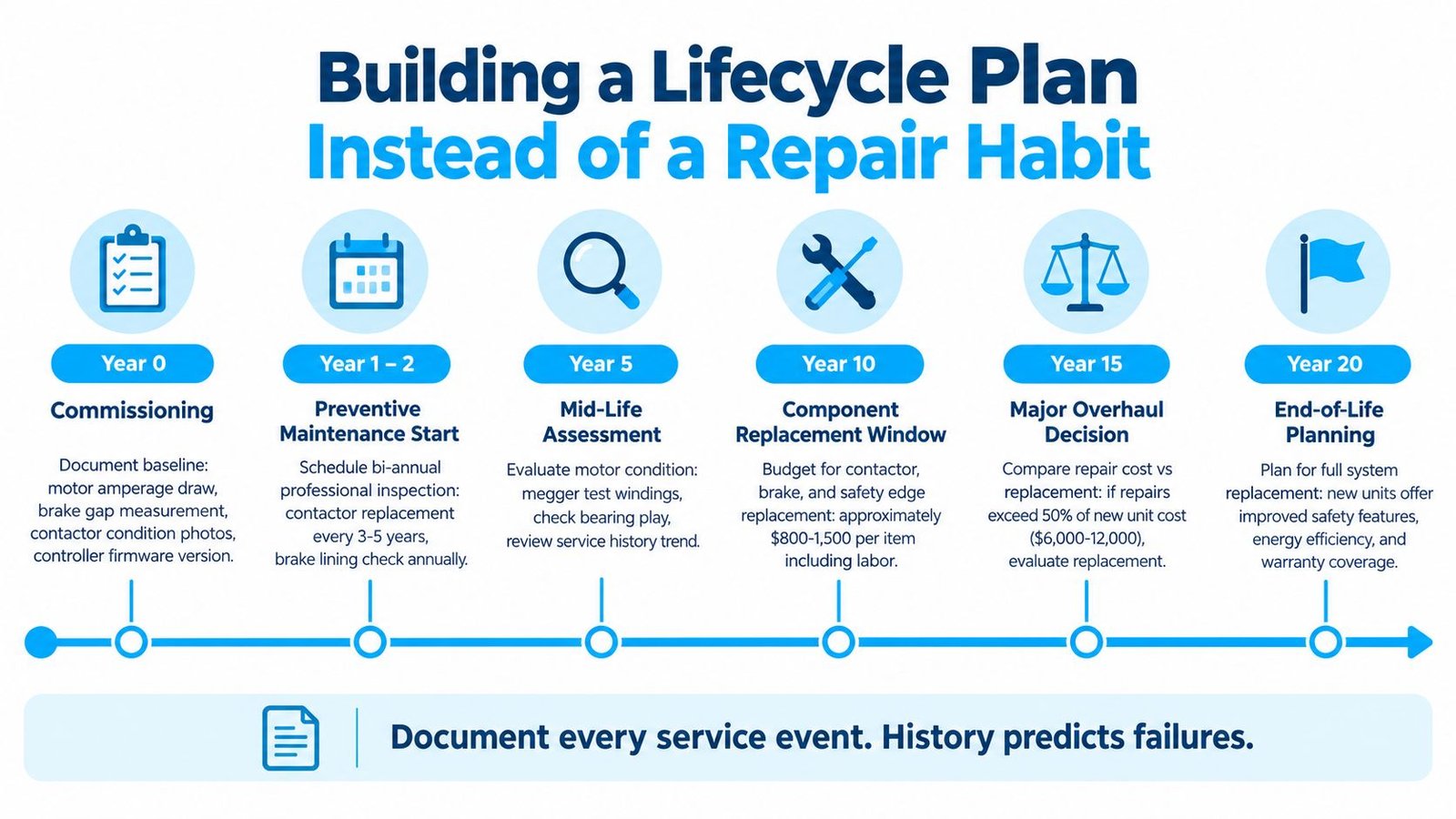
A wheelchair lift shouldn't enter service with an empty maintenance history. Record motor amperage, brake condition, contactor condition, controller information, safety-device operation, and the installation environment at commissioning. That baseline gives the next technician something to compare when the platform becomes noisy, slow, hot, or intermittent.
Daily users and building staff can handle visual checks. They can look for debris, damaged barriers, standing water, unusual sounds, and a platform that doesn't land correctly. They should never defeat a safety device or continue operating a lift that shows uncontrolled movement, exposed wiring, burning odor, or brake problems.
Build the plan around use
Pre-use checks should confirm that the path is clear, gates close, controls respond normally, and the platform stops at the intended landings.
Professional maintenance should follow duty cycle, environment, manufacturer requirements, and the applicable inspection category. Outdoor units need attention to water, ice, corrosion, seals, and drainage. Busy facilities need a more serious service plan than occasional residential use.
Emergency access needs a written response. Identify who receives the outage call, how users reach an alternate entrance, how staff communicate the loss of service, and how the building protects people who can't use stairs.
Lifecycle budgeting should include batteries, contactors, brakes, control boards, weather protection, wiring, and obsolete parts. A repair reserve is more useful than a surprise collection or an emergency purchase order.
Michigan's inspection schedule depends on device category. Administrative rules generally require passenger and freight elevators, material lifts, and barrier-free lifting devices to be inspected at least once every 12 months. Dumbwaiters, stairway chairlifts, and platform lifts generally require inspection at least once every 24 months, while personnel hoists generally require inspection at least every 30 days, as stated in the Michigan elevator inspection interval rules.
Those are minimum inspection intervals, not a complete maintenance strategy. A platform lift used heavily or exposed to weather may need more frequent professional attention. Document every service event, including test results, replaced parts, measured brake conditions, battery results, and unresolved defects. History turns recurring failures into visible patterns.
When to Call a Licensed Elevator Contractor in Michigan
Building staff can perform visual pre-use checks, clean the platform, keep the travel path clear, and report new noises or unusual operation. They shouldn't bypass interlocks, adjust brakes, open energized controls, alter the drive, or replace a motor without the required license and process.
Michigan requires installation, alteration, repair, maintenance, inspection, and testing work on elevating devices to be performed by a licensed elevator journeyperson. Detroit also maintains a dedicated elevator-inspection function within its Buildings, Safety Engineering, and Environmental Department. That team examines and licenses elevator journeypersons and contractors, inspects elevators, escalators, dumbwaiters, and wheelchair devices, investigates complaints, and reports elevator accidents, as described by the Detroit elevator inspection team.
Crane Elevator Company provides elevator service for Detroit, Lansing, Ann Arbor, Grand Rapids, Flint, Kalamazoo, Royal Oak, Holland, Battle Creek, Jackson, Ypsilanti, and surrounding Michigan communities. Its scope includes passenger and freight elevators, residential elevators, wheelchair and material lifts, dumbwaiters, preventive maintenance, repairs, testing, inspections, and modernization. A wheelchair lift motor is replaceable and serviceable, but it should be diagnosed and planned as part of the complete lift system.
Crane Elevator Company can evaluate wheelchair lift motors, controls, brakes, safety devices, and supporting equipment, then provide repair, maintenance, inspection, or modernization guidance for Michigan properties. Visit Crane Elevator Company to request service or a second opinion before a stopped lift becomes an access emergency.