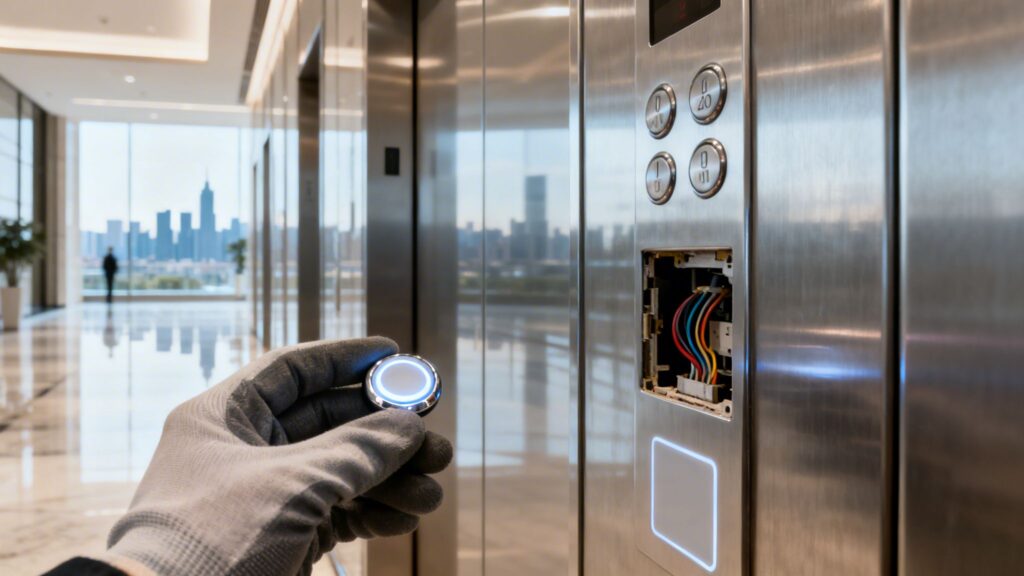
For building owners anywhere in Michigan, from a high-rise in Detroit to a historic hotel in Ann Arbor, elevator button replacement isn’t just another repair—it’s a smart investment. It directly impacts your building’s safety, tenant happiness, and even your budget.
For Service or Questions Call
734-726=4247
Or
Fill Out a Contact Form Below
(Servicing Lower Michigan)
Why Elevator Button Replacement Is a Smart Investment

Your elevator buttons are the first and most frequent touchpoint people have with your building’s vertical transportation. When they stick, fail to light up, or just look grimy and worn, it sends an immediate message of neglect.
Whether you manage a busy Ann Arbor office or a quiet condo complex in Petoskey, a single unresponsive button can trigger a flood of tenant complaints and make a quality building feel second-rate. Tackling this proactively isn’t just about fixing a broken part; it’s about upgrading the daily experience for everyone inside.
Before we dive into the specifics, this table summarizes the key signs that it’s time for an upgrade and the real-world impact on your property.
At-A-Glance Reasons for an Elevator Button Upgrade
| Indicator | Impact on Your Building | Benefit of Proactive Replacement |
|---|---|---|
| Visible Wear & Tear | Buttons look dated, dirty, or damaged, hurting your building's image. | A modern panel boosts property aesthetics and perceived value. |
| Unresponsive Buttons | A leading cause of tenant frustration and costly emergency service calls. | Drastically reduces breakdowns and improves user confidence. |
| No Illumination or Braille | A serious code violation that creates accessibility and liability issues. | Ensures ADA compliance, avoiding fines and making the elevator safe for all. |
| Intermittent Failures | "Ghost calls" or buttons that only work sometimes disrupt traffic flow. | Increases elevator reliability and efficiency, minimizing wait times. |
Paying attention to these indicators helps you get ahead of problems before they lead to bigger headaches, unexpected costs, or serious compliance issues.
The Business Case for Upgrading
A planned elevator button replacement delivers real, tangible returns. Worn-out, flickering, or dead buttons are one of the most common reasons for service calls, leading to unplanned downtime and expensive emergency repair bills.
But the cost goes beyond simple repairs. Those seemingly minor issues can quickly become major liabilities.
Worn, unlit, or non-functional buttons are not just an inconvenience—they are often a direct violation of Michigan’s ADA and safety codes, creating significant legal and financial risk for building owners.
A full button panel upgrade tackles these problems head-on. By replacing outdated, failing components with modern, durable ones, you can:
- Slash Emergency Service Calls: New, reliable buttons fail far less often. That means fewer frustrating breakdowns and fewer invoices for after-hours repairs.
- Guarantee Code Compliance: Updated panels are designed with proper braille, clear illumination, and correct placement to meet today’s strict ADA requirements, protecting you from violations and fines.
- Boost Tenant Satisfaction: A responsive, modern elevator doesn’t just work better—it shows you’re invested in your tenants’ safety and daily experience.
On top of that, many older elevator systems use proprietary parts, locking you into expensive, single-source service agreements. An upgrade is the perfect opportunity to learn about the benefits of non-proprietary elevator parts and break free. This simple change allows any qualified Michigan provider to service your equipment, giving you back control over your long-term maintenance costs.
Recognizing the Warning Signs of Failing Elevator Buttons
An elevator button that stops working altogether isn’t the first sign of trouble—it’s the last. Long before a complete failure, your elevator’s buttons will give off subtle clues that they’re on their way out. For facility managers in Michigan cities like Grand Rapids and Kalamazoo, learning to spot these early warnings is the key to preventing a full shutdown.
Think of it like a slow leak in a tire. Ignoring these small problems only guarantees a bigger, more expensive headache down the road. An unresponsive button is more than an annoyance; it’s a clear signal your system needs attention before it impacts tenant satisfaction and your building’s reputation.
Physical and Functional Decay
The most obvious signs are the ones you can see and feel. Buttons that feel sticky, loose, or need a hard press are showing clear mechanical wear. While dirt and grime are common culprits, persistent issues usually point to failing internal contacts that are about to give up for good.
A flickering backlight is another tell-tale sign. It’s not just a cosmetic issue—it often points to a deeper electrical problem, like bad wiring or a fault in the control panel’s power supply. It’s a warning light that a total button failure is coming.
Keep an eye out for these specific indicators:
- Tactile Feedback: Do your buttons feel mushy or get stuck? That friction means mechanical parts are worn and will eventually break.
- Response Time: Is there a noticeable lag between a press and the button lighting up? This delay can be an early symptom of a failing circuit.
- Intermittent Operation: Does the button work sometimes but not others? This is incredibly frustrating for users and signals an unpredictable failure is imminent.
These aren’t just minor inconveniences. Imagine the chaos during peak hours in a busy Flint office building when the elevator buttons start working intermittently. Tenants lose confidence, traffic gets jammed up, and a small issue quickly becomes a major operational nightmare.
An elevator with worn-out braille or cracked faceplates isn’t just an aesthetic problem; it’s a significant ADA compliance risk. Neglecting these seemingly small details can lead to fines and legal liability for building owners across Michigan.
Compliance and Reputational Risks
Worn-out buttons create serious risks beyond just function. A cracked button faceplate might seem minor, but its sharp edges can be a safety hazard. More importantly, if the braille lettering on your buttons has worn away, your elevator is no longer compliant with the Americans with Disabilities Act (ADA).
This is a non-negotiable for any public building. Faded illumination is also a code violation, as buttons must be clearly lit for visually impaired riders.
These compliance failures send a clear message: that management isn’t paying attention to resident safety and accessibility. By spotting these warning signs early, you can schedule a planned elevator button replacement and avoid the high cost of emergency repairs, potential fines, and the damage to your building’s good name.
A Guide to Modern Elevator Button Technologies
When it’s time for an elevator button replacement, you’re making a decision that directly affects your building’s reliability, user experience, and even public health. For property owners in Michigan, understanding the available options is the first step toward a smart, durable investment.
The flowchart below gives you a simple diagnostic process for common button failures.

If you’re seeing issues like sticky buttons, flickering lights, or worn-out braille, it’s a clear signal that it’s time to evaluate an upgrade. Here’s a look at the technologies you’ll be choosing from.
Mechanical and Vandal-Resistant Buttons
For decades, mechanical buttons have been the industry workhorse. These are the familiar push-buttons that give a physical “click” when pressed, completing a simple circuit. While they are cost-effective and have a long track record, their moving parts are their biggest weakness—they inevitably wear out, especially in high-traffic elevators.
This is why vandal-resistant buttons were developed. You’ll find them in public transit stations, stadiums, and busy commercial buildings in cities like Detroit, where components have to be tough. They are built to take abuse, featuring solid metal construction, flush mounting to stop prying, and seals to keep out dirt and moisture. The upfront cost is higher, but their durability can dramatically reduce long-term service calls and repair costs.
Choosing the right button is about matching the part to the environment. A standard button in a high-abuse public elevator is a recipe for constant failures. An over-engineered button in a private, low-use residence is often an unnecessary expense.
Capacitive and Touchless Technologies
Modern elevators are increasingly using more advanced interfaces. Capacitive touch buttons, which use the same technology as your smartphone screen, have no moving parts. They work by detecting the tiny electrical charge from a user’s fingertip, making them exceptionally durable and far easier to clean.
The biggest shift, however, has been toward touchless button technology. These systems use infrared (IR) or proximity sensors to register a call when a passenger simply gestures or hovers their hand near the button. This technology’s adoption was accelerated by a new focus on hygiene, particularly in places like hospitals in Ann Arbor or busy corporate HQs in Southfield.
This isn’t just a trend; it’s backed by significant market movement. The global elevator touchless button market is on track to hit $1.3 billion by 2026. After studies showed how many germs can live on traditional buttons, building managers saw touchless upgrades as a way to reduce health risks and improve tenant confidence. Discover more about the rapid growth of touchless systems and what it means for modern buildings.
Ultimately, the right choice for your elevator button replacement comes down to your building’s daily use, your budget, and your tenants’ needs. By weighing durability against cost and user experience, you can select a solution that will provide reliable service for years to come.
Navigating Michigan ADA and Elevator Safety Codes
For property owners across Michigan, staying compliant with the Americans with Disabilities Act (ADA) and state elevator codes isn’t optional—it’s a legal requirement. An elevator button replacement project is the perfect opportunity to make sure every detail of your system meets these strict standards, protecting both your investment and the people who rely on it.
Failing to comply comes with real consequences. Picture a Lansing property manager getting hit with a notice that their building’s elevator failed inspection. The reason? The braille on the buttons is worn flat, and the emergency phone button is missing its required raised symbol. Now they’re facing steep fines and a possible shutdown until everything is corrected.
Core ADA Requirements for Elevator Buttons
To avoid that headache, you need to understand the key accessibility standards. These aren’t just lines in a rulebook; they’re designed to ensure everyone, regardless of physical ability, can use your elevator safely and independently.
- Button Height and Placement: The car’s operating panel buttons must be located between 35 and 48 inches from the floor. This makes them reachable for a person in a wheelchair.
- Size and Shape: Buttons need to be at least ¾ inch in their smallest dimension and either raised or flush—never recessed. This design ensures they can be pressed without requiring fine motor skills.
- Visual and Tactile Markings: Every button must feature corresponding braille markings. Critically, the main entry floor has to be marked with a star symbol to the left of the floor designation.
- Audible Signals: The elevator needs to provide audible tones or voice announcements to signal the car’s direction and arrival at each floor, which is essential for visually impaired passengers.
These rules are why you can’t just swap one component for another. The entire button panel system must function together to create a fully compliant experience. For a closer look at these rules, you can learn more about Michigan ADA elevator compliance and how to keep your property protected.
Beyond ADA: Local Michigan Codes
On top of the federal ADA laws, building owners from Troy to Traverse City must also adhere to state and local safety codes. These often adopt standards directly from the American Society of Mechanical Engineers (ASME).
It’s a common myth that older elevators are “grandfathered in” and exempt from modern codes. While some allowances exist, any major alteration—like a full elevator button replacement—often triggers the requirement to bring the entire system up to current standards.
This means a button upgrade isn’t just about fixing what’s broken. It’s a chance to ensure your elevator meets every current safety and accessibility benchmark. Taking this proactive approach is the best way to prevent expensive violations and ensure your building is safe and welcoming for every single person.
The Elevator Button Replacement Process Explained

Knowing what goes into an elevator button replacement helps property owners across Michigan, from Ann Arbor to Sterling Heights, set the right expectations and keep disruptions to a minimum. It’s not just a matter of swapping parts; it’s a methodical project focused on safety, compliance, and getting the job done right the first time.
The whole thing kicks off with a detailed on-site assessment. A qualified technician will inspect your existing car operating panel (COP) and hall stations to find the real cause of the problem and check the system’s overall health. This is the most important step—it tells us whether you need a simple button fix or if a full panel upgrade is the smarter move for the long haul.
Initial Steps: Assessment and Scheduling
After the assessment, we get into planning. You’ll get to review options for new button types—from tough, vandal-resistant models to modern touchless systems—that make sense for your building and budget. From there, we map out a detailed project plan and schedule the work to create as little disruption as possible for your tenants, often by working during off-peak hours or on weekends.
The market for these parts is big and getting bigger. Valued at $1.3 billion in 2026, the Elevator Control Switch market is expected to hit $1.8 billion by 2033. While the elevator itself might last for decades, its control switches typically need replacing every 7-10 years. For Michigan’s commercial properties, from factories in Flint to municipal buildings in Lansing, staying ahead of failures can cut downtime by 40% and extend the elevator’s life by 15%. You can see the latest elevator control switch market trends to understand how this impacts maintenance.
Implementation and Safety Protocols
When replacement day arrives, safety is everything. The technician will follow a strict lock-out/tag-out (LOTO) procedure. This means the elevator is de-energized, and the power source is physically locked so it absolutely cannot be turned back on during the work. This is a non-negotiable step that protects our technicians and everyone in your building.
With the elevator safely offline, the real work begins. This includes:
- Carefully removing the old car operating panel or hall station.
- Disconnecting the old wiring and prepping the connections for the new unit.
- Installing the new button panel and meticulously wiring it back into the elevator’s main controls.
This is precision work. For a closer look at what’s inside the panel itself, check out our guide on the elevator control panel.
Final Testing and Inspection
Once the new panel is installed, the job isn’t done. The technician then runs a battery of tests to make sure everything works perfectly. We check every single button for responsiveness and proper illumination, and we test its communication with the elevator controller. Finally, the system is calibrated to ensure floor calls are logged correctly and the ride is smooth.
A final walkthrough and inspection confirms that everything from the braille markings to the emergency phone functions exactly as it should and meets all ADA and local Michigan safety codes. This last check gives you complete confidence that your elevator button replacement was a success.
Shifting from Reactive Repairs to Proactive Care
When it comes to elevator button replacement, the best strategy is to avoid needing an emergency one in the first place. For building owners across Michigan, this means moving away from a reactive, “fix-it-when-it-breaks” mindset.
Adopting proactive care is the single most effective way to guarantee long-term reliability and keep costs under control.
Think of consistent preventative maintenance as a regular health checkup for your elevator. Instead of reacting to a dead button in a busy Traverse City hotel during peak season, a technician can identify early signs of wear and fix it before it ever leads to a shutdown. This approach doesn’t just save your buttons—it extends the life of every critical component in your system.
The True Cost of Neglect
Waiting for a component to fail is always the more expensive path. Emergency service calls carry premium rates, and the cost of unexpected downtime—measured in tenant frustration and operational disruptions—is often far greater. This cycle of neglect and emergency repair makes your budget unpredictable and puts your building’s reputation on the line.
Proactive care transforms your elevator from a recurring problem into a reliable asset. By investing in a quality maintenance program, you lower your total cost of ownership, maintain ADA compliance, and ensure safety for every passenger.
A strategic maintenance plan is about more than just lubrication and quick inspections. The broader elevator maintenance market is projected to hit $46.1 billion by 2026, a clear sign that property owners recognize the high price of neglect. Discover more insights on the growing elevator maintenance market and how it impacts property management.
Worn, sticky, or dead buttons trigger roughly 20% of all service calls. A proactive plan with a non-proprietary provider can cut lifetime costs by 25%—a major win for anyone from an HOA in Kalamazoo to a commercial developer in Detroit.
Benefits of a Proactive Maintenance Plan
A scheduled maintenance program delivers tangible results that protect your entire vertical transportation system.
Key benefits for your Michigan property include:
- Fewer Service Disruptions: Regular checks and adjustments catch problems before they cause a breakdown, keeping your elevator running smoothly.
- Predictable Budgeting: A fixed maintenance agreement takes the surprise out of emergency repair bills, making your expenses far easier to manage.
- Sustained Safety and Compliance: Technicians ensure your equipment, including all buttons and fixtures, consistently meets state and ADA codes. This protects you from fines and liability.
Ultimately, investing in preventative care is the key to maximizing the lifespan and performance of your elevator. It turns a necessary expense into a strategic advantage for your building.
Answering Your Questions About Elevator Button Replacement
When it’s time to replace your elevator buttons, property owners and managers understandably have questions about cost, timing, and what’s possible. Getting clear answers helps you plan and budget for a smooth upgrade.
Here are the most common questions we get from clients across Michigan.
How Much Does It Cost to Replace Elevator Buttons in Michigan?
Costs can vary quite a bit, depending on your elevator’s age, the button technology you choose, and how big the project is.
- A simple fix for a single failed button might only be a few hundred dollars.
- A full car operating panel (COP) modernization with new touchless buttons could be several thousand dollars.
We provide transparent, no-obligation quotes to help building managers from Grand Rapids to Warren budget accurately for their specific needs.
How Long Does a Replacement Take?
We know that elevator downtime is a major disruption, so we work to minimize it. A standard elevator button replacement for one car operating panel can often be finished in a single day. This fast turnaround is critical for busy office buildings in Southfield or apartment complexes in Troy.
Larger projects, like replacing all the hall call stations in a high-rise building in Ann Arbor, will naturally take a bit longer. In those cases, we work with you to schedule the job during off-peak hours or on weekends to reduce the impact on your tenants.
The good news is that most elevator systems, even older ones, can be retrofitted with modern button technologies. Upgrading to touchless buttons is an increasingly popular choice for facilities looking to improve hygiene and provide a better user experience.
Can I Upgrade My Old Elevator to Touchless Buttons?
Yes, in most situations you absolutely can. The vast majority of existing elevator systems are capable of being retrofitted with modern, touchless button technology.
Our technicians can survey your current setup—whether it’s in a historic Flint building or a newer facility in Dearborn—and recommend the most compatible and effective solution for a seamless upgrade.
Ready to ensure your elevator is safe, modern, and reliable? Crane Elevator Company offers transparent quotes and expert service for all your elevator button replacement needs in Michigan. Get your free second opinion and competitive quote today!