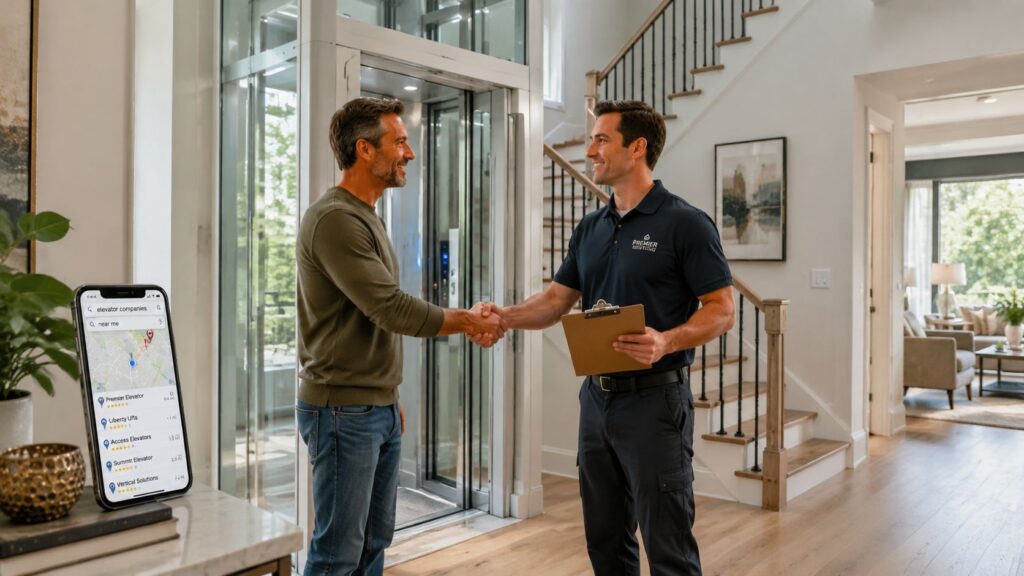
You're probably doing what most homeowners do at the start of this process. You search for residential elevator companies near me, open a few websites, and see polished photos, “request a quote” buttons, and product names that all start to blur together.
That's where expensive mistakes start.
A residential elevator isn't just a fixture you buy and forget. It's a regulated piece of equipment, a construction project, and a long-term service commitment. The companies that look similar online can be very different in the field. Some are set up to support the system for years. Others are set up to close the sale, install the unit, and leave you with a maintenance dependency you didn't understand when you signed.
The most useful way to shop isn't to ask, “Who can install an elevator?” It's to ask, “Who can install a system I can still service, inspect, and afford to maintain years from now?”
Starting Your Search for a Home Elevator Company
Urgency often drives the initial decision. A parent is moving in. Stairs are getting harder. A remodel is already underway. Or an architect has carved out space for an elevator and now the owner has to pick a company quickly.
Speed matters, but process matters more.
Search results for residential elevator companies near me usually focus on showroom visits, design options, or getting a quote fast. What they often leave out is the part that drives long-term satisfaction: serviceability. That includes whether the equipment uses non-proprietary parts, whether other qualified providers can work on it later, and whether maintenance becomes a locked-in relationship after installation. That gap shows up clearly in this discussion of long-term elevator serviceability and ownership concerns.
What homeowners usually miss first
The initial quote gets most of the attention because it's easy to compare. One proposal looks lower, another looks higher, and it's tempting to treat the elevator like any other home improvement line item.
That's the wrong frame.
A home elevator is closer to buying a mechanical asset than buying cabinetry or flooring. You're not only choosing a car and drive system. You're choosing who handles permits, how the site gets prepared, what kind of controls and replacement parts the unit uses, and how painful future service calls will be.
Practical rule: If a company spends more time talking about finishes than maintenance access, parts availability, and code compliance, keep looking.
A smarter way to begin
Start broad, then narrow fast. Look for companies that clearly provide both installation and ongoing service in your area. If you're comparing providers in Michigan, it helps to review a company's local residential elevator service coverage in Grand Rapids and surrounding areas to see whether they appear built for long-term field support, not just sales.
Use this short filter before you schedule any visit:
- Local presence: A real regional footprint matters more than a polished national-looking site.
- Residential experience: Some contractors are stronger on commercial work and treat home projects like side jobs.
- Service after install: Ask this early. If the answer is vague, the problem will get worse later.
- Parts philosophy: Non-proprietary systems usually give owners more flexibility over time.
A good search process lowers risk before anyone steps into your home. That's the point. The right company should help you avoid future lock-in, future change orders, and future downtime, not just sell you a lift package.
How to Find and Pre-Qualify Local Elevator Installers
The first shortlist should be built with skepticism, not optimism. Plenty of companies can market residential elevator work. Fewer can handle the licensing, permitting, site coordination, and service follow-through that the job requires.

Start with legal qualification
Residential elevator work is heavily regulated. Minnesota, for example, requires that only licensed elevator contractors install, maintain, alter, repair, or test elevators and related devices. The state also requires permits for installation, alteration, and removal, and launched a new permit system on June 22, 2020, according to the Minnesota elevator permits and inspections requirements. Even if you're not in Minnesota, the takeaway is clear. Elevator contractors operate under code, permit, and inspection oversight. They are not just equipment resellers.
That should shape your first calls.
Ask for the contractor's license information and ask who pulls permits. If the answer sounds evasive, you've learned enough.
What to verify before a site visit
A company doesn't need to earn your trust with a brochure. They earn it by answering direct questions clearly.
Use these pre-qualification checks:
- License status: Confirm they're properly licensed for elevator work in the jurisdictions they serve.
- Insurance: Ask whether they can provide proof of coverage before work begins.
- Physical footprint: A local office, warehouse, or service base matters because elevators need support after installation.
- Service area clarity: If they can't state exactly where they service and how they dispatch technicians, that's a warning.
- Residential project fit: Ask what share of their work involves homes, lifts, or accessibility-focused projects.
Red flags that deserve a hard no
Some problems are obvious once you know what to watch for.
| Sign | Why it matters |
|---|---|
| A firm price before seeing the home | They don't yet know structural, electrical, or access conditions |
| Pressure to sign quickly | Good contractors don't need urgency to cover weak scope |
| Vague maintenance answers | Future service may be outsourced, delayed, or restricted |
| No clear permit process | That usually turns into homeowner confusion later |
If a contractor won't discuss who services the unit after install, assume that issue will become yours.
How many companies should make the shortlist
You don't need a long list. You need a clean one.
Three solid candidates is usually enough for the next phase. More than that often creates noise, especially when some bids are incomplete and some are built on very different assumptions. The goal at this stage is simple: remove anyone who isn't transparent, licensed, or obviously prepared to support the system after turnover.
Your Vetting Checklist for Residential Elevator Companies
Once a company survives the first screen, the vital evaluation begins. At this stage, homeowners separate a workable project from a future service headache.
Ask questions that expose ownership risk
A polished proposal won't tell you what you need to know by itself. You need direct answers.
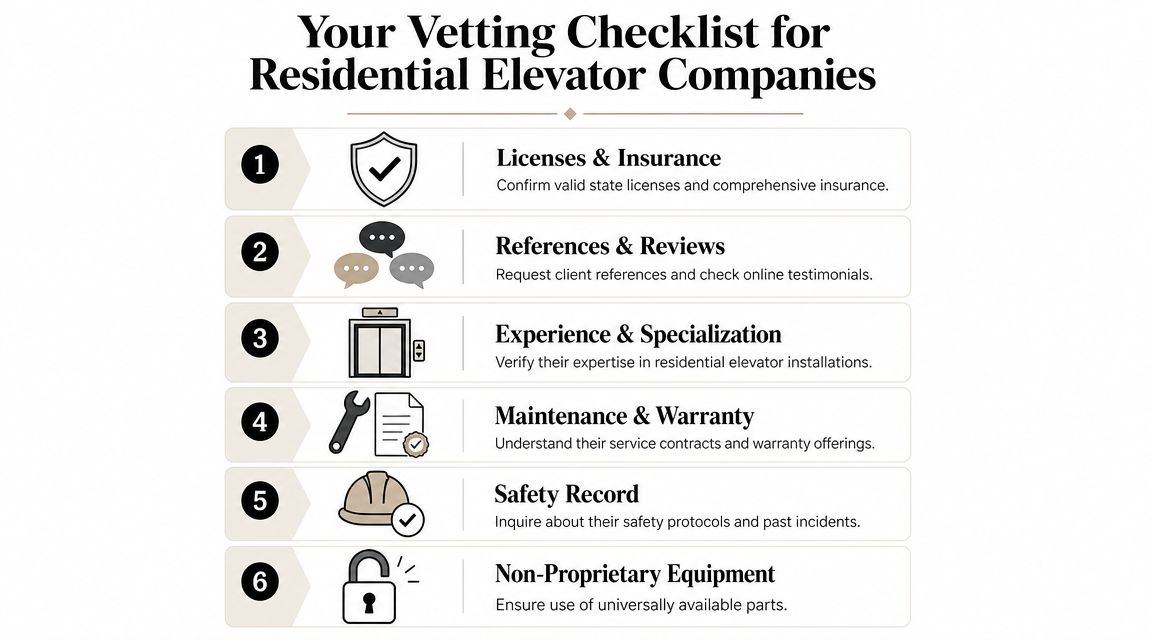
Use this checklist in your meetings and keep notes on each company's responses:
Verify licenses and insurance
Ask for current documentation, not verbal reassurance. A professional contractor should expect this request and handle it without friction.
Request recent local references
Ask for homeowners with similar projects. Then call them. Ask whether the final scope matched the proposal, whether service was responsive, and whether anything became a surprise after installation.
Find out what equipment they install
Don't stop at the brand name. Ask whether the system uses proprietary controls, parts, or diagnostic access. That answer affects your future bargaining power.
Review maintenance terms before you buy
Too many owners leave service questions until after the unit is installed. By then, your negotiating power is gone.
Ask how they handle code and accessibility decisions
This tells you whether they're advising you or just selling a box.
Clarify response expectations
Homeowners often focus on installation day and ignore what happens during a shutdown later. That's backwards.
Why non-proprietary matters so much
This is the issue most buyers miss.
A proprietary system can tie you to one installer or one manufacturer for parts, settings, software access, or specialized service procedures. That may not look like a problem on day one. It becomes a problem when response times slip, maintenance rates rise, or the original installer no longer supports your area.
A non-proprietary system gives you more freedom. More than one qualified provider can generally service it. That changes the ownership equation.
Owner mindset: Buy a system you can live with, not just one you can install.
For homeowners evaluating Michigan providers, it's worth reviewing how a contractor defines reliable elevator service and non-proprietary support before you assume all service models are the same.
Questions that reveal whether a company is thinking clearly
A good contractor should be able to walk you through practical decisions tied to reliability, accessibility, and emergency use. Guidance in the residential access market points to questions around backup power, emergency communication, maintenance response times, and space constraints, especially for aging-in-place and HOA-managed properties, as outlined in this residential accessibility and home-lift planning overview.
Ask questions like these:
- If power fails, what happens?
- How does the emergency communication setup work?
- What routine parts typically wear and how are they sourced?
- Can another qualified company service this later?
- What happens if the house layout limits shaft space or car size?
What a strong answer sounds like
The right company answers specifically. They explain what fits your home, what will require trade coordination, what may trigger code review, and what maintenance will look like after turnover.
The wrong company keeps steering the conversation back to finishes, broad promises, and “standard installs.”
Crane Elevator Company is one example of a contractor that publicly emphasizes non-proprietary modernizations and serviceable equipment across makes and models. That's the kind of detail worth noticing, because it speaks to how the company views ownership after installation, not just installation itself.
Decoding Your Elevator Quote and Site Inspection
A homeowner gets three quotes for a residential elevator. One is $28,000, one is $41,000, and one is $56,000. Six months later, those numbers often mean very little, because the actual difference was never the starting price. It was what each contractor included, what they left out, and whether the system can be serviced without locking the owner into one company.
A quote only has value if the site inspection was thorough. Home elevators touch framing, electrical service, floor penetrations, overhead clearance, pit requirements, finish work, and permit coordination. Until a contractor measures those conditions in person and explains what the house will and will not support, the quote is still a budget number.
What the price range actually tells you
Analysts at Retirement Living's home elevator market comparison found that residential elevator pricing spans a wide range. That should not push a homeowner to chase the low number. It should push them to compare scope line by line.
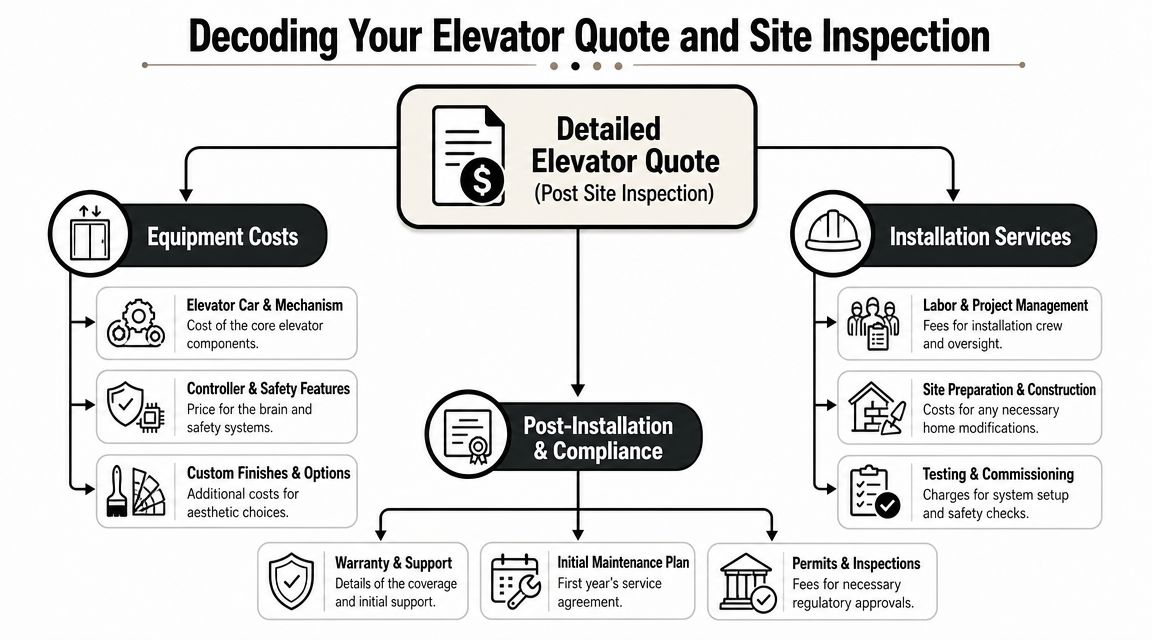
One proposal may include the elevator equipment, rail system, controller, installation labor, permit handling, startup, testing, and coordination with the electrician and carpenter. Another may price only the unit and basic set labor. The second quote looks cheaper because the missing work has not been priced yet.
That gap is where expensive mistakes start.
What a detailed proposal should spell out
A usable quote gives the owner enough detail to challenge assumptions before signing. If the proposal is vague, the contractor has room to charge later for work that should have been identified during the inspection.
Look for these categories:
| Quote area | What should be clarified |
|---|---|
| Equipment | Elevator type, model, drive system, controls, door style, safety devices, and finish allowances |
| Building work | Hoistway construction, pit depth, overhead needs, framing changes, drywall repair, and trim touch-up |
| Electrical | Voltage requirements, dedicated circuits, disconnects, phone line or communication setup, and who performs the work |
| Permits and inspections | Who pulls permits, who attends inspections, and what testing is included before turnover |
| Service and parts | Warranty terms, expected maintenance intervals, common wear items, and whether parts are proprietary or broadly available |
The last line matters more than many homeowners realize. A lower installation price can become the expensive option if the controller, door operator, or drive components can only be purchased through one manufacturer or one dealer network. Owners who want a clearer picture of long-term service exposure should review typical residential elevator maintenance costs and service factors before they approve a proposal.
Why quote comparisons often fail
The three-bid approach only works when the bidders are pricing the same job. In residential work, that often does not happen.
One contractor assumes a new hoistway. Another assumes the builder will provide it. One includes finish-grade doors. Another includes unfinished openings. One prices a non-proprietary setup that another elevator company can service later. Another prices a closed system that may limit future parts and service options. Those are not equal offers, even if the equipment looks similar in a brochure.
I tell homeowners to compare exclusions as hard as they compare totals. Exclusions are where the main risk sits.
What to watch during the site inspection
The inspection itself usually tells you how the project will go. A capable contractor does not spend the visit talking only about cab interiors and button styles. They check the structure, ask how the elevator will be used, and point out the parts of the house that will drive cost.
A productive site visit usually covers:
- Travel and usage: Number of stops, expected daily use, and whether the elevator needs to handle mobility equipment or groceries
- Physical constraints: Available shaft space, pit and overhead conditions, landing layout, and door swing conflicts
- Trade coordination: Electrical readiness, framing changes, drywall and finish impact, and permit path
- Machine and controller access: How a technician will reach serviceable components later without opening finished walls
- Parts strategy: Whether the system uses standard components that other qualified elevator companies can source and maintain
That last point separates a short-term sale from a sound ownership decision.
If the contractor cannot explain where the controller goes, how wear parts are replaced, who can service the unit later, or what conditions could trigger change orders, the proposal is incomplete. A polished quote with missing field detail still produces the same result. Delays, extras, and service headaches after the install is done.
Beyond Installation Planning for Maintenance and Financing
The install day gets the attention. Ownership is where the true cost shows up.
A residential elevator is a long-lived mechanical system. If you budget only for purchase and installation, you're planning for the easiest part. The harder part is keeping the unit reliable, serviceable, and safe without getting trapped by avoidable maintenance costs.
Why maintenance planning belongs in the buying decision
Industry guidance notes that installation can take about 7 to 14 days once site conditions are ready, but that excludes pre-installation preparation and permitting delays, according to this industry example on residential elevator installation timing. The bigger lesson isn't the install window. It's that owners often underestimate the work around the equipment itself, including inspections, electrical upgrades, and structural readiness.
The same underestimating happens after turnover.
Homeowners focus on getting the elevator in. They don't ask what routine visits include, who replaces wear items, whether the machine space gets cleaned, or how future repairs are priced. Then the first service issue lands and the cost structure becomes real.
What a useful maintenance conversation sounds like
Before you sign, ask for practical detail, not marketing language.
A maintenance discussion should address:
- Preventive visits: What technicians inspect and what they adjust on each visit.
- Cleaning scope: Whether the pit, machine area, and other service spaces are part of routine care.
- Wear items: Which components commonly need replacement and how sourcing is handled.
- Call response: How service requests are scheduled and what happens in urgent situations.
For homeowners trying to map total ownership expense, a focused review of residential elevator maintenance cost factors helps frame the difference between predictable preventive service and chaotic repair spending.
Cheap maintenance usually becomes expensive ownership.
Financing should follow scope, not wishful thinking
Some homeowners ask about financing before they've nailed down the full project scope. That puts the cart in front of the horse. Finance the complete job, not an optimistic equipment-only number.
A realistic ownership budget should consider the elevator, site preparation, permit-related work, startup, and ongoing service expectations. If you finance only the visible equipment and ignore the surrounding work, the project can feel affordable right up until the change orders arrive.
That's why maintenance planning is part of procurement, not an afterthought. The total cost of ownership matters more than the sale price because the elevator stays with the house long after the install crew leaves.
Partnering with a Trusted Michigan Elevator Expert
A homeowner usually sees the true difference between contractors after the sales conversation ends. One company keeps the discussion on cab finishes and a base price. The better company gets into service access, parts availability, who will maintain the unit five or ten years from now, and what happens if the original installer is no longer in the picture.
That is the standard.
What good partnership looks like
A good residential elevator company helps you buy an asset you can live with for years. That starts with clear scope, realistic site conditions, and direct answers about service after turnover. It also means the contractor is willing to explain the trade-offs between equipment options instead of steering every homeowner to the same package.
The strongest partners are also comfortable talking about what can go wrong. They point out where a proposal depends on proprietary parts, limited technician access, or brand-specific service tools. Those details matter more than a polished brochure because they shape your long-term ownership cost.
I tell homeowners to pay attention to how a contractor handles hard questions. If you ask whether another qualified elevator company could service the system later, you should get a straight answer. If you ask which parts are off-the-shelf and which come only from one manufacturer, you should get a straight answer there too.
Why local expertise matters in Michigan
In Michigan, local experience shows up in the field, not in slogans. Older homes, retrofits, seasonal conditions, trade coordination, and permit expectations all affect how accurately a company can scope the job. A contractor who works in the area regularly is more likely to spot access issues, structural constraints, and service coverage problems before they turn into change orders.
That local service footprint matters after installation too. An elevator is not a one-day purchase. It is a system that will need inspections, adjustments, wear-part replacement, and occasional troubleshooting. If the company that sold it cannot support it consistently, the homeowner absorbs the cost in downtime, delayed repairs, and fewer options.
The best time to test a contractor is before you sign anything. Ask them to review another quote. Ask what is excluded. Ask how they handle non-proprietary modernization and whether they will put service expectations in writing.
If you're evaluating residential elevator companies near me in Lower Michigan, Crane Elevator Company is available for consultations, quote reviews, and second opinions. The company serves homeowners and property managers with installation, maintenance, inspection, repair, and non-proprietary modernization support designed around long-term serviceability.