If you're managing a building in Detroit, Ann Arbor, Lansing, Flint, or Kalamazoo, you already know the pattern. The elevator goes down, tenants complain, staff starts making calls, and the service visit fixes the immediate problem. Then the same car drops out again a few weeks later.
That isn't reliability. That's an expensive loop.
A reliable elevator company doesn't just answer the emergency line. It helps you control downtime, keep the unit compliant, avoid getting trapped in a proprietary service model, and make sensible decisions about repair versus modernization. In Michigan, where many properties are running a mix of older hydraulic units, traction elevators, freight cars, lifts, and partial upgrades from different eras, that distinction matters.
Beyond the Emergency Call What True Elevator Reliability Means
Most owners start judging an elevator contractor after a shutdown. That's understandable, but it's incomplete. Fast response matters. It just isn't the whole job.
Your elevator is a long-life building asset. The global elevator market was valued at USD 79.06 billion in 2024 and is projected to reach USD 116.14 billion by 2030, while the U.S. market is expected to grow at a 5.4% CAGR according to Grand View Research's elevator market outlook. For a commercial property manager, that means elevators aren't a side system. They're part of a large, ongoing infrastructure market that depends on maintenance, modernization, inspections, and lifecycle planning.
Reliability is operational, not promotional
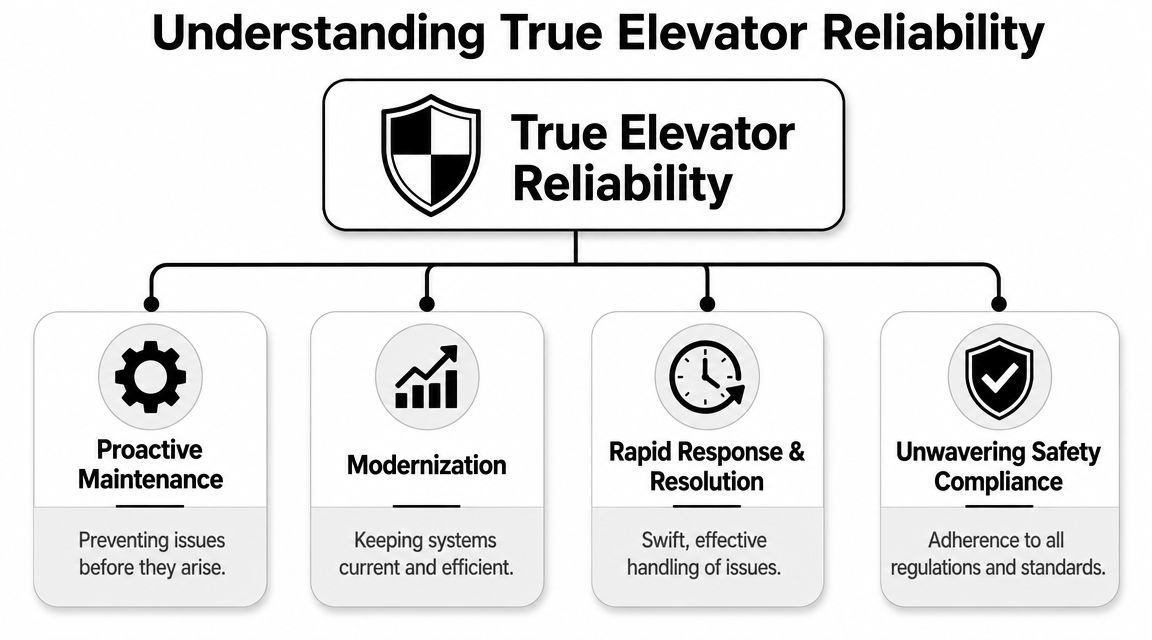
A lot of companies describe themselves as reliable because they offer service calls and preventative maintenance. That's too vague. In practice, reliability means four things working together:
- The unit runs consistently: People can use it without repeated shutdowns, nuisance faults, or door problems.
- The maintenance program catches wear early: Technicians don't just reset faults and leave.
- The equipment stays compliant: Safety devices, communication systems, and emergency functions have to match current expectations.
- The owner keeps long-term control: You can get parts, service, and modernization options without being boxed into one vendor.
A reliable elevator company should lower your dependence on emergency calls over time, not just get good at billing for them.
In Michigan commercial buildings, poor reliability usually shows up in predictable ways. Door issues keep recurring. Leveling drifts. A hydraulic unit starts leaking or riding rough. A traction car starts tripping faults no one fully explains. Then the contractor blames age, but never gives you a real asset plan.
What good reliability looks like on the ground
When a contractor is doing the job right, you see it in the records and in the building.
You get service reports that identify patterns. You get a clear answer on whether the controller, door operator, communication system, and safety devices are still supportable. You get practical advice on what should be repaired now, what should be budgeted next, and what should be modernized before it becomes a crisis.
That matters for tenant satisfaction, but it also affects cost control and liability. In hospitals, schools, municipal buildings, industrial facilities, and multifamily properties, repeated downtime creates operational problems quickly. A service partner who only reacts to outages leaves you exposed on all fronts.
Your Vetting Checklist for Michigan Elevator Providers
Before you compare prices, verify whether the company is even built to support your equipment properly. A low monthly number doesn't help if the contractor can't service your controller, won't touch another manufacturer's system, or sends different technicians every visit with no continuity.
Start with the non-negotiables
Ask for documentation first. Not later.
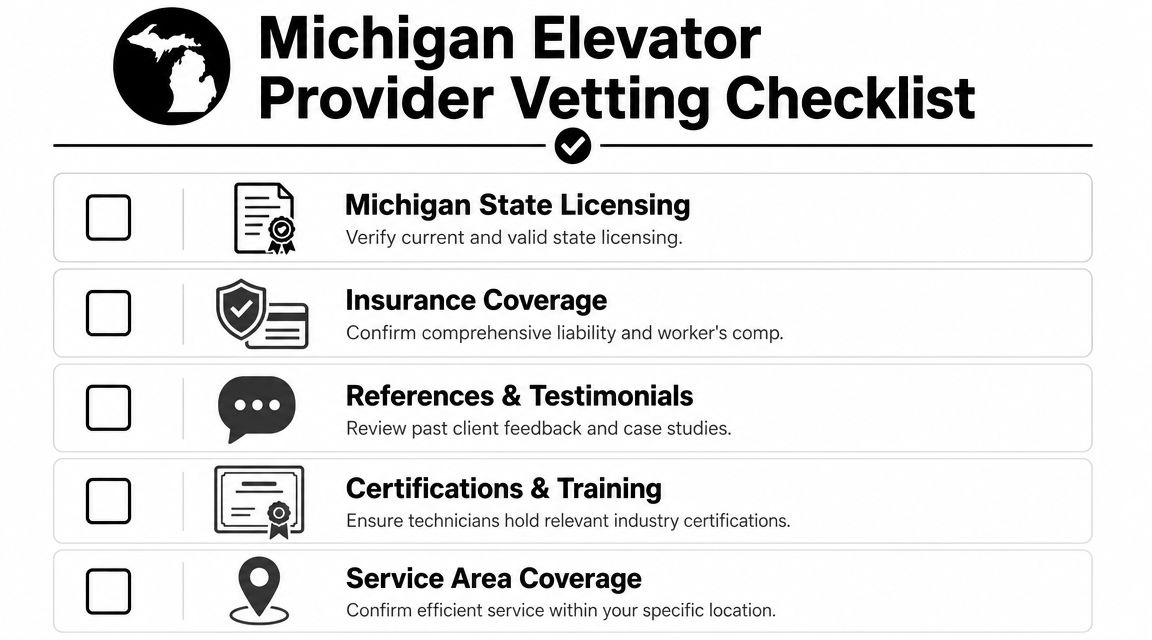
- State licensing: Verify that the company and technicians are properly licensed for elevator work in Michigan.
- Insurance: Confirm general liability and workers' compensation coverage.
- Local service footprint: Ask where their field technicians are based and which Lower Michigan cities they routinely cover.
- References on similar equipment: A hospital hydraulic unit, a downtown freight elevator, and a suburban office traction car are not the same assignment.
- Inspection and testing capability: Make sure they can support required testing, code work, and violation correction, not just repairs.
If you manage properties across Detroit, Ann Arbor, Lansing, Flint, or Kalamazoo, ask how they dispatch across that geography. A company may claim statewide coverage while relying on long-drive subcontracted response.
The overlooked issue is proprietary lock-in
Many owners make a costly mistake when they buy into a maintenance agreement that looks fine on paper, but the equipment or software ends up tied to one service ecosystem.
The practical problem is simple. If only one provider can access the controller logic, diagnostic tools, or replacement parts without delay, your negotiating position disappears. You may still have a working elevator, but you no longer control the asset.
A key but often missed reliability factor is non-proprietary serviceability. One industry discussion tied this issue to a market projected to reach $97.7 billion in 2024, noting that universal parts and software can reduce vendor lock-in over the life of the unit, as discussed in Rise Elevator's review of non-proprietary elevator serviceability.
If you can't switch qualified service providers without replacing controls or losing access to diagnostics, the equipment isn't giving you full ownership value.
One example to look at is Michigan elevator maintenance support from Crane Elevator, which is described as non-proprietary across all makes and models. Whether you choose that route or another independent provider, the point is the same. Ask if another qualified elevator company could service the equipment in five, ten, or twenty years.
Questions to settle before the first meeting
Use this short screen before you invest time in interviews:
| Checkpoint | What you want to hear | What should concern you |
|---|---|---|
| Equipment coverage | They service multiple makes and older systems | They mostly support one line or push replacement immediately |
| Parts strategy | They explain parts sourcing for legacy and current units | They give vague answers about availability |
| Records | They can review breakdown history and maintenance logs | They want to quote without seeing service history |
| Territory | They name Michigan cities and response approach clearly | They speak generally about broad coverage |
| Modernization philosophy | They discuss phased, code-driven planning | They jump from repair straight to total replacement |
A reliable elevator company should be easy to verify before it is easy to hire.
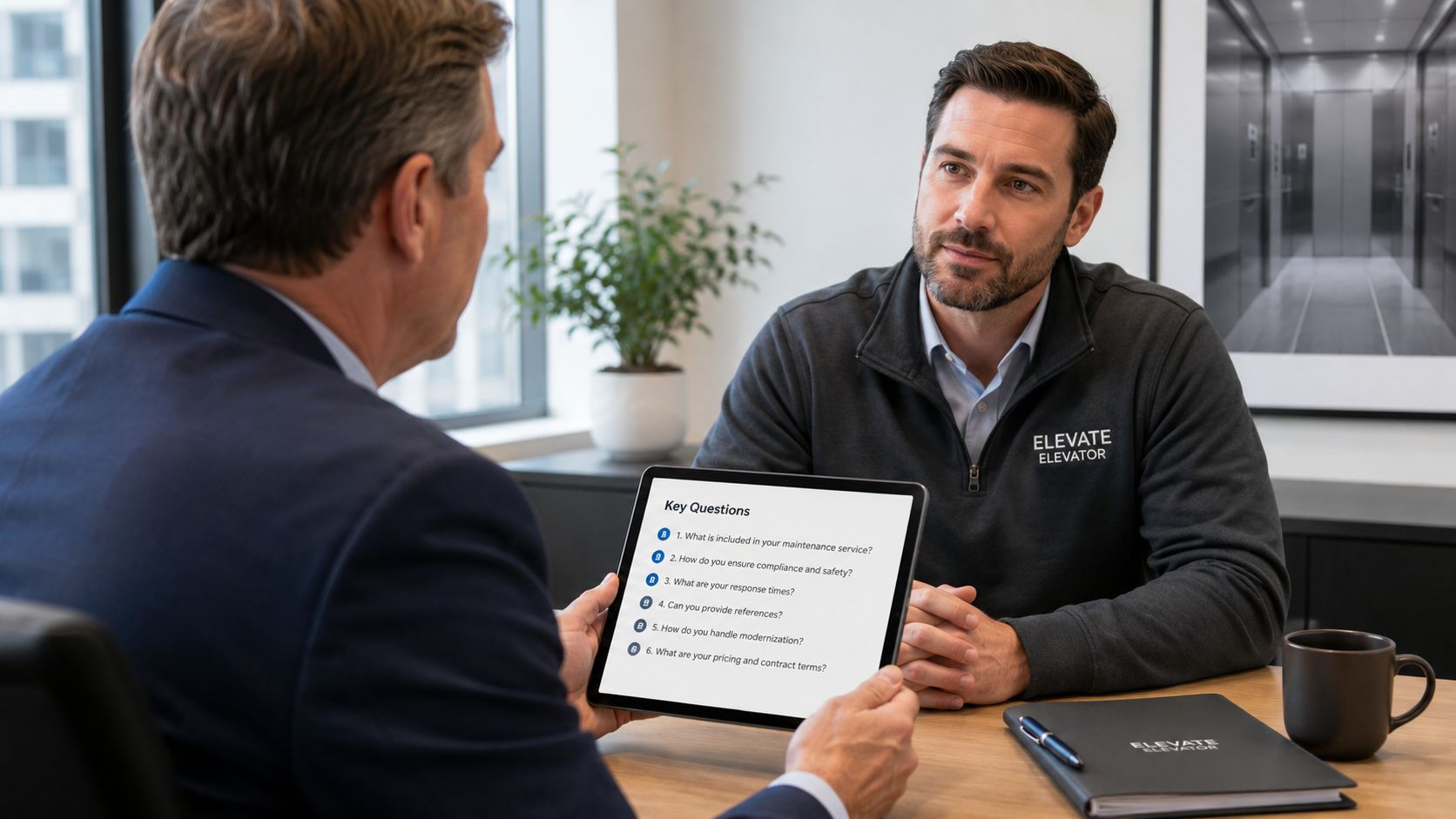
Key Interview Questions to Ask Potential Companies
Documentation tells you whether a company is legitimate. The interview tells you how it thinks.
Ask direct questions. Then listen for whether the answers sound operational or rehearsed.
Ask how they handle recurring failures
A useful question is: What do you do when the same elevator has repeat shutdowns over several months?
A strong answer includes log review, callback pattern analysis, inspection of wear components, and a decision tree for repair versus modernization. A weak answer stays generic and focuses on “getting someone out there.”
Another good question is: How do you support older equipment when parts are hard to find?
You want to hear specifics about cross-compatible parts, retrofit options, and controller or door operator strategies. A red flag is immediate pressure to replace the whole system without explaining intermediate options.
Ask who owns the long-term service path
Use questions that expose lock-in and contract behavior:
- Can another qualified provider service the equipment after your modernization work?
- Will I have access to documentation, diagnostics, and parts information?
- Do you recommend proprietary or non-proprietary controls, and why?
The strongest companies answer these without defensiveness. They explain trade-offs. Sometimes a proprietary package may fit a specific application, but they should be honest about what that means for future service flexibility.
Field rule: If a contractor dodges basic questions about parts access, software access, or future serviceability, assume the lock-in is intentional.
Ask what happens during a serious outage
You also need to know how they think under pressure. Ask: Walk me through a major component failure at my building. Who responds, what gets inspected first, and how do you communicate status?
A good answer includes site safety, diagnosis, temporary building operations, parts lead discussion, and written follow-up. A poor answer talks only about dispatch.
This short video is worth reviewing before those conversations because it helps frame what owners should expect from a maintenance partner:
Ask for examples from your type of property
Not every contractor is equally strong in every building class. Ask where they have experience with:
- Healthcare facilities: emergency operation matters
- Schools and municipal buildings: downtime creates public-facing complaints fast
- Industrial or freight applications: abuse patterns and load issues are different
- Multifamily and HOA properties: recurring nuisance calls can overwhelm management staff
If they answer with general confidence but no practical detail, keep looking. A reliable elevator company should sound like it has solved your kind of problem before.
Decoding the Service Contract and SLA
A polished proposal can still hide a weak service agreement. Here, owners lose control. The contract decides what the vendor must do, what counts as excluded work, how emergency calls are handled, and whether “preventative maintenance” means real inspection or just a monthly appearance.
The first thing to test is whether the agreement defines service in measurable terms. “Priority response” is marketing language unless the contract tells you what qualifies as an emergency, what the response expectation is, and what happens if the provider misses it.
What the SLA must cover
True reliability extends to emergencies. In the United States, NOAA reported 27 billion-dollar weather disasters in 2024, and that raises the stakes for outage readiness and recovery planning, as noted in Mountain Town Elevator's discussion of emergency-focused elevator reliability. A serious SLA should address generator operation, emergency phones, fire service, and related resilience checks because those are high-cost failure points during outages and building emergencies.
The most important SLA question isn't “How fast do you arrive?” It's “What exactly do you test, document, and guarantee before the next outage happens?”
Read every exclusion closely. “Full coverage” can still exclude door equipment, controller components, communication devices, lighting, code-required updates, and after-hours labor. That isn't full coverage in any practical sense.
A strong contract should also spell out routine tasks, reporting standards, billing rules for extra work, and who authorizes repairs above a threshold. If it doesn't, you'll end up arguing over every callback.
Essential Elevator Contract Terms Checklist
| Contract Term | What to Demand | Why It Matters |
|---|---|---|
| Emergency response | Written definition of emergency calls and the expected response standard | Prevents vague promises after a shutdown |
| Preventative maintenance scope | A task list, not just visit frequency | Tells you what technicians actually inspect and service |
| Exclusions | Clear list of parts, labor categories, and code items not covered | Avoids surprise invoices |
| Testing and documentation | Written records for inspections, callbacks, and recommendations | Gives you evidence for asset planning and accountability |
| Resilience checks | Generator operation, emergency phone, fire service, and related safety function testing | Reduces outage risk during real building events |
| Pricing for extras | Defined labor rates, parts markup approach, and approval thresholds | Protects budget control |
| Technician continuity | Commitment to service consistency where possible | Reduces repeated diagnosis time |
| Missed visit policy | Consequence if scheduled maintenance isn't performed | Stops pay-for-paper maintenance |
Watch for soft language
Owners should be wary of phrases like “as needed,” “industry standard,” and “at contractor discretion” if they aren't paired with specifics. Those terms usually give the provider flexibility while giving you very little recourse.
If you're comparing contracts, it helps to review a sample lift maintenance contract structure so you can see what should be clearly addressed in writing. You don't need legal jargon. You need operational clarity.
Evaluating a Proactive Maintenance Program
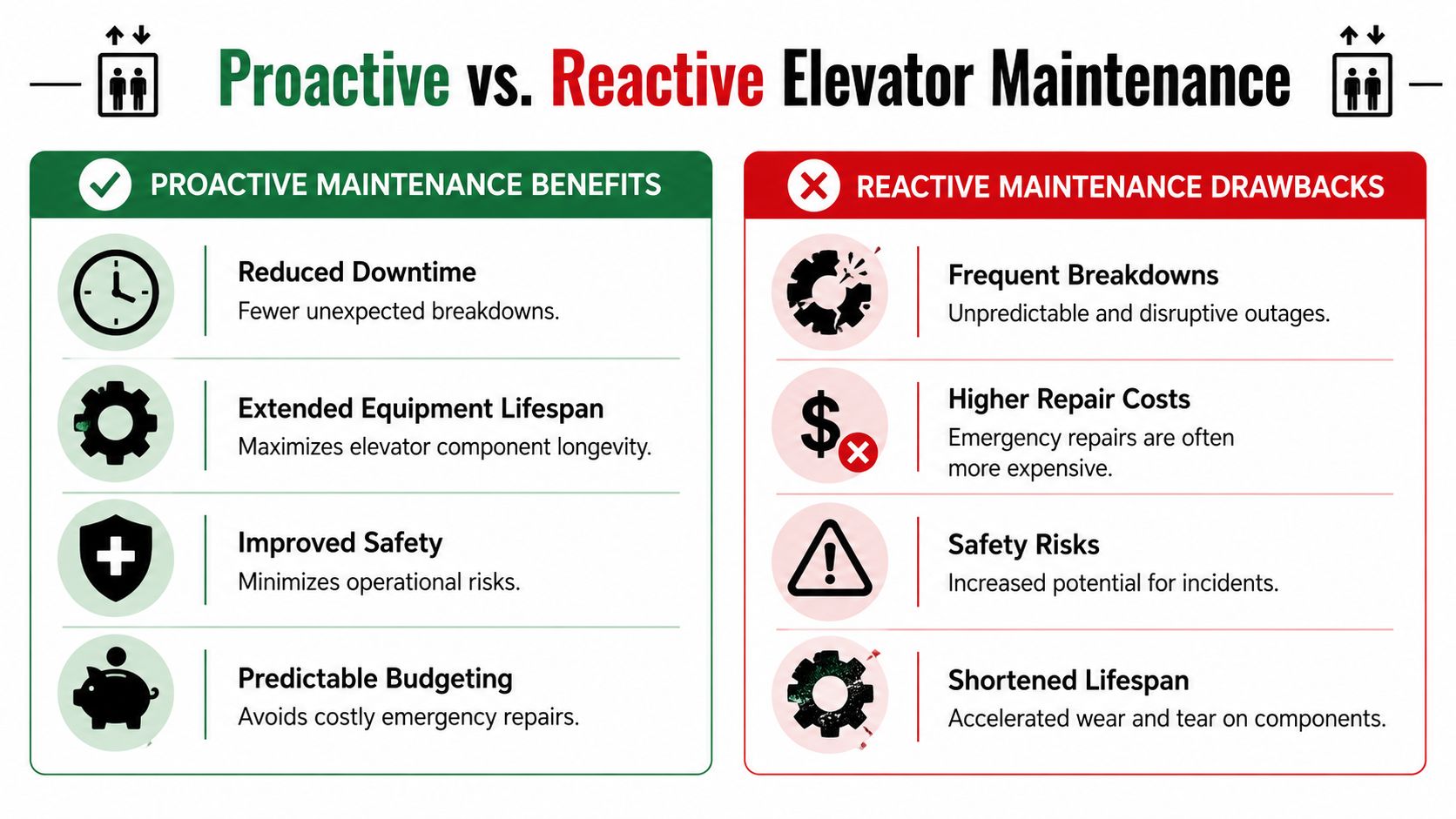
A weak maintenance program looks busy on paper. A strong one changes the failure pattern of the equipment.
The practical benchmark many mechanics and consultants use is straightforward. An elevator with no more than two breakdowns per year can be considered reliable, and that standard depends on periodic inspection of ropes, rope tension, elongation, pulley groove condition, rope diameter reduction, and brake setting, according to Elevator World's discussion of elevator reliability benchmarks. If your current program isn't driving performance toward that range, it isn't doing enough.
Reactive service costs more than it looks
Reactive maintenance feels cheaper because the monthly contract rate may be lower. Then the hidden costs show up:
- Repeated tenant disruption: building staff keeps handling the same complaints
- More emergency labor: after-hours calls pile up
- Misdiagnosis risk: intermittent faults stay unresolved
- Faster wear: components run out of tolerance while everyone waits for a bigger failure
That pattern is common with door systems, worn hydraulic components, neglected pits, dirty machine rooms, and aging traction equipment that never gets trended properly.
What a proactive program includes
A serious maintenance plan should go beyond lubrication and quick visual checks. It should include building-specific work that reduces nuisance calls and catches wear before shutdowns.
Look for programs that include:
- Full clean-downs: machine room, pit, and car top cleaning matter because dirt, oil, debris, and moisture accelerate failures and hide developing issues.
- Wear tracking: ropes, brakes, sheaves, hydraulic components, and door equipment need periodic condition review, not just “check okay” notes.
- Minor recurring-item service: COP and PI light replacement, communication checks, and adjustment of small but visible issues prevent a lot of tenant complaints.
- Testing discipline: emergency phones, fire service, and related safety functions should be part of routine oversight.
- Attendance accountability: if the contract says monthly maintenance, the building should be able to verify that it happened.
One maintenance model in Michigan is the approach used by Crane Elevator, which includes non-proprietary service, full clean-downs of machine rooms, pits, and car tops, COP and PI bulb replacement, and a No Show, No Pay policy. Those details matter because they turn maintenance from a checklist into an accountability system.
A proactive maintenance visit should leave the elevator in better operating condition than it was before the mechanic arrived. If the visit only generates paperwork, the building is paying for appearances.
Compare the two approaches honestly
| Maintenance Style | What usually happens | Long-term result |
|---|---|---|
| Reactive plan | Calls drive the work | Unpredictable cost and recurring outages |
| Proactive plan | Inspections drive the work | Better reliability, cleaner records, fewer surprises |
If your provider can't explain exactly how it reduces recurring callbacks, you don't have a proactive program. You have dispatch coverage.
Navigating Modernization and Code Compliance
At some point, maintenance stops being the full answer. Parts become inconsistent. Callbacks increase. Safety functions no longer match current expectations. That's when a reliable elevator company should stop selling you piecemeal repairs and start talking plainly about modernization.
Modernization isn't just about ride quality or appearance. Reliable operation depends on current safety features, and code compliance often requires upgrades such as automatic emergency brakes, battery backups, and updated communication systems, as outlined in Moseley Elevator's guidance on safety-focused modernization. The big mistake is partial modernization that leaves legacy controls or communication hardware in place. That can preserve hidden failure modes even after you've spent real money.
Signs it's time to modernize
Some triggers are obvious. Others are easier to miss until costs stack up.
- Parts obsolescence: repairs take too long because support is fading
- Repeat shutdowns: the same faults keep returning after service
- Code pressure: required updates start forcing decisions
- Mixed-generation equipment: one new component is being asked to carry an outdated system
- Operational risk: emergency communication, braking, or backup features no longer inspire confidence
For many Michigan properties, the best move is a planned, non-proprietary modernization. That keeps future service options open and reduces the chance that one controller decision today locks the owner into one vendor tomorrow.
Financing is part of the technical decision
Owners often delay modernization because they treat it as a sudden capital hit. That's understandable, but it usually leads to worse timing and weaker negotiating power.
A better approach is to scope the work early, compare phased versus full modernization, and review financing options while the elevator is still operating. If you're assessing that path, elevator modernization services in Michigan can give you a practical reference point for what a modernization package may include, from controls to safety devices and related code work.
The cheapest year to modernize is often the year before the equipment forces your hand.
A planned upgrade protects uptime, helps with compliance, and gives building management something it rarely gets during a failure cycle: control over schedule and budget.
If you're reviewing elevator service in Lower Michigan and want a second opinion on maintenance, repairs, code issues, or modernization, Crane Elevator Company is one option to contact. They serve commercial and residential properties across Southern Michigan with non-proprietary maintenance, repair, inspection support, and modernization services for all makes and models.