If you're dealing with an elevator that keeps dropping out of service, trapping tenants in long waits, or generating repair invoices that feel more frequent than rent checks, you're not looking at a simple maintenance nuisance anymore. You're looking at an aging building system that can start affecting occupancy, reputation, and day-to-day operations.
That's where elevator modernization services come in. For many Michigan owners, especially in active office, residential, healthcare, municipal, and mixed-use buildings, modernization is the practical middle path between constant patchwork repairs and full replacement. It keeps the hoistway and much of the existing structure, but upgrades the parts that drive reliability, safety, and ride performance.
Is Your Elevator Becoming a Liability
Most owners wait too long to ask the hard question. They keep approving repairs because each individual repair seems cheaper than a modernization project. Then the pattern sets in. A door issue this month. A controller fault next month. A leveling complaint after that. Before long, staff are apologizing to tenants, managers are fielding complaints, and the elevator has become part of the building's problem list instead of part of its value.
That's usually the point where the conversation changes from “Can we fix this again?” to “What's the long-term plan?”
The signs owners usually see first
The earliest warning signs aren't always dramatic shutdowns. More often, they show up as recurring friction:
- More callbacks: The elevator returns to service, then develops another fault soon after.
- Door problems: Doors hesitate, reopen, slam, or fail to close cleanly.
- Poor leveling: The car stops unevenly at the floor, which creates both inconvenience and risk.
- Longer waits: Dispatching gets sluggish, especially during busy periods.
- Tenant frustration: People stop trusting the equipment, even if it still technically runs.
Those are operational symptoms, not cosmetic ones. Once they become routine, repair-only thinking usually gets expensive.
Practical rule: If the same elevator is creating repeated service interruptions, the problem is often systemic. Replacing one worn part at a time won't fix an outdated control package, tired door equipment, or mismatched components.
Modernization is no longer a niche decision made only by very large properties. It's a broad industry response to aging building infrastructure. The global elevator modernization market was estimated at USD 9.46 billion in 2024 and is projected to reach USD 14.11 billion by 2033, according to IMARC Group's elevator modernization market outlook.
Why this matters in Michigan
In places like Troy, Birmingham, and Fenton, building owners face a practical mix of pressures. Older equipment still has to serve active tenants. Code compliance still matters. Downtime still disrupts operations whether the property is a medical office, apartment building, school, municipal facility, or commercial site.
Michigan owners also tend to think in terms of useful life and serviceability. That's where a non-proprietary modernization approach matters. If you modernize with equipment that any qualified provider can reasonably support, you reduce the risk of getting locked into one service path later.
A family-owned contractor serving Lower Michigan, Crane Elevator Company handles non-proprietary modernization, repair, maintenance, inspections, and testing across many building types. That kind of local service model matters when you need practical sequencing, realistic outage planning, and field support that fits an occupied building instead of a brochure.
How Your Elevator Works A Plain-English Guide
Owners make better modernization decisions when they understand the basic system they already have. You don't need to think like a mechanic. You just need to know what kind of machine is moving people in your building and why certain parts fail the way they do.
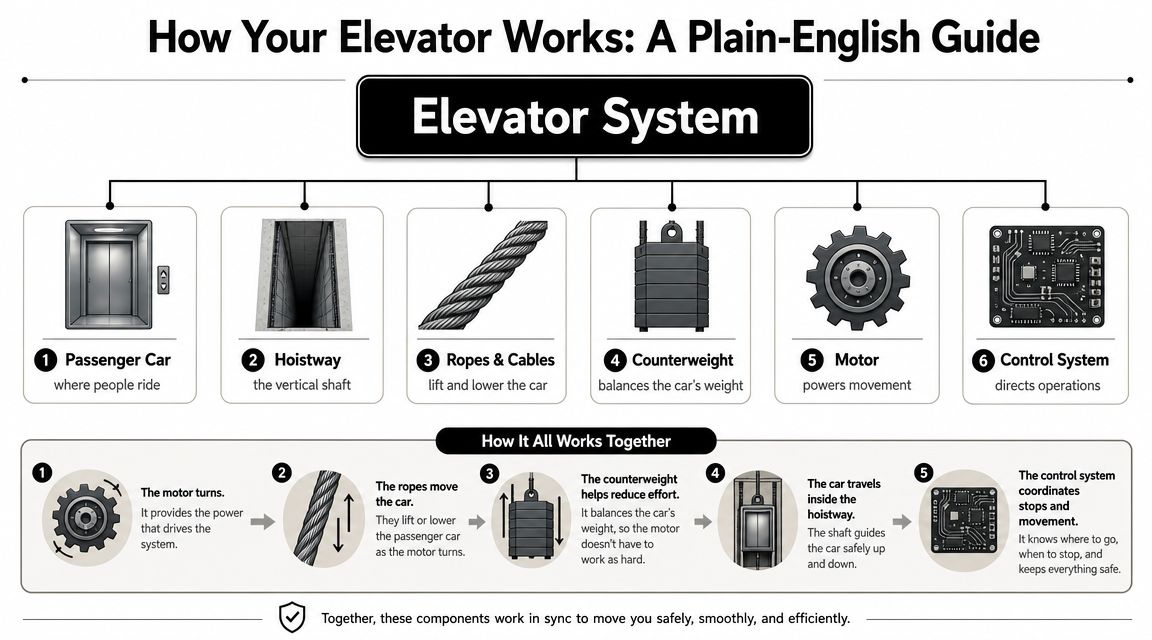
The simplest way to think about an elevator is this. The car doesn't move on its own. A control system tells the machinery what to do, the machinery moves the car, and the doors control access safely at every stop.
The basic parts
A typical elevator system includes these major elements:
- Passenger car: The part people ride in.
- Hoistway: The vertical shaft the car travels through.
- Ropes and cables: These lift and lower the car on many systems.
- Counterweight: This balances the car on traction elevators.
- Motor or machine: This provides the force that moves the elevator.
- Control system: This acts like the brain, deciding where the car goes and how it responds.
If one of those systems weakens, owners usually notice symptoms long before they hear a technical diagnosis. Slow starts, rough stops, poor floor leveling, nuisance shutdowns, and stubborn doors all point back to one of these core assemblies.
The main elevator types
Not every elevator works the same way. Most building owners in Michigan will run into one of these common system types.
| System Type | Typical Use | Key Advantage | Key Disadvantage |
|---|---|---|---|
| Traction | Mid-rise to taller buildings | Smooth travel and efficient movement over more floors | More complex equipment and controls |
| Hydraulic | Low-rise buildings | Strong fit for shorter-rise applications | Slower travel and more machine-room equipment |
| Machine-Room-Less (MRL) | Buildings where space is tight | Saves dedicated machine-room space | Equipment access and future service planning require care |
Traction elevators
A traction elevator works a lot like a controlled pulley system. The motor turns a sheave, the ropes move, the car rises or falls, and a counterweight helps balance the load. That balance is part of what makes traction systems well suited to buildings with more travel and heavier daily use.
Owners usually like traction systems because they can deliver a smoother ride and better handling across more floors. The trade-off is that traction systems depend heavily on good controls, properly matched drives, healthy door equipment, and well-maintained machine components.
A traction elevator can still “run” while performing poorly. Owners often mistake that for acceptable service until complaints pile up.
Hydraulic elevators
A hydraulic elevator works more like a powerful lifting mechanism. Instead of using a counterweight in the same way as traction, it raises the car using hydraulic force. These systems are common in lower-rise properties because the travel requirements are different.
Hydraulic units can be practical and durable, but aging hydraulic equipment can become noisy, slow, or less predictable over time. If the controller and door equipment are outdated, owners often feel the problem first in reliability rather than raw lifting ability.
Machine-Room-Less systems
MRL elevators place key equipment in or near the hoistway instead of relying on a separate machine room. For some buildings, that saves space and helps the original design.
From an ownership standpoint, the main issue isn't whether MRL is “good” or “bad.” It's whether the system was designed and modernized in a way that remains serviceable over time. Access, diagnostics, replacement parts, and vendor flexibility all matter.
Key Components and Common Failure Points
A building owner in Troy or Birmingham usually calls us after the same pattern shows up. Tenants complain about long waits, the elevator mislevels once in a while, the doors start acting up, and service calls get more frequent. The elevator still runs, but the risk is no longer theoretical. It is starting to affect tenant confidence, staff time, and budget planning.
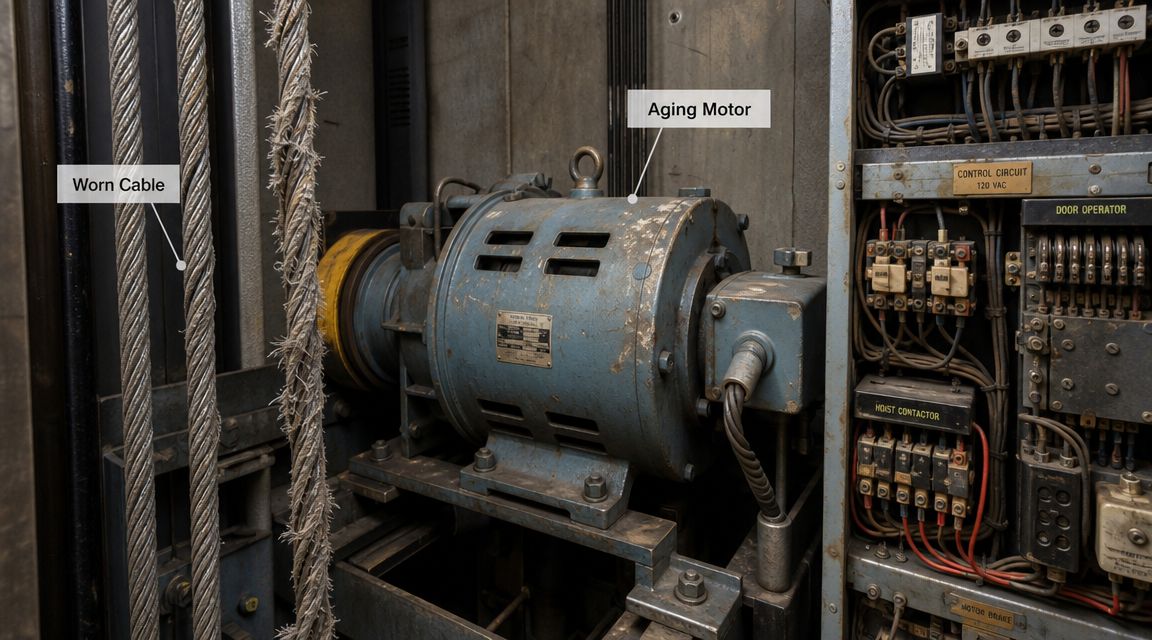
That usually points to a few core components, not the whole system at once. Elevators age unevenly, and the cost problem often comes from one failing subsystem forcing stress onto the others.
The controller
The controller handles calls, movement, stopping, and fault logic. When it starts to age out, especially on older relay or analog equipment, the first sign is usually inconsistent performance rather than a total shutdown.
Common symptoms include:
- Missed or delayed calls
- Rough or inaccurate floor leveling
- Random shutdowns or nuisance faults
- Slower response during busy periods
In practical terms, an old controller can make a usable elevator feel unreliable every day. For Michigan owners trying to control costs, this is often one of the best places to start because a controller upgrade can improve performance across the whole system without forcing a full rip-out. It also gives owners more flexibility if they choose a non-proprietary elevator modernization approach that avoids getting locked into one manufacturer for future parts and service.
The machine and drive
The machine, motor, and drive package do the lifting and stopping. When wear builds up here, tenants usually notice noise first. Then the ride gets rough, starts and stops get less controlled, and callbacks increase.
Typical warning signs are easy to spot:
- Jerky starts or stops
- More vibration or machine noise
- Slower travel than the building needs
- Repeat service tied to motion or drive faults
There is a real trade-off here. Some older machines can stay in service if the core mechanical condition is still good and the modernization scope is planned carefully. In other cases, keeping a worn machine just pushes cost into repeat repairs and lost uptime. For a mid-rise office building in places like Fenton, phased modernization often makes sense. Upgrade controls and door equipment first, then address the machine or drive once the budget cycle allows.
Door equipment
The door operator and related door hardware take constant abuse. More shutdowns start at the doors than many owners realize. If the doors hesitate, reverse for no clear reason, drag, or fail to close cleanly, the car cannot stay in reliable service.
Field experience is key. Owners often focus on ride quality because that is what tenants mention. Mechanics spend a lot of time on doors because daily service problems often begin with them.
Door equipment is also one of the smartest phased upgrades for older Michigan properties. In occupied buildings, replacing door operators, tracks, hangers, and protection devices can reduce nuisance callbacks without the cost and disruption of a full modernization all at once.
Safety devices and wiring
Brakes, governors, interlocks, traveling cables, and older wiring rarely get attention until faults become intermittent and hard to trace. Those are expensive problems because troubleshooting takes time, and time on an old system adds up fast.
This is also where older repairs can come back to haunt an owner. Over the years, many elevators pick up mismatched parts, spliced wiring, and temporary fixes that stayed in place too long. Once that happens, each new failure gets harder to diagnose. For Michigan buildings facing state inspection pressure or planning capital work around occupancy, that is often the point where selective repairs stop being the low-cost option.
When to Modernize Instead of Just Repairing
Repairing an elevator makes sense when the equipment is sound and the problem is isolated. Modernizing makes sense when the failures are recurring, the parts are aging out together, and each new repair only buys a little more time.
That decision usually becomes clearer once the building owner stops asking, “Can it be fixed?” and starts asking, “How long will this stay fixed?”
The age benchmark matters
Industry guidance places the average lifespan of an elevator at about 20 to 25 years, after which owners typically face a choice between modernization and full replacement, as outlined in ATIS guidance on elevator modernization best practices.
That doesn't mean every elevator needs a full modernization the day it reaches that age. It means the system has entered the stage where capital planning should replace reactive thinking. Controllers, doors, machine components, wiring, and fixtures often don't age on the same schedule, but by that point enough wear has usually accumulated that repeated repairs stop being efficient.
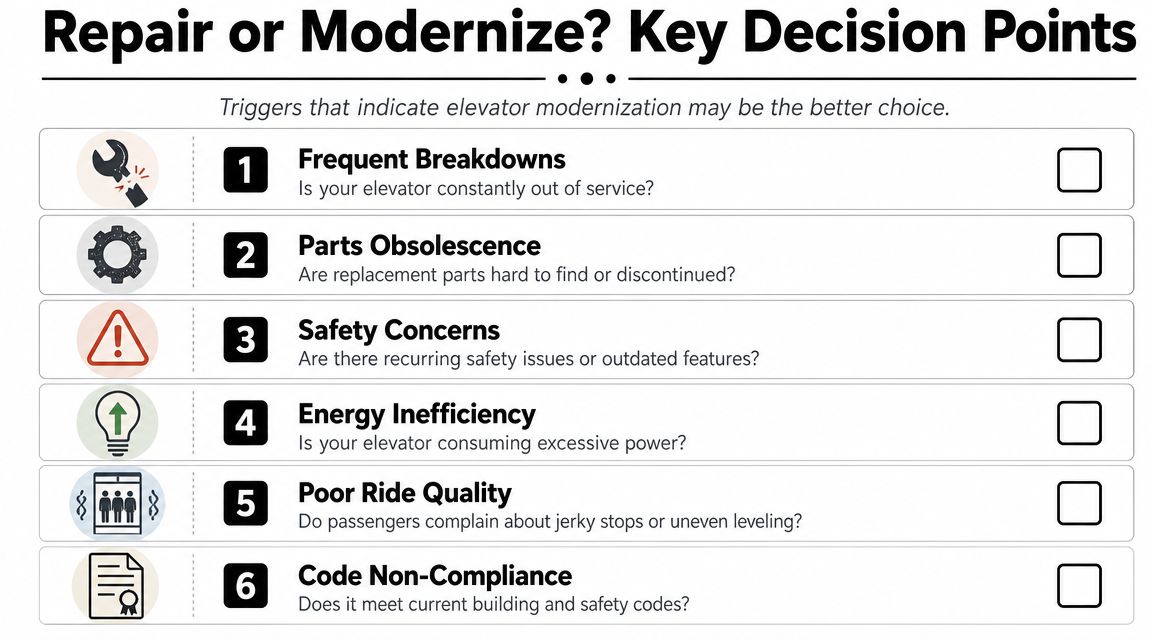
Six signs the repair cycle is no longer working
- Frequent breakdowns: Service is repeatedly interrupted, and tenants have started noticing a pattern.
- Parts obsolescence: Replacements take longer to source, or available parts are rebuilt stopgaps rather than dependable long-term solutions.
- Safety concerns: The unit may still run, but recurring faults and outdated features increase ownership risk.
- Energy inefficiency: Older controls and drives often operate less efficiently than modern equipment.
- Poor ride quality: Jerky starts, rough stops, and inaccurate leveling are usually symptoms of deeper equipment age.
- Code pressure: A repair may restore operation without bringing the system up to the level owners need.
Where owners often make the wrong call
The most expensive choice is often the one that feels cheaper month to month. Owners approve another repair because the elevator is needed immediately. Then another. Then another. The building ends up paying for emergency response, repeated tenant disruption, and extended uncertainty.
A better decision framework is to compare repair spending against expected reliability after repair. If the answer is “we still don't trust it,” modernization is usually the right conversation.
For owners who want to avoid future vendor lock-in while making that decision, non-proprietary elevator modernization options are worth understanding early. The equipment choice you make now affects service flexibility later.
What Elevator Modernization Actually Includes
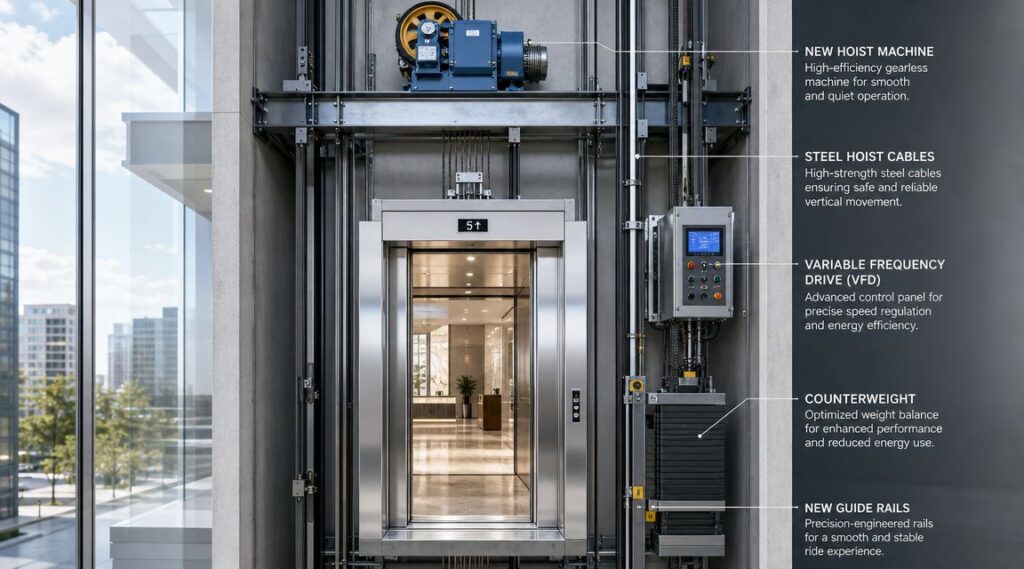
A lot of owners in Michigan hear "modernization" and assume it means swapping one bad part for a new one. In the field, that approach usually wastes money. A modernization project works best when it replaces the group of components that have to operate together every day, while keeping the hoistway, rails, and other major building elements that still have useful life.
The usual modernization scope
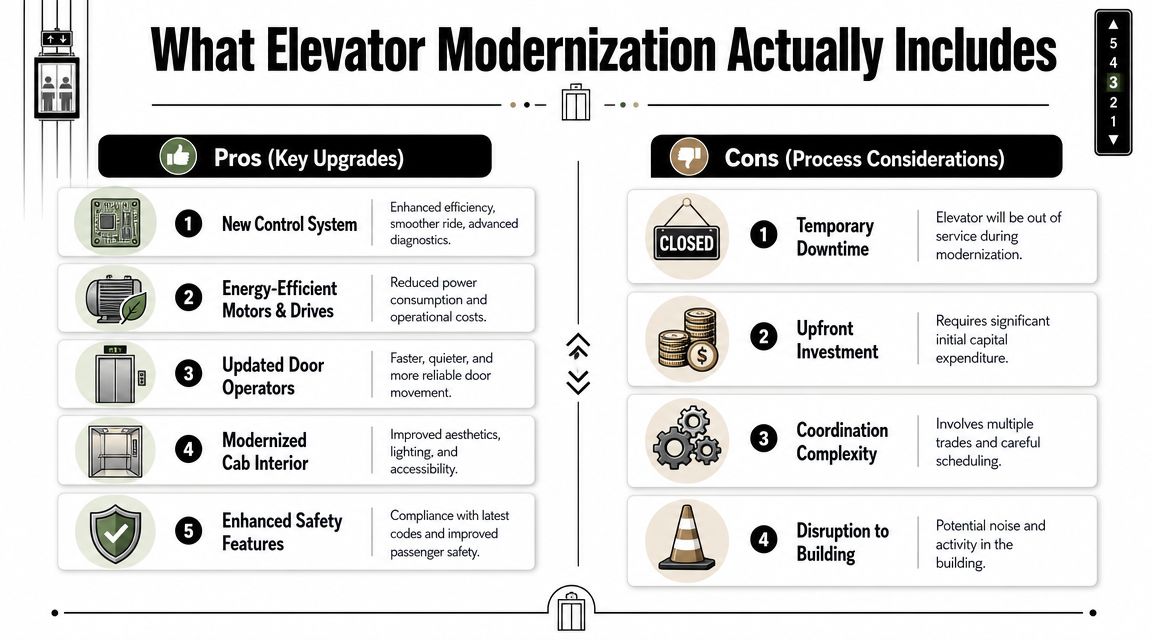
Most projects include the controller, door equipment, signal fixtures, wiring, and either the drive or machine package, depending on the elevator type and condition. Some jobs also include cab updates, but finishes should not distract from the operating equipment. If the elevator runs poorly, the control and door side of the job usually matters more than new wall panels or lighting.
That usually means some mix of the following:
- New control system: Replaces aging relay logic or outdated controls with equipment that is easier to diagnose and support.
- Updated drive or machine package: Improves acceleration, stopping, and floor leveling when the existing equipment is worn or no longer a good fit.
- Door equipment replacement: Addresses one of the biggest sources of callbacks and tenant complaints.
- Signal fixtures and hall stations: Replaces worn buttons, indicators, and related devices that affect daily use and code compliance.
- Wiring and electrical updates: Removes old connections and field wiring problems that can undermine new equipment.
- Selected mechanical upgrades: Handles related parts that would shorten the life of the modernization if left in place.
Why scope discipline matters
Owners get into trouble when they approve a partial upgrade that leaves the elevator with one new brain and several old failure points around it. The controller may be new, but the door operator is still unreliable. The drive may be replaced, but the wiring is brittle and inconsistent. Then the building pays for a modernization and still deals with callbacks.
A better approach is to define the work around reliability first, then budget. In Troy, that often means protecting service continuity in office and medical buildings by prioritizing controls and doors. In Birmingham, the right scope may separate operating equipment from cab appearance so the property keeps its character without carrying old risk in the machinery. In Fenton, phased modernization is often the practical choice. Owners can replace the highest-risk systems now and schedule the next phase around cash flow instead of forcing another year of emergency repairs.
Here's a helpful visual overview of how modernization projects are commonly approached in the field:
Proprietary versus non-proprietary
This decision affects service costs long after the installation crew leaves the building.
A proprietary package can limit who has access to diagnostics, software, and replacement parts. That can narrow your service options later. A non-proprietary package gives owners more control over maintenance relationships, parts sourcing, and long-term pricing. For many Michigan properties, especially buildings expected to stay in the portfolio for years, modernizing elevator systems with a non-proprietary approach reduces lock-in risk.
That does not mean every non-proprietary setup is the right answer. The right question is whether the equipment choice will still make sense five or ten years from now, under Michigan code requirements, service conditions, and real operating budgets.
Crane Elevator's Modernization Services in Michigan
Modernization decisions look different in Troy than they do in Birmingham or Fenton. The building use, traffic pattern, tenant expectations, and budget constraints all change the right scope.
In Troy, an office or medical building usually cares most about downtime and service continuity. If one elevator in a small bank keeps dropping out, the right approach is often a modernization sequence that protects daily operation first. That usually means prioritizing controls, door equipment, and the parts most likely to create callbacks.
In Birmingham, older properties often bring a different challenge. The owner may want better reliability and code alignment without making the elevator look out of place in a historic or design-sensitive building. In those cases, the practical answer is often to separate the project into two tracks. Modernize the operating equipment for reliability, then handle cab and fixture finishes in a way that fits the building.
In Fenton, residential and mixed-use owners are often balancing reliability against cash flow. That's where phased work becomes valuable. A building may not be ready for one large project, but it may be ready to address the highest-risk systems now and schedule the next phase around future budgeting cycles.
What that local approach should look like
A useful contractor doesn't start with a canned package. The work should begin with questions such as:
- What's failing most often right now
- Which outages hurt the building most
- What can be phased without creating rework
- What should be upgraded now to avoid getting locked into a bad service path later
For Michigan owners, local response matters because modernization isn't just design work. It affects inspection coordination, outage planning, tenant communication, and follow-up service after turnover. That's where a Lower Michigan contractor with ongoing field presence can be more useful than a one-size-fits-all proposal.
FAQ for Michigan Building Owners
Can I modernize in phases if I can't afford a full project right now
Yes, in many buildings that's the practical approach. The smart way to phase a modernization is to start with a condition assessment, then rank components by safety, reliability, code compliance, and maintenance burden. Industry guidance summarized by Stanley Elevator notes that plans should begin that way, with high-risk items often including the controller and door equipment, as explained in this overview of elevator modernization planning and cost priorities.
The mistake is phasing based only on what's visible. New fixtures and interior finishes can wait if the controller and doors are creating shutdowns.
Which parts usually deliver the biggest reliability improvement first
In many buildings, the first gains come from the controller, door equipment, and related electrical components. Those systems often drive nuisance faults, poor leveling, dispatch issues, and repeat callbacks.
That doesn't mean every machine or hydraulic component can be deferred. It means a condition-based priority list works better than guessing.
Start with the components that take the elevator out of service, not the ones that merely look old.
Does modernization mean replacing the whole elevator
Usually, no. Modernization often keeps the shaft and some major structural elements in place while replacing the operating systems that have become outdated or unreliable. That's why it often costs less and disrupts less than full replacement, while still solving the problems owners experience day to day.
The correct scope depends on the existing condition. Some elevators need a broad package. Others can be addressed in planned stages.
Should I worry about proprietary equipment
Yes. Owners should ask direct questions before signing a modernization contract. Who can service the equipment later? Who has access to diagnostics? Will the building be tied to one vendor for ordinary maintenance? Are manuals, drawings, and programming support available?
These aren't side questions. They affect your influence for the life of the equipment.
Will the elevator be out of service the whole time
That depends on the building and how many cars are in the group. In occupied properties, one common best practice is sequencing work to maintain service continuity where possible. If a building has multiple elevators, owners should expect a plan that limits exposure and keeps the building functioning during the work.
For single-elevator buildings, communication and scheduling become even more important. The right contractor will address temporary access planning early, not after work starts.
Does modernization automatically bring me into full code compliance
Not automatically. Some upgrades are driven by code requirements, while others are voluntary performance improvements. Local enforcement, project scope, and acceptance requirements can vary. Owners should ask what documentation, testing, and inspection path will apply to the specific modernization being proposed.
That conversation should happen before equipment is ordered.
How do I compare modernization proposals
Don't compare proposals on price alone. Compare them on scope clarity, equipment openness, commissioning requirements, outage assumptions, documentation, and what happens after turnover.
A weak proposal often looks cheaper because it excludes the coordination work that makes the system reliable. A strong proposal defines what's being replaced, what stays, how compatibility is handled, and what support the owner receives at the end.
What's the best first step
Start with a real assessment of the current system, not a sales pitch. You need a clear picture of what's failing, what's obsolete, what creates the most downtime, and what can be phased.
That gives you options. Without that, you're just reacting to the next shutdown.
If your building in Troy, Birmingham, Fenton, or elsewhere in Lower Michigan is stuck in the repair cycle, a practical next step is to talk with Crane Elevator Company about a condition-based modernization plan. Ask for an evaluation that prioritizes reliability, code compliance, and future service flexibility, especially if you want a non-proprietary path instead of a locked-in system.