A tenant calls before 8 a.m. The elevator was noisy yesterday, slow this morning, and now it's parked with its doors closed while people wait in the lobby. If you manage the building, the problem isn't just a motor. It's complaints, disrupted traffic, accessibility issues, vendor coordination, and a safety decision you can't afford to get wrong.
That's usually when building owners hear the same rushed conclusion: “The motor's bad.” Sometimes that's true. Sometimes it isn't. A failing controller, brake issue, power problem, or door interlock fault can look like motor trouble until someone tests the system properly.
That distinction matters because elevator motor repair is rarely just a mechanical fix. It's an asset decision. The global elevator maintenance market was valued at $21.6 billion in 2024 and is projected to reach $38.33 billion by 2026, according to Strategic Market Research on elevator maintenance. Owners are treating motor health as part of planned reliability work, not just an emergency line item after a shutdown.
The First Sign of Trouble
Most motor problems don't start with a dramatic failure. They start with a report that sounds minor.
A tenant says the car “sounds rough.” A nurse in a healthcare building says the ride feels uneven leaving the floor. A maintenance supervisor notices the machine room smells hotter than usual. Then the elevator trips out, resets, runs again, and gives everyone false confidence for a few more days.
That pattern is common in the field. The first sign of trouble is often intermittent operation. The car still runs, but not cleanly. Starts get harsher. Travel sounds change. Leveling may drift. The building team starts logging nuisance calls, and the elevator becomes unreliable before it becomes inoperable.
What building managers usually need first
In that moment, you don't need a lecture on motor theory. You need answers to three questions:
- Is it safe to keep in service: If the unit is behaving unpredictably, the right move may be to remove it from service until it's evaluated.
- Is the motor the problem: Many faults mimic motor failure.
- What decision limits long-term cost: A quick patch that leads to repeat downtime is often the expensive option.
Practical rule: Treat a noisy or sluggish elevator the same way you'd treat a leaking roof. The first symptom is rarely the full extent of the problem.
Owners get into trouble when they chase the loudest symptom instead of the actual fault. If a car is slow leaving the floor, the motor might be struggling under load. It might also be reacting to a control issue, brake drag, poor power quality, or a problem elsewhere in the system. Replacing the wrong component doesn't solve downtime. It adds another invoice.
The implications of elevator service reach far beyond convenience. Elevator service affects tenant confidence, accessibility, deliveries, staffing flow, and in some buildings, emergency response planning. That's why the first call should be about diagnosis, not assumptions.
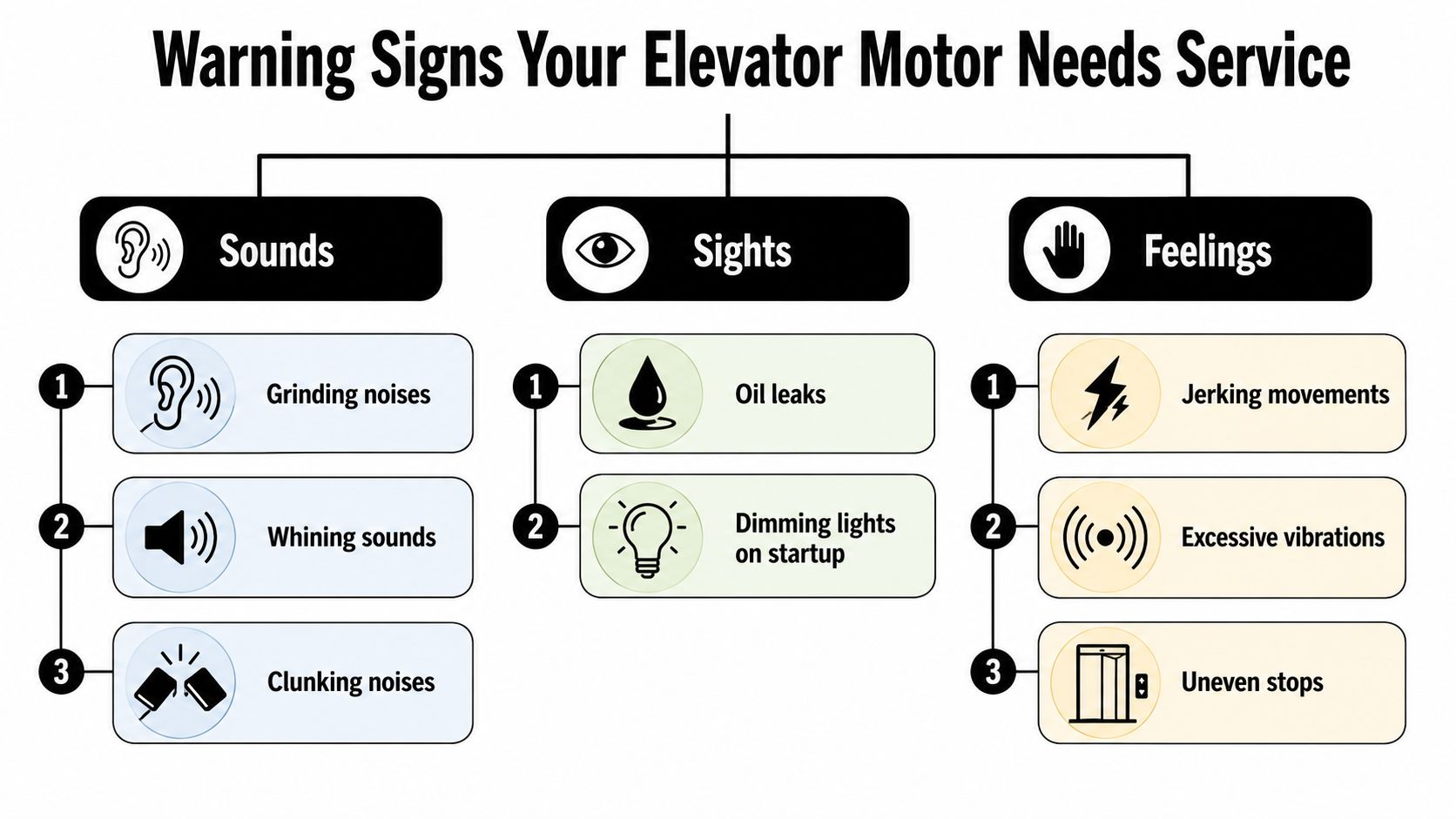
Warning Signs Your Elevator Motor Needs Service
You don't need to diagnose the motor yourself, but you should know what to watch for. The better your observations, the faster a qualified technician can separate a motor issue from a control or safety circuit problem.
Sounds that deserve attention
A healthy elevator drive system has a normal operating sound. What matters is change.
- Grinding noises often point to bearing wear, contamination, or mechanical drag.
- Whining sounds can indicate electrical stress, drive-related issues, or rotating parts under abnormal load.
- Clunking noises may come from brake action, coupling problems, or movement in associated mechanical components.
If the sound appears only at startup, note that. If it happens only under heavy passenger load or in one travel direction, note that too. Those details help narrow the fault.
Sights and operating changes
Visible clues matter more than many owners realize.
- Oil or fluid leaks in or around the machine space can contribute to contamination and heat problems.
- Lights dimming on startup can suggest electrical load or supply issues.
- Repeated resets after shutdowns tell you the problem is active, even if the car comes back online temporarily.
One of the biggest mistakes I see is assuming every rough-running elevator needs a motor pulled immediately. Professional troubleshooting guidance says to check the power supply, control panel faults, and door interlocks first, because controller or sensor faults often mimic motor failure, causing repeat downtime and wasted repair work, as noted by Infraspeak's lift troubleshooting guidance.
What passengers feel
Passengers usually describe the issue better than the machine room does.
- Jerking at start or stop
- Excessive vibration during travel
- Uneven stops or poor leveling
- Slower acceleration than normal
These are all valid service calls. They are not proof of a bad motor by themselves.
A bad diagnosis can cost more than a bad bearing.
If your staff reports symptoms, write down exactly when they happen. Cold start in the morning. Only during up travel. Only after repeated runs. Only with a full car. That kind of pattern helps the technician test smarter and keeps everyone from jumping straight to replacement.
Common Causes of Elevator Motor Failure
Elevator motors fail for familiar electrical and mechanical reasons, but the service environment makes those reasons more punishing than in general industrial work. A motor that survives on a pump or fan application may not last long in elevator duty.
Elevator-duty motors are built for high starting torque, frequent duty cycles, and precise control, and motors that work in other settings can fail early in elevator service if they can't handle repeated starts, regenerative braking, and thermal stress, according to Square One's overview of elevator-duty motors.
Heat and insulation breakdown
Heat is one of the fastest ways to shorten motor life. Poor ventilation, dirty machine spaces, overloaded operation, and repeated starts all push winding insulation harder.
Insulation doesn't usually fail all at once. It weakens over time. Moisture, dirt, and age make that worse. Once winding insulation starts deteriorating, the motor may still run, but it becomes less stable under normal elevator cycling.
Bearings, alignment, and contamination
A lot of “motor problems” begin as bearing problems.
When bearings wear, loosen, or run contaminated, the motor starts vibrating. That vibration affects more than comfort. It changes shaft loading, raises heat, and can damage other connected components if the condition continues. Misalignment adds another layer of stress, especially in systems where drive components and brake behavior need to stay tightly controlled.
Here's what commonly pushes a motor toward failure:
- Contamination: Dirt, oil, and moisture find their way into places they shouldn't.
- Lubrication issues: Too little, too much, or the wrong lubricant all create trouble.
- Mechanical stress: Coupling issues, drag, or mounting problems force the motor to work harder than it should.
Electrical mismatch and system interaction
Some repairs fail because the shop treated the motor as a standalone component instead of part of an elevator system. That's a mistake.
A proper assessment has to consider the drive, brake, controller behavior, and the rest of the package. If you're evaluating related system issues, it helps to understand how elevator controls affect performance and fault diagnosis. A motor can test acceptably on a bench and still perform poorly once it's back in the hoistway environment with real duty cycles and real loads.
The motor doesn't live alone. If the repair plan ignores the controller, brake, and application demands, the same shutdown can come back under a different name.
That's why generic motor repair shops often struggle with elevator work. They may know motors. They may not know elevator service.
Repair or Replace The Critical Decision
This is the decision owners care about most. Not “Can it be repaired?” Almost anything can be repaired if enough time and money are thrown at it. The better question is whether repair is the smart move for the building.
The primary issue is lifecycle cost. Public guidance often lists symptoms, but rarely helps owners decide how a motor repair or replacement will affect expected service life and future maintenance budgets, as discussed by Elevator Solutions on common elevator problems.
When repair makes sense
Repair is usually worth serious consideration when the fault is specific, the rest of the equipment is in stable condition, and the repaired motor will return to service without creating a chain of follow-on problems.
That often applies when:
- The issue is isolated: Bearings, contamination, limited winding damage, or correctable mechanical wear.
- Parts and support are still practical: You're not building the repair around obsolete components and guesswork.
- The controller and brake package remain sound: The system around the motor doesn't also need major work.
In these cases, repair can preserve capital and get the elevator back with less disruption than a broader modernization project.
When replacement or modernization is the better move
Replacement becomes more attractive when the motor problem is just one symptom of a tired system. If the machine, drive, brake, controls, and reliability history are all trending the wrong way, repairing the motor alone may only delay a larger bill.
Replacement or modernization deserves a hard look if:
- Failures are recurring: The motor may not be the only unstable component.
- The building has service-critical use: Hospitals, senior housing, municipal buildings, and freight operations can't absorb repeated shutdowns well.
- Compatibility is a growing issue: Older motors can become expensive to support when the connected equipment also needs attention.
- You need predictable budgeting: A larger planned project can be easier to manage than repeated emergency repairs.
Elevator Motor Repair vs. Replacement Decision Matrix
| Factor | Motor Repair | Motor Replacement / Modernization |
|---|---|---|
| Upfront cost | Usually lower if the fault is isolated | Usually higher because scope expands beyond the immediate failure |
| Downtime planning | Can be shorter if repair is straightforward and parts are available | May take longer planning, but can reduce future unplanned outages |
| Scope of work | Targets the failed or degraded motor and related corrections | Addresses broader system condition, compatibility, and aging equipment |
| Long-term reliability | Depends heavily on the condition of surrounding components | Often stronger if the motor issue is part of wider equipment decline |
| Warranty and accountability | Should cover the repaired motor and acceptance testing | Should cover new equipment and define system integration responsibilities |
| Future maintenance budget | May stay reasonable or rise quickly if adjacent components are also aging | Can improve predictability if the project removes recurring problem areas |
| Best fit | Single-component failure in an otherwise stable system | Repeated faults, obsolete equipment, or broader modernization goals |
Questions to ask before approving either path
Don't ask only, “What's the cheapest option today?” Ask these instead:
- What failed, exactly? A real answer should identify the fault, not just the symptom.
- What is the condition of the connected equipment? Motor, brake, drive, controls, sheave, and mounting all matter.
- What result should I expect after this work? Smoother operation, reduced callbacks, or temporary restoration.
- What work are we postponing if we repair? That answer tells you whether repair is strategic or just delay.
A good contractor won't push every owner toward the same answer. The right recommendation depends on whether the repair lowers your total cost of ownership or just moves the expense into the next shutdown.
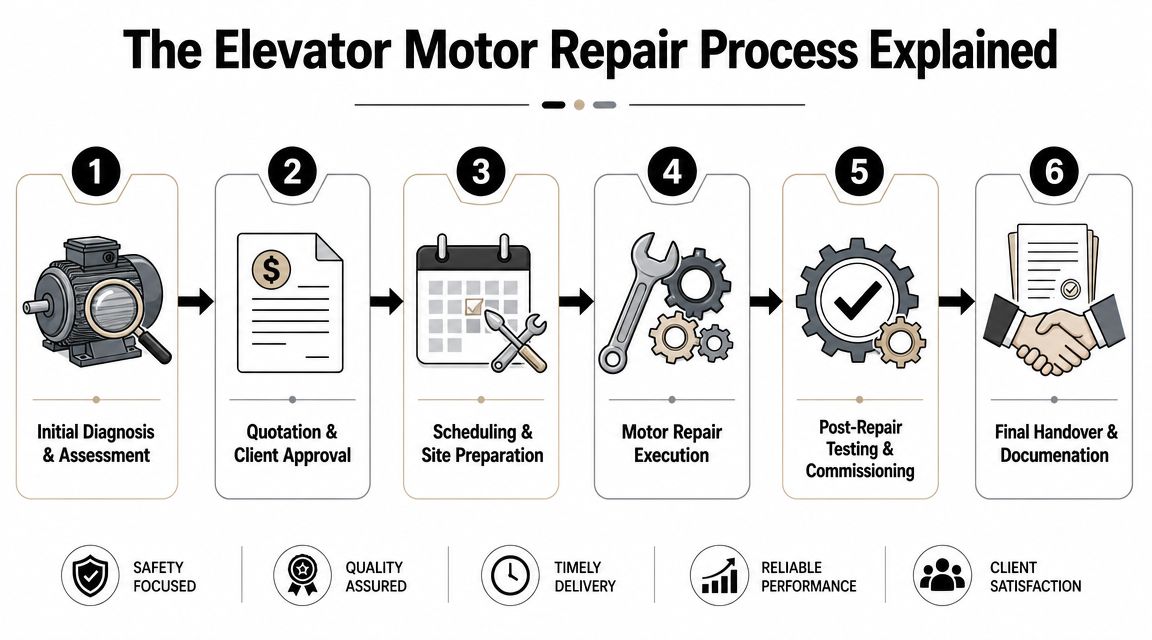
The Elevator Motor Repair Process Explained
Once the decision to repair is made, you should know what competent work looks like. Good elevator motor repair is methodical. Rushed work tends to come back as repeat noise, nuisance shutdowns, and early failure.
A clear process helps owners compare vendors and hold the work to a standard.
What happens first on site
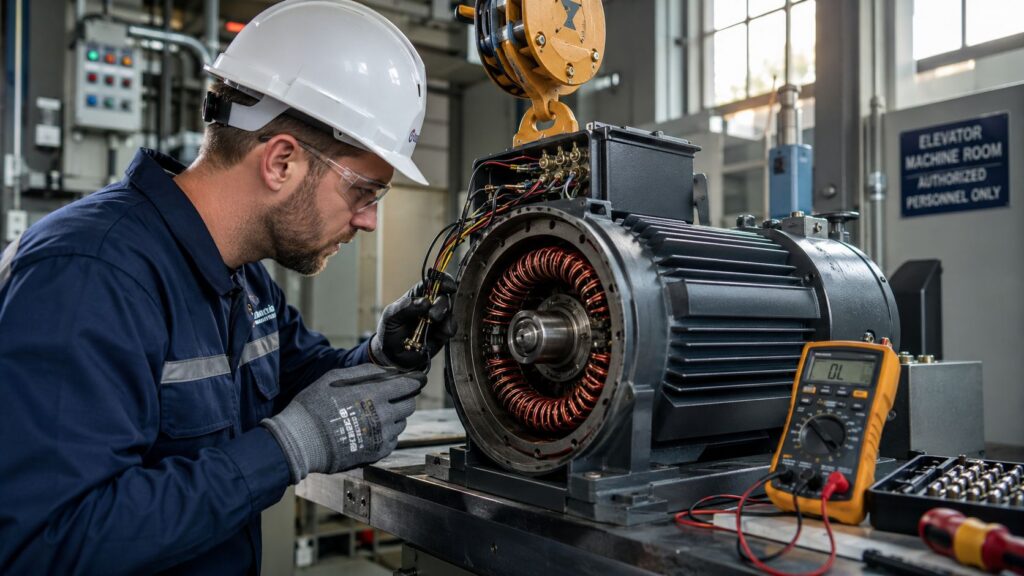
A technician should start by confirming the complaint, reviewing fault history, and isolating whether the motor is the issue. That usually includes electrical checks, mechanical inspection, and observation under operating conditions when it's safe to do so.
If the repair requires broader hydraulic system context, owners should understand how the elevator power unit interacts with performance and motor loading, especially on equipment where motor behavior can't be separated from the rest of the drive package.
The next step is a scope decision. Some motors can be corrected in place. Others need removal for shop work, rewind, bearing replacement, machining, or more complete rebuilding.
Here's a useful visual overview of the workflow:
What quality repair work includes
A proper repair isn't finished when the shaft turns. According to EASA repair guidance, acceptance testing should include all three phase currents, voltage balance, and vibration after a short run-in period to catch hidden issues such as bearing damage or winding deterioration.
That matters because some bad repairs look fine at first startup. Then the motor heats up, vibration rises, current drifts, and the elevator is back down again.
A thorough repair process should include:
- Baseline and post-repair electrical testing: Insulation condition, phase current, and voltage checks.
- Mechanical verification: Bearing condition, shaft runout, mounting integrity, and related alignment checks.
- Operational test under service conditions: Not just no-load spinning, but behavior during real elevator duty.
If the final report says only “motor runs,” the acceptance standard was too low.
What you should receive at handover
You should expect more than an invoice. A professional handover includes the findings, the work performed, the test results, and any remaining concerns that could affect future reliability.
That documentation helps your building team make better decisions later. It also creates a service record that can reveal whether you're dealing with a one-time failure or the early stage of a larger modernization need.
Preventative Maintenance and Safety Compliance
The cheapest motor repair is the one you never need. Most costly elevator motor failures don't come out of nowhere. They build through heat, dirt, moisture, neglected adjustments, and small warning signs that nobody closes out properly.
Preventative maintenance isn't paperwork. It's how you reduce shutdowns, keep the equipment safer, and avoid spending money twice on the same problem.
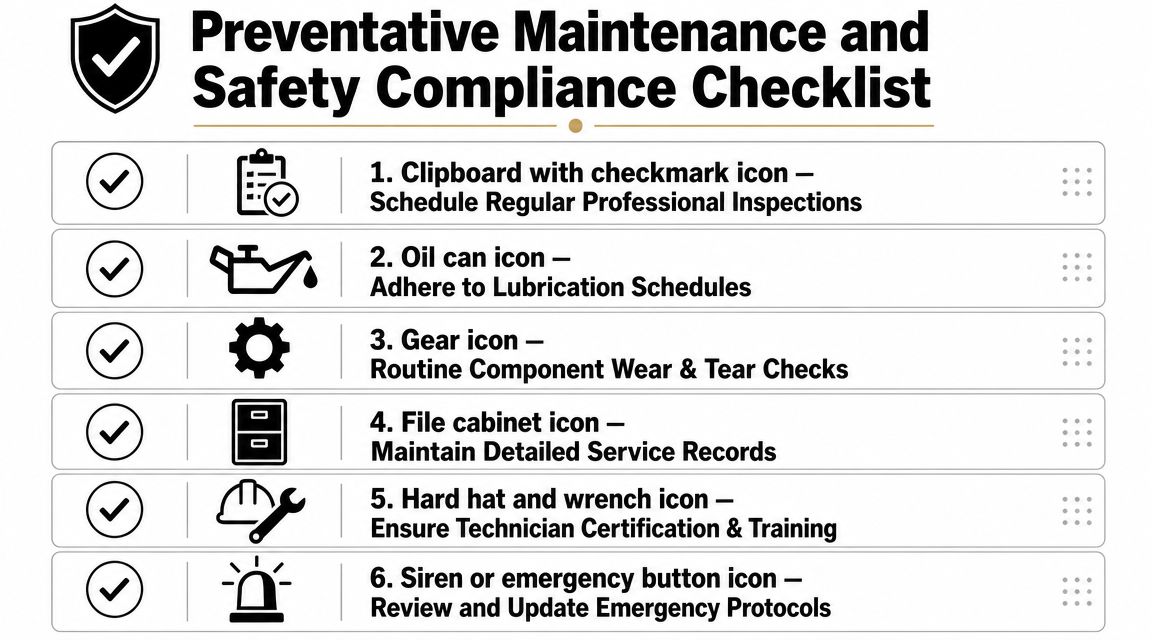
What protects motor life
Motor health depends on the environment around it as much as the motor itself. A clean, dry, properly maintained machine space gives you better cooling, more accurate inspection conditions, and fewer contamination-related failures.
The maintenance program should include:
- Scheduled professional inspections: Not just code-required visits, but condition-focused checks that catch drift before shutdown.
- Lubrication discipline: Bearings and related moving parts need the correct lubricant and interval.
- Machine room housekeeping: Dirt and oil buildup trap heat and hide developing problems.
- Recordkeeping: Repeated faults only become obvious when someone tracks them.
For building teams comparing service programs, it's worth reviewing what's included in a structured elevator maintenance program and whether the contractor documents findings clearly enough to support repair-versus-replace decisions later.
Compliance is part of cost control
Owners sometimes separate safety compliance from operating cost. In practice, they're tied together.
When maintenance slips, you increase the chance of unsafe conditions, failed inspections, tenant complaints, emergency calls, and rushed after-hours repairs. Those are expensive outcomes even before you discuss liability. A documented preventive program also gives you a clearer service history, which makes it easier to defend budgets and justify capital planning.
What doesn't work
Reactive maintenance looks cheaper until the pattern repeats.
It doesn't work to reset faults without root-cause testing. It doesn't work to ignore noise because the elevator “came back.” It doesn't work to clean up leaks cosmetically while the source stays active. And it doesn't work to let every vendor start from zero because nobody kept the last service records.
Maintenance lowers cost when it is specific, documented, and tied to observed equipment condition. Calendar-only service without follow-through won't protect a hard-working elevator.
If you manage multiple buildings, consistency matters. The same logging standard, same service expectations, and same acceptance criteria make your contractor easier to manage and your repair history far more useful.
Choosing Your Qualified Elevator Repair Partner
This is specialized work. It isn't general building maintenance, and it isn't a good place to shop by lowest hourly number alone. The U.S. Bureau of Labor Statistics notes that elevator installers and repairers had a median annual wage of $106,580 in May 2024, with employment projected to grow 5% from 2024 to 2034 and about 2,000 openings per year on average. The occupation typically requires apprenticeship training, and most states require licensing, according to the BLS occupational outlook for elevator installers and repairers.

What to vet before you sign anything
A qualified partner should be able to explain their diagnostic process in plain language. Not just “we think it's the motor,” but what they tested, what they ruled out, and why the recommended scope fits the equipment.
Use this checklist during vendor review:
- Licensing and insurance: Verify them. Don't assume.
- Equipment familiarity: Ask whether they regularly work on your type of elevator, not just elevators in general.
- Diagnostic discipline: They should check the full system, not jump straight to the most expensive component.
- Documentation: Require a written scope that separates findings, parts, labor, and testing.
- Acceptance standards: Ask what post-repair testing they perform before turning the unit back over.
Good partners lower future cost
The right contractor doesn't just restore operation. They help you avoid paying for the same lesson twice.
That means they should tell you when the motor is the issue, when it isn't, and when the problem lies in the building trying to nurse along a package that no longer supports reliable service. They should also be comfortable discussing non-proprietary options if long-term service flexibility matters to your budget.
One example in Michigan is Crane Elevator Company, which offers maintenance, repairs, inspections, and non-proprietary modernizations for various vertical transportation equipment. For owners, that kind of scope matters because the best repair partner is usually the one who can diagnose the whole system and discuss both immediate fixes and longer-term planning without locking you into a narrow path.
The question that separates good contractors from expensive ones
Ask this: “If we approve your recommendation, what does that reduce for us over the next few years?”
A strong answer will address repeat downtime, service predictability, parts support, inspection readiness, and whether the work extends useful life in a meaningful way. A weak answer will circle back to urgency and pressure you into approving a component swap.
Choose the company that treats elevator motor repair as a reliability decision, not just a parts transaction.
If you need a second opinion on an elevator motor issue, planned modernization, or recurring shutdowns in Lower Michigan, Crane Elevator Company can review the equipment, explain the likely fault path, and help you compare repair against longer-term options in practical terms.