A tenant calls before 8 a.m. The main passenger car is out of service. Deliveries are backing up at the freight entrance. Someone from the third floor wants to know when the elevator will be back, and your maintenance team is already asking whether this is a quick reset, a door issue, or a major repair.
That's the moment when elevator ownership stops feeling like a line item and starts acting like an operational risk. In Michigan commercial buildings, a down elevator affects access, tenant confidence, staffing, deliveries, inspections, and in some cases legal exposure. If the building serves healthcare, industrial, municipal, or mixed-use traffic, the pressure gets worse fast.
Commercial elevator repair works best when you treat it as part of total asset management, not just a response to a shutdown. The owners who spend the least over time usually aren't the ones chasing the cheapest service call. They're the ones who understand failure patterns, keep records, budget for preventive work, and know when a recurring repair is really a modernization decision in disguise.
Your Guide to Navigating Commercial Elevator Downtime
The hardest part of elevator downtime is that it rarely stays contained. A single unit outage can turn into tenant complaints, missed deliveries, accessibility issues, overtime for staff, and pressure from ownership to “just get it fixed.” That reaction is understandable, but it often leads to bad decisions: rushed approvals, incomplete diagnostics, and repairs that restore service for the day without solving the underlying problem.
That's why commercial elevator repair has to be viewed as an operations issue first and a mechanical issue second. The machine may have failed in one component, but the consequences land across the whole property. When a property manager in Michigan calls for service, the underlying question usually isn't just “What broke?” It's “How long will this disrupt the building, what's the compliance risk, and are we about to pay for the same problem twice?”
Downtime is a management problem before it becomes a repair ticket
A building can tolerate cosmetic issues. It can't tolerate unreliable vertical transportation for long. In offices, tenants lose patience quickly. In healthcare and municipal settings, downtime interferes with core operations. In industrial buildings, freight movement and loading schedules can fall apart if the wrong car is down.
Practical rule: If the same elevator has repeated door faults, nuisance shutdowns, or leveling complaints, stop treating each event as an isolated service call.
The broader market tells you this isn't a niche concern. One major forecast projects the global elevator maintenance market will grow from $38.33 billion in 2026 to $68.25 billion by 2034, a 7.5% CAGR, and defines the work to include inspections, preventive maintenance, repairs, and modernization in one service cycle, according to Fortune Business Insights on the elevator maintenance market.
What property owners usually need most
Most managers don't need a deep lecture on elevator theory. They need a practical way to answer four questions:
Is this an immediate safety issue
Determine whether the car is shut down, intermittently operating, or trapping passengers.What symptom matters most
Door problems, brake issues, misleveling, and control faults don't carry the same urgency or scope.Is this repeat failure or first occurrence
Recurring faults often point to drift, wear, or bad prior diagnosis.Should we repair, monitor, or modernize
That choice determines total cost far more than the first invoice.
Handled well, commercial elevator repair protects service continuity. Handled poorly, it becomes a cycle of callbacks, tenant frustration, and avoidable capital spending.
Decoding Elevator Distress Signals Before a Breakdown
Most elevator failures don't arrive without warning. They announce themselves the way a vehicle does. You hear a new sound, feel a rough stop, notice the doors hesitating, or get reports that the car isn't landing cleanly at the floor. None of that guarantees a shutdown today, but it often means a component is drifting out of tolerance.
Property managers don't need to diagnose the machine. They do need to report symptoms accurately. The better the symptom report, the faster a technician can separate a door operator issue from a leveling problem or a brake-related complaint.
The symptoms that deserve attention
A few patterns come up again and again in commercial buildings:
Slow or hesitant doors
This often shows up before a full door fault. Tenants describe it as doors “thinking too long” before opening or closing.Jerky starts or stops
Occupants may say the ride feels rough, abrupt, or inconsistent between trips.Misleveling at the landing
If the car stops above or below floor level, even slightly, treat it seriously. That's both an operational issue and a safety concern.Unusual sounds
Grinding, clanking, scraping, or repeated clicking matter. The useful detail is when the sound happens: during travel, at the landing, or during door movement.Intermittent outages
The elevator works, then goes out of service, then comes back. Those are often the most expensive problems if nobody tracks the pattern.
What to tell your service provider
A vague report like “elevator not working right” slows everything down. A useful report sounds more like this:
| Observation | Why it helps |
|---|---|
| Car stops short at second floor | Points toward leveling or control behavior |
| Doors reverse three times before closing | Suggests door system or safety edge issue |
| Problem happens mostly during morning traffic | Indicates load, cycle frequency, or peak-use pattern |
| Loud noise only on descent | Helps narrow when the fault appears |
That kind of information gives the technician a starting point before they even open the controller or inspect the landing equipment.
A recurring elevator problem usually looks random only from the lobby. On the equipment side, there's almost always a pattern.
What doesn't work
Waiting for a total shutdown is the expensive route. So is resetting the same fault repeatedly without documenting it. If your staff notices passengers nudging doors, carts striking freight entrances, or one floor generating most complaints, those details matter. Small observations often explain why one car keeps eating service time while another identical unit runs fine.
Commercial elevator repair gets easier when the building team notices symptoms early and writes them down in plain language. That's how you stop chasing isolated events and start finding root causes.
Proactive Maintenance Versus Reactive Repair
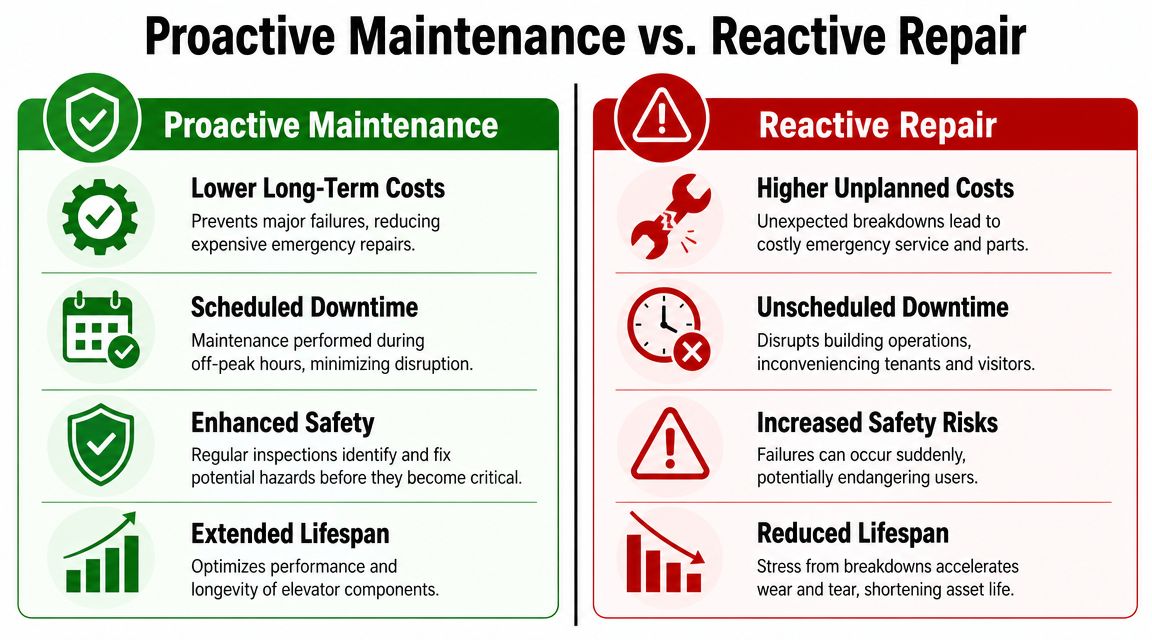
There are two ways to run a commercial elevator. You either maintain it on a schedule and catch wear before it becomes a shutdown, or you wait for tenants to tell you something failed. One approach gives you control over cost and timing. The other gives the building control over you.
What proactive service actually does
Preventive maintenance only works when the visit is structured. A quick look in the machine room isn't enough. In commercial service, effective PM is often performed monthly, and higher-usage properties may need more frequent attention. The reason is straightforward. Technicians can catch components drifting out of tolerance, especially in the door operator or brake system, before they trigger a shutdown or a larger failure, as described in this commercial elevator preventive maintenance checklist.
A real maintenance program should include symptom tracking across visits. If a car has been slow to level, then starts showing door nuisance faults, and then has a brake adjustment issue, those events may be related. Reactive service treats them as separate calls. Good maintenance connects them.
For owners reviewing service options, a provider offering scheduled elevator maintenance programs should be able to explain what gets inspected, what gets cleaned, what gets adjusted, and how repeat issues are recorded.
Side by side in the real world
Here's the practical difference:
| Approach | What you get | What you risk |
|---|---|---|
| Proactive maintenance | Planned visits, trend tracking, cleaner equipment conditions, fewer surprise shutdowns | You still pay for wear items, but on a more predictable basis |
| Reactive repair | Lower attention until something fails | Emergency labor, repeat callbacks, tenant disruption, incomplete root-cause correction |
Reactive repair looks cheaper only when you ignore interruption cost. If a building loses a main passenger unit during peak traffic, you don't just pay for labor and parts. You also absorb complaints, staff time, access issues, and pressure to authorize a rushed fix.
Where owners get this wrong
Three mistakes show up often:
They judge the program only by monthly price
Cheap maintenance that skips cleaning, adjustment, and documentation often leads to more service calls later.They approve repeated parts replacement without asking why
If the same type of problem keeps coming back, the issue may be setup, environment, deferred modernization, or usage pattern.They separate maintenance from ownership strategy
Elevator service shouldn't live in a silo. It affects budgeting, inspections, and capital planning.
Good commercial elevator repair starts long before a unit goes out of service. It starts when someone notices a small drift and does something about it.
Navigating an Elevator Repair Emergency and Process
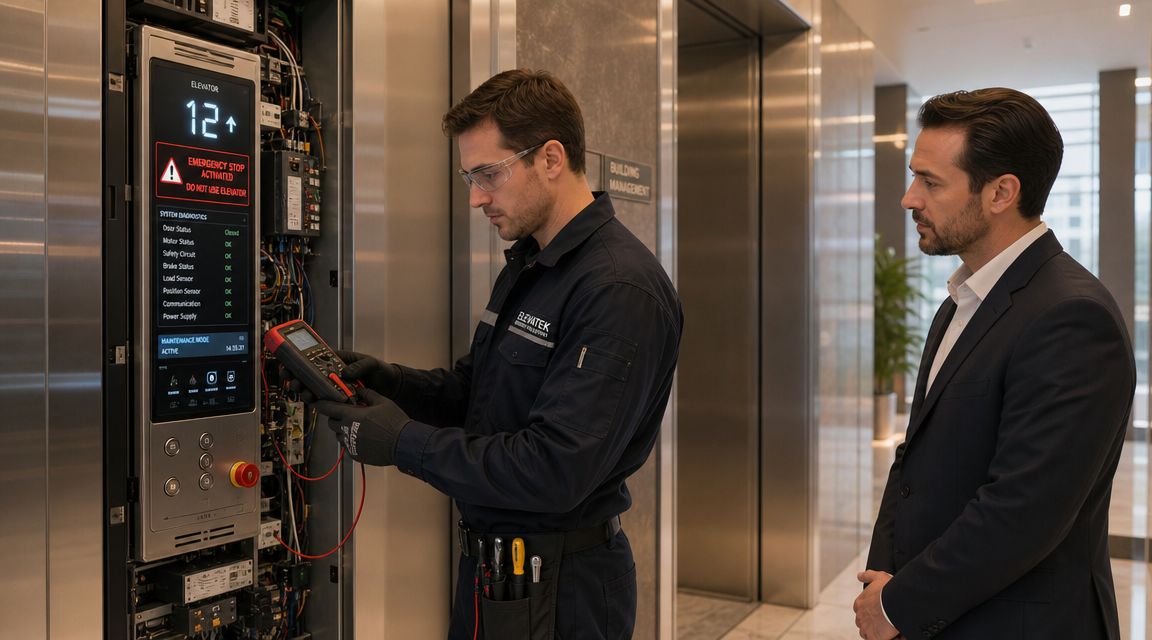
When an elevator goes down, the first priority is simple. Protect people before you worry about schedule, parts, or blame.
What to do first
Use a short decision sequence:
Check for trapped passengers
If someone is inside, follow your emergency protocol and call your elevator service provider immediately. Don't let building staff try to force doors or perform an unauthorized rescue.Secure the affected elevator
Keep tenants and visitors from attempting to use a car that's faulted, misleveling, or repeatedly opening and closing.Document the symptom
Note the floor, time, what the display shows, whether doors are open or closed, and whether the outage followed a noise, power event, or heavy traffic period.Communicate early
Tell tenants what's known, what's not known, and when you expect the next update. Silence creates more frustration than a limited but honest update.
If you need immediate dispatch, providers with emergency elevator service should be able to tell you how they triage entrapments, shutdowns, and non-emergency malfunctions.
What happens once the technician arrives
The first visit is usually about stabilization and diagnosis. Sometimes the technician can reset, adjust, or replace a minor failed part and return the elevator to service. Other times the elevator is shut down for good reason because running it would create more risk or compromise later inspection results.
Typical on-site actions include:
Fault review
The technician checks logs, indicators, and any visible code or controller information.Mechanical inspection
Door equipment, interlocks, brake condition, leveling behavior, and ride performance get checked against the complaint.Temporary versus permanent correction
A reset or adjustment may restore service, but that doesn't always mean the problem is solved.
After the initial assessment, owners should expect a plain answer to three questions: what failed, whether the unit can safely run, and whether parts or follow-up work are required.
A useful visual overview of elevator response and field service looks like this:
What delays repairs
Parts availability is one issue, especially on older or proprietary equipment. Incomplete history is another. If the building has no record of prior faults, past adjustments, or repeat shutdowns, the technician has to build the story from scratch.
That's why the best emergency response doesn't start with heroics. It starts with records, symptom notes, and a building team that knows when a “small issue” has already become a pattern.
Understanding Repair Costs and Modernization Options
Most owners ask the wrong cost question first. They ask, “What will this repair cost?” The better question is, “What will this elevator cost us over the next few years if we keep repairing it this way?”
Commercial elevator repair spans a wide range. Some calls involve adjustments, minor replacement parts, or correcting an isolated defect. Others uncover aging controllers, repeated door failures, obsolete components, or a machine that's still running but no longer economical to support. The invoice matters, but the pattern matters more.
The budget benchmark that helps frame the decision
In the United States, IBISWorld estimates there will be 32,787 businesses in the Elevator Installation & Service industry in 2026, with $53.9 billion in industry revenue, and it notes that commercial maintenance spending commonly falls around $3,000 to $8,000 per year per building, with higher costs for larger or heavily used systems, according to IBISWorld coverage of elevator installation and service.
That range isn't a quote for your building. It is a useful benchmark. If your annual repair and service history keeps climbing while reliability keeps dropping, you may be spending like an owner who needs modernization but still budgeting like an owner who only needs maintenance.
Repair versus modernization
Use this comparison when a problem keeps returning:
| Condition | Repair is usually reasonable | Modernization deserves serious review |
|---|---|---|
| Single failed component | Yes | Usually not the first move |
| Repeated door or control faults | Sometimes | Often yes |
| Parts are difficult to source | Short-term only | Often yes |
| Unit passes from call to call but performance stays poor | Temporary fix at best | Usually yes |
| You want service flexibility across providers | Limited if equipment is proprietary | Strong case for non-proprietary upgrades |
Non-proprietary modernization matters because it affects lifetime service options. If your equipment locks you into one vendor ecosystem, your future repair choices narrow. If the system uses open, serviceable components that qualified providers can support, you gain flexibility on pricing, parts strategy, and response options.
Owners considering a larger upgrade should review what elevator modernization services include, especially controller work, door equipment, fixtures, safety updates, and whether the package is proprietary or non-proprietary.
The cheapest repair can be the most expensive ownership decision if it keeps an obsolete system in a callback cycle.
What works financially
A sound ownership strategy usually includes three buckets:
Operating budget work
Routine maintenance, known wear items, small corrective repairs.Planned corrective work
Mid-level repairs you can schedule before they become emergencies.Capital planning
Modernization or major component replacement when repair history shows the machine is no longer stable or economical.
That's how you stop treating every failure like a surprise and start managing the elevator as a long-life building asset.
Michigan Elevator Code and Inspection Requirements
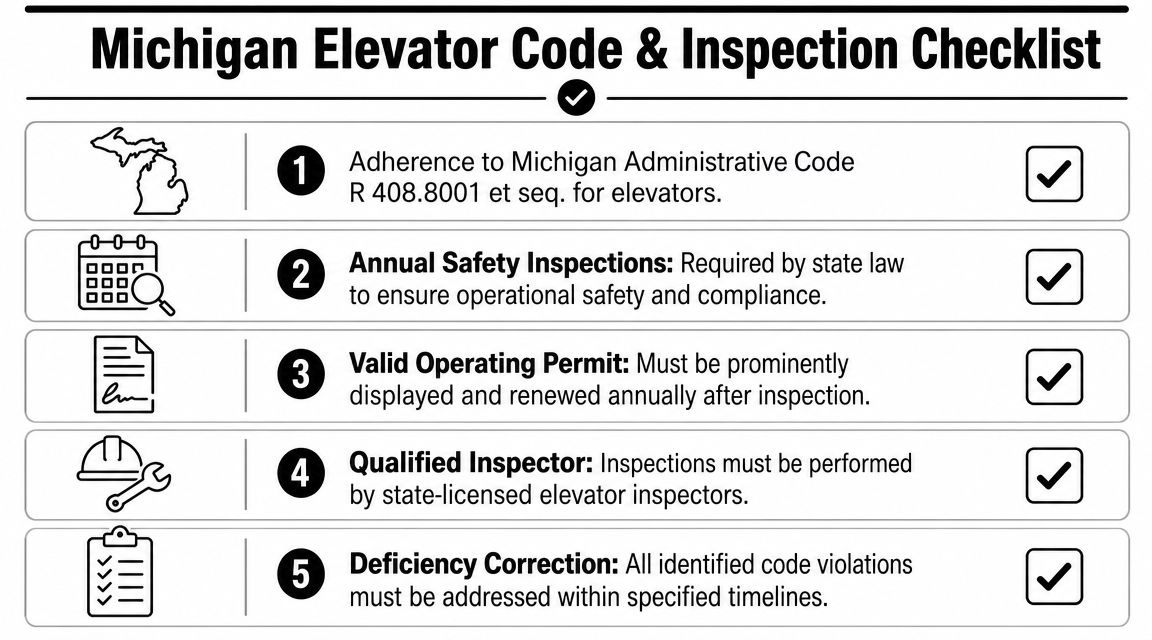
Repair decisions in Michigan don't happen in a vacuum. They sit inside an inspection and compliance framework, and that framework affects whether an elevator can stay in service after corrective work. Owners who focus only on restoring operation often miss the second requirement. The repair also has to stand up to testing, documentation, and inspection review.
The repair has to support compliance
One common U.S. pattern is a yearly no-load safety test and a five-year full-load test, with annual performance and safety testing often witnessed by the authority having jurisdiction. That matters because brake adjustments, governor-switch verification, firefighter's emergency operation checks, and door-safety-device testing are part of the service envelope, not optional extras, as outlined in this overview of commercial elevator maintenance and testing.
If a contractor fixes the immediate complaint but leaves weak documentation, the next inspection gets harder. An inspector needs to see what was corrected, what was tested, and whether the safety devices remain compliant.
What property managers should keep on file
Keep records in a way the next technician and the next inspector can use. At minimum, that means:
Service history
What failed, what was adjusted, and what parts were replaced.Fault pattern notes
Repeated issues on the same floor, at the same time of day, or under the same operating conditions.Close-out documentation
What testing was performed before the elevator returned to service.Inspection and test results
Especially when the building has older equipment or previous deficiencies.
Where owners get exposed
Compliance risk grows when the building delays corrective action after an identified issue. In aggressive enforcement environments, elevator service problems can become occupancy and legal problems, not just maintenance problems. New York City's housing guidance is a useful example of how fast the issue can escalate. If elevator service isn't restored after the compliance period following a Department of Buildings order, the matter can be referred to HPD, according to NYC HPD elevator enforcement information.
Michigan owners should take the lesson even if the local agency path differs. Once an elevator issue crosses from inconvenience into cited deficiency, delay gets expensive fast.
Repairs should leave a paper trail strong enough that the next inspector doesn't have to guess what was done.
For commercial elevator repair, compliance isn't a separate project. It's part of the repair scope from the moment the first wrench comes out.
How to Choose Your Commercial Elevator Repair Partner
A car goes down at 7:45 a.m., tenants start calling, and your first question is whether the contractor will fix the immediate fault or reset the problem until it fails again next week. That is the decision point. The right repair partner protects uptime, inspection readiness, and long-term ownership cost at the same time.
The checklist that actually matters
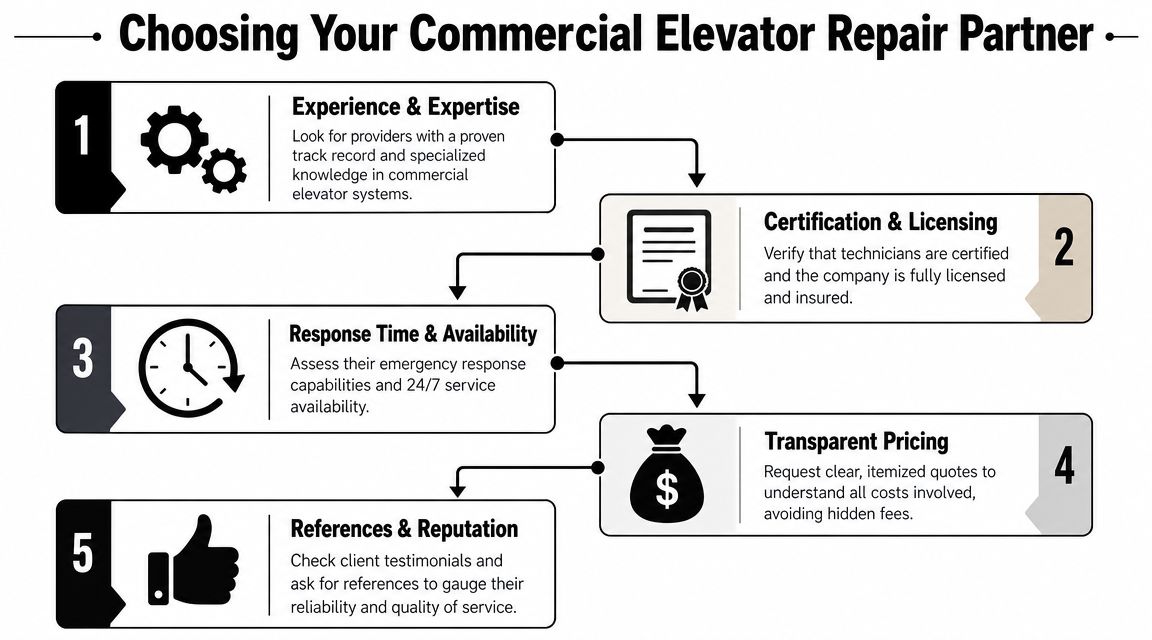
Choose a provider based on how they manage risk over the life of the equipment, not how polished the proposal looks.
Can they service the equipment you own
Freight elevators, hydraulic units, traction cars, platform lifts, and older controllers fail in different ways. Freight service in particular has different wear patterns, which is why Warren Elevator's freight elevator repair guidance treats that work separately from general passenger service.Can they support non-proprietary systems
This affects your options for parts, future bids, and modernization strategy. A locked-down system can turn routine service into a sole-source expense.Can they identify root cause and explain the trade-off
A good mechanic should be able to tell you whether the problem is isolated, recurring, or a sign that the equipment is aging out. Owners need plain language, expected risk, and a realistic next step.Can they produce usable documentation
Repair tickets should show what failed, what was tested, and what still needs attention. That record matters when the next inspection comes around or a recurring shutdown turns into a dispute over prior work.Can they cover emergency response and planned corrective work
A contractor that only handles callbacks will not help you control annual cost. A contractor that only wants scheduled work may leave you exposed when an elevator is out of service and occupants are waiting.
What a strong local partner looks like
In Southern Michigan, Crane Elevator Company is one example of the type of contractor owners should look for: a family-owned company serving Lower Michigan with preventive maintenance, repair, inspections, and non-proprietary modernization across passenger elevators, freight cars, lifts, and related vertical transportation equipment.
The key point is not the name. It is capability. Your repair partner should be able to work on older and newer equipment, tell you when a repair is worth doing, and tell you when the smarter financial move is to plan a modernization before failures start driving tenant complaints, compliance trouble, and repeat emergency invoices.
I tell property managers to watch for one thing above all. Does the contractor reduce your dependence over time, or increase it? If every solution points back to proprietary parts, vague diagnoses, and recurring shutdowns, ownership cost goes up even if the first invoice looks manageable.
Choose the company that treats uptime, documentation, code exposure, and life-cycle cost as one responsibility. That is the true scope of commercial elevator repair.