A lot of building owners call about the same kind of elevator problem. The car still runs. The visual inspection doesn't show an obvious failure. But tenants keep reporting a light shudder leaving the lobby, a faint scraping sound near the top landing, or a ride that feels just a little less steady than it did last month.
Those are the hardest issues to manage because they sit in the gap between “working” and “healthy.” If you wait for a clear failure, you risk downtime, emergency service, and rope damage that spreads into sheaves, bearings, and related components. If you replace parts too early, you spend money before the data justifies it. That's where a modern elevator cable replacement service has to go beyond visual checks and basic adjustment.
Beyond Visual Checks A Smarter Approach to Elevator Safety
If you manage a property in Detroit, Ann Arbor, Lansing, or Grand Rapids, you've probably seen this pattern. An elevator starts to feel rough under load, or it develops a wobble that comes and goes. The doors operate fine. The controller doesn't show a dramatic fault. A standard inspection may catch surface wear, but it may not explain why the ropes are wearing faster than they should.
That's the key problem. Rope wear is often a symptom, not the whole diagnosis. The underlying issue may be uneven tension, a worn sheave groove, a bearing beginning to deteriorate, or a machine alignment problem that loads the ropes unevenly every trip.

Why visual inspection alone can miss early trouble
A rope can look acceptable at first glance and still be operating under bad conditions. That's why owners get frustrated. They hear “we'll keep an eye on it,” but the ride quality keeps slipping.
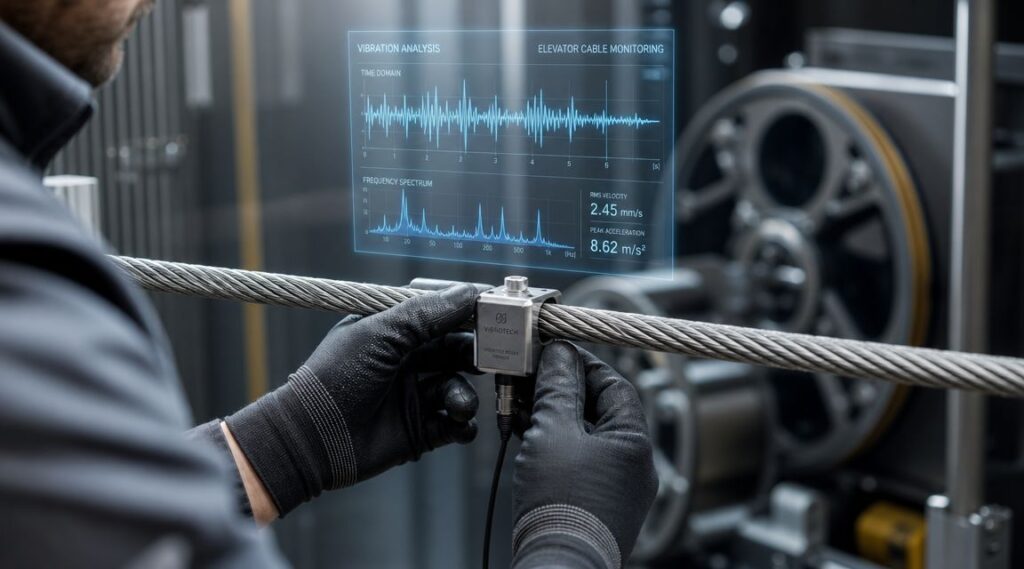
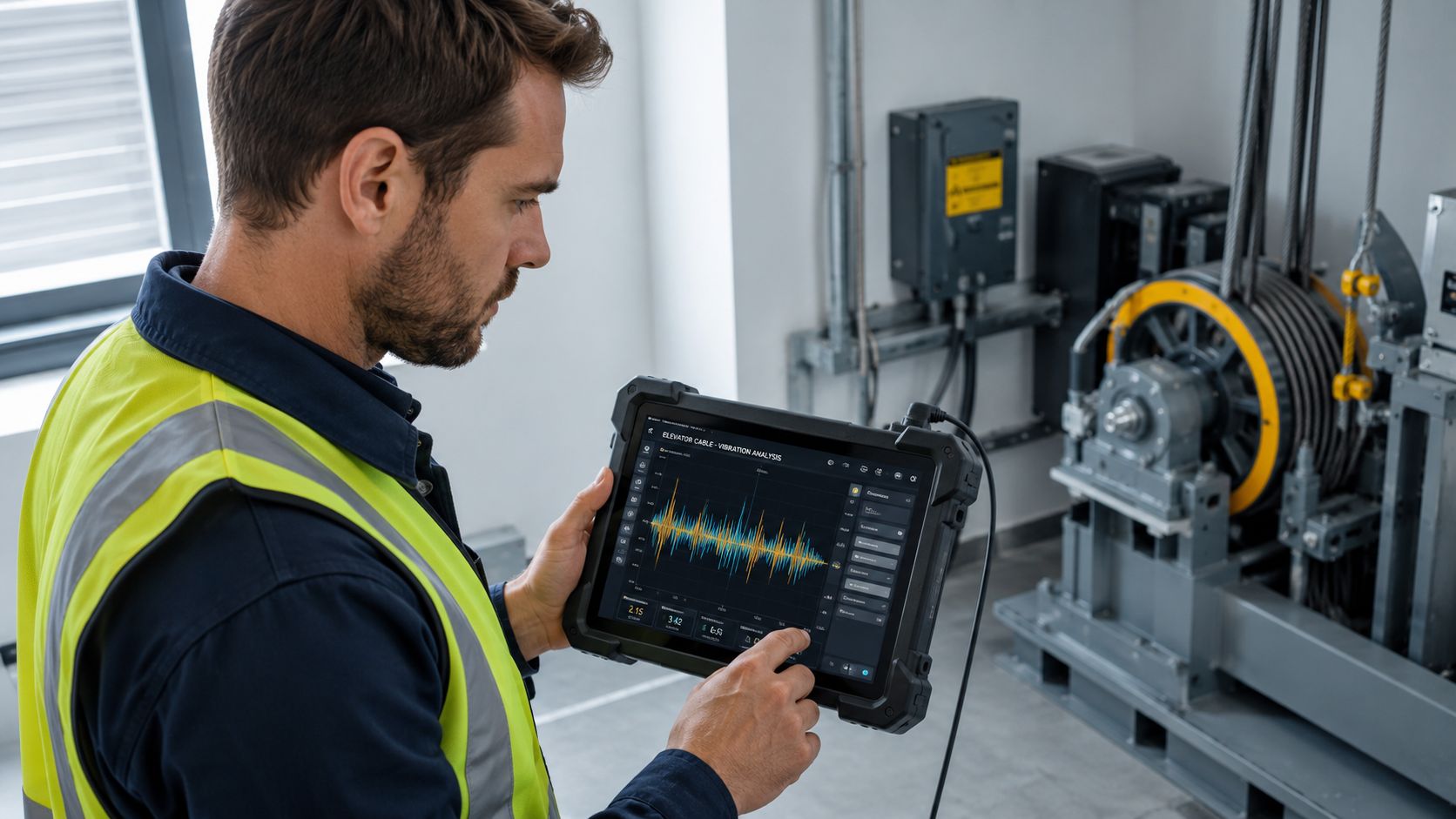
Vibration analysis changes that. It works like a mechanical stethoscope. Instead of waiting for fraying, metallic debris, or a visible diameter loss to become obvious, technicians can track how the machine, sheaves, and rope path behave under motion.
Practical rule: If the elevator feels different, it usually is different. The question is whether the change is minor drift that can be monitored or the start of a wear pattern that needs planned correction.
That decision should be based on measurable criteria, not age alone. Technical guidance emphasizes broken wires, diameter reduction, and tension imbalance as key decision points, and it also warns that worn sheaves can accelerate rope damage, which means a cable-only fix may miss the root cause, as noted in this elevator cable replacement best-practices analysis.
The shift from emergency response to planned work
For owners, the financial difference between reactive and planned service is simple. Planned work can be scheduled around building traffic. Emergency failures force the schedule on you.
A smarter replacement strategy asks:
- Is the rope set wearing evenly: Even wear suggests the system may still be stable enough for monitoring.
- Are vibrations pointing to a machine-side fault: If so, rope replacement alone won't hold.
- Has ride quality changed without a clear visual cause: That's when deeper diagnostics earn their keep.
When an elevator starts sending small warnings, the goal isn't to panic. It's to catch the problem while you still control the timing, scope, and budget.
Understanding the Language of Elevator Vibrations
Most owners don't need a lesson in signal processing. They need a clear way to understand what technicians are looking at and why it matters. The easiest analogy is an EKG. An EKG doesn't just say whether a heart exists. It shows rhythm, irregularity, intensity, and patterns that point to a specific problem. Vibration analysis does the same for elevator equipment.
In a traction system, every rotating component leaves a signature. Motors, gearboxes, sheaves, bearings, and ropes all produce motion patterns. When those patterns change, trained technicians can tell whether the system is stable or developing a fault.
The reason this matters is scale and complexity. Elevator cable replacement sits inside a mature, high-skill service market. The global elevator repair and maintenance service market was valued at about USD 50 billion in 2023 and is projected to reach USD 85 billion by 2033, according to DataHorizzon Research on elevator repair and maintenance services. That's a useful reminder that rope replacement isn't a one-off handyman task. It belongs to a specialized maintenance ecosystem.
Frequency tells you where to look
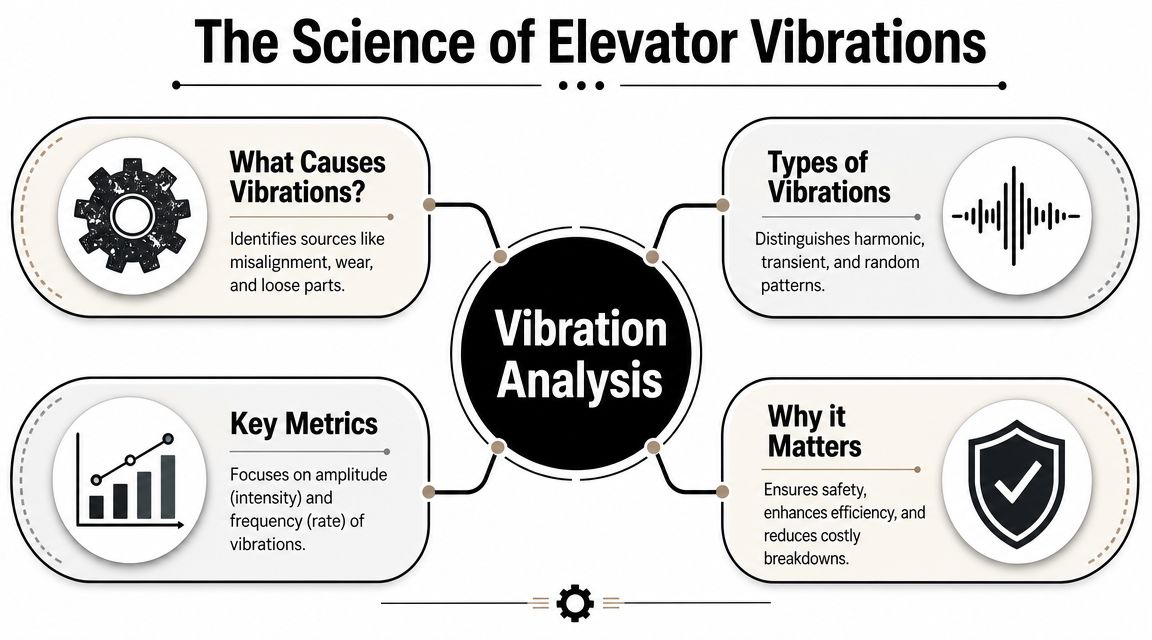
Frequency is the rate of vibration. In plain terms, it helps identify which component is likely producing the problem.
A fast repeating vibration may point toward a bearing or a high-speed rotating part. A slower, repeating pulse may line up with one sheave rotation or one rope cycle through a damaged contact area. That's why frequency matters. It narrows the search from “the elevator feels rough” to “this specific assembly is probably responsible.”
Amplitude tells you how bad it is
Amplitude is the strength of the vibration. Think of it as the volume knob on the problem.
A low-level vibration can still be important if it's new and trending upward. A large amplitude event usually means the fault has moved beyond early detection and is affecting ride quality, component stress, or both.
A small vibration pattern with a clear trend is often more useful than a loud complaint with no history.
Spectra shows the full fingerprint
Spectra is the combined picture. It's the graph that shows multiple vibration components at once, which lets a technician separate overlapping issues.
That matters because elevators rarely fail in a neat, single-cause way. A worn bearing can exist alongside rope tension imbalance. A sheave condition issue can show up with machine vibration. The spectrum helps sort those signals so maintenance decisions aren't based on guesswork.
For owners, the takeaway is simple. Vibration data turns vague symptoms into a readable mechanical fingerprint. That gives you a more defensible answer to the question every building asks sooner or later. Monitor it, or schedule replacement now?
What Your Elevator's Vibrations Are Trying to Tell You
When an elevator develops a vibration issue, the pattern matters as much as the presence of vibration itself. Different faults leave different signatures. Technicians aren't just listening for noise. They're matching patterns to root causes.
Maintenance guidance recommends monthly basic inspections and professional checks every six months for high-traffic lifts, with replacement needed for signs like fraying, rust, reduced tension, excessive stretch, unusual vibration, or metallic shavings near the sheave, as described in this elevator cable maintenance and replacement guide. In practice, vibration often shows up before the rope problem becomes visually dramatic.
Common patterns and what they usually mean
A once-per-revolution thump often points to a sheave issue, misalignment, or a localized defect that repeats every cycle. That matters because repeated contact at the same damaged point can grind away at rope surfaces and accelerate uneven wear.
A high-frequency roughness often suggests bearing distress. Owners usually experience that as a faint growl, screech, or a ride that feels harsher at speed. Bearings don't just affect comfort. As they degrade, they can alter how the machine loads the rope path.
A low-frequency hum or shake can indicate imbalance in the motor or drivetrain. That kind of vibration may not produce immediate shutdowns, but it can shorten component life and create the kind of chronic complaints that are hard to solve with simple adjustment.
What a symptom checker looks like in the field
| Fault Type | Typical Vibration Signature | Potential Impact |
|---|---|---|
| Bearing deterioration | High-frequency roughness or screech-like pattern | Heat, noise, increasing stress on rotating assemblies |
| Sheave misalignment or groove wear | Repeating pulse tied to rotation | Accelerated rope wear, poor load sharing, rough ride |
| Rope tension imbalance | Uneven oscillation under travel or load changes | Leveling issues, vibration, shortened rope life |
| Motor imbalance | Low-frequency hum or shake | Reduced ride quality and added strain on connected parts |
| Structural looseness | Intermittent rattling or broad vibration pattern | Fastener movement, noise, wear in adjacent components |
| Resonance | Strong vibration at specific speeds or travel zones | Passenger discomfort and amplified stress on the system |
Why the rope may not be the first failed part
By diagnosing correctly, owners can save money. If a rope set is wearing because the sheave grooves are no longer supporting proper contact, replacing the ropes without addressing the sheave can create a very expensive repeat problem.
Guide conditions can contribute too. Car motion isn't influenced by ropes alone. Rail interaction, alignment, and machine behavior all affect ride feel. If you want a practical reference on that side of the system, this overview of guide rails for elevators is worth reviewing.
Don't treat rope wear as an isolated event. In many traction elevators, the rope is the reporter, not the criminal.
The point of vibration analysis isn't to replace inspection. It's to make inspection smarter. It helps answer whether the elevator has a rope problem, a machine problem, or both.
How We Measure and Interpret Elevator Health
Good vibration work starts with disciplined data collection. If the measurements are sloppy, the conclusions will be too. In elevator service, that means using the right sensors, placing them consistently, and comparing readings over time instead of chasing one noisy snapshot.
Technicians typically use accelerometers and data loggers on key points such as the motor housing, gearbox, bearing locations, machine frame, and sheave support areas. The goal is to capture motion where force is being generated or transmitted. One reading from one point doesn't tell the full story. A useful data set comes from comparing locations and operating conditions.
Baseline first, trending second
The most valuable reading is often the baseline taken when the elevator is operating normally. Once you have that reference, later readings show whether vibration levels and patterns are drifting.
That's how technicians separate normal machine character from real deterioration. One machine may always show a mild signature in a specific band. Another may run very clean until a bearing starts changing the profile. Without a baseline, every reading looks more mysterious than it should.
Two common monitoring approaches are:
- Route-based checks for commercial buildings. A technician gathers readings during scheduled visits and compares them to prior data.
- Continuous monitoring for facilities where downtime carries more operational risk, such as healthcare or critical public-use buildings.
Precision matters in rope decisions
Rope replacement calls for more than “it looks worn.” Technical guidance from Prysmian states that suspension, compensation, and governor ropes must be replaced when actual diameter falls below the specified minimum. It also notes a measurement discipline many people miss: take two measurements at the same position to avoid false readings from rope irregularity. For ropes under 8 mm, the cited maximum allowable diameter reduction below nominal is 3.125%, according to Prysmian's elevator wire-rope technical guidance.
That's a good example of why calibrated tools matter. Rope wear isn't just a visual story. Diameter loss can indicate internal degradation, strand wear, or fatigue that the eye won't fully capture.
Turning readings into maintenance decisions
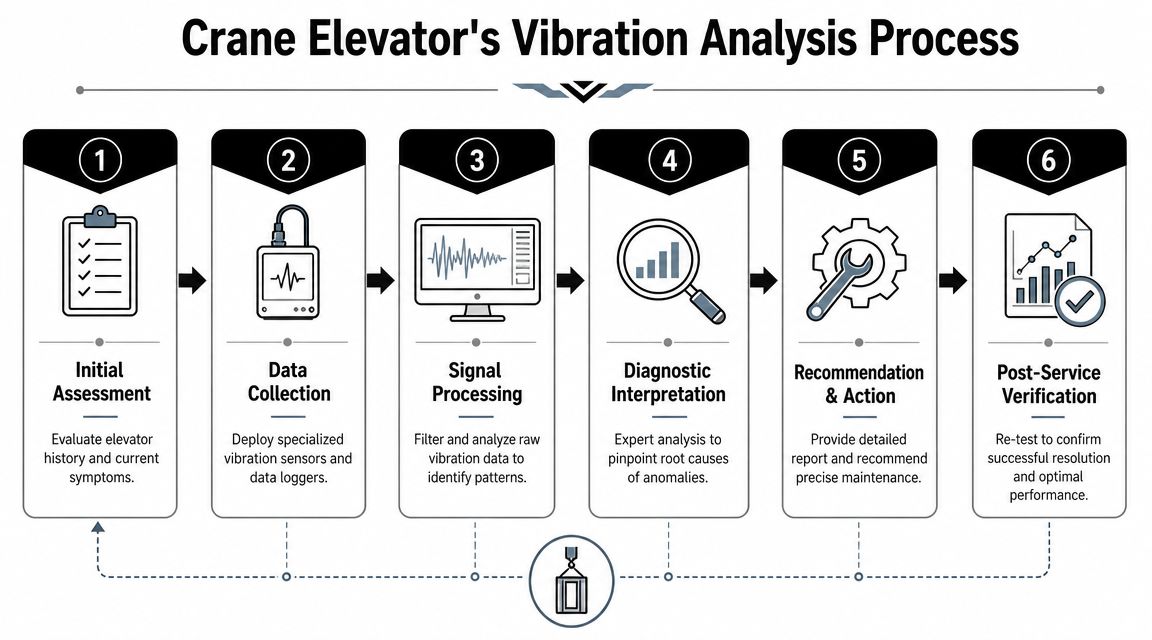
A sound process usually follows this sequence:
- Review service history and current complaints.
- Place sensors consistently on the same machine points each visit.
- Run the elevator through repeatable operating conditions so readings can be compared.
- Compare with the baseline to spot new or rising signatures.
- Confirm with physical inspection of ropes, sheaves, bearings, and related components.
- Retest after correction to verify the fault is gone.
For owners who want a broader view of required verification work around elevator systems, this page on elevator testing provides useful context.
Crane Elevator Company uses this kind of methodical approach as one option for buildings that need more than a visual rope check. That's especially useful when the question isn't merely “are the ropes worn,” but “why are they wearing this way?”
Interpreting Vibration Data for Cable Replacement
The value of vibration analysis shows up when it turns a vague complaint into a clear maintenance decision. That's what building owners need. Not a pile of graphs. A workable answer.
Ann Arbor example with tension imbalance
Consider a residential property in Ann Arbor where residents reported that one car felt “bouncy” leaving certain floors. The elevator still passed routine visual checks well enough to stay in service, and the rope set didn't show dramatic surface damage from a quick look.
Vibration review pointed to uneven rope behavior under load transition. That kind of pattern usually tells you the ropes aren't sharing the work evenly anymore. The owner had a choice. Keep adjusting and hope the ride stabilized, or schedule a planned elevator cable replacement service before the imbalance turned into heavier wear and a service disruption.
The planned approach usually wins in that situation because you can align scheduling with occupancy needs. You also avoid the mistake of treating recurring adjustment as a long-term repair.
If the same complaint keeps coming back after minor correction, the system is telling you adjustment is no longer enough.
Detroit example with sheave-related rope damage
A downtown Detroit office building can present a different story. The complaint may be a brief roughness at a repeatable point in travel. Vibration patterns can point toward a rotating contact problem rather than a general ride issue.
That often leads the inspection team to the sheave and groove condition. If the grooves are worn, they can chew into the ropes and create a cycle where new adjustments improve the ride for a short time, then the problem returns. In that case, replacing only the ropes is false economy. The better recommendation is to correct the sheave condition and replace the rope set together.
A short visual explanation helps here:
What owners should take from these examples
The point isn't that every vibration issue ends in rope replacement. Some don't. The point is that data helps separate:
- Monitor and trend
- Adjust and retest
- Replace ropes on a planned schedule
- Replace ropes plus related hardware because the root cause is elsewhere
That distinction matters to your budget. Planned work costs money. Repeated partial fixes plus tenant complaints plus avoidable downtime usually cost more.
When to Schedule Your Elevator Cable Replacement Service
Owners usually wait too long for one of two reasons. They don't want to replace ropes before it's necessary, or they assume a rough ride is just part of an older elevator. Both assumptions can lead to the same result: a preventable shutdown.
A good time to schedule an assessment is when the elevator changes behavior, not when it stops. New vibration, new sound, repeated leveling drift, or recurring tension adjustment are all reasons to get ahead of the problem. That's especially true in older systems with original ropes still in service.
Three clear triggers to stop watching and start planning
- A new ride-quality complaint appears: If tenants describe shaking, humming, scraping, or a repeated thump, don't treat that as background noise.
- The elevator has aged in place with major original components: Older traction systems deserve closer measurement, even when they're still operating daily.
- You want predictable maintenance instead of emergency decisions: A planned replacement window is always easier to manage than an unplanned outage.
What doesn't work
Waiting for visible failure alone doesn't work. By the time broken wires, metallic debris, or severe vibration become impossible to miss, the elevator may already be damaging associated parts.
Replacing one rope in a set also doesn't work in normal service conditions. Bethlehem Wire Rope guidance states that if one rope in a set is worn or damaged and requires replacement, the entire set should be replaced, with only narrow exceptions. Mixing old and new ropes creates uneven load sharing and inconsistent elongation, which can lead to vibration and leveling problems, as explained in the Bethlehem Wire Rope elevator catalog.
Replace the rope set as a system, because that's how the elevator uses it.
What a practical service decision looks like
If you manage a building in Detroit, Grand Rapids, Ann Arbor, Lansing, or nearby Lower Michigan communities, a sensible replacement decision usually includes:
- Measured rope condition rather than age guesses alone
- Review of sheaves and pulley contact surfaces so the new ropes won't inherit the same damage pattern
- Tension and ride evaluation to confirm the system shares load correctly
- Post-work verification so the repair solves the original complaint, not just the visible symptom
For owners who want to reduce surprise shutdowns, a structured elevator maintenance program is often the easiest place to start. It creates history, trending, and clearer replacement timing instead of last-minute decisions.
The biggest budget mistake in elevator rope work is paying for the same problem twice. First in recurring adjustments. Then again in emergency repair. A data-backed elevator cable replacement service helps you avoid that by identifying whether you should keep monitoring, schedule rope replacement, or correct a deeper mechanical issue at the same time.
If your elevator has started to feel different, sound different, or generate repeat service calls, contact Crane Elevator Company for an assessment. They serve Lower Michigan properties including Detroit, Grand Rapids, Ann Arbor, Lansing, and surrounding communities, with support for maintenance, inspections, repairs, modernization, and elevator cable replacement planning.