
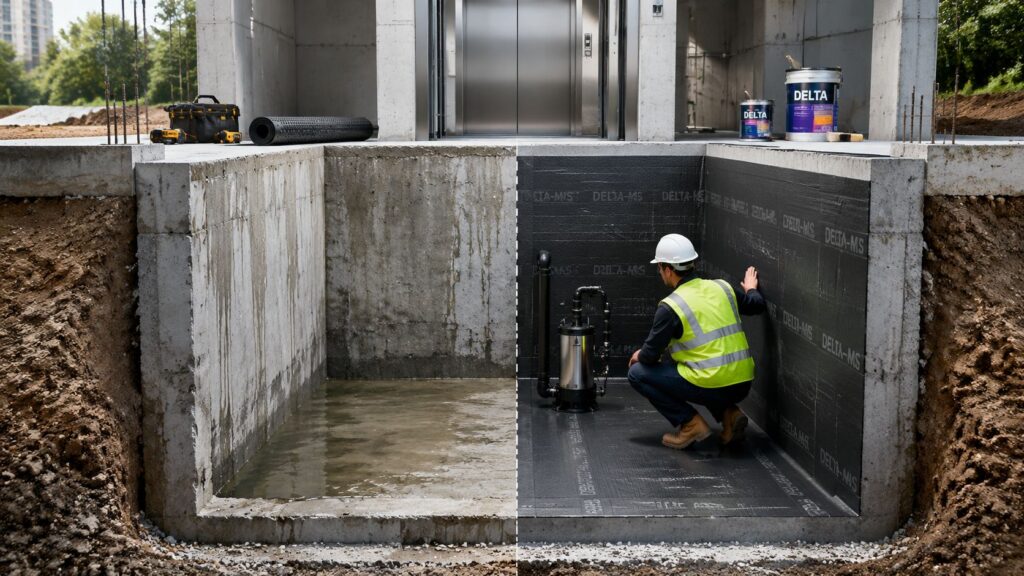
You usually find out about a wet elevator pit at the worst possible time. A manager gets a complaint that the elevator is acting up, someone opens the pit access, and there it is. Standing water, damp walls, rust starting to show, and a sinking feeling that this isn't just cleanup work.
In Southern Michigan, that reaction is justified. Water in an elevator pit is rarely a one-time nuisance. It often means groundwater pressure, failed joints, cracked concrete, drainage trouble, or a pit that was never detailed correctly in the first place. If it's ignored, the problem spreads from concrete to equipment, from maintenance headache to shutdown risk.
Elevator pit waterproofing is one of those building issues that owners put off until they can't. The better move is to treat it as a lifecycle decision. Fix the source, choose a system that matches the building, and keep the elevator operating instead of waiting for water damage to force your hand.
Why a Wet Elevator Pit Is More Than Just a Puddle
A wet pit changes the whole conversation around an elevator. The moment water reaches the bottom of the shaft, the risk is no longer cosmetic. It affects reliability, safety, and how much money the owner will spend over the next few years.
The first signs are often easy to dismiss. A little seepage along the wall. Damp residue at the slab edge. A sump that runs more often after heavy rain. Then the calls start. Intermittent faults. Corrosion on pit components. Odors. Repeat service visits. In some buildings, the elevator stays in service longer than it should because the water problem developed gradually.
That's where owners get hurt financially. One patch leads to another. Somebody seals a visible crack, but the true leak path is a cold joint or penetration. A pump gets added, but the walls still take on moisture. The pit looks better for a while, then the next storm or spring thaw puts everyone back where they started.
A wet pit doesn't stay a pit problem. It becomes an elevator problem.
Water can attack rails, buffers, metal supports, wiring pathways, and any steel embedded in or near the pit environment. It also creates a poor service condition for the technicians who have to inspect and maintain the equipment. That matters for routine maintenance, for shutdown decisions, and for inspection readiness.
If you're already dealing with standing water or recurring seepage, it helps to look at a dedicated overview of what a flooded elevator pit means for your building. The biggest mistake is assuming the answer is always simple cleanup. In practice, the right answer depends on where the water is entering, how long it's been happening, and whether the building has a broader drainage or flood exposure problem.
In this region, a wet pit is usually a warning. Ignore it, and you end up paying for the waterproofing job plus the elevator damage.
Understanding Water Intrusion in Elevator Pits
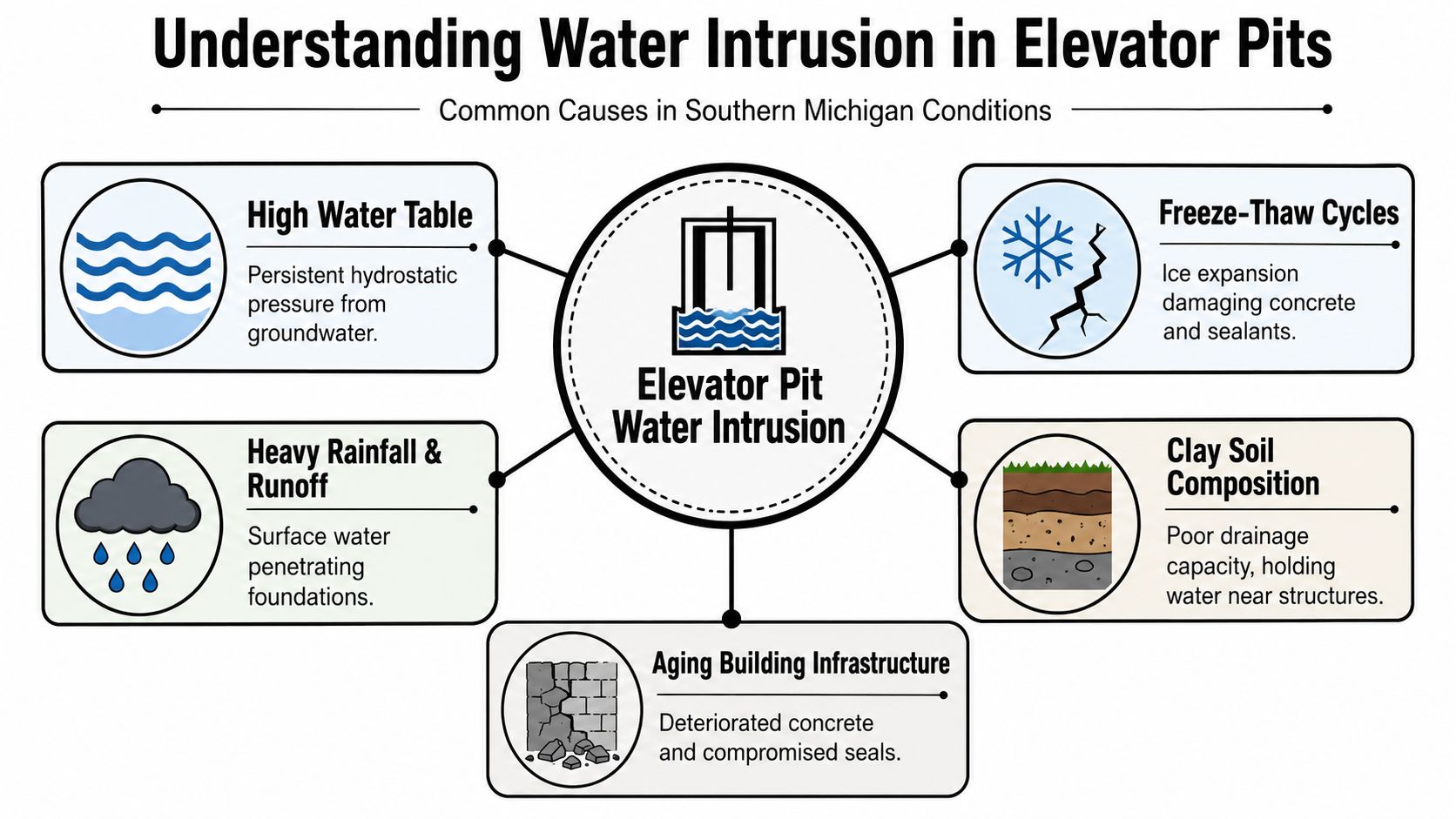
Southern Michigan gives below-grade structures a hard time. You have spring thaw, heavy rain, aging foundations, and plenty of sites where groundwater doesn't stay put. Elevator pits sit at the lowest point of the building, so they collect the consequences of every weakness around them.
Hydrostatic pressure is the real enemy
Most owners describe the problem as a leak. Technically, the bigger issue is hydrostatic pressure. Water in the surrounding soil pushes against the pit walls and slab continuously. If the concrete has a crack, a cold joint, a penetration, or a weak transition at the slab-to-wall connection, water looks for that path.
That's why pit leaks often seem to come and go. The leak path may be constant, but the pressure changes with weather, groundwater level, nearby drainage conditions, and seasonal shifts. A pit can look manageable in a dry stretch and then take on water fast when the site gets saturated.
Why Michigan pits fail in familiar places
Freeze-thaw cycles don't help. Water gets into small defects, temperatures swing, and those defects widen over time. Sealants age. Concrete becomes more porous. Penetrations that looked acceptable years ago stop performing.
The common entry points are usually predictable:
- Slab-to-wall joints: This transition is one of the first places to fail when movement or poor detailing exists.
- Pipe and conduit penetrations: If these weren't sealed as part of a complete system, they become easy leak paths.
- Cold joints and control joints: Separate pours and movement points need specific treatment, not general coating.
- Hairline cracks that become active cracks: What looks minor in winter can become active seepage in spring.
- Integrated foundation geometry: Complex layouts make continuity harder, and continuity is what keeps water out.
A useful technical point from The Construction Specifier's discussion of elevator pit waterproofing is that the most reliable and cost-effective approach is often to make the elevator pit an independent foundation element. That lets the pit be fully wrapped with exterior waterproofing. Once the pit is tied into a more complicated mat or slab-on-grade arrangement, detailing gets harder and failure risk goes up.
Field reality: The pits that stay dry longest are usually the ones with the fewest complicated transitions.
What owners should look for first
If you're trying to understand the source before calling for repairs, start with symptoms that point to pressure, not just surface moisture:
- Recurring water after rain or thaw: That suggests site or groundwater influence.
- Efflorescence or mineral residue: Water has been moving through the concrete, even if the pit isn't flooded that day.
- Localized seepage at corners or penetrations: Those spots often reveal the weakest detail first.
- A pit that was “fixed” before: Repeated patching usually means the assembly was never fully addressed.
A dry pit doesn't happen by accident. It happens when the design, drainage, joints, and repairs all work together.
Comparing Waterproofing Methods for Your Building
There isn't one best waterproofing method for every elevator pit. In Southern Michigan, the right choice usually comes down to three job conditions. How much hydrostatic pressure the pit sees through the year, whether the exterior can still be reached without tearing up half the site, and how much risk the owner is willing to carry in future service calls, shutdowns, and repeat repairs.
That last point gets missed.
A lower-cost repair can look fine in a proposal review and still cost more over ten years if it only slows the leak instead of controlling it. I have seen owners spend money three times on interior patching because the first scope never matched the water conditions around the pit.
Exterior waterproofing versus interior work
Exterior waterproofing is still the strongest option when the pit is new, the site is open, or excavation is already part of the project. It stops water before it enters the concrete, which is always better for the pit structure, the equipment, and long-term maintenance. If a building owner has that access, it deserves serious consideration even if the first price is higher.
Existing buildings are different. In Ann Arbor, Jackson, Lansing, and across the rest of Southern Michigan, many pits sit behind sidewalks, tight property lines, utilities, or attached additions. Excavation can be expensive fast. It can also create its own schedule and tenant headaches. In those cases, interior systems are often the practical answer, but they need to be chosen for the conditions that are there, not the conditions everyone wishes were there.
Comparison of Elevator Pit Waterproofing Methods
| Method | Best For | Pros | Cons | Typical Lifespan |
|---|---|---|---|---|
| Negative-side membrane | Existing pits where exterior access is limited | Installed from inside the pit, limited site disruption, useful in retrofit work | Does not remove outside water pressure, depends heavily on surface prep and detailing at joints and penetrations | Varies with water pressure, substrate condition, and installation quality |
| Cementitious coating | Sound concrete with light seepage and good surface preparation | Bonds well to concrete, practical for broad wall and floor coverage, often fits rehab budgets | Usually not enough by itself for moving cracks, failed joints, or active leaks | Varies with substrate condition and leak activity |
| Interior drainage and sump pump system | Pits with recurring groundwater entry that cannot be stopped economically from outside | Gives water a controlled path, reduces standing water, practical for high water table sites | Manages water rather than eliminating every entry point, requires maintenance, monitoring, and backup power planning | Ongoing service life depends on pump quality, maintenance, and replacement cycle |
| Chemical grout injection | Active cracks, joints, penetrations, and isolated leak paths | Targets specific leak routes, useful before coatings or membranes, good retrofit tool in experienced hands | Diagnosis matters, installation quality matters, and it does not solve whole-surface moisture by itself | Varies by material, crack movement, and surrounding conditions |
Field-Proven Techniques
The pits that hold up best usually use more than one method. A common sequence is to stop active leaks at cracks, joints, and penetrations first, then repair damaged concrete, then apply the interior coating or membrane system. If groundwater is persistent, controlled drainage and a sump system may also need to be part of the final design.
That sequence matters because each material has a job. Grout injection can shut down a leak path. Repair mortar can rebuild the section. A coating can then perform on a stable surface instead of being asked to bridge active water movement.
The linked Xypex white paper on elevator pit waterproofing with crystalline technology makes the same practical point in different terms. Joint treatment and leak stoppage have to come before the final waterproofing layer. That aligns with field experience. If water is still pushing through a cold joint or pipe penetration, no finish coat is going to save a bad sequence.
A practical way to choose
Owners usually make better decisions when they look at lifecycle cost instead of only first cost. A cheaper interior coating may be the right call for a pit with minor seasonal seepage and limited consequences from brief maintenance work. It is often the wrong call for a hospital, senior living facility, or apartment building where elevator downtime turns into a tenant, safety, and operations problem.
Ask these questions early:
- Can the water be blocked outside the structure, or does it need to be controlled from inside?
- Are the leaks limited to a few joints and cracks, or is the entire pit taking on moisture?
- Will freeze-thaw movement keep reopening the same detail every winter?
- If a sump pump is part of the plan, is backup power included?
- What costs more over time. One larger repair now, or repeated service calls, pump failures, cleanup, and shutdown risk?
The best method matches the building, the site, and the owner's tolerance for future trouble.
A good product used in the wrong assembly still turns into a bad result.
A Michigan Project Case Study How We Keep Elevators Running
One recent Southern Michigan project is a good example of how this work usually unfolds in practice. The building had a recurring water problem in the pit. Not a dramatic flood every week, but enough seepage and accumulation that the owner knew downtime was coming if it wasn't addressed properly.
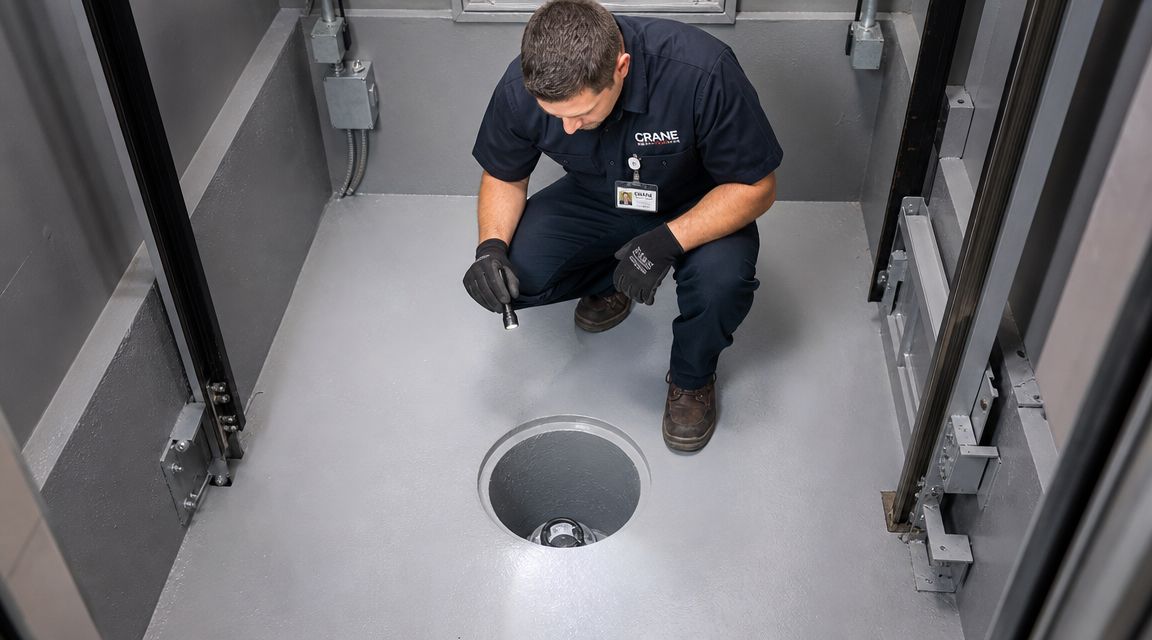
The site conditions were familiar for this part of Michigan. The pit sat below grade, the surrounding area held water after storms, and the leakage pattern suggested that both the walls and the floor needed attention. The owner had already lived through repeat moisture issues and didn't want another short-lived patch.
What the crew did
The repair scope came down to two priorities. First, give the water somewhere controlled to go. Second, stop the pit surfaces from continuing to absorb and transmit moisture.
The crew drilled out a new sump pump well in the elevator pit so water could be actively managed instead of collecting unpredictably at the bottom of the shaft. After that, the walls and floor were waterproofed as part of the interior rehabilitation.
That combination matters in older buildings. If you only waterproof the surfaces and ignore active water management, the pit can still struggle under changing site conditions. If you only install a pump and ignore the leaking concrete, you're still leaving the structure wet and vulnerable.
Some pits need a seal. Some need drainage. The difficult ones need both.
The result was a pit the owner could manage with confidence. The standing water issue was addressed, the surfaces were treated, and the building avoided the kind of shutdown that usually arrives after one more storm than the old system can handle.
Why this approach made sense
This wasn't a glamour job. It was the kind of practical elevator pit waterproofing work that saves owners from recurring service calls and emergency decisions. The building had access constraints that made a full exterior solution more disruptive, so the repair had to be built around what could be done effectively from the interior.
A short look at the kind of pit conditions technicians deal with helps make that clear:
What owners should take from this project
The lesson isn't that every pit needs the same fix. It's that the right solution often combines more than one move.
In Southern Michigan, a sensible project plan usually includes:
- Diagnosis before materials: Find out whether the issue is pressure, a joint failure, a penetration, slab seepage, or a combination.
- Active water control where needed: A sump pump well can be the right answer when water has to be managed continuously.
- Wall and floor treatment together: If both surfaces are involved, splitting the repair usually leads to repeat problems.
- A lifecycle view: Owners save money when they stop treating every leak as an isolated event.
Local experience matters. The weather, soil, and age of the building stock all influence what will hold up and what won't.
Navigating Michigan Elevator Code and Safety Rules
A wet elevator pit is more than a maintenance headache. In Michigan, it can turn into a code problem, a safety problem, and a budgeting problem at the same time.
That matters more in Southern Michigan than many owners expect. We deal with freeze-thaw movement, older concrete, seasonal groundwater swings, and plenty of sites where the pit sits in soil that stays wet longer than the rest of the building. A pit may look manageable in July and fail inspection conditions in March.
Why inspectors care about a wet pit
Inspectors are not only looking for standing water. They are looking at the condition that water creates around pit equipment, structural surfaces, and access areas. Persistent moisture can lead to corrosion, damaged joint sealant, rust at embedded metal, deteriorated concrete, and unsafe service conditions for anyone entering the pit.
That is where owners get caught. They treat seepage like housekeeping, but the state and the inspector see the effect on safe operation.
Michigan owners also need to keep broader compliance deadlines in view. If your building is already planning around Michigan elevator code compliance deadlines and 2028 upgrade requirements, a wet pit is one more item that can complicate inspections, corrective work, and scheduling.
What code-based decision making looks like on a real job
Code thinking changes the scope of the conversation. The question is not just how to dry the pit out this week. The question is whether the below-grade assembly is performing the way it should under actual site conditions, including groundwater pressure and vapor drive.
In practice, that means looking closely at the parts of the pit that usually fail first:
- Slab-to-wall transitions
- Cold joints and control joints
- Conduit entries and pipe penetrations
- Termination points, anchors, and patch areas
- Continuity of the waterproofing system across the full pit envelope
Owners save money when they make this distinction early. Spot repairs may quiet a leak for a while, but they often do not address the underlying issue if water is entering along multiple paths or if hydrostatic pressure is pushing through the slab and wall connection. In Southern Michigan, that short-term approach is expensive because one winter can reopen work that looked acceptable the previous season.
As noted earlier, building code requirements for below-grade waterproofing apply when a structure is below the water table or exposed to hydrostatic pressure. For elevator pits, that puts the discussion at the structural level, not the janitorial level.
Liability and cost both rise when owners wait
Owners sometimes ask if they can defer pit waterproofing until a larger capital project. Sometimes that is reasonable. If the condition is stable, monitored, and not affecting operation, there may be room to plan the repair properly.
If water is reaching components, creating repeat shutdowns, or showing up during inspection, delay usually costs more than the repair itself would have. I have seen pits in Southern Michigan go from minor seepage to equipment damage after one hard freeze-thaw season and a wet spring. The owner ends up paying for waterproofing, corrosion cleanup, extra service calls, and downtime instead of one coordinated project.
The practical rule is simple. If the pit condition can affect safety, reliability, or compliance, treat it like a building systems issue and correct the source of the water. That is the cheaper decision over the life of the elevator.
Planning Your Waterproofing Project Cost and Timelines
A Southern Michigan owner usually asks the same two questions after the first serious pit leak. How long is the elevator going to be down, and am I fixing this once or buying the same repair every spring?
Those questions matter because pit waterproofing is usually tied to operating risk, not just a construction line item. Freeze-thaw movement, seasonal groundwater, and access limits can turn a low bid into a repeat expense if the scope is too narrow.
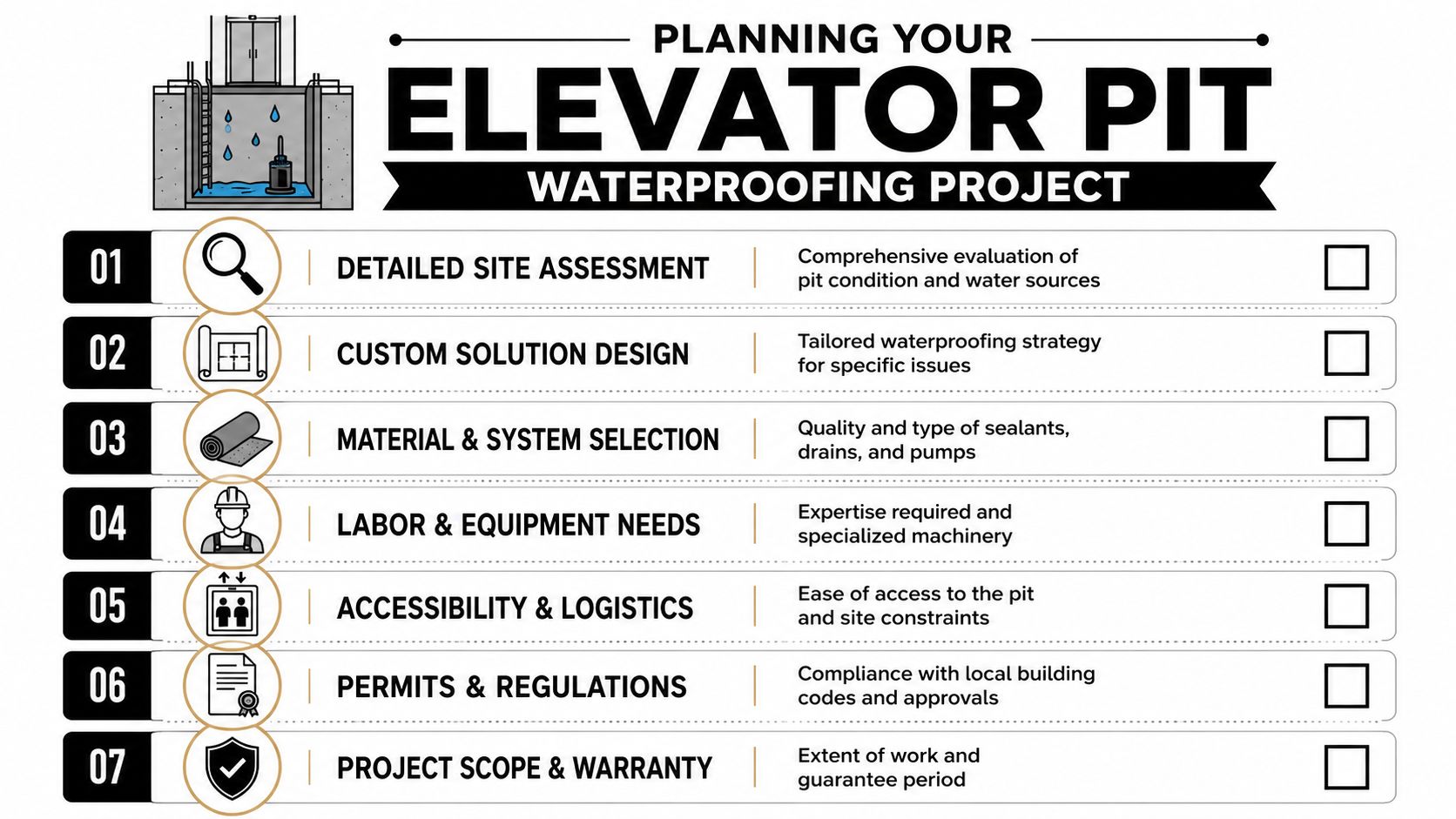
What drives cost and schedule
Price and timeline usually come down to field conditions, not brochure promises.
A pit with minor seepage and sound concrete can often be addressed faster than a pit with active wall-floor leakage, rusted steel, failed patching, and electrical coordination issues. If the building stays occupied during the work, scheduling gets tighter. Schools, medical buildings, apartment properties, and municipal sites all have different shutdown tolerances, and that affects labor hours just as much as the waterproofing method.
The main cost drivers are usually:
- Extent of deterioration: Surface prep, crack repair, corrosion cleanup, and concrete restoration add time before waterproofing even starts.
- Chosen repair path: Exterior excavation, interior negative-side treatment, injection, drainage improvements, and sump work each carry different labor and sequencing demands.
- Access limits: Narrow access, debris removal, and material handling inside an existing shaft slow production.
- Elevator shutdown planning: Some jobs can be staged around limited service windows. Others require the car to be out of service for a longer block.
- Coordination with other trades: Electricians, waterproofing crews, and elevator mechanics may all need time in the same area.
In Southern Michigan, schedule also depends on weather. Exterior work is harder to plan during wet periods, and freeze-thaw conditions can delay excavation, curing, or final sealing.
Avoiding costly rework
Older buildings get into trouble when the repair is sized to this quarter's budget instead of the building's remaining service life. W. R. Meadows' guidance on waterproofing elevator pits is useful here because it separates interior repairs from full exterior waterproofing and forces the owner to look at long-term performance, not just first cost.
That is the decision point I walk owners through. If the building will be held for years, has repeated water entry, and offers workable exterior access, a larger correction can be the cheaper ownership decision. If exterior access is blocked by adjoining structures, utilities, or site constraints, an interior approach may still make sense, but it should be planned as a managed compromise with realistic maintenance expectations.
A 40-year-old apartment building in Southern Michigan does not need the same answer as a newer municipal building with capital funds already set aside. Good planning accounts for ownership horizon, tenant impact, inspection exposure, and how often the pit has already been repaired.
How to vet the contractor
Hire for pit conditions, code awareness, and coordination discipline.
A contractor who only knows general crack sealing can miss the bigger issue. Elevator pits bring together groundwater pressure, confined working conditions, equipment protection, and shutdown planning. The proposal should show that the contractor understands all four.
Use this checklist during bidding:
- Ask for elevator pit-specific experience: Basement waterproofing experience helps, but pit work has different consequences and tighter tolerances.
- Require a clear scope: Separate source control, concrete repair, waterproofing, drainage, and equipment protection so you can see what is and is not included.
- Review the shutdown plan: The contractor should explain when the elevator is unavailable and what conditions must be met before returning it to service.
- Confirm safety and insurance: Moisture, electrical components, and restricted access raise exposure for everyone on site.
- Ask about post-project care: If the repair depends on pumps, sensors, or periodic inspection, that needs to be folded into the building's elevator maintenance program.
The cheapest proposal often leaves out the work that prevents callbacks. Owners usually feel that omission later, through extra service calls, tenant complaints, and another round of pit repairs before the first one has paid for itself.
Proactive Maintenance for a Permanently Dry Pit
A successful waterproofing job is only half the answer. The other half is keeping the pit from slipping back into the same condition over time.
That means treating the pit like part of the building's flood and downtime planning, not just part of elevator service. Metro Elevator's discussion of elevator pit flood prevention points out a gap many owners miss. Effective pit management should include water sensors, backup power for pumps, and operational checklists for basement flooding or power-loss events, not just sealants or a sump pump.
What building staff should check
A simple routine catches a lot of trouble early:
- Look for new moisture patterns: Damp spots, seepage lines, residue, and rust stains matter.
- Test pump operation: If the pit depends on a sump pump, verify it runs as intended.
- Watch the weather relationship: If the pit gets worse after storms or thaw cycles, log it.
- Inspect penetrations and joints visually: Changes around conduits, sleeves, and wall-floor transitions often show up before major water entry.
- Include the pit in your maintenance program: Don't leave it off the regular elevator maintenance schedule.
Why operations matter as much as waterproofing
Even a well-repaired pit can be stressed by a broader building water event. Stormwater backup, site flooding, and power loss can defeat a system that looks fine in normal conditions. Owners who plan for those events tend to avoid the worst downtime because they know who responds, what gets checked first, and when the elevator should be taken out of service.
The long-term goal isn't just a dry pit today. It's a pit that stays dry enough, monitored enough, and managed well enough that it doesn't surprise you later.
If your building in Southern Michigan has recurring seepage, standing water, or a pit that never seems fully dry, now's the time to get it evaluated before the next weather cycle makes the decision for you.
If you're dealing with a wet or flooded pit in Southern Michigan, Crane Elevator Company can help. We handle elevator pit waterproofing, including practical retrofit work like drilling new sump pump wells and waterproofing pit walls and floors. If you want a straight assessment of what's causing the water, what can be repaired, and what approach makes sense for the life of your building, contact Crane for an inspection.