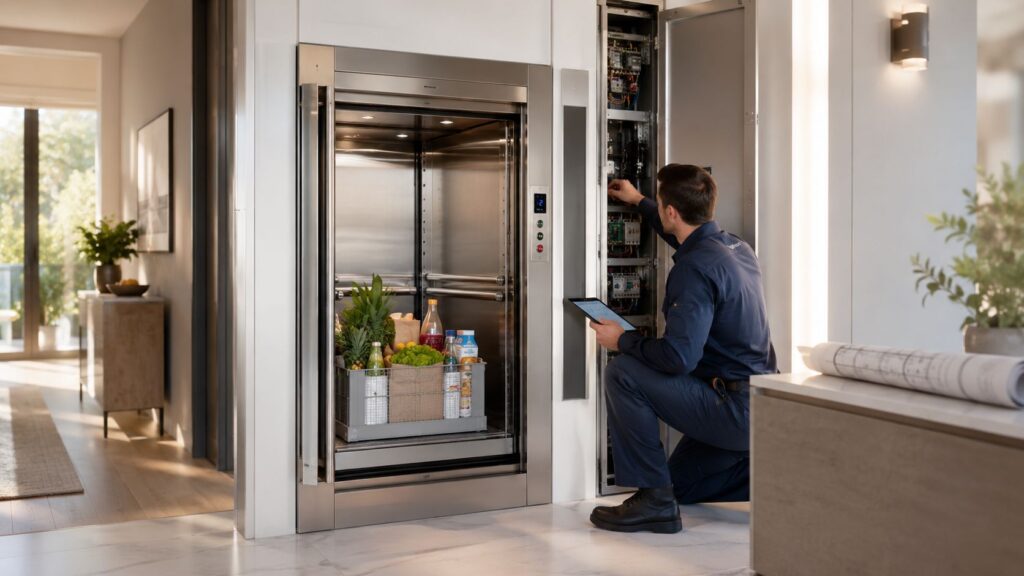
If you manage a restaurant in Detroit, a clinic in Ann Arbor, a municipal building in Lansing, or a multi-story home anywhere in Lower Michigan, you've probably seen the same problem play out over and over. Someone carries trays, files, supplies, laundry, or boxed inventory up a stair run because “it only takes a minute.” Then that minute turns into lost time, dropped materials, sore backs, and a workflow that never really gets fixed.
A dumbwaiter solves a very specific problem. It moves goods between floors without tying up staff on stairs, and it does it in a much smaller footprint than a passenger elevator. For Michigan property managers, that matters twice. First, space is expensive. Second, older buildings across places like Flint, Kalamazoo, Jackson, Dearborn, and Grand Rapids often don't have room for oversized service equipment, but they still need a safe way to move materials.
Owning one, though, is where the main questions start. Installation is only part of the story. The harder issues are code compliance, inspections, recurring maintenance, aging parts, and knowing when a repair is still reasonable versus when modernization is the smarter move.
Your Smart Solution for Moving Goods Between Floors
The buildings that benefit most from a dumbwaiter usually have the same warning signs. Staff are carrying goods by hand. Stair traffic is constant. Small deliveries pile up on one floor because moving them to another takes time away from actual work.
In a two-story restaurant, that might mean plated food going up and bus tubs coming down. In a professional office, it might be boxed records, mail, and supplies. In a large home, it's groceries from a lower level, laundry between floors, or seasonal storage that nobody wants to drag up stairs again.
A dumbwaiter is not a luxury item in those settings. It's a work tool. It's a small freight lift used to move food, dishes, or other goods between floors, and common payload references run from about 45 to 450 kg (100 to 992 lb), while other references note commercial units around 500 lb and residential units around 200 lb in Wikipedia's dumbwaiter overview. That range is exactly why these systems fit so many building types.
Where owners usually get it wrong
The first mistake is treating a dumbwaiter like a convenience appliance. It isn't. It's vertical transportation equipment, and it needs to be selected, installed, maintained, and inspected accordingly.
The second mistake is choosing the wrong type of lift for the job. Some buildings really need a material lift, a wheelchair lift, or a passenger elevator instead. If you're sorting through those differences, this breakdown of different types of lift systems is a useful starting point.
A well-chosen dumbwaiter removes repetitive stair carrying. A poorly chosen one becomes a code problem, a maintenance problem, or both.
What works in Michigan buildings
In practical terms, dumbwaiters work best when the load is predictable and the route is repetitive. Food service, records transfer, laundry movement, lab materials, office supplies, and household goods all fit that pattern.
They work poorly when owners try to use them like a passenger elevator, overload them, or ignore service until the unit stops. That's when a simple labor-saving device turns into downtime, inspection trouble, and avoidable repair costs.
What Is a Dumbwaiter and How Does It Work
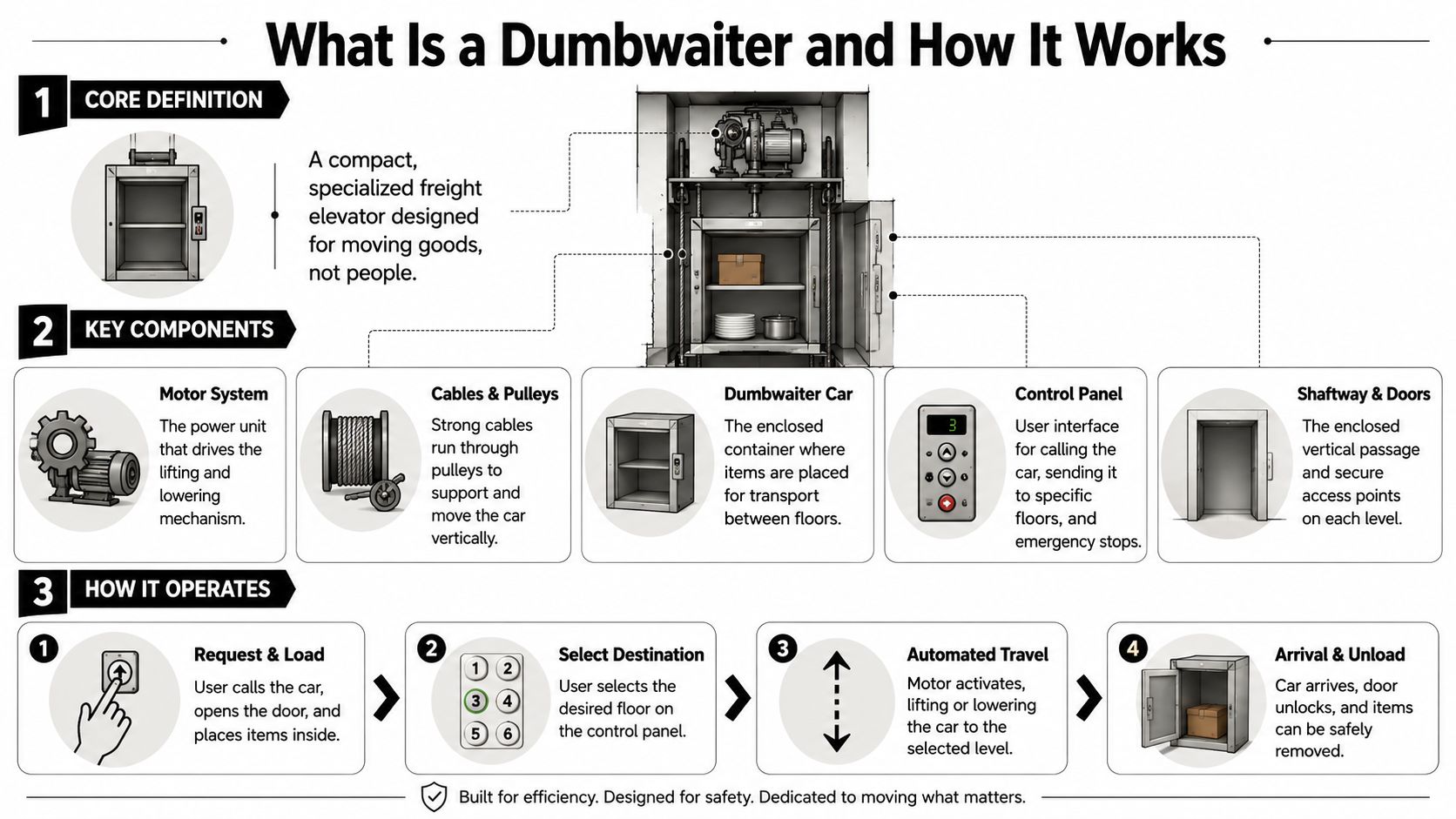
A Michigan property manager usually starts asking this question after the same problem shows up for months. Staff are carrying trays, files, laundry, or supplies up and down stairs, productivity drops, and sooner or later someone gets hurt or the building falls behind on basic handling tasks. A dumbwaiter solves that specific problem. It moves goods between floors in a fixed shaft using a small car, landing doors, controls, and a drive system sized for material handling.
The equipment has been around for a long time. The concept reaches back to Ancient Greece, and a major mechanical milestone came in 1887, when George W. Cannon filed a mechanical dumbwaiter patent, as outlined in this historical dumbwaiter reference. What matters to an owner today is simpler. Modern dumbwaiters are fixed pieces of conveyance equipment, and they need to be treated that way from installation through service life.
The parts that matter in day-to-day ownership
A dumbwaiter system is straightforward, but every component has a job tied to safety and reliability:
- Car. Holds the goods being moved.
- Guide rails. Keep the car tracking straight in the hoistway.
- Drive machine and lifting means. Raise and lower the car in a controlled way.
- Controls and interlocks. Allow calls and dispatching while preventing unsafe operation.
- Landing doors and frames. Restrict access to the shaft and protect users at each stop.
For owners, the practical point is this. A dumbwaiter is only as reliable as its door hardware, interlocks, and drive components. In the field, I see more avoidable shutdowns caused by worn contacts, misaligned doors, and neglected adjustments than by major machine failures.
How the system actually works
A user calls the car to a landing, loads approved materials, closes the door fully, and sends the car to another floor. The controls confirm that the access point is secured before travel. The car then moves on guide rails to the selected landing, where the receiving user opens the door and unloads it.
That sequence sounds simple because it is. Safe operation depends on discipline. Loads need to stay within the rated capacity, weight needs to be distributed sensibly in the car, and staff need to keep carts, boxes, and hands clear of the opening while the unit is in motion.
Residential and commercial dumbwaiters are built for different duty
Owners need to make a careful decision early. A house unit moving groceries a few times a day does not face the same wear pattern as a restaurant unit, a clinic records unit, or a hospitality service unit running repeated trips through the day.
The difference shows up in several places:
- Duty cycle
- Door type and abuse resistance
- Control configuration
- Motor and brake sizing
- Service access and replacement part availability
In Michigan, that distinction affects lifecycle cost more than the purchase price alone. An undersized unit may run at first, then start eating through door hardware, switches, and drive components because the building is asking it to do commercial work on residential-grade equipment.
A short visual walkthrough helps if you want to see the operating sequence in action.
What good operation looks like
A well-run dumbwaiter program is boring, and that is a good thing. Staff know what belongs in the car, doors latch properly, the unit levels consistently, and routine service catches wear before it turns into a shutdown.
The opposite pattern is also easy to spot. People overload the car, prop doors, ignore strange noises, or keep using a unit with failing interlocks. That is when a small material lift turns into a safety issue, an inspection problem, and a larger repair bill than the owner expected.
Practical rule: If building staff are guessing about loading, door closure, or basic operating steps, the equipment needs clearer procedures and a service company that will address the whole system, not just reset it and leave.
Common Uses for Dumbwaiters in Michigan
A Grand Rapids restaurant with prep in the basement and plating on the first floor feels the labor cost of stairs every shift. A lakeshore home with garage storage below the main living level feels it every grocery trip. In both cases, a dumbwaiter makes sense when the building needs to move small goods between floors repeatedly, safely, and without tying up staff or wearing people out.
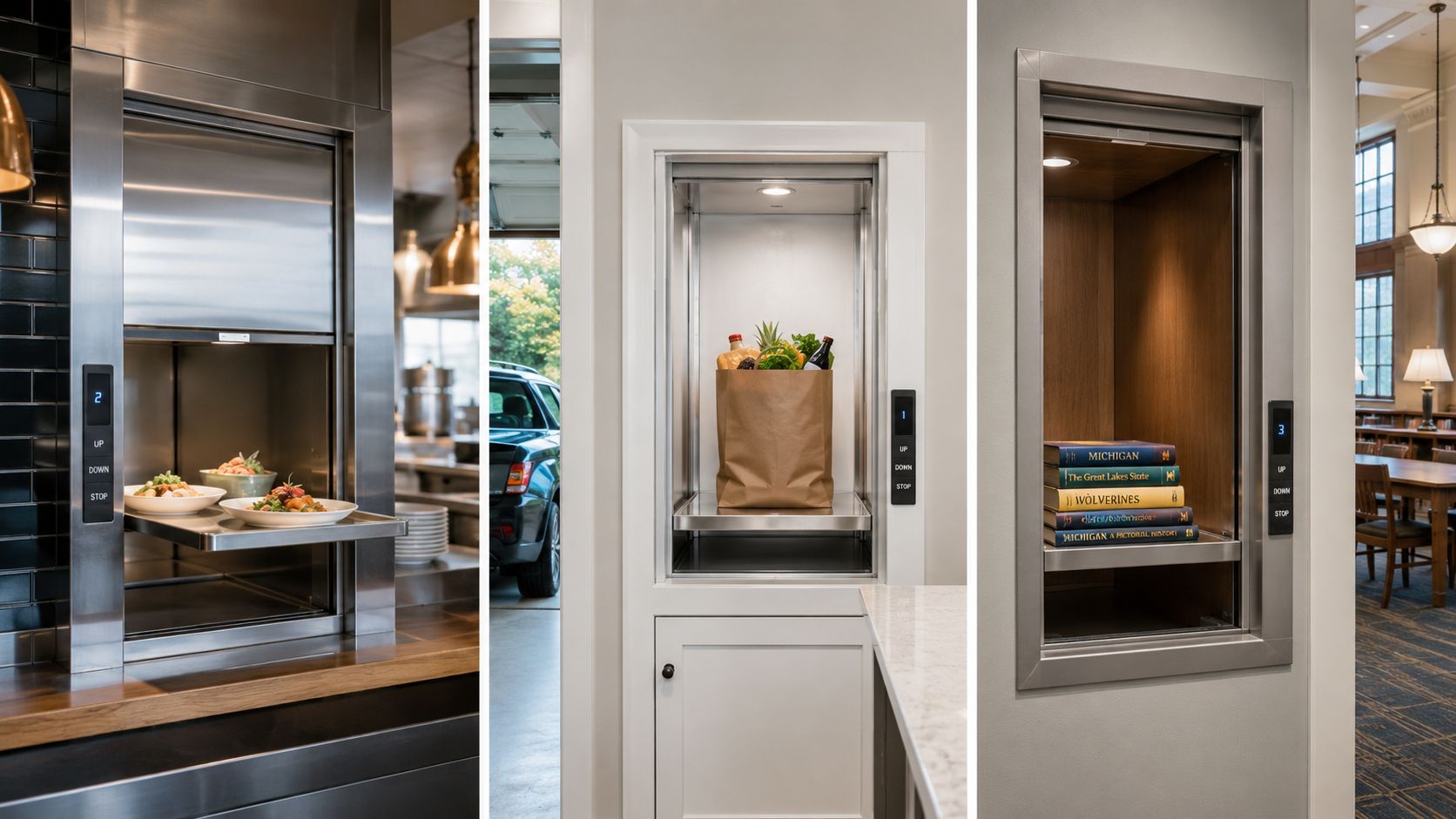
Michigan buildings are a good match for this equipment because many were not designed with wide service corridors or spare shaft space. In older downtown properties, schools, clubs, and mixed-use buildings, a dumbwaiter can solve a materials-handling problem without the footprint and cost of a full passenger or freight elevator project. That only works if the owner matches the unit to the actual load, traffic pattern, and building layout.
Commercial settings where they make sense
Restaurants are the most obvious example. A dumbwaiter can move plated food, dry goods, dishes, or bar stock between floors while keeping staff off stairs during rush periods. The gain is not just convenience. It reduces carrying injuries, cuts wasted steps, and keeps service more consistent.
Medical, office, and institutional properties also use dumbwaiters well when the load is predictable. Common examples include:
- Files and records between storage and administrative floors
- Mail and small packages in multi-level offices
- Linens, supplies, and boxed goods in hospitality or care settings
- Lab samples or materials where internal movement needs to stay controlled
The best-performing installations have clear rules. Staff know what can go in the car, what weight range is acceptable, and what should never be loaded. That discipline matters in Michigan facilities because misuse usually shows up later as damaged doors, bad interlocks, nuisance shutdowns, and avoidable service calls.
Residential uses that hold up over time
In homes, the value is usually practical and long-term. Owners use dumbwaiters for groceries from garage or lower-level entry points, laundry between floors, luggage, seasonal storage, and kitchen supplies. In larger homes around Ann Arbor, Birmingham, Rochester, Traverse City, and Grosse Pointe, those trips add up fast.
A dumbwaiter also helps owners stay in the home more comfortably without committing to a full accessibility project right away. It does not carry people, and it does not replace a residential elevator. It does remove a steady stream of lifting that tends to become a daily problem over time.
I usually tell owners to focus on repetition. If the same items go up and down the same route every week, a dumbwaiter is often a solid investment. If the need is occasional or the load is bulky and irregular, the equipment may sit unused or get abused.
Where owners make the wrong call
Some buildings really need a different solution. If users expect carts, oversized boxes, or passenger service, a dumbwaiter is the wrong equipment. If the building has no practical path for a code-compliant hoistway, landings, and access doors, the project can become expensive in a hurry.
That is why early planning matters. Before choosing equipment, owners should review shaft, door, fire separation, and use requirements against applicable elevator code requirements for Michigan properties. That step helps you avoid installing a unit that fits the wish list but not the building.
Used correctly, a dumbwaiter is a narrow-purpose machine with a good return over its service life. Used like a freight elevator, it becomes a repair account.
Navigating Michigan Dumbwaiter Codes and Inspections
A Michigan property manager usually finds code problems with a dumbwaiter at the worst time. The unit is in daily use, an inspector asks for records, and nobody can produce a clear paper trail for permits, past repairs, or the current operating certificate. At that point, the job is no longer just maintenance. It becomes corrective work, paperwork recovery, and sometimes downtime for the building.
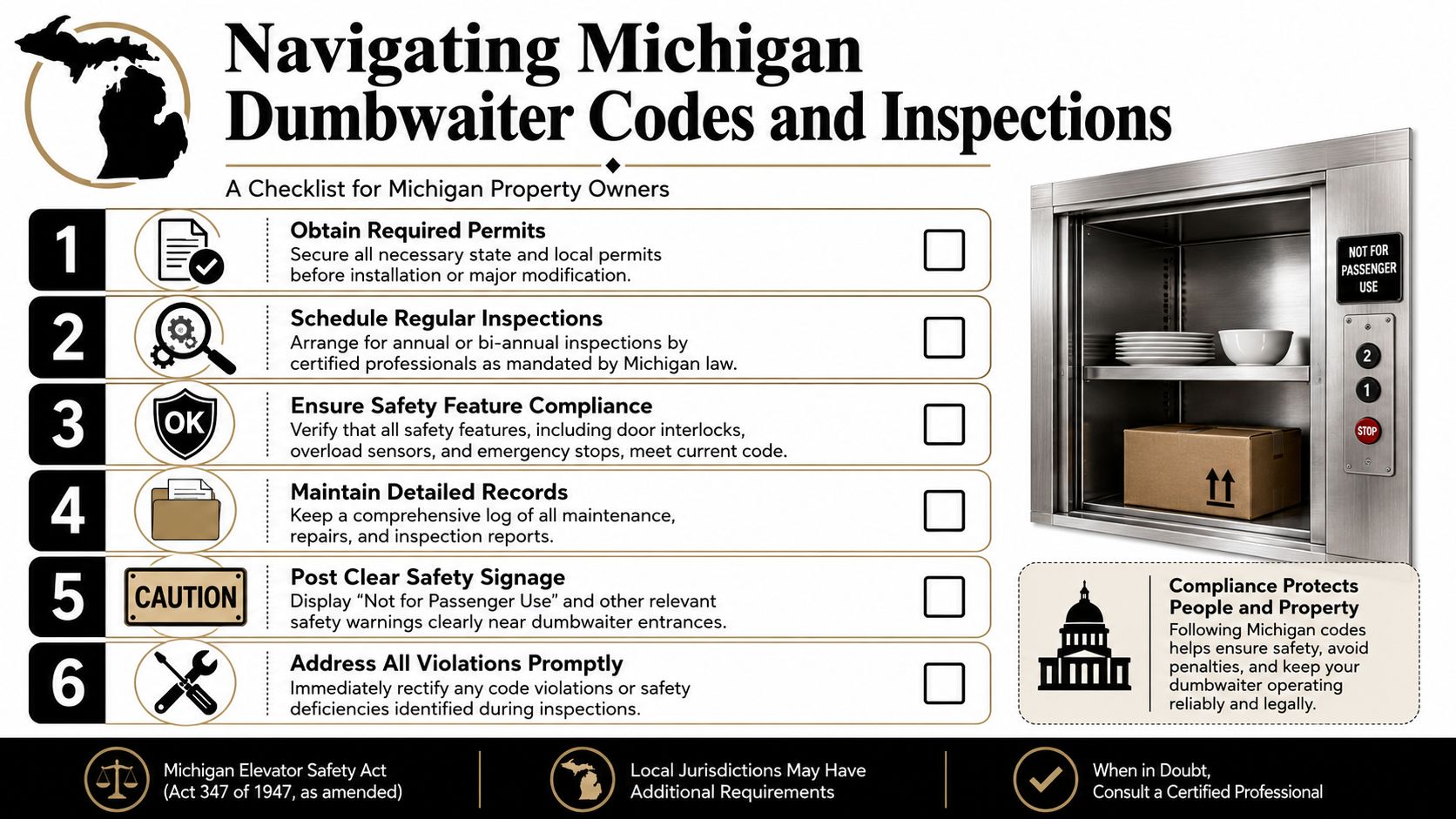
Michigan treats dumbwaiters as regulated conveyance equipment. In commercial, institutional, and multi-tenant buildings, owners should expect permit review, inspection requirements, and documented corrections when work affects safety or code compliance. That applies to new installations, but it also comes up during alterations, controller replacements, door work, and other major repairs on older units.
The inspection problem older buildings run into
The biggest mistake I see is assuming an existing dumbwaiter is legal because it still runs. That is not a safe assumption in an older school, church, clinic, apartment building, or mixed-use property. If the paperwork is thin, owners need to verify the inspection status, certificate status, maintenance history, and whether prior modifications were approved.
Older Michigan properties create real complications. Hoistway doors may have been replaced with mismatched hardware. Electrical alterations may not match the original design. Fire separation details may have changed during renovations. A dumbwaiter can operate for years with those issues sitting in the background, then fail an inspection when the records or field conditions finally get reviewed closely.
What Michigan owners should keep on file
A useful compliance file saves time and money. It also gives your service company a starting point when recurring problems point to past alterations or incomplete repairs.
Keep these records together:
- Permit documents for installation, alteration, and major component replacement
- Inspection reports and any correction notices
- Current certificate records showing the unit is approved for operation
- Maintenance logs with dates, findings, and completed repairs
- Violation history and proof of correction
- Parts and modernization records for controllers, interlocks, landing doors, suspension components, and machine equipment
That file matters during state review, ownership changes, insurance questions, and repair planning. It also helps you decide whether you are dealing with a repairable maintenance issue or a unit that has drifted too far from current expectations and needs modernization.
Code knowledge has to match field conditions
Code compliance on paper is only part of the job. The field conditions decide how expensive the fix becomes. A contractor who works on Michigan dumbwaiters should be able to spot settlement issues, non-original door hardware, patched electrical work, clearance problems, and access limitations before permit or inspection problems slow the project down.
For a broader summary of elevator code requirements for Michigan properties, use that as a starting reference, then match it to the actual dumbwaiter, the building's age, and the local authority having jurisdiction. That is usually where owners either control lifecycle cost or end up paying twice for the same work.
Proactive Maintenance and Common Dumbwaiter Repairs
A dumbwaiter usually doesn't fail all at once. It warns you first. Doors stop making good contact. The car starts landing rough. Controls become inconsistent. The machine sounds different. Service gets called only after the unit is already affecting operations.
That approach costs more in the long run.
Higher-performance dumbwaiter designs can travel up to 150 feet per minute and are offered in 200 lb, 300 lb, and 500 lb capacities, according to the Montgomery dumbwaiter specification PDF. Those operating demands are exactly why regular maintenance matters. Motors, cables, brakes, door hardware, and controls all need attention before they become failure points.
What preventive service should include
A proper maintenance visit isn't just a quick ride test. On a dumbwaiter, useful preventive work usually includes:
- Cable and suspension checks for wear, damage, tracking, and tension issues
- Door interlock and contact testing so the unit won't run with unsafe access conditions
- Guide rail and roller review to catch alignment and wear before the ride degrades
- Machine and brake inspection for heat, noise, adjustment drift, and contamination
- Controller and call station checks for unreliable buttons, relays, or electrical faults
- Housekeeping around the machine area, shaft access points, and related components
The simplest maintenance work often prevents the ugliest callbacks. Dirt buildup, loose contacts, neglected lubrication points, and ignored door problems create a lot of unnecessary downtime.
The common repairs that follow deferred maintenance
Most recurring dumbwaiter repairs are not random. They usually trace back to one of a few neglected areas:
| Problem | What operators notice | Usual root issue |
|---|---|---|
| Door faults | Unit won't run or stops intermittently | Worn contacts, misalignment, damaged interlocks |
| Rough travel | Jerking, scraping, noisy movement | Rail issues, worn rollers, poor adjustment |
| Drive trouble | Slow movement, failure to start, abnormal sound | Motor, brake, or power/control faults |
| Landing problems | Car not leveling or inconsistent stops | Control issues, switch problems, adjustment drift |
That's why a reactive model fails owners. Emergency repairs restore operation for the day. Preventive maintenance reduces the number of emergencies in the first place.
A dumbwaiter that “mostly works” is usually one service cycle away from becoming a shutdown.
Why non-proprietary service matters
Many owners become trapped. If the equipment or controls are set up in a way that pushes you back to one vendor for every service decision, your options narrow fast. That's a problem when parts become obsolete, response time slips, or pricing becomes hard to challenge.
A non-proprietary approach gives owners more flexibility. Any qualified provider familiar with the equipment should be able to inspect, maintain, repair, and modernize it without being locked out by avoidable barriers. For Michigan property managers looking at service options, material lift and dumbwaiter repair support from providers such as Crane Elevator Company is worth comparing against proprietary service models.
Modernizing and Financing Your Dumbwaiter Upgrade
A Michigan property manager usually reaches this point after the same pattern repeats. The car is down again, tenants or staff are working around it, and another repair estimate lands on the desk. At that stage, the question isn't whether the unit can be made to run one more time. It is whether the next dollar should go into repair work or into a planned upgrade that reduces shutdowns, code exposure, and parts risk.
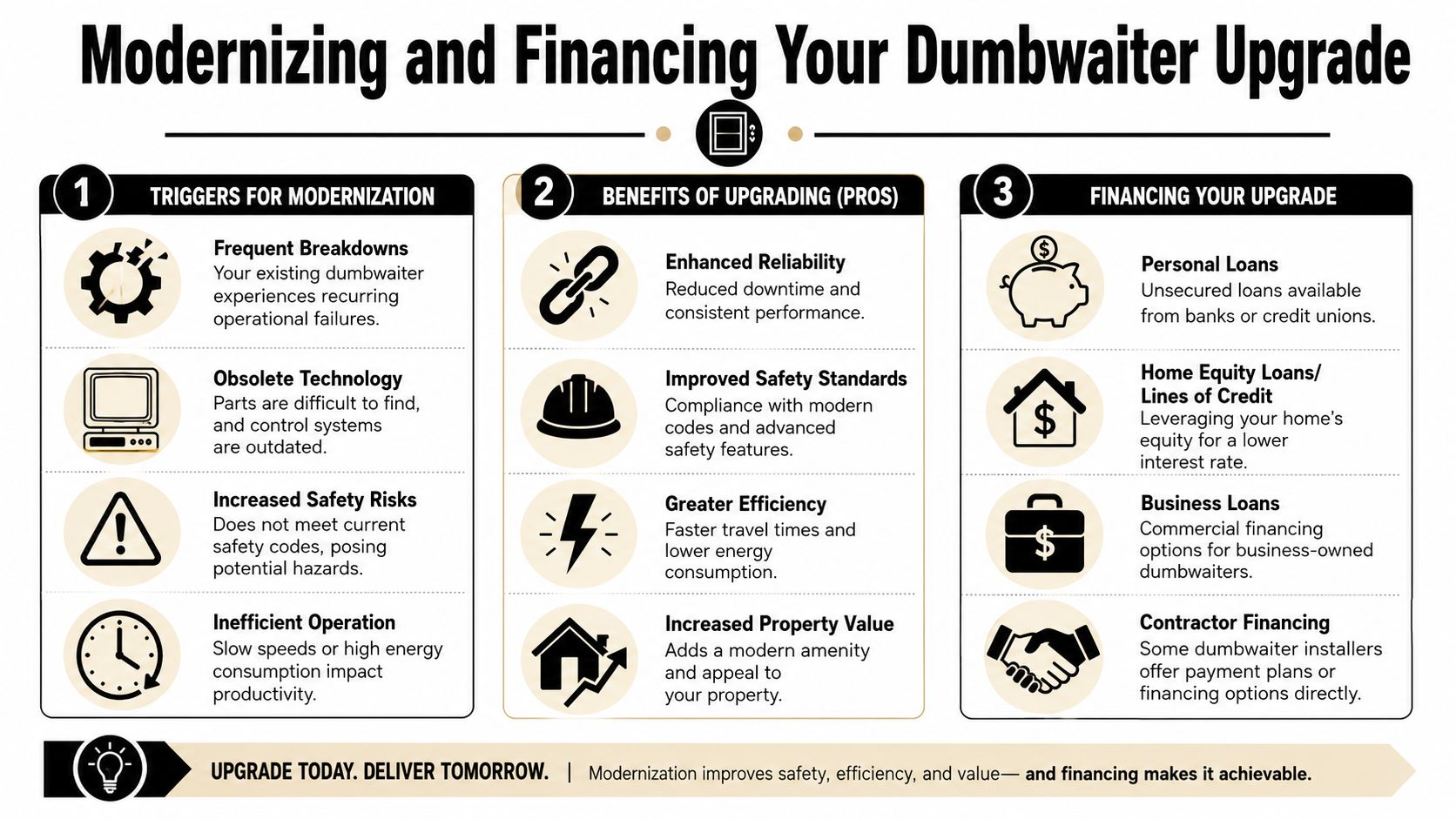
That decision should be based on lifecycle cost, not frustration. I look at four things first: how often the unit is failing, whether replacement parts are still available in a reasonable timeframe, whether the existing equipment can still be kept compliant under current Michigan inspection expectations, and whether the building depends on the dumbwaiter more now than it did when it was installed.
When repair stops being the smart answer
Many commercial dumbwaiters were built for regular, workmanlike service, not occasional light use. If yours is carrying kitchen supplies, records, linen, or other daily loads across multiple floors, age shows up faster in the controls, door equipment, and machine components.
Modernization usually makes more financial sense when you are dealing with:
- Repeat outages that interrupt operations and create staffing workarounds
- Obsolete controls or electrical parts that are difficult to source or impossible to match reliably
- Inspection-related deficiencies that keep returning after temporary fixes
- Higher usage than the original setup was expected to handle
- A pattern of small repair invoices that add up without improving long-term reliability
A smart upgrade fixes root causes. It does not just replace the last failed part.
What owners typically upgrade
Most modernization scopes focus on the controller, door interlocks and contacts, wiring, limit devices, and machine or brake components if wear is advanced. Sometimes the right answer is a targeted package. In other cases, the controls and mechanical equipment have aged together, and partial work only delays the larger decision.
That is where experience matters. I have seen owners spend for three or four isolated repairs over two years, then approve a modernization anyway after another shutdown or failed inspection item. Planned work usually costs less than repeated emergencies, rushed part searches, and lost use of the unit.
For Michigan buildings, modernization planning should also account for local service realities. Winter humidity swings, older building electrical conditions, and long lead times for legacy components all affect how long an aging dumbwaiter stays dependable.
Financing the work without letting the problem drag on
Dumbwaiter upgrades often get stuck between operating expense and capital planning. That delay is expensive. A unit that supports a church kitchen, medical office, restaurant, school, or multifamily service operation can create daily inefficiency long before it reaches full failure.
For properties in Detroit, Lansing, Flint, Kalamazoo, Grand Rapids, and smaller Michigan markets, financing can turn a reactive repair pattern into a scheduled modernization with known monthly cost. That approach also gives managers a cleaner way to budget code-related corrections, reduce emergency call volume, and avoid putting more money into equipment that is already near the end of its serviceable life.
The best financing decision is tied to a clear scope. Get a proposal that separates must-do safety and compliance work from optional improvements, identifies which components stay in place, and explains whether the finished system remains non-proprietary for future service. That last point matters over the full lifecycle. An upgrade should improve reliability without locking the property into one service path for the next decade.
How to Hire the Right Dumbwaiter Service Provider
The right contractor for a dumbwaiter is not just someone who can get it running today. You want someone who can keep it compliant, maintain it properly, document the work, and give you a straight answer when repair no longer makes sense.
Start with the basics. Verify that the company works on dumbwaiters specifically, not just passenger elevators. Ask whether they service both residential and commercial equipment. Ask how they handle inspections, callbacks, recurring fault diagnosis, and modernization planning.
What to ask before you sign
Use a short hiring checklist:
- Licensing and field experience matter more than polished sales language.
- Inspection support should be part of the conversation, not an afterthought.
- Non-proprietary service philosophy gives you more options over the life of the equipment.
- Maintenance scope should include real preventive work, not only ride tests and paperwork.
- Emergency response needs to be clear before the first shutdown happens.
- Documentation habits tell you a lot about how the company operates.
The best service relationship is boring in the right way. The unit runs, records are current, inspections don't turn into surprises, and nobody is guessing what was done last visit.
In Michigan, that matters whether you manage one church dumbwaiter in a small town or multiple service lifts across properties in Detroit, Ann Arbor, and the rest of Lower Michigan. The contractor you hire affects not only repair bills, but also compliance risk, tenant disruption, and how long the equipment remains usable.
If a provider can't explain the difference between a temporary repair and a durable fix, keep looking.
If you own or manage a dumbwaiter in Detroit, Ann Arbor, Lansing, Flint, Kalamazoo, or anywhere in Lower Michigan, Crane Elevator Company can provide a practical review of your equipment, maintenance condition, inspection status, and modernization options. A second opinion is often the fastest way to find out whether you need a repair, a compliance correction, or a longer-term upgrade plan.