A material lift usually picks the worst time to quit. The truck is at the dock, maintenance is already juggling three other problems, and somebody in Flint, Kalamazoo, Ann Arbor, or Lansing is asking how fast you can get product moving again.
That's the pressure behind material lift repair. You're not looking for theory. You need to know what to check safely, what the likely failure points are, where a Hidral material lift or similar unit tends to act up, and when to stop troubleshooting and call a licensed elevator professional. In Michigan, that last part matters just as much as the repair itself, because a fix that isn't safe or properly documented can turn one outage into a compliance problem.
Your Material Lift Is Down Now What
The call usually comes after the first delay hits the dock. A pallet is waiting, an operator says the lift stopped mid-travel or will not respond, and building staff are already asking whether they can get one more run out of it.
The first hour matters because bad decisions happen fast. Someone tries the controls again and again. Someone else suggests forcing a gate, resetting power without checking the car position, or clearing a jam while the unit is still available to other users. That is how a routine outage turns into an injury risk, equipment damage, or a repair that raises inspection questions later.
Start with control of the area. Keep the lift out of service. Keep freight off the platform. If the car is stuck between landings, if a load has shifted, or if you see oil, damaged gates, bent guarding, or signs of impact, treat it as a safety event first and a repair call second.
What you need at this stage is a clean triage picture:
- Is anyone at risk right now. Stop use, secure the landing area, and prevent repeated reset attempts.
- What changed since the last normal cycle. New load, new operator, power interruption, impact from a pallet jack, recent service, or unusual noise.
- What kind of failure are you dealing with. Dead controls, partial travel, rough movement, door or gate issue, leak, burning smell, or a fault that appears only under load.
- Will the next step cross into licensed repair work. In Michigan, that line matters. Basic observation is one thing. Opening panels, bypassing safeties, or making adjustments that affect operation is another.
A lot of outages are smaller than they first appear. A lot are not. The point is to separate a simple operating interruption from a condition that needs a licensed elevator technician, and to do it without guessing.
One practical rule has saved many facility teams from making a bad situation worse. If you cannot explain why the lift stopped, do not put it back in service.
For building managers in Southern Michigan, that also means documenting the basics before you call. Note the make and model, where the platform stopped, whether the unit is loaded or empty, what the controls do when pressed, and whether anyone heard a pop, grind, hum, or alarm. Good notes shorten the first visit and help you tell the difference between a contractor who diagnoses methodically and one who starts by swapping parts.
Initial Diagnosis What to Check Before You Call
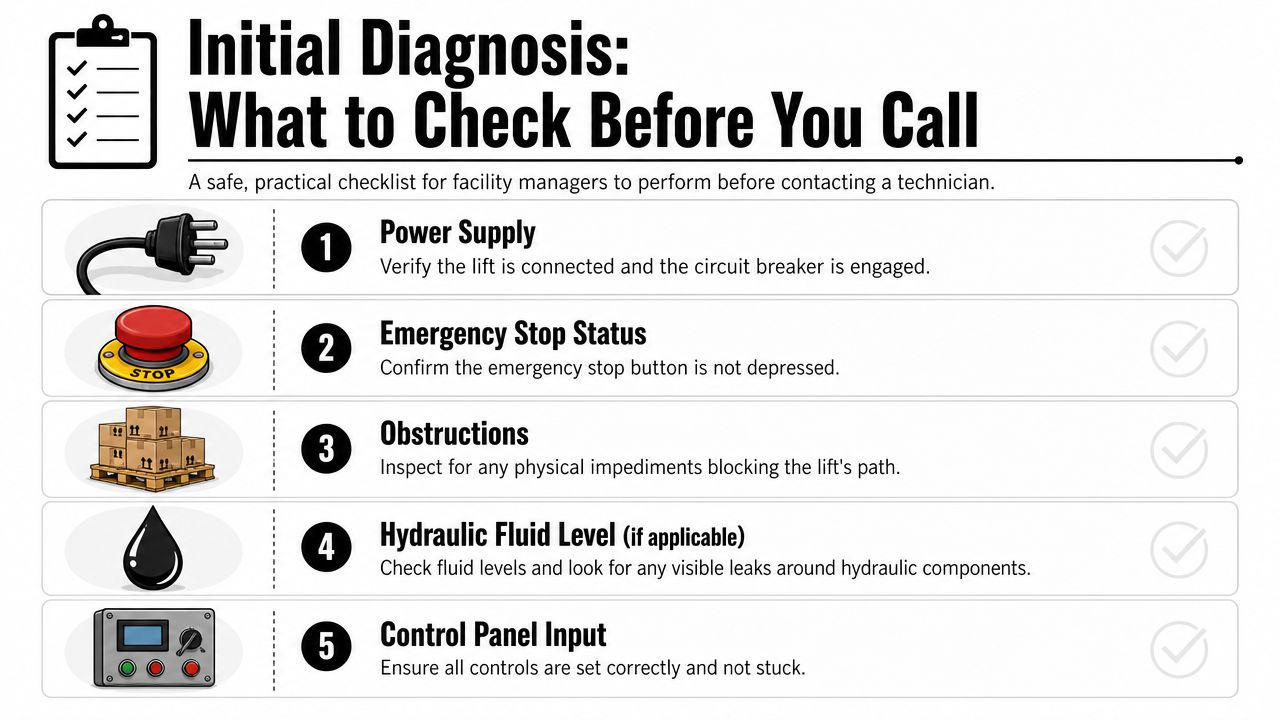
When a material lift is down, the best first call may be to your own eyes and ears. A building manager can gather useful information without opening a panel, touching live components, or making the problem harder to diagnose.
That first check has one job. Confirm whether the issue looks like an operating interruption, an obvious physical obstruction, or a fault that needs a licensed elevator technician.
Start with what an operator can verify
Approach the unit the same way a careful operator would during a normal cycle. Stay outside guarded areas. Leave covers in place. Keep hands clear of gates, sills, and moving parts.
Check these items in order:
- Power status. Confirm the disconnect is on and the breaker or fused disconnect has not opened.
- Control station condition. Look for a tripped emergency stop, a damaged pushbutton, or a call/send station that has no indicator lights.
- Doors and gates. Make sure every landing door and car gate is fully closed and latching as designed. A lift can look ready and still be locked out by an interlock that never made up.
- Load position. Verify the load is centered, stable, and not contacting a wall, gate, or overhead obstruction.
- Travel path. Check for pallet wrap, broken skids, bent guards, loose banding, or debris in the landing area that could block movement.
- Hydraulic signs. On hydraulic units, look for fresh oil at the power unit, along hose runs, near fittings, or around the cylinder area.
This takes a few minutes and often gives the service company a much better starting point than “it stopped working.”
Use sound and response to narrow the problem
A silent lift and a lift that hums without moving are not the same call. That distinction matters because it changes what the technician should bring and how urgently the unit needs to stay locked out.
| What you observe | What it usually points to |
|---|---|
| No lights, no sound, no response | Incoming power, disconnect, breaker, control power, or a dead station |
| Button registers, but nothing moves | Door interlock, gate switch, limit, or control circuit problem |
| Motor or pump starts, but the platform does not travel correctly | Hydraulic fault, brake issue, drive issue, or mechanical binding |
| Lift starts, stops, or levels poorly | Wear, contamination, misadjustment, or a component beginning to fail |
| Scraping, banging, or grinding | Mechanical damage. Keep it out of service until inspected |
| Fresh oil on floor or frame | Active hydraulic leak or seepage that needs repair before return to use |
One caution from the field. Intermittent problems waste time if the first report is vague. If the unit fails only on one landing, only under load, or only on the first run of the day, write that down.
What facility staff should leave alone
This is the line many buildings get wrong. Observation is fine. Adjustments and bypasses are where a simple outage turns into a safety issue, a damaged component, or a code problem.
Do not:
- Open electrical panels unless you are qualified, authorized, and working under the right safety procedures.
- Bypass interlocks, gate switches, or other safeties to test whether the lift will run.
- Top off hydraulic oil by guesswork without confirming the correct fluid, the reservoir condition, and the reason fluid is low.
- Keep hitting reset after repeated faults or nuisance trips.
- Run an informal test with people standing nearby just to see whether the problem cleared.
In Michigan, that distinction matters. Basic checks by site staff are one thing. Any step that changes operation, defeats a safety device, or enters protected electrical and mechanical spaces belongs to a licensed professional.
What to tell the repair company
A good service call starts before the truck arrives. Give the contractor the make and model, the building location, where the platform is stopped, whether it is loaded or empty, what the controls do when pressed, and any sound, smell, or leak you observed.
Also ask a few direct questions when you call. Do they service material lifts regularly, or mainly passenger elevators? Can they handle code-related corrections if the fault involves a gate, interlock, or safety circuit? Do they have Southern Michigan coverage, or are you paying for a long dispatch from outside the area?
Those details help you sort out two very different vendors. One will diagnose methodically and arrive prepared. The other will show up to find out what machine you have.
Common Material Lift Failures and Their Causes
A material lift usually fails in a pattern before it fails outright. The platform starts landing a little rough. A call station works intermittently. The unit lifts empty but struggles with a normal load. Those clues matter because they point you toward the system at fault before anyone starts ordering parts.
A Hidral unit is a good example because the same troubleshooting logic applies to many enclosed freight and service platform lifts. You are dealing with three systems that have to work together. Power to move the lift, controls that authorize movement, and mechanical and safety components that keep travel within design limits. If one part of that chain drops out, the lift stops.
Hydraulic faults
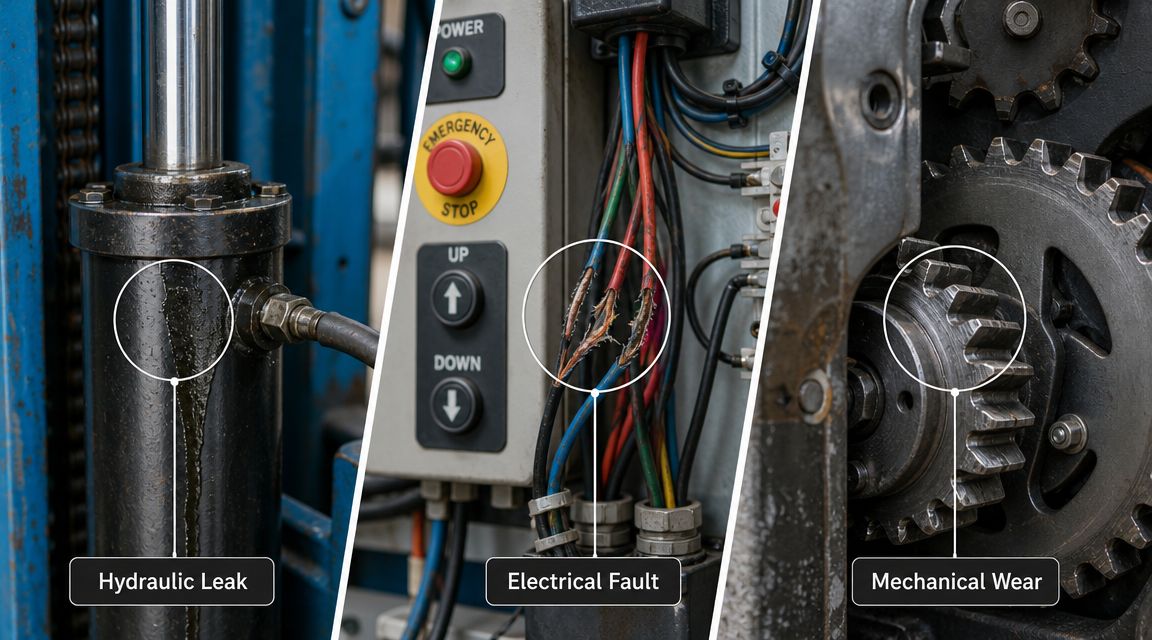
Hydraulic problems tend to show up as slow upward travel, platform drift, failure to lift a routine load, jerky starts, or visible oil around the unit. Building teams often focus on the leak they can see. In the field, that is not always the failed part.
A lift with contaminated fluid, a sticking valve, air in the system, a weak pump, or worn cylinder seals can produce similar symptoms. The correct path is to isolate the load, secure the unit, verify pressure conditions, and test the system in sequence. Fluid condition, filters, seals, hoses, pump output, and valve performance all need to be checked before the lift returns to service.
That trade-off is simple. Fast guesswork gets a bigger invoice later.
Electrical and control faults
Electrical failures are often permission failures. The lift still has power, but one device in the safety or control chain is not proving safe operation. That can leave the platform completely dead, able to answer a call but not travel, or able to move in one direction only.
On Hidral material lifts and similar equipment, common causes include misaligned gate contacts, worn interlocks, damaged field wiring, failed relays, bad limit devices, and control station faults. A blown fuse does happen, but it is rarely the whole story. If a gate contact has shifted or a landing device is worn, the controller is doing its job by refusing movement.
That is why a proper diagnosis on a commercial material lift system starts with the circuit logic, not just the first component that looks suspect.
Mechanical wear and structure
Mechanical problems usually develop slowly, then start affecting daily operation all at once. You may hear rubbing in the hoistway, feel vibration during travel, or see the platform stop unevenly at the landing. Chains, guide components, rollers, brakes, landing hardware, and structural attachment points all wear with use. Once clearances change, the rest of the machine starts compensating.
A lift can still run while those parts are wearing past acceptable limits. That is where building managers get misled. Movement is not proof that the unit is safe, level, or code-ready.
Pay attention to symptoms that repeat. Uneven landing, chatter, hard stops, sag at rest, and recurring adjustments usually mean wear has moved beyond a minor tune-up.
How Hidral units fit into the conversation
Hidral material lifts are often tied closely to the building itself. Doors, enclosures, landings, and control interfaces are part of the repair picture, not side issues. That changes the work. The technician is not just fixing a lifting machine. The technician is checking how the lift interacts with the structure, the entrances, and the safety devices that govern operation.
On older units, that also raises a practical question. If parts are hard to source, if failures keep returning, or if code-related corrections are stacking up, repeated repair may stop making financial sense. At that point, the right answer may be a repair with targeted upgrades, or a modernization plan instead of another temporary fix.
The Repair Decision DIY vs Calling a Licensed Technician
The lift is down, staff is waiting, and someone from maintenance is standing at the controller with a screwdriver. That is usually the point where a simple outage turns into a bigger repair.
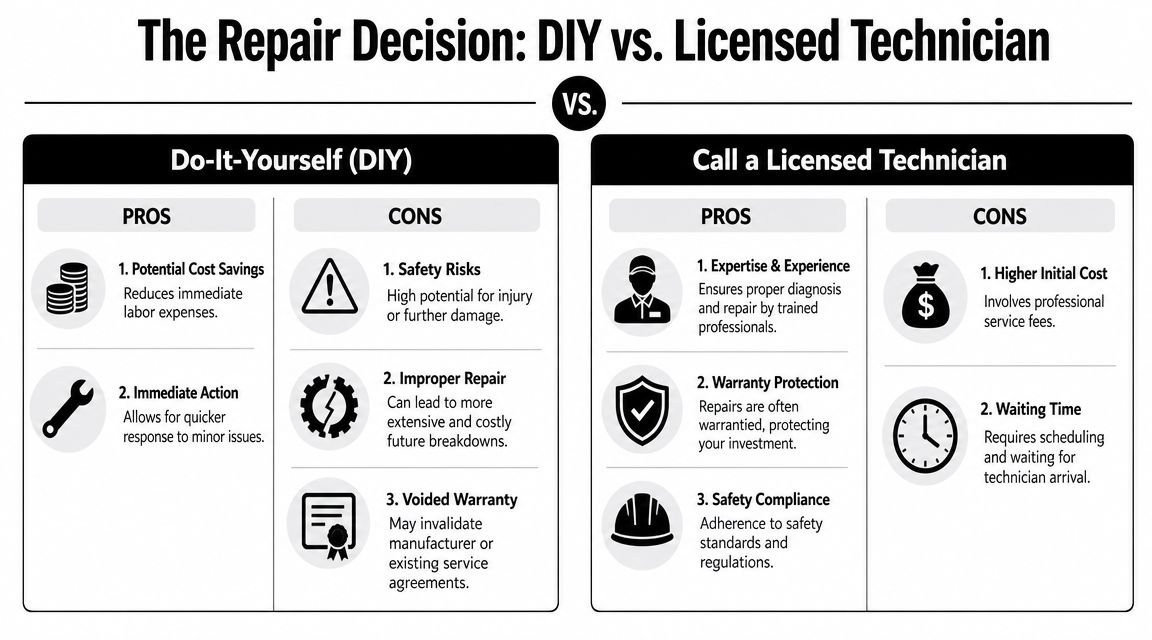
Facility teams can do basic checks. Actual repair is a different category of work. If the problem touches electrical components, hydraulic components, controls, doors or gates, safety circuits, or any load-bearing part, stop there and call a licensed elevator technician.
What DIY can handle
In-house staff can usually handle a limited set of checks without creating new risk:
- Verify the disconnect is on and the unit has power
- Reset an emergency stop that was pressed accidentally
- Remove obvious debris outside the travel path
- Confirm a gate or door is fully closed, if the operator manual allows that check
- Write down fault symptoms, noises, timing, and what happened before the shutdown
That work helps. A clean symptom report can cut diagnostic time and rule out avoidable trip charges.
Where DIY should stop
Opening controller panels, adjusting interlocks, bypassing contacts, or trying parts until the lift runs again is where owners get into trouble. Material lifts have stored energy, safety circuits, and operating limits that need to be tested, not guessed at. A lift that runs after an improvised fix can still be unsafe, out of level, or out of compliance.
I have seen small mistakes turn into expensive ones. A bent gate contact gets forced into service, then the unit starts faulting intermittently. A hydraulic issue gets treated like an electrical issue, so the wrong parts get changed while the underlying failure keeps getting worse. By the time the right mechanic arrives, the building has more downtime and a larger invoice.
For owners comparing providers, reviewing a contractor's material lift service capabilities is more useful than asking whether they work on lifts in general. You want a company that can diagnose the fault, make the repair, test the safety side, and document what was done so the unit can return to service without loose ends.
A quick visual overview can help frame the decision.
The practical rule in Michigan buildings
Use a simple rule. If the task involves covers off, tools on, circuits exposed, pressure adjustments, brake work, door hardware adjustment, or anything that affects how the lift stops, levels, or protects the opening, it belongs to a licensed technician.
That matters even more in schools, healthcare buildings, municipal facilities, and mixed-use properties across Southern Michigan. In those settings, a bad repair does not just create another service call. It can create inspection problems, shutdown orders, incident exposure, and a paper trail that is hard to defend later.
Field judgment: Operational checks are fine. Repairs belong to trained technicians with the right tools, testing procedures, and code awareness.
Choosing a Repair Contractor in Southern Michigan
A repair company doesn't need a flashy sales pitch. It needs to show up, diagnose correctly, document the work, and understand the difference between a short-term patch and a durable fix. That matters whether your building is in Detroit, Dearborn, Southfield, Ann Arbor, Jackson, Lansing, Flint, Grand Rapids, Kalamazoo, or a smaller southern Michigan community where response time and parts strategy can make or break the job.
What to ask before you hire anyone
Use a short vendor screen. It will tell you a lot.
- Do they work on material lifts specifically. Freight, dumbwaiter, passenger, and material lift work overlap, but they are not identical service calls.
- Can they support both repair and compliance follow-through. A contractor should be able to talk about inspections, documentation, callbacks, and return-to-service process.
- Are they locked into proprietary solutions. Owners usually do better with non-proprietary service approaches because future maintenance options stay open.
- Do they cover emergency response. Material lift failures rarely happen on a calm day with extra staff standing by.
- Can they explain repair versus modernization straightforwardly. Older units with obsolete parts need a straight answer, not wishful thinking.
Why local knowledge matters
Michigan work isn't just about driving distance. Local knowledge means understanding the building stock, common equipment conditions, and how to keep projects moving when a school, warehouse, hospital support area, or municipal facility can't afford long disruption.
The market is also getting larger, not smaller. Fact.MR projects the global material lift rental market at US$1.5 billion in 2026 and US$2.1 billion by 2036, a sign that the installed base needing inspection and repair support will continue to grow (Fact.MR material lift rental market projection). For building owners, that reinforces a practical point. As more lifts stay in service across industrial and commercial settings, experienced regional service coverage matters more.
One option in Lower Michigan is Crane Elevator's local elevator service team, which provides repair, maintenance, inspections, and non-proprietary modernization across multiple lift types. That kind of scope is useful when a material lift problem touches doors, controls, hydraulic equipment, or broader building compliance issues instead of a single failed part.
Signs of a contractor worth keeping
| What you ask | What a solid answer sounds like |
|---|---|
| How do you diagnose before replacing parts | They describe testing, fault isolation, and documentation |
| What happens after the repair | They talk about verification, safe return to service, and records |
| Can you support older equipment | They discuss parts availability, retrofit options, and limits honestly |
| Do you understand local code expectations | They answer directly, without hand-waving |
| Can you maintain the unit after this call | They offer a real maintenance path, not just emergency dispatch |
A contractor who can't answer those questions cleanly probably won't make your material lift more reliable.
Beyond the Fix Maintenance and Compliance
A single repair only solves today's failure. Good ownership solves the next one before it happens. That's the shift building managers need to make with material lifts, especially in hospitals, schools, municipal buildings, industrial plants, and mixed-use properties where the lift is part of daily operations.
Repair is part of lifecycle management
The strongest maintenance programs don't just react to shutdowns. They watch for repeat faults, declining ride quality, poor landing accuracy, oil leaks, dirty machine spaces, worn gate hardware, and recurring callback patterns. Those are the clues that tell you whether the unit needs adjustment, component replacement, or a larger modernization discussion.
This matters even more on older lifts or specialized equipment such as rideable material lift systems, where use conditions, enclosure design, and building traffic can make “quick fixes” age badly.
Compliance is not a side issue
One of the most overlooked parts of material lift repair is knowing which fixes trigger inspection requirements and what records the owner should keep afterward. That gap shows up constantly in emergency-only service models. As one industry source points out, a critical issue is understanding which repairs trigger mandatory inspection requirements and how to document work to avoid violations and shutdowns (Elite Elevators on repair documentation and inspection-trigger gaps).
If your vendor can't tell you what to document, the job is only half done.
Keep a service history that shows symptoms, findings, parts changed, testing performed, and any follow-up inspection needs. That record protects the building as much as the repair itself.
What actually reduces future breakdowns
Preventive maintenance works when it includes more than a quick glance and a signature. In practical terms, a useful program should focus on:
- Cleaning and access. Dirt, debris, and neglected machine areas hide leaks, wear, and heat problems.
- Adjustment and inspection. Gates, contacts, brakes, limit devices, and travel components need regular attention.
- Hydraulic health. Oil condition, seals, hoses, and pressure behavior should be checked before failure forces the issue.
- Parts planning. If a unit depends on aging components, don't wait for a hard shutdown to discover they're unavailable.
- Documentation discipline. Record what was done, why it was done, and what needs to happen next.
That's how material lift repair becomes part of a reliability plan instead of a repeating emergency.
Your Partner in Vertical Transportation
Material lift repair goes better when the response is calm, ordered, and honest about risk. Check the obvious items first. Don't guess with controls, hydraulics, or load-bearing parts. Treat compliance and documentation as part of the repair, not paperwork after the fact.
For building managers across southern Michigan, the safest path is a qualified contractor who understands material lifts, older equipment, inspection follow-through, and long-term maintenance. That keeps one breakdown from turning into a second outage, a failed inspection, or a much larger replacement decision under pressure.
If your material lift is down in Detroit, Ann Arbor, Lansing, Flint, Kalamazoo, or surrounding southern Michigan communities, contact Crane Elevator Company for repair support, a second opinion, or a conversation about preventive maintenance and modernization planning.