Water shows up in elevator pits at the worst time. In Michigan, that usually means after a hard spring thaw, a stretch of heavy rain, or a freeze-thaw swing that opens up an old crack you didn’t know was there. A property manager in Detroit, Ann Arbor, Lansing, or Flint walks into the hoistway area, sees standing water in the pit, and realizes this isn’t a janitorial problem. It’s an elevator problem, a building-envelope problem, and often a code problem at the same time.
A wet pit puts expensive equipment at risk. It also puts building operations at risk. If water reaches electrical components, corrodes steel, or keeps returning after pump-outs, you’re no longer dealing with a simple nuisance. You’re dealing with a condition that can trigger shutdowns, failed inspections, emergency repair calls, and arguments about who owns the lasting fix.
Your Guide to a Dry and Compliant Elevator Pit
Waterproofing an elevator pit means preventing groundwater and seepage from getting into the lowest part of the hoistway where critical elevator components live. In practice, that can involve exterior membranes during construction, interior repair systems for older pits, crack treatment, penetration sealing, drainage management, and sump system review. The right answer depends on whether you’re building new, correcting a chronic leak, or responding to active water intrusion.
Michigan owners face a few realities that make this work especially important. Southern Michigan gets snowmelt, wet springs, shifting soils, and repeated freeze-thaw cycles. Those conditions push water toward foundations and exploit weak points in concrete. Elevator pits are vulnerable because they sit low, often below grade, and they collect the consequences of every drainage, grading, and waterproofing mistake around them.
Practical rule: If you can see water in the pit, the leak has already moved past “monitor it” status.
The hardest part for owners is that a pit leak often looks smaller than it is. The puddle might be limited, but the pathway feeding it can run through a cold joint, a wall crack, a floor joint, a conduit penetration, or deteriorated concrete hidden behind surface staining. By the time rust shows on metal components or a sump struggles to keep up, the building has usually been fighting the same moisture problem for a while.
A sound repair starts with the right diagnosis. Not every wet pit needs the same treatment, and not every coating sold as “waterproof” belongs in an elevator environment. Some products only hide moisture briefly. Others fail because they’re applied to the wrong surface condition or used where hydrostatic pressure is still pushing from the outside.
Owners need a practical standard. Stop the water. Protect the equipment. Keep the pit serviceable. Keep the building compliant.
Why Elevator Pits Leak in Southern Michigan
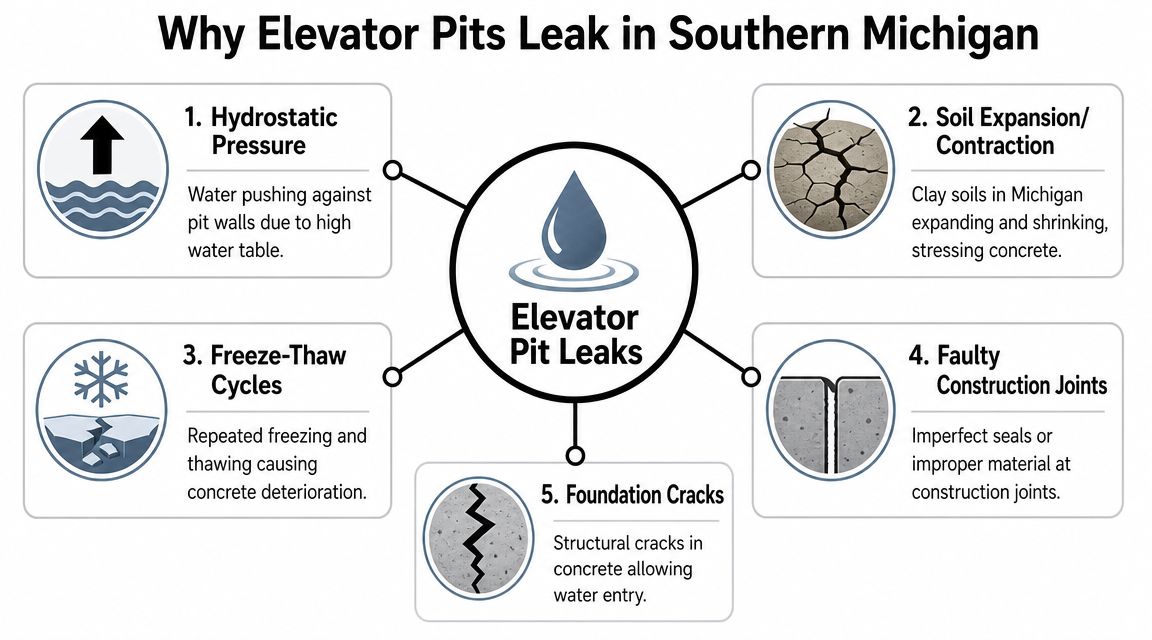
Southern Michigan creates the perfect setup for pit leaks. Snowmelt saturates the ground. Spring rains raise groundwater. Summer storms can overload exterior drainage. Winter freeze-thaw movement stresses concrete that already has age, shrinkage, or construction defects working against it.
The first thing to understand is that the pit is not just another basement corner. Below-grade pits are treated as a hydrostatic-pressure risk area in code, not just a maintenance issue. Polyguard’s discussion of elevator pit waterproofing and IBC §1805.3 notes that the code requires waterproofing where structures are below the water table or subject to hydrostatic pressure. It also points out that even small cracks, cold joints, and pipe penetrations can become leak paths.
Hydrostatic pressure after thaw and rain
When the soil around a building holds water, that water pushes against pit walls and slabs. In low-lying sites across places like Dearborn, Ypsilanti, Jackson, and Monroe, owners often notice the problem after the snowpack breaks and the ground stays wet for days. If exterior waterproofing is weak, the water finds the easiest route in.
That route is rarely dramatic at first. It’s usually a damp seam, a hairline crack, or seepage at a penetration.
Freeze-thaw damage and concrete movement
Michigan’s freeze-thaw cycles punish below-grade concrete. Water gets into tiny defects, temperatures swing, and the concrete expands and contracts. Over time, that movement opens pathways that didn’t matter much in dry weather but start leaking once groundwater rises.
Common trouble spots include:
- Cold joints: The connection between separate concrete pours can become a continuous leak line.
- Pipe and conduit penetrations: Utility entries are notorious weak points if they weren’t sealed correctly.
- Anchor points and embedded hardware: Small openings around fasteners can admit water under pressure.
- Wall-to-slab intersections: If that joint moves or was poorly detailed, seepage often starts there.
Site drainage and building age
Some pits leak because the waterproofing failed. Others leak because the site keeps feeding water toward the foundation. Poor grading, blocked drains, hardscape changes, and aging sump systems all make the pit work harder than it should.
If you’re already seeing recurring seepage, warning signs of a flooded elevator pit usually point to a broader building condition, not just an isolated elevator issue.
Water in the pit is usually the last visible symptom, not the first failure.
The High Cost of Ignoring a Wet Elevator Pit
Owners sometimes delay pit waterproofing because the elevator still runs. That’s a mistake. A wet pit can stay quiet for a while, then turn into an equipment problem, an inspection problem, and a liability problem all at once.
Equipment damage gets expensive fast
Water attacks elevator components from the bottom up. Steel parts rust. Rails and brackets corrode. Buffers, supports, and fasteners degrade. In hydraulic applications, moisture around pit components creates a harsher environment for seals, piping, and related equipment. Even if the car keeps operating, the condition underneath it worsens.
Electrical exposure is the more urgent concern. A damp pit can threaten wiring, connections, switches, and anything else installed low in the hoistway. Water and electricity don’t leave much room for “wait and see.”
Violations and shutdowns disrupt the building
A wet pit also creates practical operational trouble. Inspectors and elevator personnel expect the pit to be safe to access. If water accumulation, active leakage, or deteriorated concrete makes the space unsafe, the owner may be pushed into corrective work on someone else’s timeline.
That’s where the hidden cost shows up:
| Risk area | What it means for the owner |
|---|---|
| Tenant disruption | Elevator downtime frustrates residents, staff, patients, students, and visitors |
| Emergency dispatches | After-hours calls and urgent pump-outs usually cost more than planned work |
| Deferred repairs | A small leak can turn into concrete repair, replacement parts, and longer outages |
| Scheduling pressure | Work often has to happen when the building can tolerate shutdowns, not when it's convenient |
Liability doesn't stay in the pit
If maintenance staff, elevator mechanics, or other building personnel have to enter a wet or degraded pit, the owner has exposure. If the elevator is taken out of service in a medical, senior living, municipal, or multifamily building, the operational consequences widen immediately.
The legal issue isn't just whether there was water. It's whether the owner knew about it, let it continue, and failed to act before equipment or safety conditions worsened.
A pit leak is one of those building problems that punishes delay. The longer it stays active, the fewer low-cost options remain.
Common Waterproofing Solutions Explained
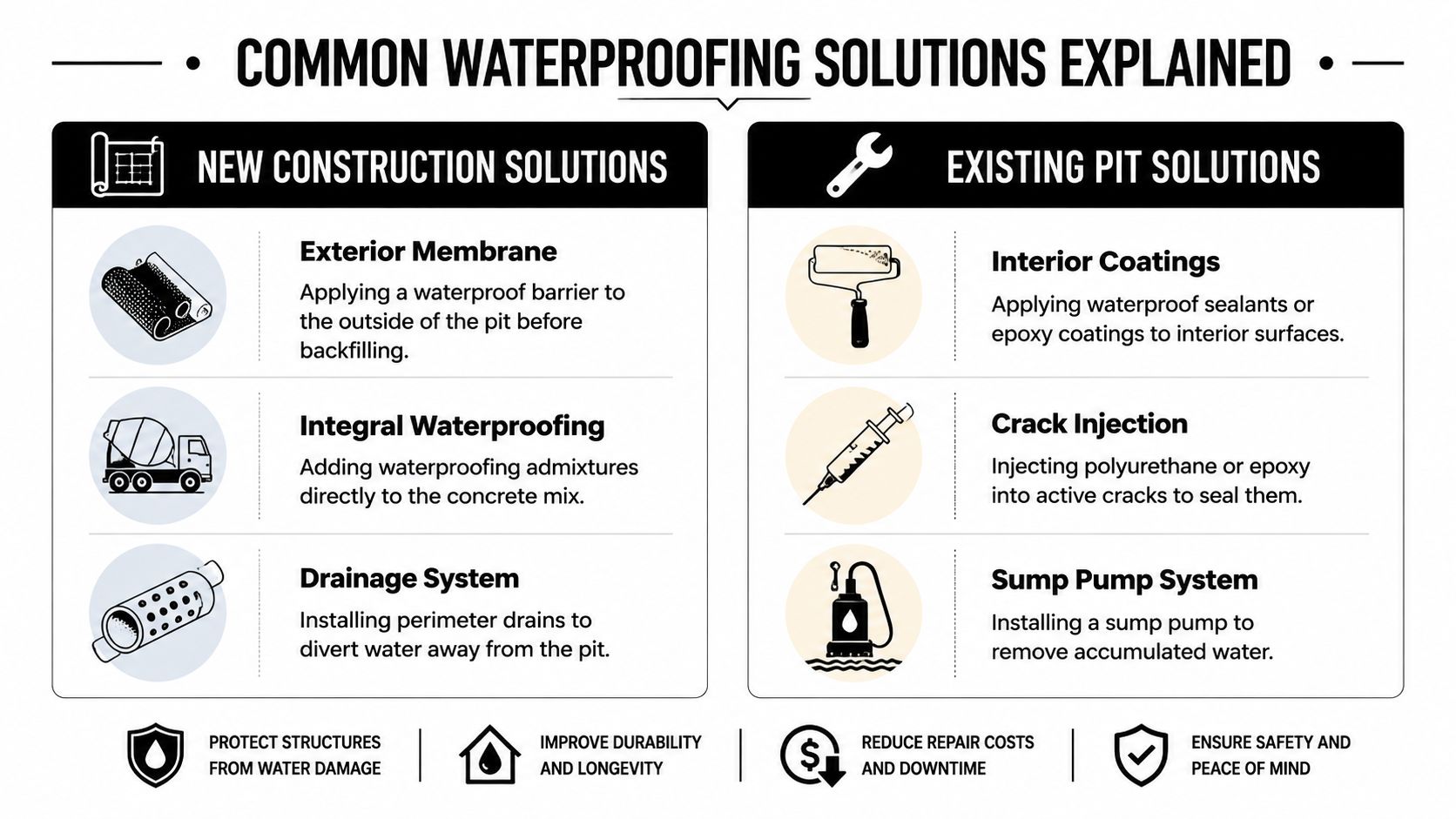
Not every method belongs on every project. The main split is simple. Positive-side waterproofing goes on the outside of the pit structure and is the preferred approach when you can reach the exterior. Negative-side waterproofing is applied from the inside and is usually the repair path when the building is already standing and excavation isn't practical.
W. R. Meadows explains the distinction between positive-side and negative-side elevator pit waterproofing and states that positive-side waterproofing is the best method. It also notes that interior repairs often require shutting down the elevators and keeping treated surfaces moist for 72 hours for proper cure.
Positive-side waterproofing for new construction
This is the cleanest way to handle a pit. The waterproofing barrier is installed on the exterior face before backfill, so water is stopped before it enters the concrete. That protects the structure itself, not just the interior surface.
A few common approaches show up in the field:
| System | Where it fits | What works well | Common failure point |
|---|---|---|---|
| Sheet membrane | New pits with good access and careful detailing | Consistent thickness and controlled application | Bad seam work or damaged membrane during backfill |
| Liquid-applied membrane | Projects with irregular geometry and penetrations | Good continuity around corners and details | Uneven thickness or poor substrate prep |
| Integral waterproofing | New concrete placement | Helps the concrete body resist water movement | Doesn't replace good joint and penetration detailing |
| Drainage layer and perimeter drainage | Sites with persistent water pressure | Reduces water load against the wall | Misused as a substitute for actual waterproofing |
Positive-side systems reward good planning. If the pit is treated as an independent foundation element, the detailing is usually simpler and more reliable. Once the pit is woven into a complicated foundation condition, the work gets harder, and execution mistakes become more likely.
Negative-side waterproofing for existing pits
Most owners in Detroit, Ann Arbor, Kalamazoo, Flint, and surrounding communities don't have the luxury of excavation and exterior access. They have an existing building, an active leak, and a need to keep disruption under control. That's where interior systems come in.
These are the common categories:
- Cementitious waterproof coatings: Breathable systems that bond to prepared concrete and are often used in repair work.
- Crystalline waterproofing: Materials that work within the concrete matrix to reduce seepage through pores and micro-cracks.
- Crack injection: Used when a defined crack is a primary water path.
- Hydraulic cement at active leaks: A stopping measure for flowing water at point-entry locations.
- Penetration sealing: Needed around conduits, pipes, sleeves, and embedded items.
A paint-like coating slapped over a wet wall usually doesn't solve anything. If hydrostatic pressure is still active behind it, the material often loses bond and fails.
What owners should ask before choosing a system
The wrong repair usually comes from asking only one question: “What can you put on the inside?” The better questions are broader.
Ask the contractor:
- Where is the water entering. Crack, joint, penetration, slab edge, or multiple points.
- Is the concrete sound enough for a coating or crystalline treatment to bond and perform.
- Does the pit need structural repair first before waterproofing starts.
- Can the sump and drainage keep up, or are they only masking a failed envelope.
- How much shutdown time is required for prep, cure, and safe return to service.
What works and what doesn't
What works is a system matched to the underlying source of water. What doesn't work is cosmetic treatment over active hydrostatic pressure, untreated joints, contaminated concrete, or loose substrate. Owners often spend money twice because the first contractor tried to “seal” the symptom instead of correcting the entry path and the surface conditions.
If the pit is in new construction, fight for exterior waterproofing and proper detailing. If the pit is already leaking in an older building, expect a repair sequence that combines leak stoppage, concrete prep, joint treatment, and a compatible interior waterproofing system.
How to Repair an Actively Leaking Elevator Pit
An actively leaking pit needs a controlled repair, not improvisation. The first job is making the pit safe. The second is identifying exactly where water is entering. The third is using materials that can handle active seepage and long-term moisture pressure from the inside.
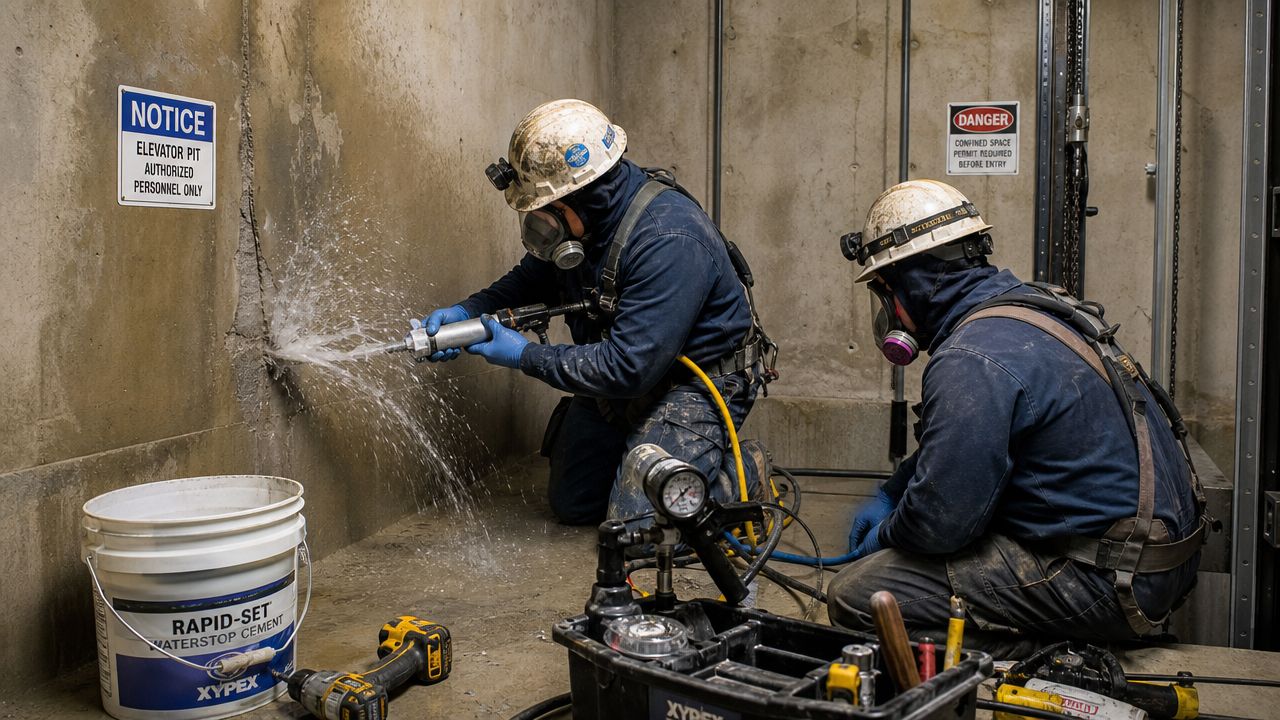
Step one is control and diagnosis
Before repair materials come out, the pit usually has to be dewatered and cleaned so the crew can see what's happening. That means removing standing water, clearing debris, and exposing the concrete surface enough to distinguish a wall crack from a leaking cold joint or a penetration issue.
The crew then checks for:
- Active flow points
- Deteriorated or hollow concrete
- Open cracks and joint separation
- Rust staining that marks recurring water paths
- Previous failed patching or coating systems
The proven two-step repair sequence
For pits that can't be waterproofed from the outside, professionals commonly use a specific sequence documented in Xypex's white paper on elevator pit waterproofing with crystalline technology. The sequence is straightforward.
First, stop active inflow with a fast-setting hydraulic cement. That stabilizes the leak point so water isn't pushing through the repair area while the broader system is installed.
Second, apply crystalline waterproofing in two coats. The purpose of that second step is to densify the concrete and block seepage through pores, capillaries, and micro-cracks that are too small to open mechanically.
That approach matters because many pit leaks are not a single wide crack. They're a network of tiny pathways in concrete that has been under pressure for years.
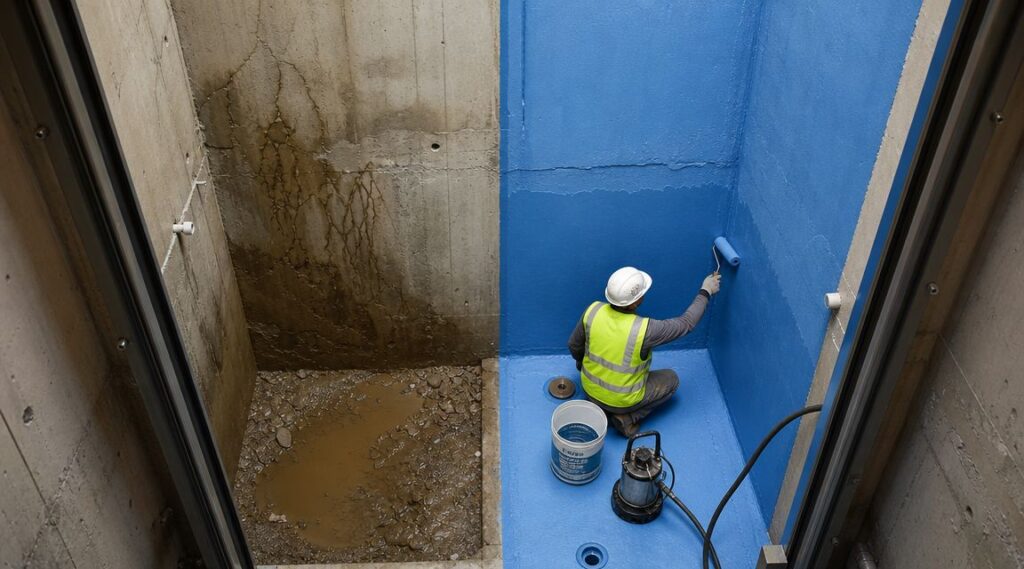
A short visual helps show the kind of repair environment crews face in the field.
What owners should expect during repair
A proper pit repair is messy, confined-space work. It often includes grinding or other surface preparation, local patching, sealing around penetrations, and cure protection. If active leaks are still moving, the repair crew may need to attack those first before the full waterproofing treatment can hold.
If a contractor talks only about coating the wall but not about active leak stoppage, surface prep, and joint treatment, you're probably not hearing a complete repair plan.
The goal isn't to make the wall look dry for a week. The goal is to interrupt the water path and turn the concrete back into a serviceable barrier.
Navigating Code Compliance and Project Budgeting
Most owners ask two practical questions right away. Do I have to fix this now, and what will drive the budget? The first answer is usually yes if the pit is wet enough to threaten safety, equipment, or inspection status. The second answer is that price depends less on the word “waterproofing” and more on the actual repair conditions on site.
Code issues start with the building condition
A leaking pit isn't just an elevator contractor's concern. It can involve the building envelope, the foundation condition, and the safety of the hoistway workspace. Permits, inspections, and coordination requirements vary by municipality, but any substantial repair can pull in code review, documentation, shutdown planning, and return-to-service steps.
If you manage property in Southern Michigan, it helps to review Michigan elevator code requirements and compliance issues early so you know whether the problem is limited to pit waterproofing or tied to broader correction work.
What affects the budget
The biggest cost drivers are usually these:
- Severity of the leak: Damp seepage is one thing. Active inflow and recurring flooding are another.
- Number of entry points: One crack is simpler than multiple wall, floor, and penetration leaks.
- Concrete condition: Sound concrete is easier to waterproof than spalled or deteriorated concrete.
- Access and shutdown logistics: Occupied buildings, limited access, and work-hour restrictions increase complexity.
- System choice: Localized repairs cost less than full-surface treatment, but only if they solve the actual problem.
Budget for the repair you need, not the patch you hope will hold
Owners sometimes under-budget because they assume the pit just needs sealant. In reality, the work may involve dewatering, prep, crack treatment, hydraulic cement, crystalline application, cure protection, sump review, and follow-up inspection. If a contractor prices only the visible symptom, expect change orders or a short-lived fix.
A sensible budgeting process looks like this:
- Confirm the source of water
- Separate structural repair from waterproofing scope
- Plan for downtime and access
- Ask what cure time or reinspection steps are required
- Compare repair methods, not just lump-sum numbers
The cheapest proposal often leaves out the hard part. In pit waterproofing, the hard part is usually the part that keeps the repair from failing.
When to Call a Pro and Long-Term Pit Maintenance
There's a point where this stops being a building maintenance item and becomes specialist work. Elevator pits combine water, electricity, confined access, code obligations, and equipment sensitivity. That's not handyman territory.
Call a pro when these conditions show up
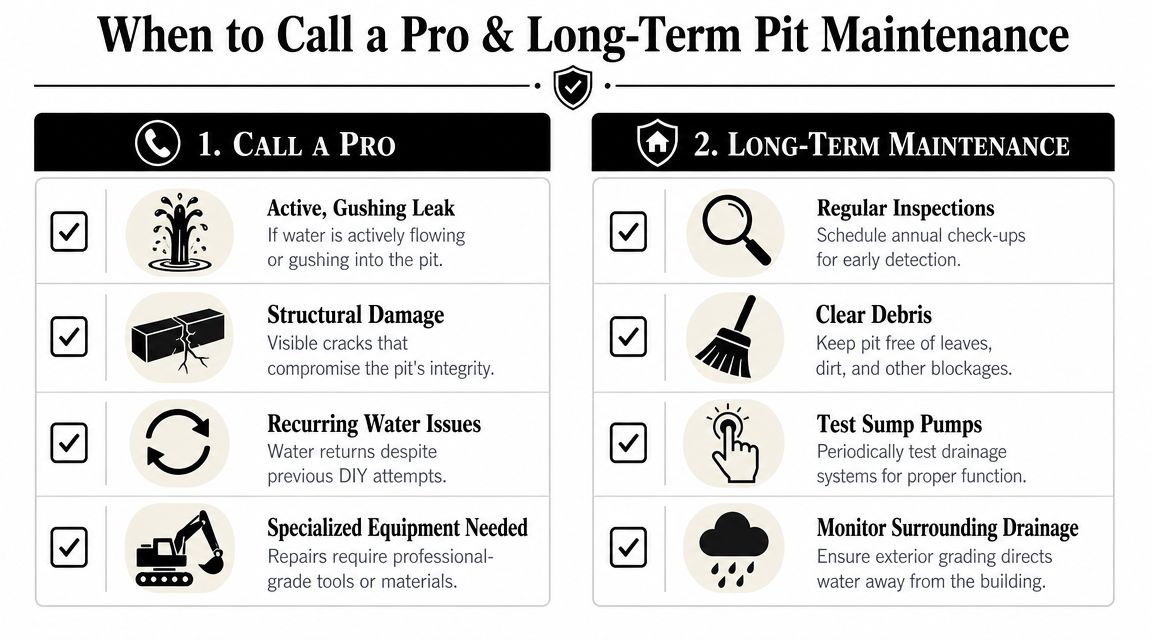
Use a simple threshold test:
- Standing water is present: If water is pooling in the pit, the condition is already affecting safe access.
- The leak is active: Flowing water through a crack, joint, or penetration needs targeted repair.
- Concrete is cracking or breaking down: Waterproofing won't succeed on unstable substrate.
- A sump has failed or can't keep up: Pumping alone isn't a waterproofing strategy.
- The problem keeps coming back: Repeated patching usually means the wrong repair method was used.
Maintenance that actually helps
Long-term pit care is mostly about catching early signs before they turn into shutdowns. Good maintenance teams don't wait for a flood. They inspect, document, and correct small changes in pit condition before water gets into the equipment environment.
Useful habits include:
| Maintenance item | Why it matters |
|---|---|
| Routine pit inspection | Finds damp spots, rust staining, debris, and developing cracks early |
| Sump testing | Confirms the pump and discharge are still functioning as intended |
| Drainage review outside the building | Reduces water load on the foundation wall |
| Prompt crack and joint assessment | Stops minor seepage from becoming a chronic leak |
For owners with elevators in Detroit, Ann Arbor, Lansing, Flint, Kalamazoo, and nearby communities, a structured elevator maintenance program should include pit condition review, not just machine and door performance.
A dry pit is part of reliable elevator service, not separate from it.
The long view is simple. Waterproofing elevator pit problems are cheaper to solve when they're small, easier to schedule before a shutdown, and easier to document before an inspector or tenant forces the issue.
Crane Elevator Company serves Lower Michigan with family-owned, hands-on elevator expertise across Detroit, Ann Arbor, Lansing, Flint, Kalamazoo, and surrounding communities. If you're dealing with a wet or leaking pit, need a second opinion on a repair proposal, or want a maintenance partner that handles inspections, repairs, modernizations, and emergency service, contact Crane Elevator Company. Their team is available 24/7/365 and offers practical, non-proprietary solutions that help building owners protect equipment, stay compliant, and plan repairs with fewer surprises.