You get the call at the wrong time. A tenant says the car is stopping hard again. A medical office says patients are waiting in the lobby because one elevator is down. An apartment resident wants to know how long the outage will last, and nobody on site has a clear answer. By noon, the problem isn't just mechanical. It's operational, financial, and legal.
That's the reality of managing a Michigan elevator. The equipment may sit in a shaft or machine room, but the consequences land in your inbox, your tenant relations, and your budget. A bad unit affects leasing, accessibility, vendor coordination, and staff time. The worst mistakes usually start the same way. Someone treats an elevator like a small repair item instead of a building system that needs disciplined maintenance, code awareness, and a realistic long-term plan.
The Property Manager's Dilemma A Reliable Michigan Elevator
In Detroit, Ann Arbor, Lansing, Flint, Kalamazoo, and smaller Michigan markets, the pattern is familiar. A manager inherits a building with mixed-age equipment, partial records, and a service contract that looks cheap until the callbacks start. The car runs, mostly. Then doors hesitate. Leveling drifts. Tenants complain more often. Suddenly the cheapest option has become the most expensive one.
Michigan is not a niche market for this work. IBISWorld's Michigan Elevator Installation & Service industry profile estimates the sector at $2.3 billion in 2026, with 1,002 businesses and 6,186 employees statewide. It also reports average annual business growth of 2.1% and employment growth of 3.4% from 2021 to 2026. For owners and managers, that means there are plenty of contractors in the market. It does not mean all of them manage long-term risk well.
The dilemma isn't finding someone who can answer the phone. It's finding a contractor who can tell the difference between a repair, a recurring symptom, and a modernization trigger. That's where building owners usually win or lose money.
If you're sorting through options, start with a reliable elevator company in Michigan that can document what's failing, what can be repaired, what should be upgraded, and what needs to happen to keep the asset serviceable over time.
Practical rule: If the same complaint keeps coming back, you don't have an isolated repair. You have a system problem, a maintenance problem, or both.
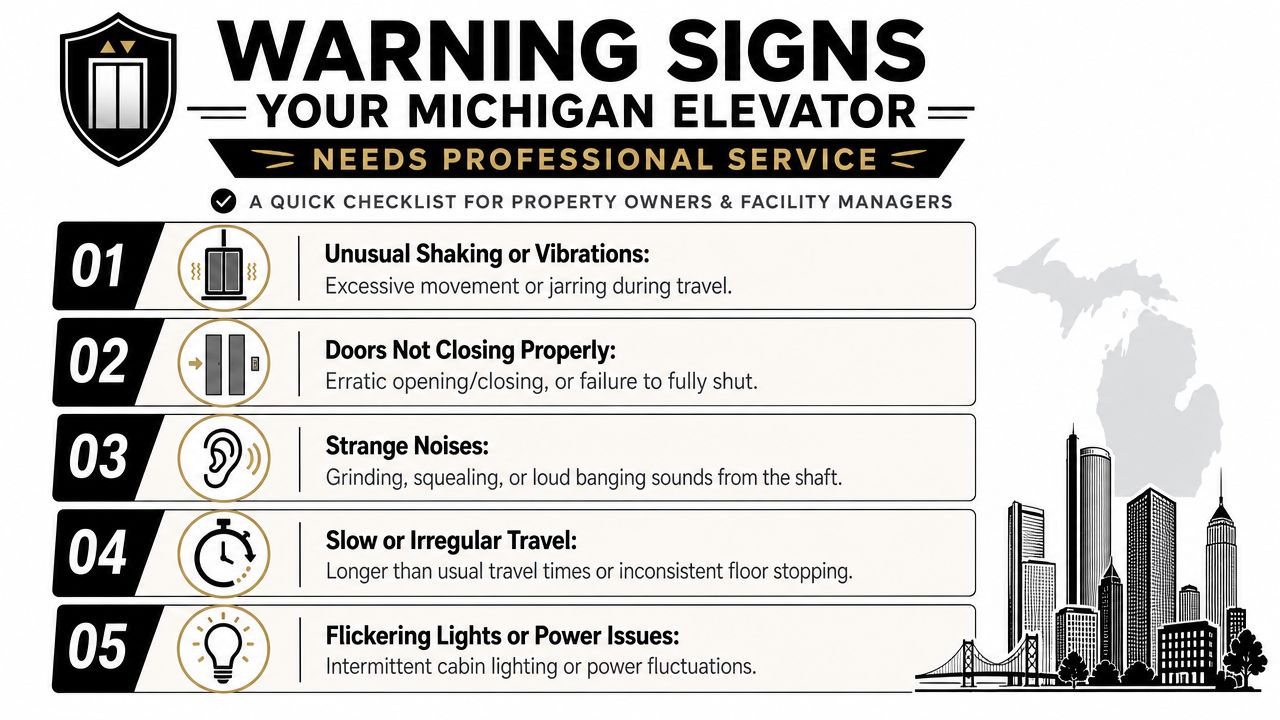
Warning Signs Your Michigan Elevator Needs Professional Service
Most managers know when an elevator feels “off,” but that description doesn't help much on a service call. The better approach is to watch for repeatable symptoms. Elevators usually tell you something is wrong before they fail completely.
What you can hear and feel
A healthy car has a pattern. The ride quality is consistent, stops are predictable, and the doors behave the same way on every cycle. When that changes, pay attention.
- Grinding or scraping noises often point to wear, contamination, misalignment, or components running under strain.
- Jerky starts and stops can indicate control issues, braking problems, leveling trouble, or worn drive components.
- Shaking or vibration during travel usually means something in the system is no longer moving cleanly or evenly.
- Hard landings at the floor are never something to shrug off. They can become a safety complaint quickly.
When a tenant says, “It sounds worse than last week,” that matters. Tenants ride the car every day. They notice subtle decline before many managers do.
What you can see at the landing
The landing tells its own story. A lot of service problems show up before anyone opens a controller.
Consider these visible clues:
| Sign | What it usually means in practice |
|---|---|
| Doors hesitate or reverse repeatedly | Door operator wear, sensor issues, track contamination, or alignment trouble |
| Car doesn't level cleanly with the floor | A ride-quality issue that can become an accessibility and trip-hazard problem |
| Hall calls or car buttons respond inconsistently | Worn fixtures, electrical faults, or intermittent control problems |
| Flickering cab lights | Electrical instability, fixture problems, or a broader power quality issue |
| Persistent error displays | A fault that needs diagnosis, not repeated resets |
A common management mistake is treating these as cosmetic annoyances. They aren't. A sticky door today becomes a shutdown tomorrow if the underlying cause isn't corrected.
What operations staff should document
Good notes lower repair time. Bad notes waste it.
Ask staff to record:
- The floor where it happened
- What the passenger experienced
- Whether it happens at a certain time of day
- Any noise, odor, or visible fault message
- Whether the issue affects one car or multiple cars
A clear symptom log often saves more time than a vague “elevator not working” call.
If the car is trapping passengers, missing floors, failing to close, or stopping unevenly, don't keep cycling it and hoping the problem clears. Take it out of service and get a qualified elevator mechanic involved. Repeated resets can hide the pattern that would have helped diagnose the actual fault.
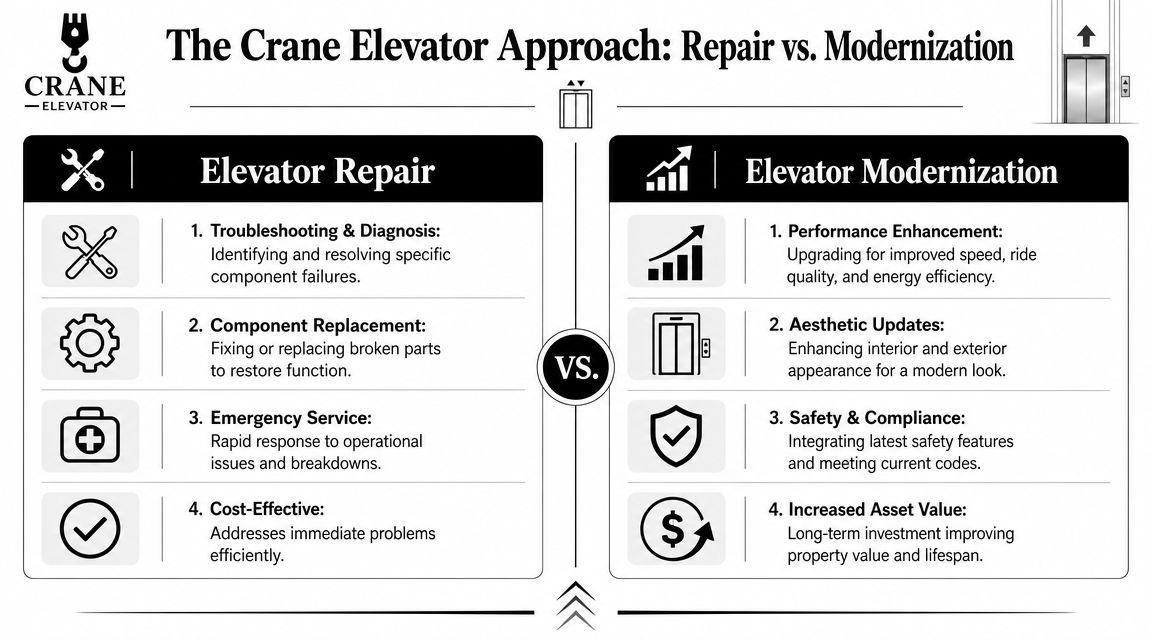
The Crane Elevator Approach to Repair and Modernization
A service visit should answer one question first. Are you dealing with a single failed component, or are you spending money to hold together an outdated system that keeps generating new failures?
That distinction drives everything. Repair is often the right move. Modernization is often the smarter move. Confusing the two is how owners burn through budget without improving reliability.
Repair solves a defined failure
A proper repair starts with diagnosis, not guessing. The mechanic should identify the failed part, the condition that caused the failure, and whether adjacent components are near the same point of wear. If a door operator fails because the track is dirty and the rollers are worn, replacing one piece won't hold for long.
Repair work usually makes sense when:
- The fault is isolated
- Replacement parts are available without long delays
- The controller and safety circuits remain serviceable
- The unit has a stable maintenance history
That's also where emergency service, testing support, hydraulic packing work, door equipment repairs, motor work, sheave replacement, jack replacement, and similar field corrections fit. They restore operation. They don't necessarily change the long-term economics of the system.
Modernization changes your long-term cost structure
Modernization is different. You're not just fixing what broke. You're replacing aging control, drive, door, signal, or safety-related components so the unit becomes more dependable, easier to service, and less vulnerable to chronic downtime.
The biggest strategic issue here is proprietary versus non-proprietary equipment.
A proprietary setup is like a closed device ecosystem. It may work fine, but access to software, specialty parts, or technical support can stay tightly controlled. That narrows your service options and can leave you dependent on a single channel for future work.
A non-proprietary modernization works more like an open platform. Qualified elevator contractors can service it without being boxed out by closed access, brand restrictions, or hard-to-source platform dependencies. For many building owners, that means more bidding flexibility, less vendor lock-in, and clearer long-term budgeting.
One option in Michigan is Crane Elevator Company, which provides repair, testing, maintenance, and non-proprietary modernization work for vertical transportation systems across Lower Michigan. That model matters because future serviceability is part of total cost of ownership, not a side issue.
Code pressure often decides the timeline
Owners sometimes wait too long because the car still runs. That's understandable, but Michigan code pressure often narrows the window for delay. Michigan elevator rules and related code materials have been tied to modernization timing for older buildings, and state announcements in 2025 flagged compliance as an enforcement priority, especially around pit safety and related systems.
If code exposure is rising and parts access is falling, postponing modernization isn't neutral. It increases the chance that the next repair becomes an emergency capital decision.
A good modernization plan doesn't start with finishes and cab panels. It starts with serviceability, code exposure, machine-room conditions, controller age, fault history, and whether the next contractor after this one will be able to maintain the system without being trapped by proprietary restrictions.
Proactive Maintenance That Prevents Problems and Reduces Costs
Reactive service feels cheaper because you only pay when something breaks. In practice, reactive service often costs more because the building pays for downtime, callbacks, tenant frustration, temporary workarounds, and avoidable part failures. A maintenance program earns its value when it catches deterioration before passengers notice it.
What disciplined maintenance actually looks like
A useful maintenance contract isn't a promise to “check the elevator.” It should define what gets inspected, cleaned, adjusted, tested, and documented. For most commercial properties, the work has to go beyond wiping fixtures and restarting equipment.
A stronger program usually includes:
- Machine-room attention that looks for heat, dirt buildup, leaks, loose connections, and signs of component stress.
- Pit clean-downs so debris doesn't interfere with safeties, switches, or moving equipment.
- Car-top service that checks door equipment, traveling cable condition, and items that only show themselves when someone gets on top of the car.
- Fixture upkeep including COP and PI bulb replacement so small visibility issues don't turn into service calls and tenant complaints.
- Trend recognition that separates one-time faults from recurring behavior.
That last point matters more than most owners realize. The primary advantage of preventive work is pattern recognition. A mechanic who sees the same door drift, contamination issue, oil trace, or leveling variation over multiple visits can intervene early.
Accountability matters as much as the checklist
A maintenance agreement is only useful if the contractor shows up and performs the work billed. Owners should ask direct questions. Was the pit cleaned? Was the machine room walked? Were callbacks from the prior month tied back to root causes? Were minor issues documented before they became outages?
That's why policy matters. A lift maintenance contract built around visible accountability is more useful than a low monthly number with weak follow-through.
Field insight: Dirt, oil residue, and neglected machine spaces don't just look bad. They hide the evidence of leaks, wear, heat, and loose components that a mechanic needs to catch early.
What doesn't work
Some service models almost guarantee recurring trouble. Property managers should be cautious when they see these patterns:
| Weak practice | Likely result |
|---|---|
| Break-fix only mindset | More emergency calls and less predictable budgeting |
| Minimal cleaning | Debris-related faults and poor visibility into wear |
| Repeated resets instead of diagnosis | Longer outages when the real failure finally surfaces |
| No discussion of parts access | Surprise delays when aging or closed systems need support |
| Thin service notes | No maintenance history, no trend line, no planning basis |
A lot of aging Michigan elevator equipment can stay in service for years with the right care. It usually fails early when maintenance becomes superficial.
How maintenance lowers total ownership cost
The savings aren't just in fewer shutdowns. Good maintenance stretches the usable life of expensive components, reduces panic spending, and gives owners time to phase improvements instead of funding them under pressure.
It also improves planning. If a contractor documents that door equipment is wearing but still serviceable, you can budget replacement before the next failure traps passengers or takes out a tenant-facing entrance. If hydraulic components show progressive leakage or deterioration, you can compare repair and replacement options before the unit becomes unreliable.
That's the practical value. Maintenance doesn't eliminate every breakdown. It gives you fewer surprises, cleaner decisions, and more control over timing.
Navigating Michigan Elevator Inspections and Code Compliance
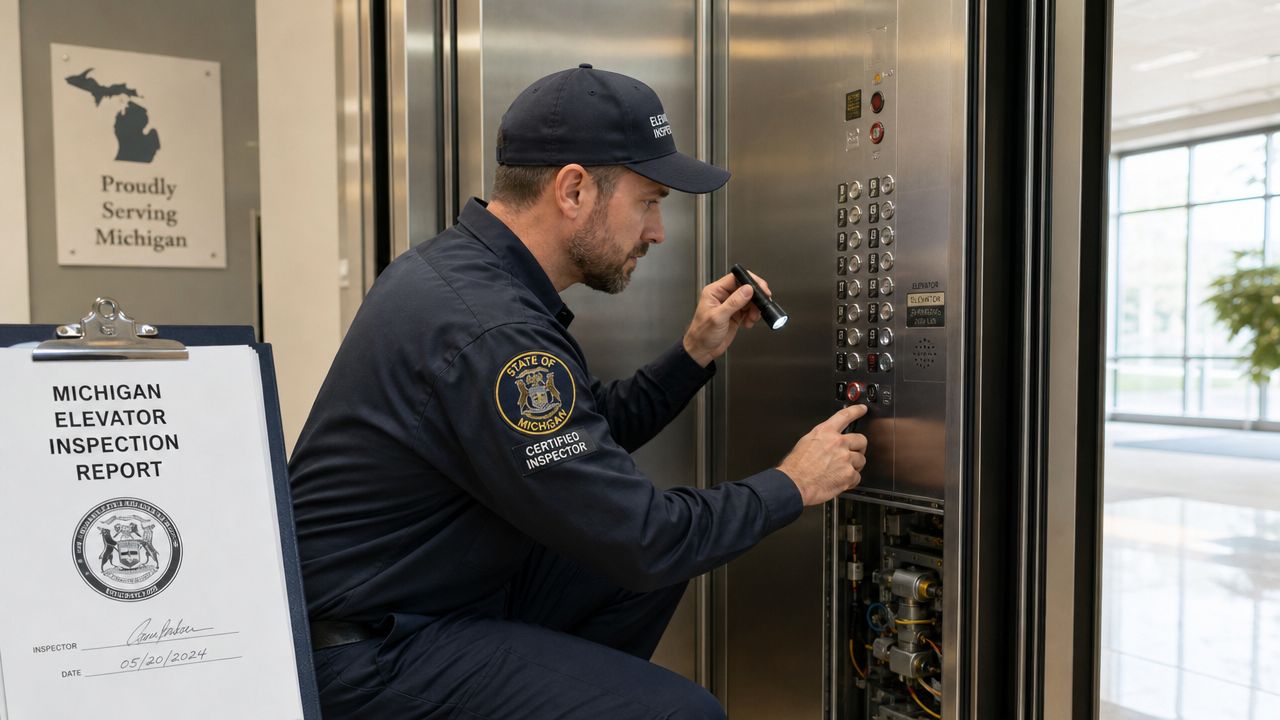
Code compliance is where many elevator problems become building problems. A rough-running car is frustrating. A car that fails required testing, lacks proper documentation, or gets altered without the right permit can disrupt occupancy, delay projects, and create liability exposure.
Licensing and permits are not optional
Michigan puts elevator work under a formal state framework. Michigan's elevator permit information from LARA states that installation, alteration, maintenance, and repair must be performed by a licensed elevator journeyperson, and a permit must be secured before alteration work begins. The same Michigan guidance also states that before installation or alteration, a licensed elevator contractor must submit an application, and detailed plans and specifications must be filed in triplicate and approved before the permit is issued.
For property managers, that means two things. First, you can't treat elevator alterations like general building maintenance. Second, paperwork quality directly affects schedule risk.
If a contractor is vague about licensing, permit responsibility, or submittal documents, stop there. That's not a clerical issue. It's a compliance issue.
The code issues owners should track closely
Michigan owners should keep their eye on a few practical compliance areas, especially in older buildings and mixed-age portfolios.
Alteration scope
Once a repair becomes an alteration, permit and documentation obligations change. That shift needs to be identified early, not after parts are ordered.Machine-room conditions
Michigan's current code cycle includes targeted technical updates affecting machine-room and safety-system design for the 2026 to 2028 period, including ventilation, re-opening devices, pipes, air ducts, wiring, electrical protective devices, overspeed governors, and car safety switches, as outlined in Michigan elevator code update materials from MSBO. Older rooms often need a fresh compliance review before work begins.Remote and nonstandard layouts
Some Michigan installations place machine or control rooms overhead, adjacent to, underneath the hoistway, or at a remote location. Those layouts can complicate access, modernization scope, and coordination.
A useful compliance partner should walk the building, review the history, identify likely triggers, and tell you which items are maintenance matters and which are code matters.
Testing and inspection readiness
Owners often focus on the test date itself. The essential work is what happens before it. An elevator that “usually runs fine” may still fail a required test if a safety device, phone, fire service function, governor-related component, or door-related operation isn't performing correctly.
Before a scheduled test or inspection, confirm:
- The unit's maintenance records are current
- Known violations or recurring faults have been addressed
- Communication devices and emergency features are operational
- Machine room, pit, and car top are accessible and serviceable
- Any recent work is documented and permitted where required
For owners who need a more direct summary of obligations, Michigan elevator code requirements for building projects and service work are worth reviewing before you schedule major repairs or modernization.
A short technical overview can also help teams understand what inspectors and mechanics look for in the field.
Buildings rarely get into trouble because one big issue appeared out of nowhere. They get into trouble because small compliance items were allowed to pile up without ownership.
Your Partner for Emergency Response and Long-Term Uptime
Emergency response matters, but response time alone doesn't solve the whole problem. If a Michigan elevator goes down in a commercial office, you have access issues, delivery disruptions, and tenant pressure. If it goes down in multifamily or senior housing, the stakes get much higher because people may not be able to safely access their homes.
That's why uptime planning has to include both technical response and building operations. A mechanic can restore service only when parts, access, and the underlying fault allow it. The owner or manager still needs a continuity plan if the outage stretches.
What an outage plan should cover
For properties in Detroit, Ann Arbor, Lansing, Flint, Kalamazoo, and surrounding Lower Michigan communities, the practical questions are immediate:
- Who communicates with tenants or occupants
- How frequently updates are issued
- Which residents or users need accommodation first
- How deliveries, medications, mobility devices, and staffing will be handled
- When legal counsel, ownership, or risk management need to be informed
This is especially important in multifamily housing. Michigan legislative discussions about long-term elevator outages highlighted written accommodation plans, tenant notice, hotel assistance, grocery and medication delivery support, increased onsite staffing, and coordination with volunteer groups. Even where proposed policy language doesn't directly govern your building, the practical lesson is clear. Downtime is no longer just a repair issue. It's an accessibility and liability issue.
The right way to think about emergency service
Good emergency service is not just “send someone fast.” It includes:
- Accurate triage so the right mechanic and likely parts path are assigned
- Clear site communication so managers know whether the problem is repairable that day
- Temporary operating guidance if one car remains in service
- A realistic outage forecast instead of overly optimistic promises
- Follow-up planning to reduce the chance of repeat failure
If your only outage plan is “call the elevator company,” you don't have an outage plan yet.
That's the true standard for uptime. Fast dispatch matters. So do tenant communication, accommodation planning, and honest expectations when a system needs more than a quick reset or single-part replacement.
Investing in Your Asset Pricing Financing and Our Guarantees
Owners usually call about an elevator when they need a repair. The bigger financial decision is whether they want to keep paying for unpredictability or move the asset into a more stable operating position.
A Michigan elevator is a capital asset with a long service life. Treating every major expense as an isolated bill usually leads to poor timing and weaker purchasing decisions. Treating service, modernization, and compliance as asset management produces better results.
Price transparency changes the conversation
Most owners don't mind paying for necessary work. They mind paying without clarity. That's why second opinions, competitive quotes, and price comparisons matter. They force scope into the open. They also make it easier to separate required work from padded work, and urgent work from work that can be phased.
Financing can help when the job is legitimate but the timing is bad. Commercial elevator financing and modernization financing give owners a way to complete required upgrades without waiting for the next budget cycle while the equipment continues to decline.
Think in service life, not just this quarter
Michigan's elevator history is a useful reminder here. The Rochester Avon Historical Society's research on the Rochester Elevator notes that it was established in 1880 and identifies it as the oldest continuously operating business in Rochester, Michigan. That doesn't mean every elevator should run for generations unchanged. It does mean vertical transportation systems can remain productive assets for a very long time when owners maintain them properly and modernize them when needed.
The right financial question isn't, “How cheaply can we get through this repair?” It's, “What spending path gives us the lowest long-term operating burden and the fewest forced decisions?”
What owners should ask before approving work
Use these questions before signing any proposal:
| Question | Why it matters |
|---|---|
| Is this a repair or an alteration? | It affects permit scope and compliance handling |
| Will the proposed parts keep us locked into one provider? | Future service flexibility matters |
| What recurring issue is this work intended to stop? | A repair should solve a problem, not just reset it |
| Can the work be phased logically? | Phasing helps budgeting without ignoring risk |
| What does the maintenance plan need to change after this job? | Otherwise the same failure pattern may return |
A serious contractor should be able to answer those questions without hedging.
If you're managing a Michigan elevator that's becoming unpredictable, expensive, or difficult to keep compliant, contact Crane Elevator Company for a quote, a second opinion, or a practical review of repair, testing, maintenance, modernization, and financing options.