
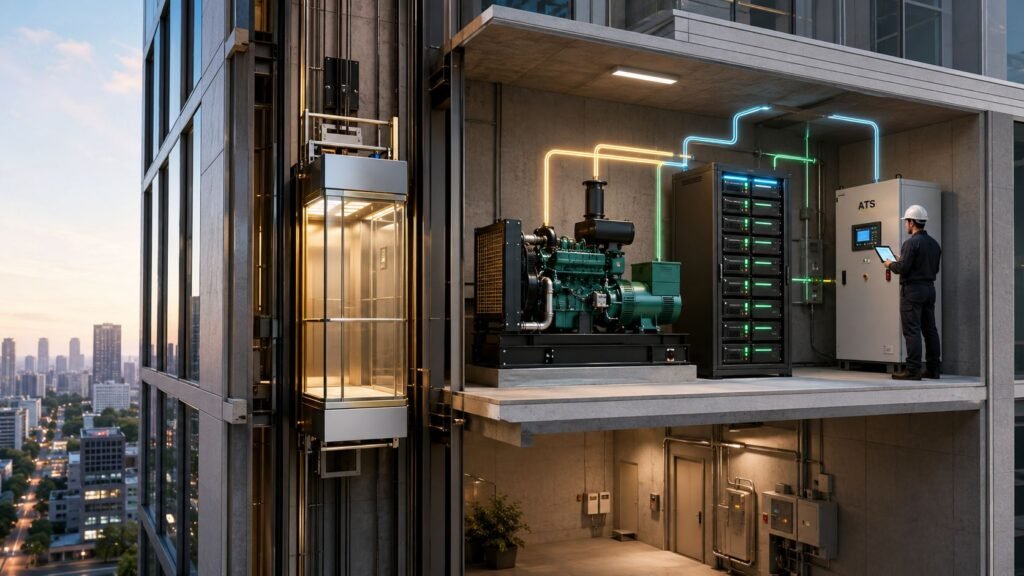
The call comes in at 2 a.m. during a storm. The building has lost utility power, tenants are calling, and someone may already be trapped in an elevator cab. In that moment, the question isn't whether the backup system looks good on the bid sheet. It's whether it can move a loaded car safely, keep communication alive, and satisfy the building's code path without failing the next inspection.
That's why elevator backup power systems deserve a different conversation than ordinary emergency power. A lobby light can go dark and nobody gets hurt. An elevator that loses power mid-travel creates a rescue problem, a compliance problem, and a liability problem all at once.
Why Elevator Backup Power Is Different
A lot of owners start with the wrong mental model. They assume the elevator just needs a generator or a UPS the way a server rack or sump pump does. In reality, elevator emergency power has to coordinate with the machine, the controller, attached loads, and the building's emergency notification and recall logic, all while handling the motor's startup demand and the conditions created by an outage.
A small UPS can keep control electronics energized, but that's not the same thing as moving a car to a landing. The distinction matters because the backup source has to do more than avoid a reboot. It has to support controlled car movement, lighting, communication, and, in many buildings, the logic that tells the system what to do when utility power disappears.
The practical difference shows up at the worst possible time. A battery that powers a controller for a few minutes may still leave passengers stranded if it can't handle the actual elevator load. A properly integrated backup setup does the opposite, it treats the outage like a planned sequence, not a panic event.
Practical rule: if the backup source can't carry the real load path, including inrush and attached devices, it's not an elevator rescue solution, it's just energized electronics.
The compliance side is just as important. One industry source notes the familiar 90-minute emergency-power benchmark used in high-rise code discussions, and says the backup system must support full-load conditions plus attached devices such as exhaust fans. That's why owners in taller buildings often end up comparing UPS or battery-based systems for short-duration evacuation with generators for longer runtime or fire-service needs. The code pressure makes this a building-systems decision, not a product preference, and the elevator code requirements overview is a useful starting point if you're trying to translate code language into purchase criteria.
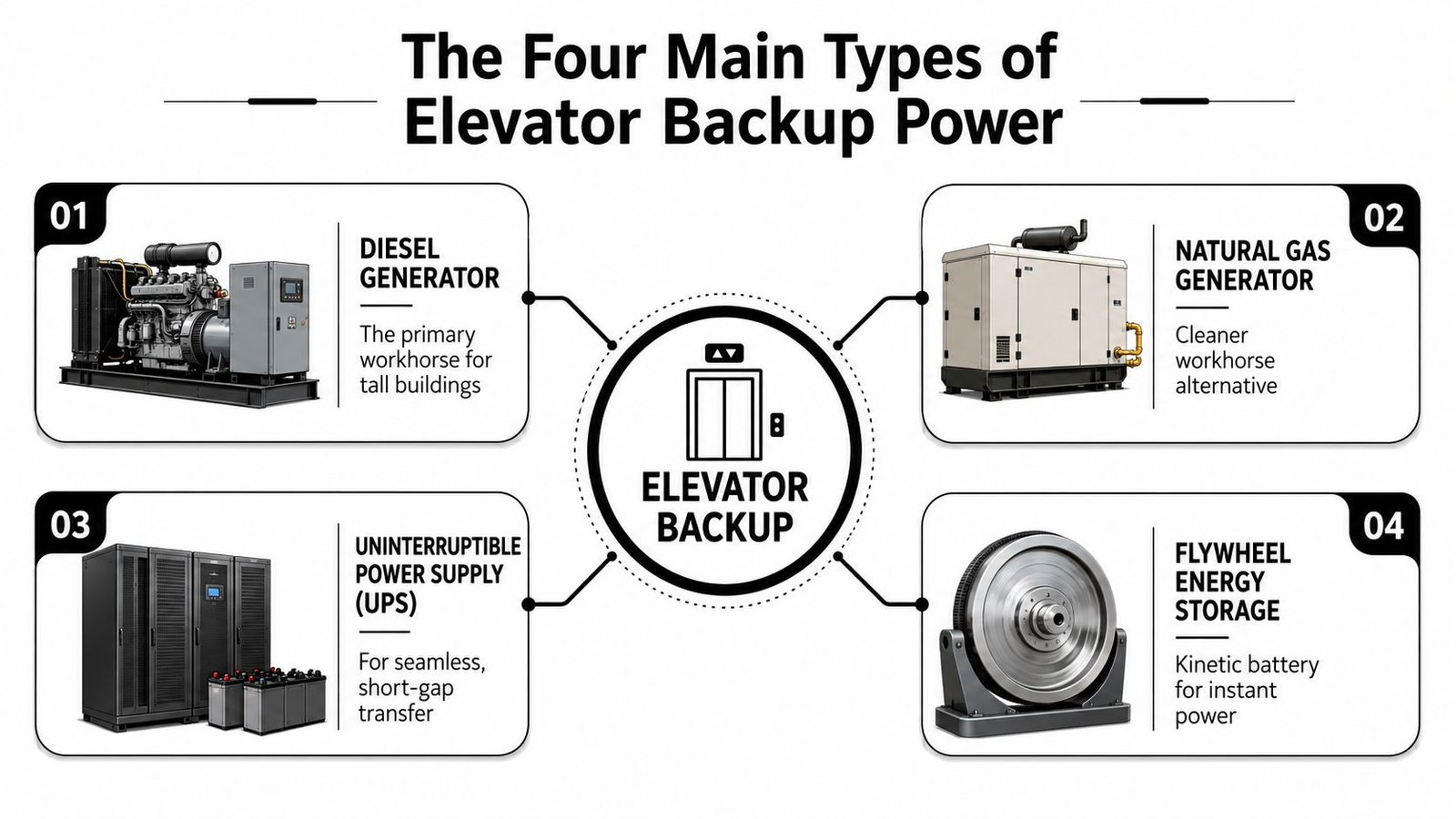
The Four Main Types of Elevator Backup Power
Think of the options the way you'd think about keeping your house running during an outage. A flashlight helps you find the door, a portable battery keeps one device alive, and a whole-home generator carries the house. Elevator backup works the same way, except the load is heavier and the safety consequences are higher.
Generators, the heavy-duty option
Diesel and natural gas generators are the workhorses for buildings that need extended runtime or multiple elevators to stay available. They're best when the building can't rely on a short battery ride to solve the outage problem. In practice, they're used when owners need a source that can keep going long enough for normal operations, fire service functions, or longer emergency events.
ATS equipment, the traffic cop
The automatic transfer switch is the part that decides when the building moves off utility power and onto the backup source. It doesn't create power, it coordinates it. If the switch is slow, poorly sized, or not aligned with elevator controls, the system can behave unpredictably at the exact moment you need clean handoff.
UPS and inverter systems, the instant-response tools
Battery UPS and inverter systems are designed for quick response and short-duration support. They're useful when the goal is to keep the elevator safe long enough to complete a controlled move or maintain essential functions during a brief interruption. Elevator-specific products matter in this context, because ordinary consumer UPS units usually aren't built to handle motor loads.
Rescue travel and battery lowering, the narrower but often smarter choice
Elevator-specific emergency power units can do one of two things, depending on the application. Some support controlled rescue travel, others support battery lowering to bring the cab to a landing so occupants can exit. That narrower function is often the right fit for residential and low-rise projects where keeping the elevator fully operational during an outage isn't necessary.
The best backup system often isn't the one with the biggest nameplate. It's the one that matches the building's real duty cycle.
These categories overlap in real projects. A building may use a generator for life-safety continuity, while a specific car also has battery rescue logic for passenger evacuation. That's normal. What matters is choosing the right architecture for the job instead of forcing every building into the same generator-versus-UPS argument.
How Backup Systems Integrate with Elevators and Buildings
A working system starts with sequence, not equipment. The transfer switch watches utility power, the elevator controller reacts to that signal, and the backup source comes online in a way that lets the car finish a controlled move instead of stalling wherever it happens to be. If those pieces don't talk to each other correctly, the result is usually a nuisance trip at best and a trapped car at worst.
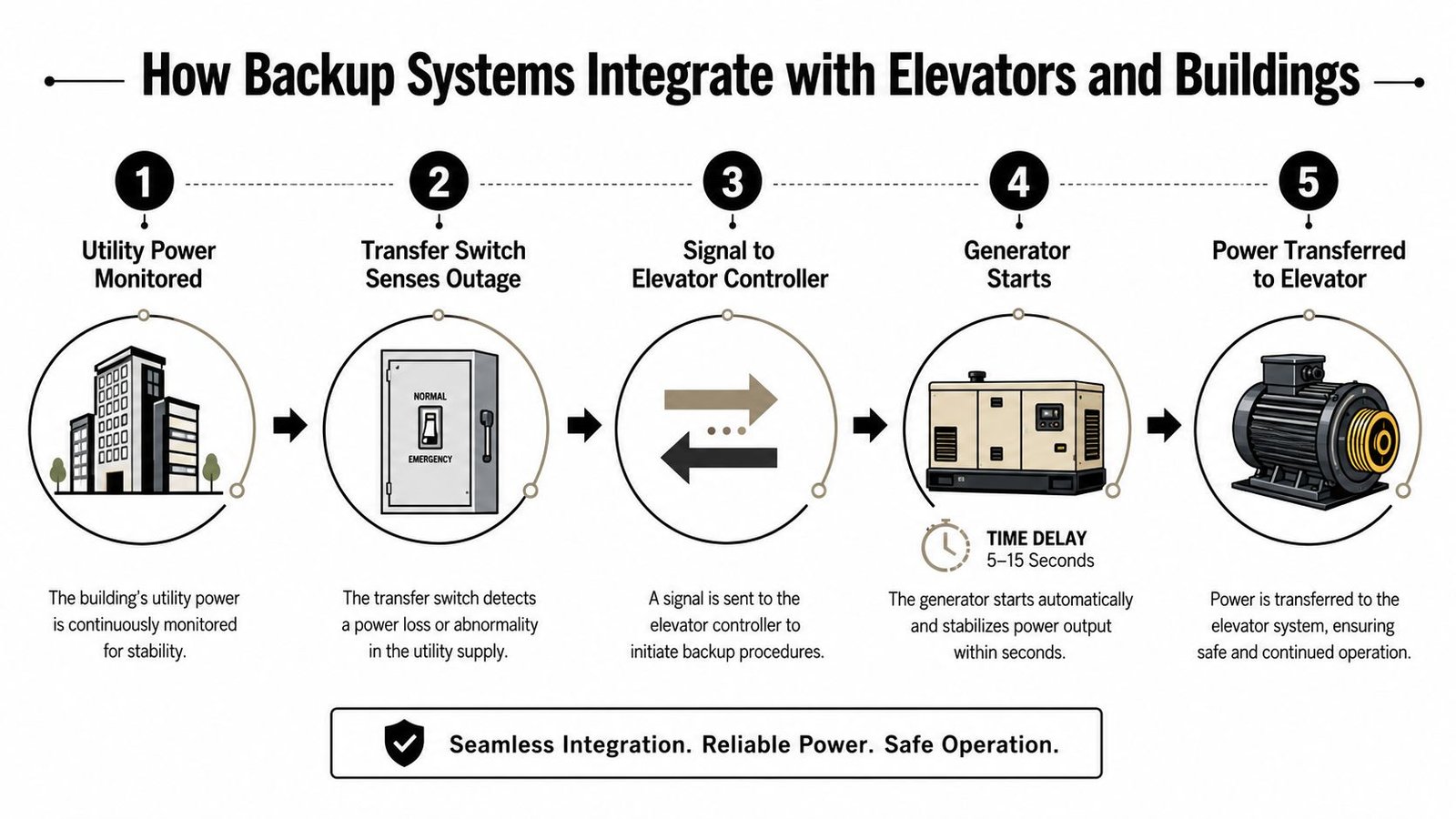
The integration chain usually looks like this in a real outage:
- Utility power drops, and the building's power quality changes immediately.
- The transfer switch senses the outage and starts the handoff process.
- The elevator controller gets the signal and decides whether to recall, run, or enter rescue mode.
- The generator starts, or the inverter takes over if the system is battery-based.
- Power transfers to the elevator, and the car completes the intended sequence.
The hard part is not the individual step. It's the timing between them. Multiple elevators on one generator need sequencing so the first car doesn't hog capacity while the second car reboots. Fire-service and recall functions also need to be coordinated, because the elevator must know when to return to a safe floor and when to remain available for emergency use.
When integration is sloppy, the symptoms are easy to spot. Cars stall mid-shaft. Controllers reboot. A transfer switch takes too long. A battery unit supports the controls but not the car movement, so the occupants still need a rescue. Those failures are usually not “bad elevator brands.” They're system-design failures.
The safest way to think about integration is simple. The elevator isn't receiving backup power as a standalone appliance. It's participating in a building-wide emergency sequence, and every delay or mismatch becomes visible at the car doors.
Codes and Standards Every Owner Should Know
Most owners don't need to memorize the code book. They do need to know which rules change the equipment they buy. The main issue is that life-safety emergency power is not the same thing as a standard battery backup, and code requirements treat those differently.
The IBC is the big driver in many U.S. projects. For elevators designated for occupant evacuation or emergency use, the equipment has to connect to the building's emergency power system. That's different from a standalone battery source that only keeps electronics alive. In practical terms, the code path affects transfer switching, sizing, and the way the elevator behaves during an outage, not just the brand of backup equipment.
The familiar 90-minute benchmark matters because it shows up in high-rise compliance conversations as a minimum emergency-power expectation for full-load conditions. That doesn't mean every building has to run a car for 90 minutes on batteries. It does mean owners in taller buildings need to think in code terms, not convenience terms, when they compare generator, UPS, and rescue-only systems.
What owners should ask their contractor
- Which code path applies to this elevator? A rescue-only residential lift isn't treated the same way as a fire-service elevator.
- What is the authority having jurisdiction looking for? Local enforcement can shape the final equipment package.
- How does recall work? The car may need to return to a landing before backup operation is considered complete.
- Does the design fit the existing building? Older properties often need a different answer than new construction.
For existing elevators in Michigan, ASME A17.3 adoption can affect modernization and alteration work on older equipment. That's why a contractor should be able to explain the current code route in plain English, not just hand over a part number. If the answer stays fuzzy, the bid probably is too.
Choosing the Right Backup for Your Building
The right choice starts with the building profile, not with the equipment catalog. Height, occupancy, number of elevators, and the existing electrical room all matter. A low-rise residential property with one car needs a different solution than a multi-elevator commercial tower that has to stay functional during a longer outage.
A useful way to think about it is this, the system should match the rescue problem. If the main risk is passengers being left in a cab during a short outage, a battery-lowering or rescue-only package may be the cleanest answer. If the building needs continued service across multiple cars, the case for generator-backed emergency power gets stronger.
| Backup Type | Typical Runtime | Response | Best Fit |
|---|---|---|---|
| Diesel or natural gas generator | Longer-duration building support | Slower than battery systems, but suitable for extended outages | Taller buildings, multiple elevators, life-safety continuity |
| Automatic transfer switch with generator | Depends on the generator and fuel supply | Coordinates the handoff between utility and backup source | Buildings that need managed switchover and code-aligned emergency power |
| Battery UPS or inverter system | Short-duration rescue or controlled travel | Instant or near-instant | Limited continued operation, short evacuation, controller support |
| Elevator-specific battery lowering or rescue unit | Usually rescue-only, not full service | Immediate enough to complete a landing move | Residential, low-rise, and modernization projects where safe exit matters more than full operation |
The contrarian point is important. A smaller building often does not need a full generator just because the sales pitch sounds more convincing. In many homes and modest commercial properties, the smarter choice is a rescue-focused system that gets people to a landing reliably without trying to power the whole elevator indefinitely.
Ask one question before you approve the equipment, what job do you want the backup system to perform during the outage?
That question keeps the conversation honest. It also keeps owners from overbuying capacity they'll never use or underbuying a unit that can't protect passengers.
Sizing and Load Considerations That Matter
Elevators are hard on backup equipment because motors don't start gently. A motor can draw far more current at startup than it does once it's moving, and that surge is exactly where cheap backup gear falls apart. Consumer-style UPS units are built for electronics, not for the kind of load a hoist motor creates.
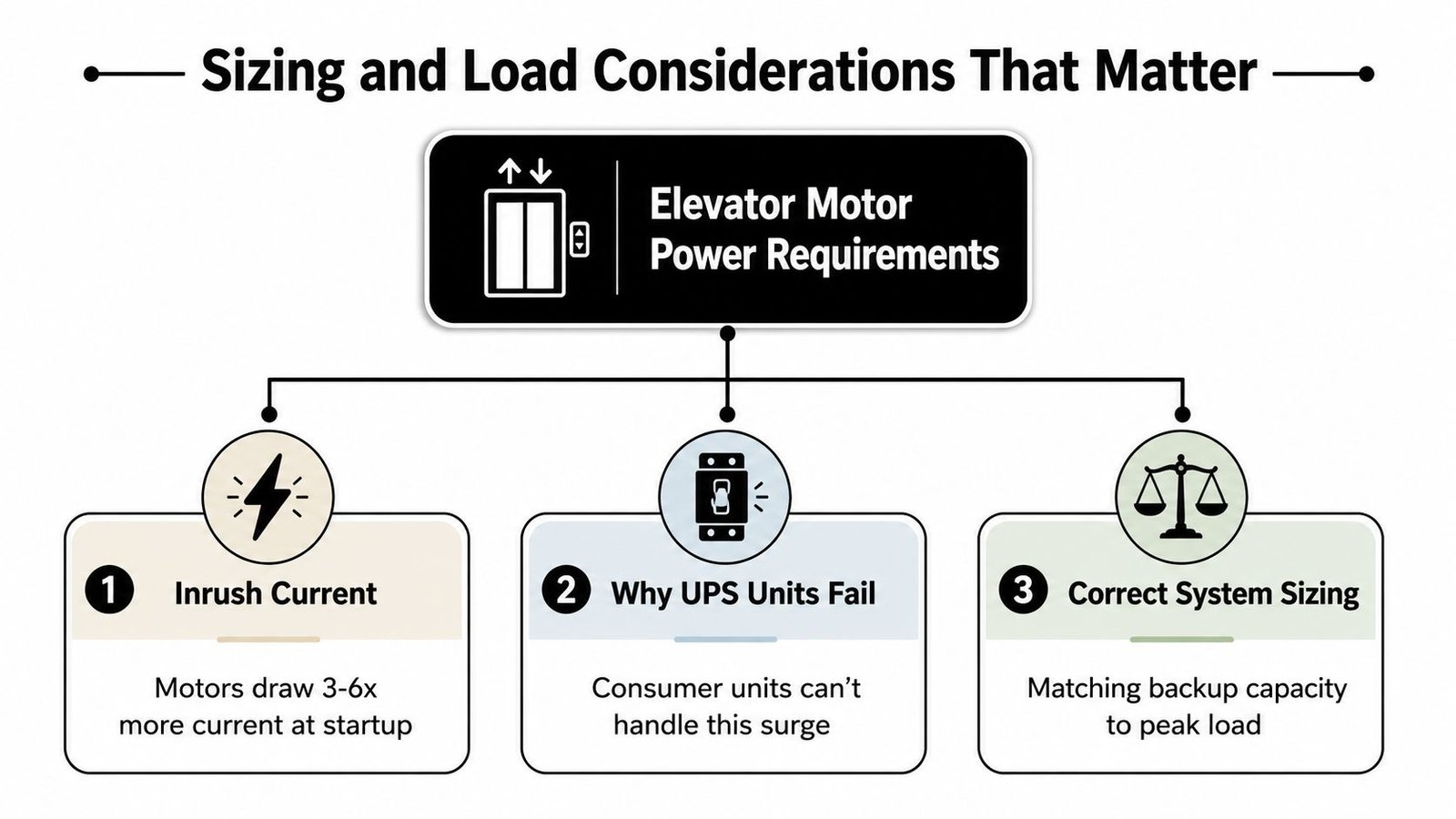
A contractor should calculate the elevator's real electrical demand, then size the backup source to handle full load plus starting demand. That means looking at the motor, the controller, and the attached loads that people forget about, including cab lighting, fans, and emergency phones. It also means checking whether the drive system introduces harmonics or other electrical behavior that changes how the backup source responds.
Here's the practical mistake owners make most often. They compare nameplate price without asking whether the equipment will survive the first start. A unit that looks cheap on paper can become expensive fast if it can't handle the inrush or if it causes nuisance shutdowns during testing.
If you want a contractor to be serious, ask for the load math in writing. A proper proposal should show the motor demand, the backup capacity, and the assumptions behind the design. If you're evaluating a modernization or a replacement path, the elevator load capacity testing guidance is a good reminder that the system has to be proven against actual load, not guessed at from a brochure.
Bottom line: if the sizing document doesn't account for the real starting surge, it's not a design, it's a guess.
That's why oversized confidence and undersized equipment can both fail you. One wastes money. The other leaves passengers in the cab.
Maintenance and Testing Best Practices
Backup power that works on paper can still fail at 2 a.m. if nobody tests it under real conditions. A generator that hasn't been exercised, a transfer switch that sticks, or batteries that have aged out can all look fine right until the outage happens. In the field, “set it and forget it” is the shortest path to trouble.
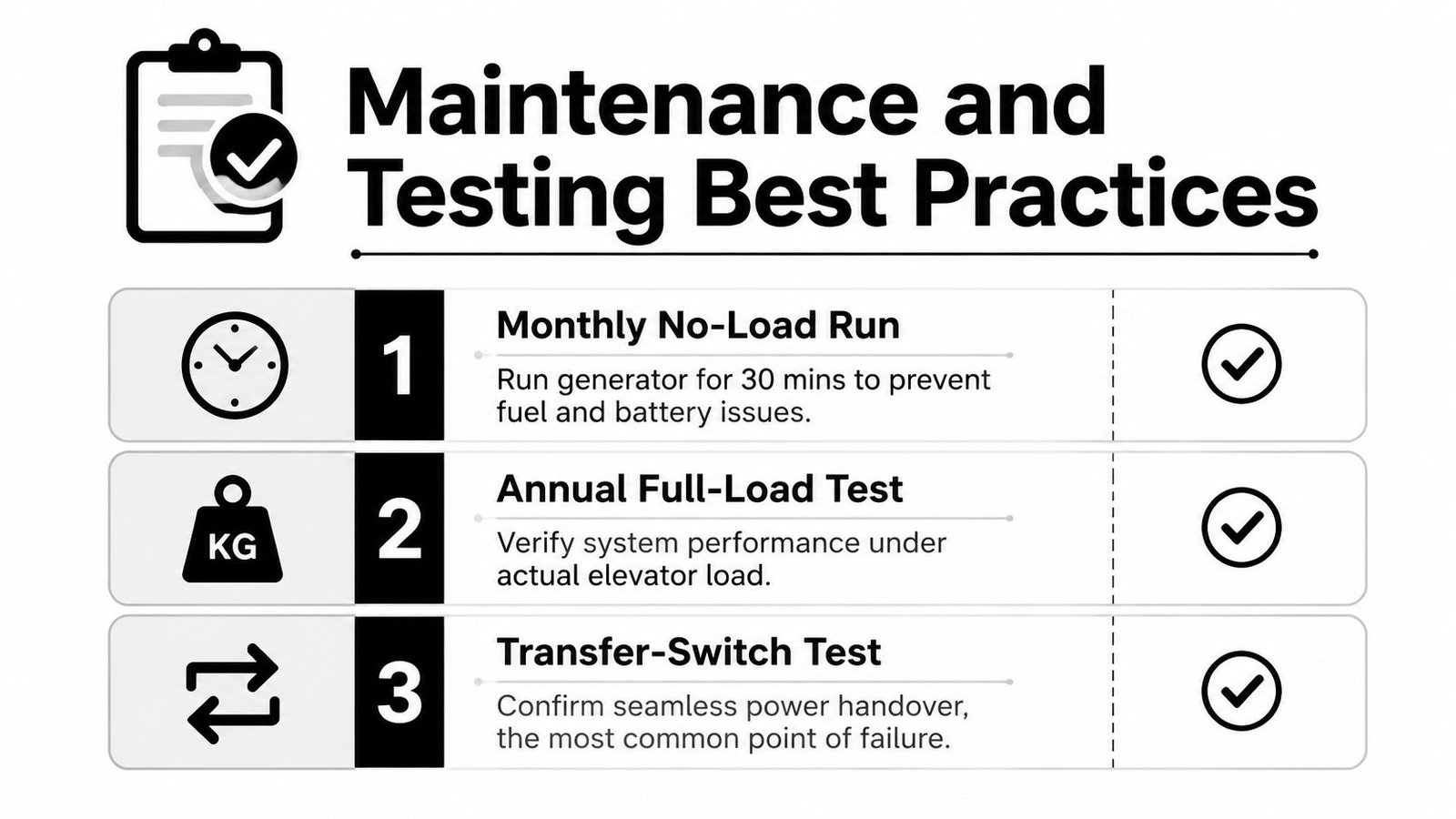
A simple maintenance rhythm helps keep the system honest:
- Monthly no-load run: Run the generator long enough to keep the engine and related systems healthy, and verify that starting logic still behaves.
- Annual full-load test: Confirm performance under actual elevator demand, not just under a light exercise condition.
- Transfer-switch test: Check the handoff point carefully, because that's where many problems show up.
- Battery capacity testing: Verify that battery-backed units can still complete the rescue function they were installed to perform.
That schedule only helps if the documentation is real. Inspectors want proof that the equipment was exercised, not reassurance that someone “thinks it was serviced.” Keep the test records with the elevator maintenance file, especially if staff turnover is common or the building uses multiple vendors.
A good service provider will tie backup testing into the broader elevator contract so nothing gets split off into a forgotten line item. That matters because emergency power is part of the elevator's operating system, not an accessory. If the backup device isn't maintained alongside the rest of the equipment, it tends to fail in the very scenario it was bought for.
You can also verify whether the elevator vendor and the electrical contractor agree on who owns which test. That avoids the familiar gap where both sides assume the other side already handled it.
For a deeper maintenance checklist, the elevator testing overview is a useful reference point when you're comparing service proposals.
Costs, Financing, and Your Next Steps
The cost of backup power isn't just the equipment. It's the installation, the electrical coordination, the periodic testing, and the avoided cost of an entrapment event or a failed inspection. Owners usually feel the difference most when a project is underbid on upfront hardware and then keeps collecting surprises during commissioning.
That's why the cheapest quote isn't always the lowest-cost solution. A system that needs repeated troubleshooting, extra electrical work, or emergency callbacks can erase the initial savings quickly. A better bid is the one that spells out the runtime target, the code path, the testing schedule, and the maintenance ownership before anyone signs.
Financing can help when the upgrade is tied to a modernization project. Spread over time, the capital hit is easier to manage, especially for buildings that need more than one improvement at once. That said, financing shouldn't be used to justify the wrong system. A rescue-only package for a low-rise property can be the smarter spend than a full generator that the building doesn't need.
Before you meet with a contractor, bring a short decision checklist:
- Building profile: height, occupancy, number of elevators, and whether the car is part of a life-safety path.
- Code obligations: what the AHJ expects, and whether the project falls under emergency power or rescue-only requirements.
- Runtime needs: one landing move, short evacuation, or extended service.
- Maintenance plan: who tests it, how often, and where the records live.
- Budget horizon: upfront spend, service cost, and modernization timing.
The best system is the one sized to the building and verified on a schedule. For many low-rise and residential properties, that means rescue-focused backup, not a larger generator for its own sake.
If you're weighing backup power for an elevator in Michigan, talk with a contractor who can map the code path, load requirements, and maintenance plan to your actual building, not just the equipment brochure. Contact Crane Elevator Company to review your elevator backup power options, compare rescue-only and generator-based solutions, and get a practical plan that fits your property.