
A Toledo homeowner is standing beside a quiet residential lift, waiting for a service call that was supposed to solve a recurring door problem. The lift still runs, but the stops feel less precise, the doors hesitate, and a new scraping sound has appeared somewhere above the cab. That situation is common. A home lift rarely fails because of one dramatic defect. More often, small wear issues go unaddressed until they combine into an inconvenient and expensive outage.
Residential lift maintenance in Ohio works best as an ongoing relationship between the owner and a qualified elevator contractor. The service plan has to account for the equipment, the way the home uses it, and the legal category Ohio assigns to that lift. A private-residence elevator isn't handled exactly like a commercial passenger elevator, but the exemption from a particular inspection frequency doesn't eliminate the need for disciplined maintenance.
What Residential Lift Maintenance Looks Like in Ohio Homes
A routine visit in Toledo might end with a technician wiping dust from the drive area while explaining that a door roller is beginning to wear. The lift may still be operating normally, so replacing the roller immediately can feel unnecessary. An experienced technician sees the trade-off clearly: address a manageable component during scheduled service, or wait until the roller affects door movement and creates a second problem.
That visit should cover more than the symptom that prompted the call. The technician checks the cab, doors, guides, drive components, controls, safety devices, emergency communication equipment, and the condition of the lift space itself. A maintenance record should identify adjustments, worn parts, unusual sounds, and recommendations that need a separate repair authorization.
Practical rule: A maintenance visit should leave the owner with a condition report and a clear next action, not just a statement that the lift is running today.
Five years of neglected operation tends to show up as a collection of small defects. Door tracks accumulate debris, rollers develop flat spots, belts or cables lose their proper condition, batteries weaken, and electrical connections become less reliable. The lift may continue moving between floors, but ride quality deteriorates and minor callbacks become harder to predict.
A planned service agreement helps the homeowner budget for wear instead of reacting to every failure. It also gives a contractor a history of the unit, which makes troubleshooting faster when a problem does occur. For homes in Cleveland, Columbus, Dayton, Toledo, and surrounding communities, that continuity can protect daily accessibility and support the condition records a future buyer or insurer may want to review.
Crane Elevator Company performs maintenance, repair, and modernization services for residential lifts in Michigan and Ohio, including Toledo and surrounding cities. Owners can review the company's Ohio elevator services when comparing local service options.
How Ohio Classifies Residential Lifts and Why It Matters
The first question isn't how often the lift makes noise. It's what kind of conveyance Ohio considers it to be.
Ohio's inspection-frequency law distinguishes elevators installed in a private residence from listed passenger, freight, and other conveyances subject to routine state inspection intervals. The statute explicitly excludes elevators installed in a private residence from the twice-per-12-month inspection requirement, as described in Ohio Revised Code Section 4105.10. That exemption is specific. It shouldn't be read as a blanket exemption from elevator safety responsibilities.
Start with the property and the users
A lift serving one private home is evaluated differently from equipment serving a public, commercial, institutional, or shared-use environment. A conveyance in a building with multiple residences, a common area, or public access may fall into a different regulatory category. A dumbwaiter or hoist in a non-residential setting can also remain subject to routine inspection requirements even when the equipment feels “small” or residential in appearance.
Classification affects the service plan in practical ways:
- Inspection cadence: A private-residence elevator isn't automatically placed on the same frequency as a commercial passenger unit.
- Documentation: The owner still needs service records, test results, repair invoices, and information about the equipment's condition.
- Authority: The contractor must understand Ohio elevator requirements and the applicable safety code, not just the manufacturer's installation manual.
- Insurance review: An insurer may ask how the lift is maintained, who services it, and whether required tests or inspections have been completed.
Ohio's framework recognizes private-residence elevators as elevators within the broader safety system, even though the routine frequency rule treats them differently. The Ohio inspection provision is useful because it shows why owners shouldn't copy a commercial schedule blindly, or assume that no stated frequency means no maintenance plan.
When the classification is unclear, the owner should contact the Ohio Department of Commerce Elevator Section or the relevant local authority before scheduling work. A contractor can help identify the equipment and prepare records, but the owner shouldn't guess at a legal obligation based solely on the lift's appearance.
Core Maintenance Tasks That Keep a Home Lift Reliable
A residential lift's reliability comes from several systems working together. A technician isn't just checking whether the cab travels. The inspection looks for developing conditions that can affect movement, stopping accuracy, access control, communication, and safe operation.
Mechanical condition comes first
The hoistway rails and guides need to remain clean, aligned, and properly lubricated for the equipment design. Cable or drive-belt condition matters because tension, wear, contamination, and glazing can change how the lift accelerates and stops. A belt that has hardened or become polished may contribute to rough movement, while a cable with visible deterioration requires immediate professional evaluation.
Door equipment causes a disproportionate share of residential complaints. Tracks collect grit, rollers wear, and interlocks can become difficult to engage. A dirty track may trigger reversals or incomplete closing. The door lock and interlock system is a safety circuit, not a convenience feature, so a technician must inspect and test it rather than just spray lubricant and move on.
Electrical and safety systems need measured checks
The motor, controller board, wiring, terminals, and sensors should be assessed for heat, contamination, loose connections, and abnormal readings. Level sensors and stopping controls deserve attention when the cab begins stopping high or low at a floor. Battery backup equipment also needs testing, especially where the lift relies on battery power for emergency lowering, lighting, alarms, or communication.
The cab inspection includes lighting, ventilation, the emergency phone or alarm button, operating controls, and visible condition. These details directly affect whether an occupant can summon help or exit safely during a power interruption or equipment fault.
The tasks most often missed by informal homeowner plans are proper lubrication, electrical contact cleaning, and ride-quality adjustment. Those jobs require the right materials, testing approach, and familiarity with the specific drive system. Cleaning alone won't correct a worn roller, and replacing a roller won't solve a controller issue.
A clean machine room, closet, pit, and car-top area also matters. Storage, moisture, dust, and household chemicals can interfere with inspection and accelerate deterioration. Keeping those spaces clear is part of maintenance, not an optional housekeeping project.
A Practical Maintenance Calendar for Ohio Homeowners
A home lift can run smoothly for months, then show several wear signals at once: a rough start, a door that pauses, or leveling that drifts. A written calendar catches those changes before they become an outage. It should account for component wear, the manufacturer's instructions, and Ohio's applicable safety-test requirements.
Ohio requires periodic safety tests for elevators covered by the rule, including at least one full-load safety test every five years. The administrative code connects the maintenance standard with ASME A17.1. Review the applicable requirement in the Ohio safety-test rule, rather than assuming a private home follows the same schedule as a commercial building.
Use this rhythm:
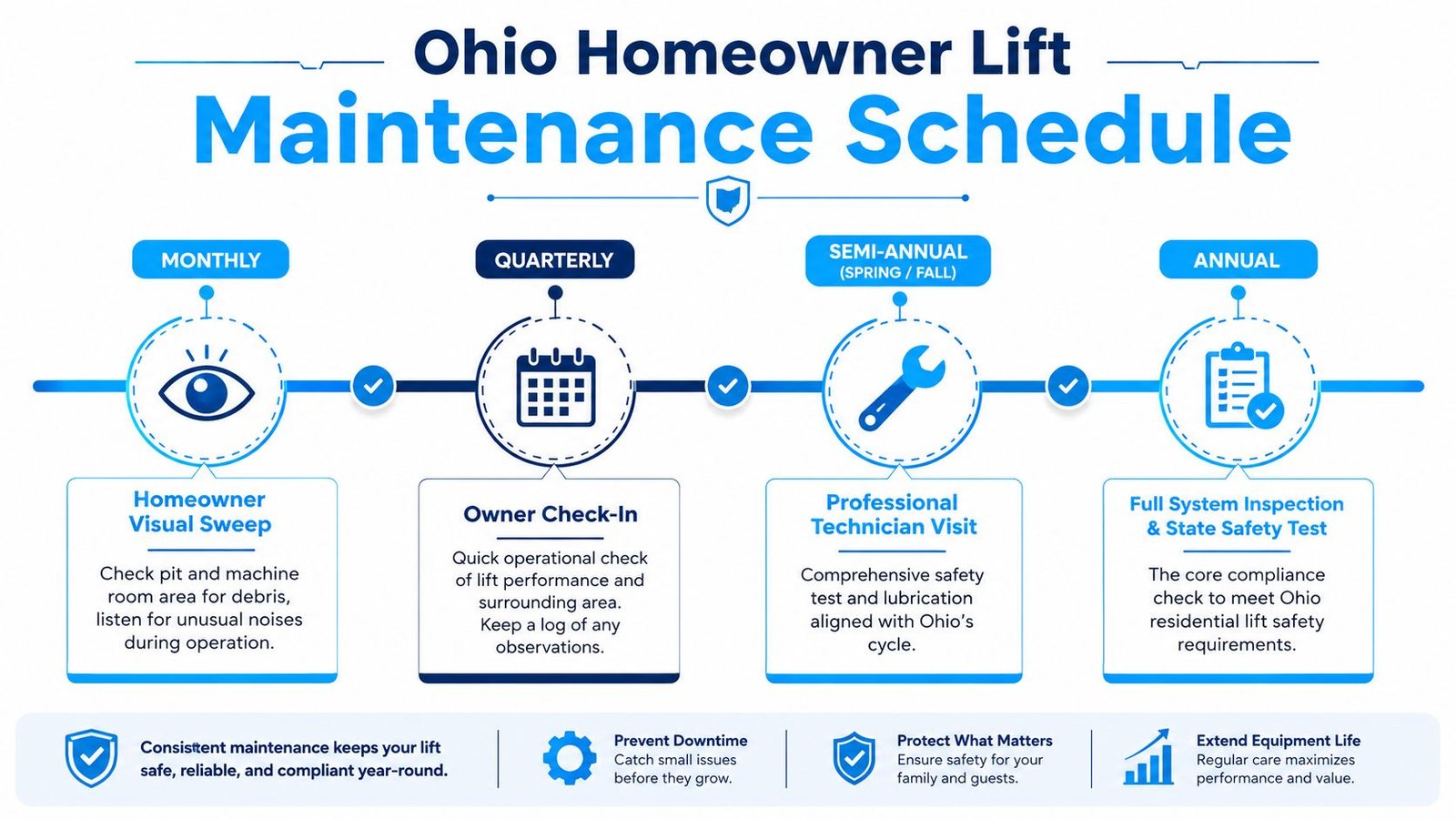
- Monthly homeowner sweep: Check for debris, moisture, oil, or stored items around the lift. Note grinding, rubbing, delayed starts, unusual vibration, or changed stopping accuracy. Test the phone or alarm button and confirm the cab light works.
- Quarterly observation: Watch door operation, landing consistency, and backup features during normal use. Do not remove covers or enter the hoistway.
- Spring and fall technician visits: Arrange preventive service, cleaning, lubrication, mechanical inspection, electrical checks, and ride-quality review. These visits can expose cable stretch, brake wear, belt glazing, controller-battery deterioration, and other component-specific wear before failure.
- Annual review: Check the equipment's service records, open repair items, manufacturer information, and any inspection or certificate duties that apply to the property. A private-residence lift may follow different obligations from a commercial conveyance, so copying another building's calendar can create gaps.
- Five-year safety testing: Reserve time for the required full-load test when the lift falls under that rule. Deferred service, contamination, or worn safety components can turn a small adjustment into a failed test and an outage.
Keep the calendar with prior reports and test history. A technician should be able to see what was serviced, what remains open, and which parts or settings need follow-up without searching through household paperwork.
For recurring Toledo service, compare preventive elevator maintenance in Toledo with the manufacturer's recommendations and the requirements applicable to the property.
What You Can Check Yourself and What Requires a Pro
Homeowners should be involved, but involvement doesn't mean opening the controller cabinet or adjusting a door lock. The safest division of responsibility is simple: observe the lift's behavior, keep its environment clean and dry, and report changes promptly. Leave safety circuits, mechanical adjustments, and hoistway work to a qualified elevator mechanic.
Safe homeowner checks
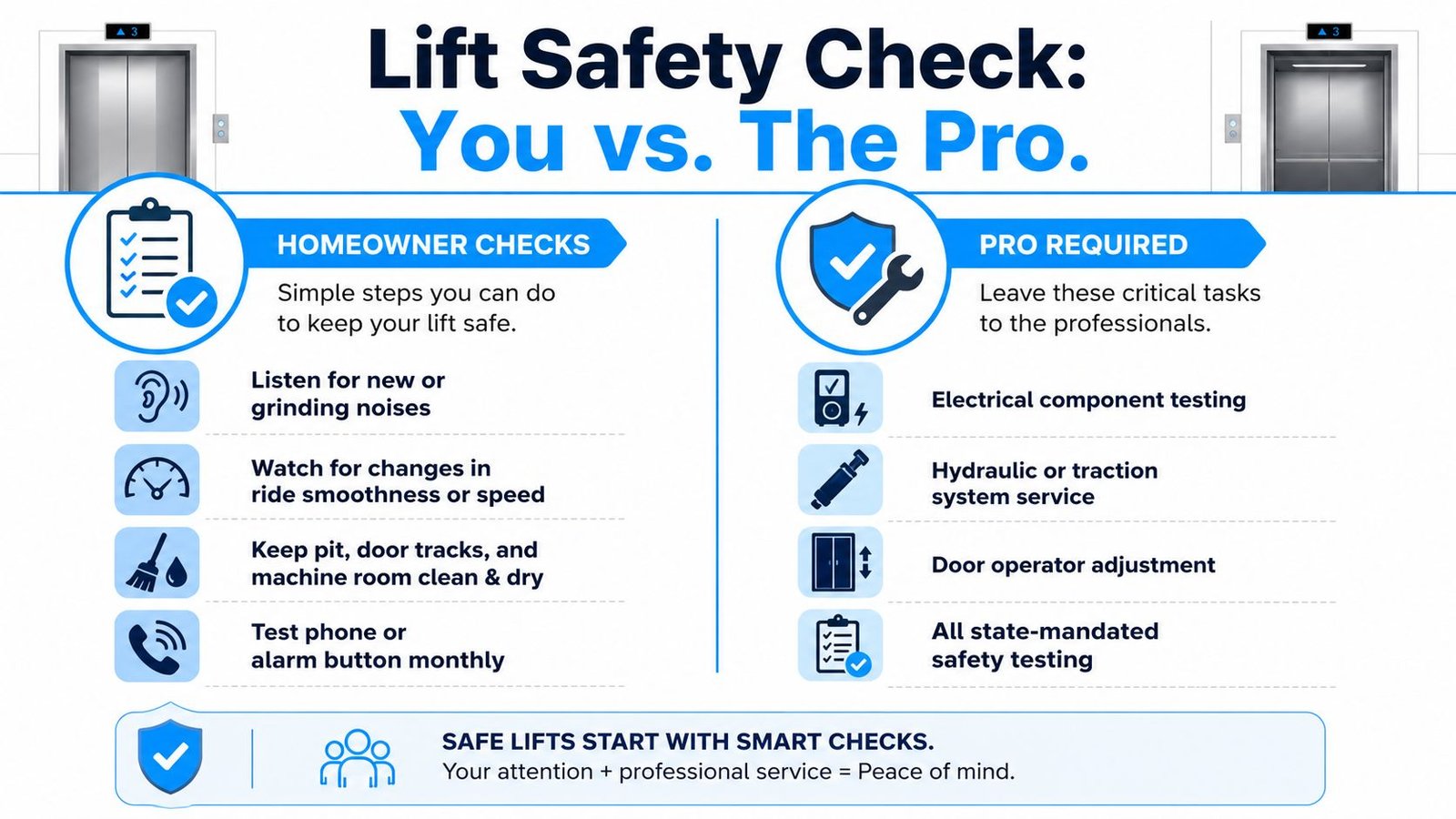
- Listen: Note new grinding, squealing, clicking, or rubbing sounds.
- Watch the ride: Pay attention to changes in speed, smoothness, leveling, or door timing.
- Keep areas clear: Remove household storage and visible debris from door tracks and accessible machine-room or pit areas, without entering restricted spaces.
- Test communication: Test the phone or alarm button monthly and confirm the cab light and ventilation operate.
The professional side includes electrical component testing, controller diagnostics, hydraulic or traction-system service, door-operator adjustment, governor and brake evaluation, buffer inspection, and all applicable state-mandated safety testing. Work inside the hoistway is not a homeowner task.
A misadjusted door lock can create a dangerous condition because the car must not run unless the required door and interlock conditions are satisfied. A tampered governor may fail to engage during an overspeed event. The fact that a lift is inside a private home doesn't make those systems less important.
The short video below reinforces the difference between routine observation and work that requires specialized training.
Choosing a Maintenance Provider in Ohio
The original installer isn't automatically the only company capable of maintaining a home lift. A non-proprietary service model gives the owner more choice, but the provider still needs the people, tools, documentation, and parts knowledge to support the specific unit.
Ask for evidence before signing. The provider should identify the mechanic's Ohio credentials, show appropriate insurance coverage, explain how entrapment calls are handled, and name the drive systems their technicians regularly service. References from residential customers in the same region are more useful than broad claims about commercial work.
A maintenance agreement also deserves close reading. The lowest bid may exclude scheduled visits, lubrication, testing, travel, or callback coverage, then bill each issue separately. A flat arrangement with defined inclusions can be easier to budget, particularly when the lift stops outside normal business hours.
| Evaluation Criteria | What Good Looks Like | Red Flag |
|---|---|---|
| State credentials | The company explains the mechanic's license or Certificate of Competency and identifies who performs testing. | The salesperson avoids credential questions or treats all lift work as ordinary handyman service. |
| Insurance | The provider supplies evidence of general liability and workers' compensation coverage. | Coverage is promised verbally but never documented. |
| Emergency response | The contract explains entrapment response, after-hours contact, and callback terms. | “Emergency service available” appears without a response process. |
| Equipment knowledge | The technician can discuss the installed controller, drive, doors, batteries, and available parts. | The proposal uses a generic equipment description. |
| Service records | Each visit produces findings, adjustments, open recommendations, and test documentation. | The owner receives only an invoice stating that the lift was serviced. |
| Contract scope | The agreement clearly states included visits, routine materials, callbacks, and exclusions. | The price is low because nearly every useful task is an extra charge. |
Crane Elevator Company is one option for owners comparing providers. Its published service offering includes residential maintenance, repair, code-required inspection support, and non-proprietary modernization across Michigan and Ohio, including Toledo and nearby communities. Homeowners can use this residential elevator company resource as one starting point for evaluating local options.
Repair vs Modernization and When to Upgrade
Modernization shouldn't be triggered by a sales calendar. It should follow the equipment's condition, repair history, parts availability, safety requirements, and the way the home now needs to use the lift.
Three warning patterns deserve a serious review. The first is a controller that predates applicable safety-code revisions or depends on obsolete components. The second is a drive system that has required repeated major service events in a short operating history. The third is a cab or operating arrangement that no longer supports the household's accessibility needs.
A repair makes sense when the underlying equipment remains supportable, the safety system can be maintained, and the problem is isolated. Modernization becomes more rational when repairs address one failing subsystem after another, replacement parts are difficult to obtain, or the existing controls cannot provide dependable diagnostics and safe operation.
| Trigger | Repair Makes Sense | Modernization Makes Sense |
|---|---|---|
| Controller condition | The board is serviceable, supported, and the fault is isolated. | The controller is obsolete, unreliable, or difficult to support. |
| Drive and motor | Wear is limited to a replaceable component such as a roller, belt, seal, or contact. | The drive has a pattern of major failures and the surrounding equipment is also aging. |
| Door system | A worn roller, track, or operator component can be corrected without repeated callbacks. | The operator, locks, controls, and fixtures require coordinated replacement. |
| Parts availability | The manufacturer or qualified suppliers can provide dependable replacement parts. | Critical parts are discontinued or delivery delays leave the home without reliable access. |
| Accessibility | The present cab, controls, lighting, and landing arrangement still work for the occupants. | The lift no longer matches the resident's mobility requirements or planned aging-in-place needs. |
| Code and permits | The repair doesn't alter regulated equipment in a way that triggers additional approval. | A controller or major system change requires permitting and post-work inspection in the local jurisdiction. |
A typical modernization may replace the controller, drive, door operator, fixtures, or related wiring while retaining usable structural and mechanical components. The exact scope depends on the inspection findings. Some Ohio jurisdictions require a permit and inspection after a controller replacement, so the contractor should identify that requirement before work begins.
A responsible provider should present both paths in writing, with projected repair scope, modernization scope, exclusions, and expected maintenance implications. The owner can then compare a targeted repair against a coordinated upgrade instead of approving work based on urgency alone.
Homeowner Questions About Residential Lift Maintenance Ohio
Does a home lift need a state certificate or only a local test?
The answer depends on the equipment's classification and the authority responsible for the property. Ohio law excludes elevators installed in a private residence from the specific twice-per-12-month inspection-frequency rule, but that doesn't settle every certificate, permit, inspection, or testing question for every installation.
Ask the Ohio Department of Commerce Elevator Section or the applicable local jurisdiction to confirm the requirement for the address and conveyance. Keep the written answer with the lift records. A contractor can help identify the equipment, but the owner shouldn't assume that a private residence is treated the same way as a shared residential building.
Who is liable if a guest is injured?
Responsibility can depend on the facts, including ownership, notice of the defect, maintenance history, installation condition, and applicable insurance terms. A homeowner shouldn't rely on a maintenance contract as a transfer of all responsibility. The owner still needs to report problems, restrict use when a defect creates a hazard, and follow the contractor's written recommendations.
An insurer or attorney should address a specific injury or claim. The service company's reports can help establish what was observed and corrected, but they don't decide legal liability.
How can I confirm a technician is qualified?
Request the technician's Ohio license or Certificate of Competency information and ask whether the person has worked on the lift's manufacturer and drive system. A qualified provider should be able to explain the controller, door equipment, safety devices, batteries, and required testing without guessing.
Verify the company's insurance and ask who performs state-related inspections or tests. The owner should also confirm that the provider is authorized and experienced for the actual equipment, not merely familiar with residential construction.
What records should I keep for insurance or resale?
Keep the installation documents, equipment model information, permits, inspection or test reports, maintenance agreements, service invoices, repair approvals, parts replaced, and written recommendations. Ohio requires an inspector to leave a full report on the day an inspection is completed, including the elevator's exact condition and every cited noncompliance item, as stated in Ohio Revised Code Section 4105.11.
That report should be stored with the rest of the lift file. Organized records show how the equipment has been maintained, help a future contractor diagnose faults, and give an insurer or buyer a clearer view of the installation's history.
Crane Elevator Company provides residential lift maintenance, repair, code-required inspection support, and non-proprietary modernization services throughout Michigan and Ohio, including Toledo and surrounding cities. Visit Crane Elevator Company to request service, a second opinion, or a written evaluation of your home lift.