At 6 a.m., a facility manager in Detroit can be standing in front of a stalled elevator with tenants arriving, deliveries waiting, and a service log that doesn't clearly show what happened during the last visit. The immediate problem may be a door fault, a hydraulic leak, a failed communication device, or an overdue inspection. The bigger problem is usually the maintenance system behind it.
Detroit elevator owners don't need a contractor who only appears after a shutdown. They need a company that understands recurring inspections, service records, permit coordination, emergency response, and the realities of older Michigan equipment. Detroit Elevator Maintenance Companies should be judged on that complete operating discipline, not on the lowest callback price.
Why Detroit Elevator Maintenance Is Its Own Market
A Detroit facility manager can face very different service demands from one property to the next. A mid-century office tower may still run aging controllers and door equipment. A multifamily building operates around the clock, while healthcare, municipal, education, industrial, and mixed-use properties bring their own traffic, access, and uptime requirements. Winter conditions, renovation schedules, heavy use, and restricted machine-room access can turn a small defect into an operational problem.
Detroit treats elevator work as an annual-credential business, not occasional repair. The city issues a Certificate of Registration each year for elevators, escalators, dumbwaiters, moving walks, platform lifts, and stairway chairlifts. Its code requires power elevators, escalators, and moving walks to be inspected and serviced at least every 30 days. Special permission can extend that interval to no more than 90 days for low-use equipment. Other covered equipment generally requires inspection and service at least quarterly, with exceptions for private-residence equipment. Detroit's elevator code also requires an occupied building with passenger elevators to keep at least one passenger elevator in each bank or group operating.
What that means on the ground
Owners should buy a maintenance program built around uptime, recurring testing, documentation, and city coordination. A technician who repairs a door operator but leaves the service log incomplete has not finished the job. Your contractor should also track certificate status, inspection dates, permit files, callbacks, and outstanding deficiencies.
Detroit states that elevator permits move through its permitting system, with issuance expected in about 10 days under the city's stated process. Detroit permit and inspection requirements belong in repair and modernization schedules from the start, not after construction begins.
Practical rule: If your contractor cannot identify who owns the inspection calendar, certificate status, permit file, and on-site records, you do not have a maintenance program. You have a series of service calls.
A provider serving Detroit, Lansing, Ann Arbor, and Grand Rapids must keep that discipline consistent across different local conditions. Michigan's market includes many small and midsized firms, according to IBISWorld's Michigan elevator industry profile. That can benefit owners who want direct technician accountability rather than a distant call center, especially when selecting a non-proprietary maintenance partner. Ask who will perform the work, how parts are sourced, and how compliance records follow the equipment between visits.
The Codes That Govern Michigan Elevators
Detroit owners normally work across three connected layers: the Michigan Elevator Code, statewide enforcement requirements, and the applicable ASME standards. These layers aren't interchangeable. One controls how equipment is designed, another governs inspection and administration, and another helps determine whether existing equipment can remain in service.
The Michigan Administrative Code establishes the state's elevator requirements and enforcement framework. Michigan licensing guidance also distinguishes routine inspections from preventive maintenance performed by elevator contractors. That distinction matters because an owner can have a contractor visiting regularly and still have a separate inspection obligation.
New equipment and existing equipment
ASME A17.1, also identified with CSA B44, is commonly used as the safety standard for new elevator installations and significant equipment work. It addresses the design and construction relationship among the cab, hoistway, machinery, controls, doors, and safety systems.
ASME A17.3 applies to existing elevators. A useful working analogy is simple: A17.1 is the rulebook for building or altering the elevator, while A17.3 helps determine whether older equipment can continue operating safely and what upgrades may be required. The standards don't turn every old elevator into a new one, but they do give inspectors and contractors a framework for identifying hazardous conditions and modernization needs.
A maintenance contract should identify the applicable code editions and state how the contractor will handle alterations, testing, violations, and records. Owners should also review Detroit elevator code requirements before approving work, especially when a repair could become an alteration under the governing rules.
| Code / Standard | Who Enforces | What It Covers |
|---|---|---|
| Michigan Administrative Code R 408 series | Michigan agencies and authorized inspectors | State elevator construction, maintenance, inspection, testing, licensing, and enforcement requirements |
| ASME A17.1 / CSA B44 | Adopted through applicable state and local code processes | New installations, alterations, safety devices, equipment arrangement, and construction requirements |
| ASME A17.3 | Applied to existing equipment during evaluation and modernization planning | Continued service, retrofit expectations, and safety conditions for older elevators |
| Detroit elevator ordinances | Detroit Buildings, Safety Engineering and Environmental Department and its Elevator Inspection Team | Local certificates, permits, inspections, complaints, accident reporting, and operating requirements |
Match the code to the event
For a new installation, the design and acceptance process is the central concern. For an alteration, the contractor must define what equipment is changing and which requirements attach to that change. During periodic inspection, the focus shifts to safe operation, test performance, maintenance records, and correction of observed violations.
A Detroit service agreement that says only “routine maintenance” is too vague. It should identify the inspection responsibilities, testing support, documentation, response expectations, and procedure for separating ordinary maintenance from code-triggered modernization.
Key Technical Requirements Every Owner Should Know
A good technician doesn't inspect an elevator as a collection of unrelated parts. They look for the failure each requirement is designed to prevent. That approach is especially important in older Detroit homes, apartment buildings, and commercial properties where a system may have worked for years without meeting current expectations.
The spaces around the car
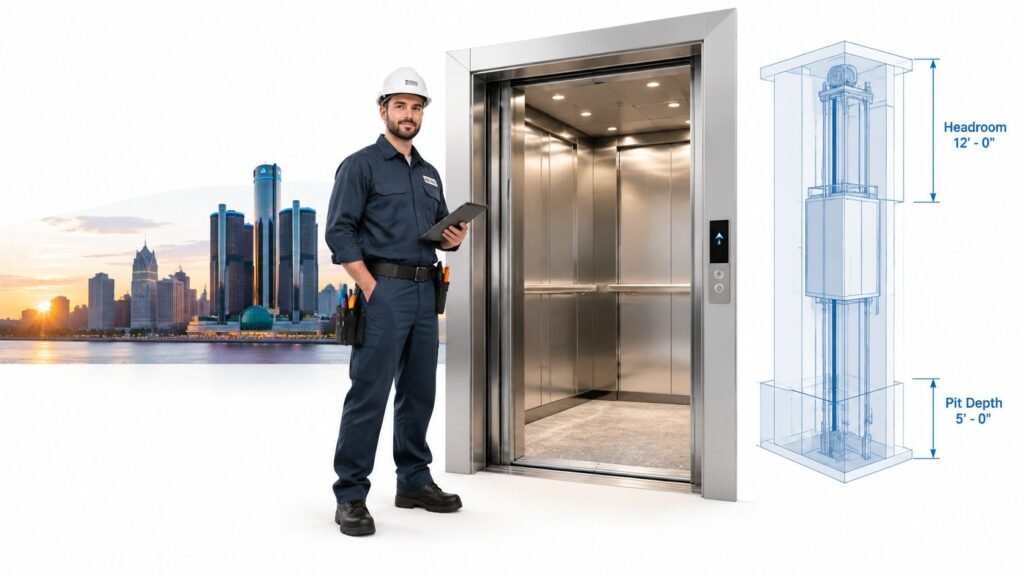
The pit must provide enough protected working space for a technician to perform tasks without being exposed to a moving car or counterweight. Pit depth, refuge space, access, lighting, drainage, and housekeeping all affect whether the technician can work safely. Older residential installations often deserve a careful evaluation here because limited pit space can create both safety and service problems.
Overhead clearance serves the same basic purpose above the elevator. A technician needs protected space at the top of the hoistway when the car moves or when equipment is serviced. A contractor should document obstructions, access conditions, and any conflict between existing construction and the required safe working envelope.
Doors, communications, and fire service
Door interlocks prevent a hoistway door from opening when the elevator car isn't properly positioned at that landing. A worn lock, misadjusted gate switch, or bypassed safety circuit can expose passengers to an open shaft. Door equipment deserves more than cleaning and lubrication. It needs functional testing and a clear record of defects and corrections.
Emergency two-way communication must connect trapped passengers with a staffed response path. A phone that rings into an empty office isn't an effective emergency communication system. Test the device from inside the car, confirm that the receiving party answers, and document the result.
For commercial and many multifamily properties, Fire Service Phase I and Phase II functions must be checked as part of the building's emergency plan. The elevator should respond correctly to fire recall inputs, and authorized firefighters should be able to operate the car using the required controls.
The minimum service conversation
Owners should ask whether the contract addresses:
- Load and speed controls: Equipment must operate within its rated capacity and intended performance limits.
- Buffers and clearances: The technician should examine the protective space below and around the car and counterweight.
- Safety tests: Michigan requires safety tests for elevator car and counterweight safeties and governors at intervals of no more than 12 months, with qualified personnel performing the tests in the presence of an authorized inspector when one is available. Michigan's safety testing rule provides the governing reference.
- Maintenance records: The contract should explain how callbacks, repairs, replacements, and testing are recorded on site.
- Housekeeping: Machine rooms, pits, and car tops should be kept clear enough for safe inspection and service.
Cosmetic cleaning has value, but it isn't a maintenance program. The key question is whether the contractor tests the systems that protect passengers and technicians.
How Detroit and Michigan Rules Diverge
Michigan sets the statewide technical framework. Detroit adds a local administrative process that owners must manage separately. A building can meet state expectations and still face a Detroit permit, certificate, inspection, or documentation problem.
The practical difference is who routes the work, who witnesses it, and what paperwork remains open. State requirements cover licensing and technical standards. Detroit's Buildings, Safety Engineering and Environmental Department handles local permits, certificates, inspections, complaints, and enforcement touchpoints.
| Requirement Area | Michigan State, LARA / BCC | Detroit, BSEED |
|---|---|---|
| Contractor authority | State licensing and elevator-code requirements | Local registration and coordination with Detroit's elevator process |
| New installation | State code, plan review, inspection, and acceptance requirements | Detroit permit routing, local review, and city approval workflow |
| Modernization | State technical standards and inspection requirements | Local permit documentation, inspection coordination, and certificate impact |
| Operating status | State inspection and certificate framework | Annual local certificate and city operating requirements |
| Maintenance evidence | Written records and required service intervals | Records that support Detroit inspection, enforcement, and certificate status |
| Problems or accidents | State enforcement channels may apply | Detroit's Elevator Inspection Team handles complaints and accident reporting |
| Occupied buildings | Applicable state safety and operating requirements | At least one passenger elevator in each bank or group must operate while occupied, subject to the city code |
Detroit requires a Certificate of Registration on an annual basis for covered conveyances and maintains recurring inspection and service obligations for different equipment types. Those local requirements create more frequent contact with city processes than an owner may expect from a state-only compliance plan.
Budget for procedure, not just parts
New installations and modernizations can require local plan review, witnessed acceptance testing, permit closeout, and updated operating documentation. Fire service controls, machine room access, hoistway conditions, signage, and venting may also receive close attention during Detroit review.
A statewide estimate is not enough for a Detroit project. Before approving a major shutdown, require the contractor to identify the state approvals, Detroit routing, inspections, witnesses, and certificate steps that apply to the specific equipment and building. Put those responsibilities in writing, including who schedules each inspection and who closes unresolved paperwork.
Code compliance is an operating discipline, not a one-time inspection. A provider serving Detroit alongside Lansing, Ann Arbor, and Grand Rapids should understand that the service plan must account for Detroit's local administrative requirements every time work, testing, or documentation changes. That is the standard owners should expect from a non-proprietary maintenance partner.
What a Michigan-Wide Service Provider Actually Covers
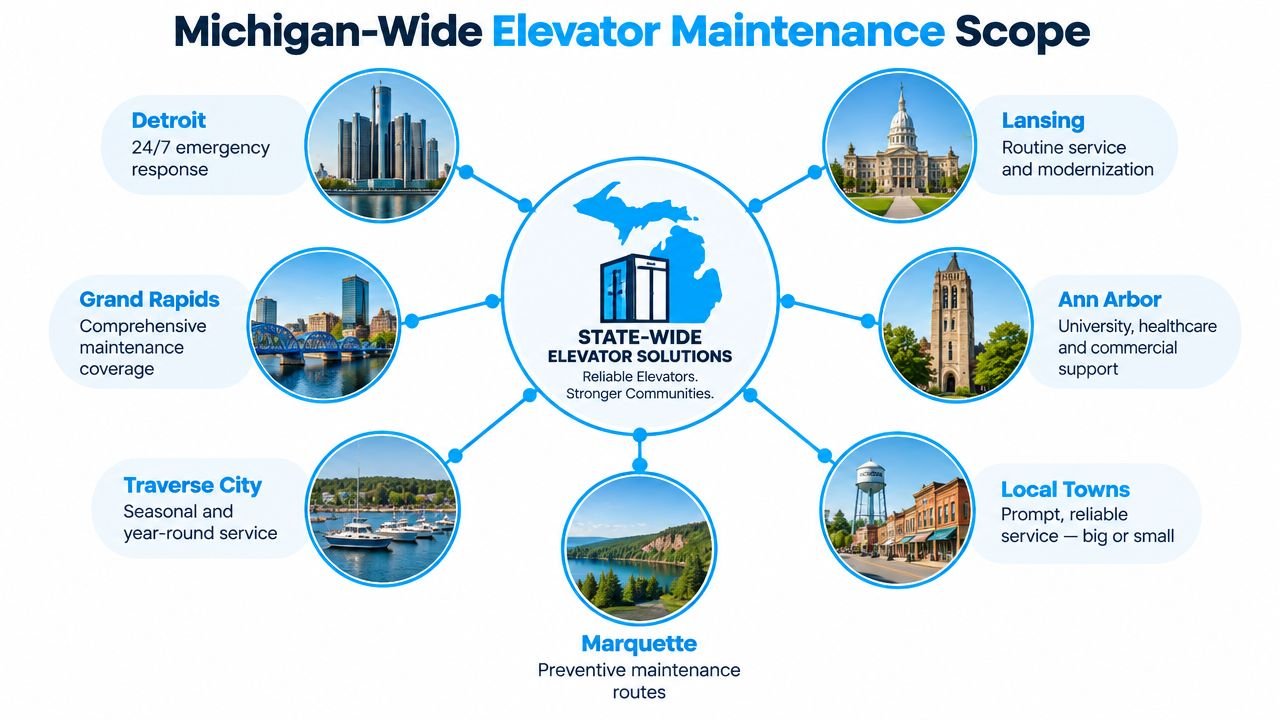
A regional provider should deliver the same disciplined process in Detroit, Lansing, Ann Arbor, Grand Rapids, Traverse City, Marquette, and smaller Michigan communities. Geographic reach matters only if it produces consistent technician ownership, parts planning, and records across every property.
Crane Elevator Company serves Detroit, Lansing, Ann Arbor, Grand Rapids, and surrounding areas, with coverage extending to communities such as Traverse City, Marquette, Flint, Kalamazoo, and other Michigan towns. The company provides preventive maintenance, repairs, code-required inspections, testing, emergency response, and non-proprietary modernization for all makes and models of vertical transportation.
What belongs in the service scope
A non-proprietary maintenance agreement should spell out the work, not hide it behind “as needed” language.
- Scheduled preventive maintenance: Inspect controls, doors, safety circuits, hydraulic equipment, traction machinery, and communication systems according to the equipment and applicable requirements.
- Testing support: Coordinate required safety tests, fire service testing, emergency phone checks, and inspection preparation.
- Records and callbacks: Document service visits, deficiencies, repairs, replacements, callbacks, and test results on site.
- Parts strategy: Explain which common door, controller, hydraulic, and communication parts are stocked locally and which require ordering.
- Housekeeping: Clean machine rooms, pits, car tops, and controller areas so technicians can identify leaks, debris, heat, and access problems.
- Repair or modernization advice: Separate a repair that restores service from a modernization that addresses obsolete or repeatedly failing equipment.
- Emergency response: Provide a clear process for entrapments, shutdowns, fire service failures, and after-hours calls.
A small-town detour shows why route planning matters. A property in Marquette may need preventive maintenance scheduled around regional travel, while a Detroit high-rise may need immediate response for a passenger entrapment. The provider's dispatch system should account for both without abandoning the rural property or treating the urban one as just another ticket.
For a multi-site owner, require one accountable contact, consistent reporting, and equipment histories that travel with the property rather than with one technician's memory.
Inspections, Permits, and the Annual Compliance Cycle
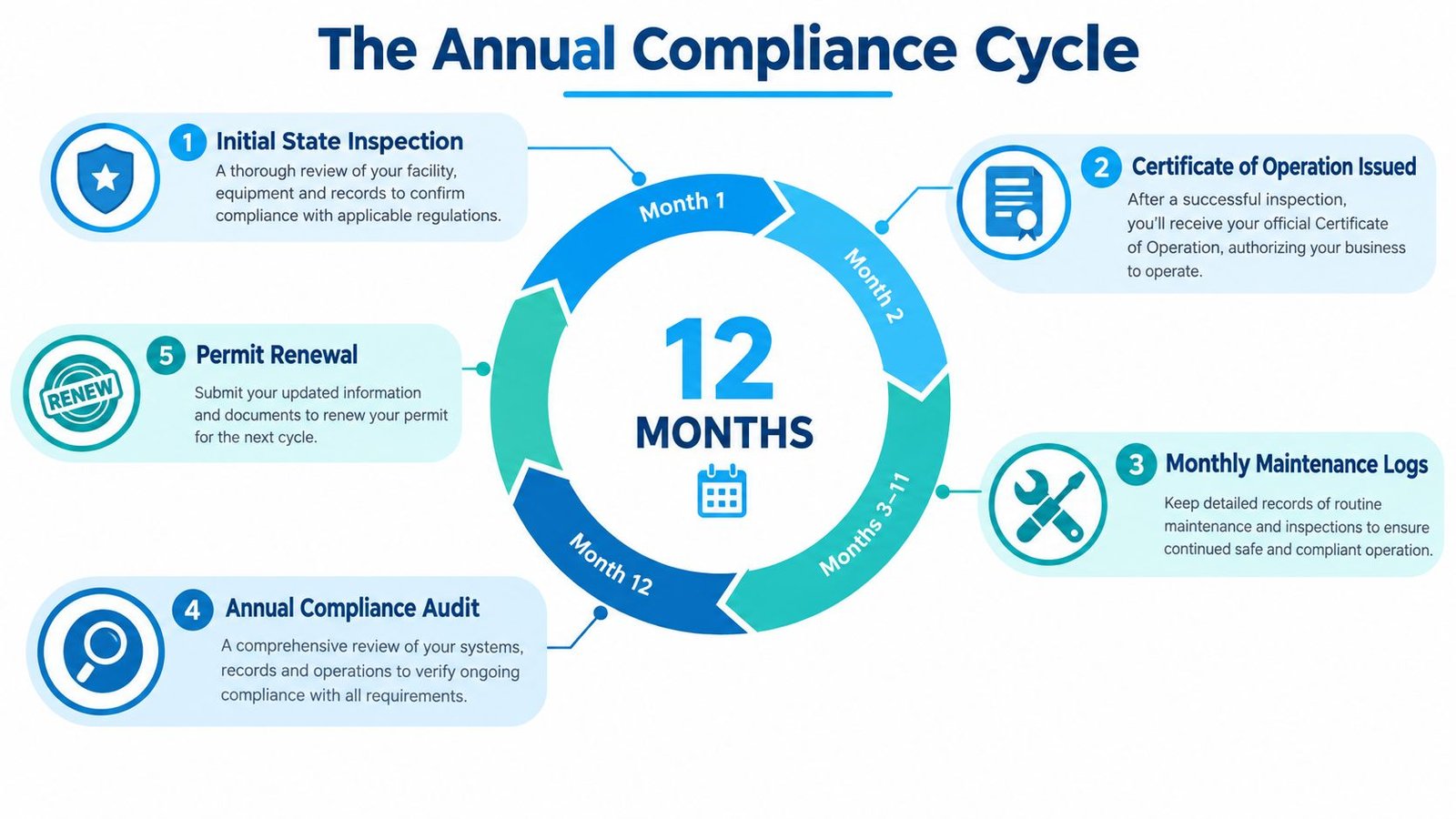
Detroit elevator compliance is a recurring operating discipline, not a once-a-year inspection appointment. The owner, maintenance contractor, inspector, and permitting authority need assigned responsibilities, documented handoffs, and a schedule that stays active between inspections.
Michigan requires power elevators, excluding private-residence devices, to receive maintenance at least every 90 days from a licensed elevator journeyperson. Dumbwaiters and several smaller lift types have a minimum interval of at least 180 days. Written records of maintenance, repairs, replacements, callbacks, and testing must remain in the machine room or on site. Add the Michigan maintenance record and interval requirements to the building's compliance file and verify that the contractor's reporting matches them.
Assign each responsibility
The maintenance contractor performs scheduled service, records findings, and prepares equipment for inspection. An authorized inspector conducts the required inspection or witnesses testing where applicable. Detroit's Elevator Inspection Team handles city licensing, inspections, complaint investigations, and accident reporting. The owner controls access, keeps records available, authorizes corrections, displays the certificate, and keeps the property ready for inspection.
Detroit also sets local expectations for recurring service. Power elevators, escalators, and moving walks follow a 30-day inspection and service expectation, with a possible extension to no more than 90 days for low-use equipment by special permission. Other covered devices generally require quarterly attention, subject to listed exceptions. Reconcile the city schedule with Michigan's equipment-specific maintenance requirements before signing off on a service calendar. Owners can review Detroit elevator services when comparing a local maintenance plan, response coverage, and reporting approach.
Keep one calendar for the entire compliance cycle:
- Certificate review: Confirm the current certificate and record its expiration or renewal requirement.
- Maintenance documentation: Verify that every visit, callback, repair, replacement, and test appears in the on-site record.
- Inspection preparation: Correct known deficiencies before the inspector arrives. Arrange access to pits, machine rooms, rooftops, and control spaces.
- Testing coordination: Identify who provides qualified personnel, who witnesses testing, and who receives the report.
- Permit tracking: Connect each modernization or qualifying alteration to its permit, inspection, closeout, and effect on operating status.
The city states that permit issuance is expected in about 10 days through its permitting system. Build in additional time for plan review, contractor scheduling, corrections, and inspection availability. A provider serving Detroit, Lansing, Ann Arbor, and Grand Rapids should explain how its route coverage, records, and escalation process support this repeating cycle. The owner still remains responsible for the certificate and records.
A short visual overview helps staff see how maintenance, inspection, permits, and documentation fit together.
Modernization Decisions and the Path to Stay Compliant
Modernization is not a decision between an expensive proposal and a cheaper repair. It is a choice between continuing to manage an aging system and replacing the parts of that system that create repeated operational, safety, or compliance exposure.
Three triggers usually justify a serious modernization study. The first is an existing-equipment deficiency that can't be corrected reliably through adjustment or replacement of an isolated component. The second is controller or drive obsolescence, especially when parts are difficult to source and the same shutdown pattern keeps returning. The third is a building-use change, such as higher tenant expectations, accessibility needs, or a mixed-use conversion that places more demand on the elevator.
Compare the operating paths
| Factor | Repair-First | Modernization-First |
|---|---|---|
| Immediate objective | Restore service or correct a defined defect | Replace obsolete or unsafe systems as a coordinated project |
| Best fit | Isolated failure with healthy surrounding equipment | Repeated failures, obsolete controls, or broad code deficiencies |
| Downtime profile | Shorter individual outage, but recurring interruptions may continue | Longer planned outage, followed by a new commissioning process |
| Cost evaluation | Lower initial commitment, but repeated repairs must be tracked | Larger capital commitment, evaluated against expected service life and risk |
| Compliance exposure | May leave unrelated deficiencies unresolved | Can address multiple connected systems in one project |
| Decision evidence | Repair history, parts availability, inspection findings | A17.3 evaluation, equipment condition, building use, project scope, financing |
Owners should ask for a written distinction between repair, alteration, and modernization. They should also ask which work will affect the controller, door operator, machine, hydraulic power unit, safety systems, emergency communication, fire service, and fixtures.
Destination dispatch and machine-room-less configurations can make sense in selected mid-rise residential or mixed-use projects, but they aren't automatic upgrades. The right choice depends on shaft geometry, traffic patterns, available machine space, accessibility, fire service design, local review, and the equipment selected by the project team.
Model the money honestly
A modernization proposal should show more than a lump-sum price. Compare the expected years of useful service, planned downtime, parts availability, recurring callback exposure, energy and operating considerations, financing terms, and the cost of keeping the building partially served during the work.
Owners may evaluate modernization loans, commercial refinancing, or SBA programs where eligible. The payback model should use the property's actual repair history and business impact. Don't approve a modernization because the sales presentation sounds advanced, and don't reject one because the first repair quote is smaller. Choose the path that gives the building a defensible operating plan.
Your Detroit Elevator Compliance Checklist and Next Steps
A Detroit elevator should have a compliance file that a new facility manager can understand without calling the previous contractor. Organize the work into four blocks, then assign one person to close each block.
Document readiness
- Certificate status: Confirm the current operating and registration documents, renewal requirements, and display obligations.
- Maintenance logs: Verify that service visits, repairs, replacements, callbacks, and testing are recorded on site.
- Existing-equipment review: Keep the applicable A17.3 evaluation, inspection findings, violation notices, and correction history together.
- Permit file: Match modernization or alteration work to permits, inspection reports, approvals, and closeout documents.
Next step: Within a week, scan the current file and create one shared folder with a clear equipment history.
Physical readiness
Inspect the pit, hoistway, machine room, car top, doors, emergency communication, fire service, buffers, clearances, and access points. Remove stored materials that block service areas and correct conditions that could delay an inspection or place technicians at risk.
Next step: Walk the equipment with your maintenance provider and request a written deficiency list, not a verbal overview.
Administrative readiness
- Calendar ownership: Assign responsibility for inspections, maintenance visits, permit milestones, and certificate renewals.
- Access planning: Give technicians and inspectors reliable access to locked rooms, roofs, pits, and control spaces.
- Occupancy planning: Coordinate shutdowns so residents, staff, patients, students, or tenants receive accurate notice.
- Correction authority: Decide who can approve repairs when an inspector identifies a safety or operating issue.
Next step: Put every known deadline and responsible person on the facility calendar.
Service-partner readiness
A maintenance company should explain its callback process, emergency entrapment response, parts strategy, technician qualifications, testing support, record format, and procedure for recommending modernization. Ask whether the agreement is non-proprietary, whether all makes and models are supported, and what the contractor will do when a part is obsolete.
Crane Elevator Company is one regional option for owners seeking preventive maintenance, repairs, code-required inspections, testing, emergency response, and non-proprietary modernization across Detroit and Michigan communities. Review the company's Detroit elevator company services before requesting a proposal, then compare the scope against your actual equipment and compliance obligations.
Next step: Request a written service scope and ask the bidder to identify exactly who owns the inspection calendar, records, permit coordination, emergency calls, and violation corrections.
A Detroit elevator maintenance contract is a long-term operating decision, not a simple price comparison. Choose the provider that can keep the equipment documented, test-ready, accessible, and supported after the first repair is complete.
Crane Elevator Company provides preventive maintenance, repairs, code-required inspections, testing, emergency response, and non-proprietary modernization for elevators, lifts, dumbwaiters, and related vertical transportation equipment across Detroit, Lansing, Ann Arbor, Grand Rapids, and surrounding Michigan communities. Visit Crane Elevator Company to request a practical service review and build a maintenance plan around your equipment, building use, and compliance calendar.