
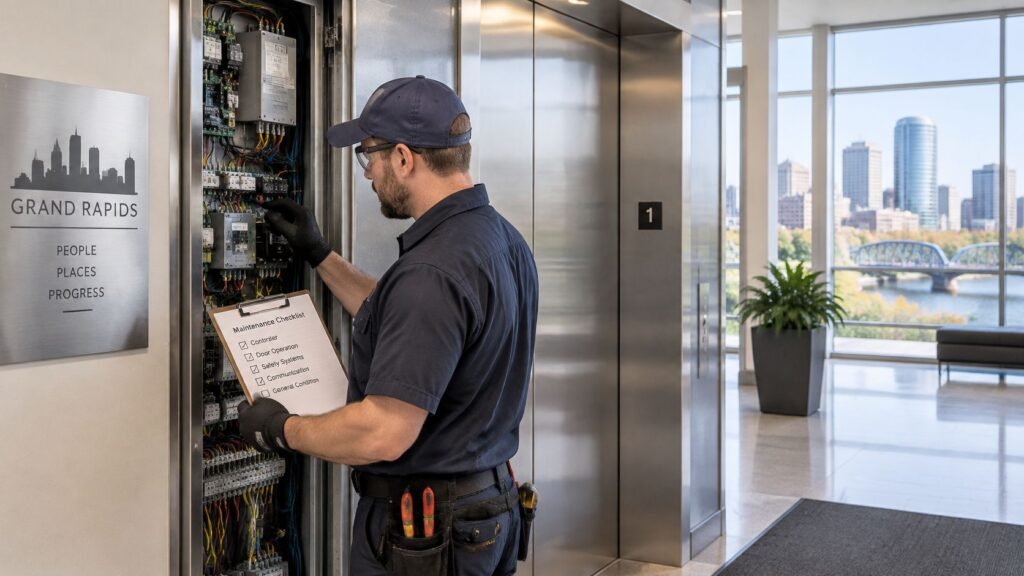
Your elevator has a current inspection certificate, but the doors are starting to hesitate and nobody can find the last safety-test report. The maintenance invoice says service completed. It doesn’t say which equipment the technician checked, what needed adjustment, or whether an unresolved fault needs another visit.
That’s the practical problem with Grand Rapids elevator maintenance: a certificate, a service contract, and a reliable elevator aren’t the same thing. Building owners need an equipment-specific schedule, qualified technicians, and records that explain what happened between inspections.
Grand Rapids Elevator Maintenance Intervals at a Glance
Say a property manager discovers that her building’s dumbwaiter and passenger elevators have followed different service schedules for years. Before she combines the contracts, she needs to establish whether those differences reflect the equipment classifications or missed work.
Michigan’s maintenance rule, R 408.7025, sets maintenance at least every 90 days for most commercial power elevators and generally every 180 days for dumbwaiters, one-person elevators, platform lifts, and stairway chairlifts, with commercial maintenance performed by a Michigan-licensed elevator journeyperson.
Michigan maintenance and inspection intervals by equipment type
| Equipment | Maintenance interval | State inspection interval | Who must do the work |
|---|---|---|---|
| Commercial passenger, freight, traction and hydraulic elevators | At least every 90 days | Generally annual, confirm device classification | Michigan-licensed elevator journeyperson |
| Commercial wheelchair lifts | Generally every 180 days when classified as platform lifts; confirm classification | Generally annual for commercial wheelchair lifts | Michigan-licensed elevator journeyperson |
| Dumbwaiters and one-person elevators | Every 180 days | Generally biennial; confirm current classification | Michigan-licensed elevator journeyperson |
| Platform lifts | Every 180 days | Generally biennial for most units; commercial wheelchair-lift classification needs confirmation | Michigan-licensed elevator journeyperson |
| Stairway chairlifts | Every 180 days | Generally biennial | Michigan-licensed elevator journeyperson |
| Car and counterweight safeties and governors on covered units | Separate safety-testing requirement | Testing is distinct from the state inspection | Qualified testing personnel, generally with a department inspector present |
| Private-residence devices | Separate residential requirements; confirm with the Elevator Section | Confirm with the Elevator Section | Separate rules; confirm with the Elevator Section |
Treat the inspection column as a classification check, not permission to apply a generic schedule to every lift. Equipment names used in purchasing records don’t always describe the regulatory classification precisely.
Keep the visit record with the equipment
The maintenance rule also requires an ongoing written record of maintenance, repairs, replacements, callbacks, inspections, and testing. Keep it in the machine room, or on-site when there’s no machine room.
A useful entry identifies the unit, technician, tasks completed, observed conditions, corrective work, and anything left open. “Checked elevator” doesn’t help the next technician distinguish a recurring door fault from an unrelated callback.
Run these checks today:
- Identify the equipment: Find each unit’s classification and identification details on its permit.
- Find the evidence: Locate its latest state inspection report and safety-test documentation, rather than relying on the invoice date.
A minimum service interval is a compliance baseline. Heavy use, equipment condition, and manufacturer instructions may justify more frequent attention.
What Elevator Maintenance Covers, Service by Service
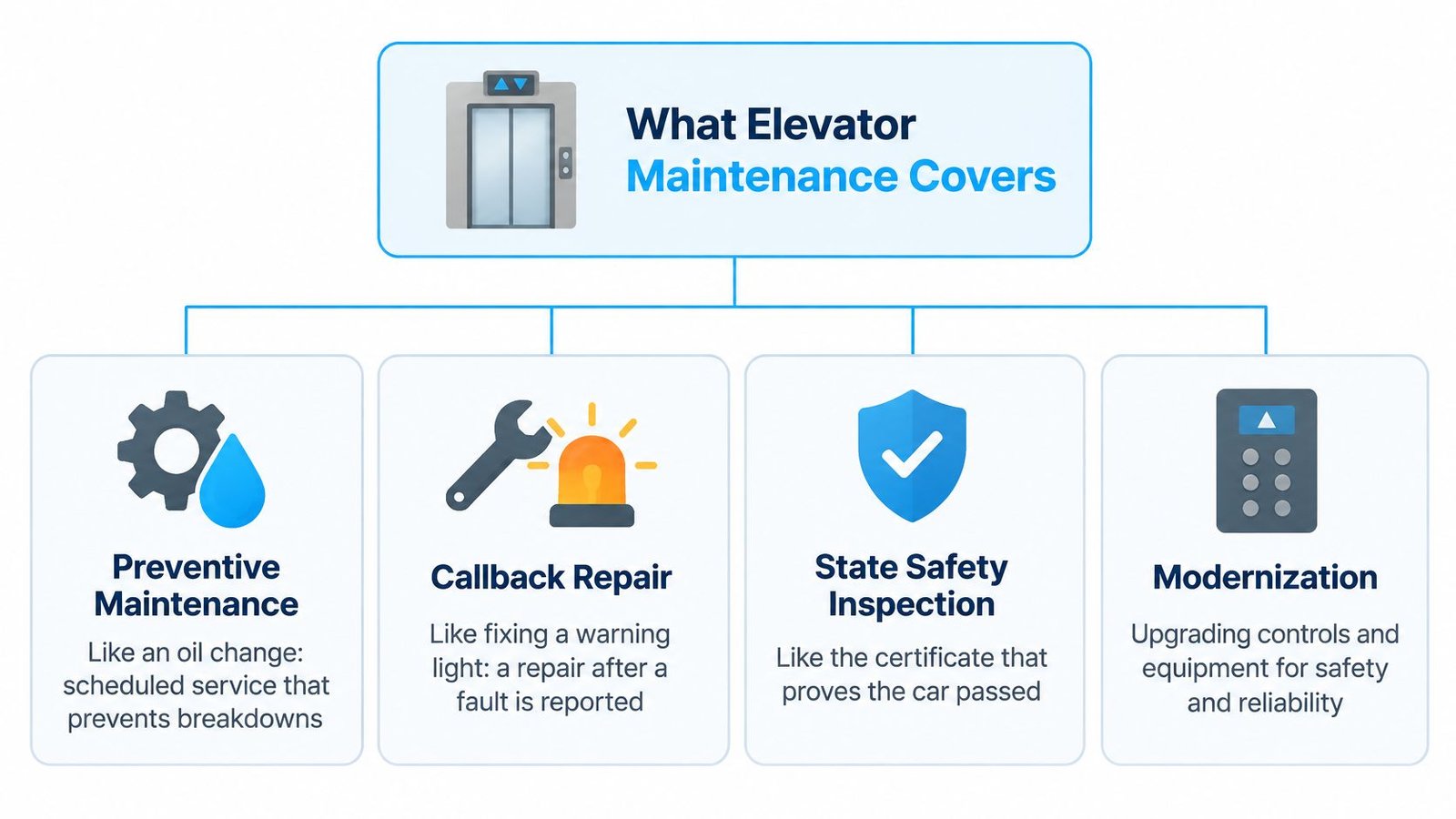
An oil change is preventive maintenance. Fixing a warning light is a repair, a vehicle inspection checks compliance at that visit, and replacing the engine is a major upgrade. Elevator work has similar distinctions, and putting everything under “maintenance” makes contracts difficult to compare.
Use the service categories to separate recurring work from testing and capital projects.
Elevator service categories compared
| Service | What it includes | When you need it | How often |
|---|---|---|---|
| Preventive maintenance | Lubrication, adjustments, door and brake checks, equipment-space cleaning, and agreed fixture-lamp replacement | Throughout operation | Scheduled by equipment classification and condition |
| Repairs and callbacks | Door faults, hydraulic packing leaks, jack, cable, motor, sheave, and controller repairs | Breakdowns, entrapments, or diagnosed defects | When a fault requires correction |
| Safety testing | Applicable car and counterweight safety tests, governor tests, and load tests | Prescribed safety verification | Follow the applicable test requirement |
| State inspection | Examination against applicable code and review of required documentation | Regulatory inspection | According to device classification |
| Door lock monitoring upgrade | Monitoring door contacts and locks to detect unsafe circuit conditions | When required for the unit or included in an approved upgrade | A compliance project, followed by equipment-specific maintenance |
| Modernization | Controller, door equipment, cab interior, fixtures, and drive upgrades | Obsolete components, persistent reliability problems, or required alterations | Planned capital project |
Safety testing isn’t an ordinary service visit
Michigan’s safety-testing rule, R 408.7102, requires covered car and counterweight safeties and governors to be inspected and tested at intervals of no more than 12 months. The owner or authorized agent arranges qualified personnel, generally with a department inspector present; the testing firm certifies the results and attaches the dated governor-rope identification tag.
Those tests verify emergency stopping and overspeed protection under prescribed conditions. Lubricating a component or clearing a controller fault doesn’t establish that the safety system passed.
Plan equipment downtime, occupant notices, and any applicable test-load arrangements before the testing crew arrives. Confirm which tests apply to the specific equipment rather than assuming every load test follows the same schedule.
Contract distinction: A state inspection, a witnessed safety test, and a preventive-maintenance visit are separate deliverables. Require the agreement to identify each one.
For door lock monitoring, get a written applicability determination and the current controlling requirement before approving a compliance project. Don’t accept a deadline without the code provision that applies to your unit.
Classify a problem by its purpose: preserving condition is maintenance, correcting a defect is repair, verifying safety performance is testing, and replacing a system is modernization. Only qualified personnel should enter pits, shafts, or car tops and establish the necessary energy-control procedures.
Michigan Rules Behind Your Maintenance Program
Michigan elevator compliance involves several authorities, but owners don’t need to become code specialists to manage the work. They need to know which authority controls the decision and who must act on it.
The historical record shows why that matters. A Michigan Office of the Auditor General review found that, as of August 12, 2009, 6,817 devices requiring annual inspection, or 29% of that group, were not current. That finding describes a historical statewide backlog, not today’s Grand Rapids inspection status.
Separate administration, rules, and technical standards
- State administration: Michigan’s Elevator Section administers the elevator code, handles inspections, investigates accidents and violations, and verifies permits. Keep state correspondence attached to the correct equipment record.
- Michigan administrative rules: These establish operational duties, including maintenance, testing, and recordkeeping. Your service agreement should identify how the contractor will complete and document the applicable work.
- Technical standards: ASME A17.1 provides the broader framework for elevator design, installation, operation, inspection, testing, maintenance, alteration, and repair. Existing-equipment provisions and Michigan amendments also need review before deciding what an older unit requires.
The equipment’s age alone doesn’t tell you which alteration or upgrade provisions apply. Installation history, subsequent modifications, and the applicable adopted code all matter.
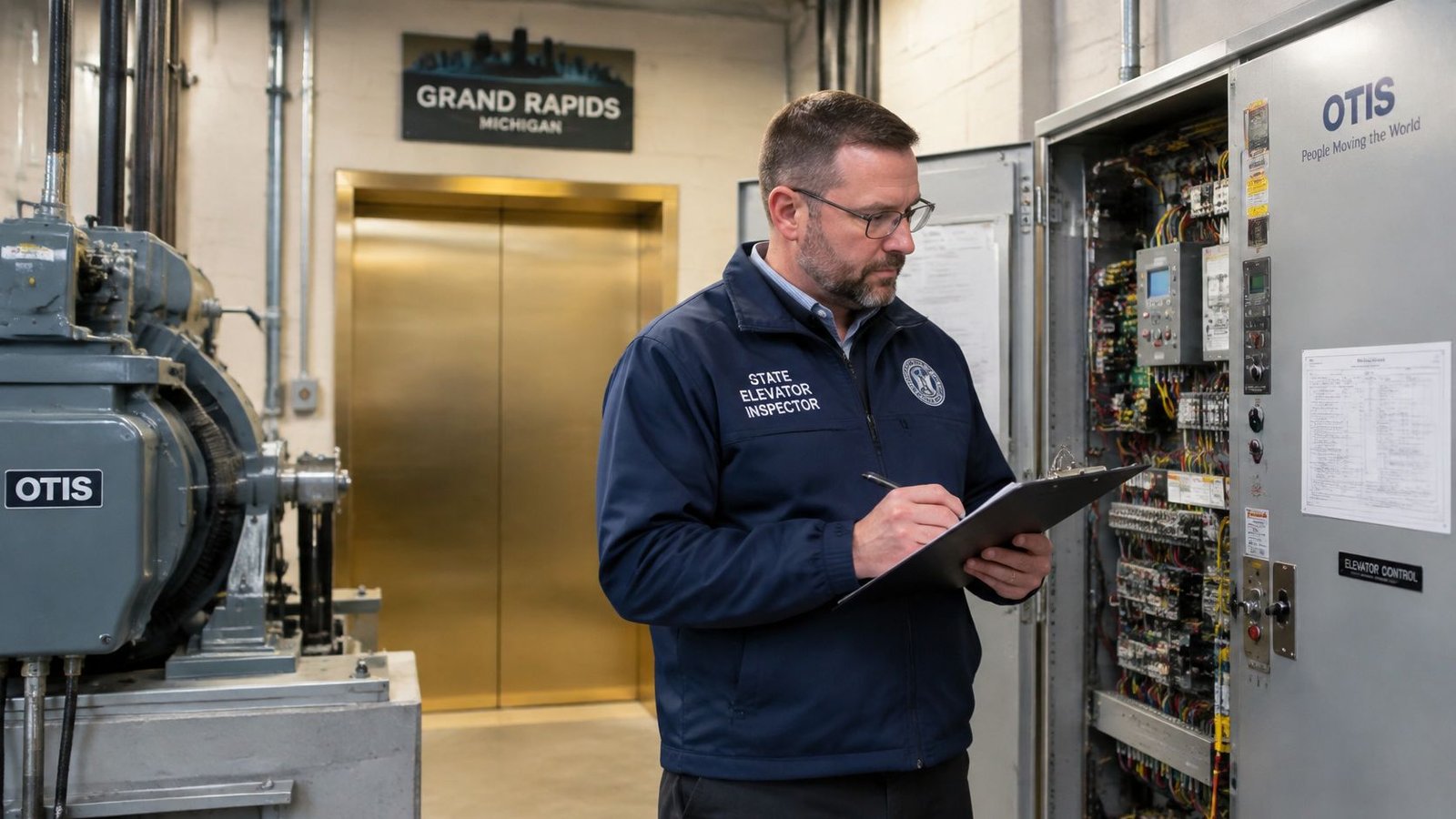
An inspector’s work includes evaluating equipment and its controls.
Give each responsibility a named owner
The certificate holder or authorized agent should arrange required testing, maintain access to records, and follow outstanding corrective work through completion. Assign that responsibility to a named person, not just “facilities.”
The contractor performs the agreed work and documents findings. The state evaluates compliance through its regulatory processes; it doesn’t manage your contractor’s visit calendar.
| Responsible party | Practical duty |
|---|---|
| Owner or authorized agent | Authorize work, track deadlines, retain records, and arrange qualified testing |
| Maintenance contractor | Perform equipment-specific tasks and document defects and corrections |
| State authority | Inspect, review compliance, and administer enforcement |
Overdue work or unresolved defects can result in corrective requirements and additional scrutiny. After an incident, incomplete records can also complicate an insurance review, so don’t assume a paid invoice proves the required task occurred.
Use our elevator code requirements guide to organize questions before reviewing a proposal. For a compliance decision, confirm the unit’s permit classification and check the current controlling rules with the Elevator Section.
Building a Year-Round Maintenance Calendar
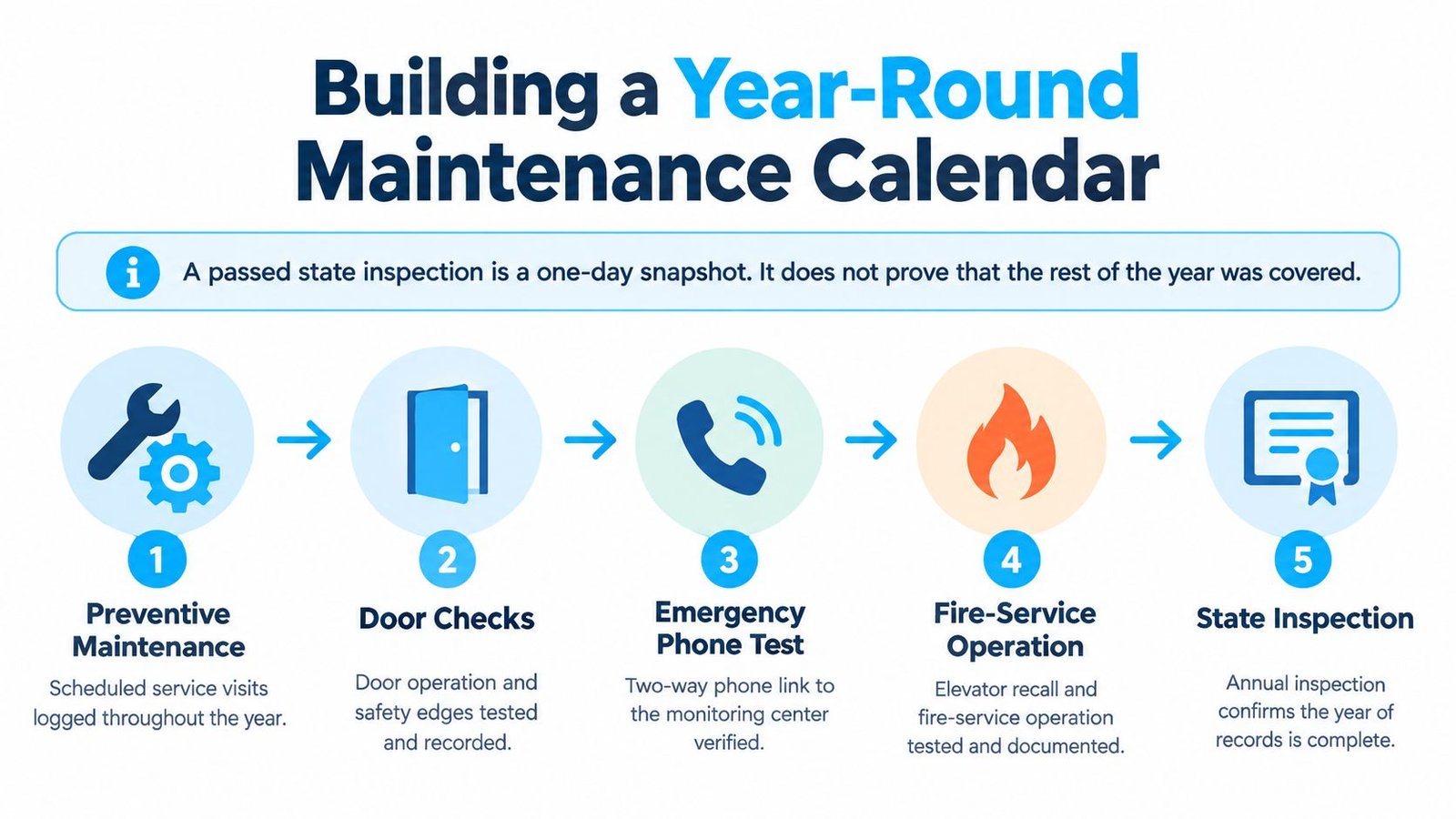
A passed inspection is a point-in-time event. It doesn’t establish that someone has since checked door operation, verified emergency communication, evaluated fire-service functions, or corrected a developing leak.
Michigan’s elevator rulemaking document distinguishes device categories generally inspected at least every 12 months from categories generally inspected every 24 months. Because this is a rulemaking document, confirm the effective requirements before using it to authorize work or establish a deadline.
Build the calendar around separate maintenance, testing, and inspection tasks.
Assign tasks and close the paperwork
- Inventory every unit. Record classification, permit number, location, service provider, and actual completion dates. An omitted dumbwaiter can disappear from the calendar even while passenger elevators receive regular attention.
- Schedule recurring maintenance from the equipment’s applicable interval. Use actual dates, not calendar-quarter labels that can conceal an excessive gap.
- Coordinate inspection and testing downtime. Request a shared planning window where practical, but don’t assume the appointments are interchangeable or automatically occur together.
- Require a completed service record after each visit. Include tasks, conditions, parts replaced, corrective actions, and open risks.
- Review repeat callbacks. Ask whether the technician established a cause, tested the repair, and explained why the symptom returned.
- Conduct an accessible-area readiness check before inspection. Review lights, signage, housekeeping, communication complaints, and open work orders without entering restricted equipment spaces.
- Convert repeated component repairs into a capital-planning discussion. Compare continued repair with a defined modernization scope.
A hospital calendar in practice
Consider a hypothetical hospital with a passenger-elevator group and a dumbwaiter. Its facilities manager would stagger downtime so patient transport and supplies still have an approved route.
| Calendar period | Illustrative planning activity |
|---|---|
| January | Reconcile permits, prior reports, and contractor schedules |
| February and March | Complete scheduled service; review door and communication complaints |
| April through June | Hold the coordinated inspection and testing window if due; resolve findings |
| July through September | Continue equipment-specific visits and review recurring faults |
| October and November | Obtain capital proposals and confirm upcoming appointments |
| December | Reconcile completed work with the schedule and hand over unresolved items |
This is a planning example, not an interval prescription. Enter the actual required dates for each unit, and adjust the appointments so month lengths, holidays, and cancellations don’t create gaps.
What Elevator Maintenance Costs and Why
There isn’t a defensible published dollar average here for Grand Rapids elevator maintenance. Equipment type, condition, age, usage, and contract exclusions change the work enough that a headline price can mislead an owner.
Compare written scopes before comparing totals. A lower maintenance charge may exclude testing, emergency labor, cleaning, or components that another proposal includes.
Elevator maintenance cost drivers and what to request
| Cost driver | How it changes the price | What to request in the quote |
|---|---|---|
| Equipment type | Hydraulic units involve jacks, tanks, and packing; traction units involve suspension components and sheaves; wheelchair and residential lifts need different scopes | Itemized scope for each equipment type |
| Age and parts availability | Discontinued controllers and difficult-to-source components can increase repair effort and lead time | Known replacement parts and availability |
| Callback frequency | Repeated faults require diagnosis beyond routine adjustments | Callback history and root-cause findings |
| Machine room, pit and car-top access | Access restrictions and housekeeping affect labor and safety preparation | Explicit cleaning and access responsibilities |
| Testing scope | Safety and load testing may be separate from recurring maintenance | Included tests, exclusions, and associated charges |
| Repair versus modernization | A component repair and a system upgrade have different purposes and budgets | Separate scopes and prices |
| Response terms | Emergency and after-hours work can have different rates | Written coverage hours, response terms, and rates |
Buy a defined outcome
Routine maintenance is the predictable operating expense. A failed controller, damaged motor, or deteriorated suspension component creates a separate repair decision, and the invoice isn’t the only consequence.
Downtime can interrupt deliveries, patient movement, accessible routes, and tenant operations. Ask the contractor to describe the expected outage and temporary operating arrangements alongside the repair scope.
There’s no useful universal multiplier for comparing a major failure with routine upkeep. A diagnosis and an equipment-specific proposal are more valuable than an unsupported savings claim.
A cheap contract isn’t economical if the owner must purchase the basic work separately.
Check the exclusions before signing
- Cleaning: Identify whether machine rooms, pits, and car tops are included, and distinguish equipment cleaning from building housekeeping.
- Fixture lamps: Clarify coverage for car operating panel and position indicator lamps, commonly abbreviated COP and PI.
- Response: Separate answering the phone, dispatching a technician, and arriving on-site.
- Testing: List the required tests and identify which charges sit outside the recurring fee.
- Parts and labor: Check exclusions for obsolete components, travel, freight, and after-hours work.
Our elevator maintenance cost guide can help frame that comparison. Require the final proposal to describe your actual units, not a generic elevator fleet.
Red Flags That Mean You Need a Technician Now
A CDC-hosted analysis using federal injury and employment data estimated that U.S. elevator and escalator incidents killed about 31 people and seriously injured approximately 17,000 people annually during its study periods. About half of the annual fatalities involved people working in or near elevators, a reason to treat improvised troubleshooting as a hazard rather than a convenience.
An elevator that still runs isn’t necessarily safe to keep using. Building staff should recognize symptoms, protect occupants, and report conditions without attempting a mechanical diagnosis.
Stop use when the symptom warrants it
- Entrapment or an unexplained stop between floors: Contact emergency responders when needed and the elevator service provider; keep occupants from attempting self-rescue.
- Doors repeatedly reopening or failing to close: Remove the unit from public use through the building’s approved procedure and request door-fault service.
- Drifting or inaccurate leveling: Stop use and report the floor and travel direction involved.
- Visible hydraulic oil: Keep people away from the affected area and request immediate assessment.
- Grinding, knocking, smoke, or a burning smell: Stop use and follow the building’s emergency procedure where appropriate.
- A returning fault: Request a documented root-cause review rather than accepting another unexplained reset.
- Missing or apparently expired inspection documentation: Confirm operating status with the contractor and the state.
- Missing or unreadable governor-rope identification: Have qualified personnel verify the test record and determine what action is required.
- An unresolved door lock monitoring requirement: Obtain an applicability and completion review promptly.
Report observations without resetting the evidence
Record the time, unit identification, floor, direction of travel, displayed message, and whether anyone was inside. A photograph of a visible indicator can help, provided taking it doesn’t expose anyone to danger.
Don’t cycle disconnects, reset controllers, force doors, or enter the pit to investigate. Those actions can expose staff to hazardous energy and interfere with the technician’s diagnosis.
Safe boundary: Building staff report symptoms and manage access. Qualified elevator personnel diagnose equipment and control hazardous energy.
Shaft, pit, and car-top work requires trained personnel using appropriate lockout/tagout, fall protection, and other hazard controls. Never use a staff member’s familiarity with the building as a substitute for elevator qualifications.
How to Evaluate and Hire a Grand Rapids Elevator Contractor
A useful contractor proposal identifies the people doing the work, their qualifications, and what they’ll document. A logo on a service vehicle doesn’t establish familiarity with your controller, hydraulic system, or accessibility lift.
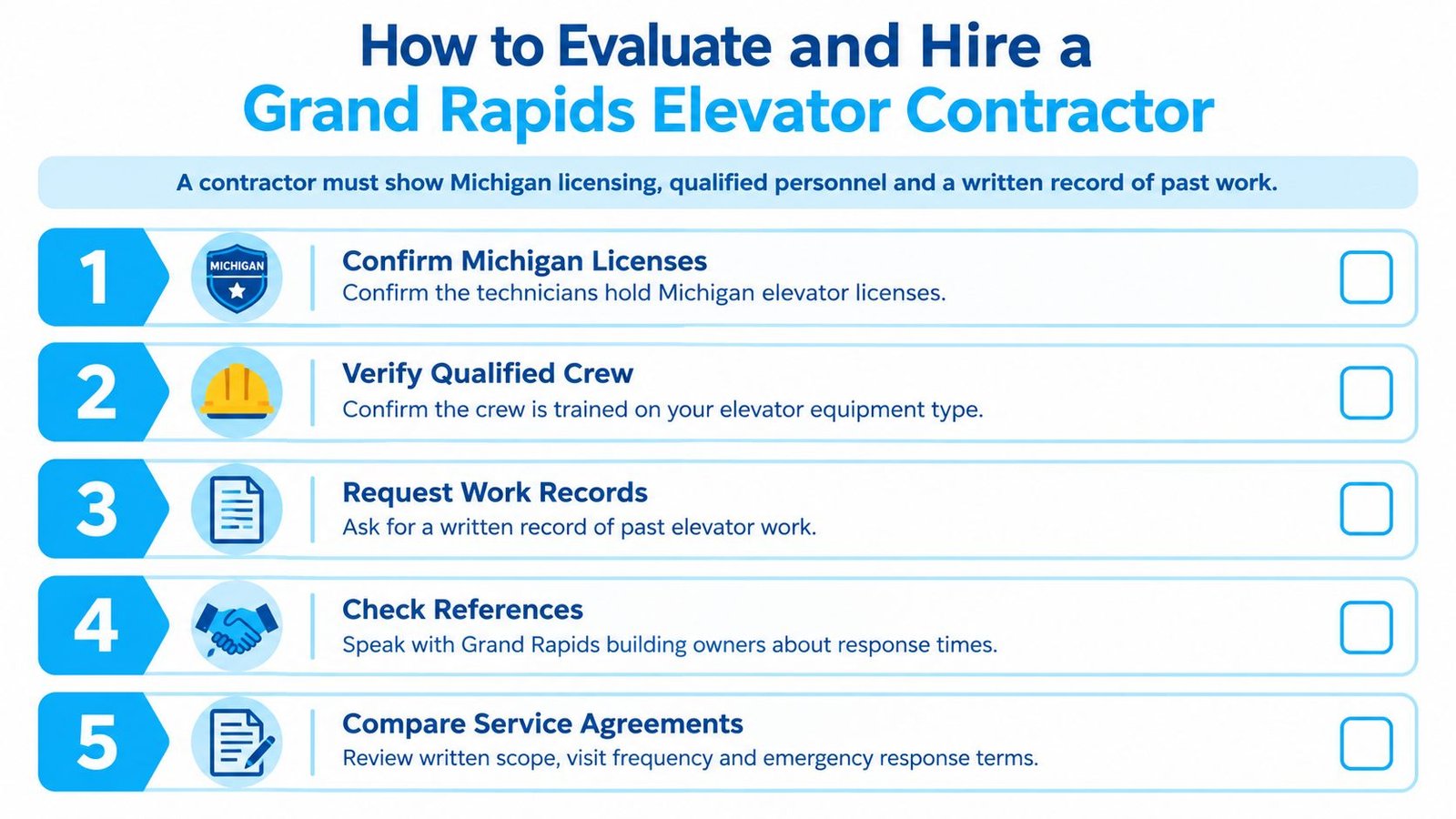
Use licensing, records, references, and contract terms as separate checks.
Evaluate the proposed work
- Confirm Michigan licensing. Identify who will service the equipment and verify the appropriate credentials. Ask how substitute technicians will receive the unit’s history.
- Request the existing maintenance history, including callbacks, unresolved defects, and testing documentation. A new agreement shouldn’t erase an old problem.
- Compare scopes line by line. Match visit frequency, cleaning, fixture-lamp coverage, testing, and emergency terms before evaluating the annual total.
- For modernization, examine future service access. Ask who can obtain diagnostic tools, documentation, passwords, and replacement components.
- Put missed-visit and billing terms in writing. Define what proves a visit occurred and how incomplete work is handled.
- Use a second opinion to test an existing diagnosis. A useful assessment explains the suspected cause, evidence, alternatives, and limitations.
- Require inclusions and exclusions. Separate immediate repairs from optional improvements and long-term modernization recommendations.
A contractor discussion is more useful when you arrive with the unit list and open work orders.
Verify coverage instead of assuming it
We’re a family-owned and operated company with over 25 years of elevator-industry experience. Our stated service area covers Southern Michigan and Michigan and Ohio cities including Lansing, Detroit, Flint, Kalamazoo, and Toledo.
Grand Rapids isn’t specifically named in that city list. Confirm coverage directly, including dispatch arrangements and emergency availability for the property, before treating any proposal as a local service commitment.
Use our guide to choosing a reliable elevator company to prepare contract questions. References should address comparable equipment and building demands, not whether the contractor’s staff were courteous.
The strongest proposal doesn’t automatically recommend replacement. It distinguishes a repairable defect from an obsolete system, explains uncertainty, and gives the owner enough detail to make the decision.
Take Three Next Steps for Your Grand Rapids Elevators
Start with the records you already have. Missing paperwork and undefined contract scope are problems you can identify before authorizing equipment replacement.
Establish the condition and compare the options
-
Audit the maintenance record. Match completed visits against the equipment-specific schedule. Collect callback reports, safety-test records, and outstanding corrective items, then ask for clarification wherever an entry doesn’t identify the work performed. Separate a missing document from a missed task so you don’t assume they’re the same problem.
-
Verify each unit’s status. Match the permit to the equipment and locate the latest inspection documentation. If an inspection or test appears overdue, arrange prompt review with qualified personnel and confirm any operating restrictions with the appropriate authority. An independent assessment can help when the existing diagnosis doesn’t explain recurring trouble.
-
Compare written proposals before committing. Evaluate maintenance, immediate repair, and modernization as distinct decisions. Check cleaning, fixture lamps, testing, response terms, and exclusions, then choose the scope that addresses the documented condition rather than the most persuasive sales presentation.
We offer a second opinion on an existing or ongoing elevator problem at no extra charge, including a visit and a solution plan. We also have a No Show, No Pay Maintenance Policy and guarantee that maintenance is done right every time.
Call 1-734-726-4247 for service or questions, including confirmation of Grand Rapids coverage. Ask how the policy applies to the proposed agreement and retain the answer with your contract.
The decision remains yours. Our offer is an option to weigh against other written proposals, the equipment’s condition, and your building’s operational needs.
Crane Elevator Company offers a second-opinion visit and solution plan for an existing or ongoing elevator problem at no extra charge. Visit Crane Elevator Company to discuss your maintenance records, unresolved faults, and service needs, and confirm coverage for your Grand Rapids property.