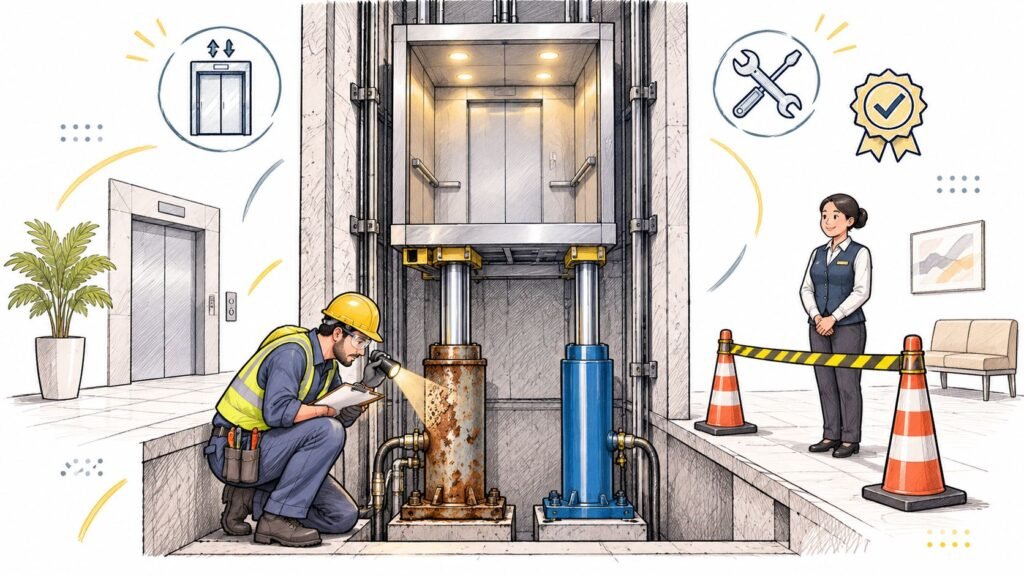
If you spot oil pooling in the pit or an inspector just red-tagged your in-ground cylinder, Elevator Hydraulic Jack Replacement means replacing the hydraulic cylinder that actually holds and lifts your car. It’s a regulated safety repair — not a quick parts swap.
The fix might be a packing replacement, pressure testing, a qualified repair, or a full jack replacement. Only a licensed contractor can tell you which one you need.
What Elevator Hydraulic Jack Replacement Means
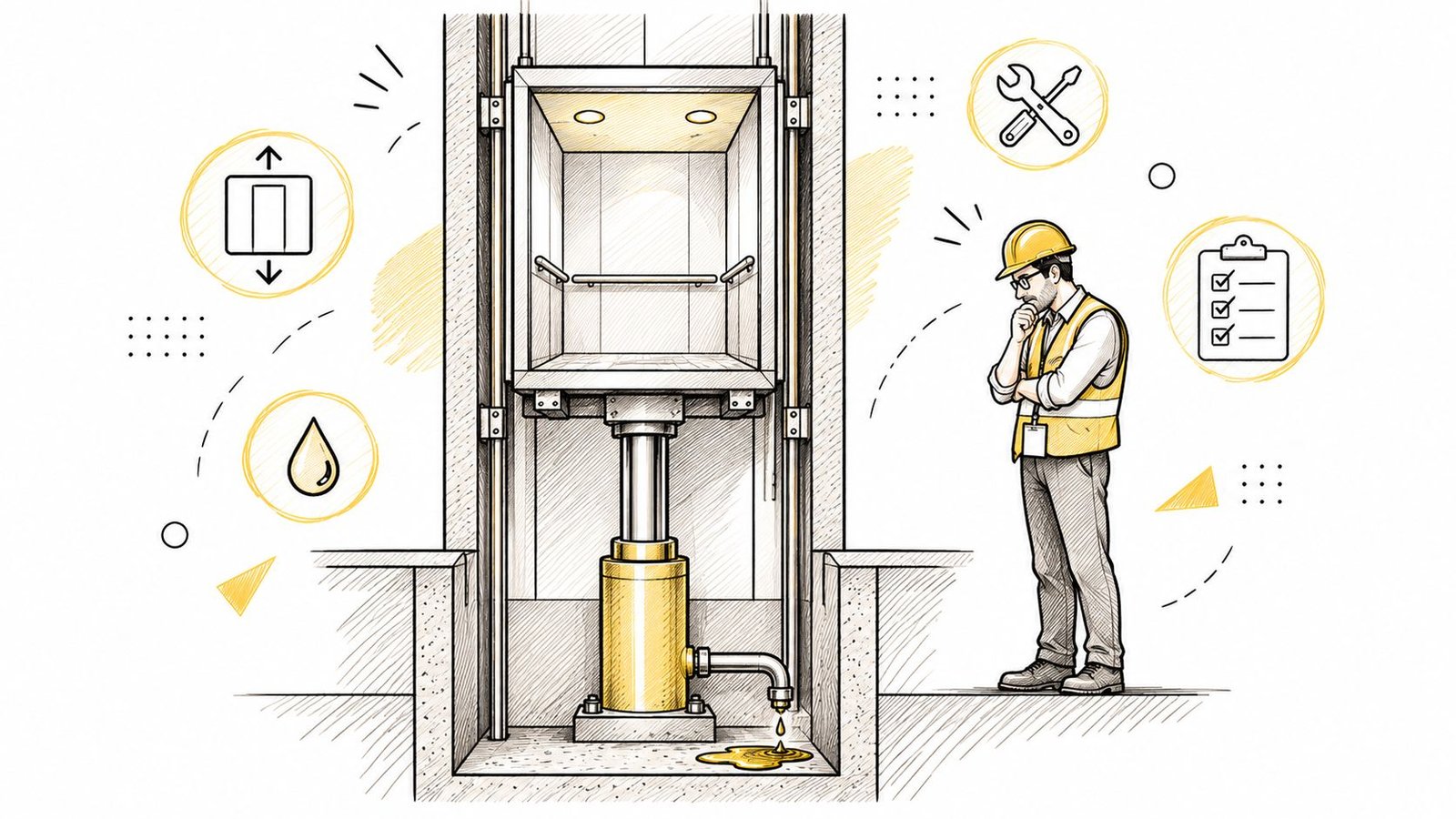
The jack is the buried steel cylinder and plunger. Pressurized oil pushes against it to raise the car.
When that steel corrodes or starts leaking, oil escapes underground where you can’t see it. That hidden loss is exactly why inspectors take a suspected cylinder leak so seriously.
There’s no set calendar date for this job. Cylinder condition, corrosion protection, and the code your state has adopted drive the decision — not just the age of the building.
The Same Leak Matters Anywhere
It doesn’t matter if it’s a hospital in Detroit, a school in Ann Arbor, a freight dock in Grand Rapids, or a home elevator in Lansing. The physics are the same.
Passenger, service, freight, residential, and lift equipment all run different duty cycles. But a failing jack takes every one of them out of service.
That’s why the evaluation matters more than the equipment type. A good contractor checks the records, the leak evidence, and the test results before recommending anything.
Who Crane Elevator Company Is
Crane Elevator Company is a family-owned contractor servicing all major cities in Michigan with more than 25 years in the field. They’re open 24/7/365.
From Detroit, Grand Rapids, Ann Arbor, Lansing, Flint, and Kalamazoo to Saginaw, Muskegon, Traverse City, Holland, Bay City, and Jackson, plus random Michigan towns like Howell, Owosso, Petoskey, Midland, Brighton, Chelsea, and Otsego, Crane Elevator Company provides local coverage statewide.
Their free second opinion includes a site visit and a written solution plan. So you’re not left guessing between a packing fix and a full replacement.
A leaking cylinder or piping must be replaced or properly repaired before the elevator returns to service. There is no shortcut around that.
Warning Signs and the First Safe Response
I’ve seen managers lose time because they called without the right details. Have this info ready and everything moves faster.
Warning Signs and the First Safe Response
| Warning Sign | First Safe Response | Details to Have Ready |
|---|---|---|
| Oil visible in the pit | Take the car out of service immediately | Building address, elevator ID, make if known |
| Car won't level or drifts | Stop passenger use, call a contractor | What failed, when it started |
| Inspector flags the cylinder | Request a second opinion before signing | Inspection report, test history |
| Rising oil consumption | Schedule a professional evaluation | Oil usage records, maintenance logs |
Keep those notes together before anyone picks up the phone. Whether you’re in Flint and Kalamazoo or out toward Saginaw, Muskegon, Toledo, and Perrysburg, that same prep work gets you a faster response.
When a hydraulic elevator acts up, people come first. Always take care of riders before anyone even thinks about touching the equipment.
Emergency Actions for Occupants and Staff
We saw this at an Ann Arbor clinic not long ago. A car stalled between floors, and the best thing riders did was stay calm. If that happens to you, use the emergency phone, tell them exactly where you are, and stay in the car until trained help gets there.
It’s a different situation with misleveling. At a Lansing school we worked with, the car wasn’t sitting flush with the landing. Staff did the right thing — they stopped boarding, moved students away, and called management. Never force the doors or try to help someone climb out.
- Occupants should call in on the emergency phone if there are injuries, medical issues, smoke, or any strange movement.
- Staff should tag the car out of service, keep people clear of the hoistway, and stay out of the pit entirely.
If there’s a medical emergency, fire, or anyone is in immediate danger, call 911 right away. Don’t wait on the normal notification chain.
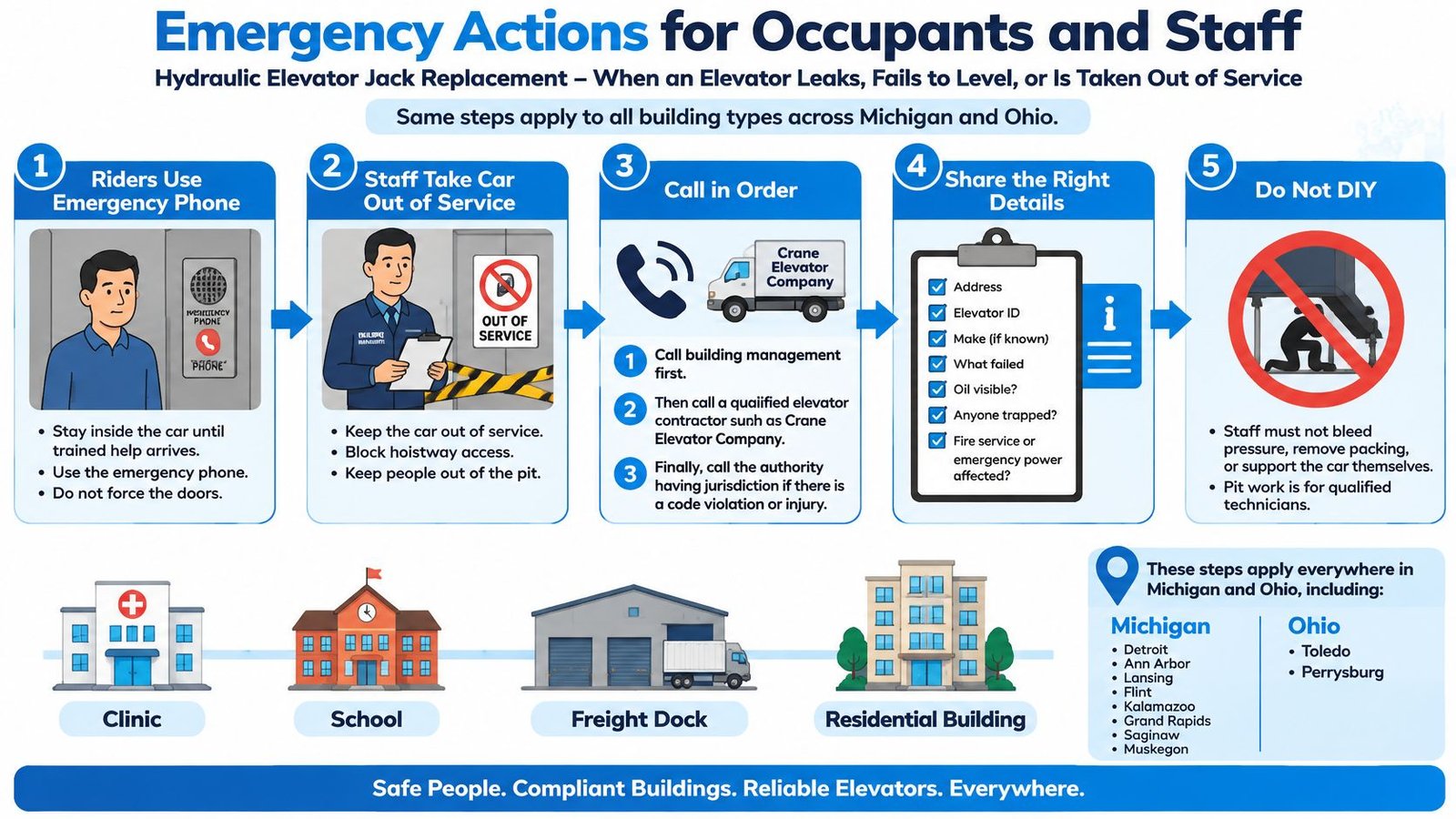
The infographic above lays out that handoff pretty well. Riders communicate, staff locks things down, and a qualified tech handles the gear. No DIY repairs, ever.
Coordinate the Elevator Emergency Response
Say you spot oil at a Flint freight dock. Stop loading and shut the operation down. Or you’re in a Grand Rapids apartment building with an outage — let residents know what’s going on and sort out an accessible workaround, but don’t promise a restart time you can’t keep.
For a normal escalation, stick to this order:
- Get building management involved to coordinate access and look after occupants
- Call a qualified contractor through Crane Elevator Company’s emergency elevator service
- Bring in the authority having jurisdiction if there’s an injury or a possible violation
When you call, have the basics ready. Building address, elevator ID, make if you know it, what went wrong, any visible oil, anyone trapped, and whether fire service or emergency power is affected. And gather all that from a safe public area — not from inside a machine space.
Crane Elevator Company services all major cities in Michigan, including Detroit, Ann Arbor, Lansing, Flint, Kalamazoo, Grand Rapids, Saginaw, Muskegon, Traverse City, and Holland, plus surrounding Michigan towns like Howell, Brighton, Owosso, and Chelsea and Ohio spots like Toledo and Perrysburg. Crane provides elevator maintenance, elevator repair, elevator testing, elevator modernization, home elevator and residential lift service, wheelchair lifts, emergency elevator service, code violation correction, and commercial elevator project financing.
Don’t bleed pressure, pull packing, or try to block up the car on your own. Pit work is for qualified technicians only.
Reach out to Crane with your incident details and get a proper evaluation before you put the car back in service or talk about Elevator Hydraulic Jack Replacement.
Elevator Hydraulic Jack Replacement takes the car out of service for a reason. The crew has to hold its weight on its own before they pull the equipment that normally holds it. That is licensed contractor work. It is never an after-hours job for building staff.
What A Safe Replacement Actually Involves
A good contractor starts by checking the jack and pit condition, pulling what records exist, and looking at access, cylinder size, borehole conditions, and corrosion protection. That homework drives the whole plan, as this hydraulic cylinder planning overview lays out pretty well.
Before the car comes off its normal drive, qualified techs set redundant temporary support sized for that job. In the pit that usually means engineered setups with jacks, pipe stands, or rail blocks. Not whatever cribbing happens to be lying around.
- Secure the car before anyone gets under it.
- Apply lockout and tagout to control hazardous energy.
- Relieve hydraulic pressure before opening any hydraulic parts.
- Control suspended loads during removal and installation.
An electrical shutdown alone doesn't secure an elevator car or remove stored hydraulic pressure.
Keep Loads Controlled Until Final Testing
Same goes for piping, packing, and valves. The crew lands or hangs the car on an approved setup, isolates energy, and bleeds off pressure before they break into the system.
The December 7, 2018 OSHA incident with a broken clamp and a dropped load is exactly why this matters. You can never hang a replacement schedule on one temporary piece holding with no backup plan.
A healthcare building in Midland might need to keep a patient route open, while a school in Owosso has to reroute kids between floors. Neither pressure justifies working under an unsecured car.
| Project Stage | Owner’s Responsibility |
|---|---|
| Replacement work | Maintain barriers and alternate access |
| Testing | Keep the elevator unavailable |
| Release | Await authorization before restoring use |
Crane Elevator Company serves all major Michigan cities and surrounding communities, supporting commercial, healthcare, education, industrial, and municipal properties with maintenance, repairs, testing, modernization, residential service, and financing.
Ask Crane for a written replacement plan that spells out required testing, inspections, and return-to-service sign-off. Put a failed cylinder into your maintenance and code plan, not an improvised overnight fix.
Elevator Hydraulic Jack Replacement comes down to documented condition and the code that applies — not some set expiration date.
When Codes and Corrosion Trigger Jack Replacement
Oil leakage, visible corrosion, damaged protection, a failed pressure test, outdated construction, or simply not being able to prove the jack is still safe can all put replacement on the table. A qualified contractor has to sort out whether it's actually cylinder damage or just a packing or valve issue, since the symptoms look a lot alike, as this cylinder evaluation guide explains.
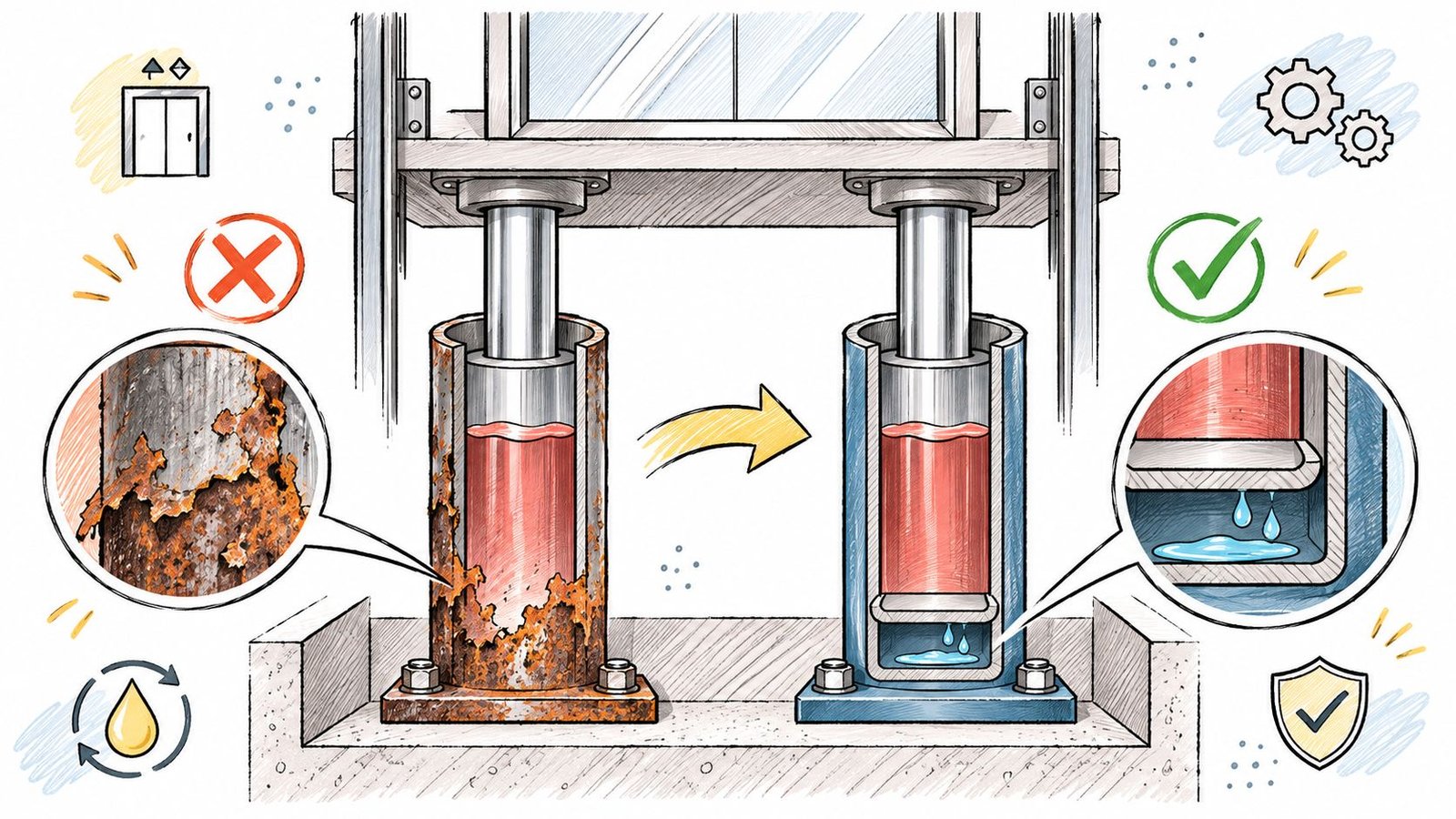
Wisconsin's history is a good cautionary tale for owners in Michigan and Ohio, but it doesn't replace your local requirements. Older single-bottom cylinders use one welded bottom plate, and corrosion at that joint can lead to fast oil loss.
- Double-bottom designs add a safety bulkhead with a restricted opening to slow oil loss if the outer bottom fails.
- Corrosion protection is still separate because cylinder walls and welded joints can keep deteriorating.
- Installation records matter because age alone won't tell you how that buried cylinder was built.
The single-bottom and double-bottom comparison breaks down those differences and why neither design gets you out of a professional evaluation.
Check Historical Dates Against Local Requirements
Wisconsin's protection timeline includes January 1, 1975, and January 1, 1994, with annual-testing changes running through March 2004, December 2008, 2014, and May 2020. Don't read those as Michigan or Ohio deadlines. Ask your contractor to confirm which state-adopted rules actually cover your installation.
Older passenger, freight, and residential hydraulic elevators are still running every day, so construction age and protection are worth a look well beyond Wisconsin. Start with Crane Elevator Company's elevator code requirements guide before you talk it through with your inspector.
A leaking cylinder or piping must be replaced or properly repaired before the elevator returns to service.
Say you're managing a property in Howell or Petoskey. Get documented answers — don't just assume new packing will fix underground leakage.
- Ask whether packing replacement, testing, qualified repair, or full jack replacement is defensible.
- Request the supporting records and required approval process.
Crane Elevator Company serves all major Michigan cities, with maintenance, repair, testing, modernization, residential elevator service, and financing. Contact Crane for a qualified evaluation and written solution plan before you authorize work or put the car back in service.
A jack replacement alone won't keep the car running. Pair Elevator Hydraulic Jack Replacement with steady maintenance if you want to prevent the next breakdown.
Prevention and Crane Service in Michigan
Crane Elevator Company builds its preventative program around the small details that get missed. That means a No Show, No Pay policy, full clean-downs of machine rooms, pits, and car tops, plus COP and PI bulb replacements on every visit.
Whether your building is in Detroit, Kalamazoo, Bay City, Jackson, Otsego, or Traverse City, Crane's technicians deliver the same full-service maintenance, repair, testing, and modernization support.
For ongoing care, check Crane's hydraulic elevator maintenance guide. Think of the jack project as the starting point, not the finish line.
Crane Elevator Company Service Choices
Most owners call about one problem and find out they need help in two or three areas. Here's how Crane's options usually break down:
| Service Choice | Typical Need | Related Work |
|---|---|---|
| Maintenance | Prevent breakdowns | Cleaning, bulbs |
| Repair | Restore equipment | Packing, components |
| Testing | Check compliance | Safety, emergency systems |
| Modernization | Update equipment | Controls, doors, fixtures |
| Residential | Support accessibility | Home elevators, wheelchair lifts |
| Financing | Plan spending | Commercial elevators, modernization |
If you need one vendor to cover maintenance through capital planning, that mix matters. You aren't juggling three contractors for cleaning, testing, and upgrades.
Related repairs often go hand-in-hand with jack work. Think hydraulic packing, tank or power unit replacement, cable replacement and shortening, and motor, sheave, and machine replacement. On the door side, that includes door lock monitoring and Safety Edge door detector replacement.
Crane also handles emergency phones, fire service tests, generator testing, safety tests, and violation corrections. Testing is code-focused and follows applicable requirements under ASME A17.1/CSA B44.
Coordinate Michigan Elevator Maintenance and Upgrades
Crane Elevator Company services all major cities in Michigan, including Detroit, Ann Arbor, Lansing, Flint, Kalamazoo, Grand Rapids, Saginaw, and Muskegon. The service area also picks up nearby towns like Howell, Brighton, Owosso, Chelsea, Midland, and Petoskey, plus Ohio communities including Toledo and Perrysburg.
Equipment coverage is broad:
- passenger, service, freight, and residential elevators
- wheelchair lifts, material lifts, dumbwaiters, and drum machines
- home elevators and wheelchair lifts through the residential division
Two practical notes for owners comparing bids:
- Non-proprietary modernization covers hydraulic and traction systems, including cab interiors, door equipment, fixtures, and controls that any qualified provider can service.
- Commercial elevator and modernization financing, competitive quotes, and a price-beat guarantee help when you're weighing project costs.
A temporary protective device isn't a permanent repair for the underlying jack problem.
I've seen this in Saginaw more than once — a little oil shows up in the pit, no one writes it down, then the car shuts down a month later. Don't wait on that.
- Report oil early, with the date and exact spot where you saw it
- Let a pro handle pit cleaning — building staff shouldn't go down there
- Keep inspections on schedule and track every corrective item to close
Contact Crane Elevator Company for a competitive maintenance quote and to line up inspections, repairs, and whatever permanent corrective work your elevator needs.
Before you sign off on an Elevator Hydraulic Jack Replacement, make sure you have straight answers on what’s actually being proposed.
Questions Owners Still Ask
Can New Packing Stop an Underground Leak?
Sometimes, yes — but only if the leak is really coming from the seal. Packing won’t fix a scored or damaged cylinder wall.
We see this a lot: same oil in the pit, totally different cause. That’s why you want a qualified cylinder evaluation instead of assuming new packing will handle it.
Keep that car out of service until the leaking parts are properly repaired or replaced and cleared for use. Pit work belongs to qualified technicians — never building staff.
Who Should Staff Call When Riders Are Trapped?
Get building management involved and call Crane’s emergency elevator service right away. If there’s injury, fire, medical distress, or immediate danger, call 911 first.
Have this information ready — and stay out of restricted areas:
- Location and equipment — street address, which entrance, and the elevator unit ID
- Observed problem — any visible oil, strange movement, and when it started
- Entrapment status — is anyone inside, and does anyone need medical help
Confirm the Permanent Solution and Service Coverage
Does a Gripper Replace a Double-Bottom Jack?
No. A plunger gripper or car safety is temporary protection. It doesn’t fix corrosion and it doesn’t change how the cylinder was built.
Any protective setup still needs contractor and AHJ review — cylinder design and compliance vary.
Temporary protection isn't permission to ignore the underlying jack defect.
Where Can Owners Request Help?
We at Crane Elevator Company service all major Michigan cities, including Detroit, Grand Rapids, Ann Arbor, Lansing, Flint, Kalamazoo, Saginaw, Muskegon, Traverse City, Holland, Bay City, and Jackson, plus towns like Howell, Brighton, Owosso, Chelsea, Midland, and Petoskey. In Ohio, we cover Toledo and Perrysburg.
We provide all services including elevator maintenance, elevator repairs, elevator testing, non-proprietary modernization, residential home elevator and wheelchair lift service, emergency elevator service, violation correction, and commercial elevator project financing. Bring your inspection reports and maintenance records so we’re pricing off the equipment’s actual condition.
Contact Crane Elevator Company for a free second opinion, including a site visit and written solution plan. Send your address, unit ID, and current proposal and we’ll walk through the corrective work before you authorize the project or put the car back in passenger service.