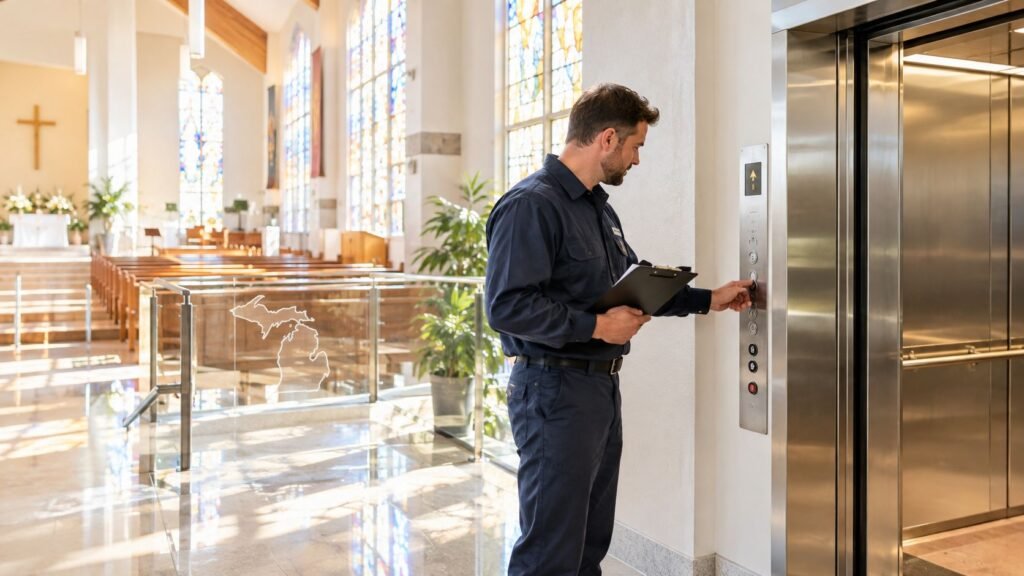
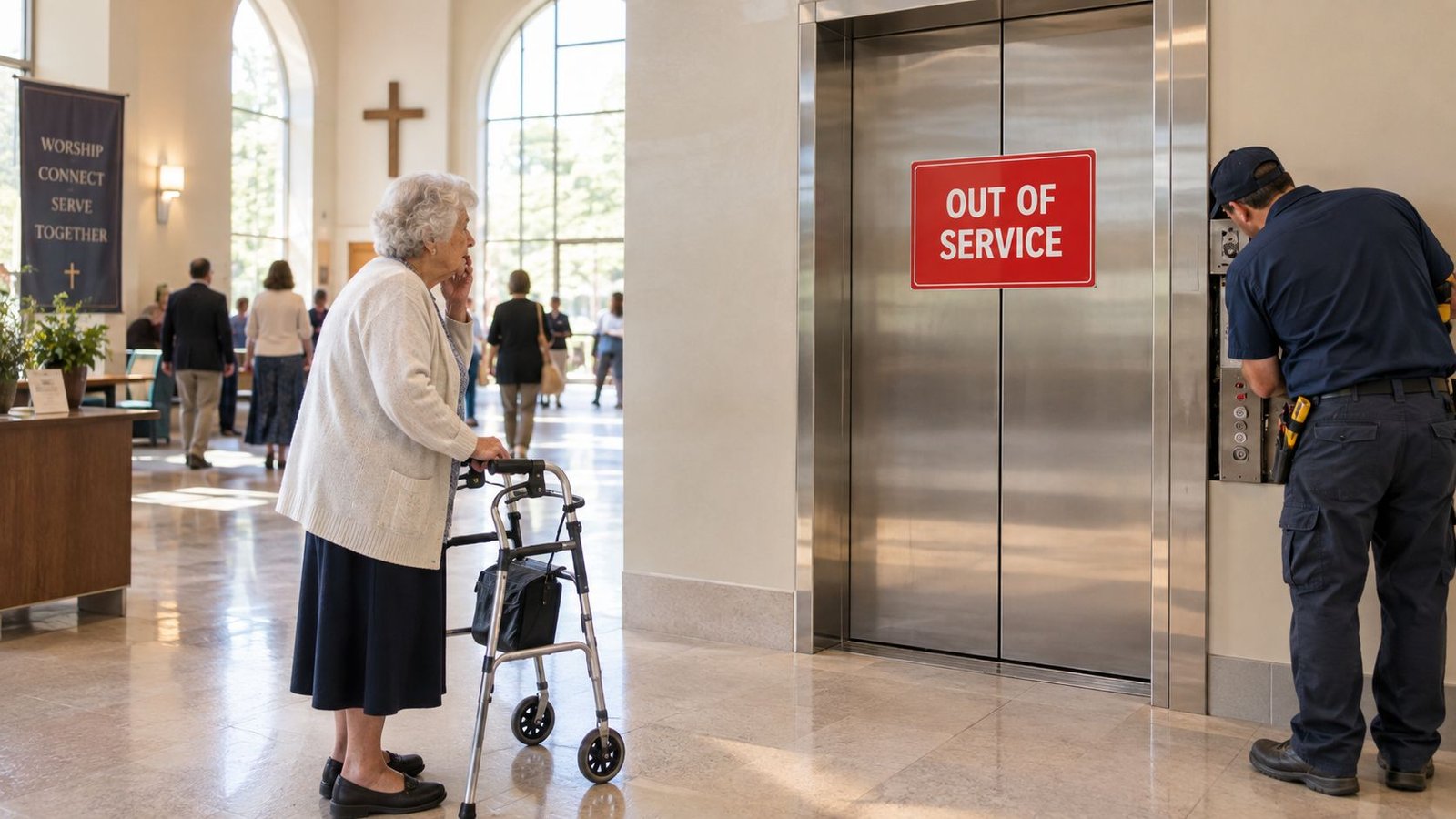
A Sunday service is about to begin, the sanctuary is filling, and the church elevator suddenly refuses to move. An older congregant with a walker is waiting in the lobby, a family is trying to reach classrooms upstairs, and the volunteer facility team is searching for a service number. For a church, an elevator outage isn't just an inconvenience. When the elevator provides the only practical accessible route, a mechanical failure can interrupt worship, restrict participation, and create serious compliance concerns.
Church elevator maintenance has to account for a difficult combination of conditions. Equipment may sit quiet during the week, then carry congregants, staff, deliveries, and event traffic in concentrated bursts. Michigan state requirements can impose a regular service schedule, Detroit can require a tighter interval, and worship-specific rules in Illinois show that religious occupancies may receive special treatment only when narrow conditions and documentation requirements are met. The safe approach is a written maintenance plan tied to the actual equipment, building use, jurisdiction, and accessibility role.
The Hidden Risks of Deferred Church Elevator Maintenance
The failure usually starts with subtle signs. A door takes slightly longer to close, the car levels unevenly, or the elevator works after a reset but stops again later. Because the church may use the equipment heavily only on Sundays, a volunteer may assume the problem can wait until the next scheduled service. That decision can turn a small defect into a service disruption at the worst possible time.
Intermittent, high-importance use is especially deceptive. Door operators, relays, contacts, and safety circuits can develop latent faults even when the elevator seems reliable during occasional trips. Long idle periods don't eliminate wear. They can make a defect harder to notice until the equipment is placed under concentrated demand during worship, a funeral, a wedding, or a community event.
Accessibility is part of the operating decision
If an elevator is the only accessible route to the sanctuary, fellowship hall, classrooms, or offices, its outage can affect whether people can use those spaces at all. Neutral industry guidance identifies the overlap between elevator requirements, ADA accessibility obligations, OSHA lockout and machine-room safety, and state inspection rules in the same maintenance decision. A church can't evaluate uptime separately from access.
The practical risks include:
- Interrupted worship: Congregants may be unable to reach the service or participate in scheduled activities.
- Restricted building access: A closed elevator can isolate upper-level classrooms, offices, and meeting areas.
- Compliance exposure: An inaccessible route may create ADA concerns when no equivalent path exists.
- Expensive correction work: Deferred defects often appear during inspections after they have affected several systems.
- Reputational damage: Congregants remember whether the building was prepared to welcome them safely.
Practical rule: Treat a church elevator as an accessibility system first and a mechanical asset second.
A reactive vendor call after a complaint doesn't establish whether the elevator, emergency phone, fire service, records, and safety devices are ready for the next service. Church leaders should ask for documented examinations, corrective recommendations, and a clear response plan before a failure strands someone who depends on the lift.
Understanding the ASME Maintenance Control Program
Elevator maintenance is built around a long-standing safety framework, not an informal agreement to repair whatever breaks. ASME says the A17.1 safety code was first published in 1921, and later ASME materials describe it as the accepted guide throughout North America for elevator design, construction, operation, inspection, testing, maintenance, alteration, and repair. The historical record shows that recurring oversight and recorded testing have been part of passenger-elevator safety for more than a century. ASME's historical code material provides that background.
A modern Maintenance Control Program, or MCP, connects the equipment's maintenance instructions with the work performed, the tests required, and the records retained. ASME A17.1 and CSA B44 treat maintenance, repair, testing, inspection, alteration, and repair as an integrated safety regime. That means a compliant program isn't just a list of emergency phone numbers or a promise to visit occasionally.
What scheduled maintenance actually includes
A working MCP should identify the examinations and tasks needed to keep the installation operating safely. Depending on the equipment, that can include:
- Cleaning: Removing dirt and debris from machine rooms, pits, car tops, door tracks, and operating components.
- Lubrication: Applying the correct lubricant to components that require it, without contaminating electrical or safety equipment.
- Adjustment: Correcting door operation, leveling, controls, and other settings before minor drift becomes a shutdown.
- Part evaluation: Identifying worn, defective, or obsolete components and planning replacement rather than waiting for failure.
- Testing: Performing required safety, emergency communication, fire service, and other operational tests at their defined intervals.
- Documentation: Recording examinations, findings, repairs, callbacks, tests, and corrective actions in a form the owner can retrieve.
The church elevator code requirements resource can help facility managers frame conversations with a maintenance provider, but the provider still needs to apply the governing code and local authority requirements to the specific installation.
Why breakdown-only service fails
Breakdown-only service appears economical because it postpones routine labor. In practice, it leaves the owner without a reliable way to identify latent faults, track recurring callbacks, or prepare for an inspection. A church may then face an outage, an inspection deficiency, and a rushed repair decision at the same time.
A formal MCP also creates accountability. The facility manager should know which tasks are scheduled, which findings remain open, who authorized corrective work, and where the records are stored. The ASME A17.1 maintenance framework supports the central point: maintenance is an ongoing safety obligation, not a reaction reserved for visible breakdowns.
Navigating Michigan and Detroit Inspection Intervals
Michigan church administrators need a calendar that distinguishes routine service from safety-device testing. For most power elevators, Michigan requires maintenance at least once every 90 days, performed by a licensed elevator journeyperson. Certain lighter-use devices, including dumbwaiters, one-person elevators, platform lifts, and stairway chairlifts, can use a 180-day maintenance cycle under the state rule. The Michigan maintenance regulation also requires an ongoing written record of maintenance, repairs, replacements, inspections, callbacks, and testing.
Michigan separately requires car and counterweight safety and governor maintenance inspections and tests at intervals of no more than 12 months. A qualified person must perform those tests in the presence of an inspector authorized by the state, and the results must be submitted to the department. The governor rope must also carry a dated tag identifying who conducted the test. Those requirements are set out in the Michigan safety-device testing rule.
Detroit can impose a stricter operating rhythm. In Detroit, power elevators, escalators, and moving walks must be inspected and serviced at least every 30 days by a licensed unlimited-elevator journeyperson. The interval may be extended to no more than 90 days by special permission when the equipment is used infrequently. Detroit also requires firefighters' emergency operation systems to undergo Phase I recall and at least one floor of Phase II operation every 30 days. Facility managers should confirm the exact local requirement with the authority having jurisdiction and their licensed contractor.
Michigan Elevator Maintenance Intervals
| Equipment Type | State Interval | Detroit Interval | Key Requirement |
|---|---|---|---|
| Most power elevators | At least every 90 days | At least every 30 days | Licensed personnel, written maintenance records |
| Dumbwaiters | Up to a 180-day cycle under the lighter-use allowance | Confirm with Detroit requirements | Record maintenance and testing |
| One-person elevators | Up to a 180-day cycle under the lighter-use allowance | Confirm with Detroit requirements | Confirm classification and local interval |
| Platform lifts | Up to a 180-day cycle under the lighter-use allowance | Confirm with Detroit requirements | Maintain records on site |
| Stairway chairlifts | Up to a 180-day cycle under the lighter-use allowance | Confirm with Detroit requirements | Confirm device category |
| Car and counterweight safeties and governors | Test at intervals of no more than 12 months | Confirm local administration | Qualified person, authorized inspector present, submitted results, dated governor-rope tag |
Build the record before the inspector arrives
Keep the written maintenance record in the machine room, or on-site when no machine room exists. The file should show routine visits, repairs, replacements, inspections, callbacks, and tests. For annual safety-device work, retain the submitted results and verify that the dated governor-rope tag is present and legible.
Detroit churches should also document the monthly fire-service operation checks. Don't rely on a contractor's invoice that only says “serviced.” The record should identify what was examined, what was tested, what failed, and what remains open.
Life Safety and Emergency Communication Systems
A Sunday service can leave a church with limited elevator coverage. Volunteers may be staffing the lobby, offices may be closed, and the person who receives an emergency call may not be the person who can reach the machine room or contact the elevator contractor. If the elevator serves the only accessible worship space, a failed communication path can turn a brief outage into an accessibility and rescue problem.
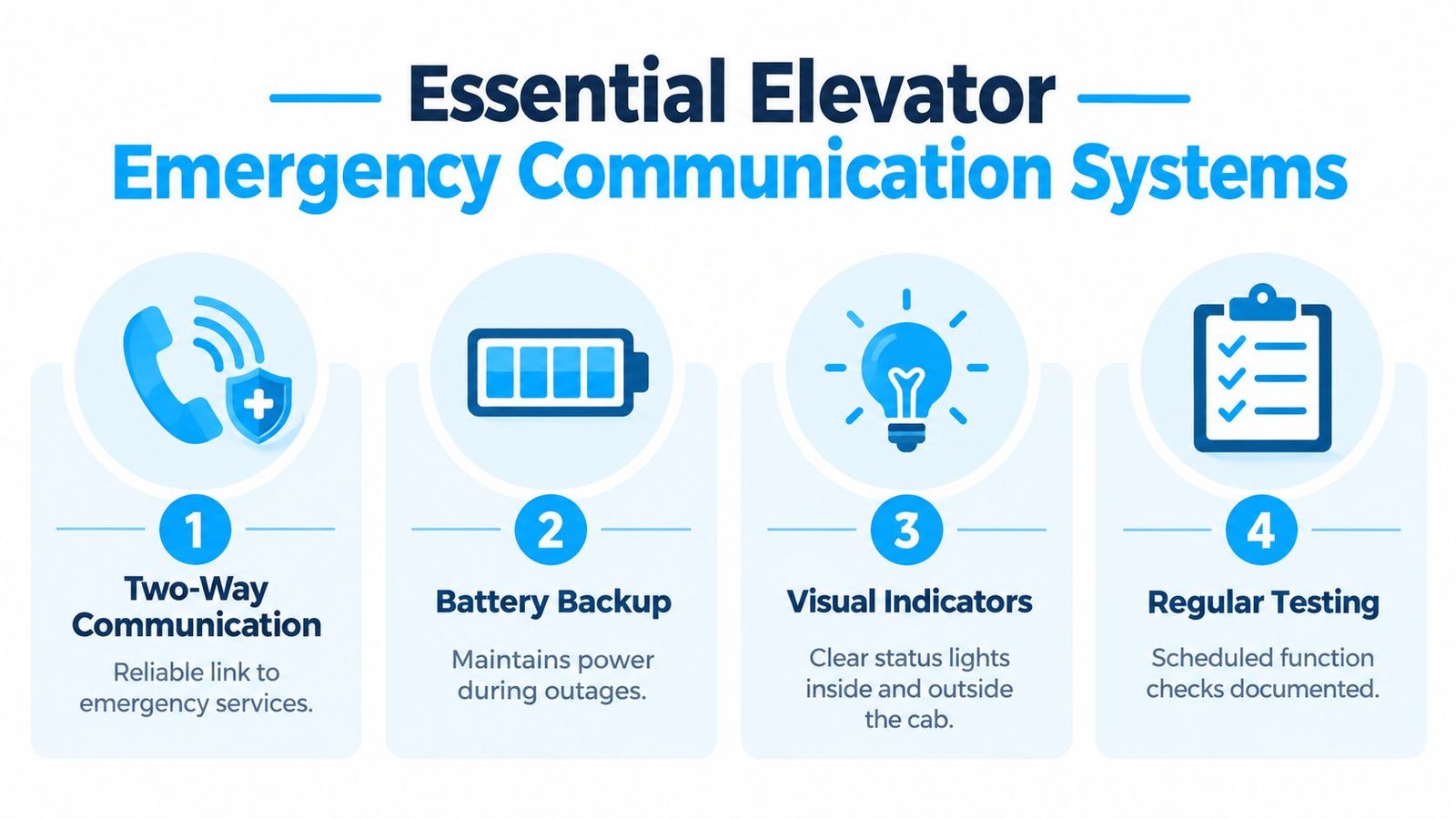
An emergency phone must connect an occupant to a constantly attended location, remain powered during an interruption, and provide clear visual or audible feedback. A weak battery, corroded terminal, failed VoIP path, or unreadable label can make an installed device ineffective. Review the Michigan elevator emergency phone code requirements for churches before changing the receiving location, telephone service, or access arrangements.
Plan the church's rescue path
A contractor should help the church identify who answers the call during worship, weekday programs, funerals, and building closures. The receiving point must be staffed as required, and volunteers need a clear escalation procedure. That procedure should identify the elevator contractor, the person responsible for contacting emergency services, and the staff member who can meet responders at the building.
Older church buildings often change from conventional telephone service to VoIP. Confirm that the network path reaches the intended attended location, that the system still supports two-way conversation, and that backup power protects the communication equipment. A working button in the cab does not prove that the complete call path works.
The two-way elevator communication resource supports periodic functional checks from inside the cab, visual review for damage or tampering, battery inspection, and detailed records for corrective actions. Apply those checks to the church's actual rescue arrangement, including Sunday staffing and any remote receiving service.
Keep access controls from blocking mobility
Churches may use card readers or fobs for offices, classrooms, and storage areas. Configure those controls so they do not interfere with fire recall, protective door-lock circuits, emergency operation, or other required elevator functions. Security settings must also allow congregants to reach accessible worship spaces without depending on a staff member to open a door.
Before changing the elevator, coordinate the elevator contractor, access-control installer, fire-alarm provider, and authority having jurisdiction. Record who receives emergency calls and who covers the building when regular staff are absent.
The True Cost of Reactive vs Proactive Service
A church budget makes reactive service tempting. The board sees a recurring maintenance invoice and asks whether the elevator can be repaired when it stops. That comparison leaves out the cost of emergency response, disrupted events, inaccessible rooms, inspection corrections, rushed parts decisions, and the staff time spent coordinating a failure.
Proactive service doesn't guarantee that an elevator will never need repair. It gives the owner a better chance to find developing problems while the work can be planned. A technician who cleans the machine room, pit, and car top can identify contamination, looseness, wear, or damage that a short breakdown visit may never document.
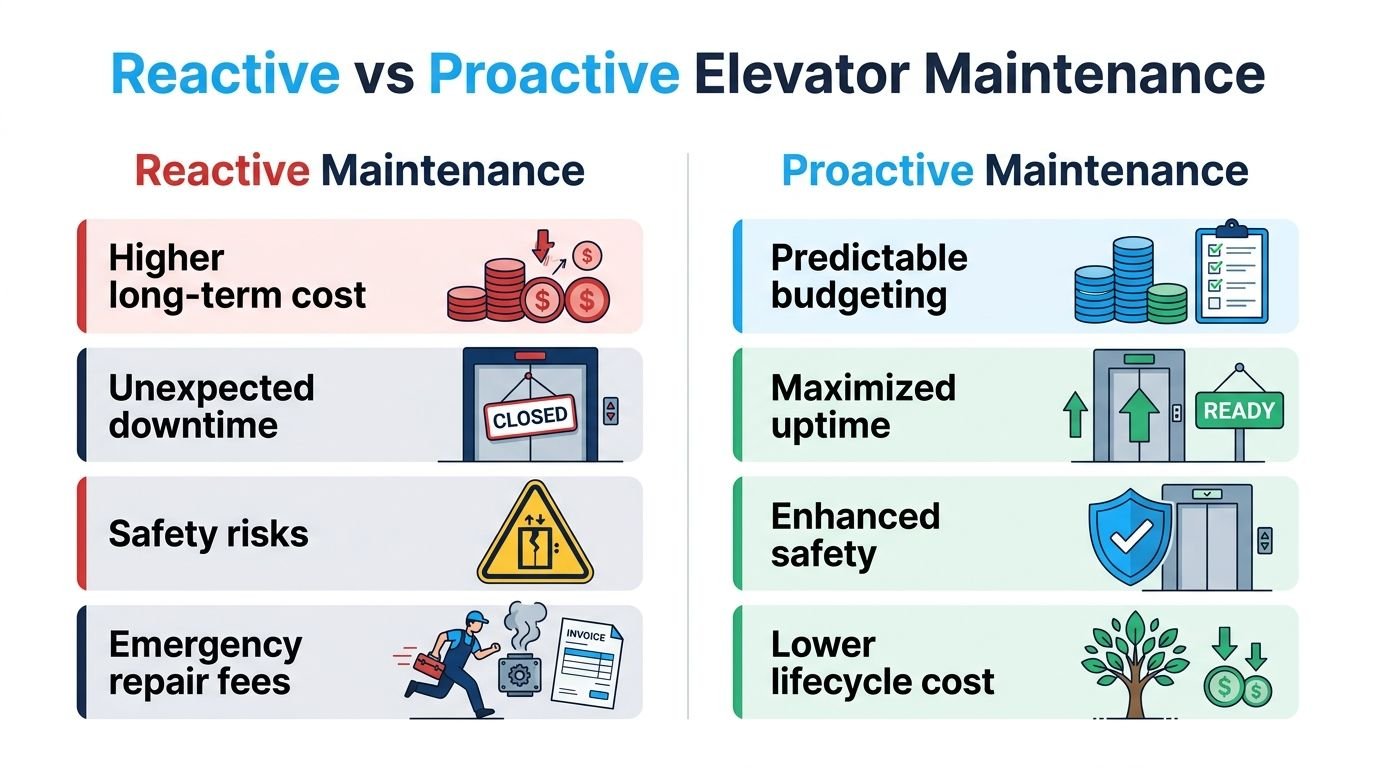
Two service models, two risk profiles
| Reactive service | Proactive service |
|---|---|
| Responds after an outage or complaint | Examines equipment on a planned schedule |
| Produces unpredictable downtime | Gives the church a clearer maintenance calendar |
| Can uncover multiple neglected defects at once | Creates a record of findings and corrective work |
| May force urgent repair decisions | Supports planned parts replacement and budgeting |
| Treats maintenance as an expense after failure | Treats maintenance as part of accessibility planning |
A sound maintenance contract should also explain what the technician will do during a visit. Look for defined examinations, clean-downs, lubrication and adjustment where applicable, safety testing, emergency-phone checks, callback documentation, and a process for escalating defects. A “monthly visit” with no written scope isn't automatically a preventive program.
Evaluate the contract, not just the price
Ask whether the provider supports all makes and models, whether the maintenance is proprietary, how emergency response is handled, and what records the church receives. Crane Elevator Company describes a non-proprietary maintenance approach, clean-downs of machine rooms, pits, and car tops, COP and PI bulb replacements, and a No Show, No Pay policy on its company materials. Its service scope also includes repairs, parts replacement, safety tests, emergency phones, fire service, generator testing, and violation corrections. The company's maintenance cost resource offers a starting point for discussing scope and budgeting.
The right comparison isn't “maintenance invoice versus no invoice.” It's planned service versus the combined operational and compliance exposure of an avoidable outage.
Elevator Services for Churches Across Michigan
A church may operate a conventional passenger elevator, hydraulic unit, wheelchair lift, dumbwaiter, or older equipment unlike newer commercial systems. The contractor must understand the device category, controls, doors, safety systems, fire service, emergency communication, and inspection process for the local jurisdiction. Service should cover the equipment the church operates, including maintenance, repairs, testing, inspection support, modernization, and corrective work.
A congregation in a smaller Michigan community still needs qualified support when its only accessible route fails. Crane Elevator Company serves Michigan and Ohio, including Detroit, Lansing, Ann Arbor, Grand Rapids, and surrounding areas. Its published service footprint also lists Whitmore Lake, Howell, Saginaw, Port Huron, Battle Creek, Livonia, Ypsilanti, Flint, Kalamazoo, Sterling Heights, Warren, and other communities. Crane Elevator's Michigan service-area page provides locations, cities, service hours, and contact information.
Match the service to the church's equipment
A practical service agreement may include:
- Preventive maintenance: Scheduled cleaning, examination, lubrication, adjustment, and documentation.
- Repair work: Door locks, hydraulic packing, jacks, cables, tanks, power units, motors, sheaves, machines, and related components.
- Testing and inspection support: Safety devices, emergency phones, fire service, generator operation, and violation corrections.
- Modernization: Non-proprietary upgrades for controls, fixtures, doors, drives, and obsolete components.
- Accessibility equipment: Maintenance and repair for wheelchair lifts, platform lifts, and related devices.
- Emergency response: Coordination when a failure affects worship access, staff movement, or building operations.
Crane's company information describes a family-owned operation with over 25 years of hands-on experience, non-proprietary modernization options, and 24/7/365 emergency response. Churches should verify the current scope before signing. Request response terms, maintenance intervals, recordkeeping procedures, parts availability, and a plan for communicating an outage to church leadership.
The service relationship should identify each conveyance, the applicable Michigan or city requirement, the technician responsible, the records delivered, and the escalation process. That specificity helps a facility manager protect accessibility during services rather than discovering gaps after the elevator stops.
Your Church Elevator Compliance Checklist
A volunteer committee can perform a useful document review before asking a contractor for a second opinion. The review doesn't replace inspection or maintenance by qualified elevator personnel. It helps the church identify missing records, unclear responsibilities, and accessibility risks before the next service interruption.
Start with the equipment file
Identify every device: Record whether the building has a power elevator, hydraulic elevator, platform lift, stairway chairlift, dumbwaiter, or another conveyance. Note which floors it serves and whether it provides the only accessible route.
Confirm the jurisdiction: Determine whether the equipment falls under Michigan state requirements, Detroit requirements, or another local authority. A church in Detroit shouldn't assume the state baseline is the complete maintenance schedule.
Check the service interval: Verify that the contract reflects the applicable cycle. Most Michigan power elevators require service at least every 90 days, while Detroit's baseline can require service every 30 days. Lighter-use devices may qualify for a 180-day cycle under Michigan's rule, but classification must be confirmed.
Review the written log: Look for maintenance, repairs, replacements, inspections, callbacks, and testing. The record belongs in the machine room or on-site when there isn't one.
Verify safety and accessibility controls
Locate the governor-rope tag: For the annual safety and governor testing, confirm that the dated tag identifies who conducted the test. Request the test results and verify that the required submission was handled.
Test the emergency communication path: From inside the cab, confirm that the call reaches a constantly attended location. Check backup power, indicators, labels, and the corrective-action record.
Review fire service: In Detroit, confirm documentation for Phase I recall and at least one floor of Phase II operation at the required monthly interval. Ask the contractor to explain any failed or deferred test.
Inspect access-control integration: Verify that card readers and fobs don't interfere with fire recall, door locks, emergency operation, or accessible travel. Any change should be reviewed by qualified elevator and life-safety professionals.
Ask for open deficiencies: Request a list separating immediate safety issues, inspection violations, recommended repairs, modernization options, and routine observations. A church board can make better decisions when those categories aren't blended together.
Plan for an outage: Keep a current emergency contact, define who can close the elevator, identify an alternate accessible route if one exists, and communicate restrictions to staff and congregants. If no equivalent route exists, treat a shutdown as an accessibility event requiring prompt coordination.
A free second opinion can clarify whether the current provider is completing the promised work, maintaining audit-ready records, and addressing the elevator's role in congregational access. Crane Elevator Company offers maintenance, repairs, inspections, testing, emergency response, and non-proprietary modernization for church buildings and other facilities across Michigan and Ohio. Visit Crane Elevator Company to request a second opinion and competitive quote for a safer, documented church elevator maintenance plan.