
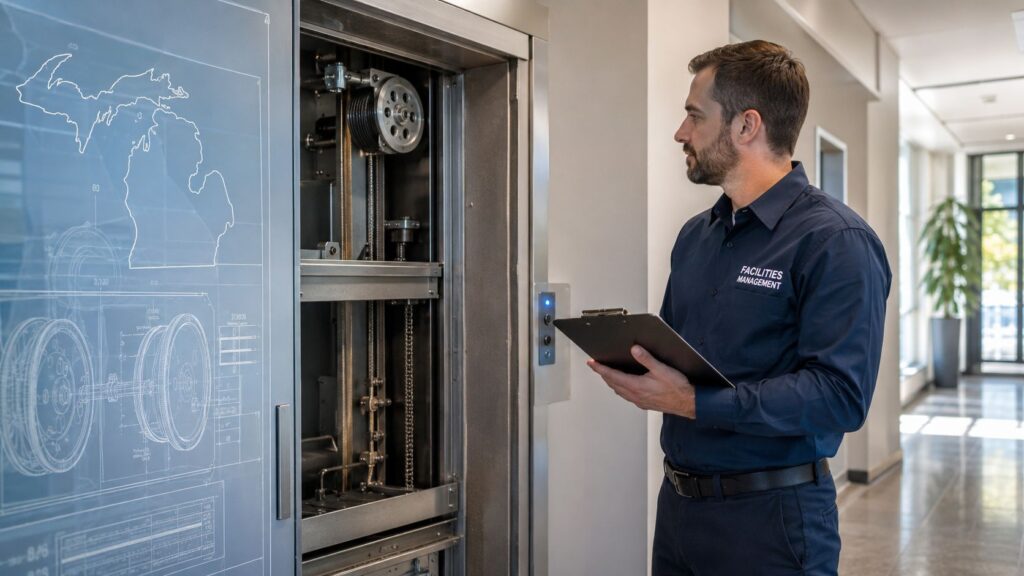
If you’re responsible for a building with a dumbwaiter, you’re usually dealing with the same problem. The unit still runs, so it keeps getting pushed down the priority list. Then one day a kitchen manager reports a door that won’t latch, a nurse says the car is slow between floors, or a tenant complains about noise from the shaft. What looked like a small nuisance turns into downtime, a service call, and a round of questions about inspections, records, and liability.
That’s where good dumbwaiter maintenance separates itself from basic upkeep. In Michigan, especially in active properties around Detroit, Grand Rapids, Ann Arbor, and Lansing, maintenance has to do two jobs at once. It has to keep the equipment dependable in daily use, and it has to keep the owner out of trouble when an inspector, insurer, or safety issue puts the unit under scrutiny.
Why Proactive Dumbwaiter Maintenance Matters
A dumbwaiter is small compared with a passenger elevator, but the maintenance logic is the same. Tight shafts, moving mechanical parts, electrical components, door interlocks, and repeated starts and stops all create wear. The difference is that dumbwaiters often get treated like appliances when they should be treated like vertical transportation equipment.
That mindset causes most avoidable problems. Owners wait for noise, sticking doors, or rough travel before they call. By then, the issue has usually moved past a simple adjustment.
Wear starts in the small parts
A dumbwaiter doesn’t fail all at once. It usually starts with parts that take repeated stress. Rollers wear. Locks drift out of adjustment. Tracks collect dirt. Wiring connections loosen. Lubrication dries out. In a tight hoistway, none of that improves on its own.
A widely cited benchmark is annual professional inspection, and that’s tied directly to how these units age in service. Dumbwaiter guidance also notes that commercial units often handle 200, 300, or 500 pounds, while some residential models are rated for 120 pounds, and that the maintenance model has shifted from occasional repair to preventive service centered on yearly inspection (annual dumbwaiter inspection guidance from Inclinator).
Practical rule: If the unit carries real loads every week, treat maintenance as scheduled risk control, not as a repair response.
Downtime costs more than the service visit
When a dumbwaiter goes out, the disruption spreads fast. Restaurant staff start using stairs with hot items or breakables. Healthcare staff lose a workflow tool. Office or municipal buildings start improvising around the outage. The direct repair isn’t the only cost. The bigger cost is operational disruption, frustrated occupants, and deferred issues stacking on top of one another.
What works is boring on purpose:
- Routine inspection: Catch wear before it turns into a shutdown.
- Load discipline: Keep staff within the unit’s rated use.
- Clean operating conditions: Dirt and moisture shorten component life.
- Documented service history: That record matters when problems repeat.
What doesn’t work is waiting for a failure that “seems minor.” A noisy machine, a sticky gate, or a slow trip is often the early warning. Ignore it, and the repair usually expands.
Michigan managers need a broader view
In Michigan properties, especially older mixed-use buildings, I’d rather see a manager ask, “What’s the next likely failure point?” than “Can we stretch this another season?” That’s the right question because dumbwaiters age according to use, loading habits, and environment. A dry residential setup and a busy commercial service lift don’t wear the same way.
Preventive dumbwaiter maintenance protects three things at once:
| Priority | What maintenance protects |
|---|---|
| Safety | Door locking, safe travel, reliable controls |
| Operations | Fewer interruptions and clearer service planning |
| Asset value | Less premature replacement of stressed components |
If you manage the unit before it complains, you spend less time dealing with emergencies and more time controlling the outcome.
Your Essential Dumbwaiter Maintenance Checklist
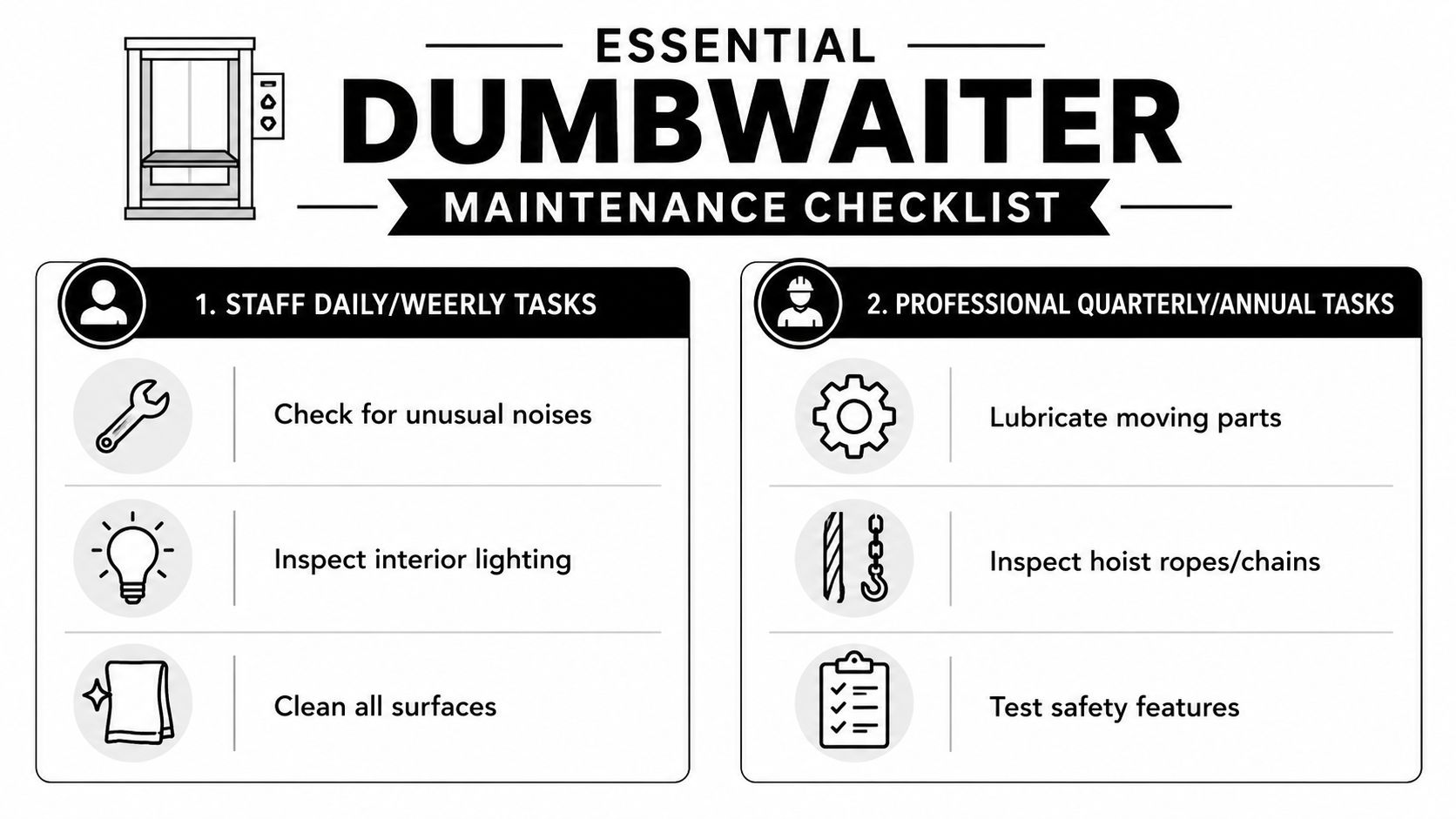
Most building teams need a checklist that separates what staff can safely monitor from what belongs to a trained elevator technician. That line matters. Good facility staff catch changes early. Good technicians handle the mechanical, electrical, and safety work that shouldn't be improvised.
What staff should check routinely
These are observation and housekeeping tasks. They help you spot trouble early without opening equipment or attempting technical adjustments.
- Listen during operation: Note grinding, rattling, scraping, humming changes, or stops that don't sound normal.
- Check landing doors: Confirm doors close properly, latch correctly, and don't require forcing.
- Inspect car interior condition: Look for loose trim, broken shelves, damaged lighting, or signs of impact from overloaded or shifted contents.
- Clean visible surfaces and tracks: Remove grease, dust, food debris, paper scraps, and packaging residue from exposed areas.
- Watch for travel changes: Slow starts, uneven leveling, hesitation, or rough motion should be logged and reported.
- Review loading habits: Make sure users aren't treating the dumbwaiter like a storage bin or stuffing oversized items into the car.
A simple logbook works better than casual verbal reports. Write down the floor, time, symptom, and whether the issue repeats. That gives the mechanic something useful to diagnose.
Hidden contamination zones cause real failures
A missed part of dumbwaiter maintenance is preventive cleaning of concealed contamination points, especially pits, tracks, machine spaces, and car tops. Most advice stops at visible symptoms, but debris buildup in those less accessible areas contributes directly to wear, electrical faults, and door problems (concealed contamination guidance from York Lift).
That matters practically because dumbwaiters often serve places where contamination is constant. Food service creates grease and crumbs. Healthcare settings create lint and packaging debris. Older commercial buildings can add dust and moisture. Once that material gets into tracks, machine areas, or door equipment, the unit starts aging faster.
Don't wait for dirt to become a symptom. By the time contamination affects travel or door function, it has usually been building for a while.
What to leave to a professional
A trained service mechanic should handle anything involving adjustment, disassembly, safety circuits, or component condition inside the equipment spaces.
Key professional tasks include:
| Professional task | Why it matters |
|---|---|
| Lubrication of moving parts | Reduces friction and premature wear |
| Inspection of worn components | Catches damage before a breakdown |
| Door lock and safety feature testing | Confirms the unit can't operate unsafely |
| Electrical wiring review | Helps identify heat, looseness, or fault risk |
| Machine space and concealed area clean-down | Removes debris that drives faults |
| Load-related wear assessment | Matches service needs to actual building use |
Staff should never bypass interlocks, force doors, add unapproved lubricants, or attempt electrical repairs. Those shortcuts create unsafe conditions and make later troubleshooting harder.
A good checklist is simple. Staff observe, clean what's accessible, and report changes. Technicians inspect, test, lubricate, clean concealed areas, and document what needs correction. That division of labor prevents a lot of expensive mistakes.
Recognizing Common Dumbwaiter Failure Modes
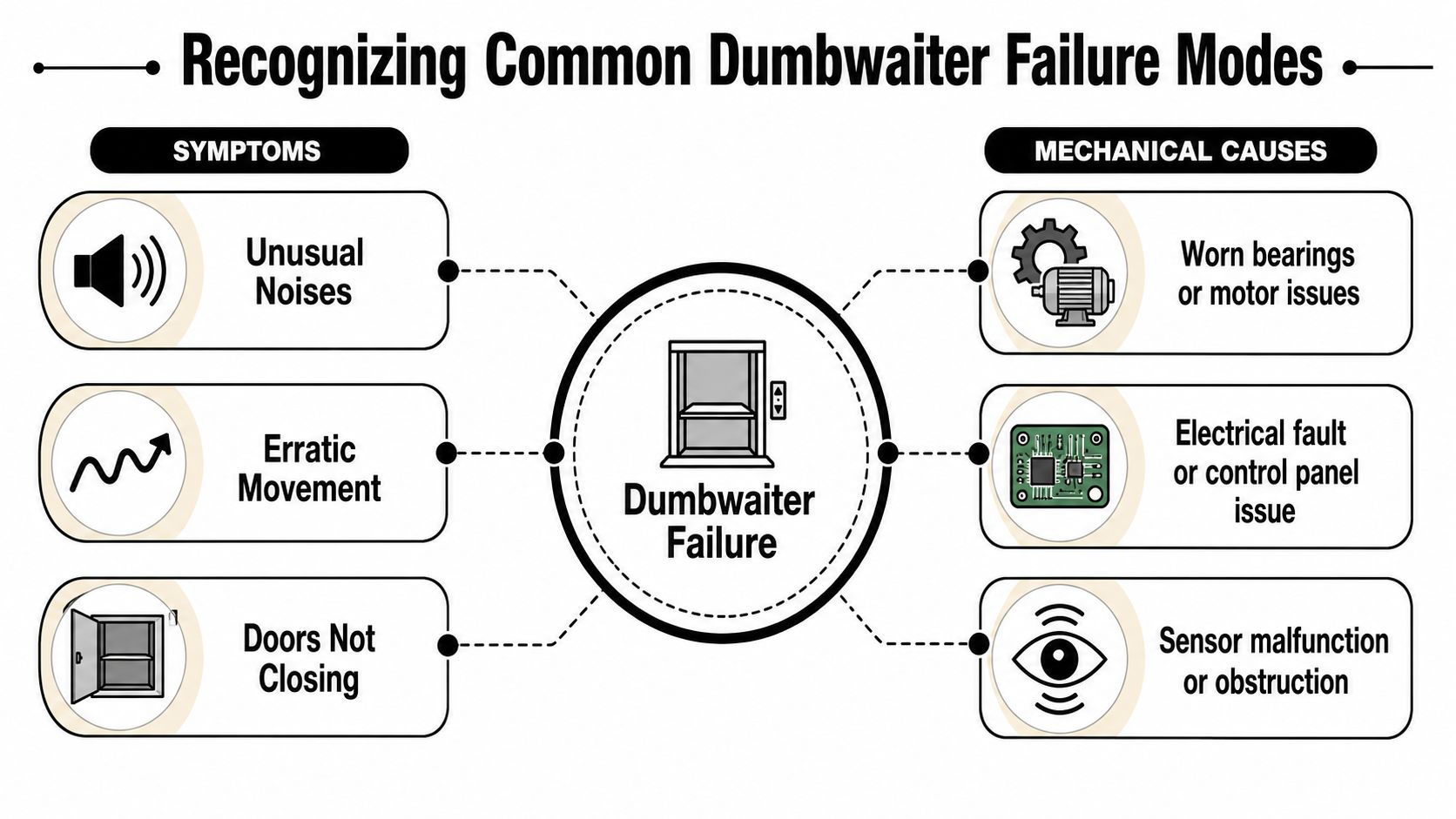
Most dumbwaiter failures give warning signs before the unit stops completely. The trick is knowing which symptoms point to wear, which suggest a control problem, and which mean the unit should be taken out of service until it's checked.
This visual lays out the common symptom-to-cause pattern.
What noises usually mean
A dumbwaiter that suddenly sounds different is telling you something specific.
- Grinding or scraping: Often points to contact where there shouldn't be contact. Think worn guides, debris in tracks, or components running out of alignment.
- Whining or strained motor sound: Often suggests the drive system is working harder than it should. That can come from drag, wear, or load problems.
- Rattling at stops or starts: Commonly tied to loose hardware, worn rollers, or door-related vibration.
Not every noise means imminent failure, but unexplained changes should be treated as maintenance calls, not background building noise.
Travel problems and door issues
When the car moves slowly, starts roughly, stops unevenly, or behaves inconsistently between floors, the cause is often harder to see than a bad door latch. Electrical faults, control issues, and worn mechanical parts can all show up as erratic movement.
Door problems are a separate category because doors and interlocks are critical to safe operation. If a landing door doesn't close cleanly, doesn't lock reliably, or needs to be pushed hard to secure, the issue may be obstruction, alignment drift, contamination, or a failing latch assembly. In practice, doors are often where users first notice trouble even when the underlying issue is elsewhere.
A symptom report that says “second-floor door sticks when the car leaves the first floor” is useful. A report that says “it's acting weird” isn't.
Here's a useful diagnostic shorthand:
| Symptom | Likely direction of the problem |
|---|---|
| Noise only during travel | Track, guide, drive, or debris issue |
| Noise only at start or stop | Motor, brake, mounting, or loose part |
| Uneven or hesitant movement | Control, electrical, or drag-related issue |
| Door won't close or latch | Obstruction, sensor, alignment, or lock problem |
For a general visual explanation of how failure symptoms connect to mechanical causes, this overview is useful:
When to stop using it
If the car is traveling erratically, a door isn’t securing properly, or the unit shows a repeating fault condition, stop using it and call for service. A dumbwaiter is not equipment you “nurse along” by using it more gently.
The best reports include:
- Exact floor where it happens
- Whether the car was loaded or empty
- What the sound or motion was
- Whether it happens every trip or intermittently
That level of detail helps a service mechanic isolate the problem faster and avoid trial-and-error repairs.
Navigating Safety Codes and Inspections in Michigan
In Michigan, dumbwaiter maintenance isn’t just about keeping the car moving. It also has to support compliance. That’s where many facility managers get caught off guard. They’ve been handling routine upkeep, but they don’t have the records, testing status, or correction plan needed when an inspection issue appears.
The biggest risk isn’t always the obvious malfunction. It’s the hidden compliance problem that sits in the background until an inspector finds it, a violation is issued, or an incident forces everyone to ask for documents.
Maintenance and compliance are not the same thing
Most dumbwaiter advice focuses on visible upkeep. Lubrication. Weight limits. Worn parts. Lock checks. Those are important, but they don’t automatically mean the unit is compliant. Guidance on dumbwaiters often misses the intersection with required inspections, safety testing, fire service, and jurisdiction-specific rules, even though the highest-risk failures are often deferred testing or hidden compliance issues that only surface during inspection or after a violation (dumbwaiter compliance and inspection considerations).
That distinction matters in Michigan cities with older building stock and mixed occupancies. A dumbwaiter in a healthcare, education, municipal, or mixed-use property may have a very different inspection burden than the manager expects. The same unit can appear to “work fine” while still carrying unresolved code exposure.
What Michigan managers should keep organized
If you manage buildings in Detroit, Grand Rapids, Ann Arbor, Lansing, or nearby communities, keep your dumbwaiter file ready before anyone asks for it. That file should support operation, inspection, and follow-up correction work.
A practical record set includes:
- Service history: What was inspected, cleaned, adjusted, or replaced.
- Testing records: Safety-related checks and any required follow-up.
- Violation or deficiency history: Open items, corrected items, and dates.
- Modernization notes: Any older components that may need updating.
- Communication trail: Who approved work, deferred work, or changed service scope.
Michigan property managers also benefit from reviewing broader elevator code requirements in Michigan when they’re aligning maintenance with inspection readiness. Dumbwaiters are smaller equipment, but the compliance mindset should be just as disciplined.
The question that protects you is simple. Not “Is it running?” but “Can I show that it’s been maintained, tested, and corrected properly?”
The real trade-off
A manager can save a little time by treating maintenance as an informal repair relationship. That works right up until the unit gets flagged. Then every missing record, delayed correction, or undocumented test becomes your problem.
The better approach is to run dumbwaiter maintenance as part of your building’s compliance program:
| Basic upkeep only | Compliance-centered maintenance |
|---|---|
| Fixes what users notice | Tracks what inspectors will ask for |
| Reactive service calls | Planned inspection readiness |
| Limited records | Organized service and test documentation |
| Short-term thinking | Insurability and risk control mindset |
That's the difference between a unit that merely operates and a unit that's defensible from a regulatory and liability standpoint.
Service Intervals and Lifetime Cost Management
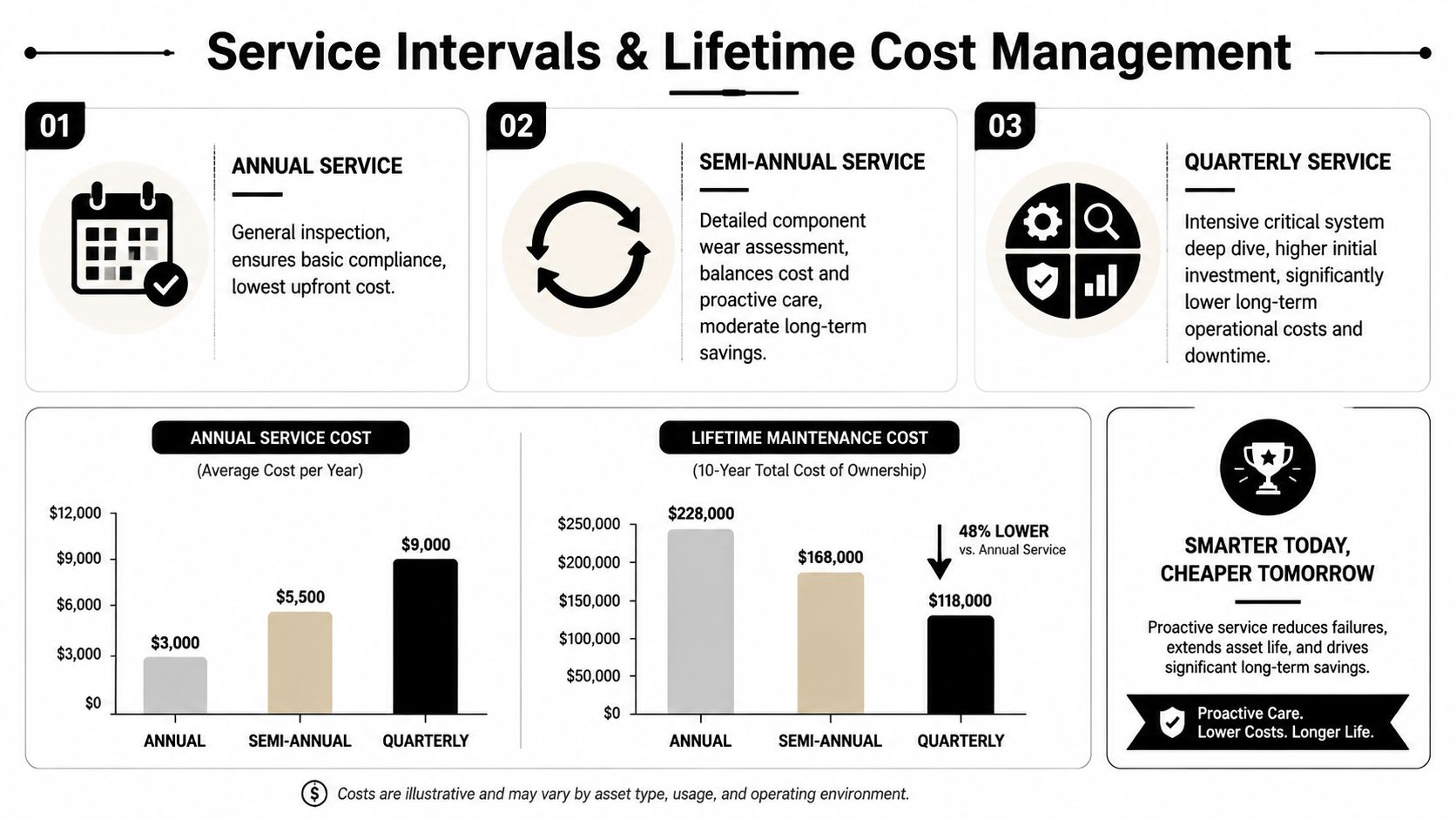
Service intervals shouldn't be chosen by habit. They should be chosen by use, environment, and consequences of downtime. A lightly used residential dumbwaiter may need a different service rhythm than a commercial unit handling constant deliveries in a busy building. The mistake is assuming every unit can be treated the same.
At a minimum, owners need a professional inspection cadence that matches the equipment's real workload. Beyond that, the right interval depends on how often the unit runs, what it carries, and how dirty the environment gets.
Matching interval to building use
A simple way to think about service planning:
- Annual service: Fits lower-use equipment where duty is light and conditions are clean.
- Semi-annual service: Makes sense where usage is steady and the building can't afford surprise downtime.
- Quarterly attention: Often justified in demanding commercial settings where contamination, load frequency, or operational dependence is high.
That doesn't mean every visit needs the same scope. Some are inspection-driven. Others focus more on cleaning, wear review, adjustments, and test preparation. What matters is consistency and documentation.
Why the budget argument usually favors maintenance
Industry pricing data commonly places annual dumbwaiter maintenance fees at $200 to $500, while electric system installation can range from $10,000 to $20,000 (dumbwaiter maintenance and installation cost ranges). That's the clearest financial case for preventive care. Routine maintenance is a modest operating expense compared with replacement, modernization, or avoidable major repairs.
If you need to frame that for ownership, the conversation is straightforward:
| Spending choice | Typical financial effect |
|---|---|
| Planned maintenance | Predictable operating cost |
| Deferred maintenance | Greater risk of disruptive repair and accelerated wear |
| Replacement or modernization | Large capital expense |
For broader budgeting context, it helps to compare dumbwaiter planning with general elevator maintenance cost considerations, especially when you're managing multiple vertical transportation assets in one portfolio.
Spending a few hundred dollars to maintain equipment is easier to justify than explaining why a neglected unit now needs a five-figure capital discussion.
A practical way to set intervals
Use these questions:
- How often is it used? Daily food or supply movement needs more attention than occasional residential use.
- What does downtime do to operations? If staff immediately lose a core workflow tool, tighter intervals make sense.
- What kind of dirt gets into the system? Grease, lint, dust, and moisture all shorten the gap between needed service.
- Is the unit aging? Older installations usually benefit from more frequent review because small issues stack faster.
The cheapest service interval on paper isn't always the lowest-cost strategy over the life of the equipment.
How to Choose a Professional Maintenance Partner
A dumbwaiter service provider should do more than show up when the unit stops. You want a company that can maintain the equipment, document the work, identify compliance risks, and avoid locking you into proprietary limitations that make future service harder.
That last point matters more than many owners realize. If the maintenance approach depends on closed parts access or brand lock-in, your future repair options get narrower and more expensive.

What a solid provider actually does
Look for a maintenance partner that can answer specific operational questions, not just quote a monthly fee.
Good questions to ask include:
- Do you service non-proprietary equipment across different makes and models?
- Do your visits include concealed area clean-downs, not just a quick operational check?
- Will you document deficiencies clearly and prioritize them by safety, compliance, and reliability?
- Can you support code-required inspections and follow-up corrections?
- Do you include small but recurring maintenance items such as lighting and door-related wear components where applicable?
A credible maintenance visit should involve inspection, cleaning, observation under operation, and written follow-up. It shouldn't be limited to pressing a button, riding the unit, and leaving.
Signs to avoid
Be cautious if a provider:
- Stays vague about scope: If they can't explain what gets checked, they probably aren't checking much.
- Pushes replacement before diagnosis: Some units need modernization. Many just need proper maintenance and targeted repair.
- Leaves no paper trail: If there's no written condition report, you're exposed later.
- Treats dumbwaiters like an afterthought: Smaller equipment still needs disciplined service.
One practical benchmark in Michigan is whether the contractor handles broader vertical transportation work with non-proprietary service methods and complete maintenance visits. For example, Crane Elevator Company states that its maintenance program includes clean-downs of machine rooms, pits, and car tops, supports code-required inspections, and uses non-proprietary solutions for all makes and models. That kind of scope is worth comparing against other providers when you evaluate proposals.
The right maintenance partner should make your equipment easier to manage, not more dependent on one company's limitations.
What to Expect from Crane Elevator Services
If you manage properties across Lower Michigan, the maintenance program you want is one that combines field service, inspection support, practical cleaning, and clear communication. That's what dumbwaiter care should look like in practice. Not a rushed stop, but a repeatable service process that helps the unit stay safe, functional, and inspection-ready.
For building owners in Detroit, Grand Rapids, Ann Arbor, Lansing, and surrounding areas, that usually means choosing a contractor who understands both equipment condition and the local compliance environment. A provider serving this market also needs to be comfortable with older installations, mixed-use buildings, and the difference between a quick repair and a recurring failure pattern.
What a complete service approach looks like
Based on the company profile, Crane's approach centers on preventive maintenance, responsive repairs, code-required inspections, non-proprietary modernization, and full clean-down work in the spaces many contractors skip. That matters for dumbwaiters because concealed dirt, wear, and deferred testing are where many long-term problems start.
Their service model also fits what many Michigan managers need from one contractor:
- Preventive maintenance for dumbwaiters and other lift equipment
- Repair capability for worn or failed components
- Inspection and testing support tied to code obligations
- Non-proprietary service so future maintenance flexibility is preserved
- Coverage across Lower Michigan through a regional field service footprint
Property managers looking at Michigan elevator service coverage and capabilities should pay attention to whether the contractor can support both day-to-day reliability and the paperwork side of compliance. That's where a lot of service programs fall short.
Why that matters in real buildings
A dumbwaiter in a hospital support area, school kitchen, office back room, or older downtown building doesn't fail in a neat textbook way. Problems overlap. Dirt causes wear. Wear affects doors. Door issues create shutdowns. Shutdowns lead to rushed service decisions. A disciplined maintenance program breaks that cycle.
The strongest service relationship usually has four qualities:
| Need | What you should expect |
|---|---|
| Responsiveness | Clear follow-up when issues are reported |
| Preventive focus | Attention before failure, not just after |
| Documentation | Usable records for managers and inspectors |
| Repair judgment | Targeted fixes instead of guesswork |
That's the standard to hold any dumbwaiter maintenance provider to.
If your dumbwaiter needs maintenance, inspection support, repair planning, or a second opinion in Lower Michigan, Crane Elevator Company can help you review the unit, identify risk points, and set up a practical maintenance path that fits your building.