
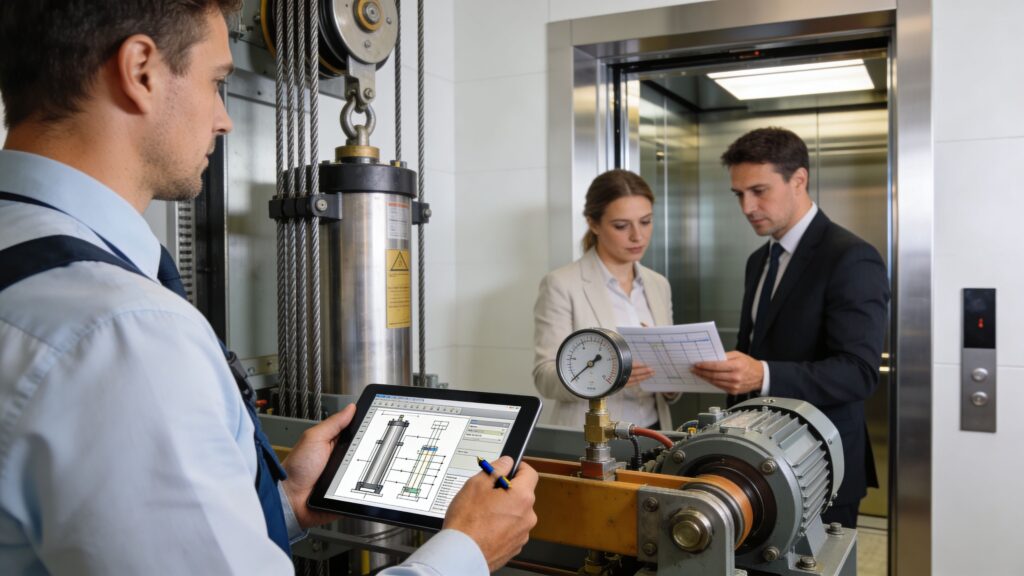
You usually find out about an Elevator Cat Test when something lands on your desk that was not in this month’s plan. It might be a maintenance proposal with “CAT 1 due,” an inspector request for a five-year test, or a question from accounting about why an elevator needs weights, witnesses, and extra downtime.
For Michigan building owners and facility managers, the confusion is understandable. “Cat” sounds like internal contractor shorthand. It is not. These are code-driven safety tests tied to specific elevator types, specific components, and specific intervals.
If you own or manage elevators in Detroit, Ann Arbor, Lansing, Flint, Kalamazoo, or anywhere else in Lower Michigan, the practical question is simple. Which test applies to your equipment, what does it check, and what happens if you miss it? The answer depends on whether you have traction or hydraulic equipment, how the unit is used, and how your local Authority Having Jurisdiction interprets the applicable code.
What Is an Elevator Category Test
An Elevator Cat Test is a periodic safety and compliance test required under the ASME A17.1 framework. The categories matter because each one checks a different part of the elevator system at a different interval.

A building owner does not need to memorize code sections to manage this well. You do need to know the purpose of each category:
- Cat 1 is the annual operational safety check.
- Cat 3 applies to certain hydraulic elevators and goes deeper into hydraulic system integrity.
- Cat 5 is the heavy-duty safety test that stresses critical braking and safety components.
Why the categories exist
Elevators are not static assets. Doors wear. Contacts drift out of adjustment. Hydraulic seals age. Brake performance changes over time. Safety gear that sits untouched for years is exactly the kind of equipment that must be tested before an emergency happens.
These tests are not paperwork exercises. They create a repeatable way to confirm that the elevator still does what the code expects it to do.
What building owners should take from it
Think about category tests in three layers:
- Routine operating safety
- System-specific integrity
- Emergency performance under stress
That is why one test is annual, another is tied to hydraulic equipment, and another is more invasive and less frequent.
Practical takeaway: If you are not sure which category applies, start by identifying the elevator type. Most scheduling mistakes happen because owners assume every elevator follows the same testing cycle.
The other point that matters in Michigan is local enforcement. National standards define the framework, but compliance becomes real at the state and local level. That means your contractor needs to know not just the code language, but how testing, documentation, and signoff are handled where your building sits.
Understanding Your Annual Cat 1 Elevator Test
Cat 1 is the test most owners encounter every year. It is best understood as the elevator’s annual physical exam. The unit is not loaded for this test. The goal is to verify that the elevator’s primary safety and operating systems work correctly under inspection conditions.
According to VSA Consulting’s explanation of CAT1, CAT2, and CAT5 witness testing, the Category 1 test mandates an annual no-load safety inspection. That same source notes there are over 1.03 million elevators in the U.S. handling 20.6 billion passenger trips yearly, and that elevator-related incidents kill about 30 and seriously injure 17,000 people annually in the United States.
What a Cat 1 test is checking
A proper Cat 1 is about day-to-day safe operation. The inspection typically focuses on whether the elevator behaves correctly during normal service and whether key protective devices respond as intended.
Common focus points include:
- Doors and interlocks: The elevator should not move when it should not, and doors must operate safely.
- Brakes and controls: The technician verifies basic stopping and control functions at inspection speed.
- Emergency features: Phones, alarms, lighting, and related features need to function when called on.
- Leveling and operation: The elevator should stop where it is supposed to stop and run predictably.
Why Cat 1 matters more than many owners think
Owners sometimes treat Cat 1 like a yearly formality because it is familiar. That is a mistake. Cat 1 catches the kind of ordinary deterioration that leads to service calls, entrapments, failed inspections, and nuisance shutdowns.
A few examples of what Cat 1 often helps expose:
- A door issue that has not caused a shutdown yet, but is trending there
- A brake or control issue that only shows up under inspection conditions
- Emergency communication equipment that everyone assumes works until it is needed
Tip: Schedule Cat 1 with enough room to correct deficiencies before your compliance window tightens. The test itself is only part of the job. The repair cycle after a failed item is what creates headaches.
What works and what does not
What works:
- Keeping maintenance records current
- Testing on schedule, not after a notice arrives
- Treating recurring minor issues as signs of wear, not isolated inconveniences
What does not:
- Waiting for a state inspection problem to discover a maintenance gap
- Assuming a quiet elevator is a healthy elevator
- Letting annual testing drift because the unit “seems fine”
For most buildings, Cat 1 is the baseline discipline that keeps everything else manageable. If the annual work is organized, the bigger category tests are easier to plan, document, and pass.
The Hydraulic System Deep Dive Cat 3 Testing
Cat 3 is where owners of hydraulic elevators need to pay close attention. This test is not a broad annual review. It is a deeper check of the hydraulic system itself, aimed at components that do the actual lifting and holding.

Under the ASME A17.1 framework, WA Elevator’s overview of elevator testing requirements states that for hydraulic elevators, Cat 1 is annual and Cat 3 is required every three years, with Cat 3 focusing on internal components like piping and cylinders.
Why Cat 3 exists
Hydraulic elevators have a different risk profile than traction elevators. Much of the concern is below the surface, inside the jack assembly, piping, valves, and related components. A hydraulic unit can run in a way that seems acceptable to occupants while a deeper pressure or leakage issue is developing.
Cat 3 exists because visual operation alone is not enough.
The test focuses on whether the hydraulic system can hold pressure and maintain integrity. That is important for both safety and long-term repair planning.
What owners of hydraulic elevators should watch for
Hydraulic equipment is common in lower-rise commercial buildings, residential applications, and some light commercial properties. If that sounds like your building, Cat 3 should not be treated as optional specialty work.
Issues that make Cat 3 important include:
- Pressure loss: A unit that cannot hold correctly may drift or behave inconsistently.
- Piping and cylinder concerns: These are not always obvious from normal riding conditions.
- Hidden leakage: Small leaks can turn into expensive repairs if ignored.
For owners evaluating system type, this overview of hydraulic elevators is a useful reference point when you are confirming what testing schedule applies to your equipment.
What a good Cat 3 process looks like
A strong Cat 3 process is methodical. The technician should know the unit, review prior history, and test with a clear understanding of what components are in scope.
Owners should expect:
- Review of the elevator’s maintenance and testing history
- Attention to the hydraulic circuit, not just car operation
- Clear notes about deficiencies, not vague language like “monitor condition”
Key point: Cat 3 is where hidden hydraulic problems stop being hidden. Owners who skip or delay it often end up paying for reactive repairs under worse conditions.
Common owner mistake
The most common mistake is assuming that if the car still runs, the hydraulic system must be healthy. That assumption fails often. Hydraulic problems can progress, especially in aging equipment. Cat 3 is designed to find that risk before it turns into a shutdown, a major repair, or a compliance issue.
The Five-Year Stress Test Cat 5 Full Load Inspection
Cat 5 is the test owners hear about and immediately ask, “Do we really have to do all of that?” In many cases, yes. This is the hard test. It is designed to push the elevator into a controlled worst-case scenario so critical safety components can be verified under stress.
Kencor Elevator’s explanation of full-load test requirements and procedures states that Category 5 full-load testing requires elevators to be loaded to 125% of rated capacity while operating at rated maximum speed. The same source explains that this overstress method is meant to identify latent failures in components such as governors, safeties, and emergency braking systems, and that failure to perform the test on schedule can result in the elevator being taken out of commission by the AHJ.
What Cat 5 is really proving
Cat 5 is not about ordinary ride quality. It is about proving that the elevator can protect people if something goes badly wrong.
If the brake system can stop the car under that heavier test condition, there is a safety margin built into normal operation. That is the logic behind the load and speed requirements.
Why traction owners need to plan ahead
For electric traction elevators, Cat 5 is the test that usually demands the most coordination. It takes planning, access, and often more downtime than a routine annual check.
Owners should plan for:
- Building coordination and notice to tenants or staff
- Test setup and, in traditional methods, load handling logistics
- Time for correction if a critical item fails
- Possible witnessing requirements depending on jurisdiction
What tends to go wrong in the field
Cat 5 becomes disruptive when owners leave it too late. The worst pattern is waiting until the testing deadline is close, then discovering one of the following:
- The elevator has unresolved maintenance issues
- A safety component needs adjustment or repair before testing
- The building has not planned for the service interruption
- Local requirements for approval or witnessing were not confirmed in advance
That is how a required safety test turns into a tenant relations problem.
Traditional full-load versus newer methods
Some Cat 5 testing still uses traditional weight-based procedures. In some jurisdictions, approved alternative electronic methods may be available. The decision is not just technical. It is also regulatory, because local authorities control what is accepted.
From an owner’s perspective, the trade-off is straightforward. Traditional methods are familiar and direct, but they can be more cumbersome. Alternative methods may reduce handling, wear, and disruption, but only if they are accepted by the applicable authority and appropriate for the equipment.
Practical takeaway: Cat 5 is not the test to schedule casually. Confirm the method, the authority’s expectations, the documentation path, and the condition of the equipment before the date is locked in.
Comparing Elevator Tests Cat 1 vs Cat 3 vs Cat 5
Owners manage category testing better when they stop thinking of it as a stack of similar inspections. Cat 1, Cat 3, and Cat 5 do different jobs. They sit inside the same safety framework, but they answer different questions.
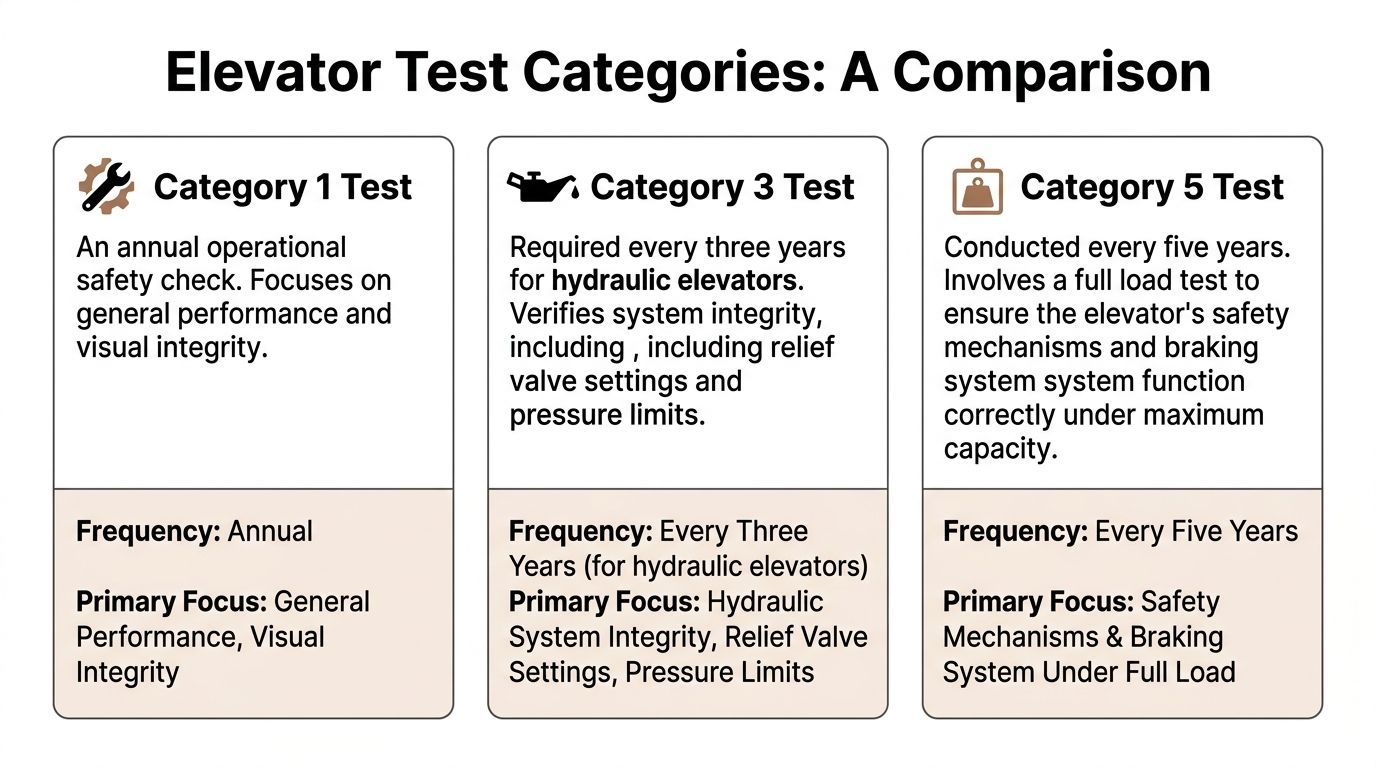
The framework itself comes from ASME A17.1. As noted in the earlier hydraulic section, the documentation side matters too. Test records must be kept in the Maintenance Control Program and on the metal test tag attached to the controller.
Elevator Category Test Comparison
| Attribute | Cat 1 Test | Cat 3 Test | Cat 5 Test |
|---|---|---|---|
| Primary purpose | Annual operational safety check | Hydraulic system integrity check | Full-load stress test of critical safety systems |
| Typical equipment | All elevators | Hydraulic elevators | Primarily traction elevators, with applicability depending on equipment and code requirements |
| Frequency | Annual | Every three years for hydraulic elevators | Every five years where required |
| Load condition | No-load | System-focused hydraulic testing | Full-load test condition |
| Main focus | Doors, brakes, controls, operating safety | Piping, cylinders, hydraulic components | Governors, safeties, braking, emergency stopping performance |
| Owner concern | Routine compliance and reliability | Hidden hydraulic issues | Life-safety verification and service disruption planning |
The fastest way to identify what applies
Use the equipment type first.
If your building has a hydraulic elevator, you are typically dealing with Cat 1 every year and Cat 3 every three years. If your building has traction elevators, Cat 1 remains in play, and Cat 5 becomes the major periodic event.
That sounds simple, but mixed portfolios create confusion. Many commercial buildings have different elevator types in the same property. One schedule does not cover all units.
Documentation is not optional
A lot of owners focus on the field test and forget the record trail. That is risky. If the work is done but not documented correctly, you can still have a compliance problem.
Keep an eye on these items:
- MCP entries: The Maintenance Control Program should reflect the test history clearly.
- Controller tags: The metal test tag matters during later inspections.
- Deficiency tracking: Repairs that arise from the test need closure, not just notation.
A useful rule for budgeting
Cat 1 belongs in routine annual planning. Cat 3 belongs in hydraulic asset planning. Cat 5 belongs in operational and risk planning because it can affect downtime, tenant communication, and scheduling more than the others.
That distinction helps owners stop underestimating the five-year test and overcomplicating the annual one.
Navigating Michigan Elevator Test Requirements
Michigan owners run into the same problem over and over. They find a national explanation of category testing, assume it settles everything, and then discover that local enforcement details still control the outcome.
That is especially true with Cat 5 methods and approval questions. According to the public review draft referenced by the National Elevator Industry materials, the frequency and approval for alternative electronic testing methods are ultimately determined by local Authorities Having Jurisdiction, and there is no centralized data clarifying these variations for Southern Michigan markets like Detroit and Ann Arbor. That lack of centralized clarity creates confusion, and non-compliance with local interpretations can lead to fines and public liability.
What this means in practice
Michigan compliance is not just about knowing the national category labels. It is about understanding how the applicable authority expects the test to be performed, documented, witnessed, and closed out.
That affects decisions such as:
- Whether an alternative electronic Cat 5 method will be accepted
- What supporting records need to be present on inspection day
- How deficiencies are reported and resolved
- Whether a local official expects a particular documentation format or sequence
For owners tracking upcoming regulatory changes, this summary of the Michigan elevator code deadline January 1st 2028 is worth reviewing alongside your current compliance planning.
Where owners get into trouble
The biggest mistakes are rarely technical. They are administrative and timing-related.
Common trouble spots include:
- Using generic national guidance only: Good background, not enough for local compliance.
- Late scheduling: Leaves no room to correct deficiencies.
- Poor records: A test done without proper documentation can still create exposure.
- Wrong assumptions about approvals: Especially on alternative methods.
Michigan-specific advice: Before any major category test, confirm acceptance requirements with the relevant authority and your contractor. Do not assume that a method accepted in another state or county will automatically be accepted for your building.
What works best for Michigan properties
The owners who stay out of trouble usually do three things well:
- They keep an accurate equipment list by type.
- They track category due dates well ahead of deadline pressure.
- They use a contractor who understands local code interpretation, not just elevator mechanics.
That local knowledge matters most when there is any gray area around testing method, witness requirements, or documentation details.
How Crane Elevator Manages Your Compliance
Most building owners do not struggle with the idea of elevator testing. They struggle with the logistics. Dates slip. Records live in different places. One unit is hydraulic, another is traction, and the person handling the property today did not inherit a clean compliance file.
That is where a testing partner earns their keep. A good one does more than dispatch technicians. They track intervals, prepare the site, identify likely failures before the test date, and keep the documentation trail clean.

What practical compliance support should include
For Michigan properties, solid compliance management usually includes:
- Deadline tracking: Knowing whether each unit is due for Cat 1, Cat 3, or Cat 5
- Pre-test review: Looking at condition and likely problem areas before the inspection date
- On-site coordination: Planning around tenants, staff, deliveries, and downtime
- Documentation control: Keeping records aligned with inspection expectations
- Repair follow-through: Closing deficiencies so the test result becomes a finished compliance item, not an open loop
When alternative methods may help
For some Cat 5 situations, alternative electronic testing methods may make practical and financial sense. According to Gunn Consultants’ discussion of traditional versus alternative elevator CAT 5 testing, these methods can reduce costs by 30-50% and minimize equipment wear compared with traditional full-load tests.
That does not mean they are automatically the right choice for every building. The method still has to fit the equipment and be acceptable to the local authority. But for owners trying to limit wear, avoid unnecessary disruption, and make better long-term maintenance decisions, the conversation is worth having.
If you need help evaluating testing options, scheduling, or records, Crane’s elevator testing company services outline the practical support side of compliance management.
What owners should expect from a contractor
A contractor should be able to answer these questions clearly:
- Which category test applies to each unit?
- What preparation is required from the building?
- Will the test require special coordination or witness approval?
- What happens if the unit fails a portion of the test?
- How will the records be logged after completion?
If those answers come back vague, that is a warning sign. Category testing is not the place for guesswork.
If your building is due for a Cat 1, Cat 3, or Cat 5 test, Crane Elevator Company can help you sort out what applies, what your Michigan property needs, and how to get it done without last-minute surprises. Reach out for a practical review of your equipment, testing schedule, and compliance records.