A tenant calls because the elevator doors kept reopening on the lobby floor. A delivery crew says the car hesitated again at the freight entrance. Your maintenance staff wipes down the entrance, resets the unit, and the problem seems to disappear until the next rush period. That pattern is common, and it usually points back to one small safety system that carries far more responsibility than most building teams realize.
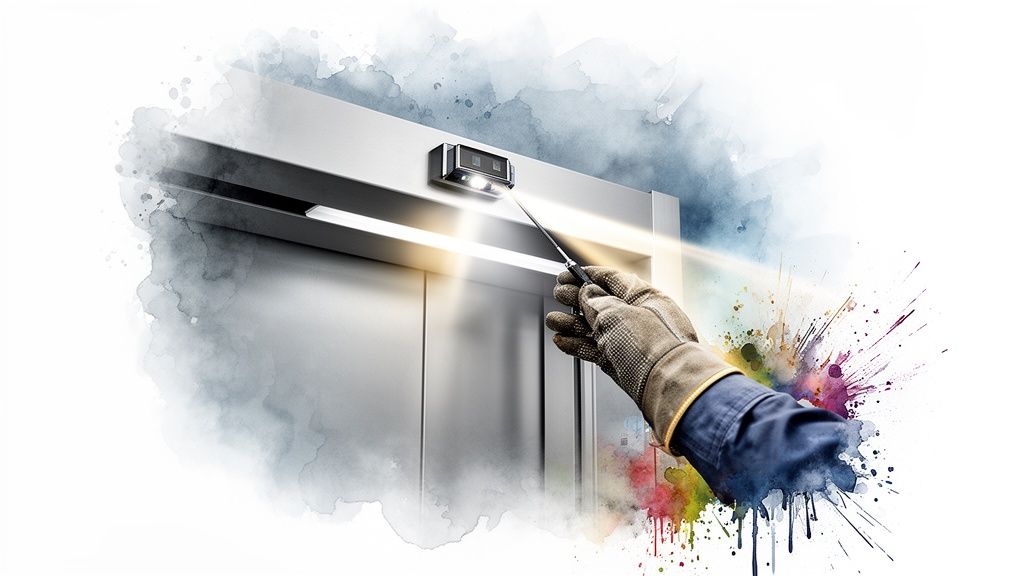
The elevator door sensor is not a convenience feature. It is the component that helps prevent door strikes, nuisance callbacks, shutdowns, and avoidable liability. In the field, it may also be called a door safety edge, door photo eye, or electric eye. Different mechanics and property teams use different names, but they are talking about the same job: detecting a person, cart, wheelchair, stretcher, or object in the doorway before the doors complete their closing cycle.
For building managers in Southern Michigan, that job has direct business consequences. In older office buildings, schools, medical facilities, municipal properties, and mixed-use sites, one weak door detection system can create repeated service interruptions. It can also turn a simple repair visit into a larger code and modernization discussion if the equipment is outdated, damaged, or incompatible with current safety expectations.
Your Building’s First Line of Defense An Unfailing Elevator Door
A smooth elevator ride means very little if the doors do not behave predictably. Passengers judge elevator safety first at the entrance. They notice slow reopening, door nudging, uneven closing, and false reversals long before they notice anything in the machine room.
That matters because door problems are not a niche issue. Door issues detected by elevator door sensors represent the leading cause of elevator breakdowns globally, accounting for 60-80% of all service callbacks in the industry, according to CEDES on turning elevator sensor data into actionable insights. When a building keeps getting elevator callbacks, the entrance should be one of the first places you look.
The names you will hear in the field
Property managers often hear several terms for the same protective function:
- Door safety edge refers to the protective detection system at the door opening, especially in older conversations about door protection.
- Door photo eye usually points to a beam-based detector.
- Electric eye is the plain-language term many tenants and maintenance staff use when they see or hear about an invisible beam.
- Elevator door sensor is the broad term that covers older and newer detection technologies.
Why managers in Michigan should care early
In Ypsilanti, Troy, Auburn Hills, and similar markets across Lower Michigan, elevators often serve mixed traffic. Office users, patients, students, carts, deliveries, and visitors all create different door timing demands. A sensor that barely works in a low-use setting will usually fail faster in a building with constant starts and stops.
Practical takeaway: If the doors are reopening randomly, closing on slow-moving passengers, or requiring repeated resets, treat it as a safety system problem first, not a nuisance complaint.
A good door detection setup protects people. A reliable one also reduces service noise in your building. Those are not separate outcomes. They are the same maintenance decision viewed from two angles.
How an Elevator Door Sensor Works
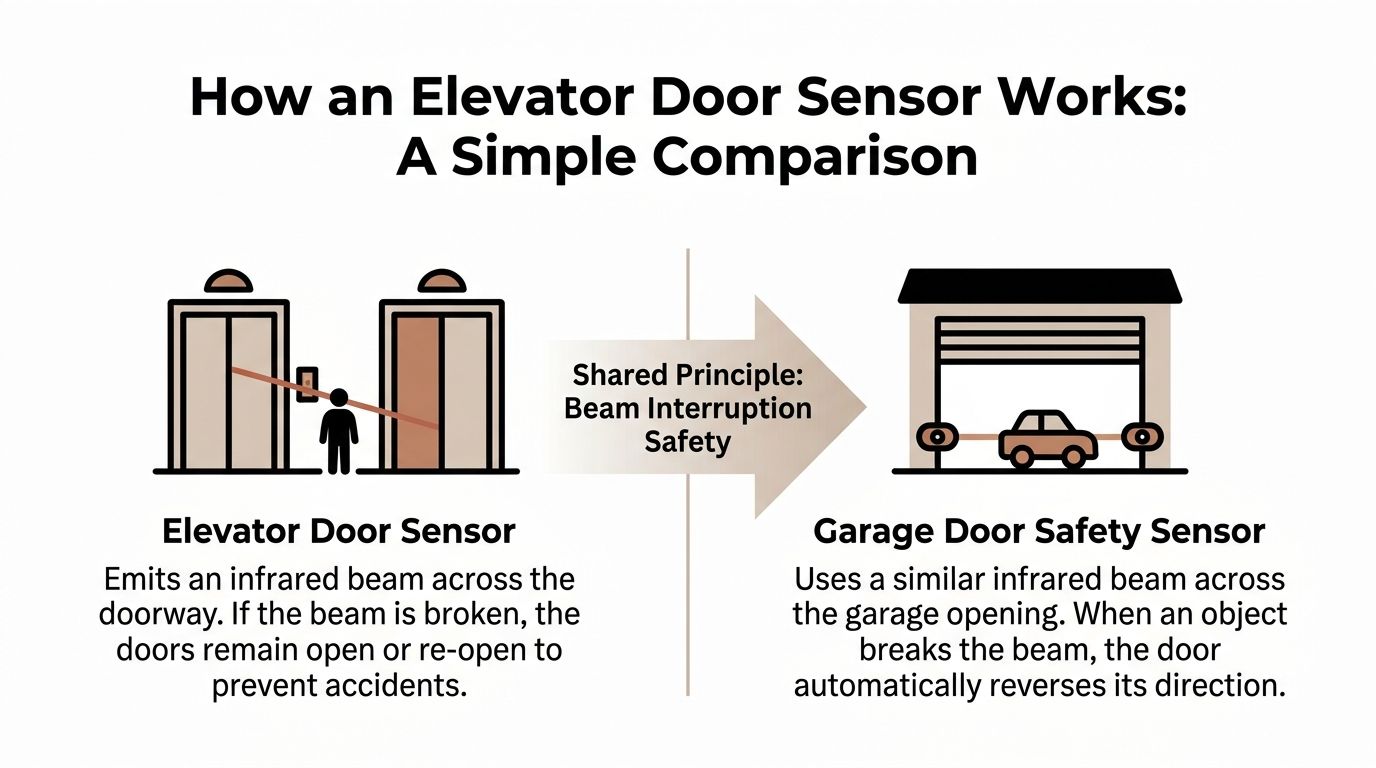
At a high level, an elevator door sensor works like the safety beam on a garage door. It creates a detection zone across the entrance. If a person or object interrupts that zone, the controller tells the doors to stay open or reopen.
The basic operating principle
People often understand a door photo eye or electric eye once they picture an invisible beam. The sensor sends or manages a detection field across the doorway. When that field is broken, the door operator gets a signal that someone or something is in the opening.
That sounds simple because the concept is simple. The hard part is making the detection field reliable across the full opening, through repeated cycles, with different lighting conditions, dirt levels, and passenger behavior.
What the controller is looking for
The door system is not just asking, “Is the doorway empty?” It is also dealing with motion, timing, and the closing sequence. A good sensor arrangement helps the controller decide whether to:
- Hold the doors open because someone is still entering
- Reopen the doors because something entered the opening after the close cycle started
- Complete the close cycle because the threshold is clear
Why some systems miss objects
Coverage is the primary issue. A simple beam can detect an interruption at one point. A more advanced system monitors much more of the opening. That is why older equipment may seem “fine” until a child, cane, cart corner, or package enters an area the sensor does not reliably cover.
Why names matter less than performance
Many service calls start with a building manager saying, “The electric eye is acting up.” That is useful shorthand, but what matters is the sensor’s detection pattern, alignment, and compatibility with the operator and controller.
Field rule: If passengers have to “beat the doors,” the system is not doing its job, even if the elevator still technically runs.
In practical terms, the elevator door sensor is the entrance’s decision-maker. When it reads the doorway correctly, the whole trip feels normal. When it reads badly, the elevator starts generating complaints, callbacks, and risk.
The Different Types of Elevator Door Sensors
A building manager usually notices sensor quality only after a complaint, a door strike, or an avoidable shutdown. In Michigan, that is the wrong time to find out the entrance is still protected by older, limited technology. Sensor type affects passenger safety, callback frequency, and whether you are spending money on repeated repairs instead of a clean upgrade.
The old starting point
Mechanical safety edges were common on older elevators. They reverse the doors only after the edge makes contact with a person, cart, or object. That may have been accepted on aging equipment years ago, but it creates obvious liability in a busy office, school, medical building, or public facility.
Basic photo-eye systems were a step up. They use one beam, or a small number of beams, across the opening. If that beam is interrupted, the doors react. The trade-off is limited coverage. A cane tip, child, box corner, or narrow cart can still fall outside the detection path, especially if alignment is off or traffic is unpredictable.
Where current practice starts
2D infrared light curtains are the standard upgrade on many passenger elevators because they monitor much more of the entrance. Instead of protecting one point, they create a multi-beam field across the doorway from low to high positions. For many Michigan commercial buildings, this is the practical baseline if the goal is fewer complaints, fewer nuisance shutdowns, and better protection at the threshold.
3D detection systems add another layer by watching movement in the approach zone, not just the flat plane of the opening. They are useful in hospitals, senior living properties, schools, and high-traffic office buildings where people stop short, enter in groups, or approach while the doors are already closing.
Elevator Door Sensor Technology Comparison
| Sensor Type | How It Works | Safety Coverage | Best For |
|---|---|---|---|
| Mechanical Safety Edge | Reverses after physical contact with the door edge | Limited, contact-based | Older equipment awaiting modernization |
| Basic Photo-Eye | Uses one or a small number of beams across the entrance | Narrow detection path | Lower-demand applications where conditions are controlled |
| 2D Infrared Light Curtain | Creates a multi-beam field across the door opening | Broad doorway coverage | Most commercial passenger elevators |
| 3D Detection System | Monitors the doorway and approach zone with adaptive sensing | Expanded coverage beyond a flat threshold line | High-traffic, higher-liability, and code-sensitive applications |
Choosing by ownership cost, not purchase price
The least expensive sensor assembly often becomes the most expensive option to own. Limited coverage leads to more door re-open events, more tenant complaints, more service calls for alignment or contamination, and more exposure if someone is struck at the opening. For a Michigan facility manager balancing uptime, insurance risk, and annual maintenance costs, those repeat losses matter more than the upfront part price.
That is why upgrades should be evaluated against total cost of ownership. A better sensor can reduce callbacks and help avoid the cycle of patching older proprietary equipment that is harder to source and slower to troubleshoot. Crane Elevator often recommends non-proprietary door protection options because they are easier to service, easier to replace, and less likely to lock a building into one manufacturer for routine repairs. If recurring door issues are already affecting tenants, a targeted elevator door repair service can determine whether adjustment is enough or whether the sensor package is the actual problem.
Matching the sensor to the building
Traffic pattern should drive the decision.
A low-rise residential building with light use may still function acceptably with a simpler setup, assuming the equipment is in good condition and code requirements are met. A hospital, university building, courthouse, municipal facility, or Class A office property should be evaluated to a higher standard because the cost of one missed detection is much higher.
Michigan managers also need to think about code compliance under ASME A17.1, inspection performance, and how the entrance behaves during winter conditions. Dirt, salt residue, moisture, and heavy coats do not create the same problems on every sensor type. More capable systems usually handle real building conditions better, which is why the right upgrade often saves money long after installation.
Diagnosing Common Elevator Door Sensor Problems
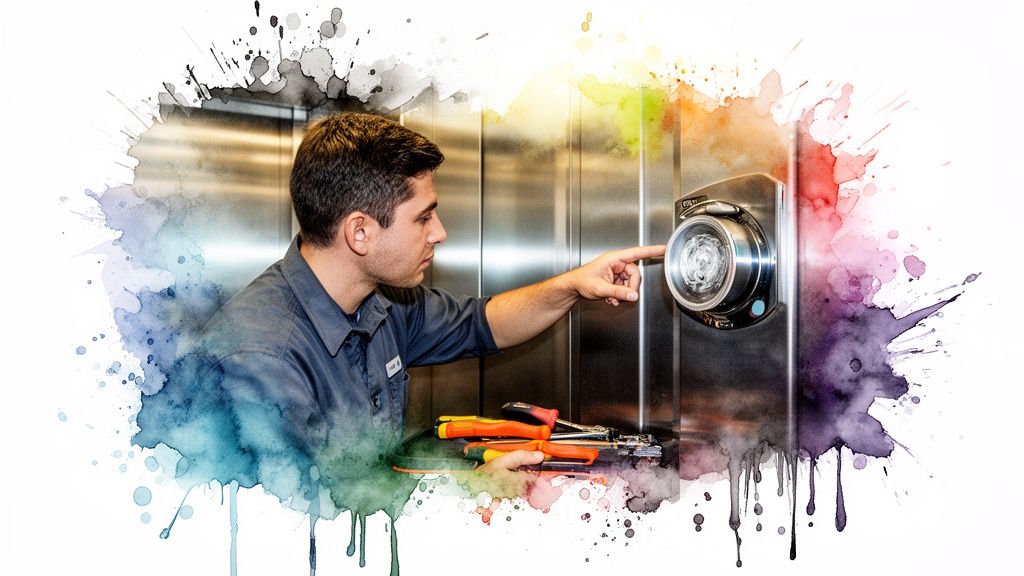
Most door sensor failures leave clues before the elevator goes fully out of service. The trick is knowing which clues matter and which ones point to a deeper fault in the operator, track, wiring, or controller.
A delayed response at the threshold is not something to put off. U.S. Consumer Product Safety Commission data from 2023-2025 reports over 1,200 elevator-related injuries annually, with door sensor malfunctions implicated in 15-20% of cases. A single entrapment lawsuit in Michigan can average $250,000 in settlements, as cited by Door Guys NYC’s discussion of automatic door sensor issues and how to fix them.
What you can check safely
A facility manager can do basic visual triage without taking apart equipment.
- Dirty lenses or covers often cause weak or inconsistent detection. Dust, tape residue, and cleaning product film can interfere with sensing surfaces.
- Visible misalignment matters when a beam-based system has been bumped, loosened, or vibrated out of position.
- Physical damage such as cracked housings, bent tracks, loose fasteners, or broken mounting points usually means the unit needs professional attention.
- Intermittent behavior is a warning sign. If the sensor works in the morning and fails later, the problem may involve wiring, vibration, door travel, or electronics.
Symptoms that usually point to the sensor path
Certain complaints repeatedly trace back to the entrance protection system:
- Doors close, then pop back open with no one present
- Doors do not reopen promptly when someone enters late
- Frequent nudging behavior or repeated close attempts
- Problems only at one landing rather than every floor
- Trouble after cleaning, remodeling, or hallway work near the entrance
If those symptoms sound familiar, start with a documented service call and photos of the entrance condition. That helps the mechanic separate environment issues from component failure.
For building teams dealing with recurring entrance faults, requesting a focused elevator door repair evaluation is often more useful than a generic service description.
Where the line is between triage and repair
Do not bypass, tape over, shim, or manually alter a safety detector. Do not ask maintenance staff to adjust electronics, change door force behavior, or defeat a fault so the elevator stays in service. Those choices create risk quickly.
A short visual explainer can help your staff understand what technicians are inspecting during a service call:
Call immediately after any passenger contact, entrapment, or repeated door strike complaint. Once an injury allegation exists, the issue is no longer a minor maintenance item.
Michigan Safety Codes for Elevator Door Sensors
Code discussions matter most when they affect an operating decision. In Michigan, the key issue for many building owners is whether the existing door detection system still aligns with current expectations for safety and modernization.
The rule that changed the conversation
The 2019 edition of the ASME A17.1/CSA B44 Safety Code now mandates 3D door detection on all new elevators, according to ATIS on elevator door detector light curtains and related door closing injuries. That requirement addresses a specific weakness. Traditional 2D systems have limited ability to detect obstructions in the final few inches of door closing, which is critical because that phase has unlimited closing force for the mechanical and electrical locking sequence.
For a facility manager, that is not abstract code language. It explains why an older detector can appear serviceable yet still leave a risky gap near final close.
Buildings in areas such as Ypsilanti, Troy, and Auburn Hills Michigan often have a mix of elevator vintages. Some properties have newer cabs with modern entrances. Others still run older controllers and door operators that have had piecemeal repairs over the years.
That mix creates three common code questions:
- New installation question. A new elevator must meet the current requirement.
- Modernization question. A major upgrade may trigger a broader compliance review of the entrance protection system.
- Existing equipment question. Even if an older elevator is not automatically forced into a full immediate replacement, owners still need to evaluate whether the current setup is acceptable from a safety and liability standpoint.
Compliance is also a budgeting issue
A door detector upgrade is often cheaper and cleaner when it is planned as part of a broader entrance or control update rather than after a shutdown, injury claim, or failed inspection item.
Managers tracking larger state requirements can also review Michigan elevator code deadline guidance in the context of long-term capital planning.
Good compliance planning starts with one question: Is this entrance merely operational, or is it defensible under current safety expectations?
That distinction matters in every sector, especially healthcare, education, municipal, and multi-tenant commercial buildings where slow-moving passengers and unpredictable traffic are routine.
Proactive Maintenance and Modernization for Door Sensors
A Michigan building manager usually sees the cost of a door sensor only after the entrance starts generating callbacks, tenant complaints, or a shutdown during a busy part of the day. By then, the actual expense is no longer the detector itself. It is technician time, lost elevator availability, frustrated occupants, and added liability if a passenger reports door contact.
Door sensors need to be managed as part of total ownership cost. In older buildings, especially those with mixed equipment vintages, a detector can still power up and still be the wrong fit for current traffic, door speed, or controller behavior.
What routine attention prevents
The entrance is a high-wear assembly. Dirt on the lens, loose mounting hardware, vibration, damaged cords, and minor alignment drift all show up first as intermittent complaints. Left alone, those small faults turn into repeat service calls and unnecessary parts swapping.
A maintenance program should check more than whether the sensor has power. It should confirm that the detector face is clean, the mounting is secure, the beams or field are aligned correctly, and the doors reopen properly under normal passenger traffic. In schools, medical buildings, senior housing, and multi-tenant commercial properties across Michigan, that last point matters. A detector that performs acceptably in light traffic often falls short once carts, deliveries, and uneven pedestrian flow enter the picture.
The goal is simple. Fewer nuisance calls, fewer shutdowns, and a safer entrance that holds up under inspection and daily use.
When repair makes sense and when modernization wins
Repair is usually the right call when the detector is current, replacement parts are available, and the fault is isolated to the sensor or its wiring. Modernization makes more financial sense when the unit is obsolete, callbacks keep returning, or the detector is only one weak point in an aging entrance package.
As noted earlier, market pricing shows the usual trade-off. Basic sensing devices cost less upfront than advanced light curtains or 3D detection. The less expensive option can still cost more over time if it misses traffic conditions in the building and drives repeated labor, tenant disruption, and after-hours service. That is the part many owners underestimate.
I advise facility teams to look at three questions before approving another repair. Has this entrance had repeat door complaints in the last year? Are parts becoming harder to source? Would a code review under ASME A17.1 put the current setup under pressure during modernization planning or after an incident? If the answer to any of those is yes, the decision is no longer just about a small part.
Non-proprietary planning reduces future lock-in
For Michigan owners with multiple properties, proprietary sensor packages can create avoidable cost later. A locked-in system limits who can service it, narrows parts options, and can turn a straightforward entrance repair into a vendor-specific problem.
That is why many owners choose elevator modernization services for non-proprietary equipment planning when door faults keep returning. Crane Elevator Company handles that work along with inspections, emergency repairs, violation correction, safety tests, emergency phones, fire service, generator testing, hydraulic and traction repairs, and non-proprietary modernization for all makes and models.
A good rule is straightforward. If you have already replaced entrance components more than once and the results do not hold, treat the opening as a system problem, not a sensor problem.
When to Call a Professional Elevator Service
Some door issues can wait for the next scheduled visit. Others should trigger a same-day call. The difference comes down to safety exposure and repeat behavior.
Call a professional elevator service if you see any of the following:
- Passenger contact with the doors at any landing, even if no injury was reported at the time
- Recurring reopen or non-detect complaints that return after cleaning or resets
- Visible damage to the detector, wiring, door edge, track area, or entrance components
- Intermittent failures that appear only during busy periods, deliveries, or certain floor stops
- A recent entrapment or emergency release
- A pending inspection, violation notice, or code-driven upgrade question
- An older detector on a heavily used entrance where performance is no longer acceptable
A qualified elevator contractor should evaluate more than the sensor itself. The technician needs to consider the detector type, beam coverage, mounting, door operator performance, controller response, and whether the opening should be repaired or modernized.
For properties in Ypsilanti Michigan, Troy Michigan, Auburn Hills Michigan, and the wider Lower Michigan region, that also means choosing a service partner that can support the full elevator lifecycle, not just swap one component. Door sensor issues often connect to broader needs such as preventative maintenance, inspections, modernization planning, door lock monitoring, machine replacement, hydraulic work, freight elevator service, wheelchair lift service, and after-hours emergency response.
If you need a practical review of an elevator door sensor problem, code-related entrance upgrade, or recurring door callback in Lower Michigan, contact Crane Elevator Company. They provide 24/7/365 elevator service, repairs, inspections, non-proprietary modernizations, and support for commercial, municipal, healthcare, industrial, residential, and specialty lift equipment across the region.