
When an elevator stops, the technical failure is only part of the problem. The true challenge begins when people are waiting, tenants are calling, deliveries are delayed, and someone on your team has to decide whether this is a short interruption or the start of a liability event.
That's why elevator emergency repair has to be managed as an operations issue, not just a maintenance ticket. The global emergency elevator repair market was valued at USD 7.97 billion in 2024 and is projected to reach USD 13.47 billion by 2032, with a projected 7.9% CAGR through 2032, according to Intel Market Research on the emergency elevator repair market. Building owners rely on vertical transportation more than ever, and when a car goes down, the pressure to get it moving again can push people toward the wrong kind of fix.
The hard part isn't just getting the elevator back in service. It's deciding whether the repair in front of you solves the actual failure or just gets you through the day.
What to Do When the Elevator Stops
The first rule is simple. Treat every shutdown as a safety event until you know otherwise. That applies whether the complaint is a stalled car, doors that won't open, poor leveling, a repeated fault reset, or a nuisance shutdown that keeps clearing and coming back.
In the first few minutes, your job isn't to diagnose the controller or guess whether it's a door lock, relay, encoder, or hydraulic issue. Your job is to stabilize the situation. That means confirming whether anyone is inside, restricting access to the affected landing, and making sure building staff doesn't try a homemade rescue.
Start with people and access
If passengers are inside the car, establish communication immediately. Use the in-car phone if it's working, the door if you can speak through it, or building staff stationed at the landing. Keep instructions short and calm. Tell them help is on the way and tell them not to force doors, climb, or try to exit without trained responders.
If the car is empty, lock down the area anyway. A shut-down elevator becomes a public hazard fast when someone presses a hall call, opens a landing door illegally, or assumes the car is operating normally.
A practical first response looks like this:
- Confirm occupancy: Find out whether anyone is trapped, injured, panicking, or medically vulnerable.
- Secure the landing: Post staff, place the car out of service, and stop public access.
- Record the basics: Note the car number, floor position if known, symptoms reported, and time of failure.
- Call qualified help: Don't send a handyman, security guard, or maintenance generalist into the hoistway or machine space to improvise.
Practical rule: The fastest bad decision in an elevator shutdown is trying to save time with an unqualified reset or forced door opening.
Don't confuse movement with resolution
A lot of bad repair outcomes start with one sentence: “Can you just get it running for now?”
Sometimes a reset does restore service. That doesn't mean the fault is gone. If the underlying problem is still present, the elevator may fail again during peak traffic, while carrying a patient, moving a cart load, or serving an accessible route in a public building.
The right question isn't “How fast can this be turned back on?” It's “What failed, what was done, and what confirms it won't recur under load?”
That mindset changes everything. It affects the service call you place, the work authorization you approve, the report you ask for, and whether the next outage becomes avoidable or inevitable.
Your Immediate Emergency Response Protocol
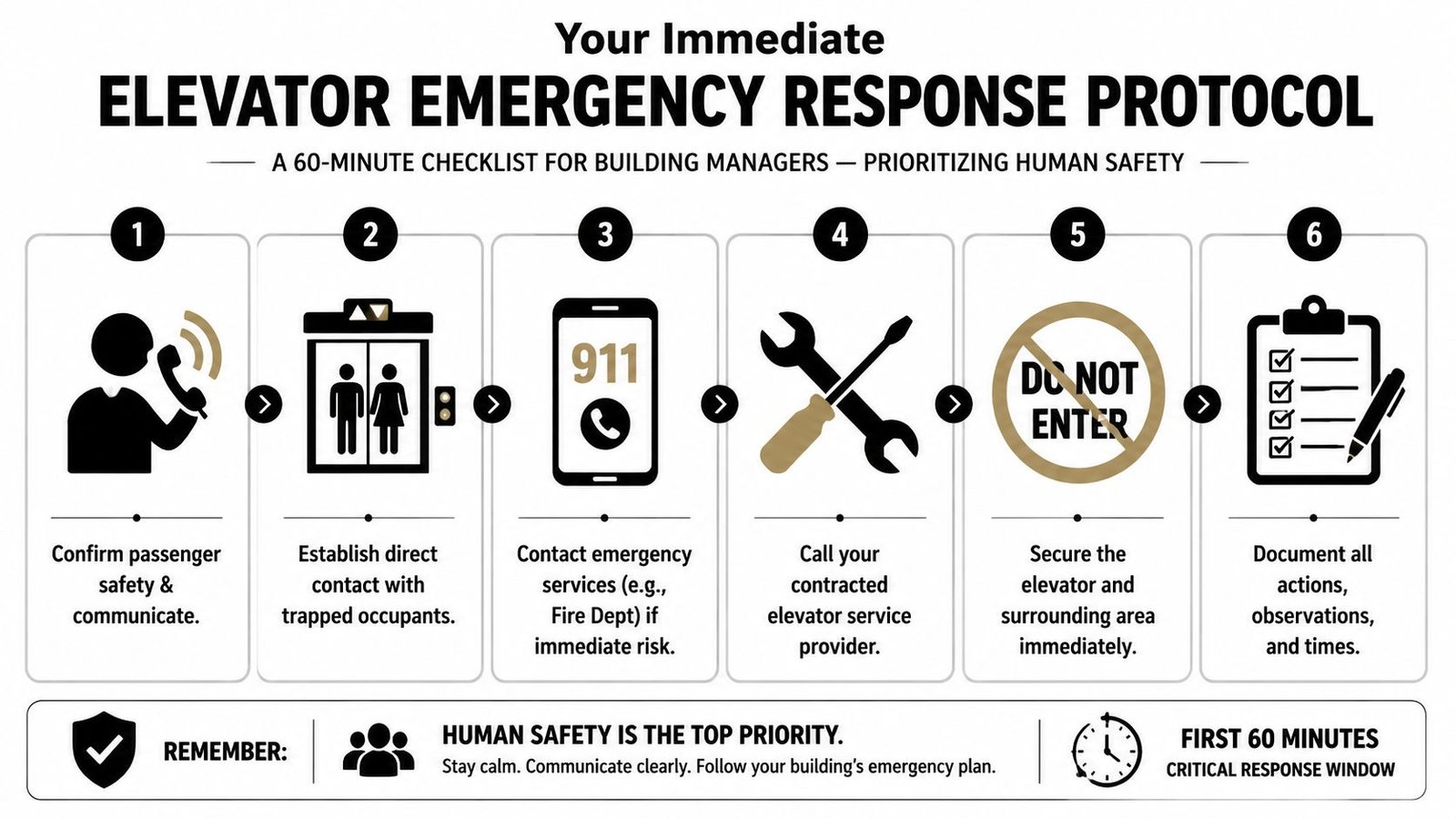
The first hour matters most when passengers are trapped or the elevator is serving a critical function in the building. Staff needs a repeatable response, not guesswork.
What building staff should do first
Start with communication. If someone is inside the car, keep contact active and confirm whether there's a medical issue, heat issue, mobility concern, or visible distress. If there's any immediate risk, call emergency services first.
Then call your elevator contractor. For entrapments, the response expectation is not casual. Industry benchmarks require licensed technicians to reach entrapment sites within 60 minutes of contact, according to this elevator specification document covering emergency response requirements.
If you need a model for what a dedicated response line should look like, review a provider offering 24/7 emergency elevator service and compare that standard against your current contract.
A workable first-hour checklist
Use this sequence with your on-site team:
Verify whether it is an entrapment
Don't assume the car is empty because no one answered right away. Confirm.Keep occupants informed
Tell them help is coming. Ask them to stay away from the doors and remain still.Call emergency services if health or fire risk exists
Shortness of breath, chest pain, panic, smoke, flooding, or a vulnerable passenger changes the response.Call the elevator service provider
Give the car number, building address, whether it's an entrapment, the floor location if known, and what the car did before it stopped.Secure the surrounding area
Keep traffic away from the affected landing and prevent anyone from using the disabled unit.Document time and actions
Write down who called, when they called, symptoms reported, and who responded.
Don't let anyone pry doors, jump circuits, or “help the car re-level.” That turns a controlled outage into a rescue incident.
What staff should never do
Some mistakes repeat in every property type. They're common because people mean well.
- Don't force landing doors: That can expose an open hoistway or create an unsafe gap.
- Don't cycle power casually: A power reset without diagnosis can complicate the fault and erase useful clues.
- Don't let occupants self-evacuate: Misleveling and unseen car movement make that dangerous.
- Don't rely on verbal summaries later: Write the timeline while it's happening.
An organized response shortens the event, protects passengers, and gives the technician a cleaner starting point when they arrive.
The Professional Repair Process Demystified
An elevator can be put back in motion fast and still be one trip away from another shutdown. That is the gap facility managers need to watch during an emergency call. A temporary reset or quick adjustment may restore service for the hour. It does not always remove the fault that stopped the car in the first place.
What happens when the technician arrives
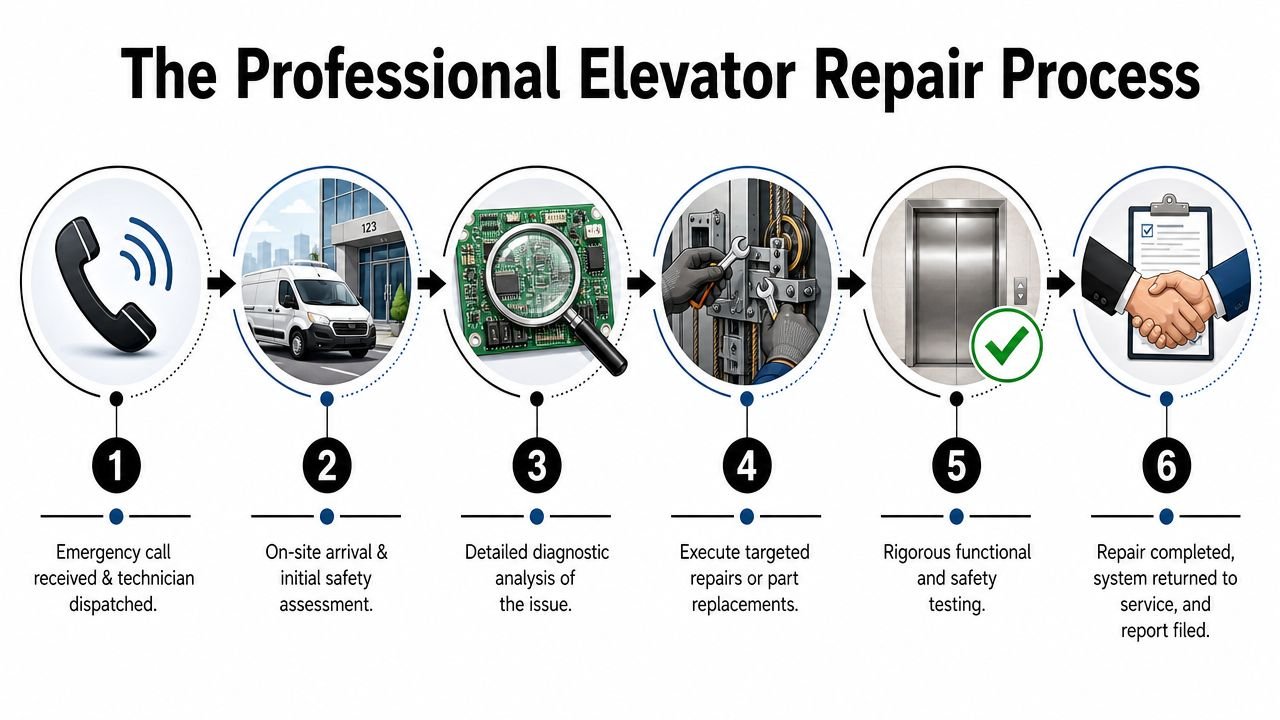
The first job is control of the risk. The technician verifies the car location, confirms whether there was an entrapment, secures the unit from use, and checks whether the machine room, controller space, pit, and top of car can be accessed safely. If the outage involved smoke, water, heat, impact damage, or repeated unexplained movement, the repair path changes immediately because the hazard profile changes.
After that, the work becomes diagnostic, not cosmetic.
A competent mechanic starts by identifying the first failure in the sequence, not the loudest symptom. That usually means reviewing fault history, checking safety circuits, inspecting door equipment, and testing whether the problem appears only under travel, only at a landing, or only after the car warms up. Intermittent faults are the ones that produce repeat callbacks, because the elevator may run normally during a short inspection and fail again under regular building traffic.
The practical questions are straightforward:
- What failed first?
- Did a protection circuit trip for a legitimate reason?
- Is the problem in the door system, controller logic, brake circuit, drive, or field wiring?
- Did the shutdown protect the passengers from a larger problem?
Why a band-aid fix often becomes an expensive callback
A reset has its place. If a known nuisance fault occurs, the technician may need to restore operation briefly to observe the unit and capture better diagnostic information. But a reset is not a repair plan.
The trade-off is simple. A quick restart may reduce immediate disruption for tenants, patients, staff, or visitors. It can also send a car back into service with an unstable door lock circuit, drifting door operator, weak relay, failing encoder feedback, or brake issue that has not been proven under load. The business result is familiar. Another outage, another after-hours invoice, another complaint, and more scrutiny if the same unit keeps trapping passengers.
I tell managers to ask one question before approving a closeout: was the failed part or condition identified, or was service only restored?
Good emergency repair isolates the failure path, corrects it, and proves the fix under operating conditions.
That proof matters because elevators hide root causes. A car that stops at random may have a door circuit dropping out on vibration. A car that mislevels may have a brake, encoder, or control issue, not just a floor-stop adjustment problem. Replacing the visible part without confirming the upstream cause is how small outages turn into repeat shutdowns.
What should be verified before return to service
Returning the car to service requires more than seeing it make one successful trip. The technician should run the unit enough to confirm that the original fault is gone and that no related safety function was affected during the repair.
A solid closeout usually includes these checks:
| Verification point | What the technician is confirming |
|---|---|
| Door operation | Doors open and close correctly, protective devices respond properly, and no lock or reversal fault appears |
| Multi-floor travel | The car answers repeated calls in both directions without dropping out or faulting mid-run |
| Leveling | The car stops accurately at the landing and holds position without drift |
| Brake response | The brake releases and sets correctly during normal operation |
| Emergency systems | Communication, alarms, and other required safety features are functioning |
Ask for the plain-language version of the repair if the report is too thin. Facility managers do not need every wiring detail, but they do need to know three things: what failed, what was done, and why the technician believes the problem is resolved instead of temporarily masked.
If those answers are vague, you may have service restored. You may not have reliability restored.
Common Causes of Elevator Emergencies
At 8:15 on a Monday, the elevator is still answering calls. By 8:40, it is out of service, tenants are lining up at the stairs, and someone is asking whether a quick reset will get the car back online. That is how many emergency calls start. The visible symptom looks small until it turns into a shutdown.
The key question is whether you are dealing with a one-time interruption or a fault that has been developing for weeks. A reset, minor adjustment, or temporary bypass can restore service fast. It can also hide the underlying failure long enough for the same car to drop again under heavier traffic. For a facility manager, that is the true cost issue. One invoice is manageable. Repeat outages, complaints, accessibility disruption, and after-hours callouts are where the expense starts to climb.
The faults managers see first
Passengers and building staff usually report behavior, not diagnosis. That is still useful. They report what the car did.
If the elevator kept reopening its doors, stopped unevenly at the floor, hesitated on startup, or went out of service after a reset, those details help narrow the fault path. They also help separate a symptom-level repair from a root-cause repair. For example, a door that reopens repeatedly may need track cleaning. It may also be reacting to a weak operator, a failing lock circuit, or unstable power. Buildings with aging electrical infrastructure should also review how outage recovery and elevator backup power systems affect controller behavior after a power event.
Common elevator faults and resolutions
| Symptom / Fault | Common Cause(s) | Typical Repair Action |
|---|---|---|
| Doors keep reopening or won't close | Dirty tracks, sensor misalignment, failing door operator components, door lock circuit issues | Clean and inspect tracks, recalibrate or replace sensors, adjust or replace door components, test door lock circuit |
| Car stops mid-travel | Controller fault, intermittent electrical issue, input loss, faulted relay or wiring issue | Review fault logs, perform circuit testing, isolate unstable electrical path, repair or replace affected control components |
| Car mislevels at the floor | Wear, adjustment drift, sensing issues, braking or control-related faults | Verify leveling operation, inspect related components, correct adjustment or replace failed parts, retest under repeated runs |
| Slow start or inconsistent movement | Hydraulic or traction-related component wear, motor or pump concerns | Inspect drive-related components, correct worn parts, verify smooth starting and travel during test cycle |
| Repeated nuisance shutdown after reset | Temporary reset masked deeper fault, unresolved root cause in door or control system | Run full diagnostics, review repeat fault history, repair underlying cause instead of repeating reset |
| Car taken out of service after safety concern | Safety circuit issue, brake concern, emergency system problem | Keep unit offline, inspect relevant safety devices, perform full functional testing before return to service |
What these patterns usually mean
Door faults produce a large share of emergency calls because doors take the most cycles. Debris in the track, worn rollers, drifting sensors, and weak operator performance can all trigger intermittent faults before the car fails outright. A quick cleanup may restore operation. If the technician does not confirm why the doors started faulting in the first place, the same call often comes back.
Control and electrical faults are usually more expensive because they are harder to pin down. The car may fail only under load, only at certain floors, or only after a brief power disturbance. Those are the jobs where a band-aid fix creates the most trouble. Resetting the controller, replacing one relay, or tightening one loose connection may get the unit running, but it does not prove the unstable circuit, failing board, or upstream voltage issue is gone.
Repeatedly “different” symptoms on the same car often point to one unresolved cause.
Treat that pattern seriously. If one month it is door trouble, the next month it is misleveling, and after that it is a mid-run stop, ask whether those events share a common source in the control system, brake response, encoder feedback, or power quality. Good emergency repair solves the failure chain, not just the last part that stopped working.
From Reactive Repairs to Proactive Reliability
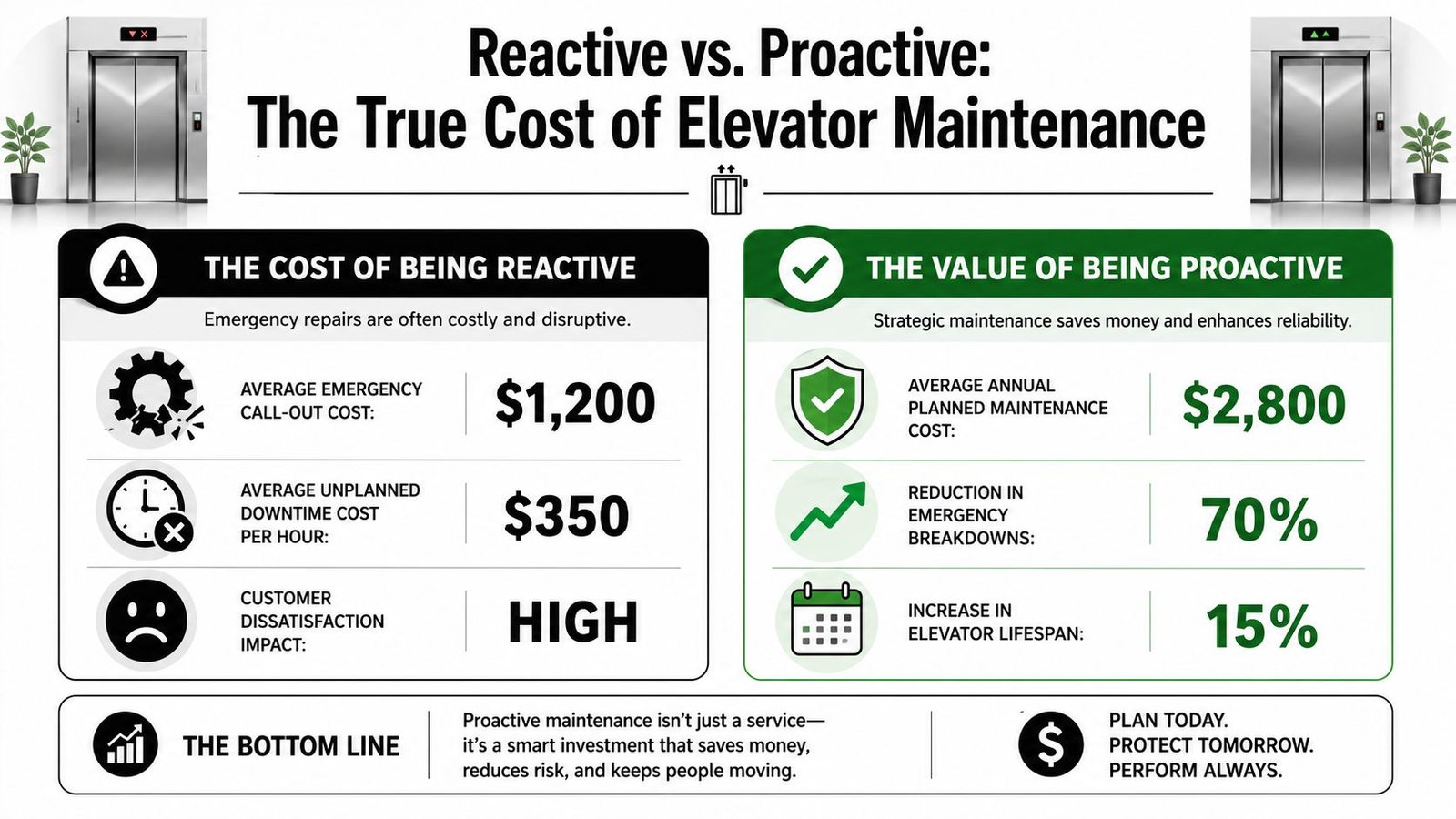
Emergency repair is expensive in ways most budgets don't show clearly. The invoice is obvious. The harder costs are service disruption, occupant frustration, accessibility problems, overtime coordination, and the management time spent chasing the same unit again.
The broad maintenance picture is already clear. Elevators break down an average of four times per year, and over a 20-year lifecycle, proactive preventive maintenance costs 30 to 40 percent less than a reactive, repair-only approach, according to eWorkOrders' elevator maintenance article.
What proactive maintenance actually changes
Preventive work is not just lubrication and a clipboard signature. Good maintenance reduces the number of emergency conditions that develop in the first place. It catches door problems before passengers get trapped. It identifies worn components before they trigger nuisance shutdowns. It verifies emergency systems before a crisis exposes a failure.
A stronger maintenance program usually includes:
- Cleaning where faults start: Machine rooms, pits, car tops, tracks, and components that collect dust, debris, or moisture.
- Watching repeat offenders: Door locks, contacts, hydraulic packing, relays, switches, bulbs, and communication devices.
- Testing safety functions: Not just whether the car moves, but whether it stops, levels, communicates, and responds correctly.
- Reviewing call history: Recurring shutdowns are patterns, not random bad luck.
Why reactive budgets drift upward
A repair-only strategy feels cheaper until the same unit starts drawing repeated calls. That's because emergency work tends to focus on restoring service under time pressure. When the building only authorizes the minimum correction each time, unresolved wear stays in place.
This is also where backup systems matter. A building that depends heavily on elevator availability should review whether elevator backup power systems are part of its resilience plan, especially where outages affect access, operations, or safe evacuation procedures.
Here's the practical difference between the two approaches:
| Approach | What usually happens |
|---|---|
| Reactive only | Faults are handled one event at a time, recurring issues linger, and the same car tends to reappear on the service log |
| Proactive program | Known wear points are inspected routinely, patterns are caught earlier, and emergency calls become less disruptive |
Owner's view: If a car only gets attention when it fails, you aren't controlling maintenance. The failure is controlling you.
The strongest maintenance contracts don't promise a world with no breakdowns. They reduce avoidable ones, shorten the serious ones, and make post-call decisions smarter.
When Repairs Arent Enough The Case for Modernization
A car goes back into service after an emergency call, then fails again two weeks later for a different reason. On paper, those look like separate events. In the field, that pattern usually points to an aging system that can still be patched, but no longer holds a repair for long.
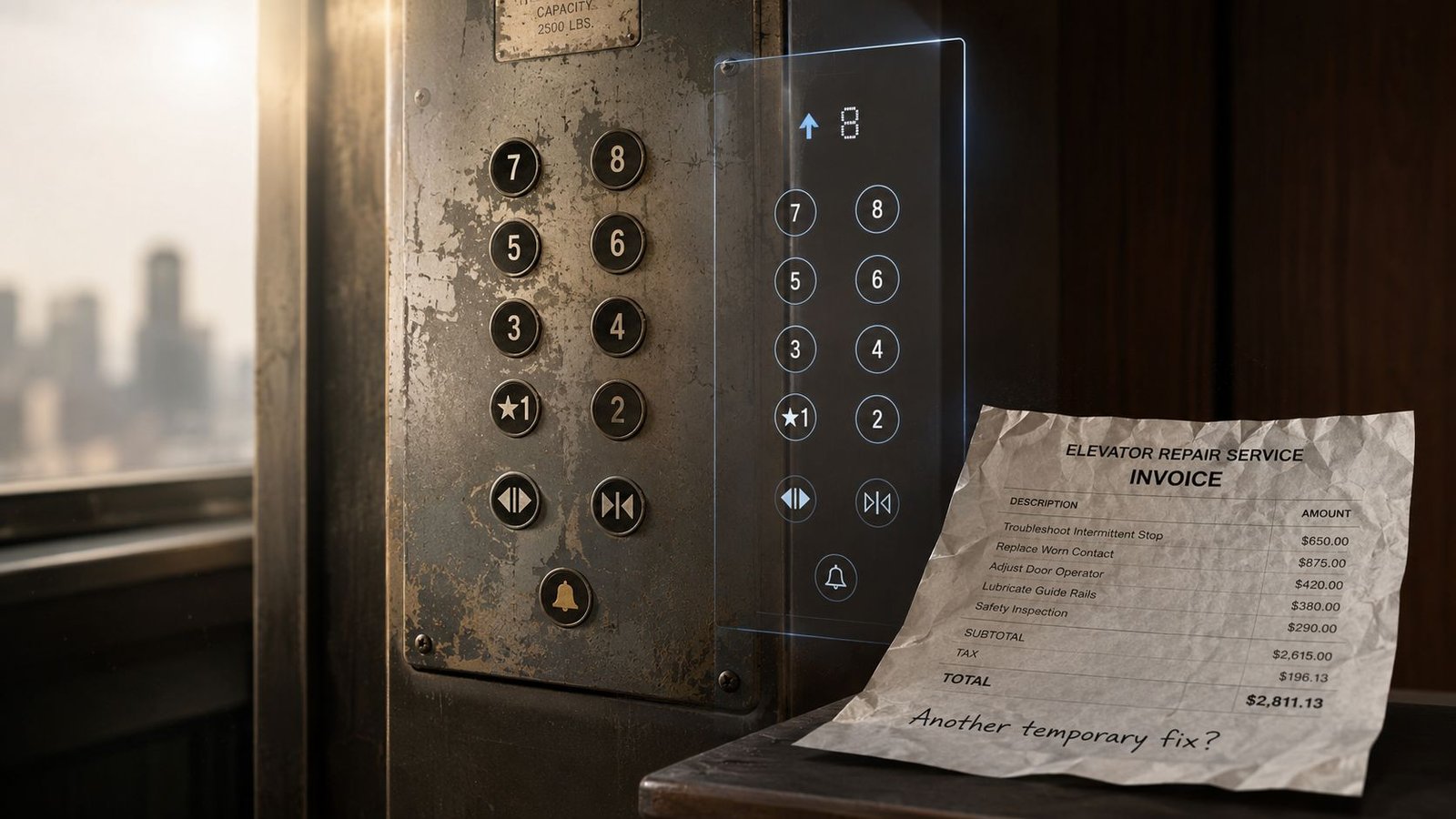
That is the point where facility managers need to separate a service restoration from a real correction. A temporary fix has a place during an active outage. People need the car back, the building needs access restored, and some failures do require immediate stabilization first. But if the same elevator keeps coming back onto the service log, the cheaper-looking decision often becomes the expensive one. You pay for repeat callouts, tenant complaints, disrupted traffic, and more exposure to shutdowns during inspections or peak occupancy.
Modernization becomes a business decision before it becomes a mechanical one.
Signs the building is paying for the same problem repeatedly
Older equipment can often be kept running. The question is how much instability, delay, and repeat labor the building is willing to keep buying.
Watch for these patterns:
- Recurring shutdowns with shifting fault descriptions: One month it is a door issue, the next month it is a controller fault, then a leveling complaint. The symptom changes, but the car remains unreliable.
- Obsolete or hard-to-source parts: A repair may still be possible, but lead times, aftermarket substitutions, and used components increase risk and cost.
- Ride and landing performance that keeps drifting: Rough starts, poor leveling, nuisance door reversals, and frequent adjustments usually mean wear is no longer isolated to one part.
- Inspection and code friction: The elevator returns to service, but every test cycle or inspection seems to expose another weak point.
- Service tickets built around resets and adjustments: If reports repeatedly mention resets, re-calibration, temporary bypasses, or return visits, the system is being kept alive, not made reliable.
Communication equipment often shows the same age problem. If the car station is outdated or unreliable during an emergency, upgrading elevator emergency phone systems should be part of the modernization discussion, not a separate afterthought.
The band-aid test
Before approving another repair, ask the contractor for direct answers to five questions:
- What failed?
- What caused it to fail?
- Was the underlying cause corrected, or was service merely restored?
- What condition in the rest of the system could cause the same failure again?
- At what point does replacement or modernization cost less than repeated emergency response?
If those answers are vague, the building is probably buying time instead of reliability.
I tell owners to look at repeat emergency work the same way they look at a leaking roof. If the patch holds through the next storm, that has value. If the leak keeps returning from different spots, the roof system is the issue. Elevators are no different. Once controls, door equipment, dispatch logic, wiring, and safety devices start aging together, isolated repairs stop producing stable results.
Modernization is not automatically the right choice for every old unit. It does make sense when the repair path no longer gives predictable uptime, parts support is getting worse, and each emergency call carries more operational and compliance risk than the last one.
Your Elevator Emergency Preparedness Checklist
Most buildings don't fail because nobody cares. They fail because the response plan lives in one person's head, the service records are hard to find, and nobody notices the difference between a one-off outage and a recurring pattern until the next entrapment.
Keep this checklist in active use
Documentation
- Post the emergency contact number: Put your elevator service number where front desk staff, maintenance staff, and security can see it.
- Keep service history accessible: Store logs, inspection records, and recent repair reports where managers can reach them quickly.
- Identify each unit clearly: Make sure staff can tell the contractor exactly which car is down.
Process
- Train staff on first response: They should know who calls, who secures the area, and who communicates with trapped occupants.
- Prohibit self-rescue attempts: Make this a written building rule, not a judgment call.
- Review technician reports: Don't just file them. Look for words that suggest temporary restoration instead of permanent correction.
Planning
- Audit repeat calls: If the same car keeps appearing, ask for a root-cause review.
- Check emergency communication equipment: Confirm the car phone or related communication setup is functional. If you need to review upgrade options, look at elevator emergency phones.
- Budget for more than the call-out: Leave room for diagnostic work, corrective parts, and, when needed, deeper capital planning.
A prepared building handles elevator emergencies better because the team knows what to do before the outage happens. That lowers confusion, shortens response time, and reduces the chance that a quick fix turns into a standing problem.
If you need a second opinion on recurring shutdowns, a maintenance plan that reduces emergency calls, or a modernization path for aging equipment, talk with Crane Elevator Company. Their team serves Lower Michigan with 24/7/365 response, preventative maintenance, repairs, testing, and non-proprietary modernization support for all makes and models.