
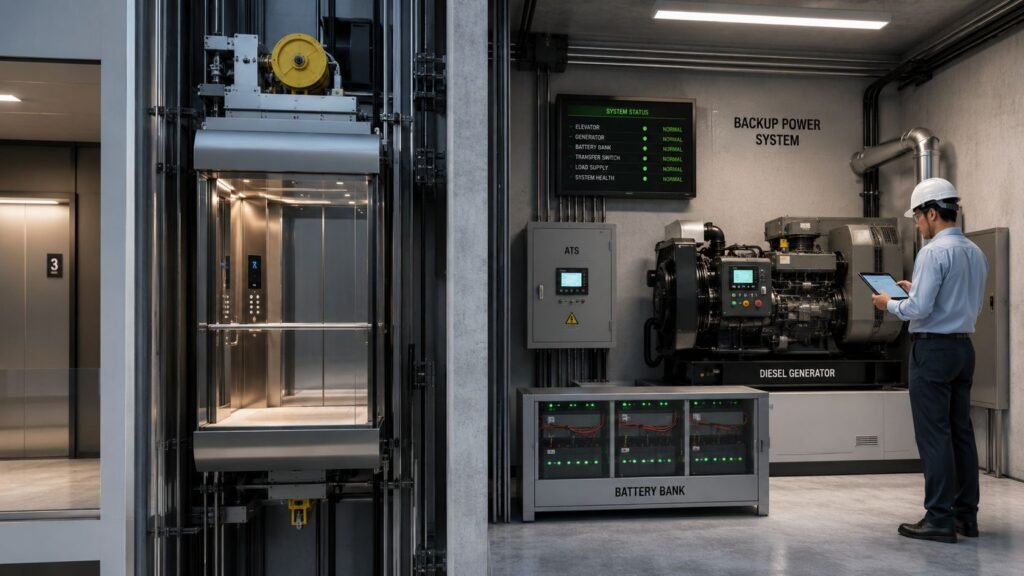
A storm rolls through. Utility power drops. The lobby goes dark for a moment, emergency lights come on, and within seconds your phone starts buzzing. A tenant is asking whether the elevators are still usable. A staff member wants to know if someone is trapped. Your maintenance team is trying to figure out whether the backup setup will just lower the cab, keep one car running, or fail a code inspection the next time the AHJ reviews the building.
That's the moment when elevator backup power stops being an electrical detail and becomes an ownership issue.
For property owners, elevator backup power systems sit at the intersection of safety, code compliance, tenant experience, and operating cost. If the system is wrong, undersized, poorly integrated, or poorly maintained, the problem shows up fast during an outage. If it's right, people exit safely, critical functions stay online, and your building behaves the way occupants expect it to.
Most confusion starts with bad assumptions. Owners hear “battery backup” and think the elevator will keep running normally. They hear “generator ready” and assume the quoted load includes everything tied to elevator operation. It often doesn't. The key decision isn't just generator versus battery. It's what level of operation your building needs, what the code requires, and what that choice will cost to own over time.
Keeping Your Building Moving During a Power Outage
In a small residential building, a power outage usually turns into one urgent question: can the elevator get people out safely? In a larger commercial property, the question changes: which life-safety functions stay online, which cars are prioritized, and whether the building can still support accessible movement and emergency response.
That difference matters.
A backup power system for an elevator isn't there to make outages convenient. It's there to keep a bad situation from becoming a dangerous one. People inside the cab need lighting, communication, and a predictable response. Building staff need to know whether the car will return to a landing, whether standby power will support recall functions, and whether the system matches the way the building is used.
What owners usually get wrong
The biggest mistake I see is treating backup power as an accessory. It's not. In many applications it's part of the building's basic safety design.
Owners also tend to focus on the purchase price and skip the operating picture. They compare one quote against another without asking:
- What exactly is backed up: Is the system only intended to lower the cab to the nearest floor, or does it support continued elevator operation?
- Which loads were included: Did the design account for controls, lighting, communication, fans, and related equipment?
- How the system transfers: Is there a clean, tested transition from utility power to standby power?
- What happens in an extended outage: Will the system still meet code-required emergency functions after the first few minutes?
Practical rule: If a vendor can't clearly explain what the elevator does in the first seconds, first minute, and first hour of an outage, the proposal isn't complete.
The business side of a safety system
A failed backup strategy shows up in more than one place. You can end up with trapped passengers, frustrated tenants, inspection trouble, and emergency service calls that could have been avoided. On the other hand, a properly designed system gives building staff a predictable playbook during a utility failure.
That's why this decision needs to be made like an owner, not like a shopper. You're not buying a box. You're buying a response.
Generators vs Battery Backup Systems Explained
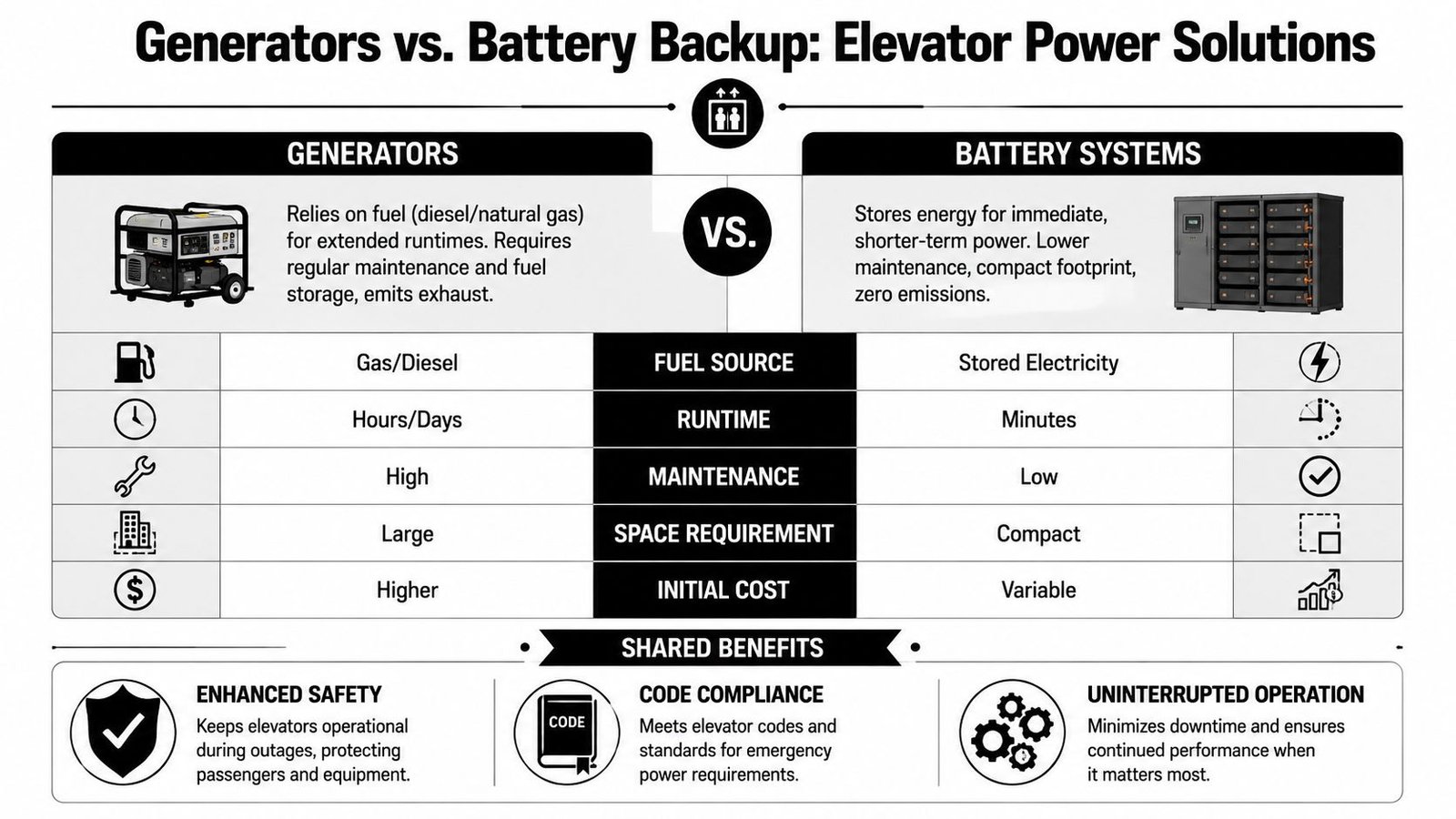
The cleanest way to think about this is simple. A generator is a small power plant for the building. A battery or UPS-based system is a controlled emergency bridge. They solve different problems.
What a generator does well
A generator is the right answer when the building needs sustained standby capability. Larger buildings, buildings with multiple elevators, and buildings using elevators as part of accessible egress usually land in this category.
The code side is clear. IBC Section 1009.4 mandates that elevators serving as an accessible means of egress in buildings with four or more stories must have standby power, typically from a generator. Fire service access elevators and occupant evacuation elevators also have standby power requirements tied to normal and standby supplies under the IBC provisions cited in the verified data.
In practical terms, a generator can support:
- Continued operation: One or more elevators can remain available based on the design sequence.
- Longer outages: Runtime depends on the generator system and fuel supply.
- Broader building support: The same standby system may support other life-safety and building loads.
Generators are strong, but they're not simple. They need fuel management, ventilation, testing, and coordination with transfer equipment. They also take space and introduce real maintenance obligations.
What battery backup does well
Battery systems, often built around a UPS or rescue device logic, are usually intended to prevent entrapment. They respond instantly when utility power drops. In many residential and light-duty applications, that means the car moves to a landing and opens the doors.
That's where owners need to slow down and ask better questions.
NEC Section 700.12 mandates that batteries for elevator emergency power must supply connected emergency circuits for a minimum of 1.5 hours, which means emergency lighting, control systems, and communication devices must remain supported for that duration under the code requirement described in the verified data. That does not mean a battery system will keep the elevator running like normal for 1.5 hours.
Most residential battery systems are built for safe landing, not full ongoing service. Owners hear “backup” and picture normal operation. The equipment often isn't designed for that.
Side-by-side trade-offs
| System type | Best fit | Main strength | Main limitation |
|---|---|---|---|
| Generator | Larger commercial buildings, multi-story properties, accessible egress applications | Supports extended standby operation and higher loads | More space, more maintenance, more integration complexity |
| Battery or UPS | Residential elevators and smaller applications | Instant transition and controlled safe landing | Usually not intended for full continued operation during long outages |
The detail that separates good specs from bad sales talk
Some UPS systems are built specifically for elevator service and can be configured for the elevator's load profile. According to PowerRide technical specifications from Perfect Power Systems, modern elevator emergency power systems may use UL924/UL1778-certified bidirectional UPS units and can provide up to 120 minutes of backup power, which exceeds the code minimum in the verified data. Those systems also emphasize custom configuration for elevator inrush demands rather than generic off-the-shelf sizing.
That sounds good, and in the right application it is good. But custom UPS equipment still isn't a blanket replacement for generator-backed standby power in buildings where code or load demands require a generator.
The right question isn't which technology sounds newer. The right question is what your building must do when the grid goes away.
How Backup Power Integrates with Your Building
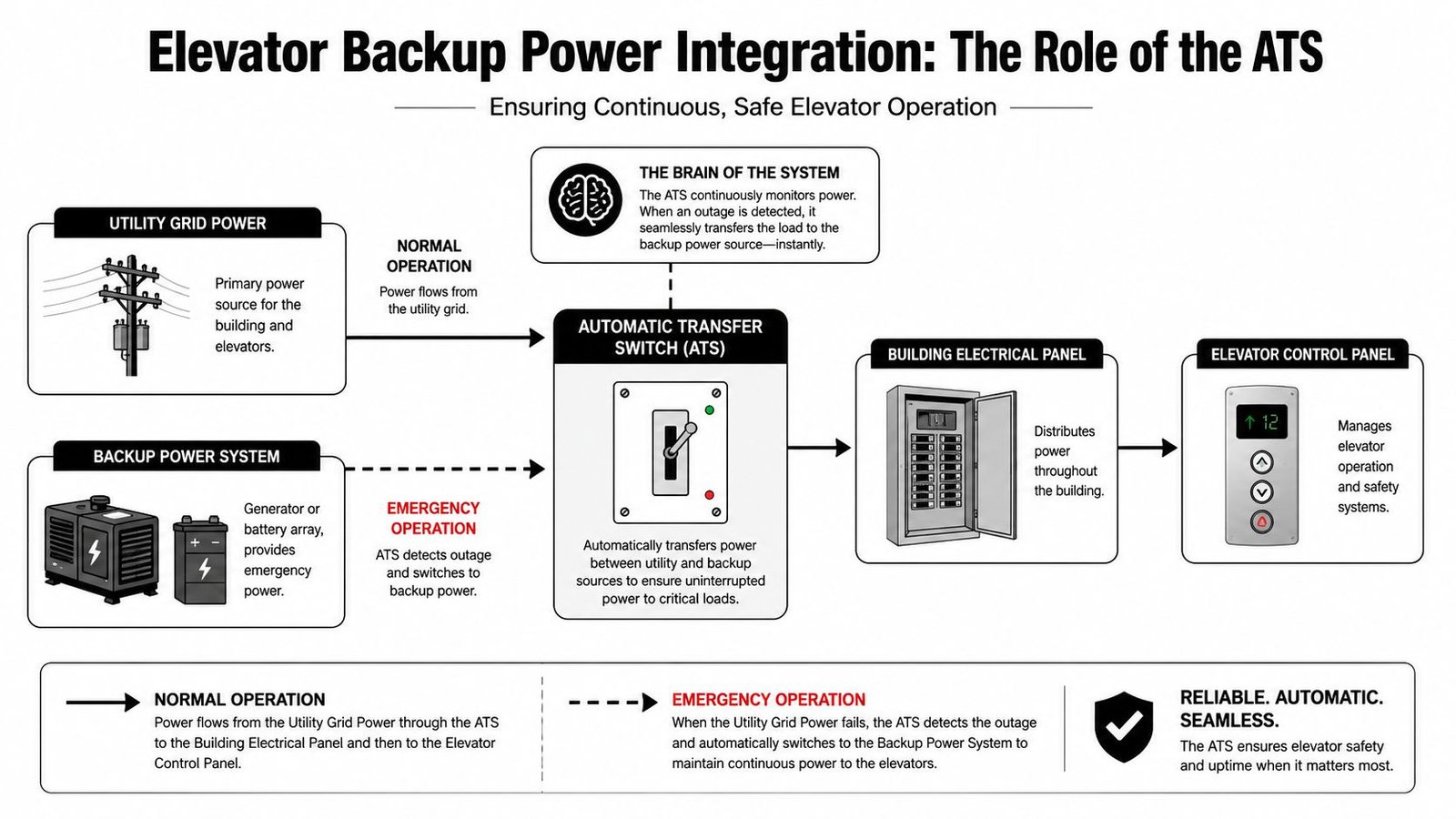
Most owners think about the elevator machine first. The transfer path matters more. Backup power only works if the building can detect the outage, transfer the load correctly, and feed the right circuits in the right order.
That's where the Automatic Transfer Switch, or ATS, comes in.
What happens during a power failure
A good standby setup follows a sequence. If you understand that sequence, you can spot weak specifications before they become field problems.
Utility power fails
The ATS senses loss of normal power.The standby source responds
If the building uses a generator, the generator starts and comes up to acceptable output. If the building uses a UPS-based setup for emergency circuits, the transition is immediate for those supported loads.The ATS transfers the load
Power shifts from the normal source to the standby source once the system is ready.The elevator controller follows programmed logic
Depending on the design, the elevator may perform recall, safe landing, limited operation, or standby service sequencing.Emergency functions remain available
That includes the functions that keep occupants safe and help responders do their job.
It's more than the motor
Owners get into trouble when they size or evaluate backup power around motor horsepower alone. The elevator depends on a network of devices, not just the drive machine.
That usually includes:
- Cab lighting: So passengers aren't left in the dark
- Emergency communication: So trapped occupants can call for help
- Control circuits: So the system can execute its emergency logic
- Fans and related cab loads: Depending on the system design
- Recall and safety functions: Especially where fire service operation is involved
The elevator controls are the traffic director in this whole event. If you want to understand how the logic side ties into power behavior, it helps to review how modern elevator controls coordinate car movement, door operation, and emergency response.
Where integration fails
The weak points are usually not dramatic. They're coordination issues.
If the electrician, generator supplier, and elevator contractor aren't working from the same sequence of operation, the building may have “backup power” on paper and poor elevator behavior in real life.
I've seen buildings where the standby source was present, but the transfer timing, load priority, or control programming didn't match the intended emergency function. That's why integration testing matters just as much as equipment selection.
Navigating Elevator Backup Power Codes and Testing
Code language can get dense fast, but the owner-level decision is straightforward. Your building has to provide the level of emergency elevator performance the adopted code requires. That requirement changes by building type, height, and elevator use.
The three code families owners need to understand
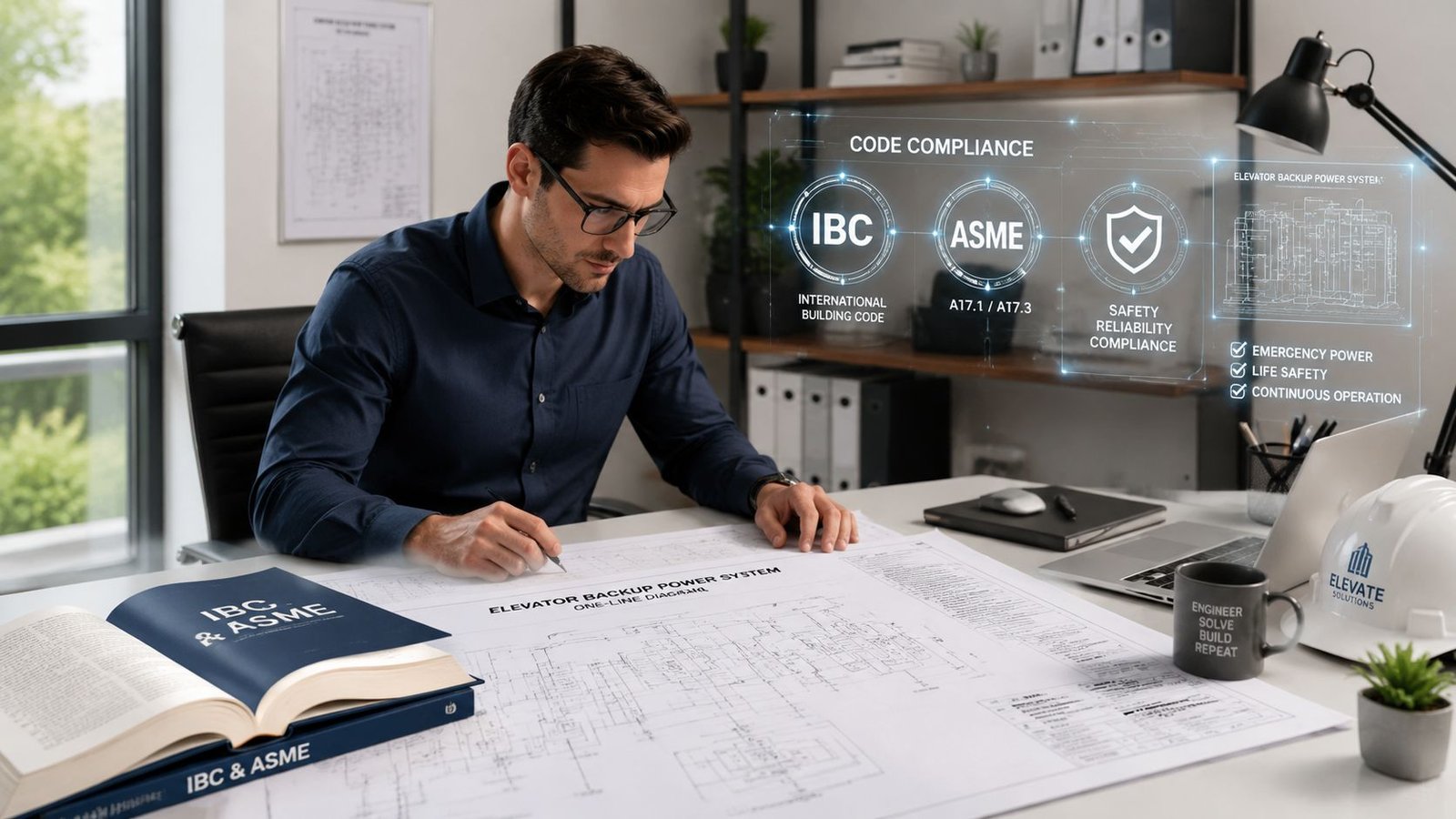
For elevator backup power, most owners need to keep track of three code frameworks:
- ASME A17.1/CSA B44: Governs elevator safety and equipment requirements
- International Building Code: Governs when standby power is required based on building use and egress
- National Electrical Code: Governs emergency power capacity and electrical performance
The practical translation matters more than the code book titles.
According to the verified data, ASME A17.1 Section 5.3.1 requires residential and private elevators to have a dedicated backup power source to prevent passenger entrapment, with emergency lighting requirements in the cab. Also according to the verified data, IBC Section 1009.4 mandates standby power for elevators serving as an accessible means of egress in buildings with four or more stories, typically using a generator. Those rules make backup power a mandatory safety feature across a wide range of buildings, not an upgrade item.
What code compliance actually means on site
Compliance isn't just about having a battery cabinet or a generator pad outside. It means the system does what the code expects under loss of normal power.
That can include:
- Returning to a designated landing or reference level
- Keeping emergency lighting active
- Maintaining communication capability
- Supporting recall or access functions during emergencies
- Providing the required standby source where the building classification demands it
For battery-backed emergency circuits, the verified data states that NEC Section 700.12 requires a minimum duration of 1.5 hours for connected emergency circuits. That requirement is often missed in basic sales discussions because people focus on the rescue trip and ignore the rest of the emergency loads.
Why testing is not optional
A compliant design still has to work in the field. That means testing under realistic conditions.
Owners should expect periodic verification of transfer operation, emergency functions, controller behavior, and related life-safety responses. If your team wants a baseline on what a proper inspection and verification program looks like, review the scope of elevator testing and compare it to your current records.
This video gives a helpful visual reference for how emergency power and elevator behavior are evaluated in practice.
Questions to ask before an inspector does
Use this list when you review your building with your elevator contractor and electrical team:
- Which elevators are required to be on standby power: Don't assume all cars have the same requirement.
- What exact emergency sequence is programmed: Safe landing, recall, selective service, or continued operation.
- How long do emergency circuits remain active: This is a code issue, not a preference.
- When was the last live transfer test performed: Paperwork without operational verification isn't enough.
- Are testing records organized and current: That matters during inspections and after incidents.
Code compliance is the floor, not the finish line. A legal system that operators don't understand will still create confusion during an outage.
Sizing Your System for Real-World Demands
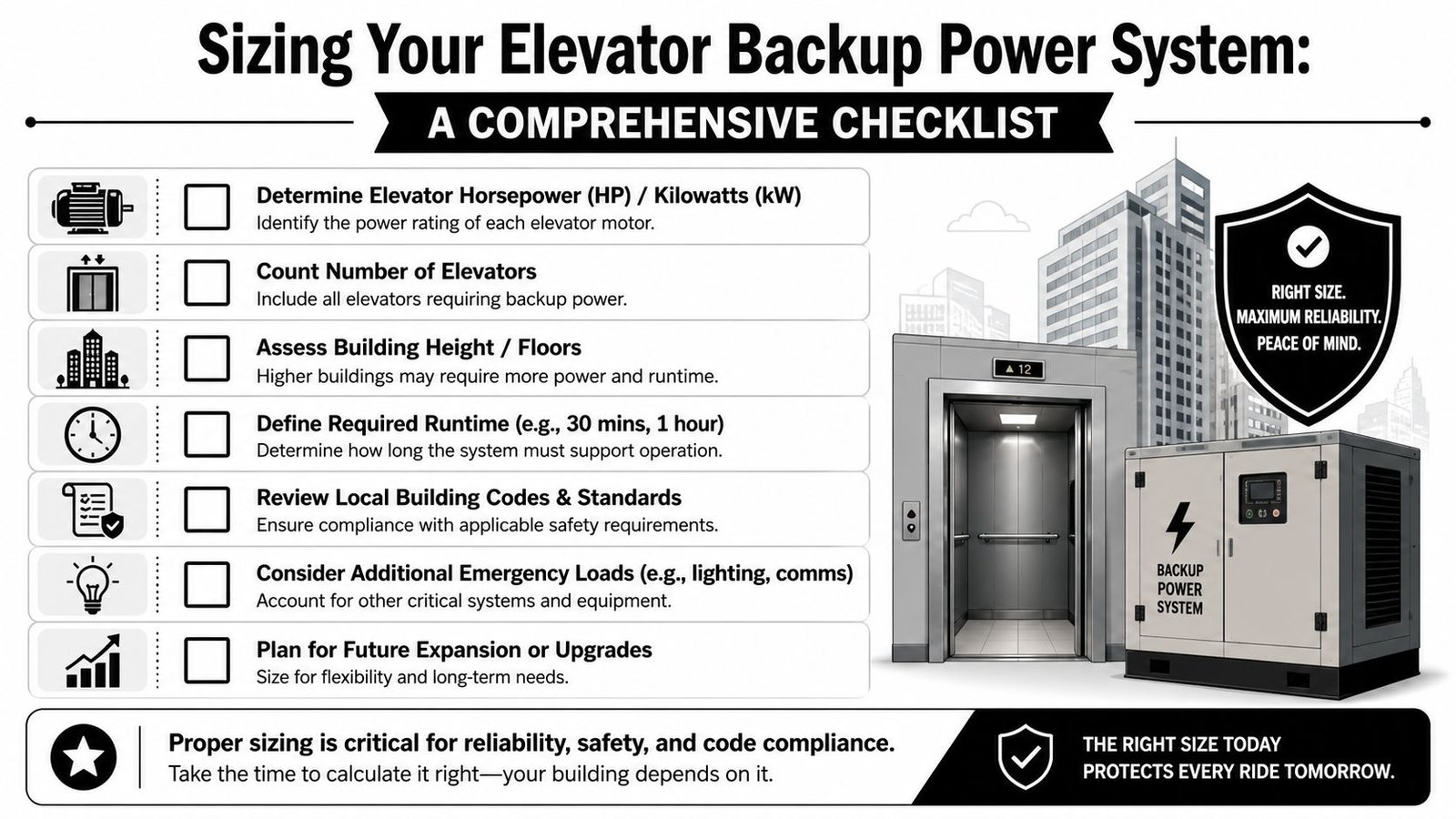
Backup power gets undersized for one simple reason. Too many quotes start with the elevator nameplate and stop there.
That approach misses the way elevators start, transfer, and operate under standby conditions. A system that looks adequate on paper can struggle at the exact moment it's needed most.
Nameplate load is not the whole story
Elevator motors create startup demands that don't behave like a simple steady load. UPS systems and generators both need to be sized around the actual electrical behavior of the system, including the momentary demand when the equipment starts and the load from associated devices.
That's one reason generic backup products often disappoint in elevator applications. The verified data notes that modern elevator UPS systems need to be custom-configured to the specific load, especially to handle inrush current demands. Off-the-shelf assumptions can leave you with nuisance trips, failed transfers, or incomplete operation.
The hidden load owners miss
This is the part many vendor quotes leave out.
A critical detail in the verified data is that IBC Section 3003.1.4 requires machine room ventilation and air conditioning to be connected to the standby generator. According to Consulting-Specifying Engineer's discussion of elevator emergency power requirements, that requirement can increase generator load and fuel consumption by 20 to 30% during an outage.
That changes the ownership math.
If a proposal only talks about the elevator motor load, it may be understating generator size, runtime assumptions, and operating cost. In a hot machine room, that ventilation and cooling requirement isn't optional. It's part of keeping the equipment within operating conditions while the building is already under stress.
Owner check: Ask every bidder whether machine room ventilation or air conditioning was included in the standby load calculation. If the answer is vague, the quote is incomplete.
Questions that expose weak sizing
Don't ask, “What size generator do I need?” Ask narrower questions.
- What loads are included beyond the elevator drive: Lighting, communication, fans, controls, and machine room environmental loads.
- What sequence is assumed: One car at a time, all cars, or a selected service group.
- How was startup demand handled: This matters for both generator and UPS applications.
- What runtime assumptions were used: Especially if the building has tenant expectations for longer outages.
- What happens if the building expands or the elevator is modernized later: Future flexibility matters.
Cheapest upfront rarely means cheapest to own
The least expensive proposal often wins because it excludes the expensive realities. Smaller standby equipment, limited scope, and optimistic assumptions reduce the bid. They also raise the chance of operational problems, fuel surprises, and change orders later.
For owners, the smart move is to buy for real conditions, not brochure conditions.
Best Practices for Maintenance and Testing
A backup power system that isn't maintained is just a theory. During an outage, nobody cares what the submittal said. They care whether the car lights come on, whether communication works, and whether the transfer happens.
What a maintenance program should cover
Generator-backed systems and battery-backed systems age differently, but both need scheduled attention.
For a generator-based setup, focus on:
- Fuel and fluid checks: Verify levels, condition, and any contamination issues before they become a no-start event.
- Automatic start verification: Confirm the unit starts and transfers the load as designed.
- Transfer equipment review: Inspect the ATS and related controls for wear, alarms, and switch function.
- Load-based testing: Make sure the generator can support the actual standby demand it was selected for.
For battery or UPS-backed systems, focus on different failure points:
- Battery health: Capacity fades over time, and that decline may not be obvious without testing.
- Connection integrity: Loose or corroded connections create avoidable failures.
- Charger operation: A healthy battery system still fails if charging equipment isn't performing correctly.
- Emergency circuit verification: Lighting, communication, and control circuits need live confirmation, not assumptions.
Documentation protects you twice
Good records do two jobs. They improve reliability, and they protect the owner after an incident or during an inspection.
Keep a log that shows:
- Dates of all tests and inspections
- Who performed the work
- What was tested
- What failed or was adjusted
- What corrective work was completed
If you don't already have a structured service plan, review what a dedicated elevator preventative maintenance program should include and compare it against the work your building is receiving.
The most common surprise in backup power isn't a major equipment defect. It's a neglected battery, a failed transfer component, or a test that hasn't been performed in too long.
Keep operations staff in the loop
Maintenance shouldn't live only in a contractor's file. Building engineers, security staff, and property managers should know the emergency sequence well enough to answer basic questions during an outage. If they don't know whether the elevator will lower, recall, or stay available on standby, they can't manage tenant expectations when it matters.
Your Decision Checklist for Choosing a System
By the time you're comparing proposals, most of the important mistakes have already been made. The best time to think clearly is before the numbers are on the page.
Use this checklist to pressure-test your decision.
Ask these questions before you buy
- What type of building am I operating: A private residence, low-rise commercial property, healthcare facility, school, or high-rise all point to different backup expectations.
- What do occupants need during an outage: Safe exit only, limited continued service, or sustained standby operation.
- Which code requirement applies to this elevator: Don't rely on assumptions from another building in your portfolio.
- What is the actual operating cost: Include maintenance, fuel, battery replacement, testing, and any loads omitted from the first quote.
- Was the system sized for startup behavior and related loads: If not, you may be paying for a system that won't perform under stress.
- How long do I need this system to support emergency functions: Match the design to realistic outage expectations and code obligations.
- What happens after modernization or building changes: The cheapest system can become the most expensive if it has no flexibility.
A practical way to compare bids
When two proposals look similar, compare them on three lines:
| Decision area | Weak proposal | Strong proposal |
|---|---|---|
| Scope clarity | Vague description of “backup power” | Exact emergency sequence and supported loads |
| Sizing method | Based mainly on elevator nameplate | Based on actual load behavior and integration |
| Ownership view | Focused on install price | Includes maintenance, testing, and outage operation |
A good backup power decision balances code, safety, and long-term cost. A bad one usually overpromises operation and underestimates integration.
If you need a second opinion on elevator backup power systems, code-required testing, modernization planning, or long-term maintenance strategy, Crane Elevator Company is a practical resource for building owners across Lower Michigan. Their team works on commercial and residential equipment, handles inspections and emergency power coordination, and can help you evaluate whether your current setup is compliant, correctly sized, and worth keeping.