
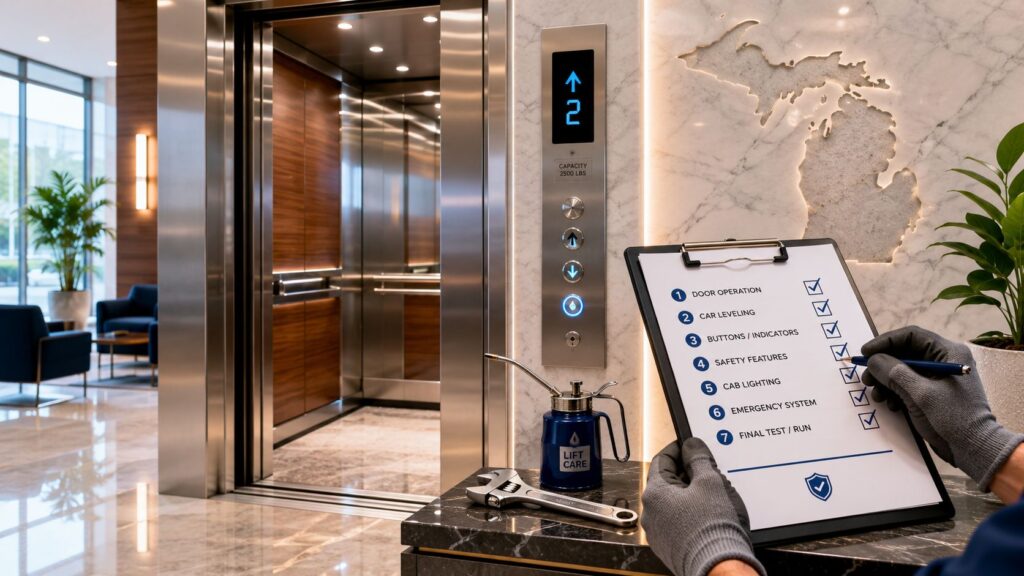
When an elevator goes down in a commercial building, the problem spreads fast. Tenants call the office, deliveries stall, accessibility becomes an immediate concern, and someone on your team has to explain why the same unit is out again.
That cycle is common in office buildings, medical facilities, schools, apartment properties, and municipal sites across Southern Michigan. In Detroit, Ann Arbor, Lansing, Flint, Kalamazoo, Jackson, Monroe, and the surrounding towns, the pattern is usually the same. Deferred service turns a manageable wear issue into a shutdown, then the shutdown becomes an emergency invoice, an inspection concern, and a tenant-relations problem.
Elevator preventative maintenance changes that pattern. Done properly, it gives property managers control over reliability, compliance, and budget planning instead of leaving all three to chance.
Why Waiting for a Breakdown Is Not a Strategy
An elevator that fails without warning rarely fails in isolation. The car is out of service, but the broader damage shows up around it. Staff lose time fielding complaints. Building traffic backs up. Accessibility routes get constrained. If the shutdown hits a healthcare, education, or municipal property, the disruption becomes operational, not just inconvenient.
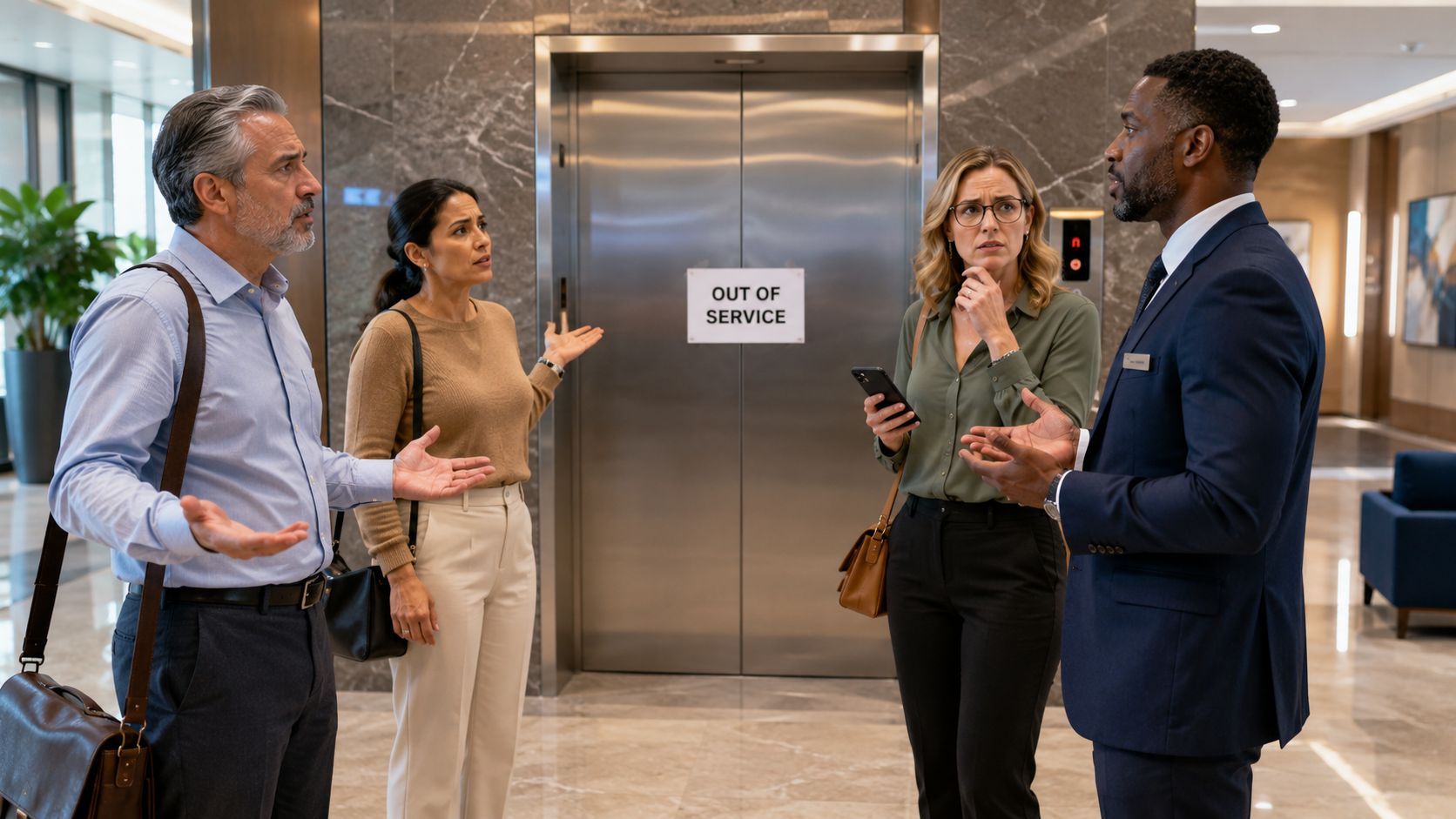
Reactive ownership sounds cheaper until the failures become repetitive. A door operator starts hesitating. A hydraulic unit begins leveling poorly. Dust builds in the controller space. A small leak in the pit gets ignored because the elevator still runs. Then one morning it doesn't.
What reactive operation looks like in the field
In older Southern Michigan properties, especially where winter moisture, tracked salt, and inconsistent housekeeping affect machine rooms and pits, elevators don't usually jump from “fine” to “dead” overnight. They decline in visible ways first.
Common warning signs include:
- Door performance changes: Doors start closing hard, reopening randomly, or taking longer to cycle.
- Leveling drift: A hydraulic car stops slightly above or below the landing and creates repeat callbacks.
- Dirty spaces: Machine rooms, pits, and car tops collect dust, litter, oil, and moisture that should've been removed during routine service.
- Minor leaks: A small hydraulic leak gets treated like a nuisance instead of the early stage of a larger repair.
Practical rule: If the same elevator keeps generating “small” service calls, the building usually has a maintenance problem, not a bad-luck problem.
What a managed building does differently
A properly maintained elevator isn't just one that runs today. It's one that gets inspected, cleaned, adjusted, and tested on a schedule that catches wear before occupants feel it.
That's the value of preventative maintenance. It reduces avoidable shutdowns, supports safer operation, and keeps the owner in a stronger position when inspection time arrives. For a property manager, that's not theory. It's the difference between a building system you can plan around and one that controls your day.
Preventative vs Corrective and Predictive Maintenance
Property managers often hear three terms used interchangeably when they shouldn't be. Corrective, preventative, and predictive maintenance are not the same service model, and they do not produce the same result.
Corrective maintenance is the oldest model. Something breaks, then a mechanic comes out and fixes it. That works for non-critical equipment. It's a poor strategy for elevators because the failure happens first, and the downtime, tenant frustration, and safety exposure arrive with it.
Preventative maintenance is schedule-based. A contractor visits at planned intervals and handles cleaning, inspection, adjustments, lubrication where appropriate, and wear-item review before a shutdown occurs. This is the maintenance approach most commercial properties need.
Predictive maintenance uses monitoring, condition data, or sensors to flag developing issues. In the right setting, it can help. But it doesn't replace hands-on maintenance. An elevator still needs a technician to inspect the equipment, verify operation, and deal with the physical causes of wear.
The car analogy property managers understand immediately
If you never change oil, inspect brakes, or check fluids, your car will still run for a while. Then it won't. That's corrective maintenance by neglect.
If you service it on schedule, replace parts before they fail, and pay attention to how it sounds and performs, that's preventative maintenance.
If your vehicle also uses monitoring to warn you that a component is trending toward failure, that's predictive support layered on top.
Maintenance Strategy Comparison
| Strategy | Approach | Cost Profile | Best For |
|---|---|---|---|
| Corrective | Repair after failure | Unpredictable and often disruptive | Non-critical issues where downtime is acceptable |
| Preventative | Scheduled inspection, cleaning, adjustment, and service | More predictable operating expense | Most commercial elevators and lifts |
| Predictive | Condition-based monitoring used to flag developing faults | Can add technology cost and still requires field service | Larger portfolios or sites that want extra visibility |
What works and what doesn't
What works is simple. Keep a regular maintenance route, document what was inspected, clean neglected spaces, and correct small defects before they become call-backs.
What doesn't work is paying for a “maintenance contract” that only responds after failures, or relying on remote alerts while basic housekeeping and mechanical checks are missed.
A sensor can tell you something is wrong. It can't clean a pit, tighten a loose connection, or verify that a hydraulic leak is getting worse.
In practical terms, most Southern Michigan properties benefit from a strong preventative program first. Predictive tools can be useful later, but they shouldn't become an excuse to skip the fundamentals.
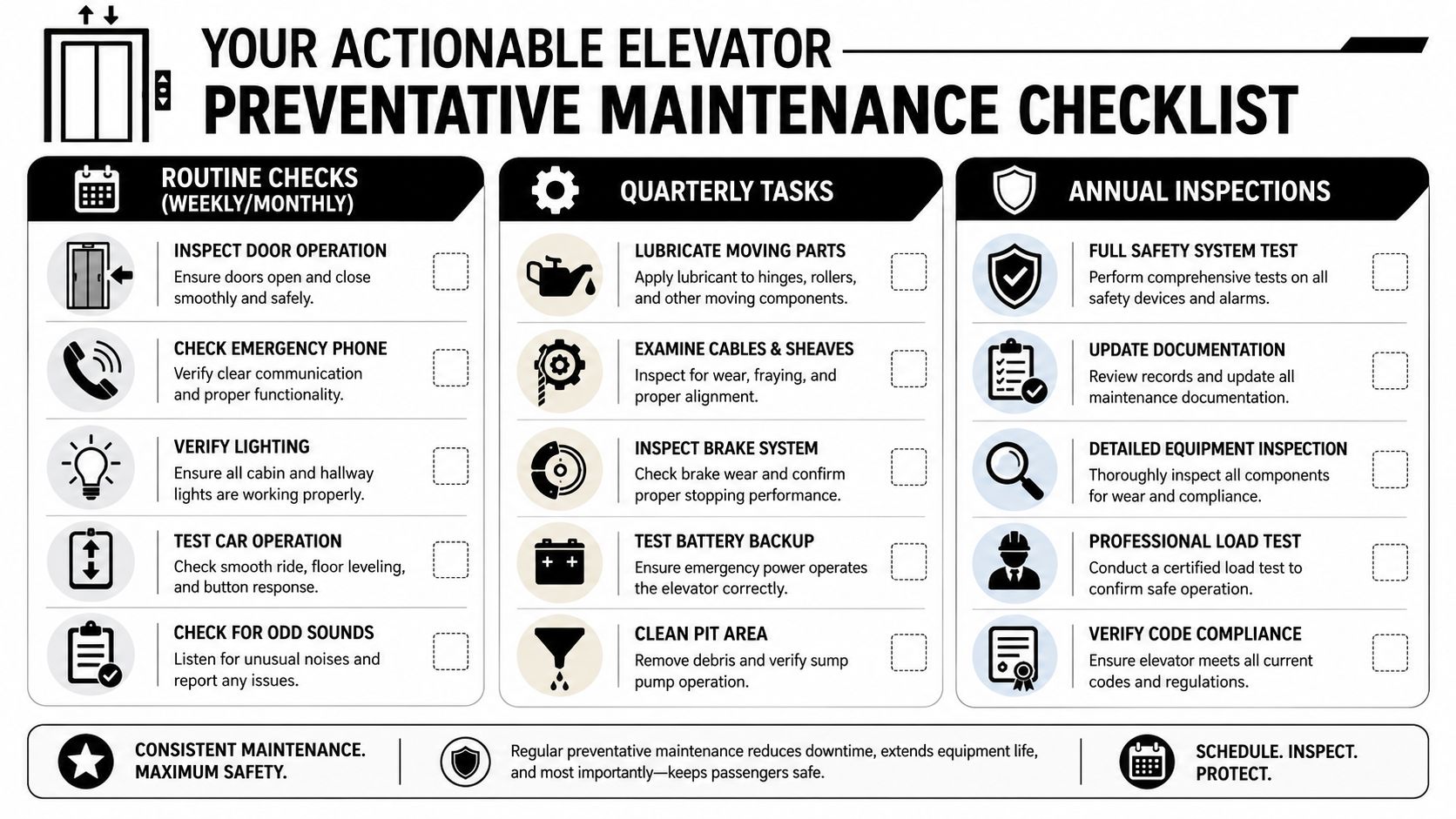
Your Actionable Elevator Preventative Maintenance Checklist
A real preventative maintenance visit should be visible in the condition of the equipment. The machine room should look cared for. The pit should be clean. Door operation should be smoother. The technician should know what changed since the last visit and what needs attention before the next one.
For hydraulic elevators, that discipline matters even more. A Virginia county preventative maintenance checklist for hydraulic units calls for technicians to inspect hydraulic oil level and viscosity, check piping for leaks, inspect jack seals and posts for leaks and tolerance, clean the pit, test the oil sump pump and water sump pump, and tighten low-voltage and high-voltage connections on a recurring basis, as shown in the hydraulic elevator PM checklist published by Loudoun County.
Routine checks that should happen consistently
These are the basics that separate a healthy unit from one that keeps drifting toward shutdown:
- Door system observation: Watch door opening and closing cycles, listen for operator strain, and verify that doors are not dragging, slamming, or reopening without cause.
- Hall and car fixture review: Confirm lights, indicators, alarms, and communication devices are functioning.
- Ride and leveling check: Note changes in stopping accuracy, start quality, and floor-to-floor behavior.
- Machine room and pit housekeeping: Remove dust, oil, debris, and litter so contamination doesn't become part of the equipment problem.
For managers, housekeeping can sound secondary. It isn't. Dirt in the wrong place hides leaks, traps moisture, and shortens the life of electrical and mechanical components.
Hydraulic-specific items that deserve closer attention
Hydraulic elevators are common in lower-rise commercial properties throughout Southern Michigan. They're durable, but they punish neglect.
Key PM tasks include:
- Hydraulic oil condition: Low, contaminated, or degraded oil changes system response.
- Leak inspection: Review piping, fittings, tank areas, and jack-related components for signs of seepage.
- Jack seal review: Seal problems often show up first as performance complaints before they become larger repairs.
- Sump pump verification: If the pit takes on water, the pump must work when needed.
- Connection tightening: Electrical integrity matters as much as fluid condition.
When oil quality declines or leaks go untreated, the elevator may start leveling slowly, run hotter, or develop repeat service issues. Those are maintenance catches, not surprises.
Compliance-driven tasks that should not be skipped
A publicly posted New York State hydraulic elevator specification shows how formalized modern PM has become under ASME A17.1. It states that elevators must be inspected every 6 months and tested annually, and it outlines a monthly preventive maintenance routine that includes inspection of hoisting machines, controllers, doors, lights, alarms, and removal of dust, oil, and litter from machine rooms and pits, with annual tests witnessed by a Qualified Elevator Inspector, according to the New York State hydraulic elevator specification.
That document matters beyond New York because it reflects how the industry treats maintenance today. Scheduled inspection, cleaning, and testing are part of normal operation. They are not optional extras reserved for problem buildings.
The best checklist is the one your contractor actually completes, documents, and follows up on when they find a defect.
For Southern Michigan properties, ask to see what happens on each visit. If the answer is vague, the contract probably is too.
The Financial Case for Proactive Upkeep
A Southern Michigan office building can go from normal operations to tenant complaints in one morning. The elevator starts faulting at 8:15, deliveries back up in the lobby, staff start calling for updates, and now the property manager is trying to find a technician fast instead of working the day's schedule. That illustrates the full cost of deferred maintenance. The invoice is only part of it.
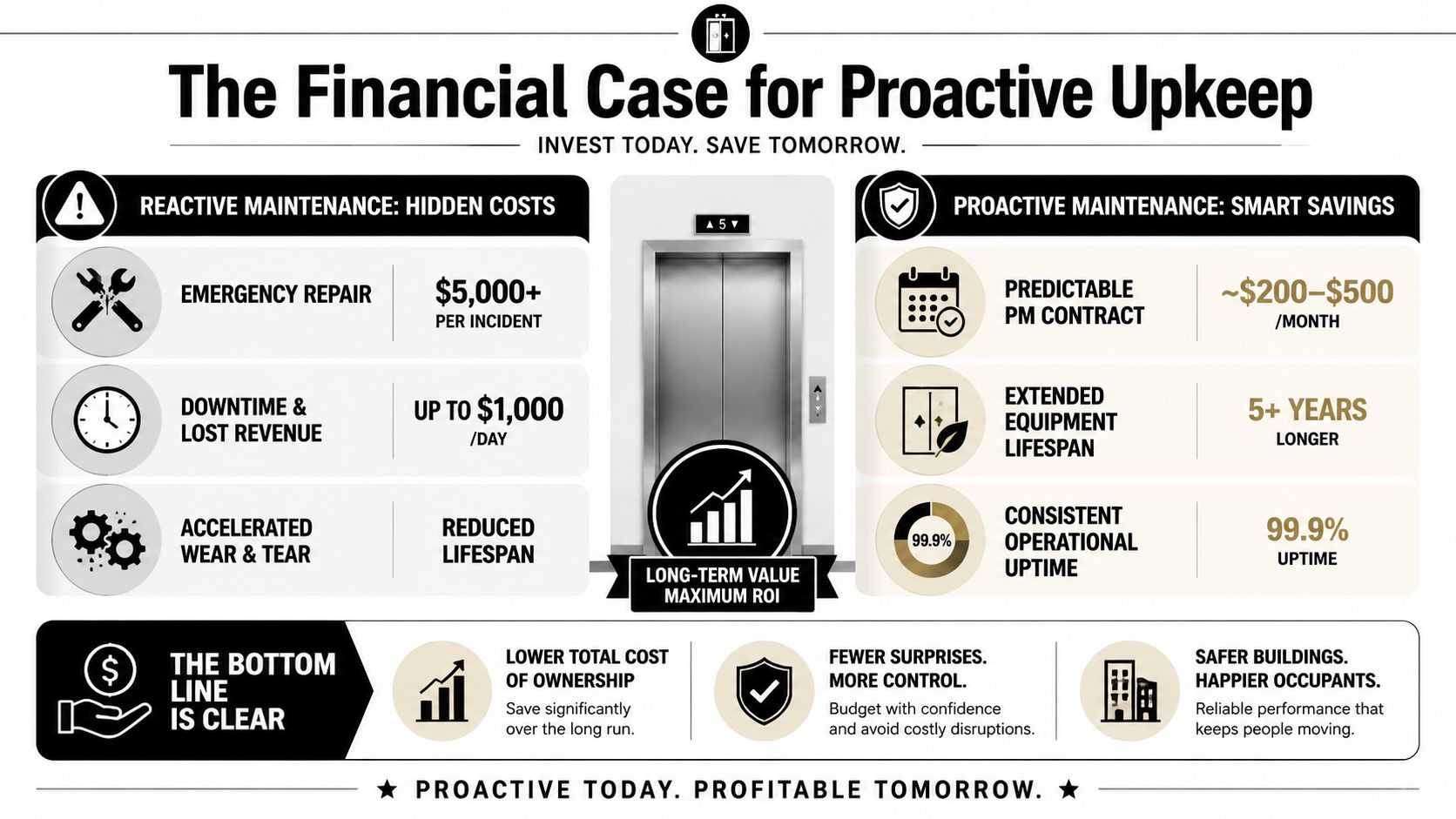
Reactive service drains money in ways owners do not always track cleanly. After-hours calls cost more. Repeated shutdowns pull building staff into problem management. Tenants notice reliability issues long before a major component fails, and in a commercial property, that affects day-to-day operations. Deferred upkeep also shortens the life of parts that should have made it much longer under normal service conditions.
Fortune Business Insights projects the global elevator maintenance market will grow from $38.33 billion in 2026 to $68.25 billion by 2034, at a projected 7.50% CAGR, and its market overview notes that maintenance is commonly performed at least annually, with more frequent service for older or heavily used units. The same overview also references industry reporting that preventive maintenance is more cost-effective than reactive repair, with annual preventive maintenance contracts estimated at roughly $3,500 to $5,000 for small buildings and $8,000 to $10,000 for high-rise buildings in the U.S., according to the elevator maintenance market forecast.
Where the savings come from
The savings usually show up in three places:
- Fewer emergency calls: Planned visits catch worn door equipment, relay issues, poor contacts, and hydraulic leaks before they turn into shutdowns.
- Longer service life from expensive components: Controllers, pumps, valves, door operators, and hoistway equipment last longer when they are cleaned, adjusted, and corrected early.
- More predictable budgeting: A defined maintenance scope and scheduled minor repairs are easier to manage than surprise failures, tenant disruption, and rush parts orders.
For Southern Michigan commercial properties, season changes matter more than many owners expect. Cold weather, moisture, salt tracked into lobbies, and wide temperature swings can add stress to doors, pits, contacts, and machine spaces. Buildings with older equipment in Detroit, Ann Arbor, Lansing, and surrounding markets often see the same pattern. Small problems are left alone through one budget cycle, then turn into a larger repair at the worst time.
A useful budget review is simple. Pull the last 12 to 24 months of service tickets and compare them to the maintenance scope you are buying. If you see repeated callbacks for doors, leveling, communication devices, or nuisance shutdowns, the contract may be paying for response without doing enough prevention. Property managers who want a clearer benchmark can review this breakdown of elevator maintenance costs.
A short visual explainer can help frame the trade-off:
What not to do with the budget
Do not buy on monthly price alone. Lower-cost agreements often mean fewer visits, less cleaning, thinner documentation, more exclusions, and slower response when a real issue hits.
Do not defer the corrective work found during maintenance visits either. Preventive maintenance only pays off when the owner approves the repairs that keep wear from spreading into larger failures. In Michigan, that is not just a cost issue. It can become a compliance problem if known deficiencies stay open too long.
Navigating Elevator Compliance in Southern Michigan
In Michigan, maintenance is tied directly to compliance. If your building is in Detroit, Ann Arbor, Lansing, Kalamazoo, Flint, Dearborn, Novi, or a smaller Southern Michigan community, inspections and code obligations don't care whether your elevator has been “mostly working.” The question is whether the equipment is safe, documented, and maintained in a condition that can pass review.

That's where many properties get into trouble. They treat maintenance and compliance as separate buckets. In practice, they're connected. Poor maintenance creates the same conditions that cause inspection issues. Dirty machine rooms, neglected safety devices, unresolved door faults, incomplete records, and unrepaired code-related deficiencies don't stay hidden for long.
What inspectors and owners both care about
From a property manager's side, the priorities are straightforward:
- Safe operation for passengers and staff
- Current documentation
- Timely correction of deficiencies
- A maintenance record that shows recurring care, not crisis response
If your elevator has aging door equipment, leveling issues, communication-device faults, or known code updates that haven't been addressed, your maintenance vendor should be discussing those items before an inspection date appears on the calendar.
Why routine service supports code readiness
A documented PM program helps in practical ways. It creates service records. It identifies recurring faults. It gives the owner a paper trail showing the equipment has been inspected and maintained instead of ignored.
That matters in commercial settings where tenant expectations, ADA access, and liability concerns are all live issues. If a building team has to answer why an elevator was allowed to operate with known defects, “we were waiting until it broke” is not a strong position.
Compliance goes smoother when maintenance, testing, and repair history all tell the same story.
Michigan owners should also pay close attention to code-specific requirements and upgrades that may affect their equipment type, age, and use. A focused review of Michigan elevator code requirements helps frame what your contractor should already be tracking for you.
The practical takeaway is simple. If your maintenance program doesn't improve inspection readiness, it's incomplete.
How to Select the Right Elevator Service Provider
The provider matters as much as the contract. Two agreements can have similar pricing and produce very different outcomes based on route discipline, documentation quality, response habits, and whether the contractor performs preventative work or just waits for trouble calls.
Start with the service model. Ask whether the equipment will be maintained with a clear visit schedule, written task scope, and documented follow-up recommendations. If the answers are vague, expect vague results.
Questions worth asking before you sign
Use these criteria when comparing firms in Grand Rapids, Flint, Ann Arbor, Detroit, Lansing, or nearby communities:
- Non-proprietary approach: If a provider locks your building into exclusive tools or parts access, future flexibility gets harder.
- Emergency availability: Elevators don't fail on a convenient schedule. Ask who answers after hours and what happens next.
- Visit transparency: Require service tickets that show what was inspected, cleaned, adjusted, and recommended.
- Scope clarity: Confirm whether basics like clean-downs, bulbs, communication checks, and pit review are included or billed separately.
- Local familiarity: Southern Michigan weather, aging building stock, and mixed-use properties create recurring conditions that out-of-area vendors may not manage well.
One local option property managers evaluate is Crane Elevator Company's elevator service profile, which reflects a non-proprietary service model, ongoing maintenance work, repairs, testing, and field response across Lower Michigan.
Warning signs in a maintenance proposal
Be careful when a contract promises coverage but says little about actual task detail. Be careful when every recommendation becomes a surprise add-on. Be careful when the company can't explain how it handles older controllers, hydraulic leak conditions, or recurring door faults.
A strong provider should be able to walk your chief engineer or facility manager through the route, the checklist, the open issues, and the likely next repair priorities without turning the conversation into a sales pitch.
Frequently Asked Questions for Michigan Property Managers
How often should a commercial elevator be maintained
At minimum, elevators are commonly maintained on a recurring schedule rather than only after failure. The right frequency depends on traffic, age, environment, and equipment type. Older or heavily used units usually need more attention than lightly used systems.
What's the first thing to check if an elevator keeps going out of service
Look at the maintenance records before anything else. Repeat shutdowns often trace back to unresolved door issues, poor housekeeping in pits or machine rooms, hydraulic leaks, electrical connection issues, or recommendations that were noted but not approved.
Are hydraulic elevators harder to maintain in Michigan
Not harder, but less forgiving when routine items are ignored. Moisture, dirt, contamination, and small leaks can change performance and create repeat problems. That's why pit condition, oil condition, leak review, and sump pump checks matter so much on hydraulic equipment.
Can I wait until inspection season to deal with maintenance
That's risky. Inspection readiness is built through the service record and the condition of the equipment over time. If your contractor only gets serious when an inspection date is close, the building is already behind.
What should be included in a good PM visit
A proper visit should involve inspection, cleaning, operational review, and clear documentation. You should know what was checked, what changed since the last visit, and what defects need correction before they affect service or compliance.
Is the cheapest contract usually the best value
Usually not. The lowest number on the proposal can hide a thin scope, weak follow-up, and more excluded work. Value comes from reduced shutdowns, better documentation, and fewer surprise failures, not just a lower line item.
If you manage elevators in Southern Michigan and want a practical review of your current maintenance approach, Crane Elevator Company provides maintenance, repairs, testing, and modernization support for commercial and residential properties across Lower Michigan. A useful next step is to have your current service scope, open repair history, and compliance exposure reviewed against the actual condition of the equipment.