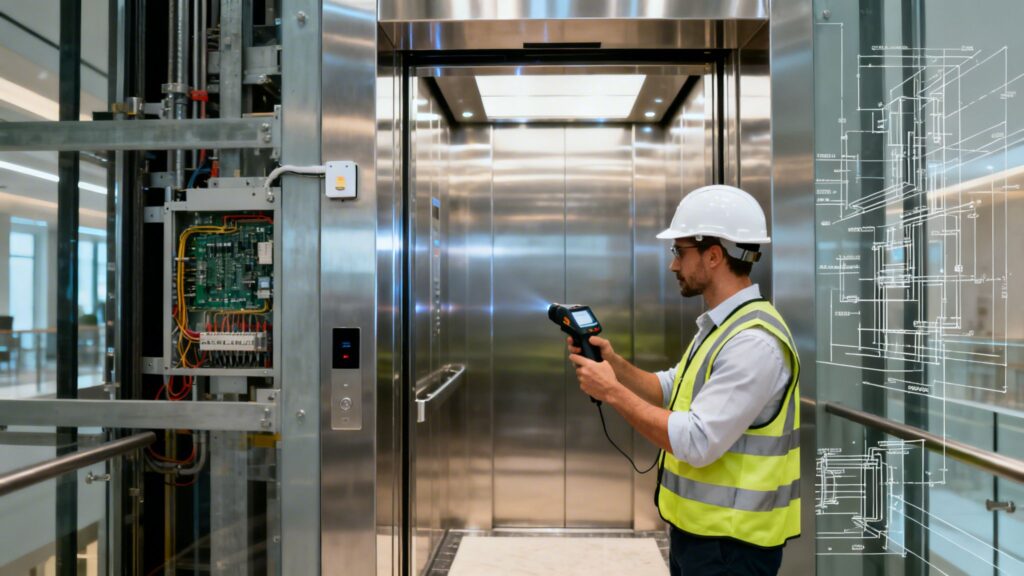
For property owners in Southern Michigan, an elevator testing company isn’t just a vendor—it’s a critical partner in safety, compliance, and asset protection. These specialized firms handle the legally required inspections and tests, verifying that everything from safety circuits to emergency phones is working exactly as it should. This guide will walk you through Michigan’s codes and help you find a qualified provider.
For Questions or Service Call
1-734-726-4247
Or
Fill Out Our Contact Form
Your Guide to Elevator Safety and Compliance in Michigan

If you own or manage property in Detroit, Ann Arbor, or Lansing, your elevator is more than a convenience. It’s a core piece of your building’s infrastructure. And like any complex machine, it demands regular, professional attention to run safely and reliably. That isn’t just good practice—it’s the law.
Think of elevator testing as a mandatory annual physical for your building. It’s a proactive step designed to find problems before they turn into shutdowns, expensive repairs, or worse, safety incidents. A qualified testing company acts as your specialist, running detailed diagnostics that go far beyond what you can see.
Why Proactive Testing Matters
Putting off elevator testing has real consequences, and they go beyond fines from state regulators. It’s about the well-being of the tenants, visitors, and residents who rely on that elevator every single day. Consistent testing is simply a non-negotiable part of responsible property management.
Here’s why partnering with the right testing company is so important:
- Ensuring Passenger Safety: This is always goal number one. Rigorous testing confirms that every safety feature, from door sensors to emergency brakes, functions correctly.
- Maintaining Legal Compliance: Michigan enforces specific codes based on the ASME A17.1 safety standard. A professional partner guarantees your equipment meets every single requirement, so you can avoid violations.
- Preventing Costly Downtime: A broken-down elevator is a major disruption that causes huge frustration. Routine tests catch wear and tear early, allowing for preventive maintenance that keeps your elevator in service.
- Protecting Your Investment: An elevator is a significant asset. Proper testing and maintenance extend its service life, pushing back the need for costly modernizations and preserving your property’s value.
A failed inspection isn’t just a piece of paper; it’s a warning sign. By tackling the issues found during a test, you turn a regulatory task into a strategic move to make your building safer and more reliable for the long haul.
We created this guide to demystify the entire process. We’ll cover Michigan’s specific testing requirements, explain what happens during an inspection, and give you a clear framework for choosing an expert partner. Understanding the fundamentals of elevator safety is the first step. With the right knowledge, you can manage your elevator system with confidence and ensure it remains a dependable asset for years to come.
Navigating Michigan’s Elevator Testing Requirements
To a property owner, Michigan’s elevator regulations can look like a maze of codes and dates. But it’s simpler than it seems. The entire system, based on the ASME A17.1 Safety Code for Elevators and Escalators, is built for one thing: keeping the people who use your elevator safe and keeping you out of trouble with inspectors.
Think of it like getting your car serviced. You have your quarterly oil change, but every so often, it needs a more detailed inspection. Elevators are the same. A licensed elevator testing company acts as your mechanic, following a schedule of tests to make sure every part of your system meets Michigan’s tough standards.
These standards are serious business. In New York City for example, a shocking 22% of elevators had violations in 2023. Michigan regulators are just as focused on enforcement. As a building owner, regular testing isn’t just about compliance—it’s your best defense against accidents, fines, and expensive emergency repairs.
Understanding the Key Test Categories
Your elevator’s testing schedule comes down to three main tests. Each one looks at different systems, building on the last to give a complete picture of your equipment’s health. If you miss one, you’re not just risking a fine; you could be running an unsafe elevator without even knowing it.
Here’s the breakdown of what Michigan requires for most commercial and residential elevators:
- Category 1 (CAT 1) Annual Safety Test: This is your yearly checkup. It’s a thorough visual and hands-on test of all the core safety features—door systems, emergency phones and alarms, and the fire service recall function. It happens once a year.
- Category 3 (CAT 3) Three-Year Safety Test (Hydraulic Only): For hydraulic elevators, this test happens every three years. It’s all about the hydraulic system’s integrity with a full load added, focusing on pressure relief valves to make sure they’re working correctly and preventing dangerous pressure buildups.
- Category 5 (CAT 5) Five-Year Full Load Safety Test: This is for Traction Elevators and is done Every five years, technicians load the elevator with its maximum rated weight and test the brakes and safety systems under over-speed conditions. This proves the elevator can stop safely in a worst-case scenario.
Think of it this way: The CAT 1 is your annual physical. The CAT 3 is a specialized heart check for your hydraulic system. The CAT 5 is a full-blown stress test to see how it performs under maximum pressure.
This tiered system ensures every critical component is checked on a regular, predictable schedule.
To make it even clearer, here’s a quick-glance table breaking down the routine testing schedule for property owners in Michigan.
Michigan Elevator Testing Requirements at a Glance (ASME A17.1)
| Test Category | Frequency | What It Covers |
|---|---|---|
| Category 1 | Annually | Checks safety circuits, door operations, fire service recall, emergency phone and alarm, and general car functions. It is a thorough operational checkup. |
| Category 3 | Every 3 Years | For hydraulic elevators only. Tests the pressure relief valve to ensure it will protect the system from over-pressurization and potential failure. |
| Category 5 | Every 5 Years | Involves testing the elevator with its maximum rated weight. Verifies that the safeties and brakes can stop a fully loaded car at governor-tripping speed. |
A good testing partner doesn’t just run the tests and leave. They should help you map out a compliance calendar, handle the paperwork, and keep you ahead of every deadline. It turns testing from a headache into a smart strategy for safety and reliability.
The Michigan Elevator Code Deadline
On top of routine testing, property owners need to be aware of upcoming code changes. Michigan is adopting newer code versions, which means existing elevators need upgrades to stay compliant.
A big one is the new requirement for door lock monitoring systems. For a full breakdown, you should review our guide on the Michigan elevator code deadline. Knowing these dates is crucial for planning and budgeting for upgrades so you aren’t stuck in a last-minute scramble.
What Happens During an Elevator Safety Test
The idea of an elevator test might bring to mind disruption and downtime, but with a professional elevator testing company, it’s a predictable, well-managed process. Knowing what to expect on testing day makes everything smoother and lets you prepare tenants with confidence.
Two key people will be on-site: your regular elevator service technician and a state-licensed third-party inspector. The technician is the hands-on expert who runs the elevator and performs the physical tests. The inspector is the independent witness, there to verify every step meets Michigan’s safety codes. This two-person system keeps everything accountable and accurate.
The day starts with securing the area. Technicians post signs on every floor to let everyone know the elevator is temporarily out of service for safety testing. Then, they take full control of the car to ensure no one can call it or use it by mistake.
The Testing Sequence Unpacked
Once the elevator is secured, the real work begins. The tech and inspector go through a detailed checklist, checking dozens of safety features. This is far more than a quick glance; it’s a hands-on validation that every component works exactly as it should.
A typical test sequence looks something like this:
- Securing the Elevator: The technician places the unit on independent service so it won’t respond to hall calls.
- Verifying Communication Systems: They test the emergency phone in the cab to confirm it connects to a 24/7 monitoring station. They’ll also check the alarm bell to make sure it’s loud enough to be heard.
- Testing Door Safety Features: This involves checking the door sensors and closing mechanisms. The doors must reverse immediately if they sense an obstruction—a crucial test to prevent injuries.
- Confirming Fire Service Recall: The fire service key is used to simulate an alarm. The elevator has to automatically return to the designated recall floor and hold its doors open, just as it would in a real emergency.
- Running System-Specific Tests: Depending on the category of test (CAT 1, 3, or 5), this is where they dig into the details—testing safety circuits, checking hydraulic pressure relief valves, or performing a full-load brake test.
This flowchart shows how each test builds on the others, creating a comprehensive safety picture.

From the simple annual check-up to the demanding five-year load test, this sequence leaves no stone unturned.
From Test to Report
As they work, the inspector documents every single pass or fail on an official report. If a minor issue pops up, like a burnt-out button light, the technician will often fix it right there to avoid a violation. This on-the-spot collaboration between the service company and the inspector is all about getting the equipment compliant as efficiently as possible.
The reason for all this diligence is simple: safety. In 2022, the U.S. saw 27 elevator-related fatalities, and about 15% were tied to maintenance issues that these tests are designed to find. The market for elevator safety systems is projected to grow from $15.65 billion in 2026 to $21.98 billion by 2030, which shows you how seriously the industry is taking this. You can see the full analysis in the elevator maintenance market report from IndustryARC.
At the end of the day, a successful test means more than a passed inspection. It’s tangible proof that you’ve done your due diligence to protect every single person who steps into your elevator.
Once the testing is finished, you get a copy of the report. If everything passes, you’re all set until the next test is due. If there are violations, the report becomes your action plan. Your elevator service partner can then give you a clear quote and a timeline to get the issues corrected.
How to Choose the Right Elevator Testing Partner
Picking an elevator testing company isn’t just about checking a box for your annual inspection. It’s about finding a true partner who will protect your building, keep your tenants safe, and help you get ahead of long-term costs.
Especially here in Southern Michigan, where codes are strictly enforced, the right choice prevents expensive violations and surprise shutdowns. This isn’t the time to simply go with the lowest bidder. A cheap quote now can easily lead to failed tests, missed compliance deadlines, or shoddy work that costs you a fortune down the road.
You need a trusted advisor—someone who knows the ins and outs of Michigan’s elevator code and can help you maintain a safe, reliable system for years to come.
Look for Proven Expertise and Proper Credentials
First things first: verify their qualifications. In Michigan, elevator work is a specialized, licensed trade. A reputable company won’t hesitate to provide proof of their credentials.
Before you even think about signing a contract, make sure you confirm these three things:
- State Licensing: The company must hold a Michigan elevator contractor license, and their technicians must be individually certified. This is non-negotiable.
- Comprehensive Insurance: Ask to see their certificate of insurance. Look for general liability, auto, and workers’ compensation. This protects your property and their people while they’re on your site.
- Deep Local Experience: A company that works daily in Detroit, Ann Arbor, or Lansing will know the local inspectors and understand exactly how state regulations are being applied in our area. That kind of relationship is invaluable.
Understand the Difference Between Proprietary and Non-Proprietary Service
This is one of the single most important factors you’ll consider, and it has a huge impact on your budget and flexibility. Think of it like a smartphone: some are locked to a specific carrier, while others are unlocked and can be used with anyone.
Proprietary equipment is the locked phone. It’s built with special software or requires unique tools that only the original manufacturer can access. If your service provider installs it, you’re stuck with them for every repair, test, and future upgrade—often at a premium price.
Non-proprietary equipment, on the other hand, is the unlocked phone. It’s built with universal components and open-source software, meaning any qualified technician can work on it. Choosing a company that focuses on non-proprietary solutions gives you the freedom to get competitive quotes for all future work. You get fair pricing and a choice of who services your equipment.
Vetting Your Elevator Testing Company Checklist
Once you’ve narrowed down your options, asking the right questions can tell you everything you need to know about a company’s philosophy and real-world expertise. Use this checklist to look beyond the price and find a partner you can actually count on.
| Qualification Category | Key Questions to Ask | What to Look For in the Answer |
|---|---|---|
| Technical Experience | What makes and models of elevators do you specialize in? Can you provide references for buildings with similar equipment? | Look for direct experience with your specific type of elevator (e.g., hydraulic, traction, MRL) and a willingness to provide contacts. |
| Maintenance Philosophy | Do you offer preventative maintenance? What’s included in your standard maintenance visit? | The best partners focus on proactive care, not just reactive repairs. Look for detailed checklists and clean-down services. |
| Emergency Response | What is your average response time for an emergency call in my area? Are your technicians available 24/7/365? | A clear, fast response time is critical. They should have a local presence and technicians on call around the clock. |
| Compliance Management | How do you help clients stay ahead of testing deadlines and code changes, like the upcoming door lock monitoring rules? | A great partner will track your schedule, notify you in advance, and help you budget for necessary upgrades. |
In the end, choosing an elevator company is about building trust. You're looking for a team that's transparent, knowledgeable, and genuinely committed to keeping your elevator safe and efficient. By focusing on credentials, non-proprietary service, and asking these detailed questions, you’ll find a partner who will be a valuable asset for years.
Solving Common Elevator Code Violations

Getting a report flagged with code violations can be unnerving. But it rarely means your elevator is about to catastrophically fail. More often, it’s just a sign that certain parts have worn out with use or that older systems don't meet today's tougher safety standards.
Think of it this way: a failed test is an opportunity to get ahead of a problem. It’s like when your car fails an emissions test—the engine isn't broken, but a specific sensor needs replacing to meet regulations. An expert elevator testing company does the same thing, pinpointing the exact issues and making targeted fixes to get you back in compliance.
Door Interlocks and Sensors
One of the most common failure points is the door system. After thousands and thousands of open-and-close cycles, door interlocks—the mechanical locks that keep doors from opening between floors—can wear down. Likewise, the electronic sensors that tell the doors to reverse when something's in the way can get knocked out of alignment.
- The Safety Risk: A bad interlock is a huge liability. It creates a potential fall hazard if the doors open but the car isn't there. Failed sensors also increase the risk of someone getting hit by a closing door.
- The Solution: A technician can quickly diagnose if the problem is mechanical or electrical. From there, they can adjust, repair, or replace the faulty lock or sensor components, making sure the doors operate exactly as they should.
These might seem like small fixes, but they are absolutely critical for everyday passenger safety.
Firefighter's Service and Emergency Communication
Another area that frequently gets flagged is the emergency equipment. Your elevator's firefighter recall service, which lets first responders take control during a fire, has to work perfectly every time. Any hiccup, from a sticky key switch to the car not responding correctly, is an automatic violation.
The same goes for the in-cab emergency phone. It must provide a clear, reliable connection to a 24/7 monitoring station. If a test reveals static, a failed connection, or a dead line, it will be written up.
An elevator's emergency systems are like a fire extinguisher; you hope you never need them, but they absolutely must work when you do. A failed test on these items is a critical warning that needs immediate attention.
Fixing these issues usually involves troubleshooting the specific electronic components, updating the software, or replacing the phone’s auto-dialer. An experienced provider knows how to work through these systems methodically to get them back online.
Worn Hoist Ropes and Hydraulic Components
Over time, an elevator’s core mechanical parts simply wear out. For traction elevators, this often means hoist ropes become frayed or worn thin. On hydraulic units, you might see a slow leak in the jack packing or a pressure relief valve that no longer works correctly.
These are precisely the kinds of problems that Category 5 and Category 3 tests are designed to catch before they become dangerous failures. In fact, proactive maintenance and testing help prevent the 15% of US elevator deaths linked directly to maintenance issues in 2022—a sobering reminder of the stakes. You can find more details in these critical elevator maintenance industry statistics on Gitnux.org.
A qualified technician from your elevator testing company will assess the degree of wear against ASME code standards. They'll then determine if a part can be safely adjusted or if it needs a full replacement to ensure the elevator can handle its job safely.
Thinking Beyond Testing to Modernization and Reliability
Routine testing keeps your elevator safe, but it's just one part of the bigger picture. After years of running up and down, even a perfectly maintained elevator starts to show its age. At some point, you'll hit a fork in the road: is another simple repair the right call, or is it time to think about a full modernization?
This isn't just about fixing a broken part. It's about looking ahead and deciding if you want to keep patching up old equipment or transform an aging system into a modern, reliable asset. Continuing to put band-aids on old machinery eventually becomes a money pit, leading to more frequent breakdowns that frustrate tenants and blow up your budget.
When Repairs Just Aren't Enough
So, how do you know you've reached that tipping point? The signs are usually pretty clear, and a good elevator partner can help you spot them.
If you’re calling for the same repairs over and over, or if your elevator’s performance is getting sluggish and unreliable, that’s a red flag. The system is likely nearing the end of its useful life.
Modernization isn’t just a super-sized repair—it's a strategic overhaul. It means replacing the core components like the controller, motor, and door equipment. Think of it as giving your elevator a new brain and nervous system, not just fixing a few aches and pains. This is how you address the root cause of the problems, not just the symptoms.
The goal of modernization is to break the cycle of breakdown and repair. It’s an investment in long-term reliability that boosts your property's value, makes tenants happier, and all but eliminates those expensive emergency service calls.
The Tangible Benefits of Upgrading
A modernized elevator delivers a lot more than a shiny new set of buttons. The improvements directly impact your building's performance and your bottom line, often paying for themselves over time through lower costs.
Some of the key benefits include:
- Significant Energy Savings: Modern drive systems and controllers can slash an elevator's energy use by as much as 40%. That’s a huge saving on your utility bills.
- Smoother Performance: New tech provides a faster, quieter, and more comfortable ride. No more jerky starts or bumpy stops, which dramatically improves the tenant experience.
- Enhanced Safety and Code Compliance: Upgrades bring your elevator up to the latest ASME safety standards, adding modern features like precise door controls and updated emergency systems.
If this sounds like the right path for your property, exploring the full scope of an elevator modernization project will give you a clear roadmap of what to expect.
By choosing non-proprietary equipment, you also guarantee that any qualified company can service it in the future. This gives you control over maintenance costs and prevents you from getting locked in with a single vendor. With predictable financing options available, upgrading becomes a smart, affordable investment in your property’s future.
Frequently Asked Questions About Elevator Testing
You’ve got the basics down. But what about the nitty-gritty details? Here are the straight answers to the most common questions we get from property owners across Southern Michigan.
How Much Does Elevator Testing Cost in Michigan?
There’s no flat rate for elevator testing in Michigan. The final price tag really depends on your specific building and equipment.
The main cost drivers are pretty straightforward:
- Elevator Type: Hydraulic elevators have different testing protocols than traction elevators, which changes the labor and time involved.
- Test Category: A basic annual Category 1 test is always going to be less intensive—and less expensive—than a five-year Category 5 full-load test.
- Building Height: More floors simply mean more time on-site for the inspection.
Any legitimate company will give you a detailed quote. Make sure it clearly breaks down the labor, any state filing fees, and the cost for the third-party inspector.
Can I Use a Different Company for Repairs Than for Testing?
Yes, absolutely. This is a critical point for controlling your budget. If your elevator has non-proprietary equipment, you are free to hire one company for testing and a different one for any necessary repairs. This gives you the leverage to shop around for the best price and service.
That said, there's a big advantage to having a single, trusted partner handle both. When one company manages your testing and repairs, you get streamlined communication, faster violation fixes, and a team that genuinely knows your equipment's history inside and out.
How Long Does a Typical Elevator Test Take?
The time it takes depends entirely on the test being done. A standard annual (Category 1) safety test can usually be wrapped up in just a few hours per elevator, keeping disruption to a minimum.
A Category 5 test, on the other hand, is a much bigger deal. It's required every five years and involves loading the car with its maximum rated weight. This is a comprehensive process that can easily take a full day to complete properly. Your service provider should always give you a clear and accurate timeline upfront.
What Happens If My Elevator Fails Its Inspection?
First off, don't panic. If your elevator fails a test, the inspector provides a formal report that lists the specific code violations. That report becomes your to-do list for getting compliant.
Your service partner will then figure out what caused the violations and give you a clear quote for the repairs. Once you give the green light, their technicians fix the problems to bring the elevator back up to code before scheduling a re-inspection to get it signed off.
Ready to ensure your elevators are safe, compliant, and reliable? The experts at Crane Elevator Company offer proactive maintenance, code-required testing, and non-proprietary solutions for all makes and models. Get your free quote and second opinion today.