A freight elevator rarely fails at a convenient moment. A dock is backed up, a hospital corridor needs a heavy cart moved, or a warehouse crew is waiting on one loaded car, and then the doors start misbehaving or the unit drops out of service. In Southern Michigan, that kind of interruption quickly turns into a budgeting problem, because the repair bill isn't just parts, it's skilled labor, downtime, and code-driven follow-up work.
Freight elevator Maintenance is different from keeping up a passenger cab in a lobby. These units take abuse from pallets, carts, moisture, dust, and uneven loading, so the wear pattern is harsher and the cost structure is less forgiving. A recent reliability study found that corrosion, overheating, and impact damage cause 63.9% of freight elevator failures, and preventive maintenance raised reliability from 62% to about 94% in the first ten years of service (peer-reviewed reliability study). That's why owners who budget early usually spend less than owners who wait for the first breakdown.
Understanding Freight Elevator Maintenance Basics
A facility manager in Toledo gets a call on a Monday morning. A freight car that carried deliveries all weekend has stopped leveling correctly, the dock crew can't use it, and the repair estimate arrives with a number that feels bigger than the problem looked on Friday. That's the moment most owners realize freight elevator Maintenance is really a risk-management expense, not a small housekeeping line.
Why the work costs more than it looks
The cost starts with the labor profile. In the United States, the Bureau of Labor Statistics reported 23,990 elevator and escalator installers and repairers in May 2023, with a mean annual wage of $100,060, a median annual wage of $102,420, and a mean hourly wage of $48.11 (BLS occupational data). That matters because freight elevator service usually calls for specialized troubleshooting, inspections, and emergency response, not general building staff with a wrench.
Practical rule: if a freight unit is carrying real production or delivery traffic, treat maintenance as an operations budget item, not a minor repair allowance.
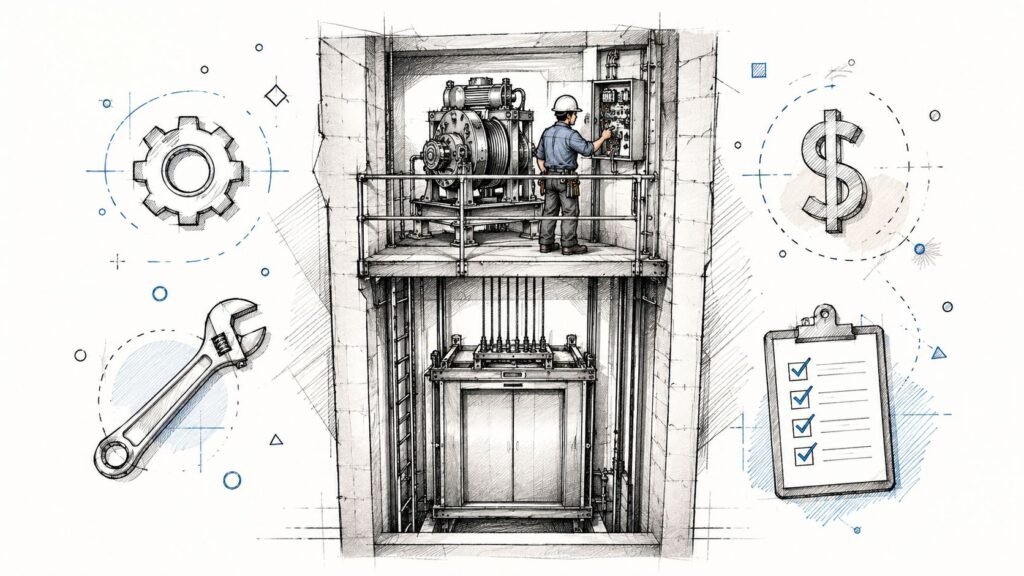
A good way to think about it is this. The car itself is only one piece of the system. The doors, controller, hoist machine, brake package, rails, ropes, and safety devices all have to work together, and one weak link can stop the entire unit.
The other reason planning matters is wear. Freight elevators often see heavier duty cycles than passenger units, so a small alignment issue or contamination problem can turn into a service call long before a major breakdown. Crane Elevator Company's industrial freight elevator service page is a useful reference point for owners who want a service model built around that reality.
Overview of Freight Elevator Project Costs
Project budgets usually fall into three buckets, and the numbers behave differently in each one. A new installation includes the most moving parts because the owner is buying equipment, installation labor, and code compliance from scratch. A retrofit usually focuses on selected components, while a full modernization is broader, often replacing controls, safety hardware, and worn mechanical systems to extend the life of the existing shaft and structure.
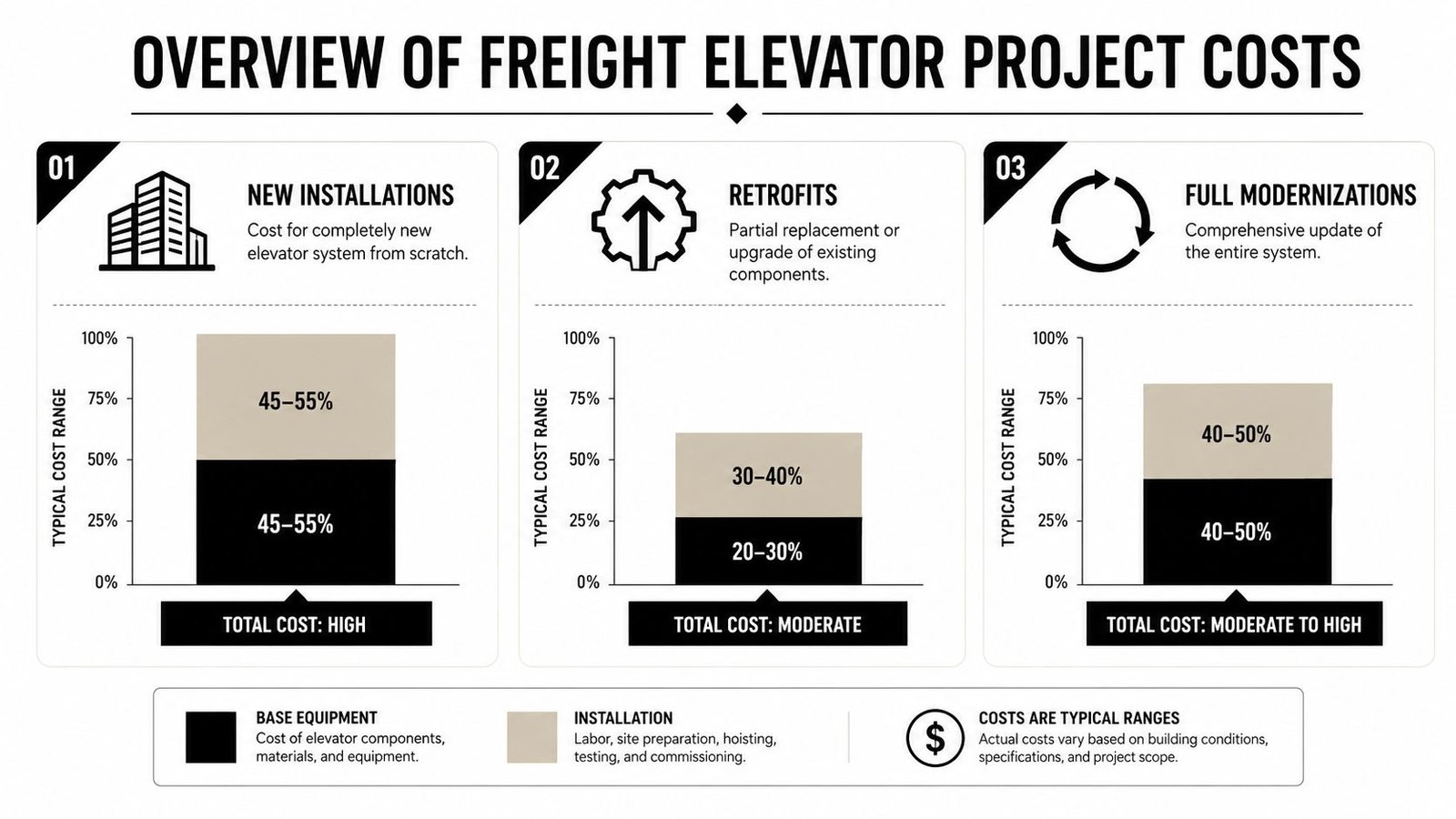
Southern Michigan pricing follows the same logic, but local labor coordination, permitting, and building access can change how fast the estimate climbs. In Detroit, Ann Arbor, Lansing, and nearby industrial corridors, contractors often have to work around active loading docks, older machine rooms, and mixed OEM equipment histories. That's why two freight projects with the same car size can still land in very different budget bands.
| Freight Elevator Project Cost Ranges | Typical Cost Range |
|---|---|
| New Installations | Varies by system scope and site conditions |
| Retrofits | Varies by component replacement scope |
| Full Modernizations | Varies by equipment age and code upgrades |
A clean quote should show where the money goes. Base equipment, installation labor, hoistway work, and electrical integration should not be buried in one lump sum if the owner wants to compare proposals fairly. Crane Elevator Company's maintenance cost page is the kind of resource owners often use when they're trying to separate ordinary service costs from larger capital work.
The main mistake is assuming the cheapest option is the lowest-risk option. A low bid that skips access planning, coordination, or safety updates can become the expensive proposal once the project starts.
Detailed Line Item Cost Drivers
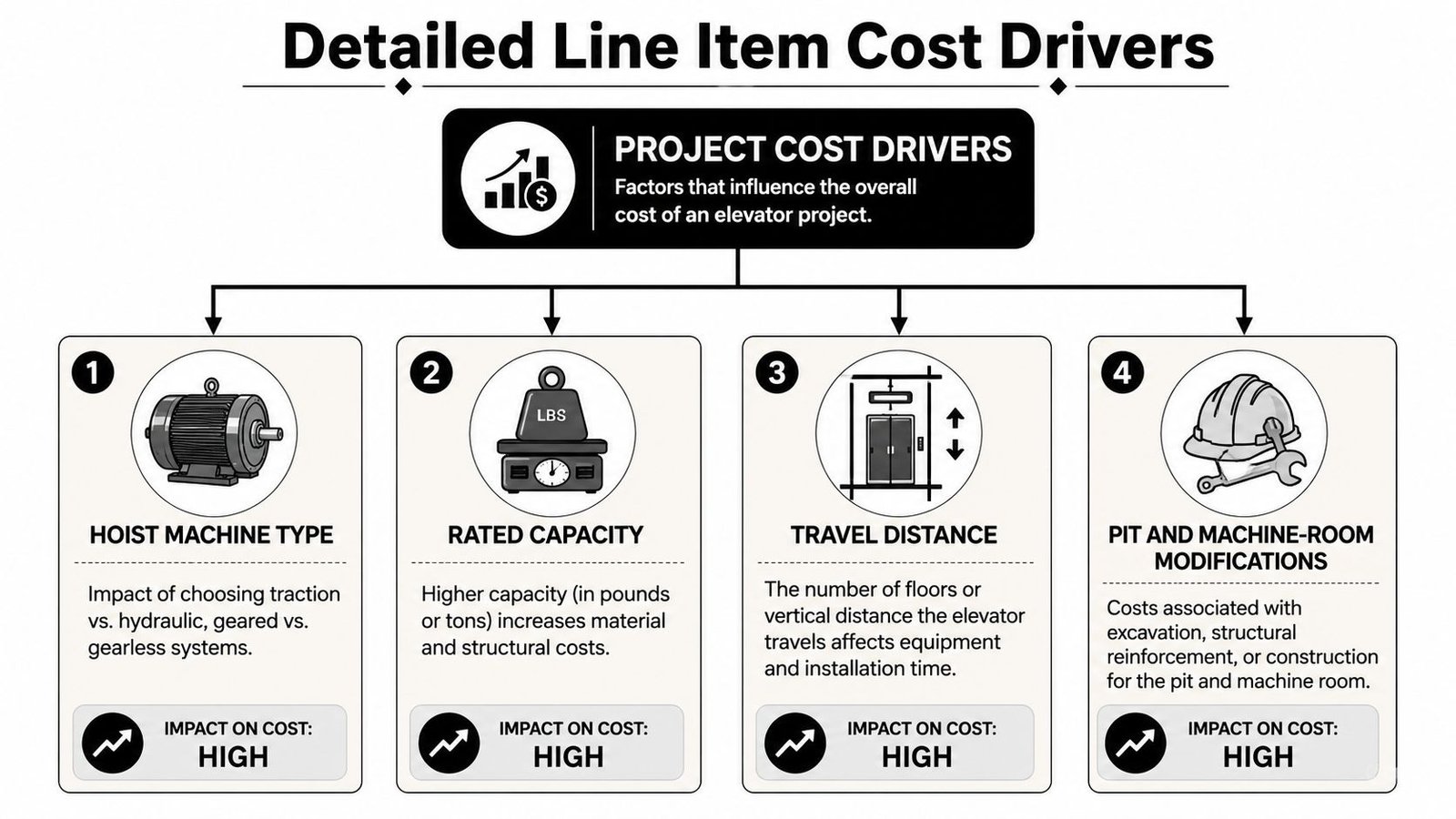
The biggest cost surprises usually come from the details no one discussed early enough. A freight elevator project can look straightforward on paper, then change once the team accounts for hoist equipment, capacity, travel distance, and the amount of structural work needed around the pit or machine room.
Equipment choices and building geometry
Hoist machine type can change both the budget and the maintenance profile. Traction and hydraulic systems don't create the same service needs, and geared and gearless configurations each bring their own replacement and inspection considerations. Rated capacity matters too, because higher-load freight equipment needs stronger components and more substantial support planning.
Travel distance is another quiet cost driver. More stops and more vertical travel mean more installation time, more material, and more coordination around the building's structure. If the shaft or pit needs modification, the project can move from a straightforward equipment replacement to a partial construction job.
Compliance and hidden labor
The paperwork side is not optional. ASME A17.1/CSA B44 Section 8.6 mandates documented Maintenance Control Programs, which means the owner has to keep part-specific records and maintain traceable service history for critical systems (UFGS maintenance control program guidance). That includes work on the controller, hoist machine, drive motor, counterbalance, ropes, overspeed governor, and emergency braking system.
A freight elevator quote that doesn't show documentation, inspections, and corrective actions is missing part of the real cost.
For owners comparing bids, the right question is not only what parts are included. It's whether the proposal reflects the actual condition of the machine room, pit, rails, and controls, because those details often decide how much labor the job really takes.
One practical option for owners evaluating repair-to-modernization paths in Michigan and Ohio is Crane Elevator Company, which handles maintenance, repair, and modernization work with a non-proprietary service approach that can matter when older equipment has mixed OEM history. For pump and motor issues in particular, see Crane's pump motor replacement resource.
Breaking Down Ongoing Maintenance Expenses
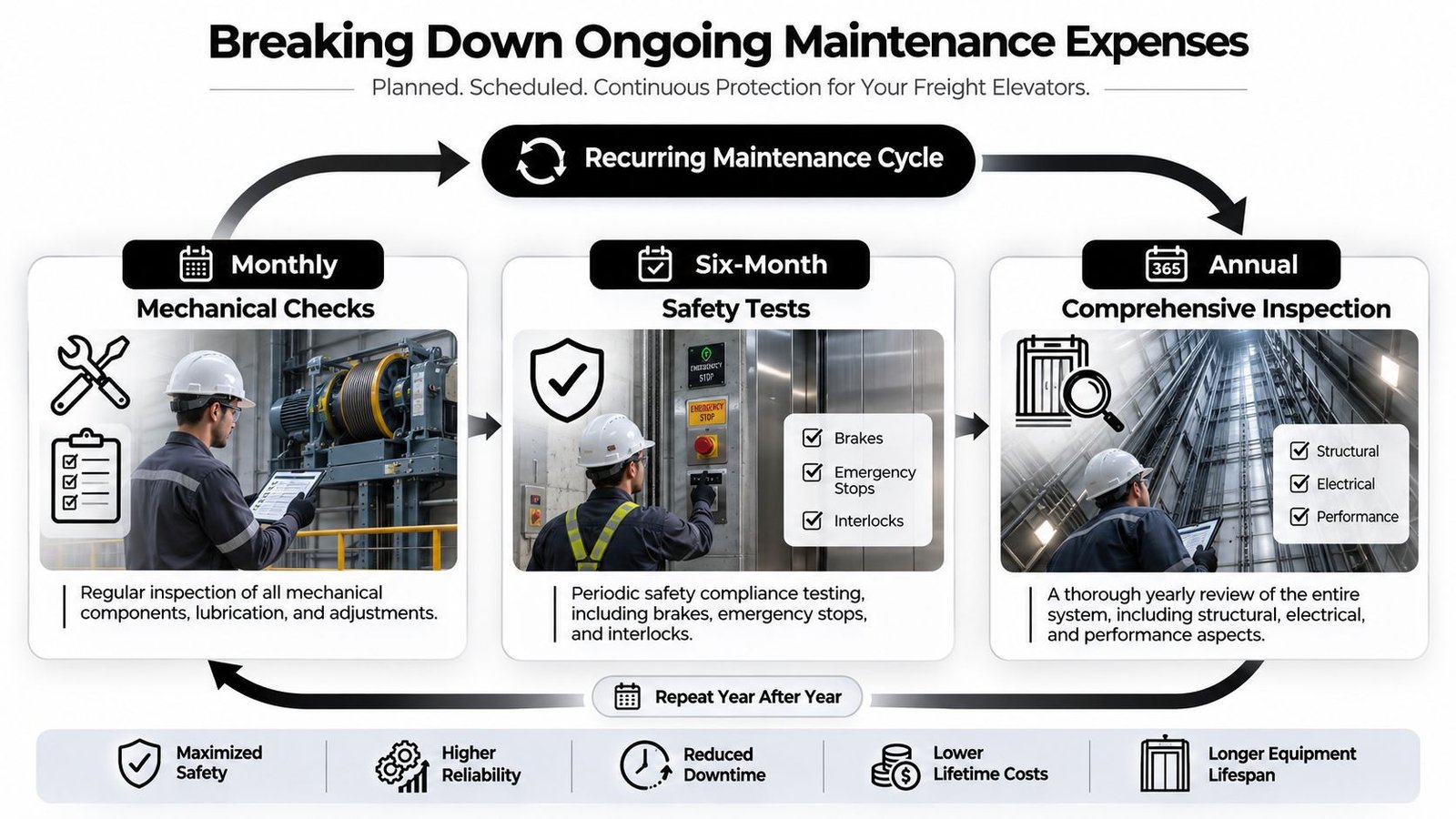
Recurring service is where freight elevator Maintenance shows up in the budget month after month. The cost is usually built from labor, cleaning, testing, small parts, and documentation, and labor is often the line item owners underestimate first. With technician pay tied to the previously mentioned mean hourly wage, it is easier to see why a serious maintenance program costs more than a casual walkthrough.
What gets done on a regular cycle
Public specifications show that monthly work includes inspecting machine sheaves and brake operation, cleaning controller cabinets, removing dust and litter from the machine room and pit, cleaning sills, checking door operation, and replacing burned-out lamps and defective indicators. Other schedules call for weekly checks such as topping up gearbox oil, verifying brake action, cleaning and lubricating the overspeed governor, and inspecting drum, sheave, and pulley bearings (state maintenance specification).
These tasks matter because contamination and lubrication drift raise friction and heat. That extra wear shows up first on guide shoes, door equipment, and brake surfaces. A small cleaning lapse can lead to nuisance shutdowns or leveling problems long before a major failure appears.
Inspections and records
Annual preventive tasks such as brake tests, guide-rail cleaning, and controller cabinet inspections are required on a six-month cycle in some jurisdictions, with Category 1, 3, and 5 tests at 12, 36, and 60 months (Cornell's New York regulation text). That affects more than timing. It shapes scheduling, staffing, and the paper trail that proves the work was done.
Freight elevator owners save money when they treat cleaning and inspection as part of the machine’s operating environment, not as optional extras.
A practical maintenance contract should spell out what gets inspected, how often, and what documentation comes back to the owner. It should also make clear who handles lockout/tagout, because repairs and replacements belong with trained personnel, not improvised labor. For Southern Michigan facilities, the price picture often depends on how clearly those service steps are defined, since vague scopes make it easier for small tasks to turn into surprise labor charges later.
Financing Options and Return on Investment
A facility manager staring at a freight elevator quote often focuses on the total and misses the pattern underneath it. The upfront number is only one part of the decision. Delays, emergency service, and repeated patch repairs can cost more over time than a planned upgrade, especially when the unit supports daily deliveries and back-of-house work.
Financing changes the project from a one-time shock into a scheduled expense. Some owners use loans, some set aside capital through internal budgeting, and some choose lease-style arrangements to protect cash flow. The right structure depends on whether the building needs immediate reliability, long-term asset renewal, or both.
ROI should include labor and downtime
The clearest return often comes from fewer interruptions, not from utility savings alone. If older equipment keeps calling for service, the labor bill keeps growing, and the wage structure in the elevator trade helps explain why those visits are rarely inexpensive (BLS). A modernization that cuts breakdowns can protect operations and make monthly spending easier to predict.
A simple way to judge the math is to compare two buckets of cost. One bucket is the visible project price, and the other is the hidden cost of waiting, including rushed dispatches, overtime, and lost productivity while the car is out of service. The second bucket is easy to overlook because it does not arrive as a single invoice, but it often shows up across several departments at once.
That is why total cost of ownership matters. An owner who pays less at the start but accepts more emergency work may spend more over time than the owner who finances a cleaner, more reliable system. In hospitals, municipal buildings, and warehouses, a single failed car can interrupt receiving, records movement, maintenance traffic, and other daily routines that depend on the lift being ready.
How to present the business case
A strong proposal should separate maintenance, repair, and modernization so decision-makers can see which costs are routine and which are capital. It should also connect the project to operational continuity, because executives usually respond faster when they can see how much disruption the building avoids. For a superintendent or controller, that is easier to evaluate than a vague promise of improvement.
Southern Michigan owners should ask for a payment structure that matches the work sequence, the service expectations, and the building's cash-flow rhythm. Crane Elevator's transparent service model is part of that discussion because clear line items make it easier to see what is included and what is not. The strongest case is practical, not promotional, and it should show how the financing choice supports steady operation without turning every repair into a budget surprise.
Case Estimates for Southern Michigan Projects
A Detroit warehouse owner called in after a freight car started slipping out of service during delivery peaks. The project needed more than a quick fix, because the team found door wear, control issues, and years of deferred attention in the same unit. The final scope shifted from repair-only thinking to a staged plan that balanced immediate uptime with longer-term equipment renewal.
Detroit and Ann Arbor examples
In an Ann Arbor municipal complex, the maintenance problem was less dramatic but more persistent. Repeated nuisance faults had become routine, and staff were losing time waiting on the car instead of moving records, supplies, and maintenance carts. The cost conversation centered on which components could be stabilized now and which should be modernized before the next budget cycle.
A hospital retrofit in the Toledo area brought a different challenge, controlled access. Freight units in healthcare settings have to support loading and unloading without confusing their role with passenger service, and detailed records matter because freight equipment is treated differently in owner documentation and access control. That distinction changes how a project is specified and who can ride.
What the local lesson looks like
Southern Michigan projects usually save money when the owner defines scope early. If a building team waits until the vendor is on site to discover that the machine room needs extra work, the budget loses its shape fast. The better approach is to identify access issues, record history, and usage intensity before the first bid is issued.
The cheapest freight project is the one that doesn't need to be re-bid after the first field surprise.
Crane Elevator Company works across Michigan and Ohio, including Toledo and surrounding cities, so owners can compare maintenance, repair, and modernization paths with a local service model that understands regional building stock and code expectations.
Pre Bid Checklist and Questions for Vendors
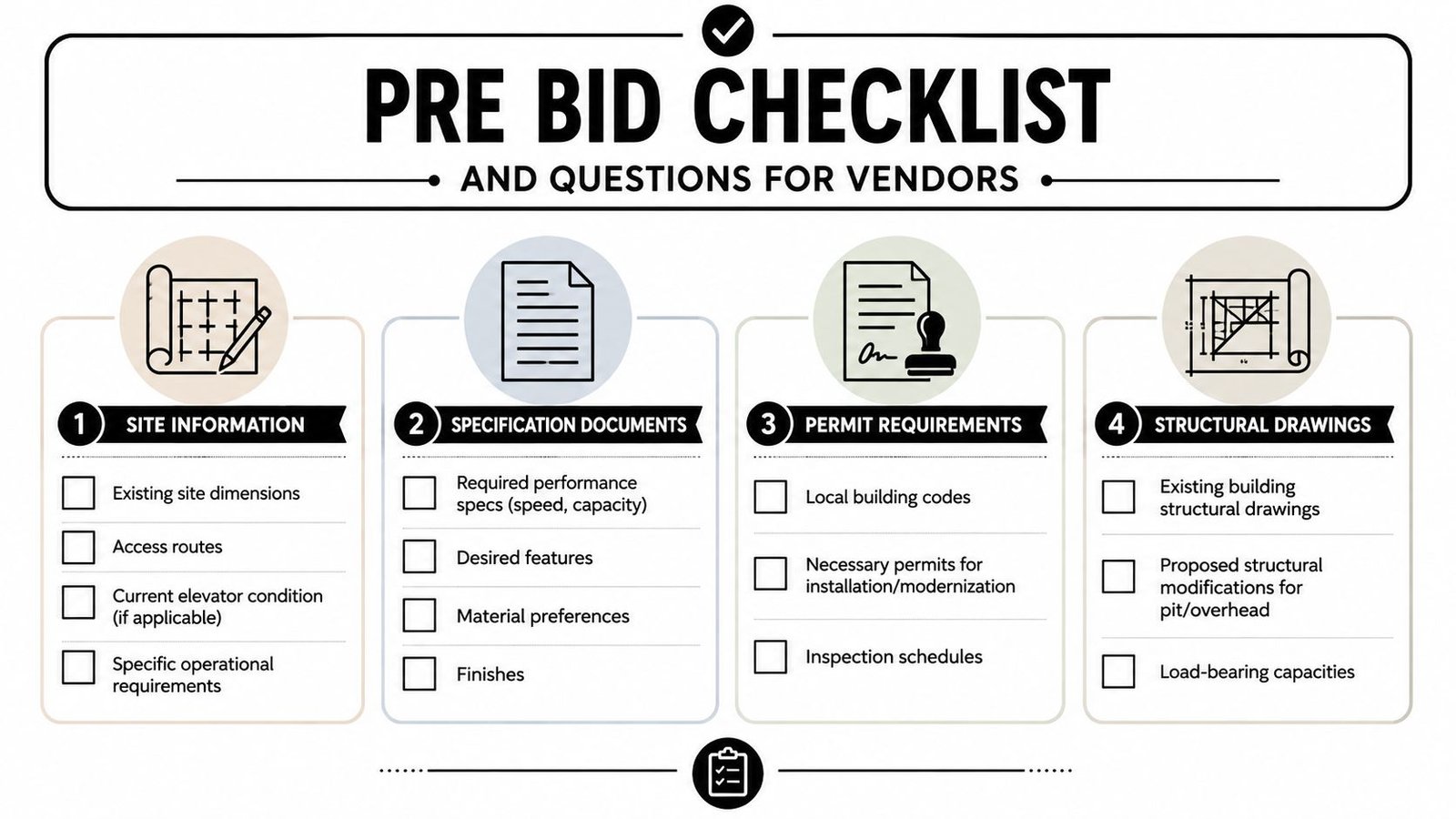
A good bid package makes vendors answer the same question set. If one contractor prices a full scope and another prices only visible labor, the quotes won't compare cleanly, and the owner will spend more time sorting assumptions than evaluating the work.
What to gather before you ask for quotes
- Site information: existing dimensions, access routes, current elevator condition, and operational requirements.
- Specification documents: speed, capacity, desired features, and finish preferences.
- Permit requirements: local codes, installation or modernization permits, and inspection timing.
- Structural drawings: load-bearing details, pit and overhead modifications, and any known reinforcement needs.
The paperwork part is not busywork. Elevator owners must keep detailed records of maintenance, repairs, and inspections, and freight units are defined by controlled access and operator-only carriage (owner guidance). That's why records, drawings, and permit documents should be in the bid folder before anyone walks the site.
Questions worth asking every bidder
Ask how warranty terms work, how quickly the vendor responds to service calls, and whether modernization financing is available. Ask what records you'll receive after each visit, because a contractor who can't show work history makes future compliance harder.
You should also ask whether the proposal covers parts-specific inspections, not just a generic service pass. Freight systems fail in specific places, and the answer to that question tells you a lot about whether the bidder understands the equipment.
Conclusion and Next Steps
Freight elevator budgets get easier to manage when owners separate the work into clear buckets, upfront project scope, recurring maintenance, and financing strategy. The strongest plans are the ones built around real usage, not guesses. That means documenting the site, comparing apples to apples, and setting a maintenance path that fits the building's load profile and compliance needs.
Start with a site audit, pull together the pre-bid information, and compare proposals on the same assumptions. If the current unit is aging, or the service history is messy, a repair-versus-modernization review will usually save more money than waiting for the next breakdown.
Crane Elevator Company helps building owners in Michigan and Ohio plan freight elevator Maintenance, repair, and modernization with code-driven service records and practical scope control. If you're ready to turn repair uncertainty into a clear budget and bid plan, visit Crane Elevator Company and ask for a site review that matches your building's real operating needs.