The freight door sticks again at 6 a.m., the controller cabinet is getting louder, and the building inspector is asking questions your last service call never answered. That's the point where most owners in Michigan and Ohio stop thinking about another repair and start looking hard at Freight Elevator Modernization, because the unit still works, but it's no longer working on your terms.
Why Freight Elevator Modernization Is on the Table
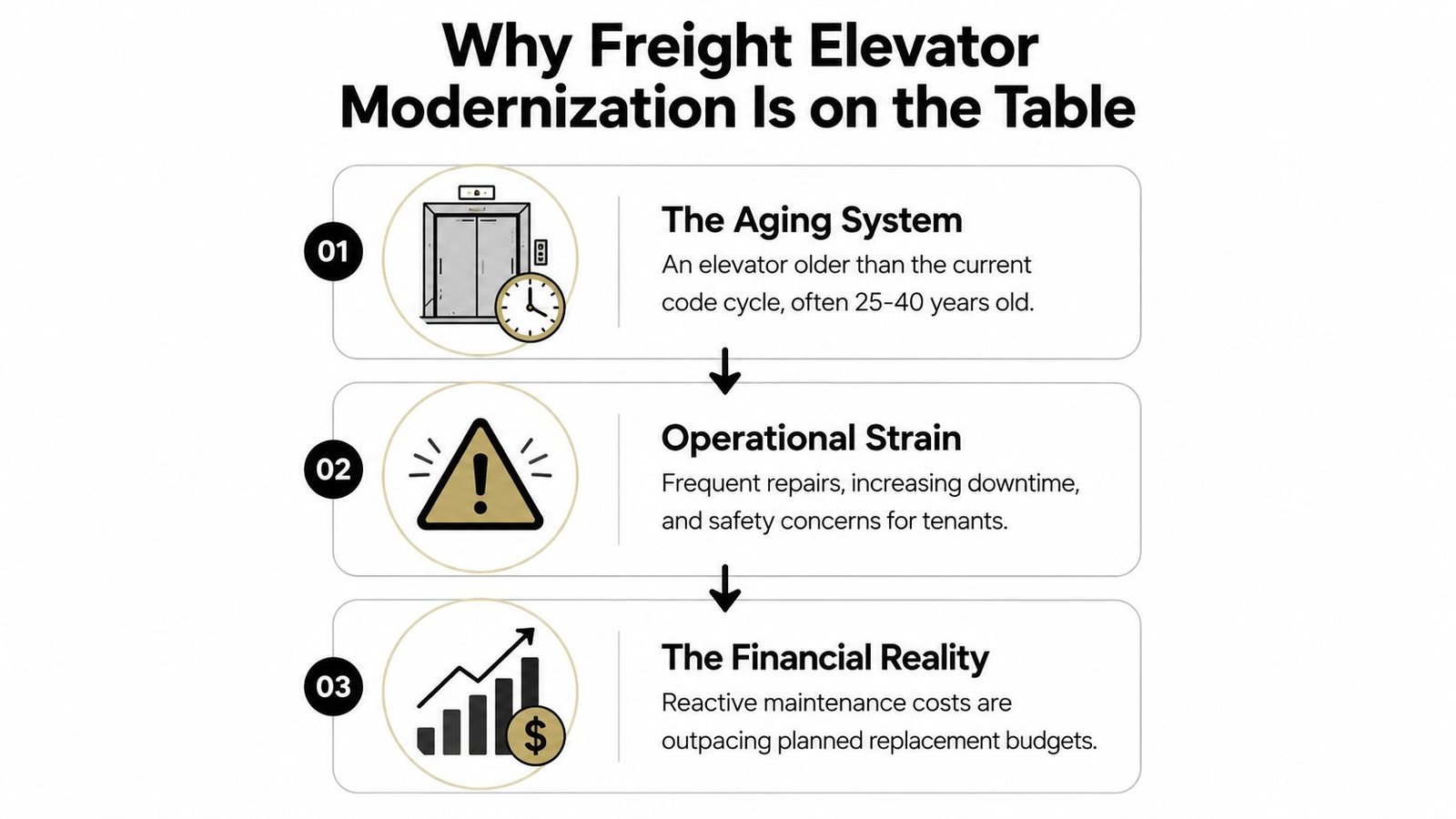
The first call often starts with something small. A door won't close cleanly, the car levels a little off, or a tech keeps chasing the same fault in a controller that's older than the people using it. In freight buildings, those symptoms usually show up faster than they do in passenger service because the elevator spends its life under harder loading cycles, rougher handling, and heavier door wear.
That's why modernization has become the practical answer in occupied warehouses, hospitals, plants, and retail back rooms. Otis says more than 7 million of the world's 21 million elevators are already more than 20 years old, and that figure is expected to more than double to 15 million within the next decade, which is the age when managers begin considering modernization. Otis modernization guidance The same aging pattern applies to freight units, where wear on doors, controllers, drives, and safety devices can pile up faster under frequent loading cycles.
The bigger market picture lines up with what owners are seeing on site. Roland Berger describes modernization as the growth business line in the elevator market, and says the overall market was worth about USD 107 billion in 2024 and is forecast to reach USD 136 billion by 2030. Otis modernization guidance IMARC Group also places the global elevator modernization market in the double-digit-billion-dollar range over the next decade, with multiple forecasts pointing to steady expansion. IMARC modernization statistics
Practical rule: if a freight elevator is still “running” but it's driving repair calls, shutdown anxiety, and code questions, you're already in modernization territory.
The rest of the decision comes down to scope, code, downtime, and how much interruption the building can absorb. That's the part owners tend to underestimate, and it's where a good plan saves more money than another round of emergency repairs ever will.
The Asset Audit and Code Review That Sets the Plan
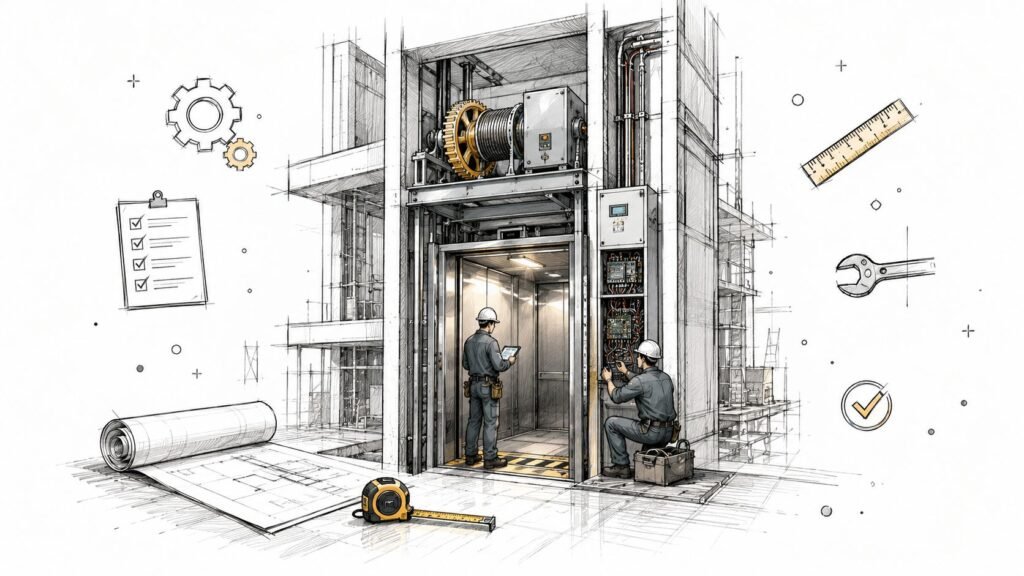
A serious freight modernization starts with the equipment that's in the shaft, not with a glossy proposal. The contractor should inspect the shaft, guide rails, brackets, controller, machine, door operators, hoistway, and safety devices, then decide what can stay and what has to go. That sequence matters because freight work gets expensive when someone assumes old structure and old power can support new controls without checking the basics first.
The most useful audits are brutally specific. They document rail condition, bracket spacing, landing door wear, machine noise, controller age, wiring condition, and the state of interlocks and safeties. A qualified contractor should also photograph the pit, the car top, the machine room, the hoistway overhead, and each landing so the proposal reflects actual field conditions instead of a template. If the truck door, counterweight clearance, or machine access is tight, that has to be captured before the scope is locked.
What the audit has to answer
A good audit doesn't just list parts. It answers go or no-go questions.
- Can the existing structure stay? If the shaft, rails, and brackets are serviceable, the project can often focus on controls and operating hardware.
- Are the doors the problem? Freight doors are a common source of slamming, bouncing, manual force, and shutdowns when they're left open.
- Is the controller obsolete or tired? That answer drives whether you rebuild around it or replace it.
- Are safety devices still code-aligned? If not, they belong in the modernization scope, not a follow-up repair ticket.
For code review, the contractor has to work against the adopted elevator code and the applicable local requirements. Federal work orders commonly require contractors to use and implement current codes and follow ASME A17.1 as the technical baseline for elevator systems and supporting structure. Federal modernization specification In the modernization context, that matters because modernization is defined as any change to equipment, including parts, components, or subsystems, other than maintenance, repair, or replacement. ASME A17.1 modernization definition
Michigan and Ohio owners should also pay attention to how freight service is classified. The U.S. Access Board states that freight elevators can't satisfy the accessible-route requirement between floors, and under ASME A17.1 they're primarily for freight, with only the operator and necessary loading or unloading personnel permitted to ride. U.S. Access Board guidance That distinction keeps the project framed correctly. Freight modernization isn't passenger modernization with a heavier car.
For building dimensions, shaft constraints, and layout planning, a useful reference is the company's freight sizing resource at Crane Elevator Company freight elevator dimensions.
Don't approve a modernization scope until someone has physically documented the shaft, the access path, the controller space, and the existing door hardware. Paper assumptions cost real money on freight jobs.
What the Money Actually Buys on a Freight Project
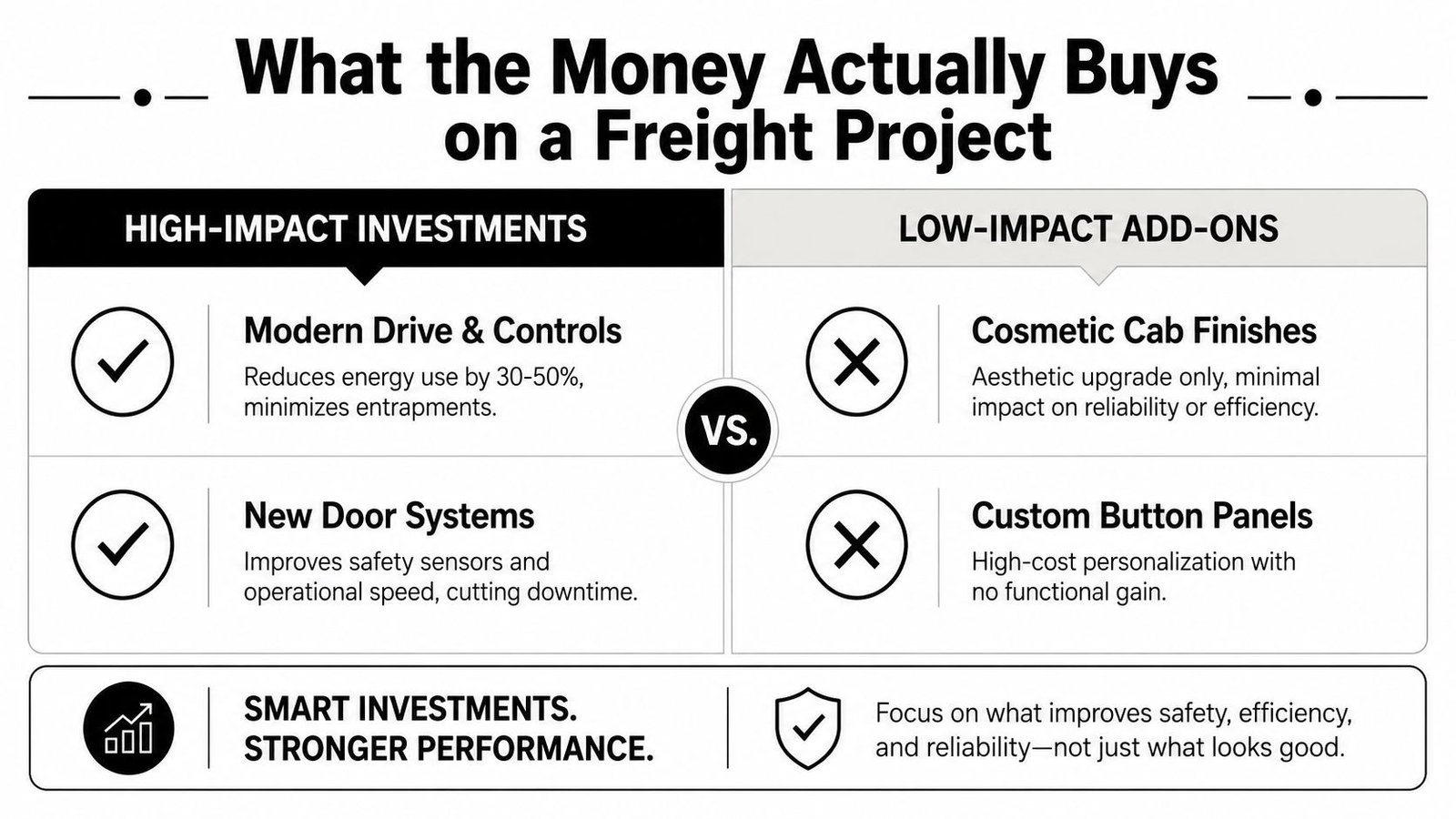
Freight modernization budgets get wasted when owners spend on visible items first and functional items second. New cab finishes can make the car look better, but they don't stop nuisance trips, misleveling, or door failures. Return usually comes from the control core, the door system, and the safety devices that drive uptime.
A common practical benchmark is the microprocessor controller plus VVVF drive combination. That pairing improves acceleration profiling, leveling precision, and power management, and it gives the contractor a cleaner platform for staged upgrades. The same applies to new door operators, hoistway door locks, and worn electrical components that keep generating repeat calls. Those are the parts that decide whether the elevator is available when receiving, shipping, or housekeeping needs it.
The market data explains why owners keep funding this work even when the project feels large. IMARC values the global elevator modernization market at USD 9.9 billion in 2025 and forecasts USD 14.4 billion by 2034, with a 4.14% CAGR from 2026 to 2034. IMARC modernization statistics Another forecast places the market at USD 10.8 billion in 2024 and USD 15.4 billion by 2030, with a 6.1% CAGR, while estimating the U.S. share at 30% or USD 3.240 billion in 2024. IMARC modernization statistics A third report projects growth from USD 9.35 billion in 2024 to USD 18.50 billion by 2032 at an 8.89% CAGR. IMARC modernization statistics
Where to stretch and where to trim
- Stretch the budget on controls and doors. Those items drive reliability, entrapment risk, and day-to-day uptime.
- Stretch the budget on safety devices. Code alignment is cheaper than repeat corrections.
- Trim cosmetic cab work if needed. Finishes matter, but they shouldn't crowd out operational hardware.
- Defer custom aesthetics. If the building can't absorb much downtime, visible upgrades can wait for a later phase.
For budgeting guidance, the cost framework at Crane Elevator Company elevator modernization cost is a useful comparison point for owners who need to separate base scope from optional finish work.
The practical test is simple. If the line item reduces door-related downtime, entrapments, or repeated service calls, it belongs high on the list. If it only changes appearance, it should be treated as a lower-priority add-on unless the building has budget to spare.
Choosing Between Full Tear-Out and Staged Modernization
The hardest decision on a freight job is rarely technical. It's operational. A plant that needs freight service every hour can't think like a low-traffic office building, and a hospital materials elevator can't sit idle while everyone waits for one big shutdown window.
A full tear-out gives you a clean reset. You clear out the old system, replace the major components in one mobilization, and finish with one commissioning sequence instead of three or four. The downside is obvious, the building takes a bigger service hit, and the capital demand lands all at once.
Staged modernization works differently. You preserve usable structure and sequence the job around the building's rhythm, then replace the control core, doors, landings, or operating equipment one phase at a time. That approach keeps the project manageable, but it also means the building lives longer with some aging parts still in service.
How to pick the right path
Use these criteria instead of defaulting to the contractor's favorite package.
- Occupancy: occupied facilities with hard daily freight demand usually favor staged work.
- Redundancy: if another freight path exists, a full shutdown is easier to absorb.
- Cash flow: budget timing often decides whether the work happens in one phase or several.
- Code deadlines: if a hard compliance issue is driving the project, a broader scope may be the safer route.
- Operational tolerance: if loading, shipping, or patient logistics can't pause, downtime planning becomes the lead variable.
Operational reality: the best modernization plan is the one the building can live through, not the one that looks simplest in a proposal binder.
In manufacturing, that often means scheduling around shift changes and staging material so trucks aren't waiting. In healthcare, it usually means keeping supplies moving while work happens after hours or on weekends. In warehousing, the decision often turns on whether a single freight car is the bottleneck for the whole dock.
The most honest answer is that neither option is universally better. Full tear-out reduces uncertainty faster. Staged modernization preserves continuity better. The right choice is the one that matches the building's downtime tolerance, not the sales pitch.
Permits, Inspections, and Testing Under the Code
Permits and testing are where rushed freight projects get exposed. If mechanical work starts before code review is finished, the job can stall, and the owner ends up paying twice, once for the wrong work and again for the redesign. The cleanest projects treat permitting as part of the schedule, not a paperwork errand.
In Michigan and Ohio, the contractor has to move through the normal code sequence, permit application, plan review, rough-in inspection, acceptance inspection, and final sign-off. Federal modernization specifications also require current elevator codes and supporting technical standards such as ASME A17.1 and, where applicable, UFC 3-490-06. Federal modernization specification That is the floor, not the ceiling.
Typical Freight Modernization Milestones
| Milestone | What Happens | Owner Action |
|---|---|---|
| Permit application | Scope, drawings, and code basis are submitted | Verify the contractor filed the correct scope |
| Plan review | Jurisdiction checks equipment, layout, and code compliance | Ask what comments came back and how they were resolved |
| Rough-in inspection | Hidden work is reviewed before it gets covered | Confirm access is clear and the inspector's notes are documented |
| Installation testing | Controller, doors, safeties, and operating functions are checked | Make sure the building team knows the outage window |
| Acceptance testing | Required safety performance is verified before return to service | Request copies of test results and punch list closeout |
| Final certificate of operation | The unit is approved for regular use | Store the certificate with the maintenance records |
The testing side deserves special attention. Category 1 and category 5 safety testing are often part of the broader compliance cycle, and the owner should know when those tests are due, who witnesses them, and what documentation is left behind. The contractor should also provide a clear record of any corrective items before the elevator is returned to normal service.
The best questions to ask are direct. What code edition are you building to? Which inspection comes next? What remains open before the final certificate can be issued? If the contractor can't answer those cleanly, the project is already behind.
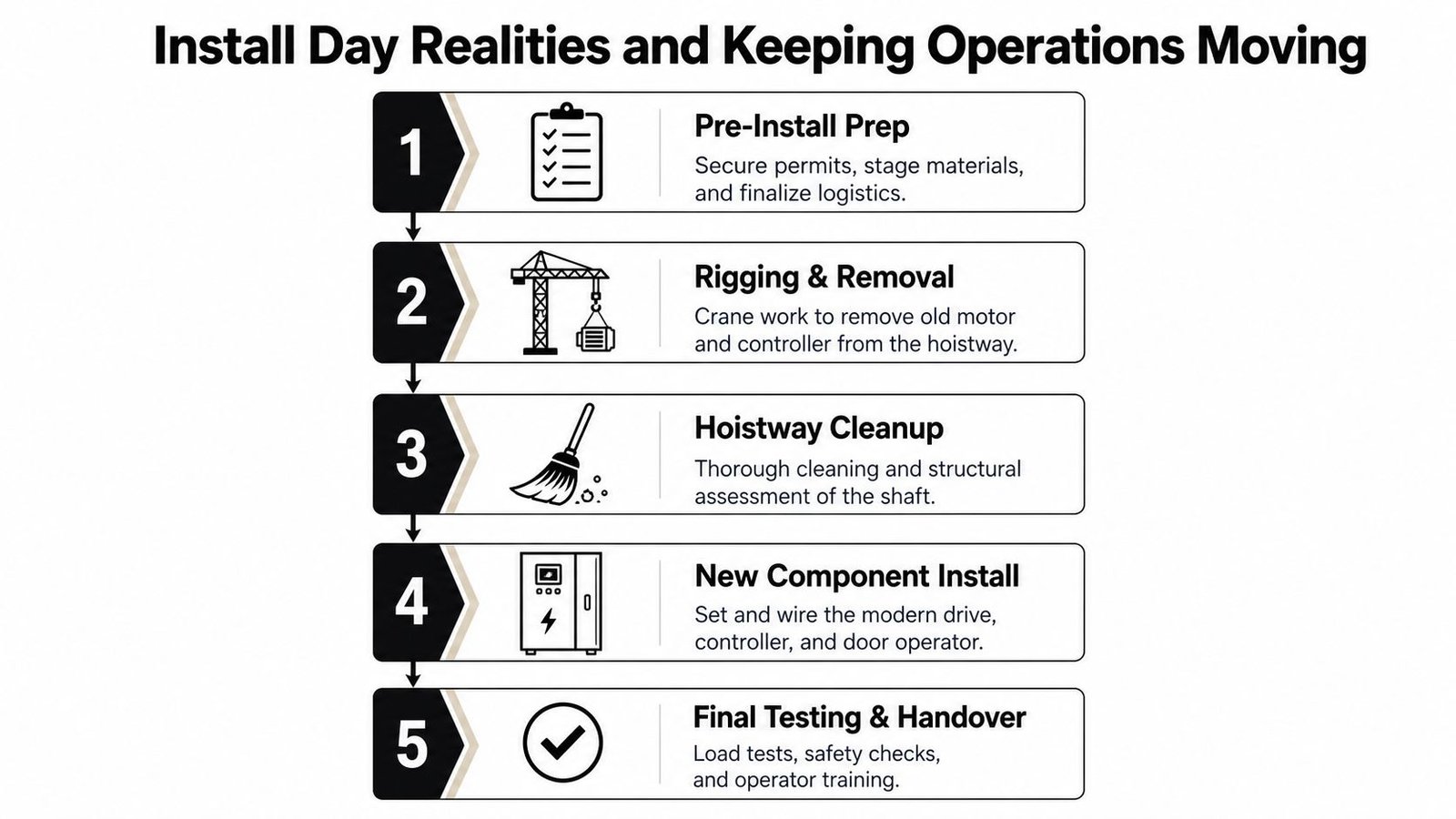
Install Day Realities and Keeping Operations Moving
On install day, the elevator doesn't disappear politely. Crews rig heavy components out, strip the old controller, disconnect the machine or operator, and clean the hoistway before new gear can go in. If the scope includes doors, that work usually needs careful sequencing because freight doors are bulky, awkward, and unforgiving when alignment is off by even a little.
The cleanest jobs are staged around the building's real traffic pattern. After-hours work and weekend shutdowns are common. So is materials staging that keeps receiving clear, because freight users get frustrated fast when pallets, carts, or debris block the dock path. If the building can't afford a full outage, the contractor has to plan whether one freight path stays live while the other side of the work is isolated.
What a disciplined install sequence looks like
- Pre-install prep. Permits are in hand, materials are staged, and the outage plan is confirmed with the building team.
- Rigging and removal. Old equipment comes out safely, with clear access and controlled debris handling.
- Hoistway cleanup. The shaft is cleaned, and the structure is checked before new components go in.
- New component install. The controller, drive, door equipment, and related hardware are set and wired.
- Final testing and handover. Load tests, safety checks, and operator training happen before return to service.
A non-proprietary control approach pays off here because the equipment isn't locked to one brand's service channel. That makes it easier for another qualified contractor to maintain and repair the unit later, which matters in lower-margin freight environments where owners need options, not lock-in.
Clean installs are won before the first panel comes off. If the shutdown window, staging area, and receiving schedule aren't aligned, the crew spends the day fighting the site instead of rebuilding the elevator.
In occupied buildings across Michigan and Ohio, that coordination is usually the difference between a project that finishes on schedule and one that drifts into extra downtime. Freight work rewards planning more than speed.
Handoff, Maintenance, and Choosing the Right Contractor
A freight modernization isn't finished when the car runs once. It's finished when the owner gets the records needed to keep it running without guessing. That means as-built drawings, controller schematics, a non-proprietary parts list, a documented maintenance plan, code-required inspection cadence, and a clear 24/7 emergency response path.
That handoff matters because the cheapest modernization invoice can turn into the most expensive one if the building gets trapped in a proprietary service loop. If only one vendor can source parts or interpret the controller, the owner loses power on both response time and long-term cost. A non-proprietary design keeps service competitive and gives the building a better shot at predictable maintenance.
The maintenance side should be visible in the closeout package, not buried in a promise. For example, Crane Elevator Company freight elevator maintenance reflects the kind of upkeep owners should expect after a modernization, including machine room, pit, and car top clean-downs, COP and PI bulb replacements, and regular attention to the equipment that wears out.
A contractor worth hiring should be able to show more than a price. Ask for these five things:
- Code familiarity: Can they explain the current code basis for the work without hand-waving?
- Non-proprietary documentation: Will you get parts and schematics that another qualified provider can use?
- Field response: Do they support emergency calls in the region you operate in?
- Maintenance discipline: Do they offer a plan that fits a freight environment, not just passenger service?
- Closeout quality: Will they leave you with records, test results, and a clear maintenance path?
Crane Elevator Company is a family-owned contractor serving Lower Michigan and northwest Ohio, including Toledo and surrounding cities, with maintenance, repair, and modernization services built around non-proprietary service and 24/7/365 field operations. For owners comparing bids, that combination of documentation, service access, and long-term support is the difference between a one-time project and a manageable asset strategy.
If you're weighing a freight modernization in Michigan or Ohio, bring your maintenance pain points, code concerns, and downtime limits to the conversation early. Visit Crane Elevator Company to talk through maintenance, repair, and modernization options that fit the way your building runs.