Freight elevator modernization costs about $70,000–$90,000 per car for partial modernization and $120,000–$400,000 or more for full modernization. The final figure depends on the scope, equipment, and site conditions, not just the elevator's age.
The biggest budget risk is often the quote itself. A proposal can look complete while leaving the owner responsible for electrical work, pit repairs, fire-alarm integration, and the cost of moving materials during shutdown. For Michigan and Ohio facility managers, a useful budget starts with a clear boundary between the elevator contractor's work and everything the building must provide.
What Freight Elevator Modernization Costs per Car
Partial and full modernization are different purchases, not competing prices for the same result. A controls package addresses obsolete electronics. A broader project addresses the machinery, doors, safety equipment, and building interfaces that determine whether the elevator can return to dependable service.
Adsimulo's modernization cost guide places controls-focused work at roughly $50,000–$70,000 per elevator and full modernization at $120,000–$400,000 or more. Its guidance also recommends a 10%–15% contingency for concealed deficiencies and notes that urban high-rise projects can cost approximately 20%–30% more than comparable suburban work.
Freight elevator modernization cost ranges by scope
| Scope | Typical cost per car | What it covers |
|---|---|---|
| Controls-focused | $50,000–$70,000 | Controller, selector, operating panel, and call stations |
| Partial modernization | $70,000–$90,000 | Controls, door equipment, and fixtures |
| Full modernization, hydraulic | $100,000–$150,000 | Pump, motor, valve package, cylinder work where needed, and cab updates |
| Full modernization, traction | $150,000–$300,000 | New drive or machine, brake and governor work, hoist ropes, and safety testing |
| Full modernization, all equipment types | $120,000–$400,000 or more | Major mechanical equipment, door operators, cab work, machine-room components, safety systems, and teardown or rebuilding |
The partial-modernization and equipment-specific bands reflect separate benchmarks discussed with the quote and equipment requirements below. They are not additive, and the hydraulic and traction bands are not subdivisions that neatly fit inside every estimate. Constrained or high-capacity freight cars can exceed every band.
Heavy-duty doors, larger capacities, older hydraulic jacks, and obsolete traction machinery require more than a standard controller change. A proposal labeled full modernization still needs a component schedule showing what stays, what changes, and what gets tested.
Crane Elevator Company provides modernization upgrades for both traction and hydraulic systems. We define the upgrade around the equipment's condition rather than treating either technology as a fixed-price package.
Practical rule: Choose the scope first, price building-side exclusions separately, and hold contingency outside the contractor's base price.
These are planning benchmarks, not freight-specific quotations; a site survey and written scope are needed before the budget is final.
What Drives Freight Modernization Price and Michigan Code Triggers
Start with the equipment that carries the load and controls access to it. Then work outward to the machinery, building conditions, and compliance obligations. Pricing in that order helps an owner distinguish unavoidable work from optional improvements.
Rank the physical cost drivers
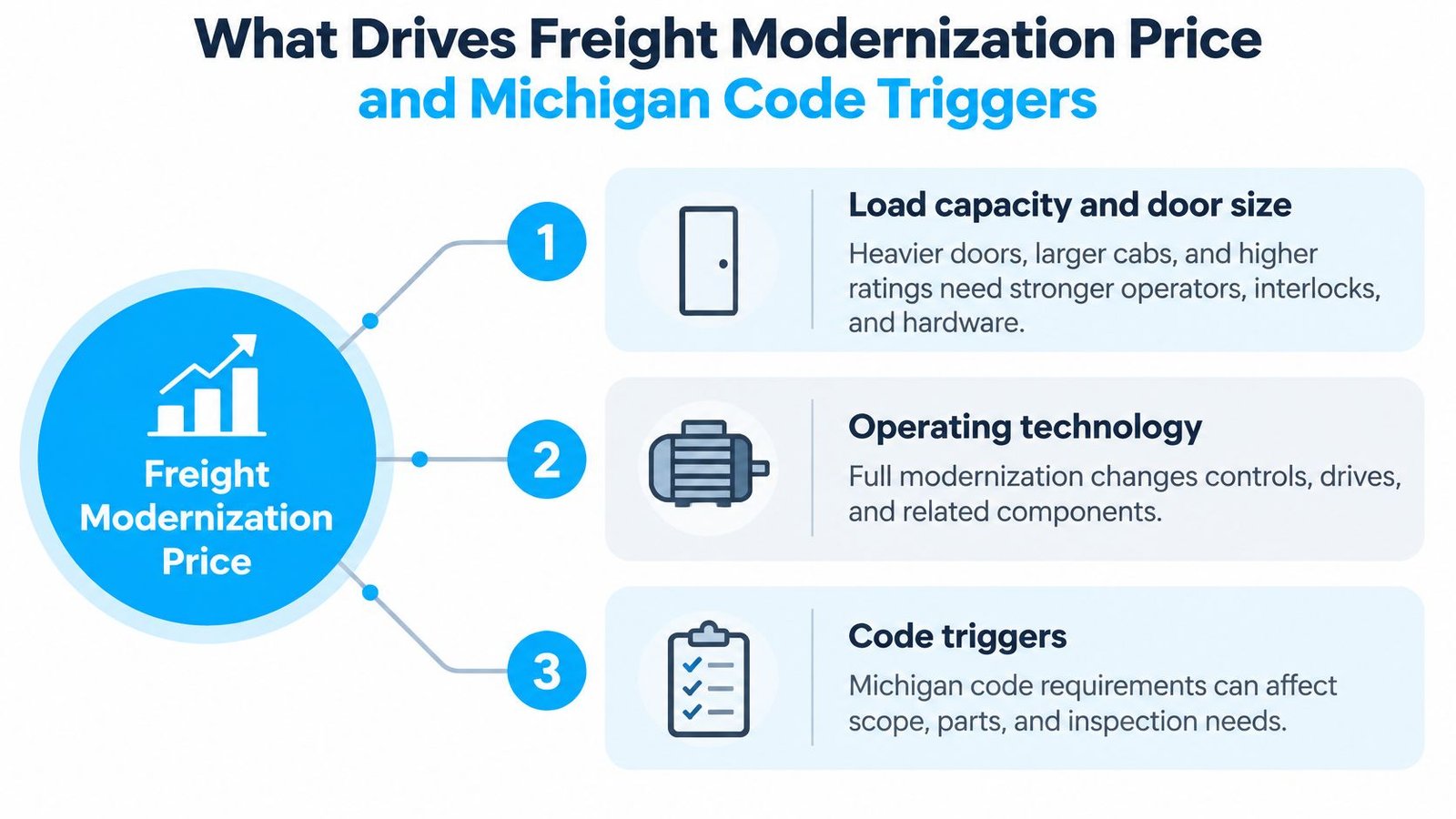
Load capacity and door size come first. Large freight entrances need suitable operators, interlocks, tracks, guides, and hardware. Record how workers load the car, including pallet dimensions and equipment clearance, without assuming modernization increases the rated capacity.
Operating technology sets the mechanical scope. LegalClarity's industrial freight elevator cost guide reports roughly $100,000–$150,000 for full hydraulic modernization and $150,000–$300,000 for traction modernization, with high-capacity or unusually constrained projects potentially exceeding those ranges. Hydraulic work may involve the pump, motor, valve package, and an older underground cylinder; traction work may involve the drive, machine or gear sheave inspection, brakes, governor, and hoist ropes.
Hoistway, pit, and structural conditions follow. Restricted equipment access changes how crews remove machinery and bring replacements into the building. Pit deterioration, water intrusion, or reinforcement needs should be investigated before the owner accepts an allowance as a firm price.
Electrical service and fire-system interfaces need separate ownership. A new controller doesn't mean the existing feeder, disconnect, alarm interfaces, and emergency power arrangements are automatically suitable. Identify the electrician and fire-alarm contractor's responsibilities before shutdown.
Location changes execution costs. A downtown building with restricted loading access presents a different installation problem from a plant with an accessible equipment entrance. Price staging, permitted work hours, protection, and material handling explicitly rather than accepting an unexplained location premium.
Our freight elevator service capabilities include door-lock monitoring, tank and power-unit replacement, cable replacement and shortening, jack replacement, hydraulic packing, and motor, sheave, and machine replacement. Our specialized expertise also covers hydraulic elevators, traction elevators, drum machines, wheelchair lifts, dumbwaiters, and residential elevators.
Separate required compliance from elective improvements
Changing a subsystem can require related safety upgrades or re-testing. Door reopening protection, interlocks, emergency lighting, two-way communication, and firefighters' emergency operation must be evaluated under the governing ASME A17.1/CSA B44 edition and local requirements.
Michigan's published elevator rulemaking document references ASME A17.2 for inspection and ASME A17.3 for existing elevators. Because this is a rulemaking document, confirm the adopted requirements applicable to the actual permit rather than treating every proposed provision as an effective obligation.
Mandatory compliance work may include:
- Altered-system testing: Demonstrating that changed equipment and connected safety functions operate correctly.
- Violation correction: Resolving deficiencies applicable to the installation and approved scope.
- Required protective systems: Updating communication, door protection, or fire-service functions when the governing requirements call for it.
Optional improvements may include:
- Cab finishes: Replacing serviceable finishes for appearance or easier upkeep.
- Reliability enhancements: Replacing otherwise acceptable components to coordinate future maintenance.
- Energy features: Adding efficiency measures beyond the required alteration scope.
We manage violation resolutions and perform mandated CAT 1, CAT 3, and CAT 5 safety inspections, as applicable. Ohio projects require their own state and municipal review; a Michigan scope isn't a substitute for confirmation by the Ohio authority having jurisdiction.
Identify the dominant cost drivers for your car, then give each a separate price or clearly defined allowance. That makes a technical disagreement visible before it becomes a change order.
Repair, Partial or Full Modernization, and When Each Makes Sense
The cheapest bid isn't the lowest-cost option if it leaves the next shutdown waiting in the machine room. Choose the smallest scope that addresses the actual failure pattern without creating an expensive sequence of temporary fixes.
Repair, partial and full modernization compared
| Scenario | When it fits | Budget effect |
|---|---|---|
| Targeted repair | A single worn part or one-off failure on otherwise sound equipment | Lowest upfront cost; repeat failure risk remains |
| Partial modernization | Obsolete controls, door equipment, or fixtures while the machines are sound | Mid-range budget; new and old interfaces must be tested together |
| Full modernization | Obsolete parts, repeat violations, several worn assemblies, or incompatible interfaces | Highest upfront cost; fewer repeated shutdowns and duplicated labor |
A targeted repair makes sense when the diagnosis is specific. A failed valve on an otherwise serviceable hydraulic elevator doesn't automatically justify replacing the controller, doors, and fixtures. The decision changes when the repair depends on unavailable parts or leaves an unresolved system incompatibility.
Partial modernization works when the retained equipment has a defensible remaining role. Before approving new controls, document the condition of the doors, brakes, ropes, hydraulic cylinder, and safety devices. Otherwise, the owner may fund a successful controls installation and still face mechanical outages.
Compare operating consequences, not just contracts
Say a manufacturing building can route light materials through another elevator but can't move its largest production loads that way. A phased upgrade may preserve some service while still requiring planned production changes. The facility manager needs to price that restriction, not only record that another car remains available.
Build a scenario worksheet covering:
- Shutdown consequences: Delayed production, receiving restrictions, and staff overtime.
- Temporary handling: Rental equipment, alternate staging, and suitable routes for material movement.
- Future service: Expected repair exposure and the condition of retained assemblies.
- Project repetition: Additional mobilization and testing if the owner splits interconnected work into separate contracts.
A partial upgrade is economical only when the retained equipment supports the operating plan.
Our approach to modernizing elevator systems includes comparing the upgrade with the equipment that will remain. Full modernization becomes the stronger choice when repeated repairs would keep taking the same critical car out of service.
Crane Elevator Company offers a second opinion on an existing or ongoing elevator problem at no extra charge, including a visit and solution plan. Use that assessment to confirm the appropriate scenario before committing the capital budget.
What Every Modernization Quote Should Include
A useful proposal lets the owner trace every required task to a price, a responsible party, and a completion requirement. A low number without those details isn't ready for comparison.
The planning ranges used earlier in this article put partial modernization at roughly $70,000–$90,000 per car and full modernization at $120,000–$400,000 per car. Those figures cover the elevator work itself. Building-side exclusions, including electrical upgrades, abatement, pit repairs, and structural reinforcement, can materially change the installed cost, so two quotes with identical equipment scope can still land far apart. The quote, not the scope category, is where the actual budget risk sits.
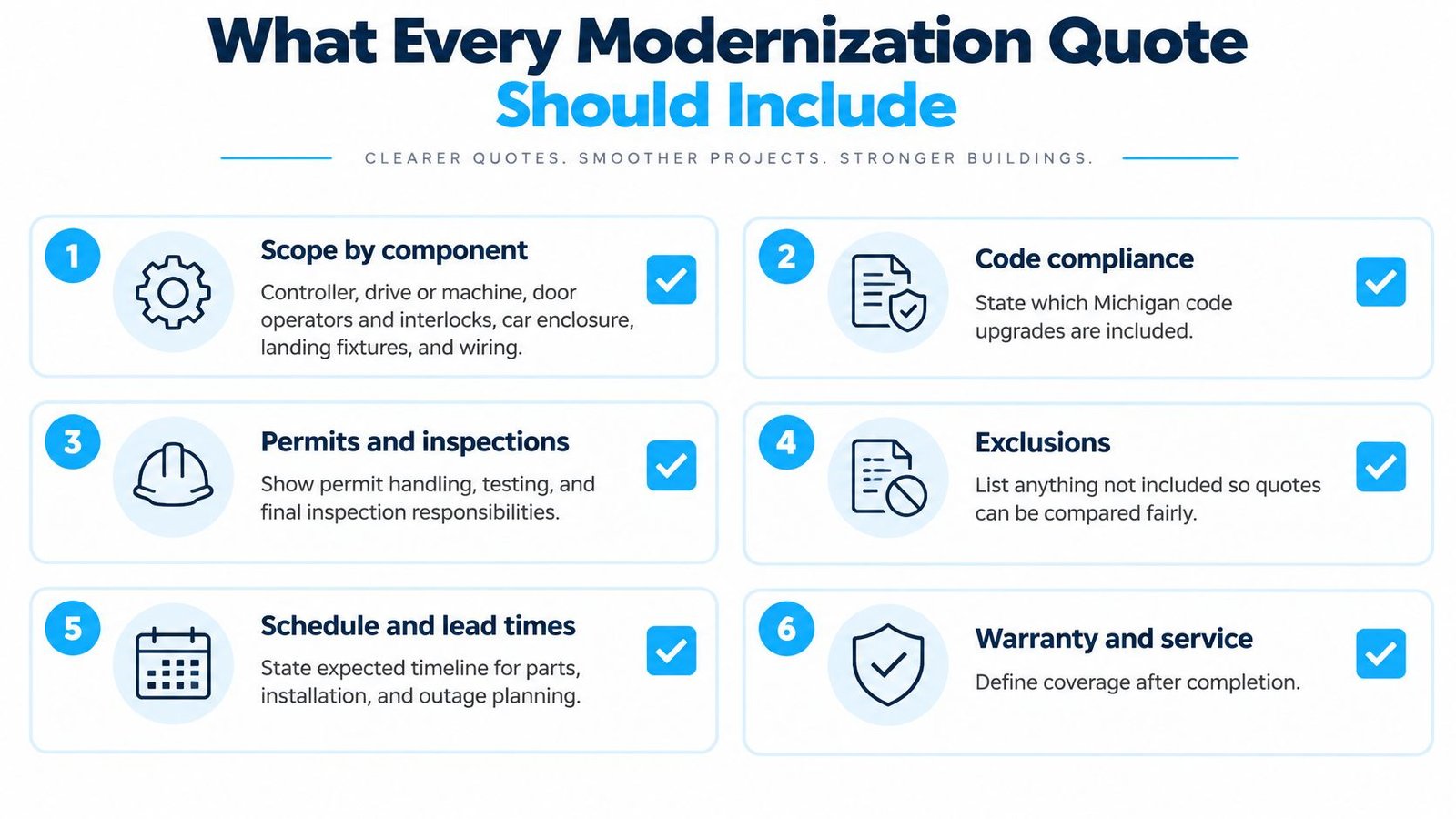
Apply this checklist before approval
- Scope by component. Mark the controller, drive or machine, door operators and interlocks, enclosure, landing fixtures, safeties, governor, buffers, suspension or hydraulic equipment, and emergency communication as retained, repaired, or replaced.
- Governing code and local rules. Require the applicable edition and alteration basis so a general compliance statement doesn't conceal unresolved design obligations.
- Acceptance tests and re-testing. Name the altered safety functions and included testing, preventing an installation-only price from becoming a testing surcharge.
- Outage and temporary service plan. Separate procurement, installation, testing, and inspection readiness so the owner can plan receiving and production around the actual loss of service.
- Warranty terms. Identify covered parts, labor, exclusions, and the start of coverage rather than relying on a warranty label.
- Priced exclusions. Assign electrical-service upgrades, fire-alarm integration, asbestos abatement, pit repairs, reinforcement, temporary protection, and after-hours work to an identified party.
- Concealed-condition contingency. Keep an owner-controlled reserve for hidden deficiencies, not work that could have been identified during the survey.
- Permit and inspection responsibility. State who submits, pays, schedules, attends, and closes out the required approvals.
I read the exclusion list before the total. That is where the price difference lives.
A proposal that excludes pit repairs can look cheaper than one that includes them. If the pit condition is already visible, that difference isn't an unforeseen condition; it's an unresolved scope item. The same logic applies to fire-alarm integration and after-hours work: anything pushed to "by others" still lands on the owner's invoice, just under a different contract.
We offer a free, no-obligation quote for compliance and violation work. That helps owners put a defined price against deficiencies instead of carrying a vague compliance allowance.
To compare bids, create a side-by-side component schedule with columns for included work, exclusions, allowances, and owner responsibilities. Add the missing work to each proposal before comparing totals, then compare outage assumptions, warranty coverage, and acceptance requirements on the same basis. The quote that wins that comparison is rarely the one with the lowest first number.
Planning Phased Budgets and Lifecycle Costs for Multiple Cars
At roughly $175,000 per car, a six-elevator program reaches approximately $1.05 million before unusual structural, fire-service, abatement, or access costs, using Colliers' commercial modernization benchmark. That is a commercial planning reference, not a freight-specific quotation, but it shows why an owner should treat modernization as a portfolio capital decision.
Six-car freight modernization program budget by scope
| Budget line | Basis |
|---|---|
| Controls-focused | 6 cars at $50,000–$70,000 each, totaling $300,000–$420,000 |
| Partial modernization | 6 cars at $70,000–$90,000 each, totaling $420,000–$540,000 |
| Full modernization | 6 cars at $120,000–$400,000 each, totaling $720,000–$2.4 million before project-specific additions |
| Industrial freight outlier | 6 cars at roughly $485,000 each, totaling approximately $2.91 million |
| Contingency reserve | 10%–15% of the full modernization range, a calculated envelope of $72,000–$360,000 |
The controls, partial, full, and reserve totals are arithmetic applications of the planning bands, not additional market estimates. The industrial outlier comes from Convex's modernization overview, which cites approximately $485,000 per industrial freight elevator and notes that elevators commonly represent only 3%–10% of building electricity use.
Controls-only funding leaves the mechanical equipment in the capital plan. Partial modernization adds selected systems, while full modernization requires a much larger commitment. The outlier is a warning against treating the top of a broad commercial range as a guaranteed freight-project ceiling.
Phase around risk and usable capacity
Inventory each car's equipment, condition, inspection status, duty, and operational importance. Prioritize unsafe or compliance-driven work first, then assess which outages the building can absorb. Don't assume the remaining elevators can handle displaced loads merely because they are operational.
A workable planning sequence is:
- Assign scope by car: Avoid giving every unit an identical package without a condition assessment.
- Reserve contingency: Keep concealed-condition funds distinct from known building work.
- Coordinate phases: Align shutdowns with production and receiving requirements.
- Maintain retained equipment: Use freight elevator preventative maintenance to support cars awaiting their scheduled phase.
Financing changes when the owner pays. It doesn't remove outage costs or make an incomplete scope complete.
We offer commercial elevator and modernization financing. All our modernizations use non-proprietary control systems, allowing any qualified service provider to maintain them later.
There isn't an established published freight-specific payback model to apply universally. Compare capital cost with avoided emergency repairs, lost production, overtime, rental handling equipment, temporary service, maintenance expense, and compliance exposure. Energy savings alone aren't a sound basis for promising a return period.
Confirm the Scope and Book a Site Assessment
A modernization quote is only as reliable as the scope behind it. Before requesting pricing, assemble the car count, capacity and age of each elevator, whether each runs on hydraulic or traction equipment, and the latest inspection report with any open violations. Add service records and a description of the loads that cannot move while a car is down.
The site assessment converts that file into a written scope with explicit exclusions. Tell us whether your priority is resolving a recurring fault, clearing a violation, or planning a broader upgrade, because each starting point produces a different proposal and a different price. Read the exclusions list as closely as the price itself. Work a quote never mentions is cost the budget still absorbs later, and that silence is where most freight modernization overruns begin.
Michigan coverage and nearby Ohio communities
Crane Elevator Company serves building owners across Michigan and Ohio, including Detroit, Toledo, Ann Arbor, Lansing, Perrysburg, Flint, Kalamazoo, Birmingham, and surrounding communities. We support industrial, healthcare, education, municipal, commercial, and residential equipment needs.
Services that support the complete operating plan
We maintain, repair, and modernize passenger, service, freight, and residential elevators, wheelchair lifts, material lifts, and dumbwaiters. Our work includes:
- Ongoing service: Preventative maintenance, major and minor repairs, machine-room, pit, and car-top clean-downs, and included COP/PI bulb replacement.
- Equipment repairs: Door-lock monitoring, safety-edge door detectors, hydraulic packing, jack, cable, tank, power-unit, motor, sheave, and machine replacement.
- Compliance and testing: State testing and inspections, safety tests, emergency phones, fire-service tests, generator testing, and violation correction.
- Capital planning: Non-proprietary modernization and financing options for commercial upgrades.
Our field operations run 24 hours a day, 7 days a week, 365 days a year. Ask for a written quote and a second opinion on the proposed scope before deciding which equipment to retain or replace. A second opinion on an existing problem includes a visit and a solution plan at no extra charge, and competing proposed prices are matched under our price-beat guarantee.
We offer freight elevator condition assessments, repairs, compliance work, and non-proprietary modernization for Michigan and Ohio facilities. Visit Crane Elevator Company to request a quote and bring your inspection report, equipment details, and shutdown constraints so we can help define a realistic modernization budget.