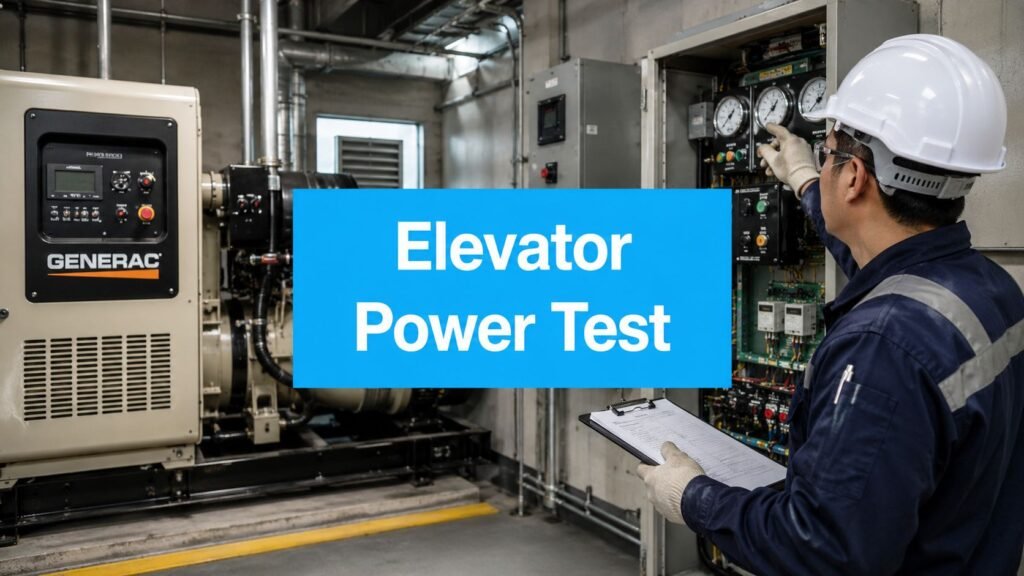
The annual generator test is on your calendar, the electrical contractor has a load-bank procedure ready, and the elevator appears to be operating normally. Then the inspector asks for the elevator emergency-power records. A generator can start, carry building load, and pass its electrical checks while an elevator still fails to recall, transfer, sequence, or operate correctly.
That distinction drives the generator testing requirements for elevators in Michigan and Ohio. The generator is an electrical system, but the elevator's response to that system is an elevator-code event. Facility managers in Lansing, Detroit, Toledo, Cleveland, Ann Arbor, Grand Rapids, and nearby communities need both trades coordinated before an inspection, outage, or planned shutdown.
When the Generator Test Is Really an Elevator Test
A facility manager in a Lansing office building schedules the annual generator test with the electrical contractor. The plan is straightforward. Start the genset, run it under load for an hour, record the results, and close the work order.
The elevator contractor reviews the scope and asks a different question. What happens to each elevator when normal power drops? Does the transfer switch operate within the required sequence? Does each car recall correctly? Does the elevator run at normal speed on generator power? Does the controller recognize emergency power through the suicide circuit?
Those questions come from the elevator side of the installation. Florida's elevator guidance explains that ASME A17.1 applies retroactively to an elevator equipped with emergency or standby power, and that the annual requirement is triggered whenever that power is provided. It also identifies ASME A17.2 item 1.17.2.1 for electric traction elevators and 1.17.2.2 for hydraulic elevators as relevant test items. Florida's elevator emergency-power guidance shows why generator-backed elevator operation is treated as a distinct maintenance event.
Practical rule: A generator load test proves the generator can support a load. An elevator emergency-power test proves the elevator and the emergency power system work together.
A general electrical test may never command the elevators to recall one at a time. It may not verify full-speed operation, phase monitoring, door operation, or the controller's emergency-power input. It can also miss a suicide-circuit fault that only appears when the elevator motor-generator or related control circuit changes state.
That's why the electrical contractor and elevator service company should agree on the test sequence before anyone starts the generator. The electrical team controls the generator, transfer switch, and building distribution equipment. The elevator mechanic controls elevator recall, group operation, controller response, safety functions, and the loaded test when one is required.
The work isn't complete when the generator returns to normal voltage. It's complete when the elevator-specific results are recorded, deficiencies are addressed, and the documentation supports the authority having jurisdiction's review.
Codes and Standards That Govern Elevator Generator Testing
Facility managers usually deal with several code layers at once. The easiest way to keep them straight is to separate the power source requirements from the elevator operating requirements.
ASME A17.1/CSA B44 governs the elevator. Its emergency-operation provisions address how an elevator responds when emergency or standby power is supplied. Section 2.27.2 is central to the operational interface, including recall and emergency functions. The framework also includes the heavier periodic testing requirements that can apply to traction elevators.
ASME A17.2 supports inspection and testing. Its guidance includes the elevator-specific procedures an inspector or qualified elevator professional uses to evaluate emergency operation. The generator's presence changes the elevator test scope, rather than turning the work into an ordinary electrical maintenance check.
NFPA 70, the National Electrical Code, governs the electrical installation. Articles 700, 701, and 702 distinguish emergency systems, legally required standby systems, and optional standby systems. The applicable article depends on the building's classification and the purpose of the power system. The electrical code governs wiring, transfer equipment, source connections, and related installation requirements.
NFPA 110 addresses emergency power supply systems and their exercise, maintenance, and testing program. Those generator exercises matter, but they don't replace an elevator-specific operational test.
Michigan adoption runs through the state construction and elevator regulatory structure, including the Bureau of Construction Codes and the LARA elevator program. Ohio uses statewide adoption through the Department of Commerce and the Division of Industrial Compliance. The local authority may still require particular forms, scheduling practices, or additional documentation in cities such as Detroit, Ann Arbor, Grand Rapids, Toledo, and Cleveland.
The code relationship is practical:
- NFPA and the NEC govern the generator side.
- ASME A17.1 governs the elevator side.
- ASME A17.2 provides inspection-oriented test guidance.
- Michigan, Ohio, and local authorities determine how those requirements are adopted and documented.
For a plain-language reference to the elevator rules that may affect a project, review Crane Elevator Company's elevator code requirements.
| Code/Standard | Scope of Authority | Adopting Authority (MI / OH) |
|---|---|---|
| ASME A17.1/CSA B44 | Elevator construction, operation, maintenance, alteration, and emergency-power functions | Michigan elevator program and Ohio statewide elevator-code adoption |
| ASME A17.2 | Elevator inspection procedures and test guidance | State elevator inspectors and local authorities having jurisdiction |
| NFPA 70 | Generator connections, transfer equipment, wiring, and electrical classification | Michigan and Ohio electrical-code enforcement authorities |
| NFPA 110 | Emergency power supply system operation, exercise, maintenance, and records | Electrical inspectors, fire officials, and the authority having jurisdiction |
| Local building and fire requirements | Building-specific emergency-power and life-safety conditions | Municipal or county authority having jurisdiction |
NFPA 96 generally concerns commercial cooking ventilation and fire protection. It isn't the governing standard for elevator generator testing, so it shouldn't be used as a substitute for the elevator and emergency-power codes that apply.
Required Test Types and What Each One Proves
A compliant program uses several tests because each test answers a different question. A generator can pass one test and still leave an elevator deficiency undiscovered.
The monthly generator exercise demonstrates that the emergency power supply system starts and accepts its intended load under its exercise program. It doesn't, by itself, prove that an elevator recalls correctly, that the elevator group transfers in the required sequence, or that the controller responds properly to emergency power.
The annual generator load test evaluates the generator's ability to sustain its rated output under the applicable electrical testing procedure. That result belongs in the generator record, but the elevator contractor still needs to observe elevator behavior during an actual transfer.
The elevator-specific operational test
The annual emergency-power operational test begins with a real change from normal power to standby or emergency power. The elevator should respond according to its programmed emergency sequence, including recall to the designated landing, door operation, and removal from normal service where the installation requires it.
The Canadian regulatory advisory from TSSA is explicit that the Category 1 test must occur while the elevator is operating on emergency power, not through simulated power loss. TSSA's emergency-power testing advisory also points to the operational functions in B44 Section 2.27.2 and the testing requirements in A17.2 item 1.17.2.1 or the maintenance-control-program script.
That distinction matters because a computer-only check can confirm a signal without proving the generator, transfer switch, elevator controller, motor, brake, and building distribution system work together under real conditions.
What the additional checks establish
A full-speed run on generator power verifies that the elevator can operate at its normal operating speed rather than merely move slowly during a limited control check. The mechanic also observes stops, door performance, brake release, controller faults, and abnormal response during the run.
The suicide circuit verification checks the emergency-power interlock associated with generator-backed elevator operation. ASME A17.2 guidance calls for a full-speed run and verification of the generator suicide circuit, including measurements at the motor-generator brushes or adjacent brush stems. The guide describes checking for rising voltage when the circuit is temporarily defeated, or zero voltage with the brake set when the circuit opens on stop. ASME A17.2 inspection guidance explains the acceptance logic behind that check.
For owners preparing a Category 5 evaluation, Crane Elevator Company's elevator CAT test service provides a useful point of coordination between the elevator test scope and the building's emergency-power program.
The five-year loaded emergency-power test is the commonly overlooked milestone. In many jurisdictions, traction elevators on emergency power require a 125% load test every five years, in addition to the annual generator-based operational check. The annual test and the heavier loaded test aren't interchangeable. One verifies emergency operation during the regular cycle, while the other evaluates traction elevator performance under the specified loaded condition.
Hydraulic and traction equipment also differ in how their emergency operation is evaluated. The facility's asset list should identify the elevator type, emergency-power arrangement, controller, and applicable maintenance-control-program procedure before the test date.
Testing Frequencies and a Practical Annual Checklist
A facility manager should maintain separate dates for the generator program and the elevator program. Combining them in one calendar entry is how the five-year traction test gets missed.
The generator's routine exercise occurs under the applicable emergency-power-system program. The elevator's annual operational test requires an actual transfer to standby or emergency power. The five-year loaded requirement applies to traction elevators on emergency power in jurisdictions or code interpretations that require it, and Ohio has its own recurring full-load safety-test requirement for each elevator.
Florida public guidance describes annual generator-backed elevator testing and identifies separate ASME A17.2 items for electric traction and hydraulic elevators. The Florida generator-testing material also highlights the planning gap between annual emergency-power tests and the less-discussed five-year loaded test.
A schedule that works
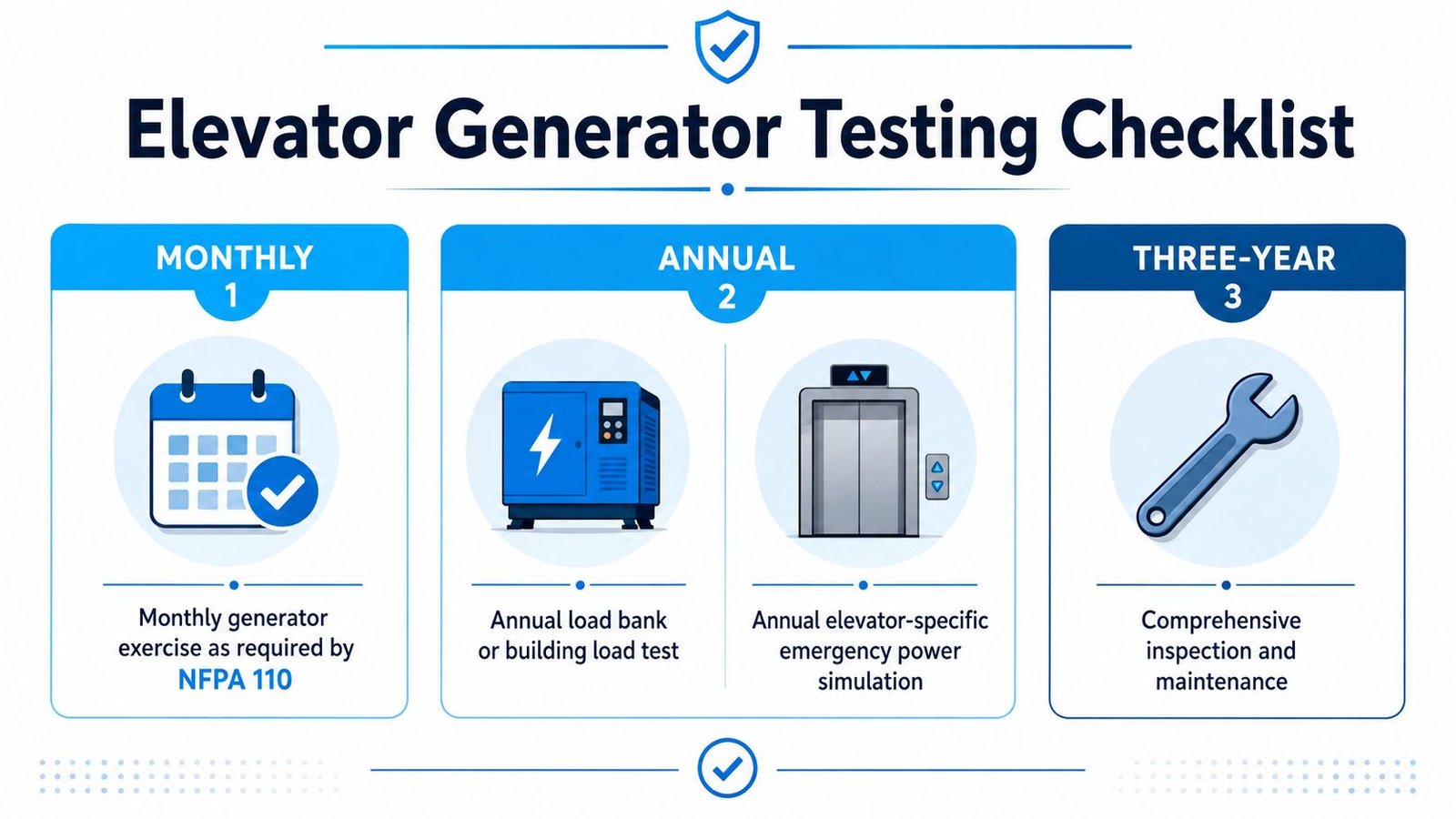
- Monthly: Complete the generator exercise required by the building's emergency-power program and retain the record.
- Annual: Coordinate the generator test with an elevator mechanic so the elevators transfer, recall, sequence, and operate on actual emergency power.
- Annual: Record transfer behavior, elevator response, signal devices, controller faults, and corrective work.
- Three-year interval: Review the maintenance and inspection requirements for components that fall under a three-year cycle in the adopted code, equipment documentation, or maintenance-control program. Don't assume every elevator asset shares the same interval.
- Five-year interval: Schedule the heavier loaded emergency-power test for traction elevators when required by the applicable code or jurisdiction. In many jurisdictions, that test is performed at 125% load. TSSA's advisory reinforces that actual emergency-power operation, rather than simulation, is the relevant condition.
Annual checklist for the service provider
Ask the team to document:
- Transfer performance: Generator start, automatic transfer, return-to-normal operation, and timing.
- Elevator sequence: Each car's individual transfer and sequential recall in a group system.
- Emergency-power signal: Visual generator-power indication and related signal-device activation.
- Controller input: Suicide-circuit operation and emergency-power recognition.
- Operating condition: Full-speed travel, several trips and stops, brake release, and door operation with the elevator on generator power.
- Electrical condition: Phase rotation, phase monitoring, voltage stability, and controller and fixture battery voltage where applicable.
- Records: Generator runtime and load information, elevator test sheets, deficiencies, repairs, and sign-off.
Ohio owners should also reconcile the elevator schedule with the Ohio Building Code and state inspection requirements. Ohio requires passenger elevators, escalators, moving walks, and freight elevators to be inspected twice every twelve months, while power dumbwaiters, hoists, and other permanently installed lifting equipment not designed to carry people must be inspected at least once every twelve months. Ohio Revised Code Section 4105.10 is particularly relevant for facilities in Toledo, Cleveland, and surrounding cities with mixed conveyance types.
The practical mistake is treating “annual” as one universal test. It isn't. The generator exercise, annual elevator operational test, and five-year traction load test prove different things and require different personnel.
What Happens During a Real Elevator Generator Test
At a Southern Michigan building, a responsible test day starts before the transfer switch is operated. The building team coordinates with the generator technician, elevator contractor, fire alarm monitoring company, security staff, and occupants who may be affected. Out-of-service signs are posted, access to the machine room and controller is confirmed, and the fire service key is available.
The team then establishes the normal-power condition and records the initial elevator status. At the transfer switch, the test simulates loss of building power in a controlled manner. The generator must start automatically, reach acceptable operating conditions, and transfer the elevator supply without leaving the cars in an uncontrolled or undocumented state.
The mechanic watches each elevator, not just the generator meter.
The operating sequence on site
The test team verifies whether the cars return to their designated landing and whether the doors open as required. In a group system, each car is transferred individually where the installation and test script require it, then the team confirms sequential operation rather than allowing every elevator to start at the same time.
The mechanic observes full-speed travel on generator power, normal stops, brake release, door operation, and the emergency-power signal. The controller fault log is reviewed for events that occurred during the transfer, especially faults that may clear before an inspector arrives.
A real procedure may also include checks identified in generator-test forms, such as several no-load trips and stops, generator-power visual indication, and individual elevator transfer in a group system. The elevator backup power systems service information helps frame why the elevator and generator scopes need to be handled as one coordinated operating event.
The closeout package
Return-to-city power is observed and recorded rather than assumed. The team confirms that the elevators return to their normal operating state, that no car remains stranded or unnecessarily locked out, and that any required reset is performed by qualified elevator personnel.
The final file should contain timed test sheets, transfer-switch records, generator runtime and load logs, elevator sequence results, controller observations, and the elevator contractor's signed compliance documentation. The building should file that package with the records required by the local authority having jurisdiction.
A signed generator report without elevator observations leaves a gap. So does an elevator service ticket that says “tested” without transfer timing, sequence results, or identified corrective actions.
Common Failure Modes and Compliance Implications
The most troublesome deficiencies usually appear at the interface between systems. The generator may be healthy, and the elevator may run normally on utility power, yet the transfer sequence exposes a problem that neither trade sees during its ordinary maintenance visit.
Transfer timing is one example. If the elevator doesn't receive usable emergency power within the applicable requirement, the car can remain unavailable during the transfer or stop with an incomplete emergency sequence. The electrical technician must evaluate the transfer equipment, while the elevator mechanic confirms the controller's response to the actual timing and voltage conditions.
A suicide-circuit fault creates a different risk. Corroded relay contacts, loose terminations, or a failed control component can prevent the elevator from recognizing or safely responding to generator operation. The ASME A17.2 brush-voltage verification is valuable because it tests the circuit's safety behavior rather than relying on a visual inspection.
Other recurring problems include:
- Phase rotation changes: Generator maintenance or rewiring can change phase sequence, causing incorrect motor behavior or drive faults.
- Controller compatibility issues: Older controllers may react poorly to generator voltage or frequency variation and produce nuisance faults during transfer.
- Simultaneous elevator starts: A group controller that starts multiple cars together can impose a severe starting demand on the generator instead of using the intended sequence.
- Unrecorded corrective work: A technician may restore operation but fail to document the deficiency, leaving the facility unable to demonstrate what was tested or repaired.
| Failure Mode | Code Reference | Compliance Impact |
|---|---|---|
| Incomplete or delayed transfer response | ASME A17.1 emergency operations and applicable electrical requirements | Elevator may fail the emergency-power test and require corrective work |
| Suicide-circuit malfunction | ASME A17.2 emergency-power inspection guidance | Unsafe generator-backed control behavior, failed inspection, or restricted operation |
| Incorrect phase rotation | Applicable electrical requirements and elevator manufacturer procedures | Drive or motor faults, abnormal operation, and possible equipment damage |
| Simultaneous group starts | ASME A17.1 emergency-operation sequence and approved control logic | Generator overload risk and failure of sequential-operation expectations |
| Missing records | State and local inspection documentation requirements | Difficulty proving compliance, even when equipment appears to operate |
Ohio's adopted safety code requires each elevator, including freight elevators and related conveyances, to undergo periodic safety tests, with at least one test every five years being a full-load safety test under ASME A17.1-2016 Section 8.6.4.20. Ohio's adopted elevator safety-code document makes that a planning issue for repairs, modernization, and inspection scheduling.
The consequences can include a failed inspection, withheld certificate, an elevator placarded out of service, or extended disruption in a hospital, senior facility, school, industrial plant, or municipal building. The exact enforcement response depends on the deficiency and authority, but an undocumented or incomplete test gives the inspector little basis to accept the installation.
Who Performs the Tests and How Crane Elevator Company Fits In
A compliant elevator generator test requires coordinated scheduling, defined records, and a clear sign-off process. The electrical contractor or generator technician records generator output, transfer-switch operation, transfer timing, and emergency-power observations. The elevator contractor documents recall, sequencing, controller response, travel, safety circuits, and, when applicable, the five-year loaded test for a traction elevator on emergency power.
The practical risk is an incomplete handoff. If the generator report arrives without elevator sequence results, or the elevator service report omits source readings and transfer data, the facility manager may have two partial records instead of one defensible test package. Unassigned deficiencies can then remain open until the inspection, when correction time is limited.
Crane Elevator Company performs maintenance, repair, modernization, and code-correction services in Michigan and Ohio, including Toledo and nearby cities. Its elevator mechanic can coordinate with the generator technician during the run, identify which cars should operate, review controller response, verify phase reversal and suicide-circuit function, and document repairs needed before inspection.
Give the facility manager one organized file: generator load data, transfer timing, elevator sequence logs, emergency-power observations, photos or readings required by the authority, and corrective items assigned to a maintenance or repair schedule. The provider should also identify each asset as traction, hydraulic, freight, passenger, dumbwaiter, wheelchair lift, or another conveyance. That classification affects the inspection calendar and whether the five-year loaded emergency-power test belongs on the schedule.
Crane Elevator Company can coordinate the elevator-specific portion of generator testing with maintenance, repair, modernization, and code-correction work across Michigan and Ohio. Visit Crane Elevator Company to arrange a documented emergency-power review before the next inspection and identify deficiencies while there is still time to correct them.