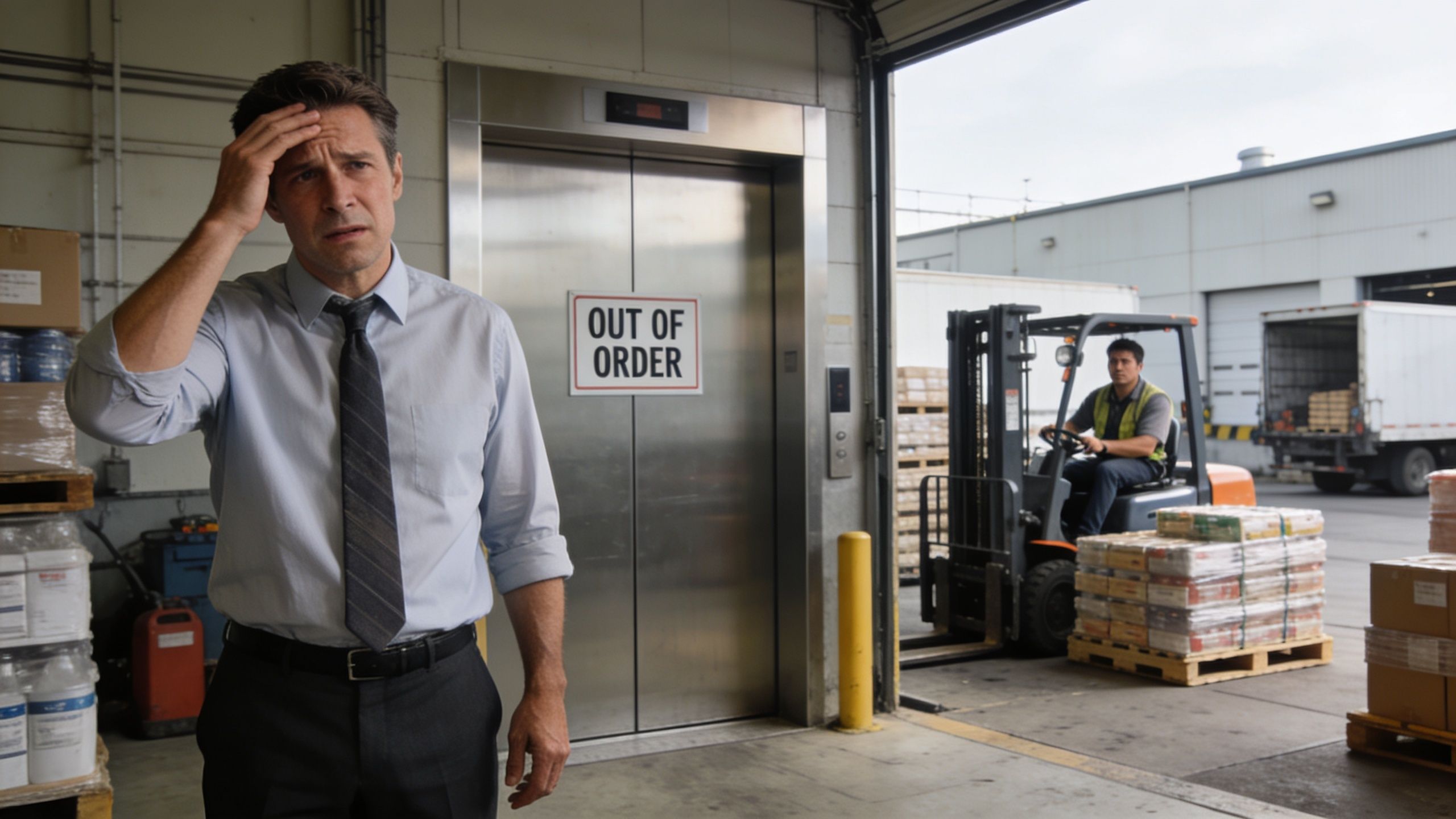
A truck is at your loading dock. The crew is waiting. Materials need to go upstairs, or linens need to get down to the basement, or a maintenance team needs to move equipment between floors. Then the freight elevator won’t run.
At that point, nobody cares what the nameplate says or when it was installed. They care that operations just slowed down, staff are improvising, deliveries are backing up, and somebody now has to explain why a basic building function failed.
For Service or Questions Call
734-726-4247
Or
Fill Out The Form Below
That’s why hydraulic freight elevator Service matters more than most owners think. A freight elevator usually gets attention only when it’s out of service, leveling poorly, leaking oil, or tripping faults under load. But in warehouses, hospitals, schools, municipal buildings, and older commercial properties across Southern Michigan, it’s one of the pieces of equipment that determines whether the building functions.
Hydraulic systems remain central to that job. The global hydraulic elevators market was valued at USD 44.57 billion in 2024 and is projected to reach USD 64.98 billion by 2032, with a 5.0% CAGR, driven by commercial and industrial demand such as warehouses and manufacturing facilities, according to Fortune Business Insights on the hydraulic elevators market.
The Unsung Hero of Your Building’s Operations
A freight elevator doesn’t generate revenue by itself. It protects revenue by keeping people, products, carts, pallets, files, equipment, and supplies moving when they need to move. When it fails, every workaround costs more than people expected.
In practice, hydraulic freight elevators become the default choice in many low-rise commercial and industrial buildings because they handle heavy loads well, fit real-world freight use, and don’t ask owners to overbuild for speed they may not need. They are workhorse systems. That’s especially true in buildings where the elevator isn’t a nice amenity. It’s part of daily operations.
Where owners usually get into trouble
The most common ownership mistake isn’t buying a hydraulic unit. It’s treating a hydraulic freight elevator like a simple box that goes up and down and only needs service when it stops.
That approach usually leads to three avoidable problems:
- Deferred maintenance becomes emergency work. A small leak, rough start, or floor-leveling complaint gets ignored until the unit is down.
- The wrong expectations get set. Owners compare freight elevator performance to passenger elevator expectations instead of judging it by load handling, reliability, and safe operation.
- Capital planning gets pushed off. Parts become obsolete, code issues pile up, and a manageable modernization turns into a forced replacement decision.
Practical rule: If your freight elevator supports deliveries, patient support, custodial flow, records movement, or production support, it isn’t secondary equipment. It belongs on the same planning list as HVAC, fire protection, and emergency power.
Reliability is the real business case
A reliable freight elevator lowers total cost of ownership in ways that don’t always show up on the first proposal. You see it in fewer shutdowns, cleaner machine rooms, fewer leaks, less product handling damage, smoother inspections, and less time spent chasing service calls.
Owners who manage these systems well usually do two things. They match the elevator to the building’s actual use, and they maintain it before symptoms become failures. That sounds basic. In this trade, basic done consistently is what keeps equipment alive.
How Hydraulic Freight Elevators Move Heavy Loads
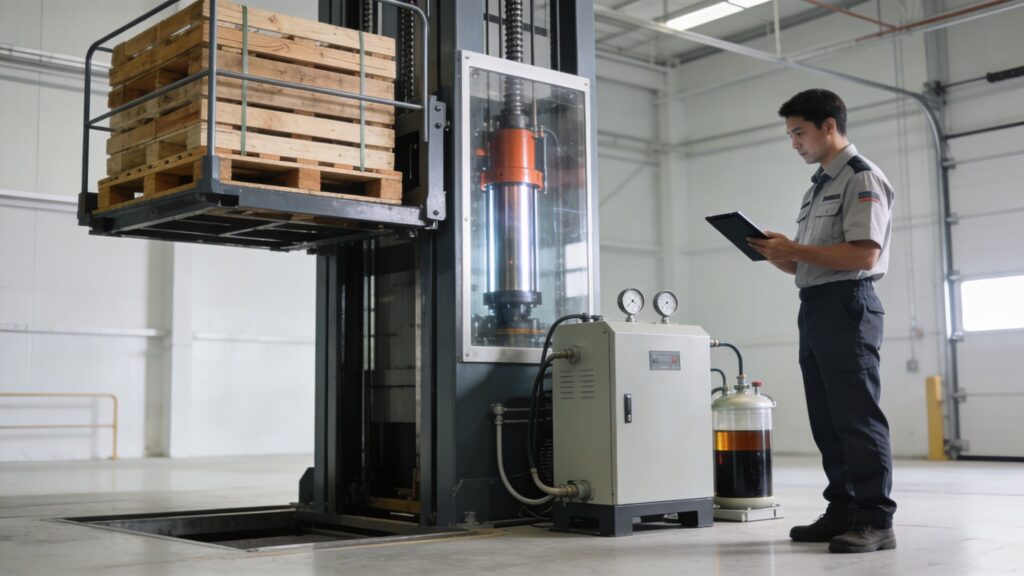
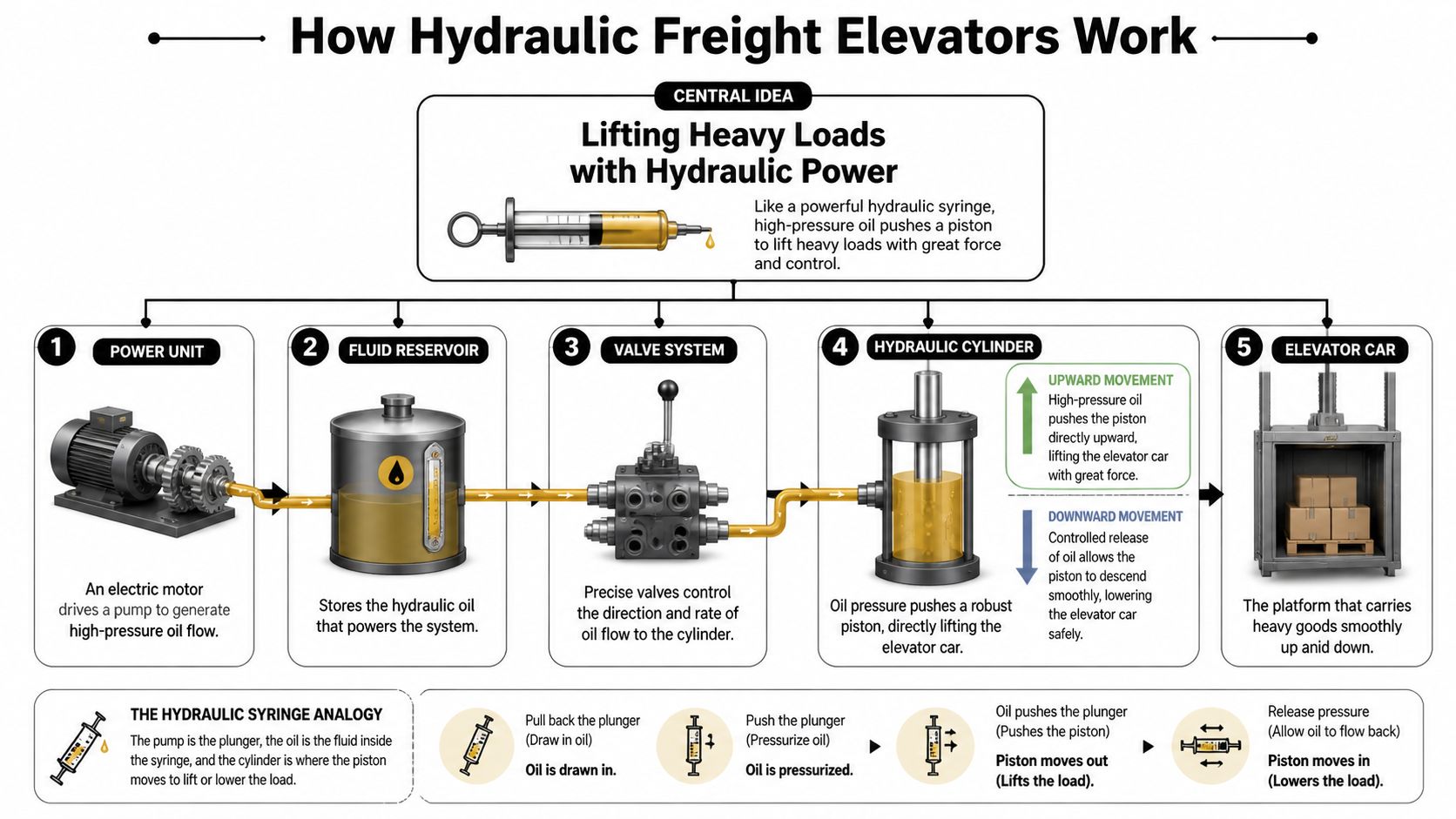
A hydraulic freight elevator works a lot like a large industrial syringe. The system pushes oil into a cylinder, pressure moves a piston, and that piston raises the car. To bring the car down, the system controls the release of that oil back to the tank.
That direct lifting method is why hydraulics make sense for many freight applications. You aren’t relying on a traction machine with ropes and counterweights to balance a car for higher-speed travel. You’re using fluid power to move heavy loads in a controlled way over relatively modest rises.
The core parts that matter
If you’re managing one of these units, you don’t need to be an elevator mechanic. You do need to understand the major components well enough to spot what affects service life and repair cost.
Power unit
The electric motor drives the pump. The pump moves hydraulic oil from the tank into the system. If the power unit is noisy, running hot, or cycling abnormally, that usually isn’t a cosmetic issue.Reservoir or tank
This stores the oil. Condition matters. Dirty oil, water contamination, and sludge don’t stay in the tank as isolated problems. They circulate through the system and affect valves, seals, and the jack.Valve system
The valve controls oil flow and, with it, ride quality and leveling accuracy. If the car stops hard, creeps, or misses the floor, the valve and related control logic are often part of the story.Cylinder and piston
This is the lifting muscle. The piston rises under pressure and lifts the car. If the jack is compromised by wear, corrosion, or seal failure, the repair scope can become serious quickly.The car and door equipment
Most complaints reported as “elevator problems” start at the doors. Freight doors take abuse. Tracks collect debris, interlocks wear, and misalignment turns into nuisance shutdowns.
Why hydraulic design stayed relevant
Hydraulic freight elevators aren’t new technology trying to prove themselves. Their roots go back to the 1850s, when the first hydraulic elevators used water pressure to move materials in factories and mines. In 1852, Elisha Graves Otis introduced the automatic safety brake, a milestone that made vertical transport much safer and helped accelerate adoption in commercial buildings, as documented by Elevator History on early hydraulic elevators and Otis safety development.
A simple system is often easier to keep reliable than a faster, more complex one, especially in low-rise freight service.
What this means for service decisions
When a hydraulic freight elevator gets sluggish or erratic, the answer usually isn’t to keep adjusting symptoms. The answer is to identify which part of the hydraulic chain is causing the behavior. Oil condition, valve response, door operation, pump performance, and jack integrity all affect one another.
That matters because good service doesn’t just restore operation. It protects the parts that are still healthy from getting damaged by the part that isn’t.
Choosing the Right Freight Elevator for Your Building
If you’re planning a new installation, a major renovation, or replacing an obsolete unit, the first question isn’t “Which elevator is best?” The right question is “Which system fits the building, the freight, and the duty?”
For many low-rise applications, hydraulic makes sense. For higher travel, faster movement, or heavier cycle demands, traction may be the better fit. A bad decision at this stage shows up later as operating frustration, unnecessary service calls, and capital costs you didn’t need.
Start with the actual use case
A building manager should pin down a few realities before talking model numbers:
- What are you moving most often? Pallets, carts, rolling bins, maintenance equipment, vehicles, or mixed freight all place different demands on the car and entrance setup.
- How often does the elevator run? Some freight elevators are occasional-use systems. Others support constant operational flow.
- How high does it travel? Hydraulic systems are commonly favored in low-rise conditions. If the building asks for more travel and more speed, the trade-offs change.
- How rough is the environment? Dust, moisture, dirt, washdown, wheel traffic, and impact abuse all affect how the elevator should be built and serviced.
Hydraulic and traction side by side
| Feature | Hydraulic Elevator | Traction Elevator |
|---|---|---|
| Initial fit for low-rise freight | Often a strong fit for low-rise buildings moving heavy loads | Often better justified when travel and speed requirements are higher |
| Speed | Typically slower, which is often acceptable in freight service | Faster travel is a key advantage |
| Travel height | Commonly suited to low-rise applications | Better suited where more travel is required |
| Load handling | Well suited for heavy, concentrated freight loads | Also capable, but the building use case determines whether the added complexity is justified |
| Machine arrangement | Typically requires space for hydraulic equipment adjacent to the hoistway | Different machine and hoistway considerations apply |
| Service profile | Focus is often on oil condition, valves, seals, jacks, and door equipment | Focus often includes ropes, sheaves, traction equipment, and related controls |
That table won't replace a site review, but it helps owners avoid a common mistake. They buy for brochure language instead of building reality.
Load class isn't a paperwork detail
Freight elevator design starts with what the code says the car must safely carry. ASME A17.1 specifies freight loading classes that directly affect design: Class A for general freight requires 50 lbs/ft², Class B for motor vehicles requires 30 lbs/ft², and Class C for industrial trucks requires capacity not less than the total weight of the truck and its maximum load, according to Schindler's hydraulic freight elevator technical document referencing ASME A17.1 classes.
That classification changes real hardware decisions. It affects platform design, door type, hydraulic sizing, and how the car is expected to be loaded in daily use.
If operators are driving powered equipment into the car, or routinely concentrating weight in one area, “general freight” assumptions may not protect you.
Good enough versus durable
A lot of owners ask for the cheapest acceptable solution. Sometimes that's reasonable. Sometimes it creates a system that works on paper and frustrates everyone in service.
The better question is whether the elevator will still suit the building after years of abuse, turnover, loading mistakes, and code changes. Freight service isn't gentle. A durable entrance setup, practical car sizing, and non-proprietary components usually matter more over time than shaving a little off the initial scope.
Navigating Safety Codes and Inspection Requirements
Most building managers don't need to memorize the code book. They do need to understand that freight elevators live in a regulated environment, and that service decisions have compliance consequences.
For hydraulic freight elevators, code compliance isn't separate from maintenance. The same conditions that trigger violations also cause shutdowns, rough operation, and liability exposure. Worn door equipment, poor leveling, weak communication devices, test deficiencies, and outdated safety features all show up in both places.
What inspectors and contractors are looking for
A proper inspection doesn't just ask whether the elevator moves. It asks whether the system moves safely, stops correctly, levels accurately, protects the hoistway, and responds the way the code requires.
A building manager should expect attention to items such as:
- Door operation and interlocks that must function correctly under normal use and during testing
- Leveling accuracy so freight doesn't hang up at landings or create trip hazards
- Machine room and pit conditions including housekeeping, access, and equipment condition
- Communication and emergency features that must work when needed
- Required testing records and corrective documentation showing what was found and how it was addressed
For owners trying to understand how size and layout affect freight compliance decisions, freight elevator dimensions guidance from Crane Elevator Company is useful background before a modernization or retrofit discussion.
Why older hydraulic units need closer attention
Older freight elevators can keep running for a long time. That doesn't mean they stay compliant by accident. Door protection expectations, monitoring requirements, controller behavior, and documentation standards don't stand still.
That matters in Michigan because older commercial and industrial buildings often still rely on legacy freight cars that were built for a different service environment. A knowledgeable contractor should be able to tell you the difference between something that is grandfathered, something that requires correction, and something that should be upgraded before it becomes a safety or reliability problem.
The cheapest path through an inspection issue is often the one that fixes the underlying condition once, instead of patching around it until the next violation.
Documentation is part of the job
Good records save time. They also help owners make better capital decisions. If your files show repeating leveling calls, recurring door faults, or the same hydraulic leak being addressed more than once, the issue isn't administrative. The records are telling you the elevator has moved beyond routine service.
Proactive Maintenance to Prevent Costly Downtime
Most expensive freight elevator repairs start as small, visible warnings. Oil at the jack head. A car that settles off level. A pump that sounds rough on startup. Doors that need a shove. None of that is random.
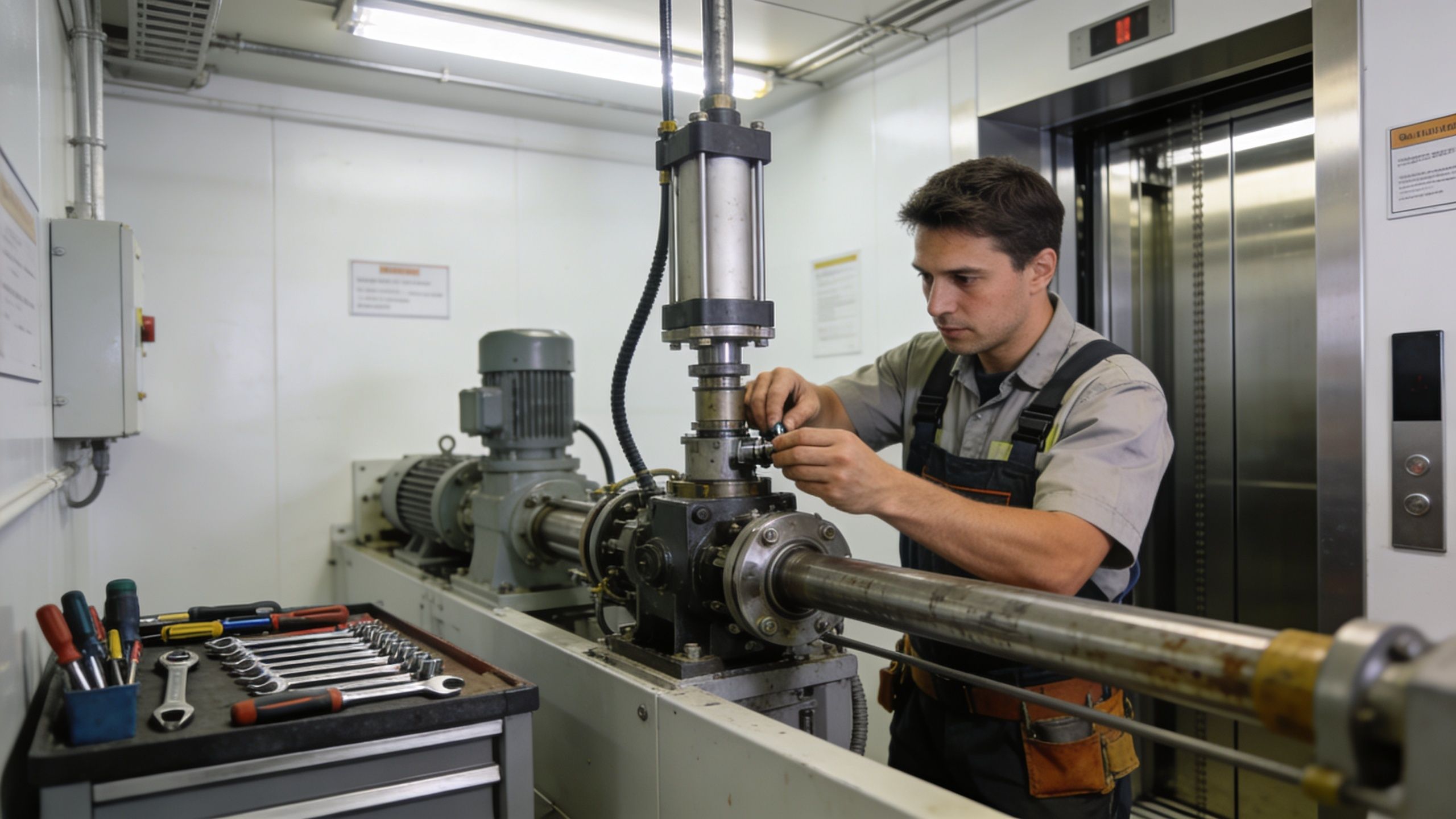
Owners get into trouble when they normalize those warnings. They tell staff to work around them. Then the elevator goes down under load, traps a workflow, and turns a service visit into an emergency response plus parts plus cleanup plus lost use of the car.
What preventive service actually prevents
The business case for maintenance is straightforward. Industry guidance states that the cost savings of regular maintenance trumps the run-to-failure method, and proactive hydraulic packing replacement every 5 to 7 years can help prevent oil leaks that are responsible for up to 40% of hydraulic elevator downtime, according to Elevator World on hydraulic elevators and preventive maintenance economics.
That isn't abstract. In the field, several repeat problems show up over and over:
-
Oil leaks
Packing and seals wear. Once leakage starts, it doesn't just create a housekeeping issue. It can affect performance, damage components, and create environmental and safety concerns. -
Bad leveling
If the car stops high or low, operators start slamming loads over the sill, and door equipment takes the punishment. Poor leveling also creates inspection exposure. -
Slow starts or rough rides
These symptoms often point back to valve performance, oil condition, motor issues, or a power unit that needs real attention instead of another reset. -
Door faults
Freight doors are high-abuse components. Tracks, gibs, interlocks, and closures need routine adjustment and cleaning if you want reliable starts.
What good maintenance includes
A proper hydraulic freight elevator service program should be hands-on, not just a clipboard visit. It should include cleaning, observation under operation, adjustment, and a plan for predictable replacement of wear items.
Key tasks usually include:
- Hydraulic system checks to look for seepage, contamination signs, abnormal noise, and heat-related issues
- Door equipment service because freight entrances fail more often from abuse and misalignment than from mystery electrical issues
- Leveling and ride-quality review so small control or valve issues get corrected before users start compensating for them
- Machine room, pit, and car-top cleaning because debris hides leaks, interferes with components, and makes diagnosis harder
- Scheduled wear-item replacement instead of waiting for failure to choose the timing
For owners evaluating machine-room-side issues, hydraulic elevator power unit service information from Crane Elevator Company gives a useful reference point for what a contractor should inspect and when a power unit is becoming the real problem.
A short visual is often helpful when discussing maintenance expectations with operations staff or ownership groups:
What doesn't work
Run-to-failure doesn't work on freight elevators that support daily operations. It only looks cheaper while the elevator is still limping along.
Neither does “reset and leave” service. If the contractor clears a fault but doesn't address contaminated oil, a dragging door, or a leaking packing set, you've bought time, not reliability.
A good maintenance visit should leave the elevator cleaner, better adjusted, and better understood than before the mechanic arrived.
One practical example is a maintenance program that includes full clean-downs of machine rooms, pits, and car tops, along with routine wear-item attention and attendance accountability. Crane Elevator Company offers that type of service model in Lower Michigan, including a No Show, No Pay policy. The important point for owners isn't the branding. It's the standard: your contractor should be able to explain exactly what gets inspected, cleaned, adjusted, and documented on each visit.
Modernization vs Replacement and Associated Costs
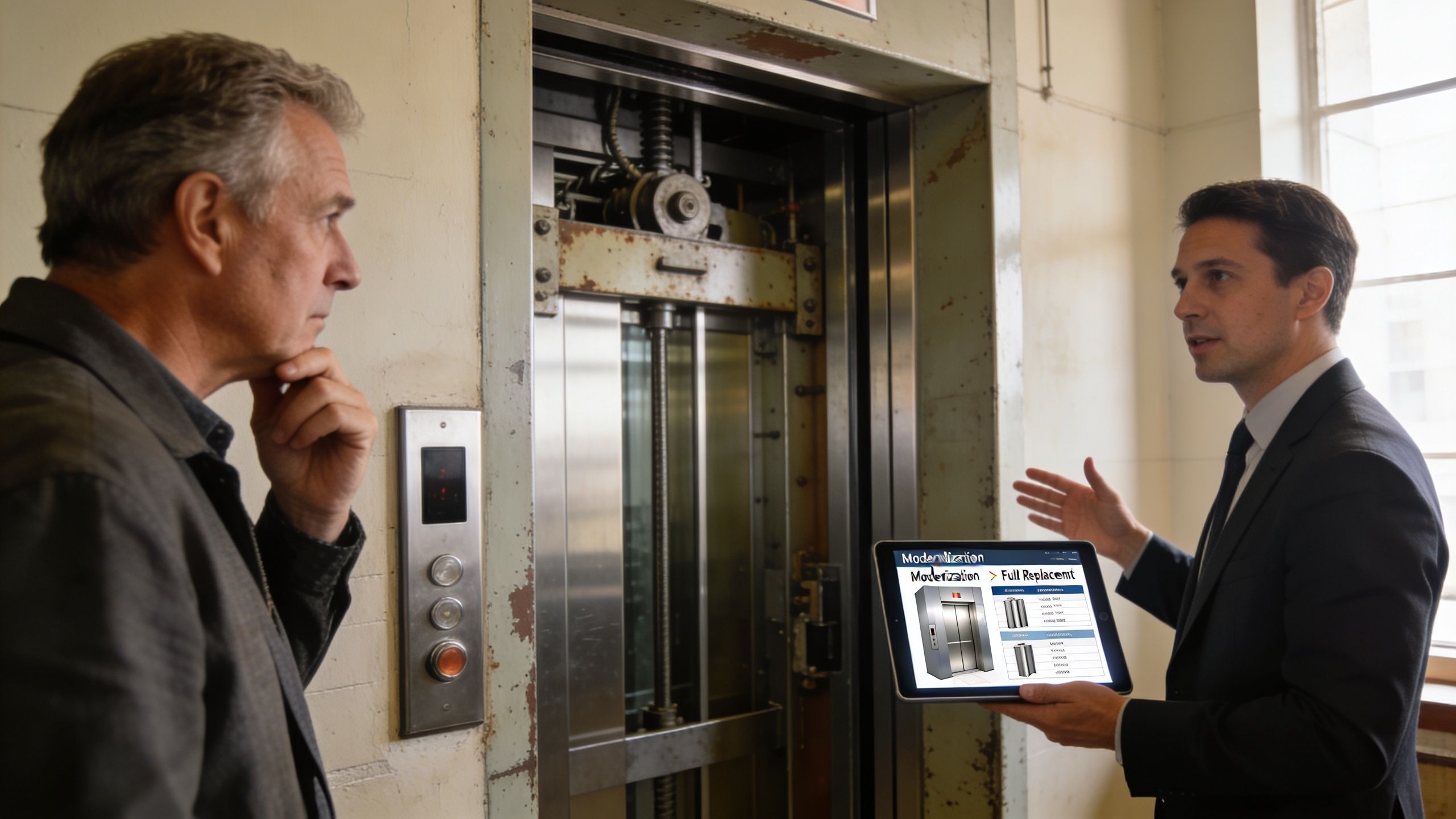
There comes a point when repeated repairs stop being a maintenance strategy and start becoming a delay tactic. The elevator may still run, but the pattern changes. More calls. Harder-to-find parts. More code corrections. Less confidence from the people using it.
That’s when owners need to decide whether to modernize the system or replace it.
When modernization makes sense
Modernization keeps the basic elevator but replaces major components that are causing reliability, safety, or supportability problems. In a hydraulic freight application, that often means updating the controller, door equipment, fixtures, communication devices, or hydraulic equipment.
Modernization usually makes sense when:
- The hoistway and car are still serviceable and the building layout doesn't need a completely different elevator
- The problems are concentrated in aging components rather than structural failure of the whole system
- You need better parts availability and less dependence on obsolete or proprietary equipment
- Code compliance upgrades are feasible without rebuilding the entire installation
When replacement is the better call
Full replacement is a bigger decision, but sometimes it’s cleaner than trying to rescue a system that's past its practical life. If the car configuration no longer fits the building, the jack condition is a major concern, or the elevator has become a patchwork of incompatible fixes, replacement may be the more predictable long-term move.
A replacement discussion should also happen when the building's freight use has changed. A car that once handled carts may now be expected to handle heavier equipment or more demanding traffic. In that case, keeping the old layout can lock you into poor operations for years.
Think in ownership terms, not repair tickets
Owners often compare modernization and replacement the wrong way. They compare the next repair bill to the larger project cost. That's understandable, but it misses the bigger question.
The better comparison is this:
| Decision path | What you're buying |
|---|---|
| Another repair | Short-term operation, with the same underlying aging system still in place |
| Modernization | Better reliability and supportability while keeping usable existing infrastructure |
| Replacement | A reset of the asset, usually with the most flexibility for future building use |
For owners building a capital plan, hydraulic elevator modernization cost guidance from Crane Elevator Company is a practical starting point for scoping discussions, financing conversations, and deciding what belongs in the current budget cycle.
If the elevator has become hard to trust, hard to inspect, and hard to support, you aren't choosing between spending and not spending. You're choosing when and how to spend.
Financing can also change the decision. A planned modernization or replacement with predictable payments is often easier to manage than a string of emergency repairs that still leaves the asset unreliable.
Why Partner with a Local Expert for Your Elevator Service
Hydraulic freight elevators reward practical ownership. They punish neglect, vague maintenance, and service providers who don't understand freight use in actual operation.
A building manager needs a contractor who can do three things well. First, keep the unit running with disciplined preventive service. Second, handle code-required inspections and corrections without confusion. Third, give honest advice when the elevator has crossed from routine repair into modernization territory.
What matters in a service relationship
The contractor's value isn't in showing up and reciting parts names. It's in making the building easier to run.
Look for a partner who offers:
- Responsive field service because freight downtime disrupts operations immediately
- Non-proprietary thinking so your building doesn't get locked into one vendor forever
- Clear documentation that helps you budget, pass inspections, and defend capital requests
- Real troubleshooting instead of repeated resets and temporary patches
- Local familiarity with the building types, usage patterns, and inspection realities in your area
Why local knowledge changes outcomes
A local contractor sees the same kinds of facilities repeatedly. Older municipal buildings. Hospitals with back-of-house freight dependence. Warehouses with abused entrances. Schools and commercial properties trying to keep aging equipment alive without wasting capital.
That local pattern recognition matters. It helps a mechanic separate a nuisance issue from an early warning sign. It also helps owners get recommendations that fit the building they have, not a generic national template.
If you're in Lower Michigan and your freight elevator is overdue for a realistic service review, code inspection support, modernization planning, or a second opinion on whether to repair or replace, contact Crane Elevator Company to discuss your hydraulic freight elevator service needs, request a quote, or review options for a more predictable long-term maintenance plan.