
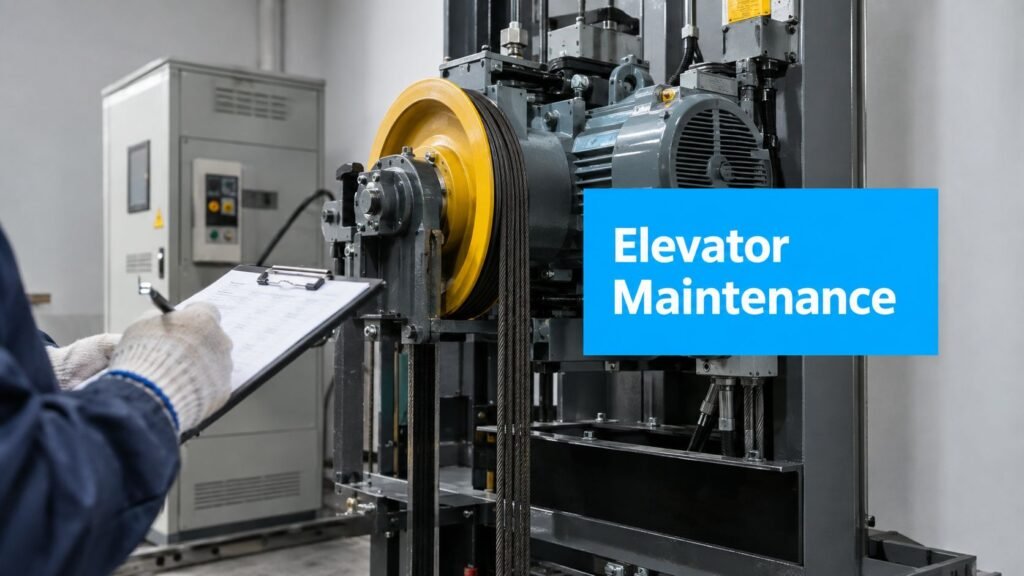
You've inherited an elevator in a Detroit or Lansing building, and the records are missing, the service history is unclear, and tenants already complain about slow doors. Then a state violation notice arrives. The contractor who used to service the equipment is gone, the inspection date is uncertain, and one disabled elevator is suddenly affecting accessibility, deliveries, tenant satisfaction, and your operating budget.
That situation is avoidable. Passenger elevator preventative maintenance is the routine that keeps minor wear from becoming a shutdown, keeps safety tests from becoming last-minute emergencies, and gives you records when an inspector asks what has been done. Michigan has clear maintenance and inspection obligations, Detroit can impose stricter service intervals, and owners remain responsible for keeping equipment safe and compliant.
The Moment a Detroit Property Manager Realizes PM Matters
The property manager finds the violation notice taped to the office door after a tenant reports that the elevator doors are reopening and failing to close. The manager calls the old contractor, reaches a disconnected number, and starts searching through invoices that show payments but not the actual work performed. Nobody can immediately prove when the last maintenance visit occurred, whether the door interlock was tested, or whether the elevator's required records are complete.
That's how a manageable maintenance issue becomes an operational crisis. A technician may correct the immediate door fault, but the owner still has to address the inspection deficiency, document the repair, coordinate any required testing, and explain the outage to occupants. Emergency service also competes with every other active call, while a scheduled maintenance visit gives the technician time to inspect the equipment methodically and identify defects before passengers are stranded.
Michigan requires a power elevator, including a passenger elevator, to receive maintenance at least once every 90 days by a licensed elevator journeyperson, with written records kept on site. The requirement appears in Michigan's elevator maintenance rule, which also calls for records covering maintenance, repairs, replacements, inspections, callbacks, and testing.
Detroit's local ordinance is stricter for many devices. Power elevators, escalators, and moving walks must be inspected and serviced at least once every 30 days, although Detroit may extend that interval to 90 days by special permission when low usage makes monthly service unnecessary. Owners and certificate holders remain responsible for periodic inspections, testing, renewal, and compliance, as described in the Detroit elevator ordinance.
Owner's rule: Don't wait for a violation to discover that your maintenance program exists only in an invoice folder.
Deferred maintenance is often what exposes an owner to violations, not the age of the elevator. A maintained older unit can have a workable service history, while a newer unit with neglected doors, incomplete records, and missed testing can create immediate trouble. Preventative maintenance is the routine that keeps you out of the inspector's office, not a line item to postpone.
What Passenger Elevator Preventative Maintenance Actually Is
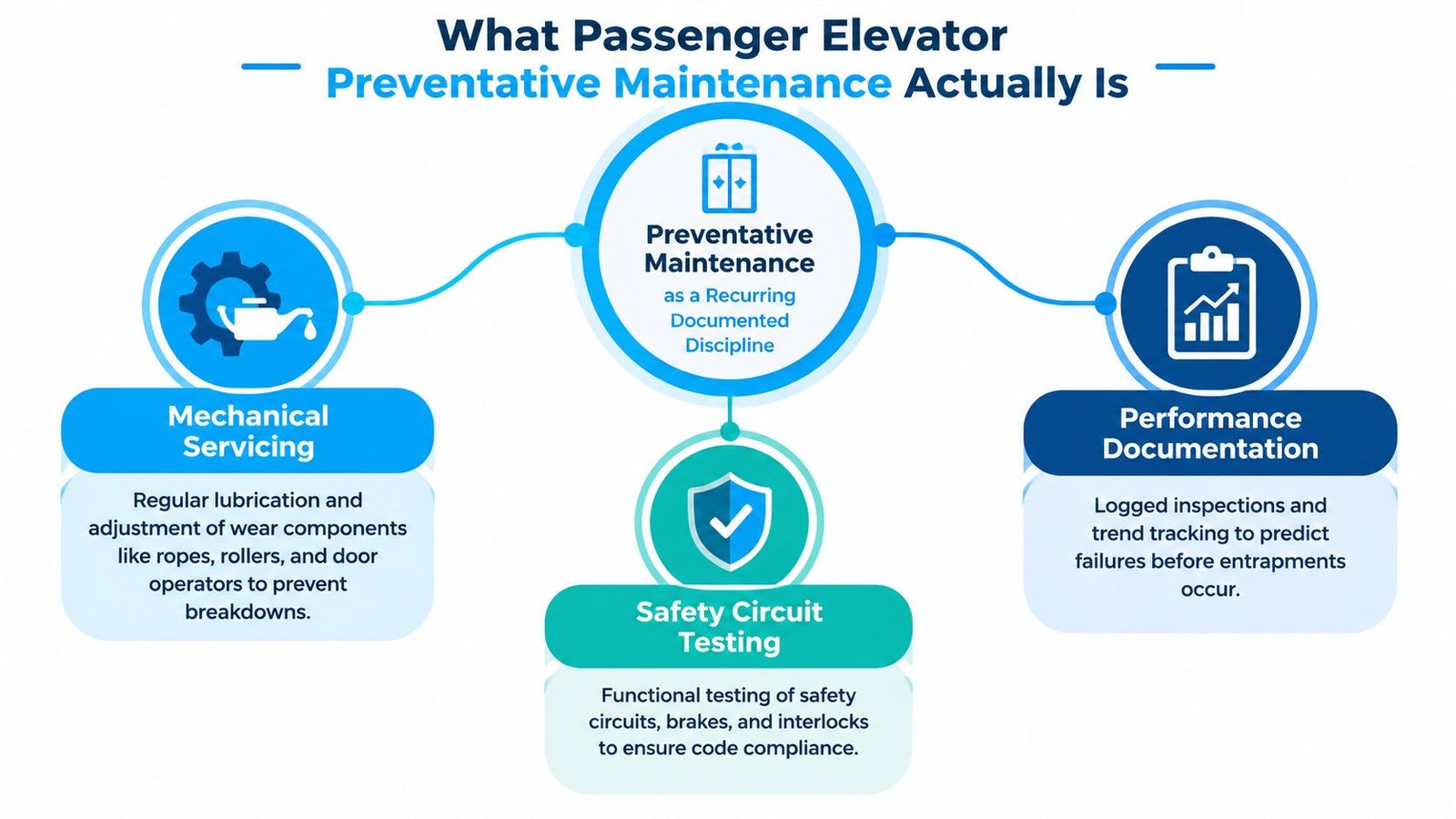
Passenger elevator preventative maintenance is recurring, documented work performed to keep an elevator safe, available, and serviceable. It has three connected parts: mechanical servicing, functional safety testing, and compliance recordkeeping. Remove any one of those parts and the program becomes incomplete.
Mechanical servicing
The technician examines and services the parts that wear through normal operation. That includes lubrication and adjustment of door operators, rollers, guides, rails, bearings, sheaves, cables, hydraulic equipment, brake components, and other equipment identified in the elevator's maintenance control program.
Cleaning matters because dirt and debris can interfere with door tracks, switches, pit equipment, and machine-room components. A proper visit should also identify leaks, unusual noise, vibration, heat, leveling changes, and recurring faults, not just applying lubricant and leaving.
Functional safety testing
A passenger elevator PM visit must include more than mechanical work. The technician needs to verify safety circuits, door interlocks, brakes, alarm functions, emergency communication, firefighter service, and other life-safety features applicable to the installation.
The U.S. Bureau of Reclamation facilities manual cites ASME A17.1 and A17.2 guidance calling for periodic inspections at six-month intervals by a qualified elevator inspector, along with monthly operation of elevator firefighter emergency operation and written records kept on site. That makes documented functional testing part of responsible maintenance, not an optional add-on.
Documentation
Every visit should produce a usable record. ASME A17.1 requires maintenance records for every elevator, including dates and descriptions of maintenance tasks, examinations, tests, adjustments, repairs, replacements, callback actions, and monthly firefighter service checks. The record should also identify open deficiencies, corrective actions, technician details, and upcoming test dates.
A callback is reactive service after something has gone wrong. Modernization replaces or upgrades major systems. Preventative maintenance is the operating discipline that supports both, because it reveals when a repair is enough and when the equipment has reached the point where an upgrade makes better financial sense.
Michigan's legal baseline is maintenance at least once every 90 days for a power elevator, while Detroit often requires service every 30 days. Your contractor should recommend a schedule based on the equipment, traffic, environment, and local requirement, then put that schedule in writing.
A good PM visit leaves the building owner with more than a signature. It leaves a clear answer to three questions: What did the technician inspect, what did the technician find, and what happens next?
Core Maintenance Tasks That Drive Real Reliability
A technician should work through the elevator as a system, not treat the monthly visit as a quick machine-room stop. The inspection needs to cover the drive equipment, hoistway, pit, cab, doors, controller, and safety circuits.
Machine room and drive
For traction equipment, the technician checks motor and brake condition, brushes where applicable, brake adjustment, sheave wear, rope condition, machine lubrication, and unusual heat or vibration. For hydraulic elevators, the inspection includes oil condition, leaks, pump performance, valves, packing, and power-unit operation.
The goal isn't to replace parts on a calendar without evidence. It's to identify wear that could affect motion, leveling, braking, or availability.
Hoistway and pit
Rails, guide components, governor equipment, buffers, pit switches, traveling cables, wiring, and sump-pump operation require attention. Water intrusion and debris can damage pit components or disable safety circuits. The technician should record findings rather than marking the area “checked.”
Cab and door assembly
Doors deserve disproportionate attention. An independent industry maintenance source reports that worn safety edges, misadjusted clutch-to-vane coupling, and debris in door tracks account for about 50% to 70% of elevator callback incidents, as documented in this commercial elevator maintenance checklist.
That makes door work the highest-yield reliability activity for many passenger elevators. The technician should clean tracks, verify roller alignment, inspect door belts and operator components, test photo eyes and reopening devices, confirm safety-edge response, and verify closing force and timing after adjustments.
Controller and safety circuits
The controller inspection includes relay contacts, fuses, wiring, fault history, and heat or contamination. The technician should also test firefighter service, alarms, emergency phones, battery lowering where installed, and related safety functions.
Use this priority order:
- Safety chain first: Test the circuits and devices that protect passengers and control the elevator during abnormal operation.
- Door system second: Correct the components most likely to generate repeat callbacks and tenant complaints.
- Everything else third: Service drive, hydraulic, hoistway, cab, and appearance items according to condition and the maintenance control program.
| System Group | Key PM Tasks | Failure Impact | Visit Frequency |
|---|---|---|---|
| Safety and controller | Fault review, relay inspection, firefighter service, alarms, emergency phone, safety circuits | Unsafe operation, failed testing, shutdown exposure | According to the applicable code, equipment condition, and service contract |
| Door assembly | Track cleaning, roller alignment, safety edge, photo eyes, clutch, operator adjustment | Repeated callbacks, entrapment risk, access disruption | Frequent review, with timing set by usage and condition |
| Machine room and drive | Brake, motor, sheave, cables, hydraulic power unit, oil and leaks | Rough operation, leveling faults, major component failure | Scheduled PM interval |
| Hoistway and pit | Rails, governor, buffers, switches, sump, traveling cables | Safety-device fault, water damage, service outage | Scheduled PM interval |
| Cab and fixtures | COP functions, lights, leveling, signals, finishes | Passenger complaints, accessibility concerns, avoidable service calls | Scheduled PM interval |
For a practical service scope, review passenger elevator maintenance from Crane Elevator and require the contractor to convert the equipment findings into a written maintenance control program.
Michigan and Ohio Code Requirements You Cannot Ignore
Michigan owners need to separate three things: the state maintenance interval, the inspection and testing obligations, and any stricter local rule. A contractor who says “the state only requires quarterly service” may still be giving a Detroit owner incomplete advice because Detroit's ordinance can require monthly inspection and service.
Michigan requires passenger elevators and other listed elevator types to be inspected at least once every 12 months. The same Michigan rule requires maintenance inspections and tests of elevator car and counterweight safeties and governors at intervals of not more than 12 months, as stated in Michigan's inspection regulation.
Michigan also requires power elevators to be maintained at least once every 90 days by a licensed elevator journeyperson. The written record must remain on site and cover maintenance, repairs, replacements, inspections, callbacks, and testing. Work involving installation, alteration, maintenance, repair, servicing, inspection, adjustment, or testing must be performed by a properly licensed elevator journeyperson under Michigan's elevator permit information.
What inspectors should be able to verify
Keep a current file, whether paper, digital, or both, containing:
- Maintenance control records: Dates, tasks, findings, adjustments, repairs, replacements, callbacks, and tests.
- Safety test records: Category testing documentation, governor and safety results, and corrective work.
- Emergency-operation records: Monthly firefighter service operation and written confirmation.
- Deficiency closure: The original defect, the responsible contractor, the correction date, and proof that the repair was tested.
- Equipment identity: Unit number, location, manufacturer, controller information, hydraulic or traction configuration, and applicable permits.
The specific test interval depends on the adopted code, equipment type, jurisdiction, and inspector direction. Don't place a Category 1, Category 3, or Category 5 test on a generic calendar without verifying the requirement for that elevator. The same caution applies to hydraulic jack work, governor reset procedures, acceptance testing, and local forms.
| Requirement | Michigan | Ohio |
|---|---|---|
| Maintenance baseline | Power elevators require service at least once every 90 days by a licensed elevator journeyperson | Confirm the adopted state and local requirements with the authority having jurisdiction |
| Routine inspection | Passenger elevators require inspection at least once every 12 months | Coordinate inspection and permits with the applicable Ohio authority |
| Safety testing | Safeties and governors require maintenance inspections and tests at intervals not exceeding 12 months under the Michigan rule | Confirm equipment-specific testing and witness requirements locally |
| Detroit overlay | Many power elevators require inspection and service every 30 days, with a possible extension to 90 days by special permission | Not applicable |
| Records | Written records of maintenance, repairs, replacements, inspections, callbacks, and testing kept on site | Keep records required by the adopted code and local authority |
Ohio owners in Toledo, Cleveland, Columbus, Perrysburg, and surrounding communities should have the contractor identify the authority having jurisdiction before work begins. Don't assume a Michigan schedule or Detroit practice transfers across the state line.
For code planning and service coordination, use elevator code requirements from Crane Elevator as a starting point, then confirm the current requirement with the responsible jurisdiction. Code compliance is not proven by a verbal assurance. It's proven by current certificates, completed tests, closed deficiencies, and records an inspector can follow.
From Calendar-Based Service to Predictive Maintenance
Calendar-based PM remains the correct starting point for most buildings. The contractor visits on a scheduled cycle, performs the maintenance control program tasks, checks wear components, reviews faults, and records the result. It works because it creates regular contact with the equipment instead of waiting for passengers to report a failure.
Predictive maintenance adds condition and fault data to that schedule. The technician looks at door reversals, motor current, vibration, controller fault history, temperature, leveling behavior, and callback patterns. The schedule still matters, but the equipment's condition determines where the technician spends time and when a component should be repaired.
The Hong Kong lift and escalator best-practices booklet.pdf) recommends predictive maintenance based on fault history and equipment condition. That approach is especially useful where a group of elevators serves a dense residential, healthcare, hospitality, or office environment and a recurring fault can affect many passengers.
Choose the model by operating risk
A small property with light usage usually needs disciplined calendar-based service, accurate logs, and prompt correction of defects. Installing sensors won't automatically improve reliability if nobody reviews the data or connects it to a repair decision.
A busy office tower in downtown Detroit, a hospital in Cleveland, or a large residential group may justify condition monitoring. These properties can use controller fault logs, door-cycle data where available, vibration readings, thermal checks, and callback history to identify a unit that is drifting away from normal operation.
Move from routine PM toward predictive maintenance when the records show repeated door faults, rising callback frequency, recurring leveling complaints, abnormal hoistway noise, or brake and motor temperatures that run hotter than the established baseline. The exact trigger should be documented in the maintenance control program, not invented after a failure.
Decision rule: If the elevator has stable performance and clean records, strengthen calendar-based PM. If the same defect keeps returning, start measuring the condition that predicts it and change the service plan.
For a condition-focused service discussion, review predictive maintenance for elevators from Crane Elevator and ask the contractor what data it can collect, who reviews it, and which repair decisions follow from the findings.
How to Evaluate a Preventative Maintenance Contract
Two proposals can use the same phrase, “preventative maintenance,” while creating very different financial exposure. Read the exclusions before comparing the monthly price.
Understand the contract structures
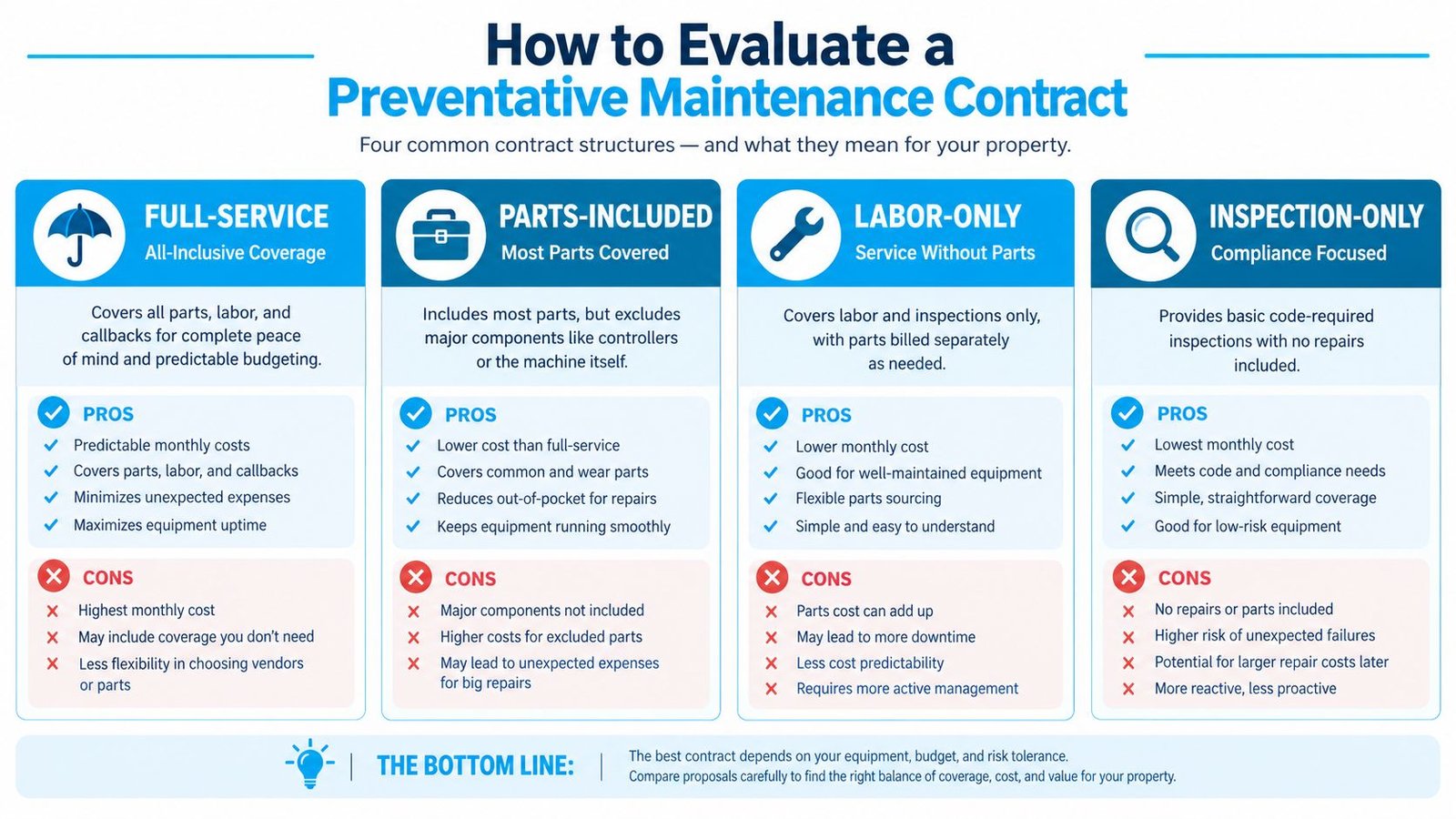
Full-service usually combines scheduled maintenance, labor, callbacks, and defined parts coverage. It offers the most predictable budgeting, but you must identify excluded major components, vandalism, water damage, modernization, and code upgrades.
Parts-included with labor covers listed parts and labor but may exclude controllers, machines, motors, hydraulic jacks, power units, or other major components. Require the exclusions by name.
Labor-only covers technician time and inspections, while parts, shipping, repairs, and major troubleshooting are billed separately. It can work for an owner with internal reserves, but it leaves more budget risk with the building.
Oil-and-grease only is the narrowest option. It may cover lubrication and basic visual checks while leaving testing, door adjustments, safety work, callbacks, and corrective repairs outside the scope. Treat it as a limited service arrangement, not a complete reliability program.
Put the protections in writing
Your bid form should require:
- Callback response: State the response time for routine calls, entrapments, and after-hours failures.
- Parts coverage: List covered door parts, rollers, belts, sensors, boards, motors, pumps, valves, and other components by name.
- Testing scope: Identify included Category 1, Category 3, Category 5, fire service, emergency phone, and generator testing.
- Finishes and abuse: Explain coverage for cab panels, fixtures, vandalism, water damage, and tenant abuse.
- Software terms: State who pays for controller software licensing, diagnostic access, and proprietary tools.
- Out-of-scope labor: Provide the hourly rate, minimum charge, material markup, and approval process.
- Records: Require a written maintenance control program, service reports, open-deficiency list, and test due dates.
- Licensing and insurance: Require appropriate Michigan or Ohio licensing and general liability coverage.
A vague scope is an audit problem waiting to happen. So is time-and-materials billing without an approval ceiling, a contractor that refuses to provide a written maintenance control program, or a proposal that says “regular service” without defining what the technician does.
Read each monthly report for three items first: callbacks by unit, open deficiencies by priority, and upcoming test dates. If the same door fault appears repeatedly without a corrective plan, the report is documenting a problem rather than managing it.
Ask the bidder: What is included every visit? What is excluded? Who responds to an entrapment? Which tests are included? How are recurring defects escalated? Who owns the records? What happens when the controller, jack, motor, pump, cable, or door operator reaches replacement condition?
How Crane Elevator Covers the Full Service Lifecycle
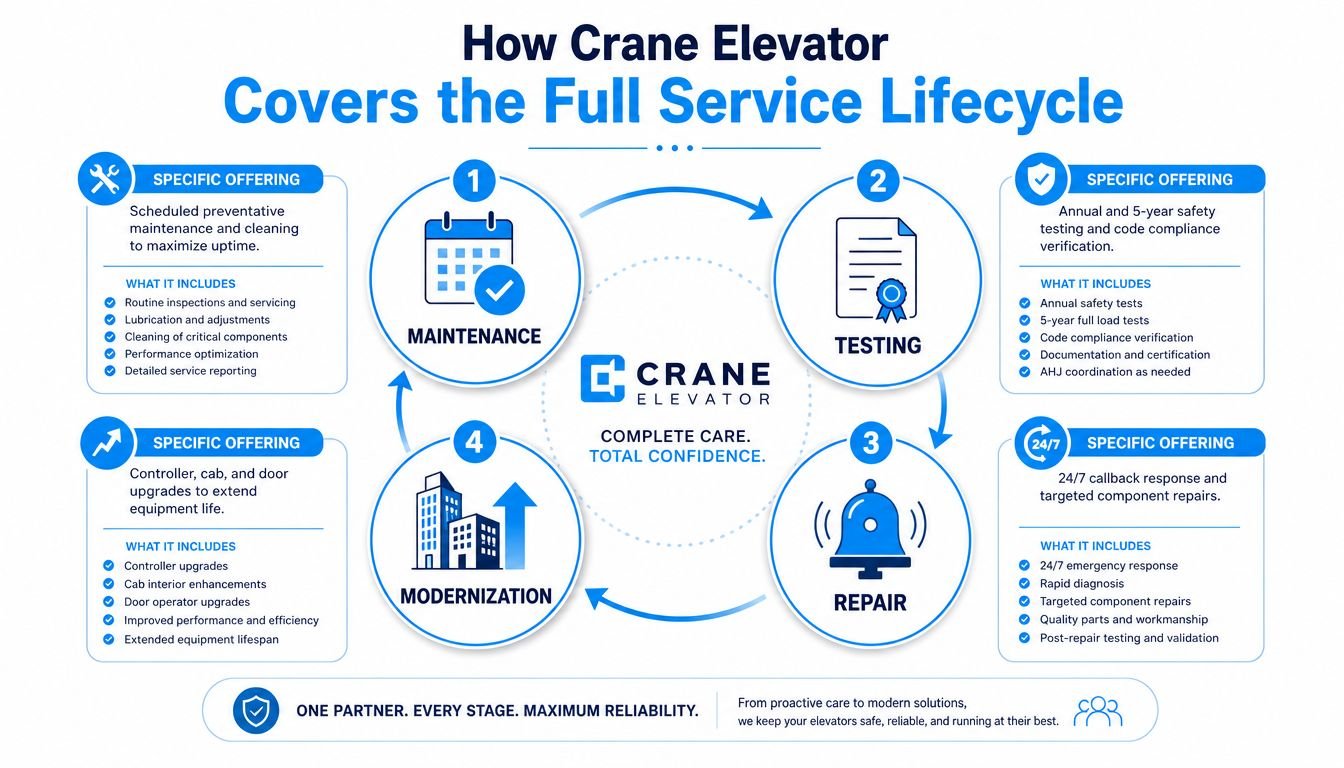
A useful elevator program has four connected stages: maintenance, testing, repair, and modernization. The owner shouldn't have to find a separate provider every time the equipment moves from one stage to the next.
Maintenance keeps the baseline stable
Crane Elevator serves Detroit, Lansing, Ann Arbor, Grand Rapids, and surrounding areas, with service extending through Michigan and Ohio communities such as Toledo, Perrysburg, Flint, Kalamazoo, Cleveland, Columbus, and other nearby towns. Its maintenance work includes monthly and quarterly maintenance, cleaning, inspection, adjustment, lubrication, wear-item review, and documentation for the equipment covered by the agreement.
The correct interval depends on the equipment and jurisdiction. Detroit owners must account for the city's monthly service rule where it applies, while other Michigan properties must meet the state baseline and any local requirement.
Testing confirms the safety functions
Crane Elevator provides support for Category 1 Testing, Category 3 Testing, and Category 5 Testing, along with safety testing, fire service testing, generator testing, emergency phone testing, and violation corrections. The owner should schedule testing from the code and the elevator's records, not from memory.
Repairs address the actual failure
The service scope includes Safety Edge Repair and Replacement, emergency phone repair and replacement, door lock monitoring, packing and seal replacement, jack replacements, cable replacements and shortening, power unit replacement, pump and motor replacement, and major and minor repairs to all types of elevator systems.
That matters when a PM technician finds a defect that cannot wait for the next visit. A complete service relationship lets the owner move from finding the issue to correcting it, testing the correction, and closing the record.
Modernization handles economic end of life
Modernization and upgrades can address obsolete controls, unreliable doors, poor ride quality, accessibility concerns, and equipment for which parts or technical support have become difficult to obtain. Crane Elevator also provides cab upgrades, controller and door-system upgrades, and broader modernization work for different elevator configurations.
A property manager should move into modernization when repeated repairs no longer restore dependable service, when the controller or drive has become difficult to support, when safety or accessibility requirements cannot be addressed economically through isolated repairs, or when downtime is disrupting the building's core operation.
Crane Elevator handles passenger, freight, residential, wheelchair, material lift, and dumbwaiter systems, including non-proprietary modernization options. It also offers emergency response and the specific component services needed to keep a maintenance program connected to the full lifecycle.
Property Manager Checklist for a Strong PM Program
Use this checklist during a site walk, contract renewal, or contractor interview.
- Verify credentials: Confirm the contractor's applicable Michigan or Ohio licensing, insurance, technician qualifications, and authority to perform the required work.
- Identify every unit: Record each elevator's location, type, manufacturer, controller, drive, hydraulic equipment, and current operating status.
- Demand a written scope: Require the contract to define visit frequency, tasks, testing, callbacks, parts, exclusions, and approval limits.
- Set the response path: Write down the emergency number, after-hours escalation contact, entrapment procedure, and expected response time.
- Review the maintenance control program: Confirm that the contractor has written instructions for what gets maintained, tested, adjusted, and recorded.
- Verify each visit: Compare the technician's report with the actual equipment condition, including doors, cab, machine room, hoistway, pit, and safety functions.
- Check open deficiencies: Require every unresolved item to show a priority, recommendation, responsible party, and target correction date.
- Track recurring callbacks: Review whether the same door, leveling, controller, phone, or safety fault appears repeatedly.
- Confirm records are complete: Make sure reports include dates, work performed, findings, repairs, replacements, callbacks, tests, and firefighter service checks.
- Coordinate inspections early: Put annual inspections, safety testing, fire service testing, and generator testing on a shared calendar.
- Reserve for repairs: Budget for parts and major work instead of treating every repair as an unplanned surprise.
- Plan modernization: Request a condition assessment when parts become difficult to source, downtime rises, or repeated repairs stop producing reliable operation.
- Spot under-service: Treat missing reports, identical checklists every visit, unexplained callbacks, dirty pits, uncorrected door faults, and overdue tests as immediate warning signs.
Crane Elevator Company offers preventative maintenance, testing, emergency phone work, fire service and generator testing, violation corrections, repairs, and modernization for elevator systems across Michigan and Ohio. Visit Crane Elevator Company to request an assessment, second opinion, or service proposal that ties your maintenance records to the equipment's full lifecycle.