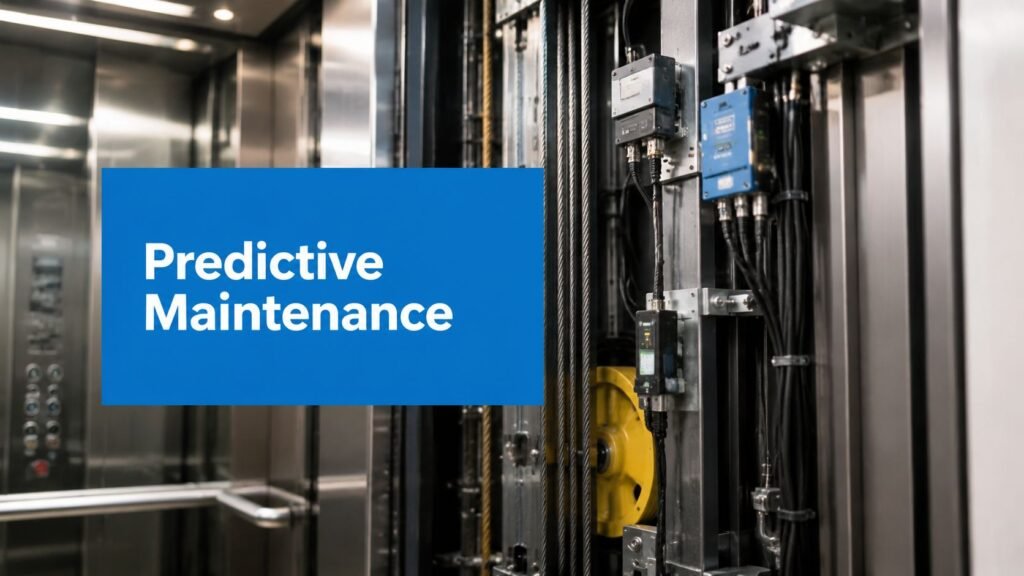
The most popular advice about predictive maintenance elevator systems is also the least useful: install sensors, connect a dashboard, and let artificial intelligence prevent failures. That may describe a polished demonstration, but it doesn't describe most working fleets. Building owners often manage modern controllers beside aging relay logic, incomplete service records, mixed manufacturers, and maintenance providers that still need to diagnose faults in the field.
Predictive monitoring can be valuable, especially on busy or failure-prone equipment. It isn't a replacement for inspections, cleaning, safety testing, or experienced technicians. The practical question is narrower and more important: which failures can your equipment reveal early, and can your team act on those warnings before they become an outage?
Why Predictive Maintenance Is Not a Universal Fix
Predictive maintenance earns its place when an elevator produces usable operating data, carries meaningful traffic, and has a defined process for acting on warnings. A busy commercial, healthcare, education, or industrial building may benefit from earlier notice because one interruption can affect many people or disrupt essential operations. A lightly used unit, limited sensor coverage, and incomplete service history make the business case harder to defend.
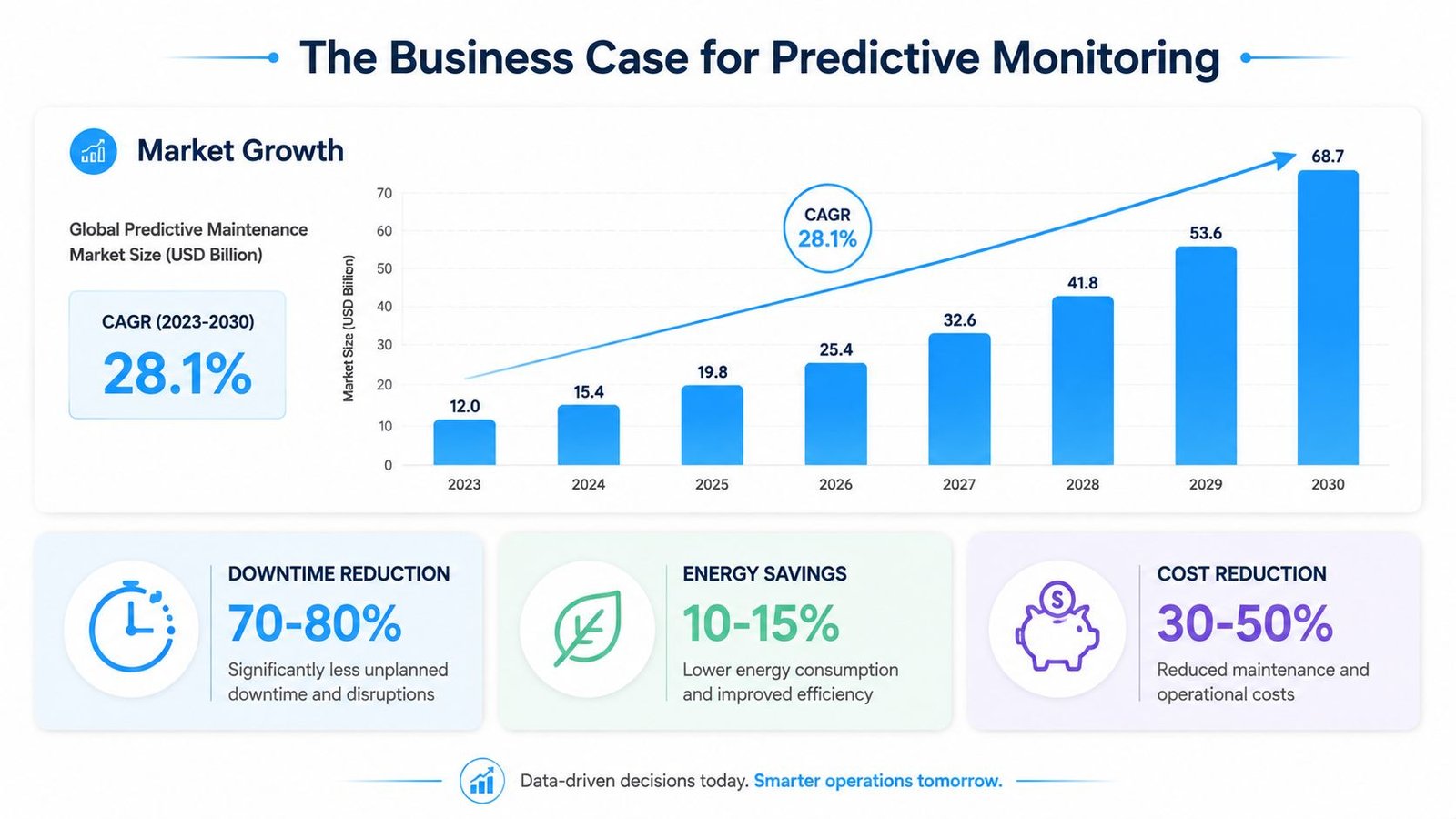
The technology has moved beyond a laboratory concept. Market research estimates that the global smart elevator predictive maintenance market reached USD 4.2 billion in 2024 and projects a 17.6% CAGR to USD 16.6 billion by 2033. Asia Pacific was identified as the largest regional market in 2024, followed by North America and Europe, according to DataIntelo's smart elevator predictive maintenance market report. Market size shows commercial momentum. It does not prove that a monitoring program will repay its cost in a mid-market building.
The gap between a demo and a working fleet
A vendor demonstration usually shows clean vibration, temperature, and door-movement data from a controlled setup. Mixed-age, non-proprietary fleets rarely provide that level of consistency:
- Mixed equipment ages: One elevator may expose controller data, while another requires retrofit sensors and separate integration work.
- Incomplete records: Service notes may sit in paper files, contractor systems, or records that use inconsistent fault terms.
- Limited fault visibility: A sensor can flag an abnormal pattern without identifying the failed component.
- Weak response workflows: An alert has little practical value if nobody owns review, field verification, and the repair decision.
- Model portability problems: A pattern learned from one manufacturer or configuration may not transfer reliably to another.
Academic work is moving toward component-specific detection, particularly for elevator doors. A 2026 study demonstrated an LSTM autoencoder approach for door fault detection, while another 2026 framework emphasized standardized datasets and improved warning systems for human-factor-related failures, as summarized in the IEOM Society proceedings paper. The practical lesson is clear: prediction depends on the failure mode, the signals available, and whether the model works across different sites and equipment.
Practical rule: Do not buy a predictive dashboard until you can name the failure modes it should detect and the person responsible for each alert.
Ask three questions before approving a deployment. How disruptive is an outage? How much usable data does each unit produce? Can the maintenance provider inspect and act on a warning quickly? If those answers are weak, stronger preventive maintenance may deliver more value than another software layer.
Reactive vs Preventive vs Predictive Elevator Maintenance
The practical difference is when the team acts. Reactive maintenance starts after a failure. Preventive maintenance follows a planned schedule. Predictive maintenance adds condition data, allowing technicians to adjust that schedule when equipment behavior changes.
Reactive maintenance can look inexpensive because planned work is deferred. The exposure appears later through emergency mobilization, unavailable parts, tenant disruption, access problems, and secondary damage. Run-to-failure creates the least control over cost, scheduling, and downtime, particularly in occupied mid-market buildings where a single elevator may carry a large share of daily traffic.
Preventive maintenance remains the foundation for every fleet. Technicians inspect safety components, clean machine rooms, pits, and car tops, check doors and locks, test emergency functions, lubricate appropriate components, and replace worn parts according to condition, experience, and established intervals. This approach can replace a component before failure, but rigid intervals may also replace parts that still have usable life.
Predictive maintenance adds a monitoring layer. Sensors and analytics look for changes in vibration, temperature, travel behavior, acoustics, electrical draw, or door operation. The system produces a prioritized warning before a complete shutdown, provided a technician verifies the finding and acts on it. That last condition separates a useful program from an alert subscription.
Elevator maintenance approaches compared
| Approach | Cost trajectory | Downtime risk | Best fit for |
|---|---|---|---|
| Reactive | Low planned spend, unpredictable repair exposure | Highest | Temporary situations, noncritical equipment, or assets nearing replacement |
| Preventive | Predictable planned spend with scheduled intervention | Moderate to low when consistently performed | Most occupied buildings and mixed fleets |
| Predictive | Added monitoring and data-management cost, with targeted intervention potential | Lower when alerts are accurate and acted on | High-use assets, larger portfolios, and equipment with useful data |
These approaches work together rather than compete. A sensible mixed-age fleet uses preventive inspections across all units, then applies predictive monitoring selectively where the equipment produces usable data and an outage carries meaningful consequences. That usually favors high-use units and repeat failure modes, not every elevator by default.
A sensor does not perform a safety test, clean a pit, correct a code violation, or replace a deteriorating door roller. On older, non-proprietary equipment, installation may also require separate gateways, limited access to controller data, or manual interpretation. Those constraints can reduce the practical value promised by a vendor's dashboard.
The decision should follow the building's operating reality. Choose reactive work only where temporary service or imminent replacement makes the exposure acceptable. Use preventive maintenance as the baseline for occupied buildings. Add predictive monitoring when alerts can be verified quickly, the maintenance provider will act on them, and the available data supports the failure modes being monitored.
How Elevator Sensors and IoT Analytics Detect Failures Early
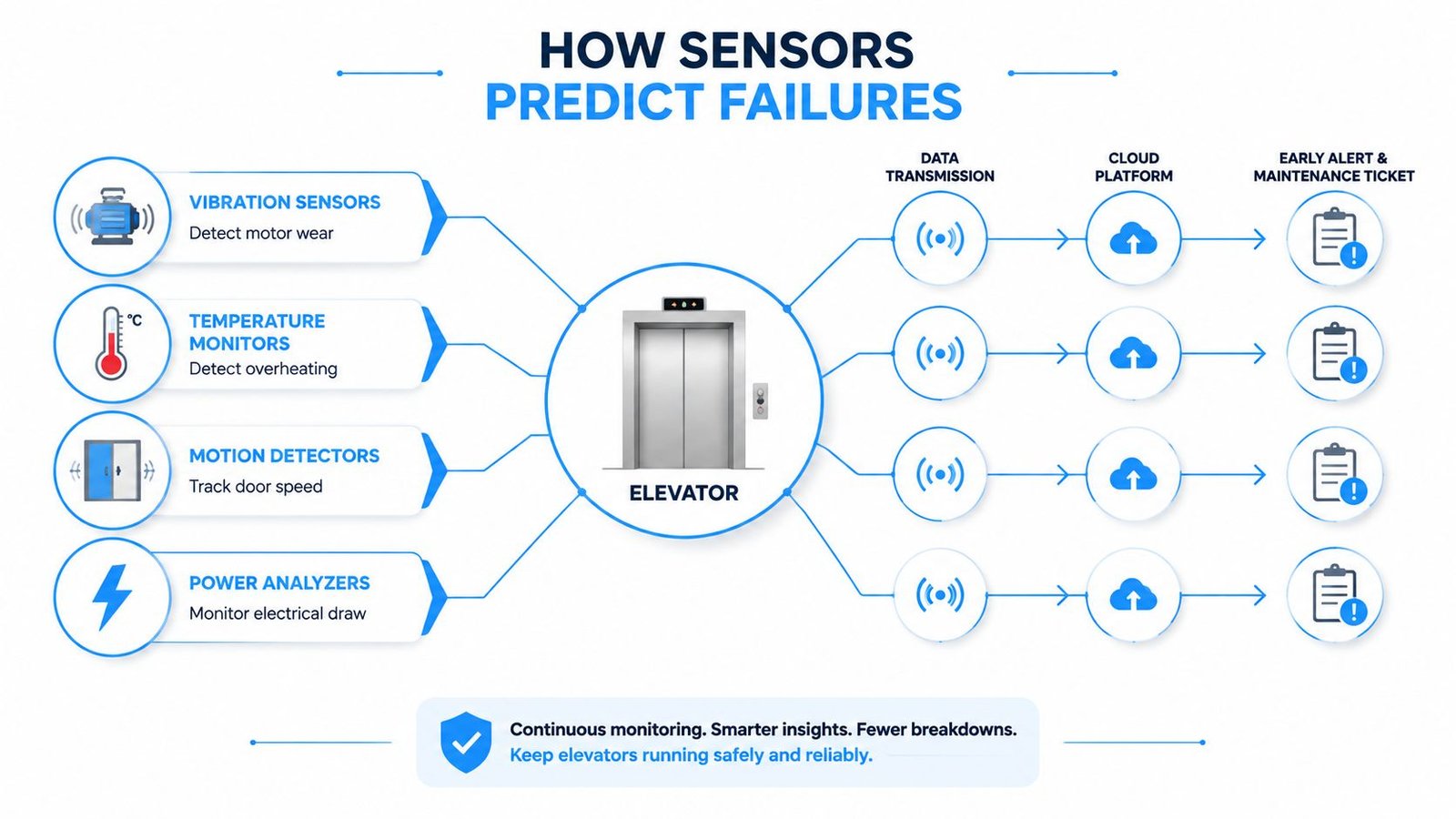
A predictive system starts with physical signals. Vibration sensors can reveal changes in motor, sheave, bearing, or rotating-equipment behavior. Temperature monitors can identify abnormal heat around machinery or in a machine room. Motion data can show changes in travel, leveling, acceleration, deceleration, or door speed. Acoustic monitoring can add another view of rubbing, impact, or unusual mechanical noise.
The valuable signal is often a trend rather than a single reading. One unusual vibration value may reflect a loading condition, a temporary obstruction, or a bad sensor. A persistent change that correlates with a service event deserves more attention. That distinction separates useful condition monitoring from a system that sends frequent alerts nobody trusts.
Why maintenance history matters
Raw sensor streams aren't enough. One elevator condition-monitoring study extracted 12 statistical features from motion and vibration signals, used a deep autoencoder for feature extraction, and then applied a random forest for fault detection. Field maintenance actions supplied the labels for supervised classification, as documented in the Scitepress elevator condition-monitoring study.
That approach reflects a practical truth. The model needs to understand what healthy operation looks like on the actual equipment and which patterns have previously led to a technician intervention. A generic vibration threshold may identify abnormal behavior, but it may not distinguish a door problem from a motor issue, or a temporary event from progressive deterioration.
A useful data stack should connect:
- Sensor readings: Vibration, temperature, motion, acoustics, and electrical behavior where appropriate.
- Operational context: Trips, loading conditions, door cycles, travel behavior, and recurring error states.
- Service history: The complaint, diagnosis, repair, replaced component, and result.
- Alert handling: Severity, recipient, acknowledgment, site verification, and final disposition.
Remote condition-monitoring field studies have used elevator vibration and machine-room temperature data to generate notifications at different severity levels and support faster repair decisions. A separate modernization study monitored temperature, triaxial vibration, and acoustics, sent deviations to cloud-based email alerts, and used historical events for troubleshooting. The Tampere University repository study reports that remote monitoring reduced downtime through early fault notification and trend-based diagnosis.
For building operators, sensor quantity isn't the central decision. Alert quality and technician response matter more. A modest retrofit that identifies a meaningful door trend and routes it to the right service team can outperform a large installation that produces noisy, unprioritized notifications. Owners evaluating smart elevator technology should ask to see how alerts become work orders, how false positives are handled, and how the system learns from completed repairs.
The Business Case and ROI for Predictive Elevator Monitoring
The business case for predictive monitoring is narrower than vendor presentations often suggest. It becomes credible when an elevator's failure has a measurable operational cost, the unit produces usable data, and someone can act on an alert before service is interrupted. A sensor package alone does not create a return.
Elevator outages affect more than the repair invoice. Healthcare facilities may reroute patients and equipment. Industrial sites may lose access between floors. Schools, offices, and residential properties may face complaints, accessibility concerns, and disruption to normal circulation. Harvard's benchmark of 190 million annual downtime hours across more than 12 million elevators illustrates why incremental uptime can matter at fleet scale, as reported in the Harvard elevator service analysis. Industry reporting also describes connected programs resolving 80% of issues proactively and reducing downtime by 30%. Treat those figures as program benchmarks, not promises for every building.
The market trajectory shows growing owner interest. The smart elevator predictive maintenance market reached USD 4.2 billion in 2024 and is projected to reach USD 16.6 billion by 2033, at a projected 17.6% CAGR, according to DataIntelo's market estimate. That growth may improve vendor availability and product maturity. It does not establish that a retrofit on a mixed-age, non-proprietary fleet will pay back.
Where the economics work
Predictive monitoring has a stronger business case when several conditions overlap:
- High consequence of downtime: A failed elevator affects critical access, revenue-producing operations, or a large occupant population.
- Recurring fault history: The same unit or component generates repeat calls that an early warning could help prevent.
- Available technical data: Existing controllers or retrofit sensors can produce consistent signals.
- A scalable portfolio: Monitoring costs can be spread across multiple assets and sites.
- A responsive service process: The maintenance team can schedule targeted work before failure.
Large commercial portfolios can spread sensor and implementation costs across multiple assets. Mid-market buildings usually need a more selective calculation. Before approving broad monitoring, compare the proposal with elevator maintenance cost guidance, including service labor, connectivity, software, inspections, repairs, and the operational effect of an outage.
A legacy controller may expose little useful data. A proprietary interface may restrict access or add recurring fees. Retrofit sensors can provide practical signals, but they still require stable communications, correct installation, and a technician who understands what the alert means. Those constraints can reduce the expected return even when the technology performs as advertised.
Why projects fail to scale
Independent industry reporting warns that about 40% of predictive maintenance projects fail to scale because of data and implementation issues, as cited in the Yahoo Finance industry survey coverage. The algorithm is only one possible failure point. Ownership may be unclear, equipment may be incompatible, labels may be incomplete, communications may be unreliable, or alerts may arrive without an agreed response.
A 2026 industry survey found that 33% of service firms viewed remote diagnostics and repair assistance as the main AI opportunity, while 31% prioritized predictive maintenance and downtime mitigation. The emphasis on assistance fits field conditions. Near-term value usually comes from helping technicians verify a developing problem and plan the visit, rather than removing technicians from the process.
Calculate the full lifecycle cost: installation, connectivity, software, data cleanup, alert review, technician verification, and eventual replacement. Compare it with recurring failures and their operational consequences. If the result is marginal, pilot one problematic unit and measure avoided disruption before committing the wider fleet.
Implementation Roadmap for Your Elevator Fleet
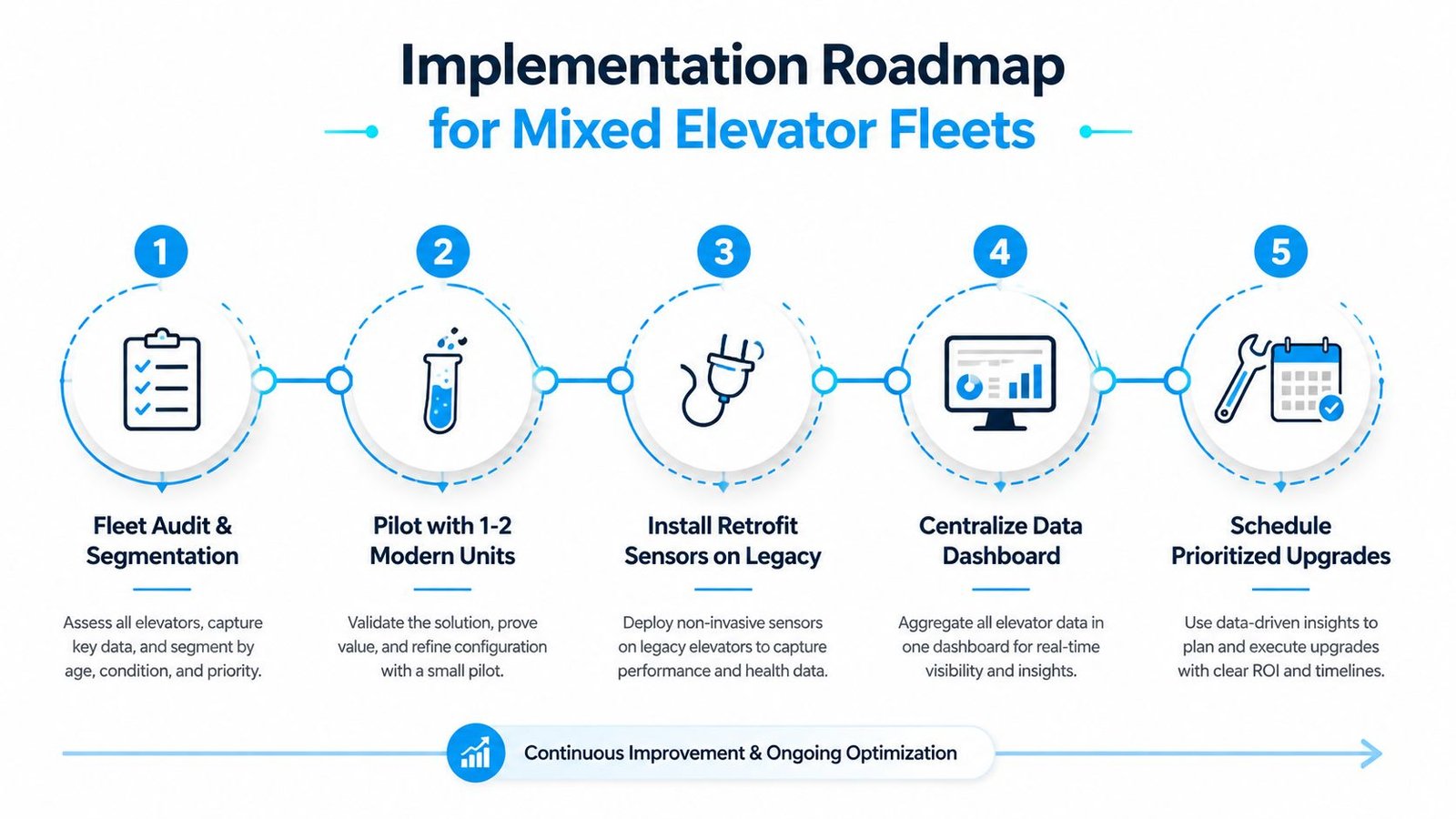
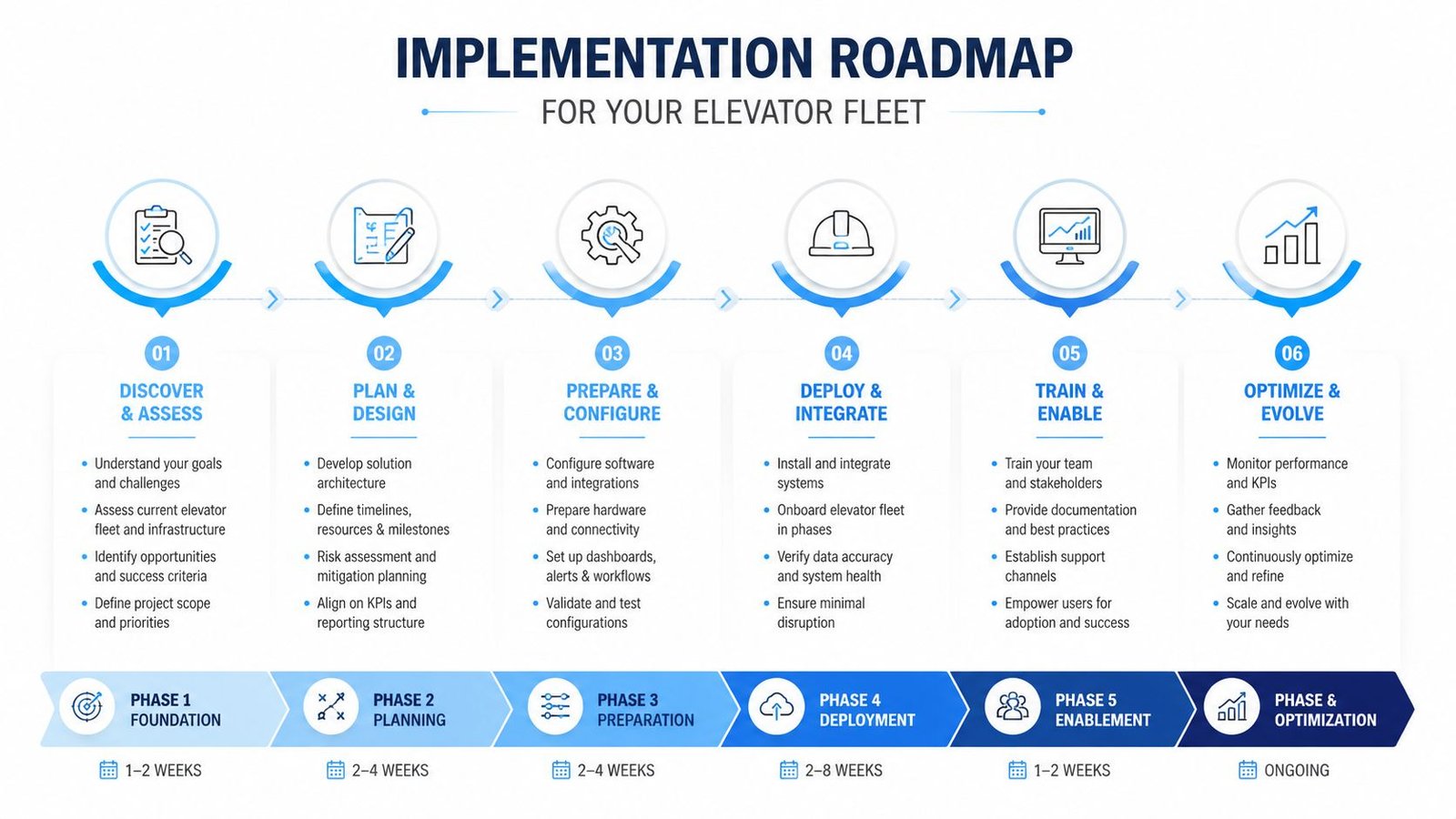
A mixed-age fleet needs segmentation before it needs sensors. Start by listing each unit's age, controller type, manufacturer, traffic role, recurring complaints, modernization status, service history, and operational importance. The result should divide the fleet into practical groups, such as modern units ready for deeper data integration, legacy units suitable for retrofit monitoring, and units better served by disciplined preventive maintenance or planned replacement.
Build the pilot around a real problem
Don't choose a pilot because the elevator has the newest controller. Choose a unit where the business consequence and failure pattern are visible. That may be the hospital service elevator with recurring door faults, the municipal building unit that causes repeated access complaints, or the industrial car whose motor behavior has changed during heavy use.
Doors deserve early consideration because component-specific research is developing strongly in that area. An LSTM autoencoder door-fault study published in 2026 and a separate 2026 framework focused on warning systems and standardized data, as described in the IEOM Society proceedings source. The practical lesson is to monitor a known failure mode with a defined intervention, not to install general-purpose sensors without a maintenance hypothesis.
Connect data to the work process
A pilot should establish who receives alerts, who reviews them, how the technician verifies them, and how the final repair is recorded. Require the system to preserve the original signal, the alert threshold, the technician's finding, the action taken, and the outcome. Without that feedback loop, the building accumulates charts rather than useful maintenance intelligence.
For older equipment, retrofit sensors may be enough to identify deterioration in vibration, temperature, acoustics, or motion. They won't expose every controller state, and they can't compensate for a failing safety circuit that the monitoring design doesn't measure. Treat the retrofit as an additional diagnostic layer.
Scale only after verification
Run the pilot long enough to collect meaningful operating and service evidence, then review alerts with the maintenance provider. Ask which warnings led to confirmed findings, which were false positives, which failures remained invisible, and whether the data changed the work plan. Expand only when the answer is operationally useful.
A non-proprietary design is important here. The monitoring data should remain usable if the building changes contractors, replaces a controller, or adds another manufacturer. The system should support qualified providers rather than turning a service relationship into a technology dependency.
Choosing a Vendor Without Getting Locked In
A polished dashboard should not decide the purchase. The lasting value is in data ownership, sensor compatibility, alert logic, service response, and the ability to work across equipment from different manufacturers. That matters most in mid-market buildings, where a newer unit may sit beside older controllers and retrofit hardware.
Ask the vendor to answer these questions in writing:
- Who owns the data? Confirm that the building owner can retrieve historical readings, alerts, and service-related records.
- Can another provider use the system? Request practical API or export access, not a general promise of portability.
- What equipment is supported? Identify which signals come from the controller and which require retrofit sensors.
- How are alerts customized? Confirm whether thresholds can differ by unit, component, operating conditions, and severity.
- What happens after an alert? Require a documented path from notification to verification, work order, repair, and closure.
- How does the model handle poor history? Ask how the system operates when records are incomplete and how it limits overconfident predictions.
- What happens when communications fail? Require a clear offline and reconnection procedure.
- What is excluded? Clarify whether the service covers analytics, sensor maintenance, technician dispatch, or the full maintenance relationship.
Favor open service relationships
Proprietary systems can perform well while the equipment, software, parts, and service team remain stable. They create exposure when an owner cannot access the data, another qualified contractor cannot interpret alerts, or pricing changes leave the building with limited choices. An open system does not guarantee good service. It preserves the ability to compare providers and retain operational control.
The non-proprietary elevator approach provides a useful procurement principle because it separates monitoring technology from exclusive service rights. A building owner should be able to select qualified maintenance support without abandoning information collected by the monitoring system.
Local response deserves the same scrutiny as the software. A remote center may identify an abnormal pattern, but someone still must inspect the elevator, communicate with occupants, obtain parts, and complete the repair. Ask how alerts are routed in Detroit, Toledo, Ann Arbor, Lansing, or the surrounding service area. Confirm that the quoted response standard applies to field technicians, not only to call-center acknowledgment.
The best vendor is not the one with the most impressive screen. It's the one that turns a credible warning into a verified repair without taking control of your fleet away from you.
Request a live demonstration using one of your own units rather than a generic sample. Have the vendor show data export, alert escalation, historical service records, and the process for removing the system. Also ask what remains usable if the monitoring contract ends. If those basics are unclear, predictive technology may create more dependency than visibility.
Putting It All Together for Your Building
Predictive monitoring is a strong candidate for a busy elevator with recurring faults, meaningful downtime consequences, and enough data to support component-level alerts. It may be a selective retrofit for a mixed commercial or institutional fleet. For an older, lightly used unit with poor records and limited communication infrastructure, disciplined preventive maintenance and a modernization plan may produce better value first.
The decision should rest on equipment age, traffic consequence, failure history, portfolio scale, and response capability. Predictive tools work best as an enhancement to inspections, clean-downs, safety tests, repairs, and planned replacement. No sensor can correct a neglected pit, restore a failed emergency phone, perform a required test, or substitute for a technician who understands the equipment.
For Michigan and Ohio building owners, the sensible next step is a fleet review rather than an automatic technology purchase. Ask for a free second opinion or competitive quote that separates immediate reliability work, retrofit monitoring, and modernization priorities. That gives you a clearer path to reliable elevators without paying for a dashboard that your maintenance process can't use.
Crane Elevator Company provides proactive maintenance, non-proprietary modernization, emergency repairs, inspections, and monitoring guidance for elevator fleets across Michigan and Ohio. Visit Crane Elevator Company to request a free second opinion or competitive quote for your building and equipment.