A Toledo facility manager can do everything right operationally, then discover that the elevator's maintenance file doesn't line up with the state inspection cycle. The equipment may still be running, but missing service records, incomplete test documentation, or an unresolved deficiency can put the Certificate of Operation at risk. The resulting shutdown, delayed inspection, or interruption to patients, students, tenants, freight, or staff can cost far more than a properly scoped maintenance agreement.
That's why Toledo elevator maintenance shouldn't be treated as a routine lubrication visit followed by emergency callbacks. Ohio's rules make inspection readiness, documented preventive work, safety testing, and timely correction part of the operating plan. The right contract supports reliability today while giving the owner a defensible path through inspections, repairs, and eventual modernization.
Why Toledo Elevator Maintenance Demands More Than Callbacks
A building manager receives an inspection notice and opens the elevator file. The last invoice shows a service visit, but the paperwork doesn't clearly identify what was tested, which deficiencies were corrected, or whether the equipment is ready for the next state inspection. The elevator is moving, yet the maintenance program has failed at the point where operation, documentation, and compliance meet.
That situation is common in facilities that buy the cheapest callback arrangement instead of a structured maintenance program. A technician may respond when the car stops, reset a fault, and return the unit to service. That helps with the immediate symptom, but it doesn't necessarily address worn door equipment, inconsistent leveling, hydraulic leakage, safety components, inspection preparation, or recurring faults that eventually become violations.
The contract should protect operation
An elevator maintenance agreement is more than a service retainer. It should define the work required to keep the equipment safe, reliable, documented, and inspection-ready. That usually means scheduled preventive visits, adjustments, cleaning, testing, callback response, repair procedures, and clear records that show what happened at each visit.
Ohio requires most passenger elevators, freight elevators, escalators, and moving walks to be inspected twice every 12 months, while certain non-passenger lifting devices follow an annual schedule under Ohio's elevator inspection rule. A reactive agreement that only activates after a failure leaves too much of the owner's risk unmanaged.
Practical rule: If a contract doesn't explain how the provider prepares the equipment and records for inspection, it's incomplete.
Why callbacks alone fail
Reactive service has a place, especially for an unexpected shutdown. It shouldn't be the foundation of a Toledo facility's program. Repeated callbacks can consume budget without correcting the underlying cause, while small defects become expensive repairs when they affect door locks, brakes, controls, hydraulic systems, machine components, or safety circuits.
A strong agreement functions more like operational insurance. It creates a predictable maintenance rhythm, gives the facility a defined response path, and identifies exclusions before an invoice arrives. For hospitals, schools, industrial sites, and multi-story commercial buildings, that structure protects more than the elevator. It protects access, workflow, tenant confidence, and the owner's compliance position.
Ohio Inspection Rules That Shape Your Maintenance Schedule
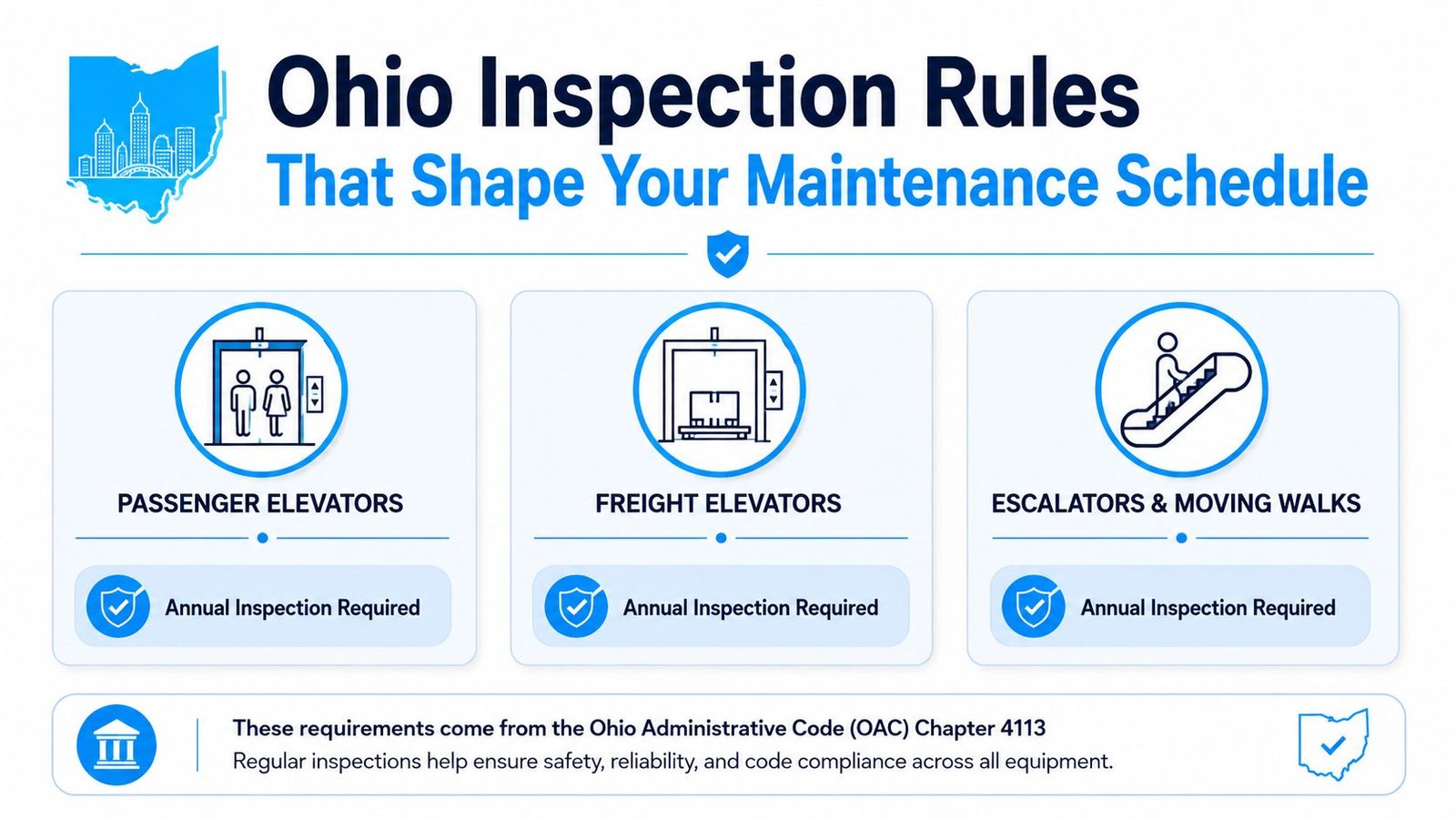
Ohio's inspection schedule determines how a Toledo maintenance program must be organized. Passenger elevators, freight elevators, escalators, and moving walks must be inspected twice every 12 months, while power dumb-waiters and other permanently installed lifting devices that aren't designed to carry people must be inspected at least once every 12 months, as stated in Ohio Revised Code Section 4105.10.
That distinction matters when one property contains several device types. A school might have passenger elevators and a dumbwaiter. An industrial facility might operate freight equipment alongside lifting devices that fall under a different inspection frequency. A maintenance calendar that labels everything “annual” can create a missed cycle for equipment requiring two inspections.
Inspection frequency is only one part of the schedule
Periodic safety testing must also follow ASME requirements, including at least one full-load safety test every five years, according to Ohio Administrative Code Rule 1301:3-6-04. The maintenance provider should know when that test is due, prepare the equipment, coordinate access, document the outcome, and address any resulting deficiencies.
The five-year cycle changes how owners should judge a contract. A provider that performs routine visits but doesn't track test readiness may leave the facility scrambling when the deadline approaches. Load testing can require scheduling, equipment preparation, building coordination, and follow-up work. Treating it as an unexpected event is poor lifecycle planning.
Ohio's program issues more than 32,000 certificates of operation statewide, a figure included in the state framework and cited in the Ohio elevator maintenance requirements. The scale reinforces why owners can't treat elevator upkeep as informal building maintenance.
Plan around inspector availability
Inspection timing also creates a practical scheduling issue. Ohio's elevator program states that inspections and re-inspections depend on inspector availability, with normal hours running from 7 a.m. to 4 p.m. Off-hour inspections require a separate written request and are billed at $60 per hour with a four-hour minimum, according to the state's elevator and escalator program guidance.
That information belongs in the facility schedule, not buried in a contract file. Coordinate inspections during planned access windows, reserve time for corrections, and confirm who handles re-inspection requests. A maintenance agreement should support this process rather than only tell the owner to call after a violation appears. For a practical Ohio-focused service framework, review elevator maintenance services for Ohio facilities.
Key Components of a Strong Maintenance Agreement
A proposal can look complete while leaving the owner exposed to labor charges, parts invoices, and inspection-related delays. Read the agreement as an operating document, not a sales brochure. The most useful question is simple: What will the contractor do before a failure or inspection creates pressure?
Start with the service level agreement
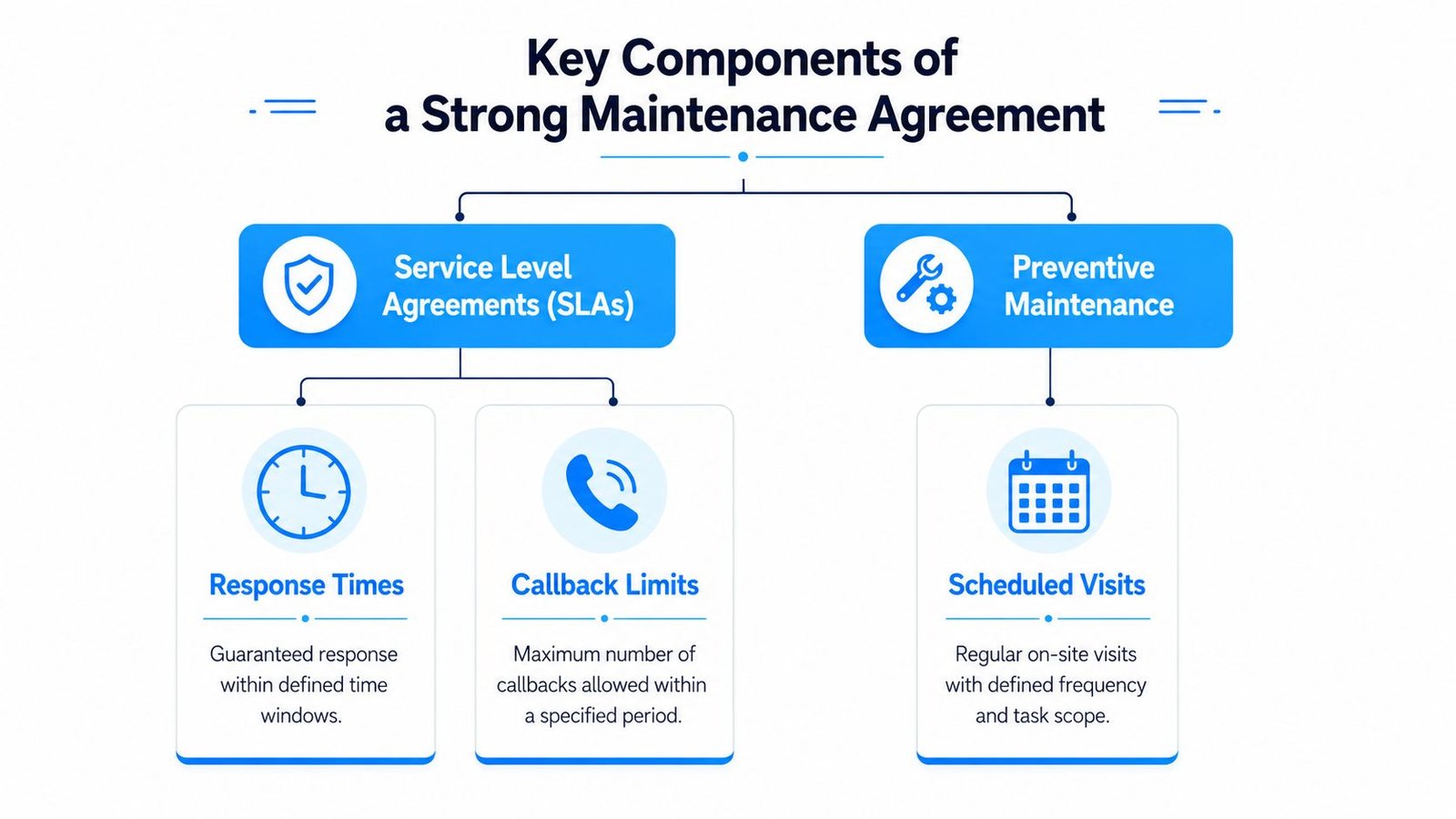
The SLA should state how service is requested, how emergency and non-emergency calls are prioritized, and what response commitment applies to each category. “Prompt response” is difficult to enforce. A defined response window is more useful, especially for a healthcare, education, industrial, or municipal facility with limited tolerance for downtime.
Callback language deserves equal attention. Ask whether the agreement limits callbacks, excludes them after certain hours, or treats repeat failures as separate billable events. If the same door fault returns after a repair, the owner needs a process for finding the cause rather than paying repeatedly for resets.
Define preventive work in plain language
A maintenance schedule should identify the tasks included in routine visits. Look for specific references to door operation, leveling, controls, electrical components, hydraulic or traction equipment, safety devices, machine rooms, pits, car tops, and housekeeping. Confirm whether COP and PI bulb replacements, machine room clean-downs, and inspection preparation are included or billed separately.
A vague phrase such as “lubricate and inspect equipment” doesn't tell you whether the technician will adjust a door operator, investigate abnormal noise, clean debris from a pit, or document a developing issue. The contract should also identify the records the provider will supply, including visit reports, deficiency notes, test documentation, and repair recommendations.
Compare coverage tiers and pricing models
Parts coverage often separates a useful agreement from a low headline price. Ask which components are included, which are excluded, and whether labor changes when a covered part fails. Proprietary controls, obsolete components, vandalism, water damage, and customer-caused damage may require separate treatment, but the exclusions should be readable.
Pricing generally falls into three practical structures:
- Flat-rate coverage: This improves budget predictability when the scope is broad and the equipment profile is understood.
- Time-and-materials service: This can suit low-use equipment or owners who prefer to pay only when work occurs, but repair exposure is less predictable.
- Hybrid coverage: This combines scheduled maintenance and defined labor with separate pricing for major parts, modernization, or unusual damage.
Escalation clauses, cancellation windows, renewal terms, after-hours charges, and permit responsibilities should appear before signature. A contract that covers the regular visit but leaves every meaningful repair outside the scope isn't necessarily economical. Compare proposals using the same equipment list and the same service expectations. Lift maintenance contract guidance can help owners frame that review.
Comparing Maintenance Contract Types for Toledo Facilities
The best contract depends on the building's risk profile, equipment condition, operating demands, and tolerance for surprise invoices. A hospital, school, warehouse, and small residential property shouldn't receive the same scope because each has an elevator.
| Contract Type | Best For | Cost Predictability | Compliance Support | Risk Exposure |
|---|---|---|---|---|
| Full-coverage | High-use facilities where downtime creates serious operational problems | Strong, if exclusions are narrow | Strong, when records, testing, and inspection coordination are included | Lower owner exposure, but contract price may be higher |
| Parts-and-labor | Owners seeking broad repair protection with defined component coverage | Moderate to strong, depending on exclusions | Moderate, unless inspection preparation is expressly included | Exposure remains for excluded systems and special work |
| Examination-only | Low-use equipment or owners with in-house coordination capacity | Limited | Limited to the defined examination scope | High, because repairs, callbacks, and documentation may remain outside the plan |
| Hybrid | Older systems, mixed-use properties, or facilities planning modernization | Moderate | Strong when compliance tasks are written into the agreement | Balanced, but only if responsibilities are clearly assigned |
A full-coverage plan can make sense for a busy healthcare or industrial facility because the owner is buying response capacity and financial predictability, not just scheduled labor. The contract still needs exclusions reviewed carefully. “Full” doesn't mean every condition is automatically covered.
An examination-only plan may work for a low-use residential elevator where the owner has a clear repair budget and can coordinate separate work. It's a poor fit for a facility that depends on continuous passenger or freight service. The lower initial commitment can become expensive when the first significant failure requires separate diagnosis, parts, labor, and follow-up.
Match the plan to the building's age
Older Toledo properties need a different conversation. A century-old freight elevator or a mid-century passenger unit may require obsolete-part research, code analysis, repeated repairs, or a modernization path. A contract focused only on routine service can delay the decision until a failure forces it.
A hybrid plan often works well in that situation. It can cover preventive maintenance and response while creating a defined process for capital repairs, safety upgrades, and non-proprietary modernization. The owner should know whether the provider can maintain the existing equipment during planning and whether another qualified contractor can service the modernized system afterward.
Decision test: Choose the contract that best controls the risk your building can't absorb, not the one with the smallest monthly line item.
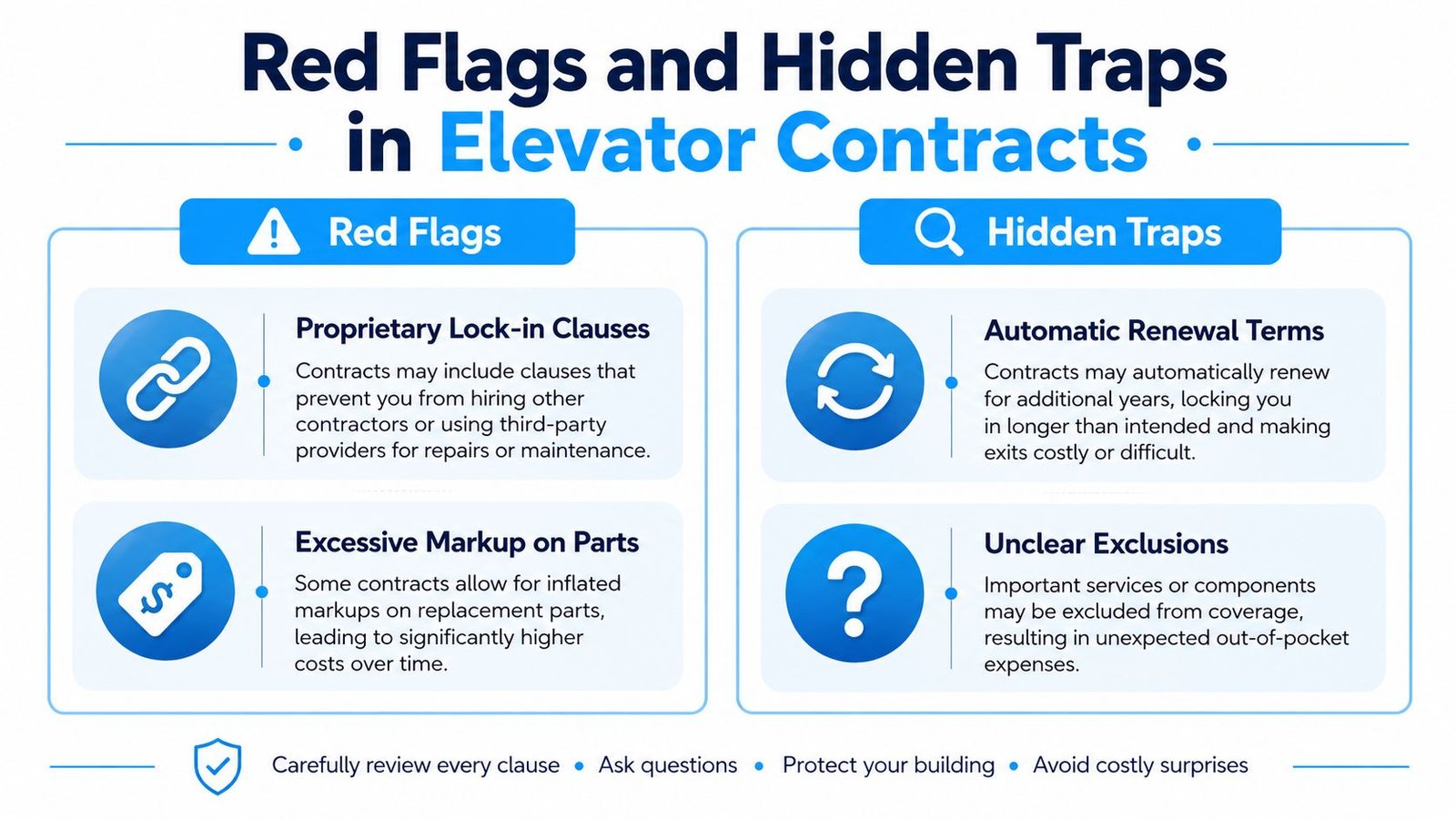
Red Flags and Hidden Traps in Elevator Contracts
A low maintenance price can be misleading if the agreement shifts the difficult work back to the owner. The warning signs usually appear in exclusions, documentation language, and termination provisions rather than in the first page of the proposal.
Read exclusions as carefully as coverage
“Routine maintenance included” may still leave door lock monitoring, hydraulic packing, safety test preparation, machine room cleaning, bulbs, callbacks, and inspection corrections outside the scope. Those items aren't minor if an inspector identifies a deficiency or a recurring fault keeps the elevator out of service.
Ask the contractor to define the boundary between maintenance and repair. If a technician adjusts a door during a scheduled visit, is that included? If the same adjustment fails shortly afterward, does the callback fall under the agreement? If a safety test reveals a problem, who supplies the labor, parts, coordination, and paperwork?
Watch for lock-in and renewal pressure
Proprietary lock-in clauses can make an owner dependent on one provider for parts, programming, or service access. That may restrict competitive bidding and complicate modernization planning. A non-proprietary approach gives the owner more flexibility, provided the equipment can be safely and legally serviced by qualified professionals.
Automatic renewal terms deserve the same scrutiny. Confirm the notice period, escalation method, cancellation rights, and treatment of work already authorized. A contract shouldn't make it difficult to leave after service quality declines.
Use this review list before signing:
- Documentation gaps: The agreement doesn't promise service reports, deficiency logs, test records, or inspection support.
- Open-ended exclusions: Terms such as “unusual conditions” or “major repairs” appear without definitions.
- Callback billing: Repeat failures can generate separate charges even when the original repair didn't resolve the issue.
- Parts markups: The provider doesn't explain how parts are priced or whether the owner can approve alternatives.
- Restricted access: The contract prevents another qualified provider from working on the equipment without a clear safety or manufacturer reason.
A partnership-oriented agreement makes responsibilities visible. It doesn't promise that every repair is free. It tells the owner what is covered, what is not, how approval works, and how the provider will help restore compliance.
The following video provides additional context for reviewing elevator service arrangements and identifying contract language that deserves closer inspection.
How Crane Elevator Company Approaches Maintenance in Toledo
Crane Elevator Company approaches Toledo elevator maintenance as a preventive, non-proprietary service relationship rather than a sequence of emergency callbacks. The company provides Maintenance, Repair, and Modernization services in Michigan and Ohio, including Toledo and surrounding cities, for commercial, industrial, healthcare, education, municipal, residential, and mixed-use properties.
The program is built around practical details that affect daily reliability. Crane uses a No Show, No Pay policy, performs full clean-downs of machine rooms, pits, and car tops, and includes COP and PI bulb replacements in standard service. Those details matter because neglected housekeeping, missing lighting, and poorly documented routine work can turn a basic service visit into an avoidable inspection or safety concern.
Maintenance that supports the full lifecycle
Crane's scope extends beyond lubrication. Services include door lock monitoring, hydraulic packing, jack, cable, tank and power unit work, motor, sheave, and machine replacement, safety testing, emergency phones, fire service, generator testing, and violation corrections. That range allows an owner to address a developing defect without immediately treating the entire elevator as a replacement project.
The company also handles full non-proprietary modernizations for all makes and models of vertical transportation. That includes century-old freight cars, newly installed passenger units, residential elevators, wheelchair lifts, material lifts, and dumbwaiters. A non-proprietary design gives the owner more flexibility for future service and reduces dependence on a single provider.
Crane brings over 25 years of hands-on experience serving Michigan and Ohio and operates 24/7/365. It offers free second opinions, competitive quotes, a price-beat guarantee, commercial elevator financing, and modernization financing. Those options can help facility managers separate urgent safety work from planned capital improvements while keeping the existing system supported.
Coverage across Toledo and neighboring markets
Service extends through Toledo, Detroit, Ann Arbor, Lansing, Perrysburg, Flint, Kalamazoo, and surrounding communities. For a Toledo owner, that regional footprint matters when a facility operates multiple properties or needs coordinated maintenance, repair, and modernization support across Michigan and Ohio.
For a closer look at local response and repair capabilities, review Toledo elevator repair services. The important comparison point isn't whether a contractor can respond. It's whether the provider can maintain the equipment, document the work, correct violations, support testing, and plan modernization without creating unnecessary proprietary dependence.
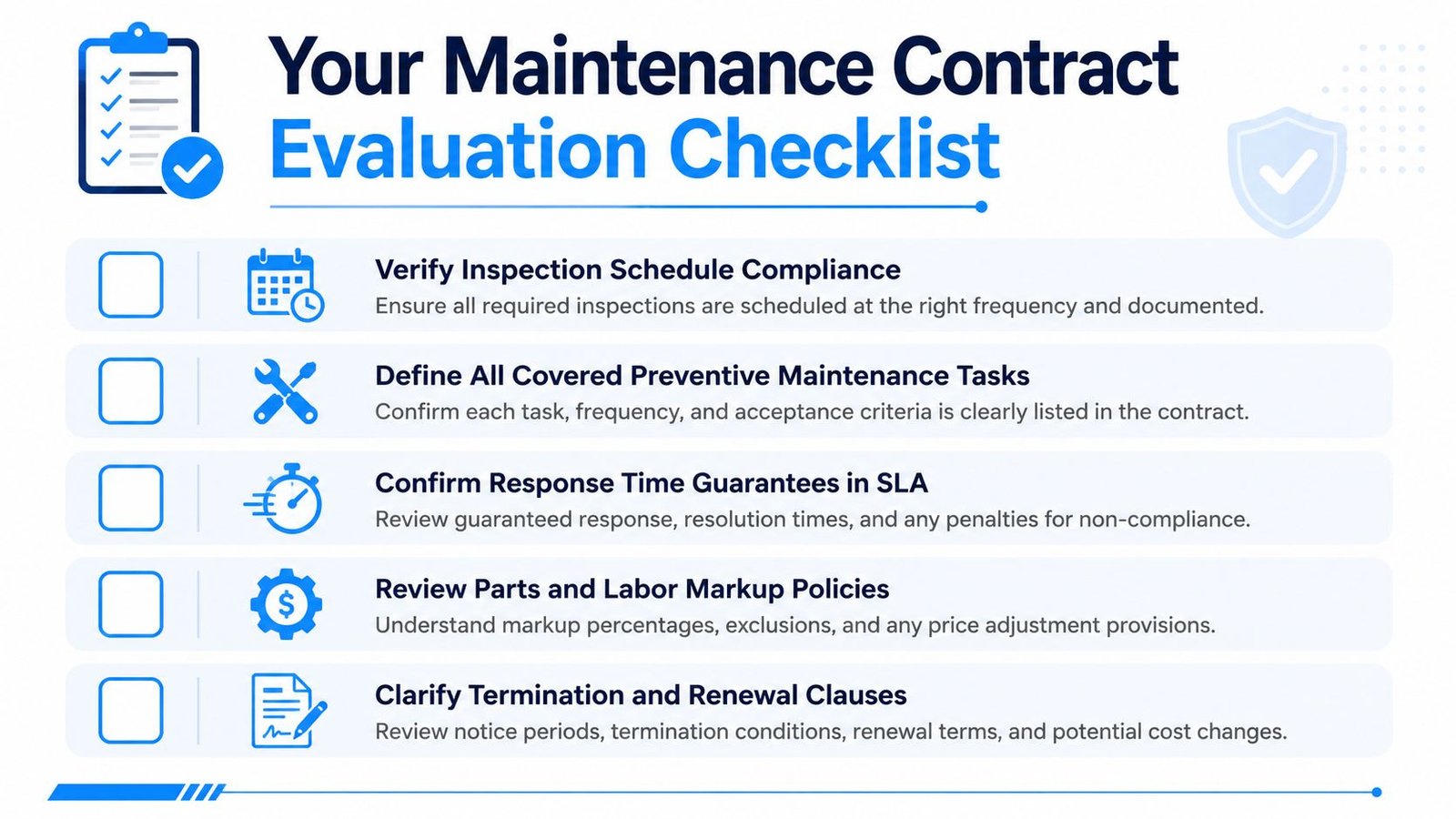
Your Maintenance Contract Evaluation Checklist
Use the following checklist before signing a new agreement, renewing an existing one, or accepting a repair recommendation. Request written answers. Verbal assurances are difficult to compare and nearly impossible to enforce when a shutdown or inspection dispute occurs.
Confirm the compliance foundation
- Verify inspection schedule compliance: List every device by type and confirm whether the provider tracks the applicable Ohio inspection cycle.
- Record test dates: Identify the next required safety testing milestone, including the full-load safety test cycle required under ASME standards.
- Define inspection preparation: State who prepares the equipment, coordinates access, supplies records, and manages corrections before inspection.
- Clarify re-inspection support: Confirm who schedules re-inspection and whether related labor, paperwork, and return visits are included.
- Assign permit responsibility: For repairs, alterations, and modernization, identify who obtains permits, submits forms, and coordinates final inspection.
Put the operating scope in writing
Ask whether scheduled visits include cleaning, lubrication, adjustments, safety checks, door system work, machine room and pit clean-downs, car-top inspection, and COP or PI bulb replacement. Confirm how the agreement handles emergency calls, repeat callbacks, after-hours work, parts, labor, vandalism, water damage, and obsolete components.
A useful clause might read: “The contractor will provide written service reports identifying work completed, observed deficiencies, recommended corrective action, and the status of open items after each scheduled visit.” Have counsel review final language, but don't accept a proposal that leaves documentation undefined.
Test the financial terms
Compare the same equipment and scope across proposals. Check the SLA response commitment, callback treatment, parts pricing, labor rates, escalation clause, renewal notice, cancellation window, and approval threshold for extra work.
Before renewal: Ask for the callback history, open deficiency list, inspection records, test status, and modernization recommendations. If the provider won't explain recurring problems, get a second opinion.
A second opinion is especially useful when a repair estimate is large, the equipment is aging, a violation has remained open, or the contract excludes the work most likely to affect uptime. Benchmark the current agreement against the checklist, not just against another monthly price.
Crane Elevator Company provides proactive maintenance, repair, code-required inspection support, and non-proprietary modernization for elevators and lifting equipment across Toledo, Ohio, Michigan, and surrounding communities. Visit Crane Elevator Company to request a maintenance evaluation, free second opinion, competitive quote, or modernization discussion built around your equipment and compliance schedule.