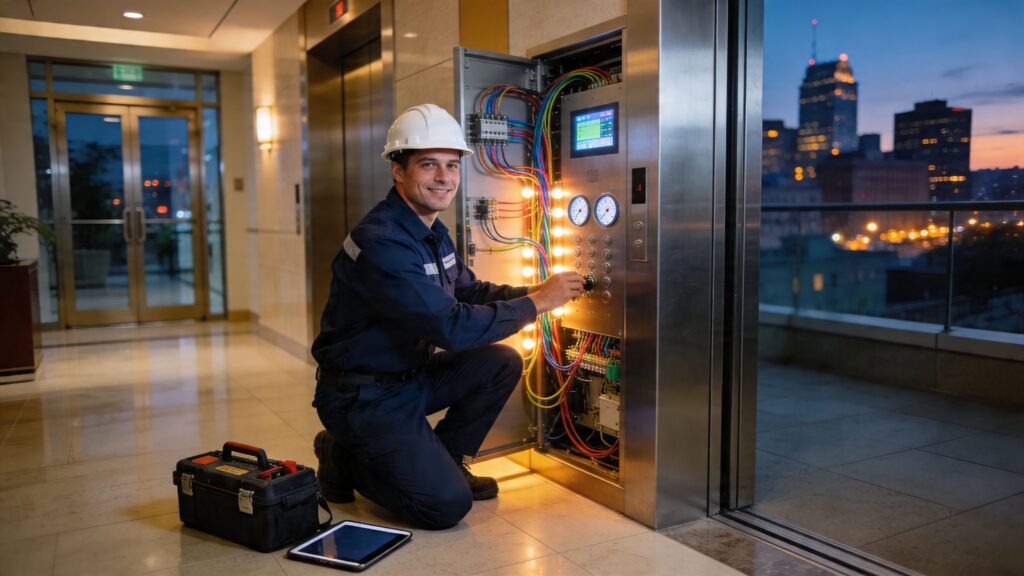
At 9:40 on a cold weeknight, the call usually sounds the same. A tenant is stuck. A nurse can’t move a patient. A freight car is sitting dead at dock level with a delivery backed up behind it. The building owner isn’t asking for marketing language. They’re asking one question: who’s coming, and how long will it take?
That is the primary issue with most pages about 24-hr Elevator Repair. They promise “fast response,” but they don’t define it. For property managers in Southern Michigan, that vagueness is the problem. You need to know what round-the-clock service means in Detroit at midnight, in Ann Arbor during a storm, or at an industrial site outside Lansing before first shift starts.
Emergency Elevator Service
A late-night elevator outage creates three problems at once. First, there’s the immediate safety issue. Second, there’s the building operations problem. Third, there’s liability, because every minute without a clear response increases frustration for tenants, staff, and ownership.
Most companies still talk about emergency service in broad terms. That leaves building teams guessing about actual arrival times, dispatch procedures, and what happens after the phone rings. One reason that gap matters is that published industry guidance points to average emergency response times of 2 to 6 hours in urban areas for this type of service, which is exactly why property managers push hard on SLA language and local coverage before they sign anything, as noted by Quality Elevator’s discussion of repair response expectations.
If you’re evaluating providers, start with a contractor’s actual emergency process rather than their slogan. Ask whether they offer 24-hour emergency elevator service with live dispatch, whether callbacks are confirmed, and whether entrapments move to the front of the line without argument.
A short video helps frame the kind of emergency thinking building teams should expect from a service partner.
What 24-hr should mean in plain terms
For a property manager, “24-hr” should mean more than a phone number that rolls to voicemail. It should mean:
- A real person answers
- The callback happens quickly
- The building gets triaged correctly
- A technician is dispatched based on severity, not convenience
- You get updates while the elevator is down
Practical rule: If a company can’t explain its after-hours call flow in plain English, it probably won’t perform well when a car is down and occupants are waiting.
What works and what doesn’t
What works is local coverage, stocked service vehicles, and honest communication when travel time changes. What doesn’t work is a national call center that logs the ticket, promises urgency, and leaves the property manager chasing status updates.
In elevator emergencies, clarity matters almost as much as repair skill. A reliable contractor tells you what’s happening, what they know, what they don’t know yet, and what the next step is.
When to Call for Emergency Elevator Repair
Some failures are obvious. Others start as a warning and become an after-hours shutdown because nobody wanted to make the call earlier. Property managers save time and money when they know the difference.
Call immediately for these conditions
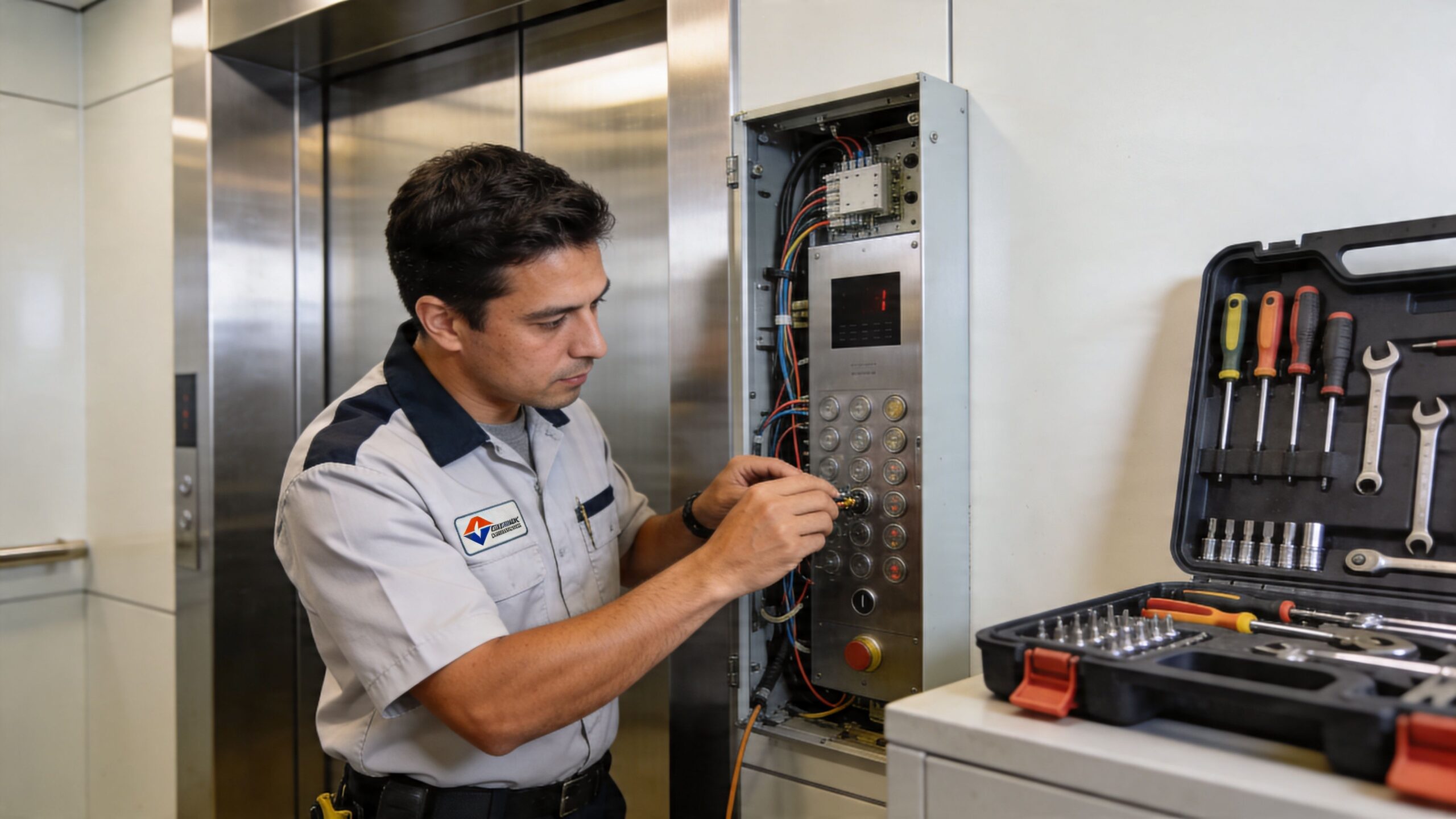
If any of these show up, treat it as emergency service and contact a qualified contractor for elevator repair in Michigan:
- Entrapment: Anyone stuck in the car is an emergency call. Keep communication calm, tell occupants help is on the way, and stop unqualified people from trying to force doors.
- Door failures: Doors that won’t open, won’t close, reverse unpredictably, drag, slam, or mis-level with the landing need prompt attention.
- Burning smell or visible smoke: Take the unit out of service and secure the area.
- Sudden hard stops or jerking: Rough motion, slipping, or inconsistent leveling often points to a condition that can get worse fast.
- Safety-related faults: Fire service problems, brake issues, recurring shutdowns, or anything affecting recall or door protection should move to the top of the list.
Warning signs people ignore too long
Not every emergency starts with a shutdown. Many begin with repeat complaints that sound minor:
- Grinding or scraping sounds
- Banging in the hoistway or machine space
- Longer wait times than normal
- Flickering car lights or intermittent panel response
- The car stopping slightly above or below the floor
Those symptoms don’t always trap passengers that day. They do tell you the equipment needs inspection before the next heavy traffic period exposes the weakness.
If multiple tenants report “the elevator feels off,” take that seriously even when the car is still running. Passengers usually notice ride changes before the unit fails completely.
What not to do
Don’t let maintenance staff, security, or a handyman “see if they can reset it” unless they’re properly qualified for elevator work. This trade is dangerous for trained people, let alone for someone trying to help after hours. Elevator installation and repair ranks as the sixth most dangerous construction trade, and maintenance personnel account for about half of elevator-related fatalities and injuries in the U.S., according to Miller & Hine’s summary of elevator accident statistics.
That matters on a practical level. A bad decision during a shutdown can turn a service call into an injury investigation. The right move is simple: secure the elevator, keep people away from the entrance if needed, communicate with occupants if there’s entrapment, and wait for a qualified mechanic.
What Happens During a 24-Hour Service Call
A good emergency call follows a predictable sequence. That predictability is what lowers stress for the property team.

Step one is triage, not guessing
When you call for elevator repair service, have these details ready:
- Building address and callback number
- Which unit is down
- Whether anyone is trapped
- What the elevator is doing or not doing
- Any visible fault message, smell, noise, or door issue
- Whether the unit has already been shut down
That information helps dispatch separate a nuisance shutdown from an entrapment, a healthcare transport issue, or a freight interruption.
The benchmark that matters
For true emergencies, especially entrapments, the service standard should be clear. A key benchmark in emergency elevator repair is technician arrival within 1 hour of contact for passenger entrapment situations, as specified in institutional elevator contract language in Hope Community elevator specifications.
That doesn’t mean every call is identical. Weather, distance, and site access still matter. It does mean a serious contractor sets a hard expectation for the highest-risk calls instead of hiding behind “as soon as possible.”
The first question after an entrapment call shouldn’t be “Can this wait until morning?” It should be “Who is en route, and what’s the ETA?”
What the mechanic does on arrival
A competent mechanic doesn’t start by swapping parts at random. The first job is to secure the situation and establish control.
Typical on-site actions include:
- Confirming occupant status: If passengers are inside, safe release takes priority.
- Taking the unit out of service: That prevents additional risk while troubleshooting.
- Checking the fault path: The mechanic traces what failed, not just what alarmed.
- Inspecting related components: Doors, interlocks, controller behavior, safety circuits, leveling, and power conditions all affect the diagnosis.
- Testing before turnover: The car shouldn’t go back into service until the mechanic is satisfied the immediate problem is corrected and operation is safe.
After that, you should get a plain-language summary. Not jargon. Not hand-waving. You need to know whether the issue was isolated, whether a follow-up is required, and whether the elevator should stay on restricted use or full service.
Repair vs Modernization Which Is Right for You
An emergency repair solves tonight’s problem. It doesn’t always solve the building’s bigger problem. If the same elevator keeps failing, the core decision isn’t “repair or not.” It’s whether you’re funding repeat outages instead of addressing the system’s age, parts condition, and serviceability.
Signs the repair path still makes sense
Repair is usually the right choice when the root cause is isolated and the rest of the system remains supportable. Examples include a door operator issue, a single failed relay, worn rollers, a damaged phone, or a component that can be replaced without opening up the whole control strategy.
Repair also makes sense when the unit has been generally stable and the outage is unusual rather than repetitive.
Signs you should consider modernization
Modernization moves to the front when breakdowns keep returning, parts are becoming hard to source, or one failure reveals several others behind it. You also need to think bigger when the elevator still runs but the equipment is proprietary in a way that limits service options, or when code-driven upgrades are no longer easy to postpone.
For many owners, the practical trigger is this: the elevator is technically repairable, but each repair buys less uptime than it used to.
A patched system can stay in service for years. A worn-out system turns every repair into a short-term truce.
Decision Guide Repair vs Modernize Your Elevator
| Consideration | Favors Repair | Favors Modernization |
|---|---|---|
| Failure pattern | One-off issue with a clear cause | Repeat shutdowns across different components |
| Parts availability | Standard parts are still obtainable | Parts are obsolete, proprietary, or unpredictable to source |
| Downtime impact | Building can tolerate short outages | Every outage disrupts tenants, residents, patients, or production |
| Budget approach | Need to address one current defect | Want to reduce recurring emergency spending over time |
| Equipment condition | Core systems remain sound | Multiple systems show wear at once |
| Service flexibility | Any qualified provider can maintain it | Existing setup limits vendor options |
| Code and safety planning | Unit is close to current operational needs | Upcoming compliance work will force broader changes anyway |
How to make the call without overspending
Ask for a root-cause explanation, not just a repair quote. Then ask what else the mechanic saw that could trigger the next outage. If the answer is a list of aging components, recurring door faults, declining controller reliability, or repeated shutdown history, the cheapest invoice today may be the most expensive plan for the next few years.
Owners make better decisions when they compare the next repair against expected uptime, service flexibility, and the effect on tenant confidence. An elevator that constantly fails doesn’t just cost money. It changes how people judge the whole building.
The Crane Elevator Service Guarantees
At 2:10 a.m., a 24-hour promise gets tested fast. A tenant is stuck, the manager wants an ETA, and the only thing that matters is whether a qualified mechanic is available, dispatch answers the phone, and the building gets clear updates until the elevator is safe.
What reliable coverage includes
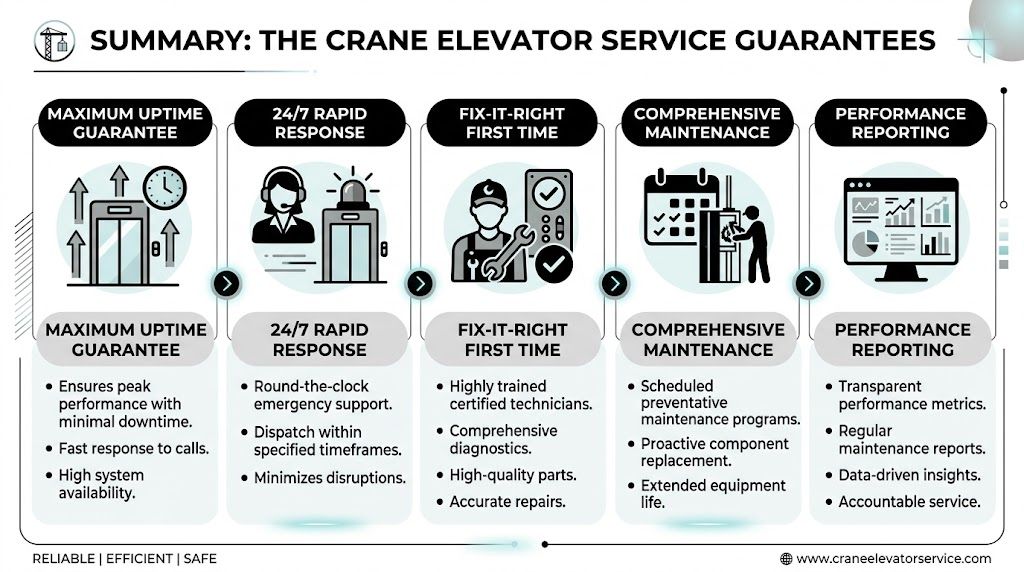
Real 24-hour coverage means more than an answering service taking a message. It means live after-hours call handling, callback confirmation, a defined escalation path for entrapments, and access to technicians who can respond in Southern Michigan without waiting for the next business day.
That operating discipline matters because small off-hours problems turn into bigger outages when nobody owns the call. Boston’s elevator maintenance specification warns that unmonitored after-hours issues can escalate into major outages, as outlined in Boston’s elevator maintenance specification.
A serious emergency contract should state who answers, how fast a manager can expect a callback, how entrapment calls are prioritized, and whether the company has enough field coverage to support that promise.
The guarantees that matter to a property manager
Property managers should look for guarantees that change how the contractor has to operate, not just how the brochure reads.
- 24/7/365 response readiness: The key question is technician availability. If the provider cannot staff nights, weekends, and holidays, the 24-hour claim has limited value.
- Callback confirmation: Management needs a clear response process, especially when residents, tenants, or security staff are asking for updates.
- No Show, No Pay: If scheduled maintenance is missed, the owner should not be billed for work that did not happen.
- Free second opinion: This gives owners a way to test a large repair recommendation before approving a major expense.
- Price-beat policy: Cost matters, but it only helps if the lower price still includes real emergency support and qualified labor.
Crane Elevator Company states those protections directly, including 24/7/365 response, free second opinions, a price-beat guarantee, and a No Show, No Pay maintenance policy.
Why these guarantees change outcomes
These terms affect safety, cost, and liability.
A contractor that promises callback confirmation must keep dispatch organized after hours. A contractor that offers a second opinion must explain the diagnosis clearly enough for an owner to compare options. A contractor that ties payment to showing up has to protect its scheduling discipline.
Good guarantees also help owners separate true round-the-clock service from marketing language. In practice, that means asking hard questions before signing: Who takes the call at midnight, who is on rotation for Southern Michigan, what is the entrapment process, and what happens if no technician arrives when promised?
Good guarantees do not replace technical skill. They show whether the contractor is willing to be measured on response time, communication, and accountability when an elevator is down.
Serving All of Lower Michigan Case Examples
The hardest part of emergency elevator service isn’t writing a promise. It’s applying the same discipline across different building types, different equipment, and different cities.

Detroit office building
A downtown office property had a passenger elevator with recurring door-closing faults during the busiest part of the workday. The immediate complaint sounded simple. However, the deeper issue was that the car had become unreliable enough that tenants stopped trusting it.
The repair approach focused on the complete door cycle, not just the symptom. The takeaway for the owner was straightforward: repeated nuisance faults usually point to a system that needs full troubleshooting, not one more reset.
Ann Arbor residential property
A residential building dealt with an after-hours shutdown that left occupants anxious and management under pressure to provide updates. In that setting, communication matters almost as much as the wrench work. Residents want a calm answer, not technical theater.
A good emergency response in a residential property keeps the board, manager, and occupants aligned on status, safety, and expected next steps.
Lansing industrial site
At an industrial facility, a freight elevator outage doesn’t just inconvenience people. It interrupts workflow and can jam receiving or production movement. Those calls require a mechanic who understands heavy-use conditions and can separate a temporary repair from a sign that the unit needs a broader plan.
That’s one reason the wider industry downtime problem matters so much. Despite €34 billion in annual global elevator maintenance spending, the average lift still breaks down at least four times per year, contributing to 272 million hours of downtime annually, according to TwinFM’s report on elevator downtime. Property owners in Lower Michigan feel the local version of that problem every time a car goes offline during a busy day.
Frequently Asked Questions About Elevator Repair
Your Top Questions About 24-Hour Elevator Repair Answered
A true 24-hour repair program gets tested at 2:00 a.m., not at 2:00 p.m. The question is not whether a contractor advertises after-hours service. The question is whether a qualified mechanic is available, dispatched, and prepared to make a safe assessment without turning your staff into the answering service.
What affects the cost of a 24-hour repair call
Cost usually comes down to four things. The failure itself, the parts required, site access, and whether the elevator can be returned to service safely on that visit or needs a shutdown until follow-up work is completed.
An entrapment call, a door operator problem, a controller fault, a power issue, and a hydraulic leak do not get handled the same way. Some problems can be stabilized that night. Others should not be patched just to get the car running by morning, because that decision can create more exposure for the owner later.
Ask for three clear answers after the call: what failed, what was done, and what still needs to be scheduled.
Can a contractor work on elevators from major manufacturers
Often, yes, but the answer depends on how proprietary the equipment is and whether the contractor has the right access, tools, and parts channels. That is where "24-hour" claims separate quickly. A company may answer the phone all night and still be limited in what it can do on certain systems.
Property managers should ask that question before signing a service agreement. If your building has equipment that only one vendor can fully support, response expectations, parts availability, and pricing need to be understood in advance.
What should I do while waiting for the mechanic
Protect the area first.
Keep passengers calm if someone is inside the car, and keep communication steady until trained help arrives. Do not force doors, try to move the car, or let maintenance staff improvise a rescue. That creates safety risk and liability fast.
After that, have the basic information ready. Which elevator is down, whether anyone is trapped, when the problem started, what the car was doing before it stopped, and how the mechanic gets into the building after hours. Good information shortens diagnosis time.
How should I evaluate a 24-hour elevator repair contract
Read the after-hours terms more carefully than the daytime rates. That is where weak contracts usually show themselves.
Look for live phone coverage, not an answering machine. Confirm whether entrapments are prioritized, whether callback time is defined, and whether the agreement states an arrival window or only promises a response. Those are different commitments. Also ask who is on call in Southern Michigan, whether they are elevator mechanics or general field staff, and what happens if the first technician cannot restore service.
A good contract also requires a clear service record after the call. You should know what was found, what was done, and whether the unit is safe to run, limited to restricted use, or shut down pending repair.
If you need a direct review of your current emergency coverage, Crane Elevator Company can assess whether your service setup matches the response and liability demands of your building.