
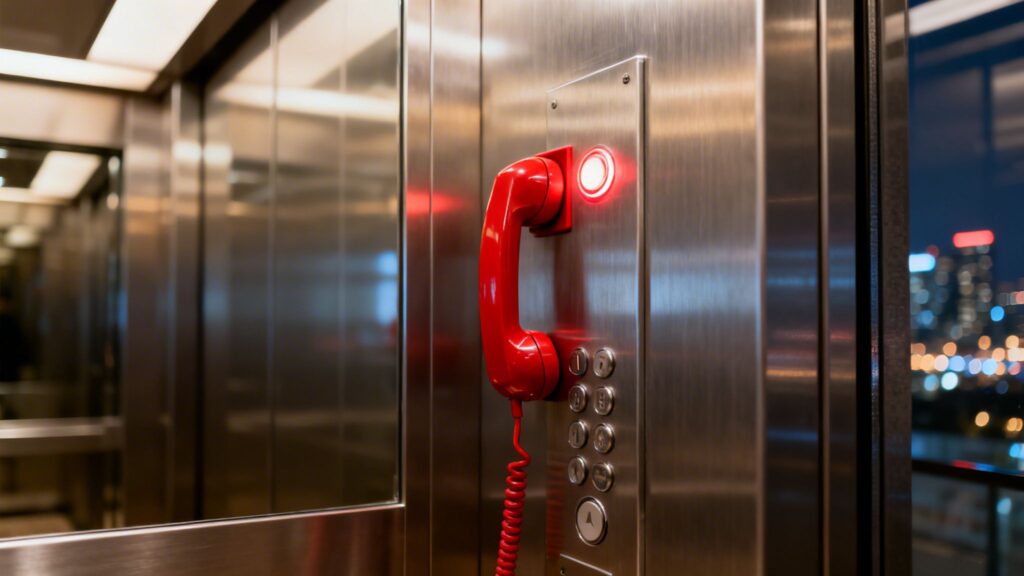
When you’re stuck in an elevator, that little Emergency phone button is everything. It’s not just a speaker—it’s a direct connection to help, the one thing that can turn a moment of panic into a professionally managed situation. For building owners, that device is your single most important tool for protecting occupants and minimizing liability.
For Service or Questions Call
734-726-4247
Or
Fill Out Contact Form Below
(Serving Lower Michigan)
Why Your Elevator Emergency Phone Is a Critical Lifeline

Think of your elevator’s emergency phone as the ultimate safety net. For owners of commercial high-rises in Grand Blanc or residential complexes in Hartland, this isn’t an optional accessory; it’s a non-negotiable part of managing your property correctly. It gives passengers peace of mind, assuring them that help is just one button press away.
That assurance isn’t just a feeling—it’s a legal and ethical requirement. If an entrapment happens, a working, professionally monitored phone is the key to getting it resolved safely and quickly. Without one, you’re exposing passengers to serious risk and your business to massive liability.
The Growing Importance of Reliable Systems
Demand for these systems is surging. The global Elevator Emergency Phone market, valued at $0.56 billion in 2025, is projected to more than double to $1.14 billion by 2033. This jump is driven by more buildings going up and safety regulations getting tougher, proving just how essential these phones have become. Find out more about the market growth trends.
This guide is for building owners and facility managers in communities like White Lake and across Michigan. We’ll walk through exactly what you need to know about these critical systems.
A reliable emergency phone does more than just meet code; it shows a real commitment to passenger safety that protects both your people and your property. It’s the first line of defense in any vertical transportation incident.
Key areas we will cover include:
- Navigating Complex Regulations: We’ll break down the codes you absolutely must follow.
- Choosing the Right Technology: Landline, cellular, or VoIP? We’ll compare the pros and cons of your options.
- Implementing Best Practices: Learn the real-world secrets to life-saving maintenance and testing schedules.
By getting a handle on these elements, you can ensure your elevator emergency phones are always ready to perform, keeping your building safe, compliant, and prepared for anything.
Navigating Michigan’s Elevator Phone Codes and Inspections
Michigan’s elevator regulations can feel complex, but for building owners, the rules for emergency phones are straightforward once you know what to look for. The primary standard is the ASME A17.1 Safety Code for Elevators and Escalators. Michigan adopted this national code, making it the law for your property.
This means your elevator emergency phone isn’t just a box on the wall—it must provide reliable, two-way communication to a live person who can dispatch help 24/7. The days of a phone ringing to an empty front desk after hours are long over. It must connect to a professional monitoring service that can respond instantly.
The Role of Local Inspectors
In Michigan towns like Hartland and White Lake, it’s your local inspector—known as the Authority Having Jurisdiction (AHJ)—who enforces these codes. During routine safety checks, they will physically test your elevator phone to make sure it works as required.
They’ll verify the call connects instantly, the audio is crystal clear, and the monitoring station can pinpoint your elevator’s exact location without any guesswork. Passing this test is critical for avoiding costly fines and, more importantly, ensuring a passenger can get help when they need it most.
Safety codes have transformed elevator phones from simple landlines into critical communication hubs. The market is projected to grow from $2.24 billion in 2025 to $3.9 billion by 2034, driven by stricter codes that have slashed elevator-related fatalities by 40% in the last decade. In some major US cities, a single compliance violation can cost owners over $10,000.
ASME A17.1 Emergency Phone Compliance Checklist
Staying compliant means getting the details right. For building owners in communities from Grand Blanc to Detroit, keeping detailed records is just as important as the phone hardware itself. You can find a deeper dive into these requirements in our guide on elevator emergency phone code requirements.
Here’s a quick checklist summarizing the key ASME A17.1 requirements your inspector will be looking for.
| Requirement | ASME A17.1 Specification | Why It Matters |
|---|---|---|
| Two-Way Communication | Must enable clear, hands-free conversation between a passenger and emergency personnel. | Ensures the trapped individual can speak directly with an operator to explain the situation and receive assurance. |
| 24/7 Live Monitoring | The phone must connect to a service that is staffed around the clock. Answering machines or after-hours voicemails are non-compliant. | Entrapments can happen anytime. A live operator guarantees an immediate response, day or night. |
| Location Identification | The monitoring station must be able to instantly and automatically identify the building's physical address and the specific elevator car number. | First responders can't waste time trying to figure out which elevator the call is coming from. This ensures help is sent to the right place. |
| ADA Accessibility | Must include a visual signal to confirm a call has been initiated and answered, helping users with hearing impairments. | The Americans with Disabilities Act (ADA) mandates that emergency systems are usable by everyone. |
| Backup Power | The phone and its communication line (cellular, VoIP, or landline) must remain operational during a power failure for at least 4 hours. | Power outages are a common cause of elevator stoppages. The phone must work when it's needed most. |
Ultimately, these aren’t just bureaucratic checkboxes. They represent a layered safety system designed to turn a frightening entrapment into a managed, professional response. Make sure your system meets every one of these points.
Choosing Your Elevator Phone Technology: Landline, Cellular, or VoIP
Picking the right phone technology for your elevator isn’t just an IT decision—it’s a critical choice that impacts safety, your budget, and future compliance. For building owners in Michigan, this is especially true now that old-school copper landlines (POTS) are on their way out.
You really have three main options: traditional landlines, modern cellular systems, and network-based VoIP. Each has real-world trade-offs you need to understand before you commit.
The Landline Dilemma: The Old Standard Fades Away
For decades, a Plain Old Telephone Service (POTS) line was the gold standard. These lines were incredibly dependable, mostly because they get power straight from the phone company, so they’d even work during a blackout.
But that era is over. Telecom companies are pulling the plug on their copper networks, which means POTS lines are getting more expensive and harder to find. If you’re managing a property in Grand Blanc and still have a POTS line for your elevator, you’re paying a premium for a service that will eventually disappear, forcing an upgrade anyway.
Cellular Communicators: The Flexible and Modern Choice
Cellular has quickly become the go-to replacement for aging landlines. These systems use a dedicated communicator to link the elevator phone to a mobile network, bypassing your building’s phone wiring entirely.
The advantages are pretty clear:
- Cost Savings: You get to cancel that expensive analog phone line, often saving hundreds of dollars a year per elevator.
- Easy Installation: Cellular units are designed to be retrofitted into existing elevators with minimal hassle.
- Independence: They don’t rely on your building’s internet, which means one less point of failure.
The biggest thing to check for, especially in areas like Hartland or White Lake, is signal strength. A professional installer absolutely must verify a strong, consistent signal inside the elevator shaft and machine room. No signal, no call.
As technology shifts, the entire emergency communication market is changing. Innovations like video links and AI monitoring are on the rise, with the market forecasted to hit $28.08 billion. Integration with the Internet of Things (IoT) is enabling predictive maintenance that can cut failures by 35%. This is critical, especially since an estimated 40% of entrapments happen during blackouts, highlighting the need for dependable backup power. Read the full research about these market innovations.
VoIP Systems: The Network-Integrated Option
Voice over Internet Protocol (VoIP) simply uses your building’s internet to make emergency calls. If your property already has a robust, modern network, this can be an efficient way to consolidate services.
The major hurdle with VoIP is reliability—both for your network and its power source. Since it depends on your local internet, everything from the modem and router to the phone itself needs a battery backup that meets ASME A17.1 code.
That means providing at least four hours of standby power. If your internet goes down or any piece of network hardware loses power, the emergency phone is useless. This is exactly when entrapments are most likely to happen, so redundancy is non-negotiable. And this is where a Line Loss communication monitoring system comes into play to become compliant
Elevator Phone Technology Comparison
Choosing between these three isn’t always straightforward. This table breaks down the key factors to help you compare them side-by-side. Think about your building’s existing infrastructure, your budget, and how much risk you’re willing to accept.
| Feature | POTS (Landline) | Cellular | VoIP |
|---|---|---|---|
| Reliability | Very high; self-powered. | High, if signal is strong. | Moderate; depends on network and power backup. |
| Monthly Cost | High and increasing. | Low to moderate; fixed cost. | Low; often bundled with existing internet. |
| Installation | Simple if wiring exists. | Simple retrofit. | Complex; requires network integration and backup power. |
| Power Backup | Not required (line-powered). | Required; usually built-in. | Required; must power all network gear for 4+ hours. |
| Future-Proof? | No; being phased out. | Yes; based on modern networks. | Yes, but depends on network quality. |
| Best For | Legacy systems (for now). | Most buildings; upgrades and new installs. | Buildings with robust, fully backed-up networks. |
Ultimately, while POTS was once the undisputed king, its time is up. For most building owners, a cellular solution offers the best balance of reliability, cost, and ease of installation. VoIP is a viable option, but only if you have the Line Loss Communication Monitoring safety measures in place to be compliant.
What Happens When Someone Pushes the Emergency Button
When a passenger hits that emergency button, it’s not just a buzzer that goes off at the front desk. It triggers a direct, immediate connection to a dedicated 24/7 monitoring station.
Think of it like a specialized 911 call for your elevator. A signal is instantly sent over the phone line—whether it’s cellular, VoIP, or an old-school landline—to a live operator. Within seconds, a hands-free, two-way audio link opens between the car and the monitoring center.
How the Emergency Call Works
The operator’s first job is to get critical information and reassure the passenger. A professionally monitored system does most of the work, automatically sending the elevator’s exact location—building address and specific car number—to the operator’s screen.
This automatic location identification is a requirement under ASME code and is a critical safety feature for properties in Michigan, from Grand Blanc to White Lake.
The operator will then:
- Verbally confirm the location with anyone in the car.
- Assess the situation, asking how many people are trapped and if there are any medical issues.
- Keep passengers calm by confirming that help has been dispatched and staying on the line.
The different technologies that make this connection possible are shown below.

While older landlines are being phased out, modern cellular and VoIP systems provide a more reliable and future-proof link. The key is that whatever technology you use, the connection to the monitoring center must be rock-solid.
How Help Is Dispatched
Once the operator understands the situation, they dispatch the right response based on the building’s pre-set protocol.
Using a professional, UL-listed monitoring center instead of a standard answering service is the key difference between a chaotic incident and a smooth, efficient rescue. These centers employ operators trained in emergency dispatch, ensuring a calm, competent response every time.
Depending on what’s happening, the operator will contact one of three parties:
- On-Site Personnel: If the building has facility staff or security, they might be the first call for a simple, non-mechanical issue.
- Elevator Service Technician: For any mechanical failure, a qualified technician must be sent to fix the problem and safely release passengers. You can learn more about our emergency elevator service for these situations.
- Emergency First Responders: If there’s a medical emergency, fire, or other immediate danger, the operator bypasses everyone and contacts the local fire department or paramedics in Hartland or the correct jurisdiction.
This coordinated process ensures trapped passengers are never left guessing. A clear, well-rehearsed response protocol is the most important part of your elevator’s safety system.
Best Practices for Installation, Maintenance, and Testing

A reliable elevator phone isn’t just about the hardware in the box. Its dependability comes down to two things: a proper installation and a consistent maintenance schedule. For any building owner in Michigan, from Grand Blanc to Hartland, getting this right is non-negotiable for both passenger safety and code compliance.
It all begins with a professional installation. A qualified technician will do more than just mount the phone; they’ll secure all wiring away from the elevator’s moving parts. This simple step prevents the most common (and avoidable) cause of phone failure: pinched or severed wires.
Professional Installation Fundamentals
A rock-solid installation is the foundation for a system that lasts. It’s not a simple plug-and-play job. The entire communication path has to be checked and double-checked.
A proper installation covers:
- Strategic Unit Placement: The phone must meet ADA guidelines, ensuring it’s within reach for all passengers, including those in wheelchairs.
- Secure and Protected Wiring: Cables have to be routed cleanly inside the traveling cable, keeping them clear of potential snag points or interference.
- Signal Verification: For cellular or VoIP phones, the installer must verify a strong, stable signal from the machine room, hoistway, and cab. This is especially critical in areas like White Lake, where service can be spotty.
Proper installation isn’t about making the phone work on day one. It’s about ensuring it can handle the constant vibration and daily grind of an elevator for years without failing.
Ongoing Maintenance and Testing Schedules
Once the phone is in, it needs regular attention. Dust, moisture, and debris in the machine room, on the car top, or in the elevator pit can easily fry sensitive electronics. A good maintenance plan always includes keeping these areas clean.
Regular testing isn’t optional—it’s mandatory. A systematic schedule catches problems long before they turn into critical failures during an actual entrapment. You can learn more about the specifics of these procedures by exploring comprehensive guides on professional elevator testing.
A compliant testing protocol must include:
- Daily Automated Checks: Many modern systems run self-tests for power and dial tone, automatically logging their status every 24 hours.
- Monthly Manual Tests: ASME code requires placing a manual call to the monitoring center every month. This verifies a clear, two-way conversation is possible.
- Annual Full System Inspections: A certified technician must perform a full inspection once a year, checking backup batteries, all physical wiring, and verifying the location ID data is still accurate.
Following these practices helps you hold your service provider accountable and guarantees your elevator’s most important safety device is ready when it counts.
Common Questions About Elevator Emergency Phones
Even with a detailed guide, we find building owners run into the same handful of questions. Here are the most common ones we hear from property managers across Michigan.
How Often Do Elevator Phones Need to Be Tested in Michigan?
Michigan follows ASME A17.1 code. This means you must manually test the phone at least once per month. The test is to confirm it connects clearly to the 24/7 monitoring station.
A certified technician must also perform a full two-way communication test annually. This is part of your yearly elevator inspection.
Keeping a detailed log of all these tests is a critical part of your compliance. It should be a standard practice with your elevator maintenance provider.
What Should I Do if My Landline Is Being Disconnected?
Old copper landlines are being actively phased out by telecom providers. You must upgrade your elevator phone to a modern solution like cellular or VoIP.
For most buildings in Grand Blanc or Hartland, a cellular communicator is the most direct and cost-effective retrofit.
A cellular unit runs independently of your building’s network, which makes it a reliable and code-compliant solution. An expert can survey your property and recommend the best path forward.
Key Point: The phase-out of traditional landlines is happening now. A proactive upgrade ensures you stay compliant and your passengers are safe—it also helps you avoid a last-minute scramble when your provider finally cuts the line.
Can My Own Staff Monitor Elevator Calls?
While technically possible, this is strongly discouraged and often non-compliant.
ASME code is clear: calls must be answered by authorized personnel who can take immediate, appropriate action 24/7/365.
Unless your front desk or security office in a place like White Lake is staffed around the clock by trained emergency dispatchers, you take on massive liability. Using a professional, UL-listed monitoring center is the industry standard for ensuring passenger safety and protecting your property.
Ensure your building is safe, compliant, and ready for any situation. The team at Crane Elevator Company offers expert installation, testing, and monitoring for elevator emergency phones across Michigan. Contact us for a free, no-obligation quote.