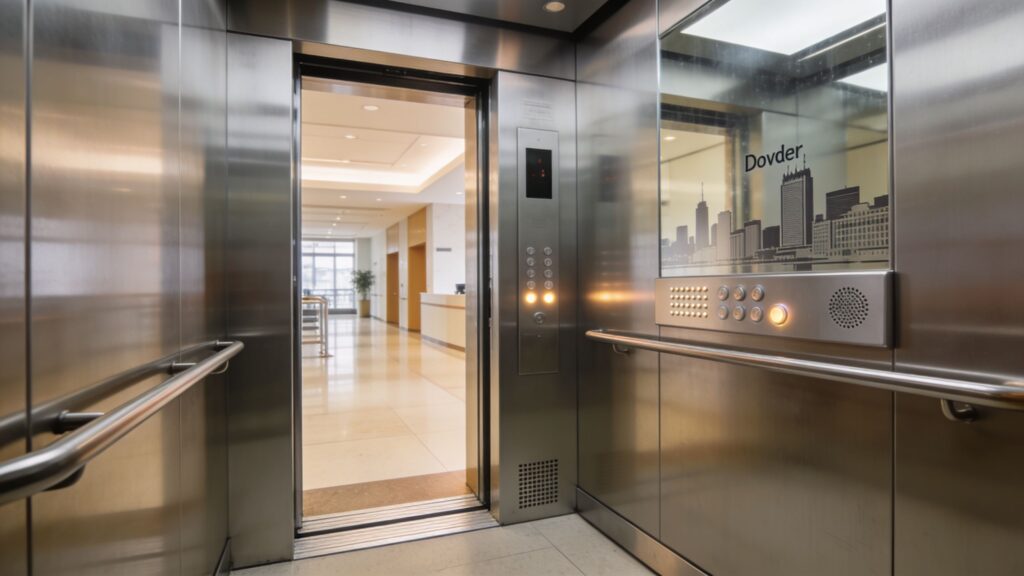
If you’re managing a building in Southern Michigan with a Dover elevator, you probably know the pattern. The car still runs. Tenants still use it every day. But service calls are getting closer together, leveling is starting to drift, and every inspection feels like it could turn into a larger project.
Get Your Dover Elevator Running Today!
734-726-4247
Or
Fill Out a Form Below
That’s common with older Dover equipment because these units were built well enough to stay in service for decades. Dover’s elevator division expanded quickly after its 1955 founding, including the 1958 acquisition of Shepard-Warner Elevator Company, manufactured hydraulic elevators until 1999, and produced the respected DMC microprocessor controller from 1985 to 2001, which helps explain why so many Dover installations are still operating today, according to Dover Corporation history.
Durability is the good news. The hard part is that an older Dover elevator now has to meet modern expectations for accessibility, safety, ride quality, and documentation. A car that was acceptable years ago may still run, but that doesn’t mean it presents well during an inspection or serves every passenger the way it should.
Your Dover Elevator and Today’s Demands
A lot of Michigan facilities are in the same position. The elevator isn’t dead, so replacement feels premature. But the equipment also isn’t behaving like a modern system. Doors hesitate. Landings aren’t always clean. The controller is old enough that every failure raises the same question. Repair it again, or finally modernize it?
That decision gets harder with Dover because the name covers several generations of equipment. Some buildings still have hydraulic Dover units tied to older control logic. Others have geared traction systems that are mechanically solid but electronically dated. In both cases, the core issue is usually the same. The machine can still do the job, but it does it with aging controls, dated fixtures, and fewer practical parts options than a facility manager wants.
Why so many Dover units are still around
Dover wasn’t a niche brand. It built scale through acquisitions and became a major elevator manufacturer over time. That history matters because it explains why Dover elevator equipment is still common in schools, offices, municipal buildings, apartments, and medical properties across the Midwest.
Older Dover systems also earned a reputation for being serviceable. Mechanics who know the product can often keep them running long after other equipment would have been written off.
Older Dover elevators usually don’t fail all at once. They wear into higher risk. That’s why owners often wait too long.
What has changed
The building hasn’t changed much. The expectations have.
A facility manager today has to think about more than whether the car moves. The checklist includes:
- Accessible operation that works for passengers with mobility, vision, and hearing needs
- Reliable landing accuracy so users aren’t stepping over mislevel conditions
- Door protection and reopening performance that won’t create repeated calls or inspection issues
- Emergency communication and signaling that fit current expectations
- Serviceability over the next decade, not just the next breakdown
If your Dover elevator is already drawing complaints, the practical question isn’t whether it’s old. It’s whether the current condition is manageable through maintenance, or whether the controls and fixtures have become the primary problem.
Understanding ADA Elevator Requirements
ADA conversations get muddled because people mix federal accessibility standards, state code, inspection practice, and manufacturer sales language into one big bucket. For a facility manager, the useful approach is simpler. Look at what a passenger experiences and what an inspector can verify.
What inspectors and consultants usually focus on
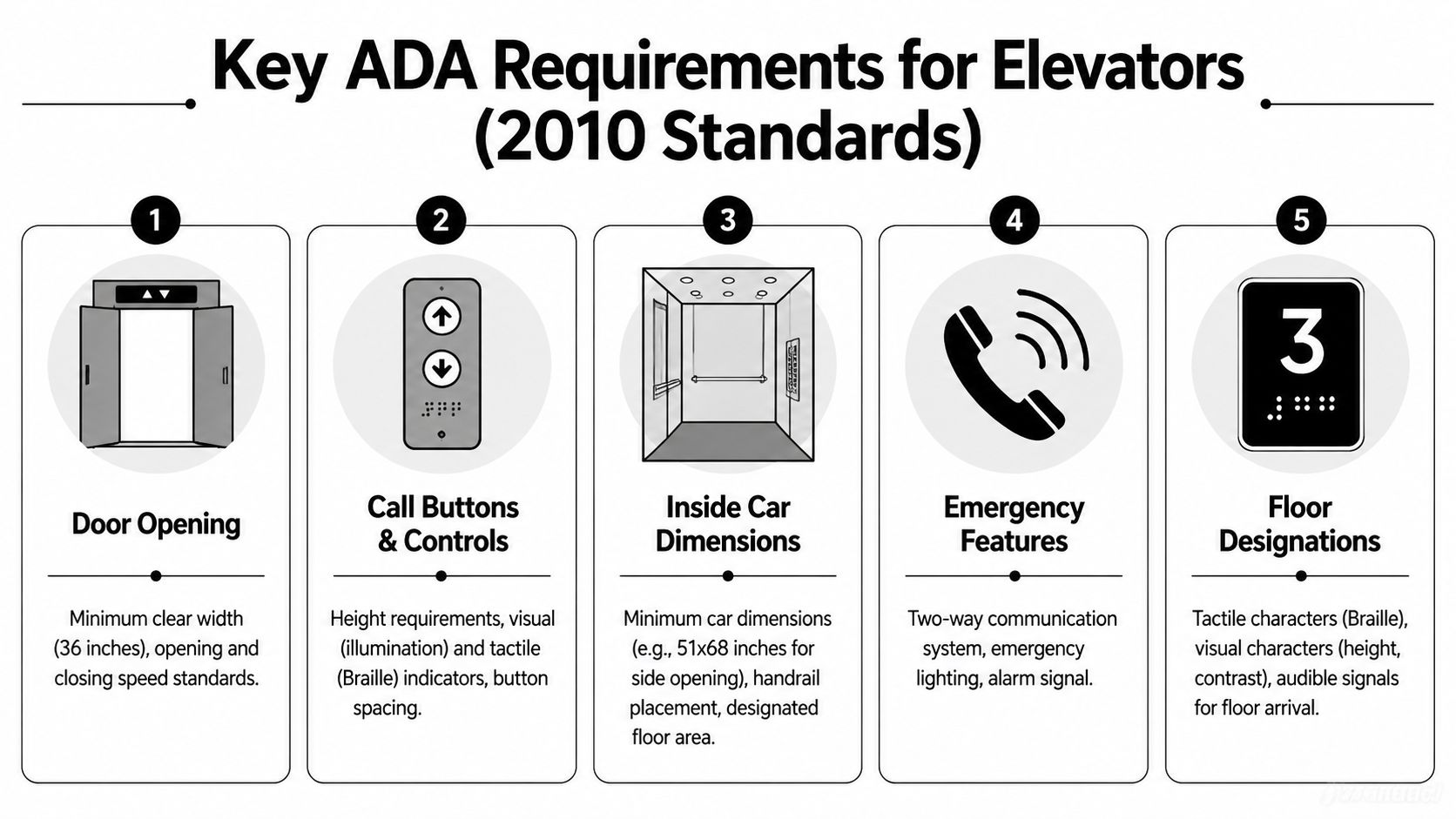
The elevator has to be usable, not just operational. That usually means checking the door opening, the car interior, hall and car controls, floor identification, and emergency features.
The best starting point is an accessibility review tied to the ADA elevator compliance guidance used in field evaluations. That gives building owners a practical baseline before they spend money in the wrong place.
The five areas that matter most
Door opening and timing
The clear opening has to work for wheelchair users and other passengers who need time and space to enter. Older Dover cars often still have functional operators, but the timing, reopening response, and protection devices may be outdated.Hall stations and car operating panels
Button height, spacing, tactile markings, and legibility matter. This is one of the most common modernization items because older fixtures often have worn legends, poor contrast, or layouts that don’t support accessible use well.Car size and interior usability
Some problems can be corrected with fixtures and layout changes. Others are physical limits of the hoistway and cab. That distinction matters because not every noncompliant condition can be solved with a controller swap alone.Emergency communication and signaling
An emergency phone that technically works isn’t always enough. The user interface, instructions, visual feedback, and integration with monitoring all need attention in older cars.Floor designations and arrival communication
Tactile characters, Braille, visual indicators, and audible floor announcements are part of the accessible passenger experience. Older Dover installations often need fixture upgrades here, even if the machine itself remains usable.
A practical reference table
| Requirement | Specification | Common Issue in Older Elevators |
|---|---|---|
| Door Opening | Minimum clear width 36 inches, plus opening and closing speed standards | Older operators may open inconsistently or lack updated reopening protection |
| Call Buttons & Controls | Height requirements, illuminated indicators, tactile and Braille markings, proper spacing | Worn buttons, poor placement, missing tactile features |
| Inside Car Dimensions | Minimum car dimensions such as 51 x 68 inches for side opening, plus usable floor area and handrail placement | Cab size may be constrained by the original hoistway |
| Emergency Features | Two-way communication, emergency lighting, alarm signal | Legacy phones and signaling often don't meet current expectations |
| Floor Designations | Tactile characters, Braille, visual contrast, audible arrival signals | Older fixtures may have weak visibility or no audible announcement |
Why control quality matters for accessibility
ADA isn't only about dimensions and signage. It's also about how the car behaves. A passenger notices rough stops, drift, delayed door response, and poor leveling long before anyone talks about a modernization budget.
That is why modern control systems matter. Dover’s Interactive 3 machine-room-less elevators use 32-bit CPUs and high-speed DSPs for all-digital control, achieving positioning accuracy within ±5mm and jerk rates under 1.5 m/s³ while complying with EN81-1, as shown in the Interactive 3 technical document. You don't need that exact product to understand the lesson. Modern controls are expected to deliver precise, repeatable performance that supports accessible entry and exit.
Practical rule: If the elevator regularly misses the floor, opens late, or closes aggressively, start with control and door performance. Cosmetic ADA upgrades won't fix operational accessibility problems.
What works and what doesn't
What works is a measured review of the full passenger interface. Controls, signaling, leveling, door protection, and communication have to be considered together.
What doesn't work is replacing only the obvious fixture. A new COP with Braille looks good, but it won't solve poor landing accuracy or unreliable door reopening. On an older Dover elevator, accessibility usually improves fastest when the owner treats control logic and user fixtures as one system.
Expert Service for Legacy Dover Elevators
Many older Dover elevators can still be maintained effectively, but only if the mechanic understands how Dover built the equipment and where these systems usually start to drift out of spec. This isn't generic maintenance work. Legacy Dover units have patterns.
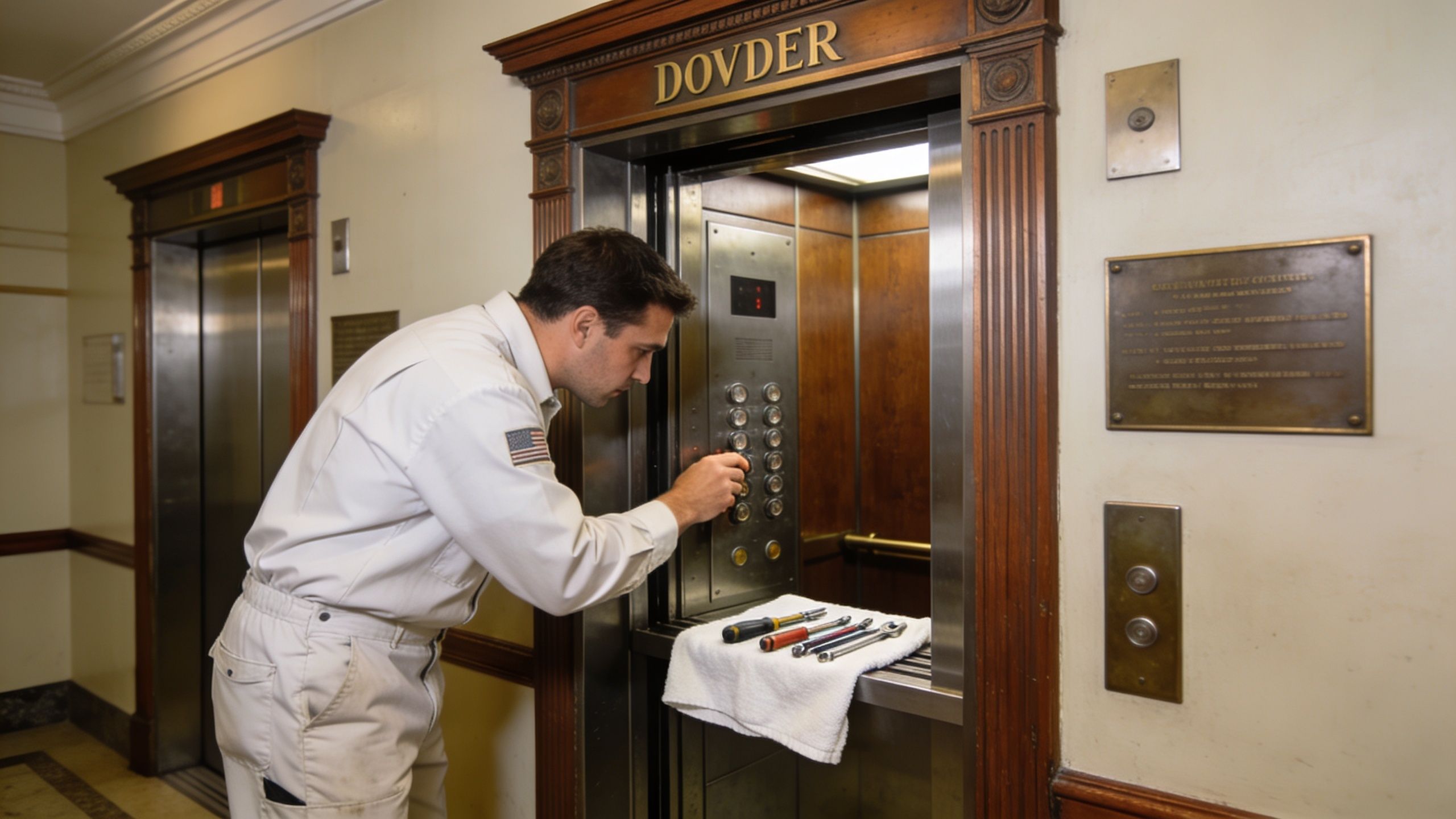
Common trouble spots on older Dover systems
The first category is hydraulic performance. Packing wear, valve behavior, contaminated oil, door coordination, and controller aging can all show up as rough operation or repeated callbacks.
The second category is control logic. Many aging Dover Impulse hydraulic elevators show a familiar pattern where up-runs are smooth but down-runs have inconsistent deceleration, a problem noted in public discussion of aging Dover Impulse units. That usually tells an experienced mechanic to stop guessing and start diagnosing the control response, stopping behavior, and associated hydraulic performance as a group.
Why generic repair often misses the real issue
A lot of frustrating service history comes from treating the symptom and not the machine. One visit replaces a relay. The next visit adjusts a valve. Then someone changes a door component. The elevator improves for a while, but the pattern comes back because the underlying control package is still old and unstable.
That's why owners of Dover equipment should pay attention to whether the contractor is comfortable working on both the legacy machine and the modernization path. If you only get repair-only thinking, you can spend years patching around a controller that should've been retired.
For building teams reviewing options, it's useful to compare older systems against non-proprietary controller approaches used in modernization work. That gives you a benchmark for what a serviceable future state looks like.
What disciplined service looks like
A strong maintenance program on a Dover elevator usually includes:
- Machine room, pit, and car top cleaning because dirt and oil contamination hide developing problems
- Door lock and door operator review since many nuisance shutdowns start at the entrance, not the machine
- Hydraulic system inspection including packing condition, leaks, and leveling behavior
- Controller diagnosis that looks at stop accuracy and repeatability, not just whether the car completed the call
- Fixture review for failing buttons, indicators, phones, and fire service interfaces
A Dover elevator can stay useful for years after it becomes inconvenient. Convenience issues are often the warning signs of compliance and reliability issues that arrive next.
The key trade-off is simple. Maintenance is still the right choice when the machine is structurally sound, the controller remains stable, and parts support is manageable. Once the elevator becomes callback-driven because the controls are dated, service alone stops being cost-effective.
Modernizing Your Dover with Pixel Controllers
There comes a point where the smartest repair is not another repair. On a Dover elevator, that point usually arrives when the mechanical equipment still has life left in it, but the controller, fixtures, and operational behavior no longer match the building's needs.
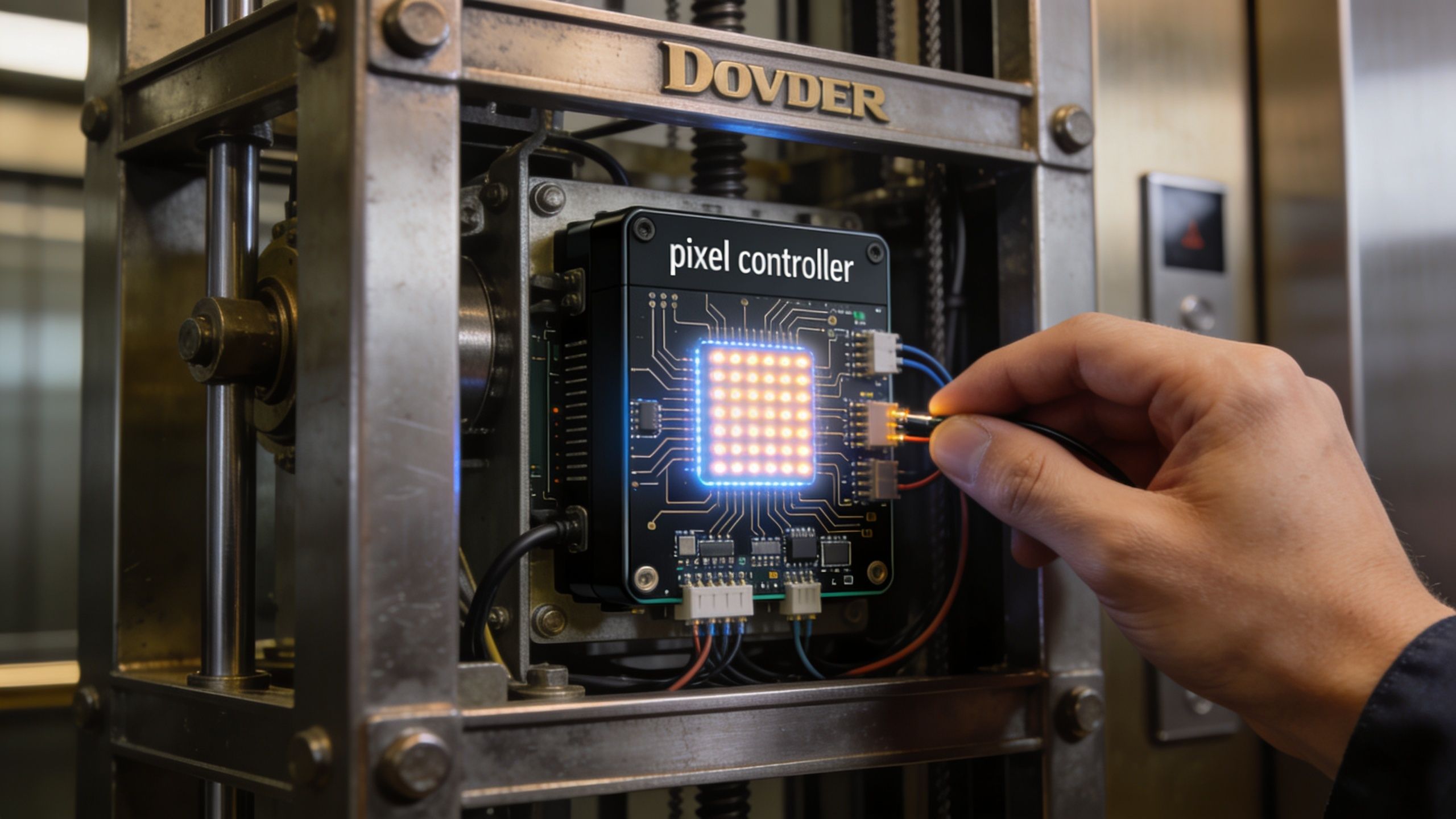
A practical modernization path is to keep what still makes sense mechanically and replace what is now holding the system back. For many legacy Dover jobs, the center of that strategy is replacing the old Dover controller with a non-proprietary Elevator Controls Pixel Controller.
Why the controller is usually the turning point
The controller decides how the car starts, slows, levels, responds to hall calls, handles doors, and interfaces with modern code-related features. When that brain is dated, the whole elevator feels dated.
This is especially relevant on Dover traction equipment. Legacy Dover SPF series geared traction elevators used Traflomatic IV controllers to manage speeds up to 500 FPM over 300 feet of travel, and modernizing those systems with new non-proprietary digital controllers can produce 20 to 25 percent lower lifetime costs while integrating with modern fire service and door lock monitoring, according to the Dover SPF technical reference.
That matters because many SPF machines are still mechanically respectable. The machine may not be the liability. The obsolete controller often is.
What a Pixel-based modernization solves
A Pixel Controller upgrade is attractive because it addresses the issues owners feel every day:
- Leveling problems that create bad landings and passenger complaints
- Intermittent control faults that are hard to reproduce and expensive to chase
- Fixture limitations when adding accessible buttons, indicators, and updated communication
- Vendor lock-in that leaves the building dependent on narrow parts channels
- Integration problems with fire service, door monitoring, and other modern interfaces
A non-proprietary package changes the service picture after installation. The building isn't trapped by an aging legacy controller or a closed ecosystem. Any qualified elevator contractor familiar with the platform can work on it.
What should stay and what should go
Not every Dover modernization needs the same scope. The right approach depends on the condition of the machine, jack, power unit, door equipment, and fixtures.
A good decision framework looks like this:
| Keep | Replace | Review closely |
|---|---|---|
| Sound machine and mechanical structure | Aging proprietary controller | Door operator condition |
| Hoistway components that remain code-acceptable | COPs and hall stations when accessibility is lacking | Hydraulic packing and valve performance |
| Cab finishes if still presentable | Emergency phone and signaling if outdated | Fire service interfaces |
| Select wiring and traveling cable when confirmed suitable | Indicators and floor marking components | Landing accuracy under load |
What modernization looks like in practice
The best Dover modernizations don't start by tearing out everything. They start with a survey of actual failure points. If the machine is healthy and the hoistway equipment is stable, replacing the controller and related fixtures often delivers the biggest operational improvement first.
Here's a useful video overview to pair with that idea:
For owners comparing packages, it also helps to review what a modern elevator control panel modernization strategy should include. The point isn't just new electronics. The point is a controller that can be serviced, documented, and integrated cleanly for the long term.
Field judgment: If the machine is dependable but the controller is causing callbacks, modernize around the machine. If the machine itself is worn out, widen the project scope.
What doesn't work
The least effective path is partial patching with no long-term plan. A few reused fixtures, one salvaged board, and repeated custom adjustments can keep a Dover elevator moving, but that doesn't create a stable asset.
What works is a non-proprietary modernization that restores reliable control, improves ADA-related usability, and leaves the building with service options instead of service dependency.
Achieving and Verifying Compliance in Michigan
Compliance work goes smoother when the owner treats it like a documented project, not a reaction to a failed inspection. That matters with older Dover elevators because accessibility and safety issues often overlap. A leveling problem can become both a reliability issue and an inspection problem. An outdated fixture can become both a usability issue and a documentation issue.
A practical sequence for Michigan buildings
Most successful projects follow a steady order.
-
Start with a condition assessment
Identify the operational issues, accessibility gaps, and code-related deficiencies before you decide on scope. -
Separate maintenance items from modernization items
Some problems can be corrected through repair and adjustment. Others require new controls, new fixtures, or broader alterations. -
Define the compliance package in writing
Owners need a clear list of what is being corrected, what is being retained, and what remains outside the project scope. -
Pull the required permits for alteration work
If the project includes controller replacement, fixture replacement, or other major changes, document it correctly from the start. -
Prepare for acceptance testing and inspection
Don't wait until the inspector arrives to discover that door monitoring, emergency communication, or signaling wasn't finished correctly.
What inspectors usually want to see
Inspectors don't care that a Dover elevator has a long history. They care whether the current system operates safely and predictably.
They typically look for clear evidence that the elevator:
- Levels accurately and consistently
- Operates doors safely
- Handles fire service and required monitoring correctly
- Provides the required passenger information and emergency communication
- Has supporting records for maintenance, tests, and alterations
Documentation matters more than many owners expect
A clean modernization can still create headaches if the paperwork is weak. Keep the alteration records, test results, service logs, and equipment information organized in one place.
That is especially important when a building moves from a legacy Dover controller to a non-proprietary platform. The owner should be able to hand a future contractor accurate documents without relying on memory or old handwritten notes inside the controller cabinet.
If your compliance plan exists only in emails and verbal instructions, it isn't a plan yet.
Ongoing verification after the project
Once the elevator is modernized or corrected, the responsibility doesn't stop. Building teams should keep watching the items that tend to drift first:
- Landing accuracy
- Door reopening behavior
- Phone and communication response
- Indicator operation
- Required testing intervals and service records
In practical terms, compliance isn't a one-time event. It's the result of a system that remains serviceable and documented after the inspector leaves.
Financing Your Elevator Modernization Project
Most owners don't struggle with deciding whether the work is needed. They struggle with timing. The Dover elevator still runs, so it's easy to push the project into the next budget cycle and hope maintenance carries it a little longer.
Sometimes that works. Often it doesn't.
The problem with delay is that older Dover systems rarely fail in a clean, predictable way. They create disruption first. You get tenant complaints, return visits, uncertain parts situations, and more staff time spent managing the same equipment. By the time the modernization is approved, you've already absorbed a lot of avoidable operating friction.
Why financing can be the right operational choice
Financing isn't just about making a big project possible. It's about aligning the cost of modernization with the useful life of the upgrade.
That can make sense when the project will:
- Reduce recurring service instability
- Improve accessibility and inspection readiness
- Replace a proprietary or obsolete controller with a serviceable platform
- Turn emergency spending into planned spending
For many commercial and institutional properties, fixed monthly planning is easier to manage than an open-ended stream of repair invoices plus an eventual capital project.
Where owners usually make the wrong call
They compare financing to doing nothing. That isn't an appropriate comparison.
The comparison is financing a planned modernization versus continuing to carry operational risk on an elevator that already shows the signs of aging controls, weak fixtures, or unreliable landing performance. If the Dover elevator is already affecting tenant experience or staff workload, the project is not only a future capital item. It's also a current operations issue.
A good modernization budget should also account for what stays in place. If the machine and major mechanical components remain usable, a controller-centered upgrade can be a far more practical move than a full replacement.
If your building in Lower Michigan has an aging Dover elevator, Crane Elevator Company has the tools and field experience to service and repair all types of Dover equipment, from older hydraulic units to legacy traction systems. When repair stops being the smart answer, Crane modernizes Dover elevators with non-proprietary Elevator Controls Pixel Controllers, giving building owners a cleaner path to better reliability, ADA-focused upgrades, and long-term service flexibility without proprietary lock-in.