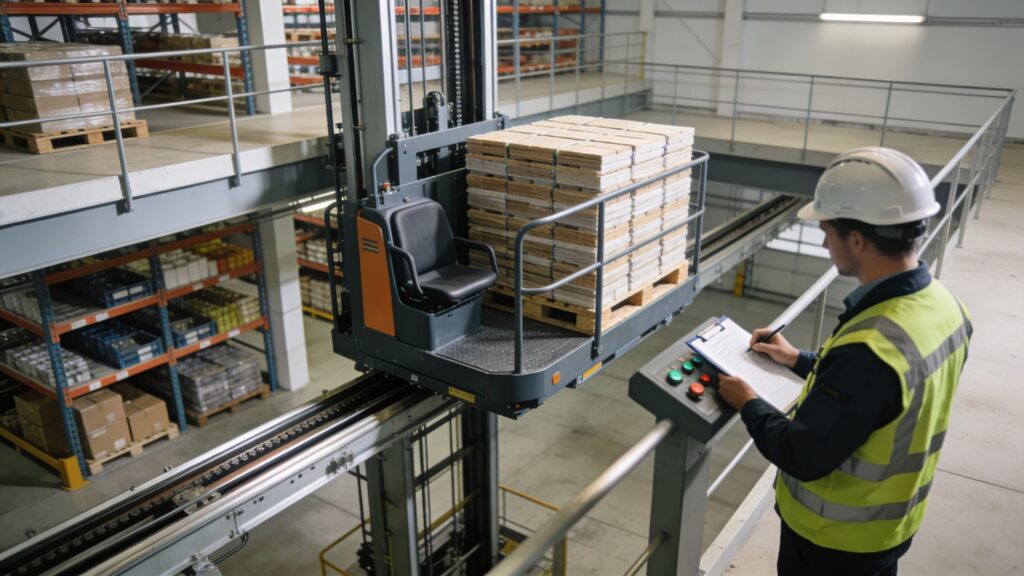
A lot of Michigan property managers run into the same problem at about the same point in a building’s life. You’ve added storage on a mezzanine, expanded production onto a second level, or reorganized a warehouse so materials need to move vertically all day. Stairs are slow. Forklifts aren’t the right answer for every layout. A full passenger elevator feels oversized for the job and expensive to own.
For More Info Call
734-726-4247
Or
Fill Out A The Form Below
That’s where Rideable Material Lifts start showing up in the conversation.
They make sense in the right building. They can move materials efficiently while allowing a trained, authorized person to ride with the load. They also create a compliance responsibility that many owners underestimate. The hard part usually isn’t choosing the equipment. The hard part is owning it correctly for years after installation, with the right training, records, inspections, repairs, and operating controls in place.
The Smart Solution for Multi-Level Facilities
A common example is a warehouse with a mezzanine pick area. Staff need to move cartons, parts, or packaged inventory between levels throughout the day. If workers have to carry items manually or make repeated stair trips, the process slows down fast. If the owner installs a full elevator when public passenger service isn’t needed, the project can overshoot the building’s operational needs.
Where they fit best
Rideable Material Lifts usually make the most sense where the building needs controlled vertical movement for goods and a limited number of trained operators. Think:
- Warehousing operations where workers need to travel with picked material
- Manufacturing plants moving parts, tooling, or product between levels
- Retail back-of-house areas with stock on mezzanines
- Municipal or institutional facilities where public passenger access is not the goal
If you’re comparing equipment types, it helps to review how material lifts are used in commercial facilities before deciding whether an RML is the right fit or whether another lift category fits the building better.
The savings only matter if the lift stays compliant
Owners often focus on the install proposal. That’s understandable, but it’s incomplete. A cheaper entry point doesn’t automatically mean a lower lifetime cost. The lift still has to be operated by the right people, maintained on schedule, inspected properly, and kept in a condition that will pass scrutiny if there’s ever an incident or insurance review.
Practical rule: If a lift lets a person ride, treat it like regulated transportation equipment from day one, not like a simple warehouse accessory.
That’s the part many facilities miss. They buy the equipment for efficiency, then manage it casually. In Michigan, that approach creates avoidable exposure.
What Defines a Rideable Material Lift
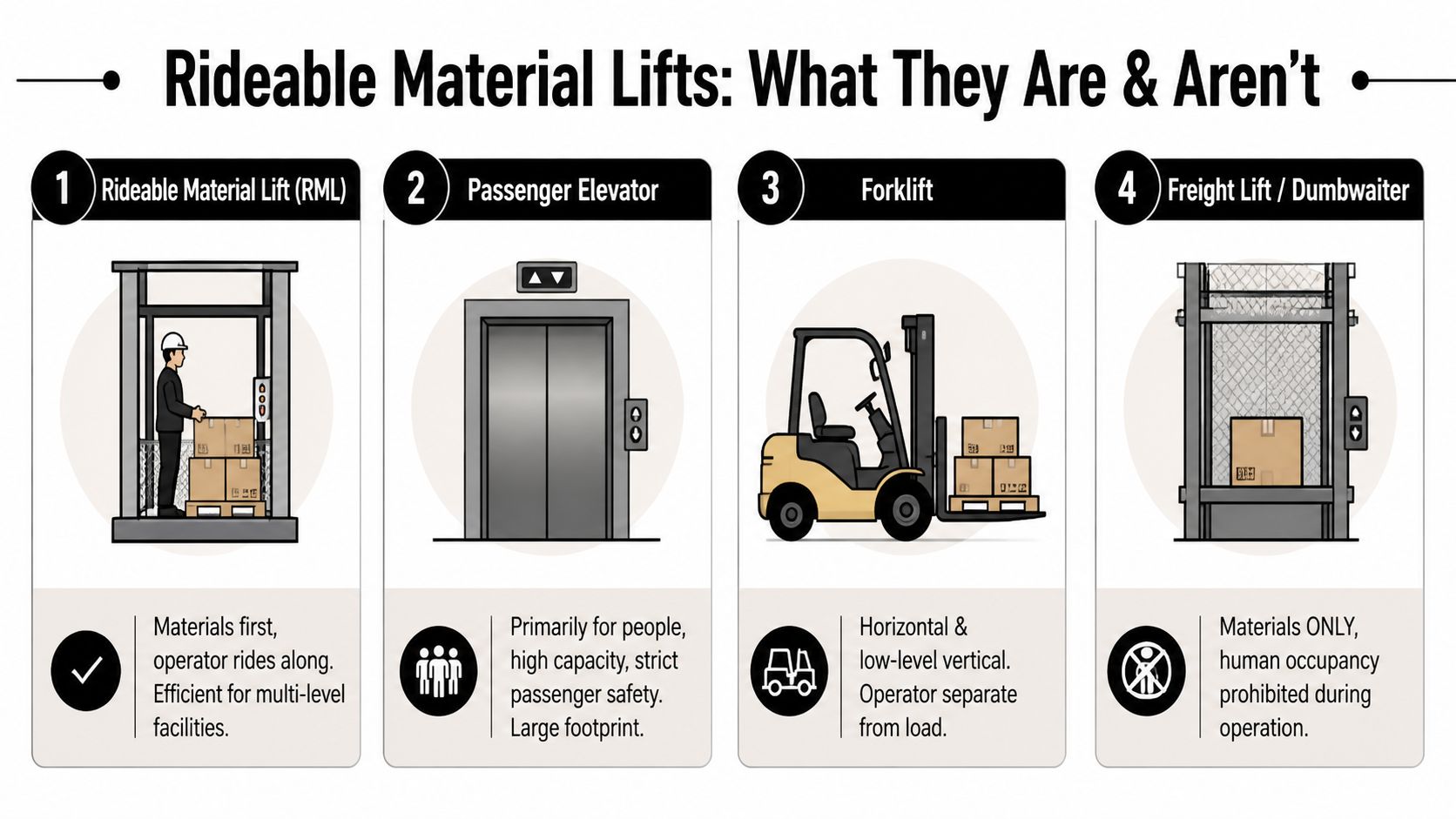
The easiest way to understand an RML is to start with what it isn’t.
It isn’t a standard Vertical Reciprocating Conveyor, because a VRC is for materials only. It isn’t a public passenger elevator either, because it’s not intended for general building occupants to ride. And it isn’t just a freight platform with a looser rule set. An RML sits in a specific category with its own operating limits and code framework.
The code distinction matters
Rideable Material Lifts operate under ASME A17.1/CSA B44 Safety Code as Type B Material Lifts, allowing one authorized rider with material. That design integrates personnel movement with material handling through a keyed enable switch so only trained staff can operate it, as described in ISHN’s coverage of Wildeck’s RiderLift category.
That single point changes the entire discussion. Once one authorized person is allowed to ride, the equipment has to be evaluated and managed very differently from a non-rider material lift.
A simple way to classify the options
Use this comparison when someone on your team says, “Can’t we just use a freight lift instead?”
| Equipment type | Who rides | Primary purpose | Typical fit |
|---|---|---|---|
| Rideable Material Lift | One authorized person with material | Controlled movement of materials with operator accompaniment | Mezzanines, multi-level warehouse tasks |
| Passenger elevator | General public or building occupants | People movement | Offices, healthcare, residential, public access buildings |
| Forklift | Operator only | Horizontal movement and limited load placement | Dock work, floor-level transport, warehouse aisles |
| Material-only lift or VRC | No riders | Freight movement only | Back-of-house freight transfer where no one rides |
What owners get wrong
The most common misunderstanding is assuming “rideable” means broadly usable. It doesn’t. The equipment is intended for authorized personnel, not tenants, visitors, patients, students, or the general public.
Another mistake is treating the keyed switch as a convenience feature rather than an access control feature. It exists to limit operation to trained users. If keys float around the building or supervisors stop enforcing operator restrictions, the owner starts drifting away from the very condition that made the installation acceptable in the first place.
If everyone can use it, you’re already outside the spirit of the equipment category, even before an inspector writes anything down.
Navigating Michigan Codes and Standards
In practice, Michigan owners need to think about Rideable Material Lifts in two layers. First, the equipment has to meet the governing safety code for its type. Second, the installation and ongoing operation have to satisfy the state and local enforcement environment that applies to the building.
The technical label is important here. Classified as Type B Material Lifts under ASME A17.1/CSA B44, RMLs can handle capacities up to 25,000 lbs material only and allow one authorized person to ride with cargo, which is a major distinction from VRCs and one reason they’re often used for mezzanine access, according to Wildeck’s overview of rideable material lifts.
What the code means in plain language
For a Michigan property manager, the practical questions are usually these:
- Who can ride? One authorized person, not general occupants.
- What can it move? Materials within the rated design limits.
- What has to work every time? Access control, landing protection, operating controls, and safety devices.
- Who is responsible? The owner or the owner’s representative. Not the installer six months later. Not the vendor rep who sold it.
That last point matters. The owner is the party that has to keep the equipment in a compliant operating condition and control how the building uses it.
Authorized personnel is not a vague term
“Authorized and trained personnel” shouldn’t live only in a binder. It needs to show up in daily operation.
That usually means:
- Named operators instead of a general assumption that “warehouse staff know how to use it”
- Documented training tied to the specific lift and the site’s operating rules
- Key control so the enable switch doesn’t become meaningless
- Supervisory enforcement when someone uses the lift outside its intended purpose
Owners in Michigan also need to watch for state adoption changes and enforcement expectations that affect vertical transportation equipment. For a broader view of where code compliance is heading, review Michigan elevator code changes and deadlines.
Compliance is a lifecycle issue
A clean install doesn’t guarantee a compliant building a year later. The lift can drift out of compliance through small decisions: a damaged interlock left uncorrected, a signage issue ignored, an unauthorized field modification, or a staff turnover cycle that leaves nobody clearly trained.
That’s why the right question isn’t “Did we install the correct lift?” It’s “Can we prove we’re operating it correctly today?”
Inspection Frequencies and Required Tests
Most owners don’t lose control of compliance because they disagree with safety. They lose control because nobody owns the recurring calendar. Inspections get treated as a notice instead of a process. Repairs get delayed. Documentation gets scattered between maintenance staff, the property office, and a service vendor.
That’s a mistake with Rideable Material Lifts. They need recurring attention, and that attention has to be organized.
What inspectors usually focus on
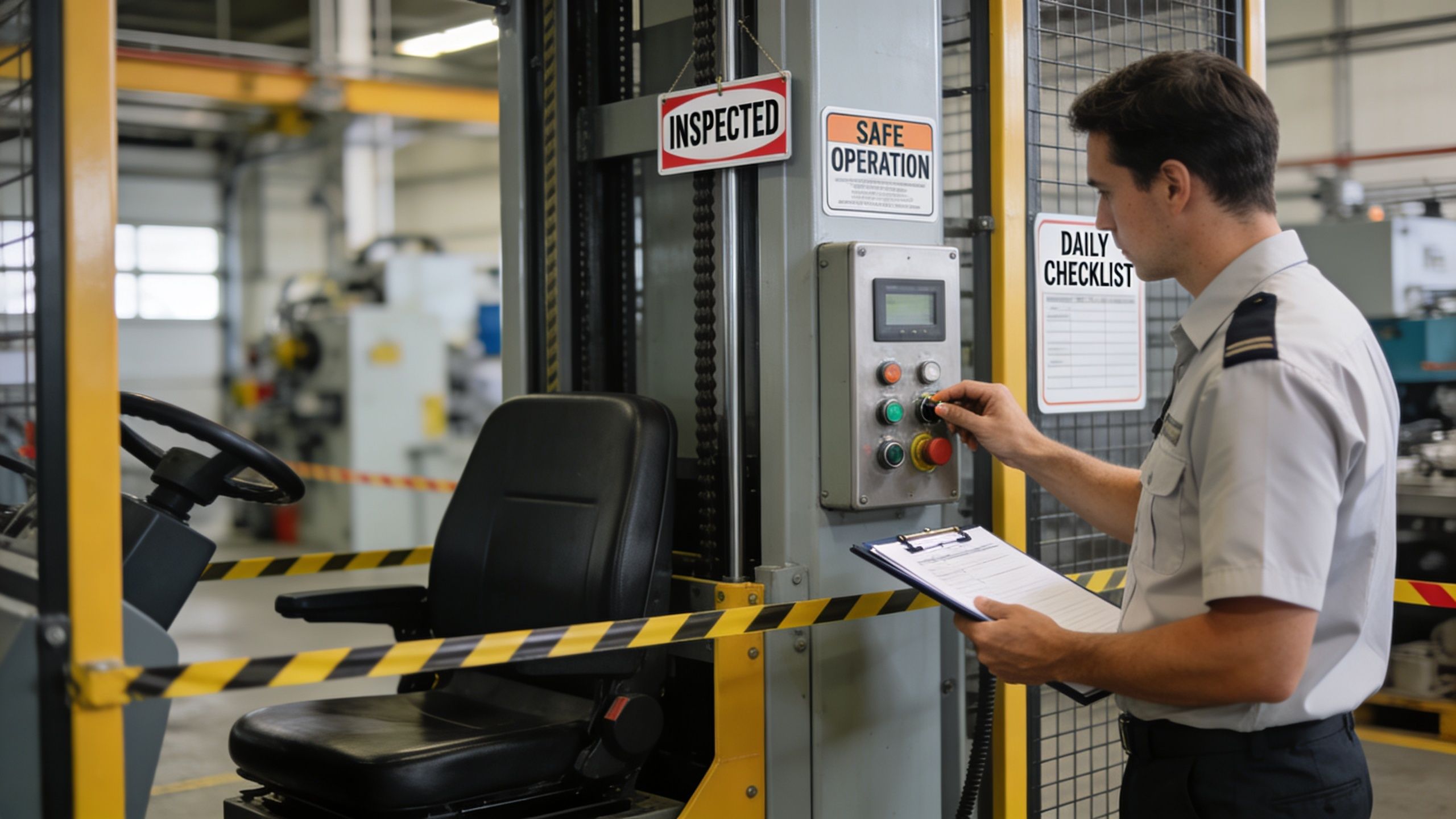
An inspector doesn’t care that the lift “seems fine.” The inspection is about whether the equipment and its safety functions are operating as required.
Typical review points include:
- Landing doors and interlocks to confirm they secure properly and interact correctly with the lift
- Operating controls including stop functions and access control
- Safety circuits to verify protective features haven’t been bypassed
- Hydraulic or mechanical components for wear, leakage, damage, and performance issues
- Signage and markings including capacity, operating restrictions, and rider limitations
- General condition of the hoistway, pit, gates, sills, and surrounding area
Some of these items are obvious. Others aren’t. A switch can be technically functioning but intermittently unreliable. A door can close yet still present an interlock issue. That’s why routine testing matters in addition to visual checks.
Testing is not the same as maintenance
Many owners blur these together. They aren’t the same thing.
Maintenance is what keeps the lift operating properly. Testing and inspection are what confirm it meets required conditions and reveal defects that the building then has to correct. If your team treats the annual visit as your maintenance plan, you’re already behind.
A passed inspection is not proof of a healthy machine. It’s proof that the equipment met the required standard on the day it was examined.
For facilities trying to organize this work, it helps to understand the broader category of elevator and lift testing services so inspections, required tests, and corrective work don’t get mixed together on paper or in budgeting.
Who should perform the work
In Michigan, owners should use properly qualified elevator and lift professionals for regulated inspection, testing, and service work. The key point is practical, not theoretical. The people touching the equipment need to understand the code category, know how the safety chain functions, and document their work clearly enough that the owner can defend the condition of the lift later.
That’s especially important after staff complaints like “the gate sticks sometimes” or “we’ve been overriding that issue for weeks.” Those comments often point to problems that turn into violations if they’re not handled correctly.
Common Violations and How to Avoid Them
Most RML violations don’t start as dramatic failures. They start as shortcuts.
A keyed switch gets left accessible to anyone on shift. A gate issue gets “temporarily” worked around. Maintenance records aren’t updated because the mechanic handled something quickly on site. Someone adds a process change in the building without checking whether the lift’s use classification still fits the new workflow. Then inspection day arrives, or worse, an incident does.
A major concern here is liability. While manufacturers emphasize safety benefits, Wolter reports a 12% rise in material lift insurance claims in industrial sectors in Q1 2026, which is a reminder that the simple “safer than stairs” story doesn’t replace rigorous maintenance and inspection discipline.
Violations that show up again and again
These are the issues that tend to cause trouble:
-
Bypassed or unreliable door interlocks
This is one of the fastest ways to create both a safety problem and an enforcement problem. If a landing door or gate doesn’t secure and interface correctly, the lift should be evaluated immediately. -
Use by untrained staff
Buildings drift into this when turnover is high or supervisors need coverage. The lift ends up being used by whoever is available, not by whoever is authorized. -
Missing or weak documentation
If training records, service logs, correction history, and operating procedures are incomplete, the owner has a harder time proving that the lift has been managed properly. -
Unauthorized modifications
Small field changes can create big code consequences. Even a change that seems operationally helpful can affect compliance if it alters controls, guarding, or access.
The business risk is larger than the repair
Owners often think the main cost of non-compliance is the correction itself. It usually isn’t. The bigger costs are disruption, reinspection, delayed operations, insurance scrutiny, and legal exposure if someone gets hurt.
Consider how that plays out in practice:
| Violation type | Immediate effect | Longer-term risk |
|---|---|---|
| Access control failure | Improper operation by non-authorized users | Liability tied to weak operator restrictions |
| Safety device issue | Shutdown or required correction | Elevated risk if incident occurs before repair |
| Missing records | Friction during inspection | Poor defense during claims review |
| Deferred repairs | Repeated service calls | Higher lifetime ownership cost and avoidable downtime |
Buildings rarely get into trouble because one component failed once. They get into trouble because the record shows the owner tolerated known problems.
That’s why a reactive approach doesn’t hold up well with Rideable Material Lifts. The equipment category itself demands controlled use. Once the owner stops controlling it, the protection that category offers starts to erode.
Your Practical Pre-Inspection Checklist
A pre-inspection walkthrough should be simple, repeatable, and documented. Don’t try to turn your building staff into mechanics. The point is to catch visible issues, operating irregularities, and paperwork gaps before the formal inspection or service visit.
Use the checklist below as an owner-level screening tool. If anything fails, stop there and have qualified lift personnel evaluate the condition.
Walk the area before you run the lift
Start with the environment around the equipment.
- Housekeeping matters because pits, landings, and access areas collect debris fast in industrial spaces.
- Signage matters because faded or missing labels are often the first sign that operating discipline has slipped.
- Access control matters because a keyed system doesn’t help if keys are uncontrolled or the switch is being bypassed informally.
RML pre-inspection checklist
| Area | Check Item | Status (Pass/Fail) |
|---|---|---|
| Landing area | Floor area is clear of pallets, shrink wrap, trash, and obstructions | |
| Landing doors and gates | Doors close fully and appear undamaged | |
| Signage | Capacity and authorized-rider signage is present and legible | |
| Key control | Enable key is controlled and limited to authorized staff | |
| Operating panel | Buttons, labels, and stop functions appear intact | |
| Communication | Emergency communication device, if provided, is present and functional | |
| Lift platform | Platform is free of loose debris, damage, or obvious misuse | |
| Hoistway or enclosure | No visible impact damage, bent guarding, or tampering | |
| Pit or lower level area | Area is clean, dry, and free of stored materials | |
| Maintenance records | Service logs and prior correction records are available on site | |
| Training records | Authorized operator list is current | |
| Ride quality | No unusual noise, jerking, sticking, or delayed response during normal operation |
What your team should never do
A good pre-inspection routine also means knowing where to stop.
- Don’t bypass a problem to keep production moving. If a gate, interlock, or control behaves inconsistently, document it and call for service.
- Don’t guess at rated use. If the building’s workflow has changed, confirm the lift is still being used within its intended operating limits.
- Don’t clean around records. Keep maintenance and training documentation organized and accessible, not buried in a general facility file.
If your operator says, “It only acts up sometimes,” treat that as a service condition, not background noise.
That habit alone prevents a lot of failed inspections.
Partnering for Long-Term RML Compliance in Michigan
The actual cost of a Rideable Material Lift shows up over time. Not just in service invoices, but in how much management attention the equipment demands, how often it interrupts operations, and how defensible your records are when an inspector, insurer, or attorney asks for them.
That’s why total cost of ownership matters more than the install number on page one of the proposal.
The lifecycle costs owners tend to miss
The common blind spots are familiar:
- Deferred maintenance because the lift is still running
- Scattered records across property management, operations, and maintenance teams
- Vendor lock-in concerns when equipment becomes hard to service competitively
- Slow response on breakdowns that disrupt workflows and push staff back to unsafe workarounds
Those issues directly affect uptime and compliance. According to Advance Lifts on rider mezzanine access lifts, vertical lift downtime can be 15-20% higher than elevators without specialized, non-proprietary service, which can erode the return owners expected from the equipment.
What works in the field
The facilities that manage RMLs well usually do a few things consistently.
First, they assign ownership. One person or one team tracks training, service history, open deficiencies, and inspection status.
Second, they keep records that tell a story. If a switch failed, the file should show when it was reported, when it was corrected, and who verified the fix.
Third, they use service providers that can support the equipment over the long term without turning every issue into a parts or access bottleneck. Non-proprietary support matters because it gives the owner options and reduces the risk of being trapped by one service path.
What does not work
What fails is the casual model:
| Weak approach | Better approach |
|---|---|
| “Call someone when it breaks” | Preventive maintenance with recurring review |
| Keys shared broadly | Controlled operator authorization |
| Logs kept inconsistently | Centralized documentation |
| Service chosen only by lowest immediate price | Service chosen for response, clarity, and long-term support |
Rideable Material Lifts can be a smart answer in Michigan facilities. But they’re only a smart answer when the owner commits to the full compliance lifecycle. That means operation, maintenance, inspection readiness, and documentation all working together, not just a successful installation.
If you own or manage a Rideable Material Lift in Lower Michigan and want a practical review of its condition, documentation, or code exposure, talk with Crane Elevator Company. Crane provides inspections, testing, repairs, proactive maintenance, violation corrections, and non-proprietary modernization support for commercial vertical transportation equipment across Southern Michigan. If you need a second opinion on an existing lift, a maintenance proposal, or a compliance issue that isn’t being explained clearly, Crane can help you sort it out with straight answers.