You're usually not shopping for a lift maintenance contract when everything is running well. You're doing it after a shutdown, after tenants start calling, after staff have to walk a visitor to the freight lift, or after your current provider missed another visit and still sent the invoice.
That's why owners often make the wrong comparison. They line up monthly prices and assume the lowest number wins. In practice, the contract that looks cheap on paper often becomes the expensive one once callout charges, exclusions, slow response, poor documentation, and repeat failures start piling up.
A good lift maintenance contract should do three things at once. It should protect the equipment, control your long-term costs, and reduce your liability when something goes wrong. If it doesn't do all three, it's incomplete.
Why Your Lift Maintenance Contract is a Critical Asset
A lift isn't just another building system. When it goes down, people notice immediately. In a medical building, hotel, school, municipal facility, or apartment property, the effect spreads fast. Access gets harder, complaints rise, and your team starts managing disruption instead of running the property.
That's why I never treat a lift maintenance contract as a commodity purchase. It's an operating agreement tied directly to risk. It affects how quickly faults get addressed, how clearly work gets documented, and how predictable your maintenance budget stays over time.
Why contract structure matters more than most owners think
In business sales, a lift maintenance contract with clear term length, notice period, and recurring revenue terms is treated as a valuable asset and has reportedly been valued at 20 to 30 times Monthly Maintenance Revenue in some transactions, which shows how much weight the industry places on reliable recurring service relationships (lift maintenance business valuation analysis).
That matters to an owner for a simple reason. If the contract is valuable to the provider, the provider has a reason to protect it with consistent service. If the agreement is vague, month to month in practice, or poorly written, you often get the opposite. Loose accountability, loose scheduling, and more arguments when a breakdown happens.
Practical rule: Judge the contract the same way you'd judge a roof warranty or a fire protection agreement. By what it obligates the provider to do when the system is under stress.
The cheapest contract usually shifts risk back to you
A low monthly fee often means one of two things. Either the provider has stripped out coverage, or the provider is counting on repair revenue later. Neither is automatically wrong, but both need to be understood before you sign.
Look at these risk areas first:
- Budget risk: Cheap monthly pricing can hide separate labor, parts, and emergency call charges.
- Operational risk: Weak response language leaves you waiting while your building absorbs the disruption.
- Compliance risk: Thin documentation makes it harder to prove work was done and harder to track repeat faults.
- Renewal risk: Automatic renewals and weak notice terms can lock you into poor service longer than expected.
The right lift maintenance contract isn't the one with the smallest invoice this month. It's the one that lowers your total lifetime cost, keeps your equipment serviceable, and allows you to hold them accountable when performance slips.
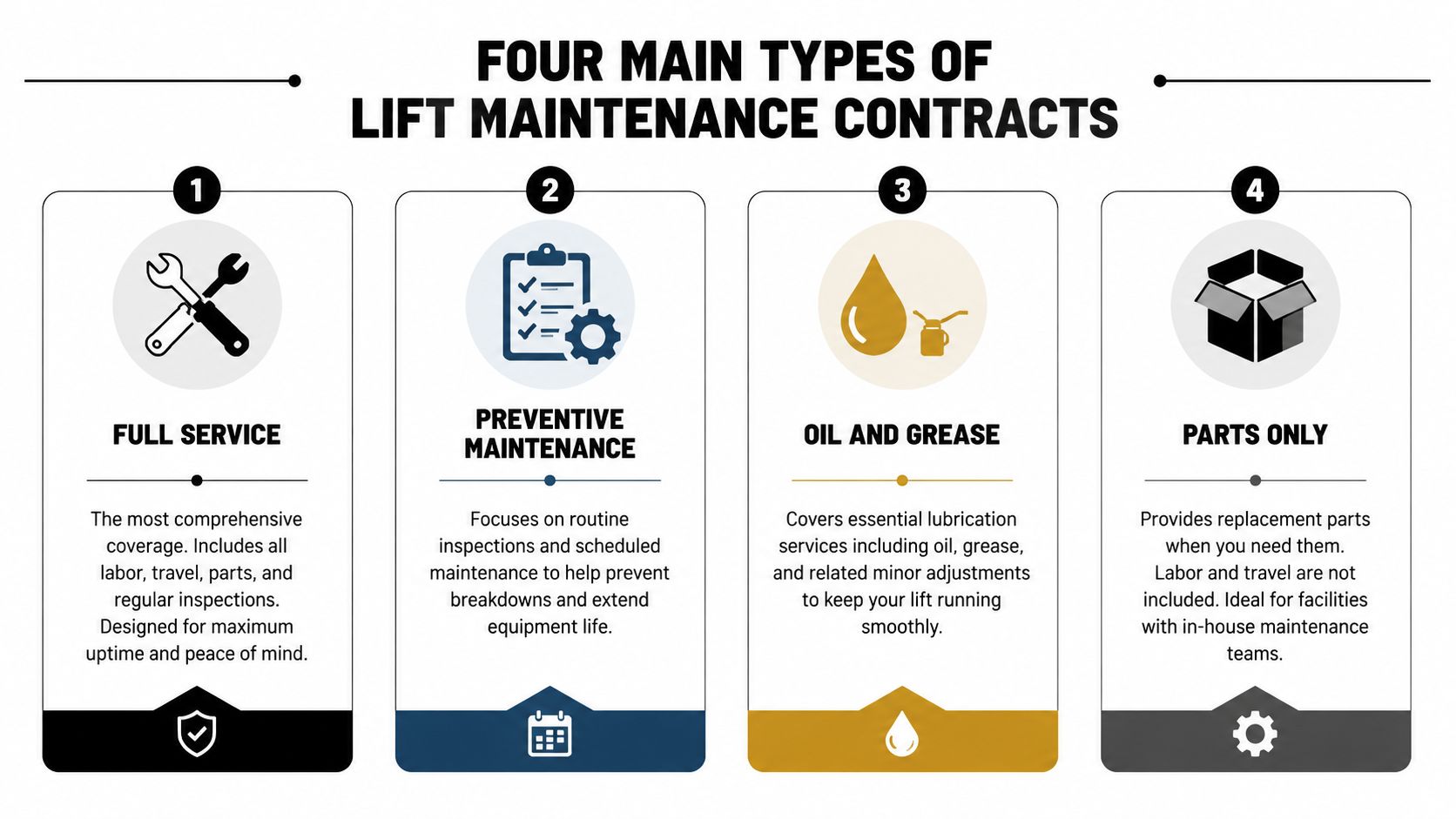
Comparing the Four Main Types of Lift Maintenance Contracts
The easiest way to understand contract types is to compare them to car insurance. Some plans cover most problems for a fixed monthly cost. Others only cover routine upkeep and leave you paying when major problems start.
Full service
This is the closest thing to full coverage. A full maintenance agreement typically includes routine preventive service plus service calls between visits, which gives the owner a more fixed-cost structure. By contrast, a limited examination-and-lubrication contract leaves those service calls billed separately and pushes the breakdown risk back to the owner (elevator maintenance checklist guidance).
Full service usually fits these buildings best:
- High-traffic buildings: Offices, hotels, healthcare, student housing, and public buildings where downtime hurts operations quickly.
- Aging equipment: Older units with a history of intermittent failures.
- Budget-driven operations: Teams that want fewer surprise invoices and a more stable monthly maintenance line.
The trade-off is straightforward. You pay more up front, but you're buying predictability.
Preventive maintenance
This is often the sensible middle ground. The contractor performs scheduled visits, inspections, adjustments, lubrication, and routine attention intended to catch wear before it turns into a shutdown. It's built around preventing failures rather than reacting to them.
This model works best when:
- the equipment is in decent condition
- the owner can tolerate some repair charges outside routine service
- the provider is performing real preventive work, not just quick walk-throughs
A preventive plan can be strong or weak depending on the checklist behind it. Two contracts can use the same label and deliver very different service.
If the proposal says “monthly maintenance” but doesn't tell you what gets checked, adjusted, cleaned, tested, and documented, you're not buying a maintenance program. You're buying a calendar entry.
Oil and grease
Many owners know this by older shorthand. It's a narrow service model focused on lubrication, visual inspection, and minor adjustments. It costs less because it covers less.
That can make sense for certain low-use situations, but it creates a common budgeting mistake. Owners compare the monthly fee against a full-service proposal and assume the cheaper option is more efficient. It isn't, if every real repair becomes an extra charge.
A limited lubrication contract may be acceptable when:
| Contract type | Monthly cost tendency | Breakdown cost exposure | Best fit |
|---|---|---|---|
| Full service | Higher | Lower | Critical-use and older equipment |
| Preventive maintenance | Mid-range | Moderate | Buildings wanting balance |
| Oil and grease | Lower | Higher | Low-traffic, low-risk settings |
| Parts only | Variable | High labor exposure | Owners with internal strategy and strict controls |
Parts only
This model usually means the provider supplies selected parts coverage while labor, routine service depth, or broader repair responsibility stays limited. Sometimes it's marketed as a compromise. Sometimes it's just a fragmented contract.
It can work for owners who already have a clear maintenance strategy and want to control specific component costs. For everyone else, it often creates confusion about who pays for diagnosis, installation labor, return visits, and failures not tied to the covered parts list.
The wrong way to choose a contract is by asking, “Which one is cheapest?” The right question is, “Which one puts the financial risk where I want it?”
Reading the Fine Print Inclusions vs Exclusions
Most contract problems don't start with the monthly fee. They start in the exclusions section, where real-world failures get carved out of the provider's responsibility.

A major gap in owner understanding is the hidden cost of exclusions. Monthly pricing can look manageable, but separate charges for non-routine repairs, modernization items, or parts not clearly covered can drive up total ownership cost, especially on older or heavily used units (building owner guidance on elevator maintenance contract exclusions).
What's usually included
Most lift maintenance contracts include some form of routine scheduled work. That often covers basic lubrication, visual checks, safety-related observations, and minor adjustments. It may also include callback handling during regular business hours, but not always.
Typical included items often look like this:
- Scheduled visits: Monthly or other recurring service intervals.
- Routine adjustment: Door operator tuning, minor leveling corrections, and basic operating checks.
- Lubrication and cleaning: Limited care of moving components.
- Basic inspection work: Looking for wear, leaks, unusual noise, or visible defects.
The trouble is that “included” doesn't always mean “fully covered.” A provider may inspect a worn part without replacing it under the contract.
Where owners get surprised
The expensive items are usually buried in language like “excluded,” “not included,” “billable as extra,” or “subject to quotation.”
Watch closely for these:
- Major components: Motors, pumps, jacks, machines, sheaves, controllers, cables, and door equipment.
- After-hours labor: Nights, weekends, holidays, entrapments, and emergency return trips.
- Obsolescence issues: Older parts that are difficult to source or no longer supported.
- Damage exclusions: Vandalism, water exposure, power events, or tenant misuse.
- Modernization items: Anything the contractor decides falls outside routine maintenance.
A contract can promise regular service and still leave you exposed on the parts and labor that matter most.
What to ask before signing
Don't ask only “What's included?” Ask what happens when a common failure occurs.
Use questions like these:
- If the doors start reversing or failing to close, what part of that repair is covered?
- If a technician finds a worn contactor, relay, operator component, or packing issue, is replacement labor included?
- What rates apply outside normal hours, and are travel charges separate?
- What failures are treated as modernization instead of maintenance?
- Which components are covered only for inspection but not repair or replacement?
Owners who ask these questions early usually get cleaner proposals. Owners who don't often end up learning the answers on an emergency invoice.
Essential Contract Clauses and Compliance Mandates
The scope tells you what work should happen. The clauses tell you what happens when the work doesn't.

A strong lift maintenance contract needs more than a visit schedule. It needs written obligations around response, records, renewal, and accountability. Federal maintenance guidance is very clear on one point: each service visit should be documented with arrival and departure times, the type of visit, parts used, work performed, tests performed, and deficiencies found (federal elevator maintenance contract guidance).
Clauses that protect the owner
Start with the terms that define performance, not just payment.
- Response time language: Don't settle for “prompt service.” Require a defined response standard for regular shutdowns and separate handling for entrapments or critical-use buildings.
- Automatic renewal terms: Multi-year contracts are common, often with renewal and escalation language. Make sure the notice window is clear and realistic for your team to manage.
- Cancellation rights: You need a path out for nonperformance, repeated missed visits, or chronic failure to document service properly.
- Insurance and indemnification: Your legal team should review these, but they shouldn't be boilerplate afterthoughts in a vertical transportation agreement.
Documentation is part of maintenance
If a technician came out but your file only shows “PM completed,” that record won't help much later. You want service logs detailed enough to support inspections, warranty disputes, and recurring fault analysis.
Ask for records that show:
| Record item | Why it matters |
|---|---|
| Arrival and departure times | Confirms the visit actually happened |
| Work performed | Shows whether service was meaningful or superficial |
| Parts used | Helps validate invoices and recurring failures |
| Tests performed | Supports compliance and safety tracking |
| Deficiencies found | Creates an action list before the next shutdown |
For owners who want to avoid vendor lock-in, equipment strategy belongs in the contract discussion too. A non-proprietary elevator approach can make future maintenance and repair sourcing more flexible because qualified providers aren't blocked by closed systems or restricted parts channels.
Compliance has to be written into the relationship
The market for elevator maintenance is built around regulation and recurring preventive service, not just repairs. One industry forecast values the global elevator maintenance market at US$41.7 billion in 2026 with a projected increase to US$62.7 billion by 2033, and notes preventive maintenance accounted for about 40.8% of market share in one 2026 estimate. The same analysis also points to code frameworks such as LOLER 1998 in the UK and ASME A17.1 / CSA B44 in North America as key drivers of the contract model (elevator maintenance market analysis).
That's the bigger point. Maintenance isn't optional housekeeping. It sits inside a compliance system. Your contract should reflect that reality in writing.
Negotiation Tips and Red Flags to Avoid
Good negotiations aren't about squeezing the last dollar out of the monthly fee. They're about removing ambiguity before the first breakdown happens.
What to push for
Start with specifics. Ask each bidder for the actual maintenance tasks they'll perform on your equipment, not a generic promise to “maintain as needed.” If one contractor gives you a detailed checklist and another gives you broad language, the second proposal should concern you even if it costs less.
Then press on the business terms:
- Pin down billing edges: Get after-hours labor, travel, return trips, and quoted repair procedures in writing.
- Tighten renewal language: Automatic renewal isn't always bad, but vague notice periods are.
- Ask for sample service tickets: If their paperwork is weak before the sale, it won't improve later.
- Match the contract to the building: A low-traffic property can tolerate more risk than a hospital, hotel, or busy office tower.
If you're comparing providers in Michigan, reviewing how elevator maintenance companies in Michigan position their service models can help you separate true preventive programs from bare-minimum coverage.
Red flags I'd take seriously
Some warning signs show up before the first wrench comes out.
If a provider resists clear scope language, clear exclusions, and clear visit records, assume the confusion is intentional.
Watch for these issues:
- Proprietary pressure: If the long-term result is that only one company can reasonably service the unit, your bargaining power diminishes.
- Verbal assurances: If it matters, it belongs in the contract.
- Vague maintenance wording: “Inspect and lubricate as necessary” is not a full scope.
- No performance accountability: Missed visits without consequences usually become a pattern.
- Poor documentation habits: If they won't show examples of real service reporting, expect weak records later.
A contract should make disagreements less likely, not create room for them.
The Real Cost of Downtime Calculating Your ROI
Most owners ask what a lift maintenance contract costs. The better question is what bad maintenance costs over the life of the equipment.

Downtime has layers. There's the repair bill, but there's also staff time, tenant frustration, accessibility disruption, delayed moves, service workarounds, and exposure when records are incomplete. That's why the right contract has to be judged on total lifetime cost, not just monthly fee.
ROI comes from fit, not from a standard template
Maintenance needs aren't one-size-fits-all. High-consequence facilities such as hospitals and busy high-rises often need biweekly or monthly visits and faster emergency response terms than lower-traffic properties. Aligning service frequency and response standards to the building's actual usage profile is central to risk control and return on investment (lift maintenance ROI guidance).
That means a smart contract accounts for:
- Traffic level: How many starts, door cycles, and user complaints the equipment sees.
- Consequence of failure: Whether a shutdown is inconvenient or operationally serious.
- Equipment age and condition: Whether the unit needs active preventive care or mainly routine monitoring.
- Response expectation: How quickly the provider must act when the lift is out.
Why non-proprietary service changes lifetime cost
A non-proprietary service approach lowers future friction. It gives owners more flexibility when they need another quote, another opinion, or another provider. You're less likely to be trapped by restricted tools, locked software, or a parts path controlled by one vendor.
That flexibility matters most when equipment ages. The more options you have for repair and modernization planning, the more control you keep over budget and scheduling.
Policy guarantees matter because they create accountability
Specific policies can also lower ownership risk if they're written and enforced. For example, Crane Elevator Company offers a maintenance model built around non-proprietary service, detailed preventive work, and a No Show, No Pay policy, along with information that helps owners understand elevator maintenance cost in practical terms. Policies like that matter because they tie payment to actual performance, not just a recurring invoice.
The right contract doesn't simply promise maintenance. It creates proof that maintenance happened, and consequences when it didn't.
A reliable ROI usually comes from four things working together. Proper scope, a serviceable equipment strategy, meaningful documentation, and accountability when visits are missed.
Answering Your Top Lift Contract Questions
Can I switch providers if I'm stuck in a long-term agreement
Sometimes, but the answer depends on the termination clause, notice period, and whether the provider is in material breach. Review the automatic renewal language first. Then review any cure period that requires you to give written notice and time to fix the problem. If the contract is vague, have counsel review it before you act.
What's the difference between a required safety test and a regular maintenance visit
They aren't the same thing. A regular maintenance visit is part of ongoing service. A required safety test is a formal compliance activity performed to satisfy code or inspection obligations. Your maintenance contract should say who coordinates these, who documents them, and what costs are separate.
What happens to the contract during modernization
That depends on the wording. Some agreements suspend parts of the maintenance scope during modernization work. Others keep limited coverage in place until the new or upgraded equipment is commissioned. Don't assume your existing contract automatically covers post-modernization adjustments or warranty coordination.
What documentation should I keep after every visit
Keep every service ticket, deficiency note, parts record, shutdown history, and any correspondence tied to recurring faults. The strongest files show when the technician arrived, what was done, what was tested, what parts were used, and what still needs correction.
How often should I review the contract itself
Review it before every renewal window and after any major change in usage, staffing, tenant mix, or equipment condition. A contract that fit the building a few years ago may be the wrong fit now.
If you want a practical second opinion on your current lift maintenance contract, Crane Elevator Company is one option for owners in Lower Michigan who need help reviewing scope, exclusions, documentation standards, non-proprietary service options, or whether their current agreement is protecting the asset.