A property manager calls because the elevator is down, tenants are angry, and the service company just sent over a repair quote that wasn't in the operating budget. The frustrating part is that the building already has a maintenance contract. That scenario is common because many owners budget for a monthly fee, not for the full cost of keeping an elevator reliable, compliant, and serviceable in Southern Michigan.
The cost of elevator maintenance isn't one number. It's a range shaped by equipment type, traffic, age, contract structure, and how much risk the owner keeps versus transfers to the contractor. If you're budgeting for an office building in Ann Arbor, a medical property in Jackson, a municipal building in Lansing, or a residential lift in a private home, the right question isn't “What's the average?” The right question is “What should I expect for this specific asset, in this specific building, under this specific contract?”
Why Most Elevator Maintenance Budgets Fail
Most maintenance budgets fail for one simple reason. They treat the elevator contract as if it covers everything.
A property manager signs a low monthly agreement, sees “maintenance” on the proposal, and assumes the major risk is handled. Then a controller issue, door operator failure, or machine room component problem shows up and the invoice lands outside the contract. The budget blows up in one service event, not because the elevator was unusually expensive, but because the contract never transferred that repair risk in the first place.
The budget problem is usually scope, not math
Owners rarely get in trouble because they forgot elevators exist. They get in trouble because they budgeted the visible number and ignored the hidden ones. A basic contract can be reasonable for the right building, but it only works when the owner also sets aside funds for excluded labor, excluded parts, after-hours work, and age-related failures.
Practical rule: If the contract price looks low, ask which repair categories you still own financially.
In Southern Michigan, this matters even more because service expectations vary by property type. A small professional office can tolerate some downtime that a senior housing property, hotel, healthcare site, or municipal building cannot. The budget has to reflect that operational reality.
A usable budget has three layers
A workable elevator budget usually needs these three buckets:
- Contracted maintenance: The recurring base cost for routine visits and preventive work.
- Repair contingency: Money set aside for excluded items, wear parts, and unexpected failures.
- Compliance and capital planning: Annual testing, code-driven corrections, and future modernization for aging equipment.
If you only budget the first line, you're not budgeting the elevator. You're budgeting the invoice you hope you get.
The goal is to avoid surprises by reading maintenance pricing the way contractors do. That means understanding what drives the bill, knowing what contract type you're buying, and putting realistic numbers around Michigan conditions instead of relying on generic national averages.
Decoding the Key Drivers of Your Maintenance Bill
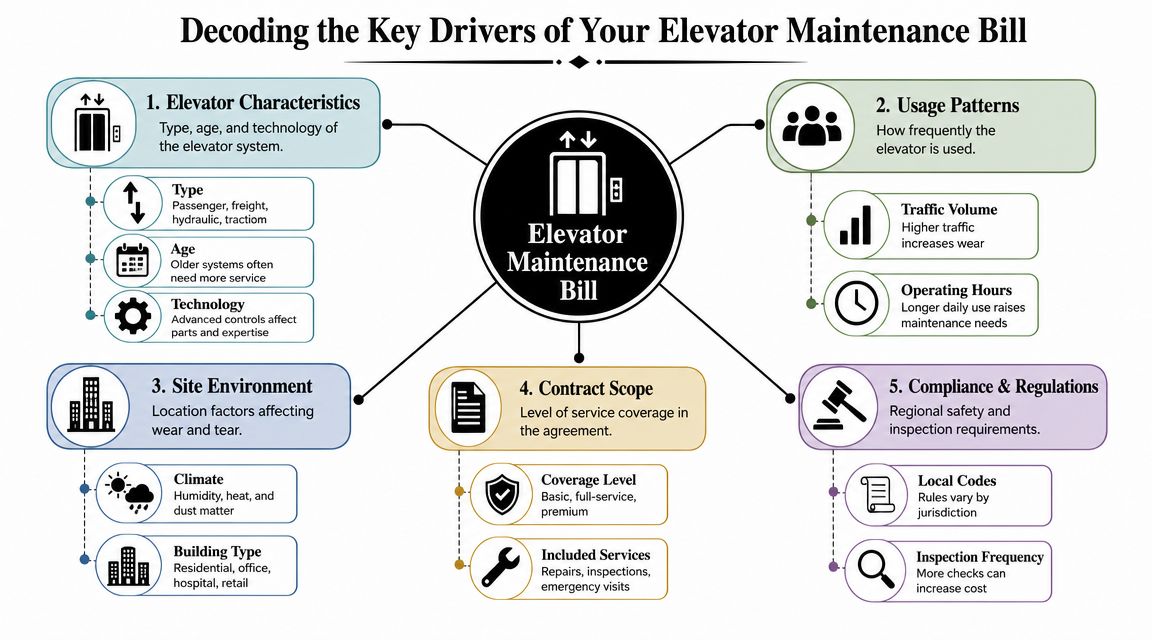
A property manager in Ann Arbor and another in Jackson can both be maintaining one elevator, under what looks like the same contract, and still end up with very different annual costs. The difference usually comes from service burden, parts exposure, and how easy the equipment is to support, not from a contractor making up numbers.
Equipment type changes the service burden
Hydraulic and traction elevators create different maintenance profiles. A basic hydraulic unit in a low-rise office usually needs less adjustment and fewer moving components serviced than a traction unit serving more floors with more complex controls.
Specialty equipment changes the picture fast. High-speed elevators, machine-room-less systems, freight applications, and older controller packages all increase technician time. They also narrow the pool of mechanics who can work on them confidently, which affects price in any market, including Southern Michigan.
Age, usage, and serviceability drive the real number
Age matters, but age by itself is not the whole story. I have seen older elevators hold a steady maintenance cost when usage is light and the equipment is serviceable. I have also seen newer units become expensive because traffic is heavy, door cycles are constant, and the system relies on proprietary components that limit repair options.
That last point matters during budgeting. If your elevator uses closed, brand-specific parts and software, routine maintenance may still look reasonable while repair pricing stays unpredictable. Owners planning future repairs or modernization often look closely at non-proprietary elevator options because open, serviceable equipment usually gives them more control over vendor choice, parts sourcing, and long-term cost.
Building use changes what “normal” should mean
A two-stop office elevator and a healthcare or senior living elevator should not share the same maintenance assumptions. They may have similar cab size and travel, but they do not have the same duty cycle or the same downtime tolerance.
In Southern Michigan, that distinction shows up clearly in budgeting conversations. Medical buildings, senior housing, hotels, and public facilities usually need faster response expectations and tighter preventive service because an outage affects operations immediately. A small professional office may accept a delay that those properties cannot.
Local market conditions show up in the quote
National averages only get you so far. Southern Michigan owners need to look at technician travel time, branch coverage, callback volume, and parts access in their own service area. A building near a dense service corridor usually gets a different pricing structure than a site that is farther from regular routes or has limited local support for its equipment.
Contractors also price based on risk. If the elevator is older, heavily used, difficult to troubleshoot, or tied to hard-to-source parts, the maintenance bill reflects that exposure. That is why the right question is not “Why is this quote higher?” The better question is “What operating risk is this quote covering?”
What to Expect for Elevator Maintenance Costs in Michigan
A property manager in Jackson or Ann Arbor often sees the same problem. The annual budget carries a flat elevator line item, then one heavy-use car starts generating callbacks, parts delays, or nuisance shutdowns, and the number is blown by midyear. The fix is to budget by equipment type, usage, and contract structure in your local market instead of relying on one national average.
For Southern Michigan owners, a practical baseline starts with one simple split. Commercial elevators usually cost several thousand dollars per year to maintain. Residential elevators and other low-use lifts usually cost far less.
Southern Michigan budgeting ranges
Industry cost references place commercial elevator maintenance in a wide annual range, often from a few thousand dollars for basic hydraulic coverage to well into five figures for full maintenance on traction or high-demand equipment. A separate elevator maintenance contract guide is useful here because the contract format often matters as much as the elevator itself.
Another published breakdown from Toledo Elevator's maintenance cost overview frames the market similarly. Commercial systems often fall in the low-thousands to mid-thousands annually, while residential systems are commonly under four figures per year.
That is directionally accurate for Southern Michigan, but local budgeting works best when owners treat those numbers as starting points, not promises.
Estimated annual maintenance ranges owners commonly plan around
| Elevator Type | Basic Contract (Oil & Grease) | Full Maintenance Contract |
|---|---|---|
| Standard commercial hydraulic | Low-thousands annually | Mid-thousands to upper-thousands annually |
| Commercial traction | Mid-thousands annually | Upper-thousands to low five figures annually |
| High-use commercial sites | Usually above standard basic pricing | Often reaches the low to mid five figures |
| Residential elevator | Lower-cost routine service | Usually far below commercial passenger elevator pricing |
Why Michigan budgets need local adjustment
Southern Michigan pricing is not uniform. Detroit high-rise service, suburban medical office coverage, and a two-stop municipal building in a smaller community do not carry the same labor assumptions, response expectations, or parts strategy.
I tell owners to sanity-check every quote against three local realities. How many qualified mechanics are covering your area. How quickly can the provider get common parts for your controller, door operator, and fixtures. How often is the elevator expected to run, and what does an outage cost your building operationally. A lower monthly number can make sense on a lightly used car. It is usually a poor fit for a building where downtime affects tenants, residents, patients, or public access the same day.
The annual price only means something if you understand what service frequency, repair exposure, and response time are built into it.
That is why two Michigan quotes for the same unit can be far apart without either one being wrong. One may cover routine visits only. The other may include more labor risk, more frequent preventive service, or faster callback response based on the building's actual use.
Residential owners should budget separately
Residential elevators, church lifts, and low-use accessibility equipment need a different budgeting lens than commercial passenger elevators. Homeowners and low-use operators typically see lower annual maintenance costs, and HomeAdvisor's elevator and stair lift repair cost data also shows that individual service visits and hourly repair labor can still add up quickly when maintenance is deferred.
That distinction matters in Southern Michigan because owners sometimes group every vertical transportation device into one budget bucket. In practice, the service model is different, the wear pattern is different, and the financial risk of downtime is different too.
Comparing Maintenance Contracts What's Included vs What's Extra
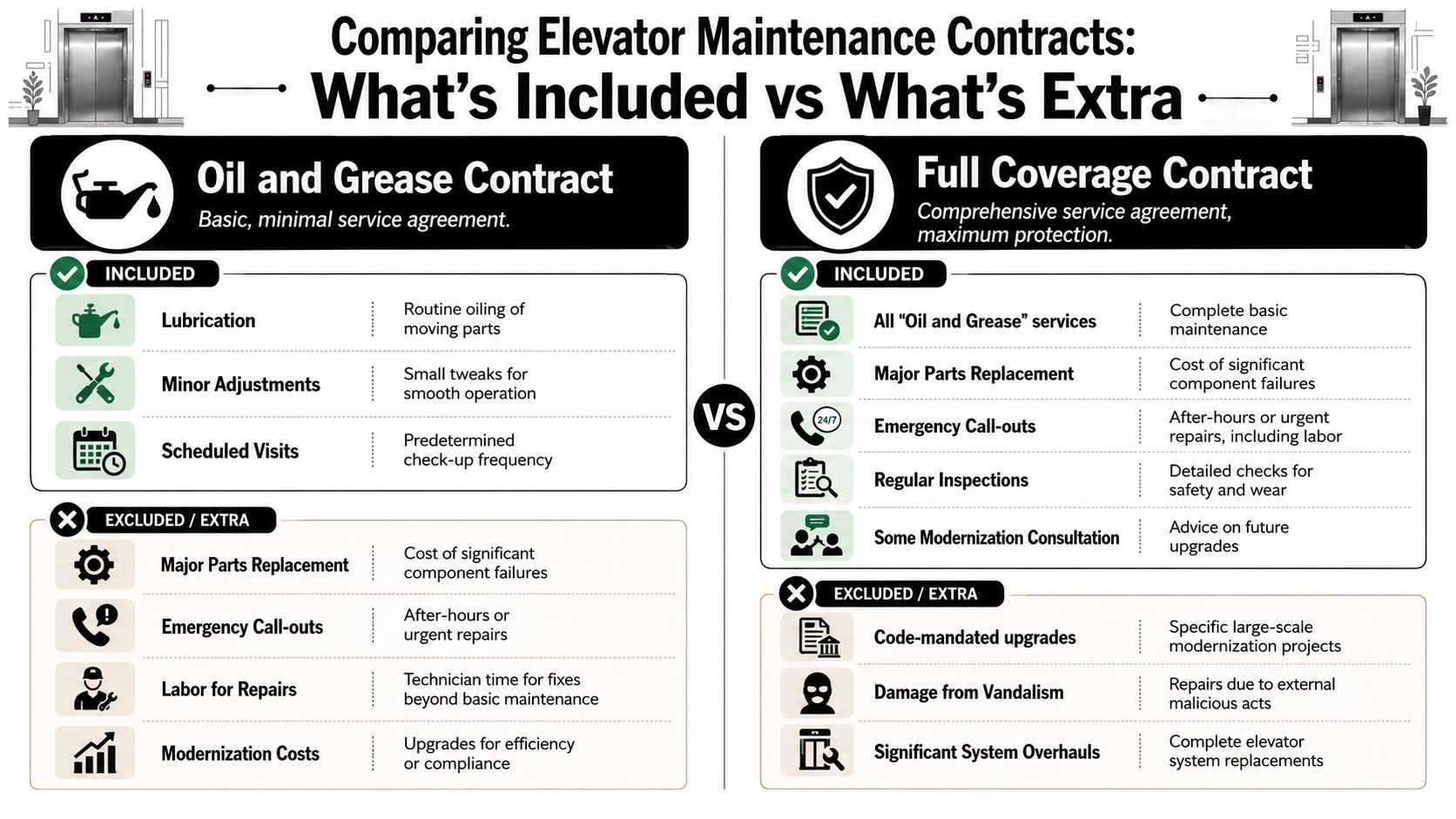
A Southern Michigan owner with two similar bids can easily pick the wrong one if the scopes are not lined up side by side. One contract may cover preventive visits only. Another may include repair labor, after-hours callbacks, and a broader parts obligation. The monthly price looks like the story. The exclusions usually decide the actual cost.
What a basic contract usually does well
An oil-and-grease contract usually covers scheduled service visits, lubrication, minor adjustments, and routine preventive work. On a newer unit with light use, that structure can be reasonable. It keeps the fixed monthly cost down and gives the owner flexibility if the equipment stays stable.
The trade-off is simple. The owner keeps more repair risk.
That matters more in older apartment buildings, medical offices, schools, and mixed-use properties across Southern Michigan where callback pressure is real and parts delays can stretch an outage. A low monthly number helps the budget only until the first repair invoice lands.
What full maintenance changes
A full maintenance contract shifts more of that exposure to the service company. In exchange for a higher monthly rate, the contractor typically takes responsibility for more repair labor and, depending on the agreement, a wider range of parts. That pricing difference reflects risk, equipment age, and how much uncertainty the contractor is agreeing to carry during the term.
This is why property managers should stop comparing contracts by monthly fee alone. Compare what happens when a door operator starts failing, a controller fault becomes intermittent, or a weekend entrapment call comes in. Those are the moments that separate a cheap contract from a useful one.
In my experience, full maintenance makes more sense when the building cannot tolerate much downtime or the equipment already has a repair history. Basic service can still work, but only if the owner has reserve funds set aside for unscheduled labor and parts.
What to check before you sign
Use this list when reviewing bids:
- Included labor: Ask whether repair labor outside scheduled maintenance visits is billed separately.
- Included parts: Confirm which components are covered and which are specifically excluded.
- After-hours service: Check rates and response expectations for nights, weekends, holidays, and entrapments.
- Visit frequency: Match the maintenance interval to traffic, age, and equipment condition.
- Exclusions: Read the excluded-items section line by line. That is where cost exposure usually shows up.
- Term and renewal: Verify renewal language, cancellation notice requirements, and price-escalation terms.
Watch list: The biggest budget surprises usually come from excluded parts, repair labor, and emergency response charges.
For owners comparing service structures, it helps to review how a lift maintenance contract is typically structured before putting proposals side by side. The right contract is the one that fits the building's traffic, age, and tolerance for downtime.
The Real Cost of Reactive Repairs vs Proactive Maintenance
A Southern Michigan owner usually sees the same pattern. The monthly contract looks manageable, service gets pushed to the minimum, then a door operator, controller issue, or recurring shutdown turns one cheap line item into an unplanned expense that blows the quarter.
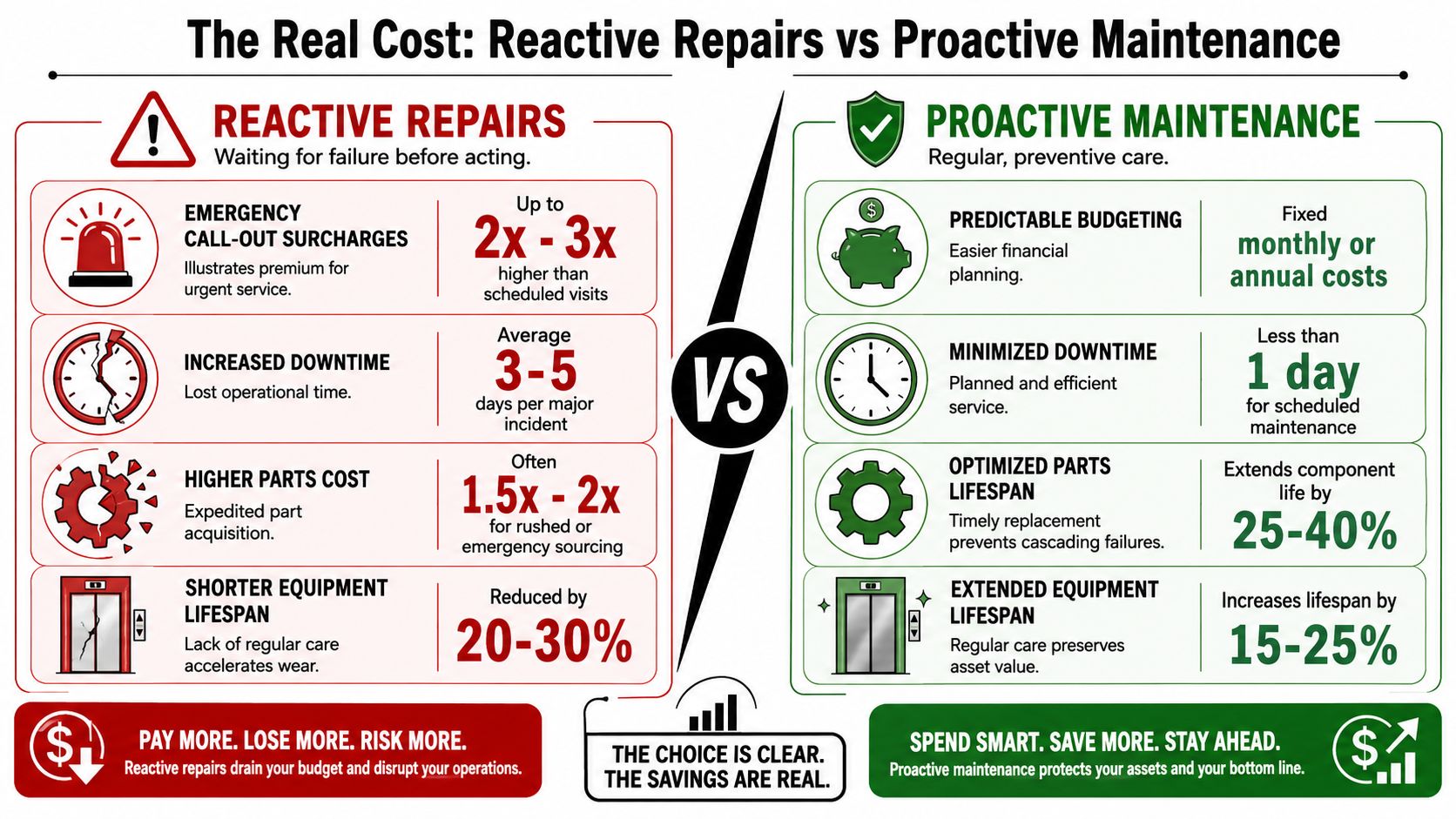
Reactive repair costs more because it stacks expenses at the worst possible time. You are paying for the repair itself, after-hours labor if the failure happens at night or on a weekend, tenant complaints, staff time, and the operational hit of having a car out of service. In a medical office, senior housing property, or older multifamily building, that downtime has a real business cost even if it never shows up on the service invoice.
Proactive maintenance works differently. It turns surprise failures into planned repairs, which gives the owner time to approve work, compare part options, and schedule service before a shutdown affects occupants.
Where reactive costs show up
The expensive part is rarely a single callback. It is the pattern.
A car with repeat door faults may still run most days, but each nuisance shutdown adds labor, shortens the life of related components, and increases the odds of an entrapment or no-start call. I see this often on aging equipment where the building keeps paying for resets and small fixes instead of correcting the root cause. That approach can look frugal for six months and get very expensive in year two.
In Michigan, weather adds another variable. Moisture, dirt, salt tracked into entries, and temperature swings all put more stress on doors, contacts, and exposed components. Buildings that defer cleaning, adjustment, and routine inspection usually feel it first in reliability.
Here's a useful visual example:
What preventive maintenance actually buys you
A good maintenance program is not just a set number of visits. It gives the owner three financial advantages.
- Earlier problem detection. Technicians catch wear before it spreads into connected parts and larger repair tickets.
- Better timing. Planned work is usually cheaper than emergency response because labor, access, and parts can be scheduled.
- Longer equipment life. Clean, adjusted equipment generally stays serviceable longer, which delays modernization pressure.
That last point matters in Southern Michigan properties with older elevators. Once a unit starts generating frequent callbacks, owners often face a bad choice between repeated repair invoices and a rushed capital project. A disciplined maintenance program buys time to budget properly and line up larger work around inspection and code deadlines. For owners planning beyond monthly service costs, Michigan's elevator code deadline requirements for January 1, 2028 should be part of that discussion.
The cheapest maintenance plan often becomes the most expensive option if it leads to repeat shutdowns, emergency labor, and earlier modernization.
What this looks like in practice
Buildings that control cost over the long term usually do the basic things consistently. They keep service intervals aligned with traffic and equipment age. They treat repeat callbacks as a signal, not bad luck. They approve small corrective repairs before those issues damage other components.
Buildings that struggle with elevator costs usually do the opposite. Service gets stretched. Known door problems stay in circulation. Each callback is handled as an isolated event.
In Lower Michigan, Crane Elevator Company is one example of a provider that offers routine maintenance, testing, repairs, and non-proprietary modernizations across different equipment types. The important point is not the logo on the truck. It is whether the contractor is finding patterns, documenting condition, and helping you budget for the next repair before it becomes an emergency.
Budgeting for Modernization Inspections and Compliance
A Southern Michigan owner usually feels this budget problem after a failed inspection, a code correction notice, or a second major repair on the same aging elevator in one year. The monthly maintenance number still looks manageable. The annual elevator budget does not.
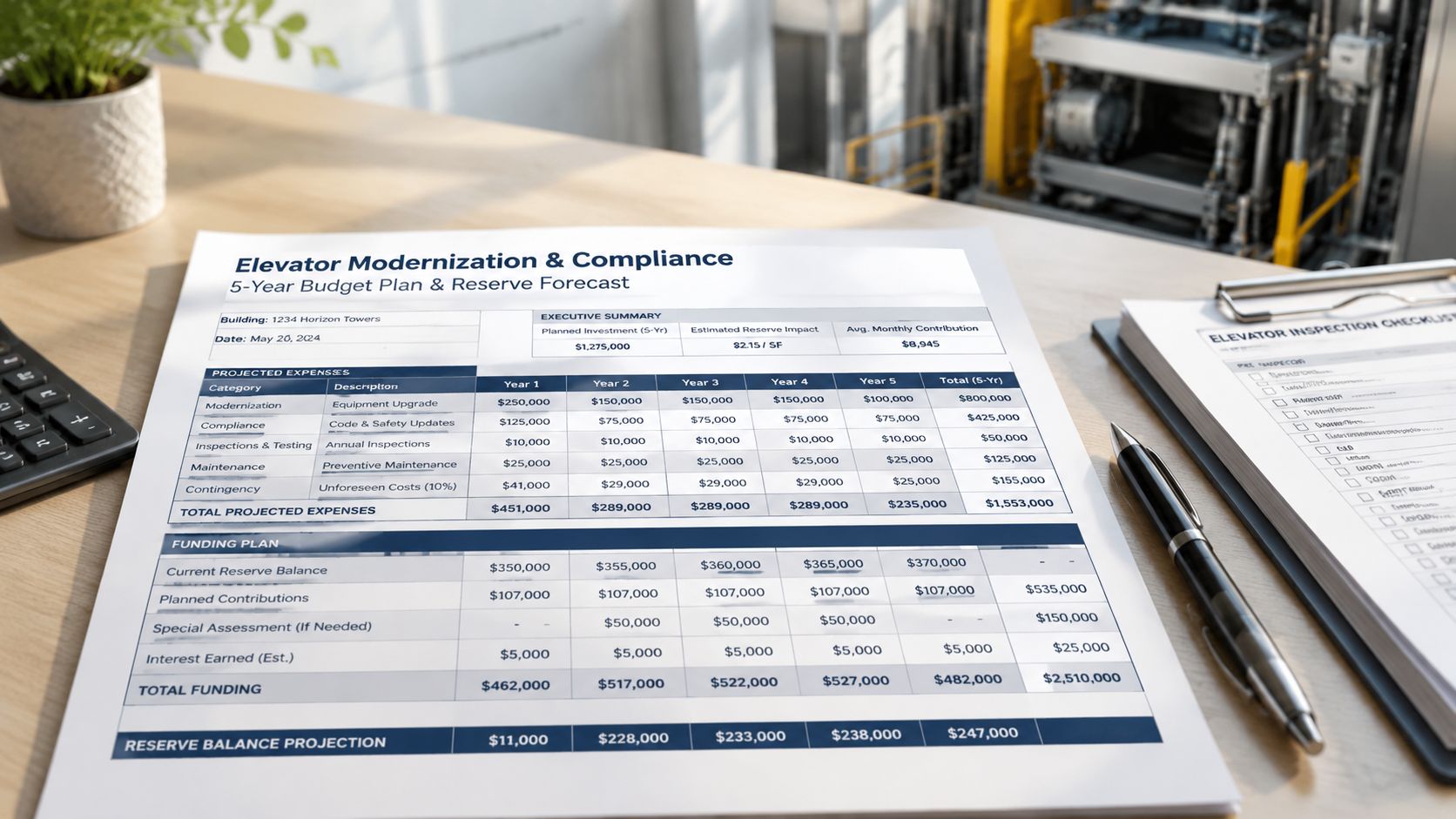
Inspections and code corrections are separate budget items
Maintenance keeps equipment running. It does not cover every test, inspection, or correction required to keep the unit compliant.
That distinction matters in Michigan because owners often approve routine service for years, then get hit with costs that were never built into the operating budget. Annual testing, inspection fees, and correction work should sit on their own line item. If they are buried inside a general facilities reserve, they usually get underfunded.
Older equipment raises the stakes. A repair can clear the immediate shutdown and still leave an unresolved code issue that has to be addressed on its own schedule. For owners building a realistic plan, the Michigan elevator code deadline requirements that included the January 1, 2028 date are a useful reference point, especially now that those deadlines have passed or are already close enough to affect scope, pricing, and contractor availability.
Modernization decisions usually start in the budget, not the machine room
Most older elevators can still be repaired. The question is whether each repair is buying useful life at a reasonable cost.
Property managers in Southern Michigan see the same pattern. Door equipment starts cycling in and out of trouble. Relays, selectors, or aging control components become harder to source. A shutdown that used to be a basic service call turns into expedited parts, extra labor, and tenant complaints. At that point, the decision is less about whether the elevator can run another year and more about whether the building should keep funding unstable equipment through the operating budget.
Modernization often makes sense before the elevator is completely worn out. It gives owners a chance to schedule work, compare proposals, and avoid making a capital decision during an outage.
A practical five-year budgeting framework
For older elevators, I recommend splitting the plan into three buckets and reviewing them every year.
- Operating budget: regular maintenance plus a realistic repair allowance for normal wear items
- Compliance budget: annual testing, inspection findings, and any required code corrections
- Capital budget: larger component replacement or full modernization, based on age, parts support, and callback history
Keep those buckets separate. It prevents a common mistake where modernization gets postponed because repeated repair invoices are masking a capital problem.
One rule helps. If the elevator needs frequent approvals for the same systems, or inspection corrections are starting to stack up, treat the equipment as an approaching capital project and budget for engineering, proposal review, and phased work before the next shutdown forces the timeline.
Questions to Ask Your Michigan Elevator Provider
A strong proposal isn't the one with the lowest monthly price. It's the one that tells you, clearly, what the contractor will do, what the contractor won't do, and how your building will be supported when the elevator is down.
These are the questions worth asking before you sign.
Use this checklist in every bid review
- What exactly is included in the contract price? Ask the provider to separate routine maintenance, repair labor, and parts coverage in plain language.
- What's excluded that commonly turns into surprise invoices? You want a direct answer on controllers, motors, door operators, after-hours calls, and damage outside normal wear.
- How do you handle entrapments versus non-emergency callbacks? Response expectations should match the building's use and occupant profile.
- How familiar are your technicians with this equipment type and vintage? A contractor that knows the system will usually diagnose faster and recommend more sensible repair paths.
- Are the parts and controls proprietary or non-proprietary? That answer affects your negotiating power and your options later.
- What does your preventive work include on each visit? General promises aren't enough. Ask what gets inspected, cleaned, adjusted, and documented.
- When do you recommend modernization instead of continued repair? A good provider should be willing to say when patching is no longer the smart move.
The answer quality tells you a lot
Don't just listen for the content. Listen for the clarity. If a company stays vague on exclusions, avoids discussing risk transfer, or won't explain how they budget older equipment, assume the contract will be just as vague when the invoice arrives.
A solid elevator provider should be able to discuss your building in practical terms. Traffic. Equipment age. Known weak points. Response expectations. Compliance exposure. Whether a basic contract is enough or whether full maintenance makes more sense.
That's how you control the cost of elevator maintenance over time. Not by chasing the cheapest monthly fee, but by buying the right scope for the actual asset you own.
If you're reviewing maintenance pricing, planning a modernization, or trying to stop recurring repair surprises in Southern Michigan, Crane Elevator Company can help you evaluate contract scope, serviceability, inspections, and long-term budgeting with a non-proprietary approach across all makes and models.