If you're running a warehouse, plant, brewery, retail backroom, or multi-level commercial building in Michigan, you may already know the problem. Materials need to move between floors. A worker usually has to go with them. Stairs are slow, risky, and hard on people. A full passenger elevator often feels like more system, more cost, and more code burden than the job requires.
That's where a Rideable Material Lift makes sense.
For the right building, it fills a very specific gap. It's not a public elevator. It's not a freight-only lift either. It's a practical vertical transport system for authorized personnel moving materials between levels in places like Detroit distribution spaces, Ann Arbor commercial buildings, Lansing manufacturing sites, Flint service facilities, Grand Rapids breweries, and Kalamazoo mixed-use properties. If you choose the right equipment, size it correctly, and keep it code-compliant, it can solve a real operational problem without forcing your building into a passenger elevator approach that doesn't fit the use.
What Exactly Is a Rideable Material Lift
A building owner usually starts with a simple question: “I need to move product and I need one worker to go with it. What's the right lift?”
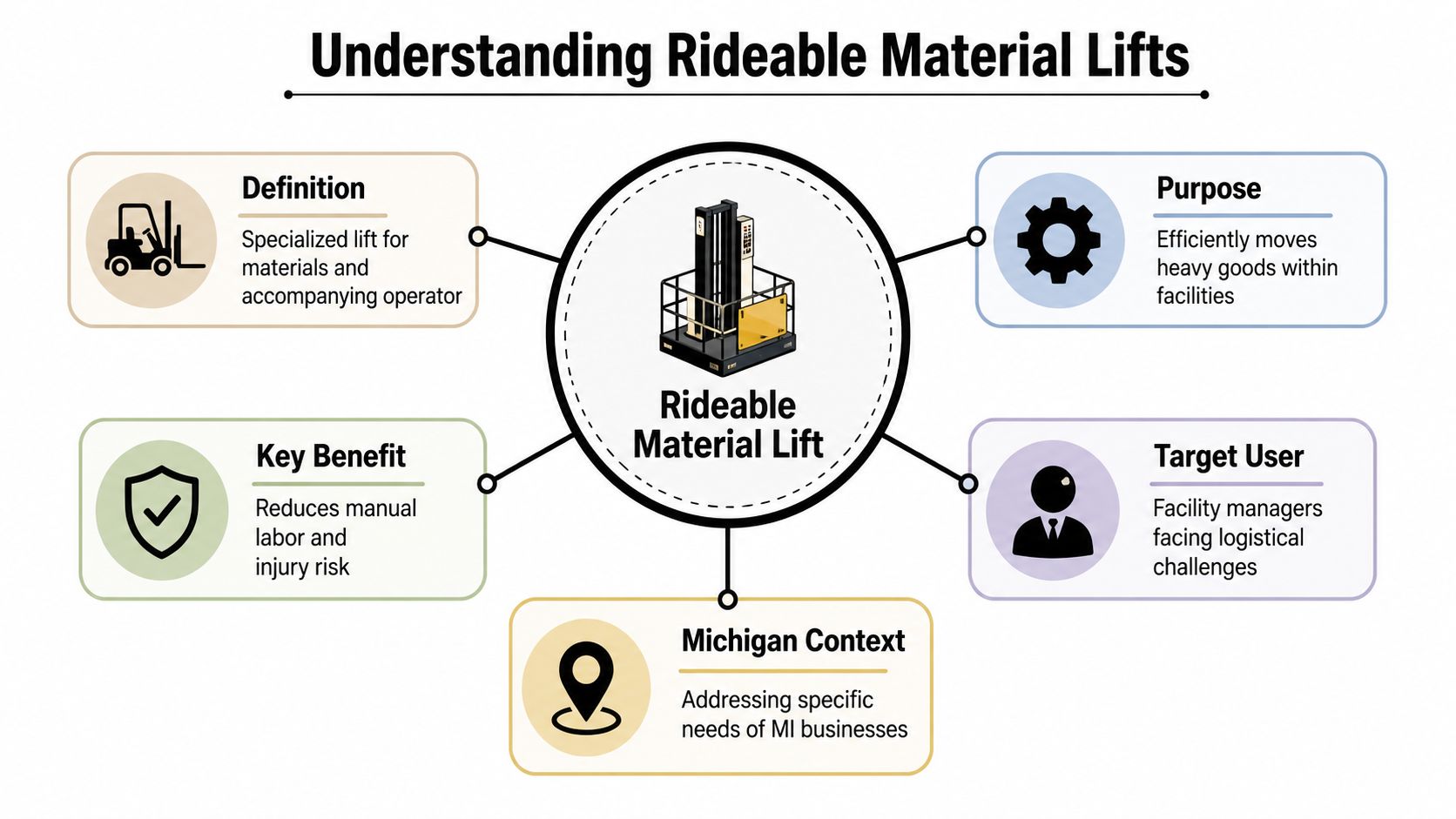
A Rideable Material Lift is built for that exact situation. It is commonly described as a Type B material lift, and it is intended for one authorized person to ride with materials. Manufacturers describe it as a way to move both personnel and goods between levels at a fraction of the cost of a public-use elevator, which is why it shows up so often in industrial and mezzanine applications (Wildeck rideable material lift overview).
What it is and what it is not
The cleanest way to understand this equipment is to place it between two familiar categories:
| System | Main purpose | Who rides | Typical fit |
|---|---|---|---|
| Freight-only lift or VRC | Move materials | No rider | Back-of-house material transfer |
| Rideable Material Lift | Move materials with one authorized person | One authorized rider | Warehouses, plants, mezzanines |
| Passenger elevator | Move people | Public or building occupants | Offices, apartments, public buildings |
That middle category matters. A Rideable Material Lift gives a facility a controlled way to move a person with the load, but only within the limited use the equipment is designed for. It doesn't replace a public elevator, and owners get into trouble when they try to use it like one.
Practical rule: If the general public, customers, tenants, or visitors need access, you're usually asking for an elevator solution, not a rideable material lift.
Why owners choose them
In day-to-day use, these lifts reduce the need for workers to carry goods on stairs. This is a core operational value. Less manual handling. Less wasted motion. Better consistency in how product, tools, and supplies move between levels.
They also fit into a long, established history of vertical transport. The earliest known elevator-like device is widely attributed to Archimedes in 236 BC, and the first documented aerial lift dates to 1644, when Adam Wiebe built one to move soil. By the 1600s through the mid-1800s, thousands of aerial lifts were used mainly for moving goods, not people. Modern rideable material lifts come out of that same long material-handling tradition, with the key difference that an authorized person can ride with the load (ANSI history of elevators).
Where they make sense
A Rideable Material Lift works when the use is controlled, the traffic is limited, and the building needs reliable vertical movement for materials plus one trained person. In my experience, they make the most sense in places where the job is repetitive and practical, not public-facing.
Common examples include:
- Warehouse mezzanines where boxed inventory and one operator move together
- Manufacturing support areas where maintenance staff bring parts and tools to upper levels
- Retail stockrooms where employees replenish inventory between floors
- Brewery and food production spaces where supplies need to move between processing and storage areas
If you need broad passenger access, this isn't the right tool. If you need controlled movement of materials plus one authorized rider, it often is.
Common Use Cases in Michigan Facilities
In Michigan, the best use cases are easy to recognize because they follow the state's building mix. A lot of facilities aren't trying to solve “people transportation” in the public sense. They're trying to solve workflow.
A Tier 1 supplier near Detroit is a good example. Parts come in at ground level, staged inventory sits on a mezzanine, and a lead or material handler needs to travel with the load to keep the transfer clean and controlled. That's a strong fit for a Rideable Material Lift because it keeps product movement and operator access tied together.
Where these lifts earn their keep
In Ann Arbor and Lansing, I often think about mixed commercial and light industrial properties. Backroom storage upstairs. Receiving or prep space downstairs. Staff moving stock, small equipment, maintenance items, or seasonal materials throughout the day. A public elevator would be overbuilt for that task. A freight-only setup may not match how the staff works.
Michigan owners also see practical value in these settings:
- Grand Rapids breweries and beverage spaces where supplies move between production, cellar, and support levels
- Flint and Lansing manufacturing plants where maintenance crews need safe access with tools and replacement parts
- Ann Arbor retail operations where stock needs to get upstairs or downstairs without tying up stairwells
- Municipal or institutional buildings with controlled access and non-public service areas
For owners comparing options, it also helps to understand the broader lift categories before narrowing to this one. Crane's overview of different types of lift systems is a useful starting point for that comparison.
In real buildings, the wrong lift choice usually comes from treating every vertical problem like a passenger elevator problem. Most service areas don't work that way.
A residential note
This category can also come up in large private properties or specialty residential applications, but owners need to be careful. Once a system starts looking like general occupant transportation, the conversation changes fast. The use, the users, and the code path all matter.
What works well is a tightly controlled application with a clear purpose. What doesn't work is trying to stretch a rideable material lift into everyday passenger service because it seems cheaper on paper.
Rideable Lifts vs Traditional Passenger Elevators
The most common owner question is straightforward. Why not just install an elevator?
Sometimes that is the right answer. But in a warehouse, manufacturing support area, or mezzanine application, a traditional passenger elevator can be the wrong tool for the job. The use case drives the decision, not the label on the equipment.
The basic difference
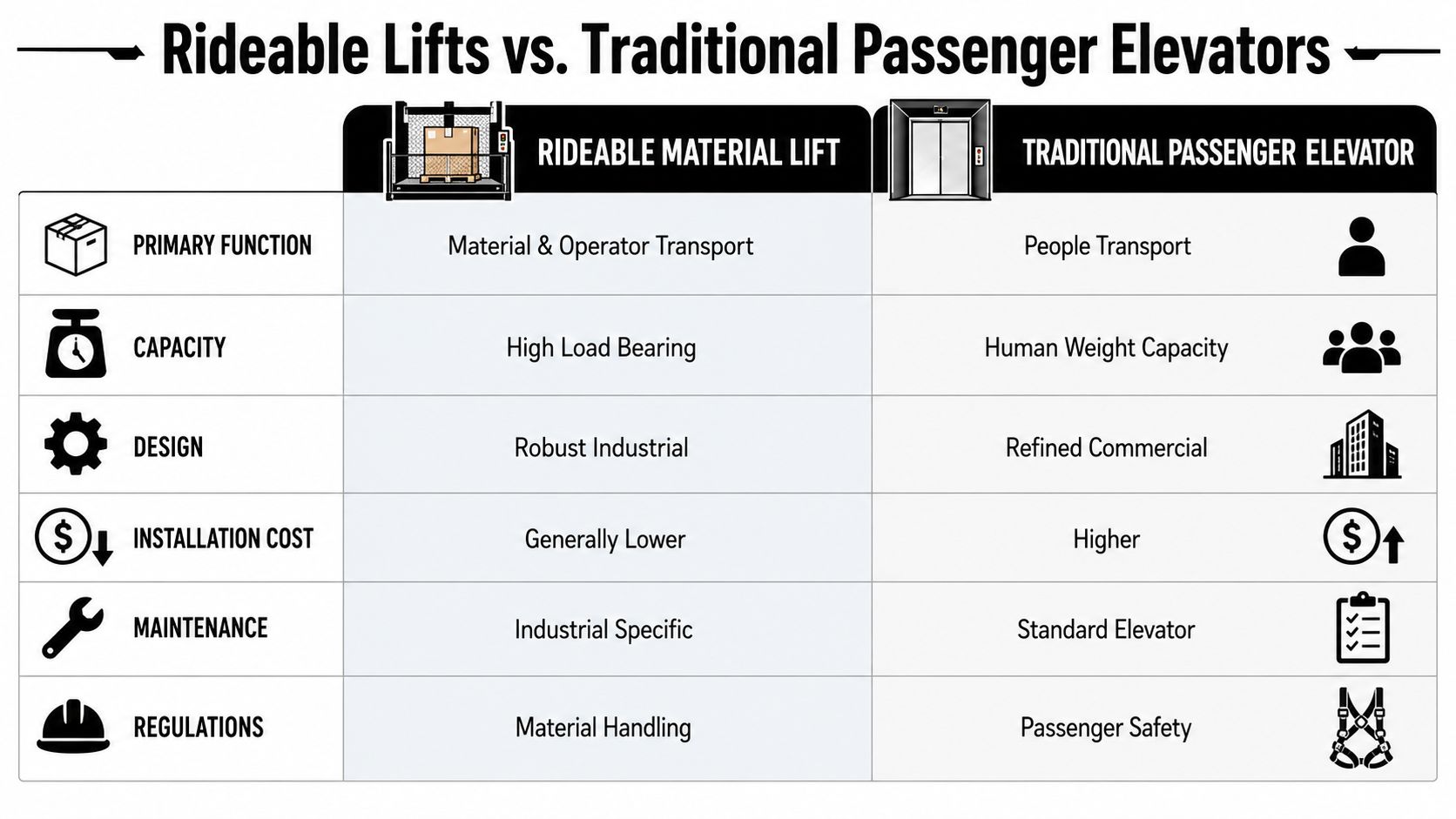
A passenger elevator is built around public or occupant transportation. A Rideable Material Lift is built around material movement with one authorized rider. That distinction affects almost everything, including design, controls, finish level, door arrangement, and how the system gets used every day.
Manufacturers in this category, including Hidral material lift options used in industrial and commercial settings, are typically chosen because owners want a purpose-built service lift rather than a public-use cab.
Side-by-side practical comparison
| Decision point | Rideable Material Lift | Passenger elevator |
|---|---|---|
| Primary job | Materials plus one authorized rider | People transport |
| Building fit | Industrial, warehouse, service areas | Public and occupant access |
| Use pattern | Controlled and limited | General circulation |
| Finish expectations | Durable, functional | More architectural |
| Cost direction | Generally lower for the right use | Usually higher overall |
| Misuse risk | High if treated like a public elevator | Lower for public use because that is its purpose |
That “generally lower” point is why owners look at rideable systems in the first place. But lower cost only helps if the application is correct. If the building really needs passenger service, trying to force a material lift into that role is a mistake.
The engineering trade-off
Commercial rideable material lifts are commonly specified around 2,500 lb lifting capacity including rider, with a 20 fpm lifting speed and a 14 ft standard top lifting height. Heavier-duty versions are marketed at 5,000 lb capacity, with an 8 ft x 10 ft car size and 14 ft travel for ground-plus-one-level applications (Wildeck RiderLift product details).
Those numbers tell you a lot. These units are designed for controlled industrial movement, not quick public transportation. The slower speed is part of the safety and control strategy. The capacity tells you they’re built around real loads, not just people.
The right question isn’t “Which lift is cheaper?” The right question is “Which lift matches the building’s actual use without creating a code problem later?”
What usually works and what doesn’t
Good candidates
- A mezzanine with palletized or boxed material movement
- A plant area where one trained worker travels with tools or parts
- A stockroom where access is restricted to staff
Poor candidates
- Tenant circulation in a commercial building
- Customer access in retail space
- Any setup where building occupants will assume it functions as a normal elevator
If you need broad access, accessibility for regular occupants, or finished passenger service, choose an elevator. If your need is narrow, controlled, and operations-driven, a Rideable Material Lift can be the cleaner answer.
Navigating Safety Standards and Michigan Code
A Detroit warehouse owner adds a mezzanine to speed up order flow. The lift quote looks straightforward until the key question comes up. Will the equipment be treated as a controlled material-moving device, or will staff start using it like a regular elevator? In Michigan, that distinction affects permitting, inspection, signage, training, and long-term liability.
A rideable material lift can work well here, but only if the use stays tightly defined from day one. Owners get into trouble when the equipment selected for a stockroom or plant area ends up serving broader building traffic than it was intended to handle.
What code means in practice
Michigan owners have to answer two code questions early. What is the lift designed and listed to do? How will the state and local authority having jurisdiction view the actual use in the field?
For a rideable material lift, the practical code concerns usually include:
- Authorized users only. If the lift is meant for trained staff, access has to stay restricted.
- Controlled entry at landings. Gates, doors, and interlocks need to match the application and prevent unsafe use.
- Clear load limits. Capacity is only part of the issue. Load placement and stability matter just as much.
- Operating controls that fit the use. The control setup has to support the intended operating pattern, not invite general passenger use.
- Signage and training. Owners often overlook these, and inspectors do not.
Owners who need a clearer baseline before approving equipment should review these Michigan elevator code requirements and compliance considerations.
Michigan enforcement happens in the field
Code language matters. So does daily behavior in the building.
In Detroit, Ann Arbor, Lansing, and other Michigan jurisdictions, inspectors look past the product label and pay attention to how the lift is being used. If employees, tenants, or visitors can call it freely and ride it like a passenger elevator, that creates a classification problem fast. I have seen projects become more expensive after installation because the owner approved a lift for one use but operated it in a completely different way.
That is why access control, landing protection, documentation, and staff training are not paperwork exercises. They are part of keeping the installation in the right lane.
Field note: Inspectors usually focus on the real operating pattern, not just the sales brochure.
Why local contractor experience matters
A vague proposal is not enough here. The contractor needs to account for structural support, pit or floor conditions, headroom, landing layouts, guarding, electrical requirements, control logic, and the inspection process in Michigan.
That is where a local company like Crane Elevator Company adds value in a practical way. A contractor familiar with Michigan permitting and service conditions can identify early when a rideable material lift fits the building, and when a code-compliant elevator is the safer answer even if the upfront price is higher.
That trade-off matters for owners in older Detroit industrial buildings, mixed-use properties near Ann Arbor, and growing commercial sites around Lansing. Saving money on the front end does not help if the installed equipment creates usage restrictions your building cannot live with.
Your Site Assessment and Selection Checklist
Most bad lift decisions happen before the first piece of equipment arrives. The owner assumes the building can take the load, assumes the traffic pattern is simple, or assumes every vendor is quoting the same thing. They usually aren’t.
A proper site review needs to test the building, the workflow, and the vendor’s assumptions.
What to verify in the building
Start with the basics. Where will the lift go, and what will it have to do every day?
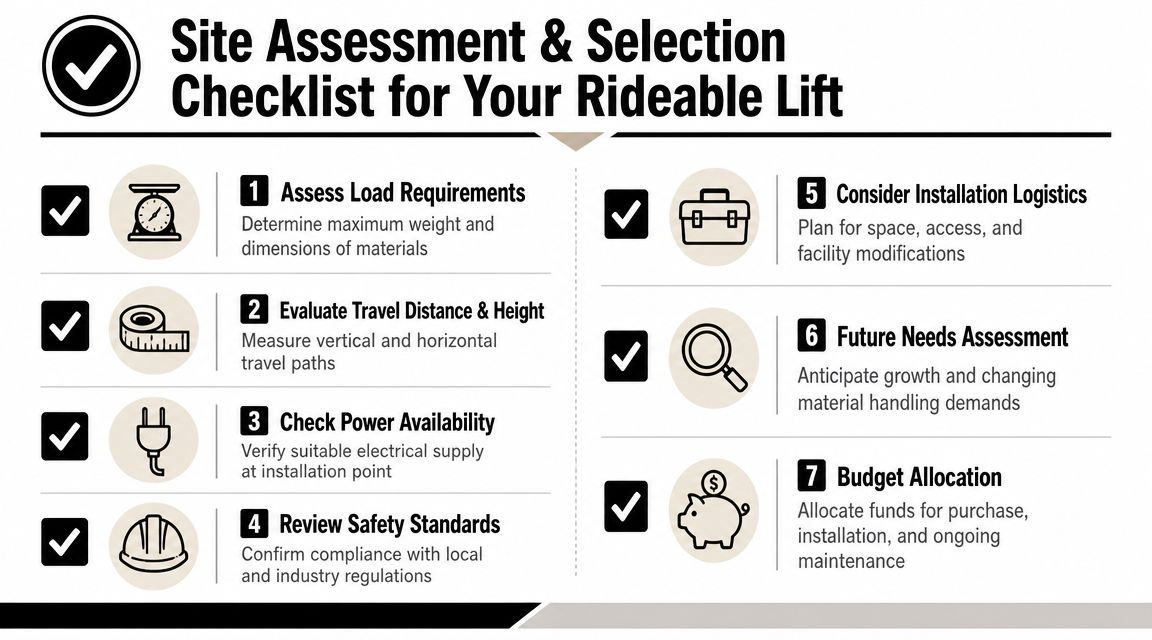
Use this checklist before you ask for final pricing:
-
Load reality
Don’t describe the average load. Describe the heaviest real load, the largest footprint, and whether the rider needs tools, carts, or hand trucks with it. -
Travel path
Measure the vertical rise, but also look at how materials approach and leave the openings. Tight turns, low headroom, and poor staging space can ruin an otherwise workable design. -
Structure
Floor support, slab condition, and load concentration matter. Heavier capacities mean more structural demand. -
Power and controls
Confirm electrical service and where disconnects, control stations, and access restrictions will sit.
Questions to ask your vendor
Here, owners separate a serious supplier from a quote machine.
- Is the system non-proprietary? If major parts or service access are locked down, your long-term options shrink.
- Who handles permitting and coordination? You want a clear answer, not finger-pointing.
- What similar applications have you installed? Not generic lifts. Similar use, similar traffic, similar building type.
- How will the lift be restricted to authorized users? This answer should be concrete.
- What does the maintenance plan include? Ask what gets inspected, cleaned, adjusted, and documented.
- Can this system be modernized later? That matters more than most owners think.
For Michigan owners comparing vendors, Crane Elevator Company is one local option to include in that conversation because it handles non-proprietary vertical transportation service, modernization, inspections, and material lift-related work across Lower Michigan.
Keep Hidral in the discussion
If you’re reviewing manufacturers, Hidral material lift products are worth discussing for applications where owners want a practical commercial or industrial platform without drifting into a full passenger elevator scope. The key is still application fit. Brand alone doesn’t solve a bad use case.
A good site assessment doesn’t just ask whether the lift fits the shaft area. It asks whether the lift fits the operation.
Maintenance Inspections and Modernization
A Rideable Material Lift is not a set-it-and-forget-it asset. The owners who get long service life out of these systems are the ones who treat maintenance as part of operations, not as an afterthought after the first shutdown.
Early neglect usually shows up in simple ways. Dirty guide areas. Worn contact points. Gate or door issues. Controls that start acting inconsistently. None of that improves on its own.
A useful maintenance program should do more than respond to breakdowns. It should actively look for wear, misuse, and small adjustment issues before they become downtime.
That typically includes:
- Routine cleaning of critical areas so debris doesn’t interfere with operation
- Inspection of gates, interlocks, and landing protection because these are often the first safety components to show trouble
- Hydraulic or mechanical system review depending on the drive arrangement
- Control and operating station checks so the unit behaves consistently
- Documentation that shows what was inspected, adjusted, or recommended
A lot of service failures start with simple neglect. The owner thinks the lift is “working,” but no one is checking the details that keep it safe and dependable.
Inspections are part of ownership
Michigan owners also need to stay current on required inspections and testing. The exact schedule and scope depend on the equipment and jurisdictional requirements, but the principle is simple. The owner is responsible for making sure the unit is inspected, documented, and kept in safe operating condition.
That means you need records. You need service history. You need a contractor who understands both the equipment and the code path.
For a visual look at rideable lift operation in practice, this video gives helpful context.
When modernization makes sense
Modernization usually enters the conversation when the structure is still useful but the components are aging out. Controls become harder to support. Safety devices no longer match current expectations. Power units, wiring, or operator interfaces become unreliable.
Good modernization work focuses on preserving what still makes sense and replacing what doesn’t. That can include controller updates, safety circuit improvements, door or gate equipment changes, and power unit work. The point isn’t to make the lift look new. The point is to keep it serviceable, code-aligned, and dependable.
Owners who wait until the lift is failing regularly usually spend more and lose more operating time. Planned modernization is almost always easier to manage than emergency replacement.
Purchasing vs Renting a Material Lift
The buy-versus-rent decision comes down to how your building uses the lift. Not every owner should purchase one, and not every short-term budget should push you toward leasing or rental.
If the lift will become part of the building’s regular workflow, ownership usually makes more sense. If the need is tied to a temporary project, major renovation, or a short operational window, renting or leasing may be the cleaner move.
When purchasing fits
Buying works best when the lift is a long-term building asset. That’s common in warehouses, manufacturing facilities, back-of-house retail, and service areas with fixed multilevel movement.
Ownership gives you more control over:
- Configuration that matches your building and load pattern
- Service planning over the life of the equipment
- Modernization timing when components age
- Operational consistency because the lift stays in place as part of the facility
If you’re evaluating permanent systems, Crane’s page on material lifts for commercial applications is relevant to the purchasing side of that discussion.
When renting or leasing fits
Renting or leasing can be smart when the need is temporary or uncertain. That could include a renovation phase, a seasonal production change, or a project where you don’t yet know whether permanent vertical movement belongs in the building plan.
That route can also help owners who want to avoid committing capital before the workflow proves itself. But it has limits. Temporary arrangements don’t always align well with highly specific site conditions, and they don’t remove the need to think about safe use.
A practical way to decide
Use three questions:
| Question | If yes | If no |
|---|---|---|
| Will this lift be part of daily operations? | Lean toward purchase | Renting may work |
| Is the building layout stable for the long term? | Purchase makes more sense | Keep options open |
| Do you need a tailored permanent installation? | Buy | Temporary equipment may be enough |
A Rideable Material Lift is most valuable when it solves a repeated problem. If the problem is permanent, ownership is usually easier to justify. If the problem is temporary, flexibility may matter more than permanence.
If you're sorting through a Rideable Material Lift project in Detroit, Ann Arbor, Lansing, Flint, Kalamazoo, Grand Rapids, or elsewhere in Lower Michigan, Crane Elevator Company can help you evaluate the application, code fit, maintenance path, and modernization options before you commit to the wrong system.