
If you manage a restaurant with prep on one level and service on another, a clinic with supplies split across floors, or a large home where groceries and laundry keep traveling the stairs, you already know the problem. The wasted motion isn't abstract. Staff lose time, people carry awkward loads by hand, and sooner or later someone spills something or gets hurt.
That's where dumbwaiter elevators still make practical sense. Not as a novelty. As a compact material-handling system that solves a very specific building problem when stairs are slowing operations down.
Why Smart Buildings Still Rely on Dumbwaiter Elevators
A dumbwaiter earns its keep when the same items move between floors all day. Food trays. Linen. Files. Medication supplies. Mail. Cleaning stock. In the right building, a small freight lift removes dozens of unnecessary stair trips and makes the workflow more predictable.
That matters in Southern Michigan properties where older buildings often have tight floorplans and newer projects still need efficient vertical transport without dedicating space to a full passenger elevator. Dumbwaiter elevators fit into that middle ground. They move goods, not people, and they do it in a compact footprint.
Where they make the most sense
Some properties benefit immediately:
- Restaurants and hospitality spaces: Hot food, dishes, bar supplies, and dry goods move faster between service levels.
- Medical and care facilities: Staff can transfer lightweight materials without using stairwells for constant hand-carrying.
- Schools and offices: Documents, supplies, and mail can move floor to floor without tying up staff.
- Private homes: Groceries, laundry, luggage, and storage items stop becoming stair jobs.
One reason this category remains relevant is that it isn't a fringe product. The market is projected at USD 18.8 billion in 2026 in a dumbwaiter lift market outlook from Future Market Insights, driven by automation and building efficiency.
Practical rule: If the same load travels the same stairs every day, a dumbwaiter deserves a serious look.
Owners who are still comparing lift categories should also review the broader types of lift used in buildings. A dumbwaiter is often the right answer when the problem is moving materials only, not passengers.
Understanding Dumbwaiter Fundamentals
A property owner usually starts asking about a dumbwaiter after the same problem keeps showing up. Staff are carrying stock down a basement stair several times a day. A homeowner is hauling laundry and groceries between floors. At that point, the question is less about novelty and more about whether a dedicated material lift will solve a recurring labor and safety issue at a reasonable cost.
A dumbwaiter is a small freight elevator designed for goods only. That single fact affects the hoistway layout, landing doors, controls, interlocks, load rating, and the code path the equipment falls under.
From simple hoists to modern building equipment
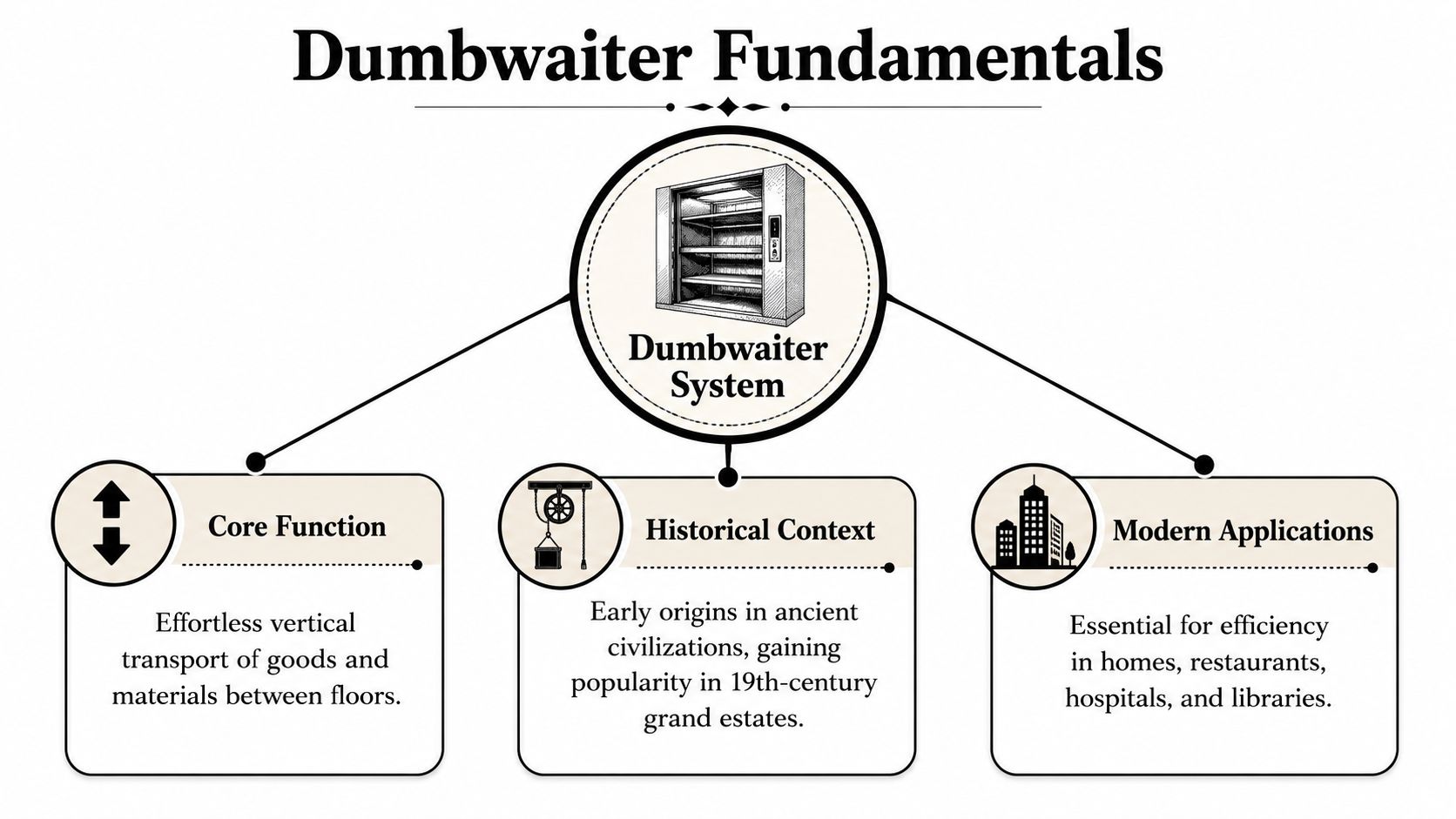
The basic idea is old. Early hoisting systems used ropes, pulleys, and counterweight concepts to move goods between levels long before modern elevators were standardized. By the late 1800s, dumbwaiters had become a defined piece of building equipment, with mechanical improvements such as safer braking and more controlled operation. Preferred Elevator's history overview traces that progression through the early patent era.
That history matters for one practical reason. Dumbwaiters stayed in use because they solve a narrow problem well. If a building needs to move small loads vertically over and over, a compact goods lift is often cheaper to install and easier to fit than larger lifting equipment.
What a dumbwaiter actually includes
Owners sometimes picture a dumbwaiter as a box on a rope. Modern units are more than that. A typical system includes a car, guide rails, a drive system, landing doors with protective hardware, controls at each stop, and safety devices that keep the unit from operating under unsafe conditions.
In the field, the specification work usually comes down to four fundamentals:
- Use case: food service, records, supplies, laundry, groceries, or medical materials
- Travel path: number of stops, floor-to-floor distance, and available shaft location
- Load profile: what goes in the car, how often it runs, and whether use is occasional or constant
- Code classification: private residential use versus business or institutional service
Those choices affect cost over the full life of the equipment, not just on install day.
What they are built to do well
Dumbwaiters work best where the load is repetitive, the route is fixed, and stair carry is wasting time or creating avoidable injury exposure. In restaurants, that usually means food, dishes, and dry goods. In homes, it often means groceries, laundry, luggage, or storage items. In schools, offices, and care settings, it can mean records, supplies, and other routine materials.
Commercial units can be built for meaningful duty and capacity, so owners should not assume these are light novelty devices. The right question is whether the car size, weight rating, and door arrangement match the building's day-to-day use.
A well-planned dumbwaiter removes repeat trips, reduces hand-carry risk, and gives the building a defined system for moving materials between floors.
That is also why early planning matters in Southern Michigan projects. The best dumbwaiter is not only the one that fits in the wall. It is the one that fits the load, the building layout, the inspection requirements, and the maintenance budget you will still be dealing with years after installation.
Choosing the Right Type Residential vs Commercial
Many owners frequently make expensive mistakes. They assume a dumbwaiter is a dumbwaiter. It isn't. Residential and commercial units may look similar on paper, but they're built, permitted, and serviced differently.
The biggest divide is compliance. Commercial equipment has to deal with public-facing or employee-facing use conditions. That means stronger safety requirements and tougher expectations around hardware, documentation, and inspections.
The compliance split matters
According to an industry FAQ on dumbwaiter requirements, commercial units require industrial-grade door locking and car gate monitoring, while residential installations may have different licensing and inspection requirements depending on the state. That's the kind of detail buyers miss when they compare equipment on price alone.
If your building is a restaurant, school, office, hospital, mixed-use property, or anything with employees using the lift as part of normal operations, assume the commercial path until a qualified contractor and local authority confirm otherwise.
Residential vs. Commercial Dumbwaiters at a Glance
| Feature | Residential Dumbwaiter | Commercial Dumbwaiter |
|---|---|---|
| Primary use | Convenience in a private home | Routine material handling in business or institutional settings |
| Duty level | Lighter-duty use | Heavier-duty use with more frequent cycling |
| Safety hardware | Typically lighter-duty configuration | Industrial-grade door locking and car gate monitoring |
| Permitting path | Can vary by state and local jurisdiction | Usually stricter review and compliance expectations |
| Inspection expectations | May differ from commercial treatment | More formal compliance and inspection requirements |
| Lifecycle cost | Lower entry cost in many cases, but still affected by shaft work and finishes | Higher initial and ongoing cost due to heavier construction and code obligations |
| Best fit | Large homes, private residences, low-cycle material movement | Restaurants, clinics, schools, offices, municipal and healthcare buildings |
What owners usually overlook
The hidden costs usually aren't in the car itself. They show up in the surrounding work and long-term obligations.
- Permitting risk: The wrong classification can delay the job or force redesign.
- Safety package differences: Commercial-grade locking and monitoring hardware affect both scope and service requirements.
- Maintenance reality: A lift used all day in a business will wear differently than one used occasionally in a home.
- Downtime consequences: In a commercial building, a failed dumbwaiter can disrupt staff routines immediately.
A residential owner often asks, “Will this make everyday life easier?” A commercial owner should ask, “Will this remain compliant, serviceable, and durable under real use?”
Buying light-duty equipment for a commercial application usually looks cheaper only at the start.
A practical decision test
Use the building, not the brochure, to decide:
- Who uses it? Family members in a home, or staff in a working facility.
- How often does it cycle? Occasional convenience use is different from all-day transport.
- What happens if it fails? In a business, failure often creates an operations problem, not just an inconvenience.
- Who regulates the installation? Local treatment can change the scope more than owners expect.
If there's any gray area, treat that as a reason to slow down, not push forward with assumptions.
Planning Your Dumbwaiter Capacity Size and Speed
Most specification mistakes come from guessing wrong on three things. Capacity, car size, and speed. Owners tend to focus on one and ignore the others, but these factors are connected.
Modern dumbwaiters are commonly engineered with load ratings from 75 lb to 750 lb, with nominal speeds around 30 fpm, while some higher-throughput commercial models can reach 50 to 300 fpm and travel up to 300 ft, according to this dumbwaiter planning guide.
Capacity starts with the real load
Don't size a unit around the lightest thing you move. Size it around the heaviest normal load, with the container, tray, cart substitute, or packaging included. A residential owner may move groceries and laundry. A restaurant may move plated meals, bus tubs, and dry stock. An office may move files or mail.
Bigger capacity isn't automatically better. Higher payload means more structural demand on the system, stronger hoisting components, and more attention to guide loads and stopping control.
Car size affects daily usability
A unit can have enough rated capacity and still be awkward if the car opening or internal dimensions don't fit the items you use. That's why application matters more than generic specs.
Consider the difference:
- Food service: Trays and containers often need a wider, more usable car layout.
- Document transfer: Smaller, quieter configurations may work better.
- Household use: Groceries, laundry baskets, and storage bins drive the sizing conversation.
Speed is not a vanity spec
Owners sometimes ask for the fastest possible unit. That's usually the wrong question. Lower-speed systems are often the right choice where quiet operation and lower mechanical stress matter more than raw cycle time. Faster commercial units make sense when throughput is critical.
Match the speed to the operation, not to the sales sheet.
A noisy, overbuilt, or over-fast system in a low-demand building often creates more owner frustration than value. A properly sized dumbwaiter should feel appropriate to the task. Not oversized. Not underpowered. Just right for the loads and travel path the building has.
Navigating Michigan Safety Codes and Compliance
The most urgent dumbwaiter issue in older buildings isn't convenience. It's safety. If you own an existing unit in Detroit, Ann Arbor, Lansing, Flint, Kalamazoo, or a smaller Southern Michigan community, the first question shouldn't be whether it still runs. It should be whether it's still safe and compliant.
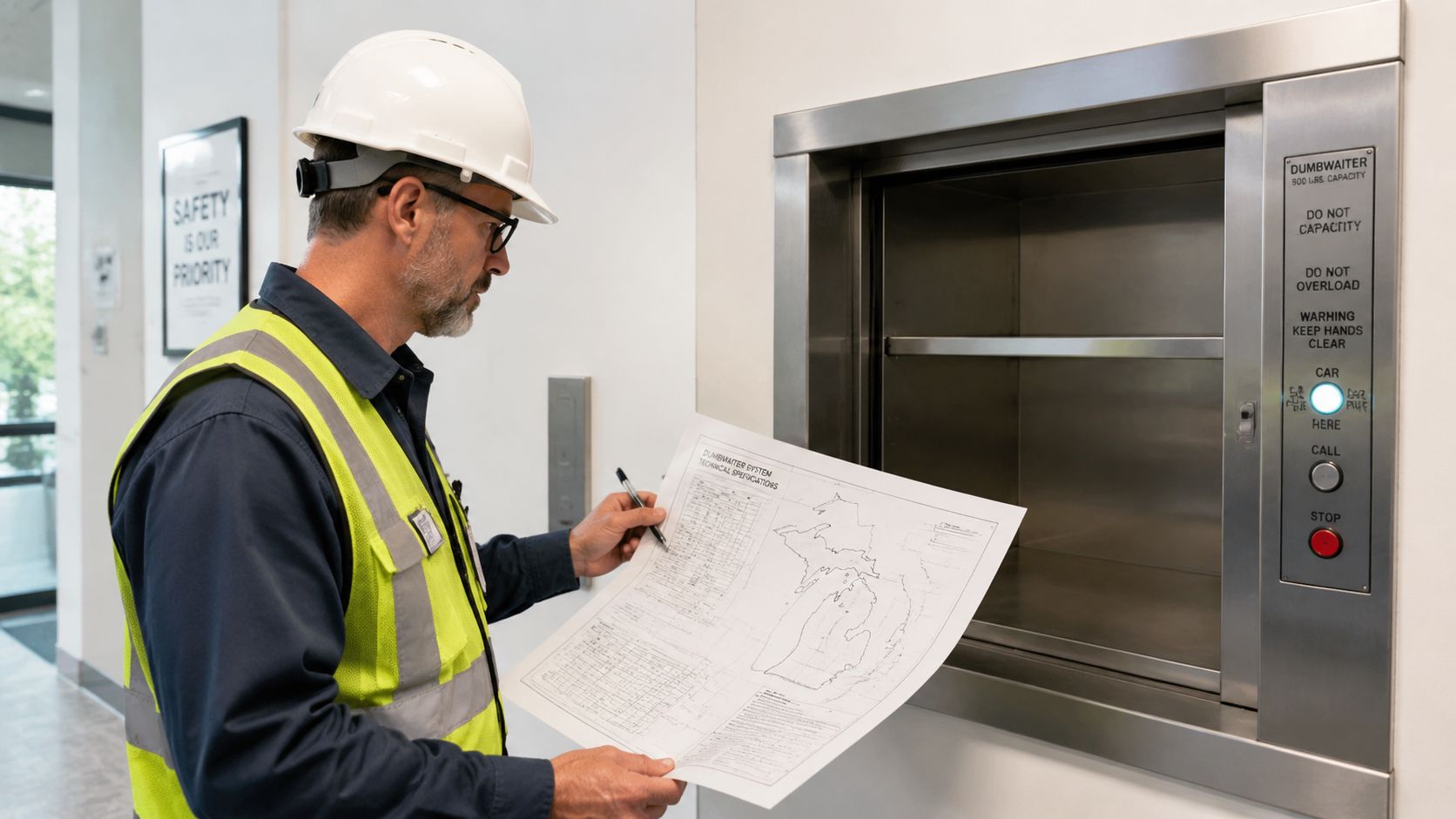
The CDC has issued a clear warning on older dumbwaiters. If a unit can move with a door open, or if a door can be opened when the car is not at the floor, that condition creates a serious injury risk and calls for immediate inspection, as noted in this CDC document on dumbwaiter interlock hazards.
What owners should check immediately
Older equipment often stays in service long after the original installation logic is outdated. That doesn't mean every old dumbwaiter is unsafe. It does mean age is not a substitute for inspection.
Start with these conditions:
- Door interlock behavior: The car should not travel with a door open.
- Landing door security: A door should not open when the car is away from that landing.
- Operational consistency: Jerky starts, poor leveling, odd noises, and unreliable stops need investigation.
- Signs of patchwork repair: Mismatched controls or improvised fixes usually indicate a deeper modernization discussion.
New installation versus existing equipment
A new dumbwaiter installation goes through design review, permitting, safety equipment selection, and final testing. Existing dumbwaiters are more complicated because owners inherit older conditions. The shaft may be usable while the controls, interlocks, wiring, or doors are not.
That's why compliance work in Michigan often falls into two buckets:
| Situation | Owner priority |
|---|---|
| New installation | Proper classification, correct safety package, approved installation path |
| Existing dumbwaiter | Hazard review, code gap identification, modernization or repair decision |
A lot of public content stops at “what is a dumbwaiter.” Owners need the harder answer, which is whether the one in their building should remain in service without upgrades.
What inspectors and contractors focus on
In practical terms, compliant dumbwaiter work revolves around safe access, reliable door protection, proper operation, and documented correction of violations. Commercial settings add another layer because use conditions are more demanding and public liability is higher.
Michigan owners should review applicable elevator code requirements and compliance issues before approving work. The details can change based on building type and use, but the principle doesn't. Safety devices are not optional accessories.
If an older dumbwaiter can defeat basic door protection, shut it down and have it inspected before someone gets hurt.
That's especially true in older restaurants, schools, apartment buildings, and municipal properties where legacy equipment often remains hidden until a failure forces attention.
Installation Modernization and Maintenance Insights
A Southern Michigan owner usually calls about a dumbwaiter at one of two points. The building is still on paper and they want to avoid an expensive mistake, or the existing unit has started failing and nobody wants to keep throwing repair money at old equipment. In both cases, the underlying goal is the same. Build a system that can pass inspection, stay serviceable, and justify its cost over time.
What a clean installation process looks like
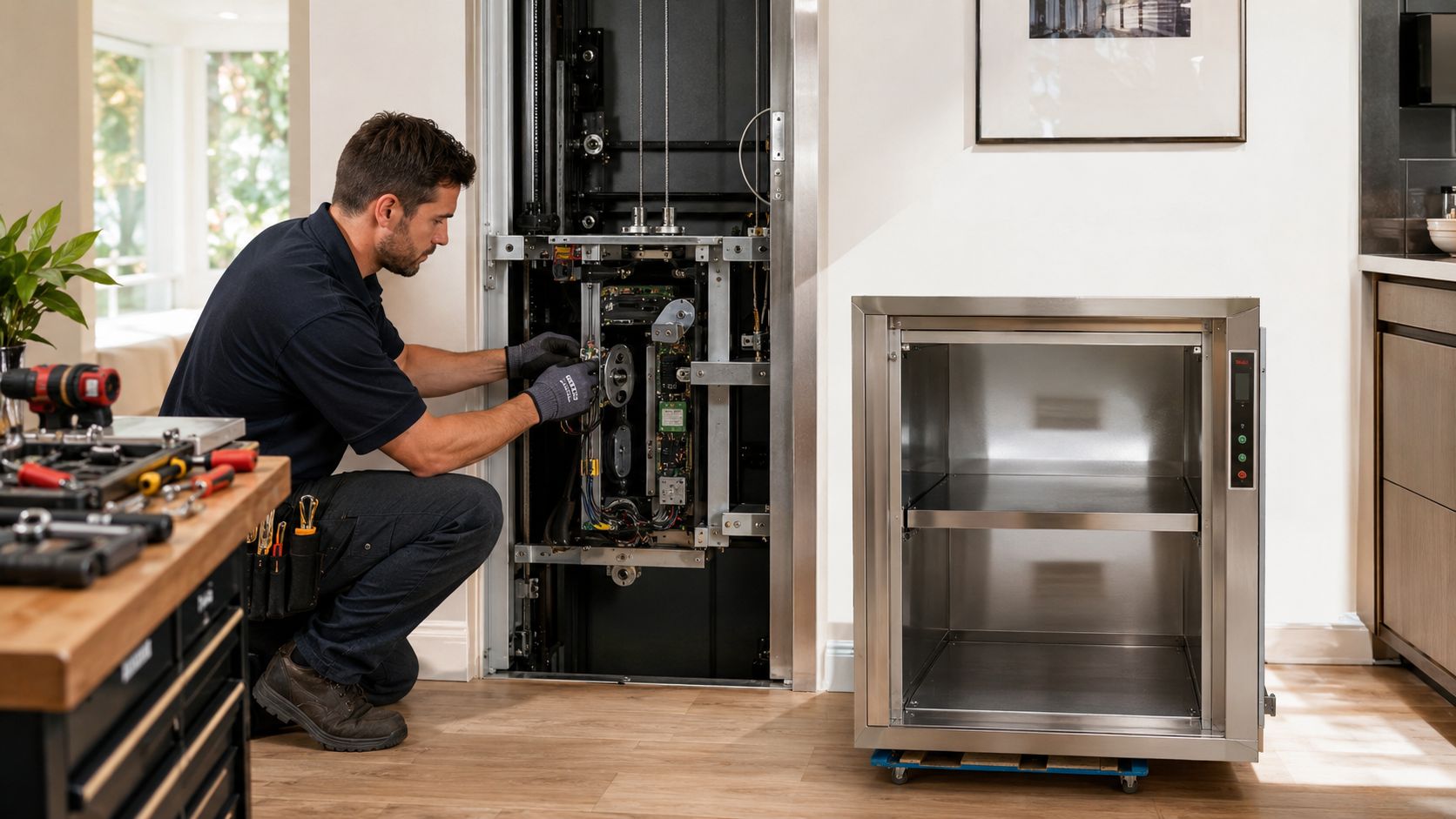
Good installations are decided before the equipment arrives. Shaft dimensions, landing layout, door swing, power requirements, and how the car will be used all need to be settled early. If those basics are loose, the project gets expensive fast because field fixes usually mean carpentry changes, electrical rework, delayed inspections, or all three.
A practical installation process usually follows this sequence:
- Existing-condition review: Verify available space, travel distance, structural limitations, and whether the shaft is new or being reused.
- Equipment selection: Match the unit to the duty. A light residential food lift is different from a commercial dumbwaiter moving supplies all day.
- Permit and coordination work: Align the plans with the building layout, electrical scope, and inspection path before installation starts.
- Installation and startup: Set rails, machine components, entrances, controls, and safety devices. Then test operation at every landing.
- Final correction and turnover: Fix punch-list items, document the equipment, and confirm the owner understands basic operation and service requirements.
Published residential price ranges can be useful as rough context, but owners should treat them carefully. Actual cost in Michigan is usually driven less by the box itself and more by construction conditions, finish work, access, code-required safety components, and how much of the building must be opened up to do the work properly.
Modernization often beats replacement
On older units, replacement is not automatically the best spend. I have seen plenty of dumbwaiters where the hoistway and basic layout were still workable, but the controller, wiring, interlocks, or landing doors had reached the point where safe, reliable service was no longer realistic without major updates.
Modernization usually makes sense when the unit has one or more of these problems:
- Intermittent shutdowns tied to aging controls
- Door interlocks or gate protection that no longer operate consistently
- Obsolete parts with long lead times or no dependable supply
- Frequent service calls for the same faults
- A unit that still runs, but no longer meets current owner expectations for safety and reliability
That last point matters. A dumbwaiter can be technically operable and still be a poor asset. If parts are scarce, troubleshooting takes too long, and every failure disrupts kitchen, staff, or tenant operations, modernization usually costs less over the life of the equipment than repeated patch repairs.
A good modernization removes repeat failure points and service dead ends. It does not just buy a little more time.
Owners should also ask a simple question before approving either route. Is the current shaft arrangement worth saving? If the answer is yes, modernization can be the cleaner path. If the shaft is poorly located, badly sized, or tied to damaged entrances, replacement or full reconfiguration may be the better long-term decision.
Maintenance is where ownership cost is won or lost
Most dumbwaiters do not become expensive because the original concept was bad. They become expensive because basic maintenance was deferred until small wear turned into shutdowns, nuisance calls, and safety corrections.
Routine service should cover the items that fail during normal operation. Door alignment, interlock operation, call stations, car gates, guide components, wiring condition, machine adjustments, and general cleanliness all affect reliability. Grease, dust, food debris, and poor door closure are common problems on working units, especially in restaurant, multifamily, and institutional settings.
Service approach matters too. Owners should ask whether replacement parts and modernization packages are proprietary or open to normal long-term service. Non-proprietary equipment is often easier to maintain because another qualified contractor can support it later. That is a practical lifecycle issue, not a sales talking point.
For owners comparing support options, local Michigan elevator service and maintenance coverage matters because response time, inspection familiarity, and parts planning affect total cost just as much as the monthly contract rate.
A short video can help visualize what modern dumbwaiter work and use conditions look like in practice:
The practical rule is simple. Install with the full building condition in mind, modernize before obsolescence turns into downtime, and maintain the unit on a schedule that matches how hard it is used.
Your Dumbwaiter Partner in Southern Michigan
If you own or manage a property in Southern Michigan, dumbwaiter decisions come down to three things. Use the right type, keep it compliant, and don't ignore lifecycle cost. A cheap-looking decision at purchase can become the expensive one if the lift is misclassified, underbuilt, or hard to maintain.
That's why local support matters. Crane Elevator Company serves building owners across Detroit, Ann Arbor, Lansing, Flint, Kalamazoo, and surrounding communities with practical elevator and lift support built around repairs, code compliance, modernization, and preventative maintenance.
For owners comparing providers in the region, the company's Michigan elevator service coverage is geared toward both commercial and residential equipment. Their published approach also highlights family-owned experience, 24/7 service, non-proprietary modernizations, competitive quotes, and owner-friendly maintenance policies including a No Show, No Pay commitment.
If you need a new dumbwaiter, an inspection on an older unit, or a second opinion before spending money on repairs, local expertise is worth more than a generic quote from outside the market.
If you want a practical review of your dumbwaiter options, contact Crane Elevator Company for a quote or a free second opinion. They work with owners across Southern Michigan on installations, modernization, inspections, repairs, and maintenance that keep vertical equipment safe, compliant, and serviceable over the long term.